

Introduction
You know that sinking feeling when your paycheck hits your account, and somehow, by Friday, you are already wondering where it went?
You are not alone.
More than half of Americans are right there with you. According to recent 2026 data, 51% of Americans are living paycheck to paycheck. Not because they are irresponsible. Not because they do not care about their future. But because rent, groceries, utilities, debt payments, subscriptions, childcare, and unexpected expenses simply do not leave room at the end of the month.
The numbers tell a stark story. As of 2026, 27% of Americans have zero emergency savings. Another 59% cannot cover a $1,000 emergency without going into debt. The personal savings rate sits at 3.6%, roughly half of what financial experts recommend.
And here is what most money advice gets wrong: the solutions are too complicated.
If saving money requires five spreadsheets, three budgeting apps, ten spending categories, and a two-hour Sunday review session, most people quit. Not because they lack discipline. But because they are already exhausted. They are working, managing families, paying bills, dealing with unexpected costs. Adding complexity to save money feels like another failure waiting to happen.
That is exactly why simple savings systems work better in real life.
This is not about becoming a perfect budgeter. It is not about giving up every coffee, never eating out with friends, or feeling guilty every time you spend money on something you enjoy. This article is about something different. It is about setting up small, automatic systems that help you save money in the background. Systems so simple that you stop thinking about them.
In this guide, you will learn eight practical financial savings solutions that thousands of Americans are using right now in 2026. More importantly, you can start with just one solution today. Not tomorrow. Not next Monday. Today.
The best savings plan is the one you will actually stick with. And the one you will stick with is the one that fits your real life.
Why the Simplest Solutions Actually Work Better
Most financial advice fails for the same reason. It treats saving money like a math problem when it is actually a behavior problem.
A complicated budget might look impressive on paper. It might show you exactly how much to spend on groceries, entertainment, dining out, hobbies, and unexpected expenses. But if you cannot maintain it for more than two weeks, it does not help you. At all.
A simple system you actually use beats a perfect system you abandon in defeat.
This is where the 80/20 principle applies to personal finance. A few simple actions create most of the financial results. Automating your savings, canceling subscriptions you forgot about, moving your money to a higher-yield account, and getting cashback on regular purchases accomplish more than most people realize. These simple moves often produce better results than painstakingly tracking every single dollar.
Simple systems also work because they are powered by habits, not willpower.
Willpower is unreliable. It depends on how you feel today. Whether you slept well. Whether something stressful happened. Whether you are hungry, tired, or emotionally drained. Willpower fluctuates.
But a system works even when you are exhausted, busy, stressed, or distracted. An automatic transfer happens whether you feel motivated or not. Round-ups happen without your thinking about it. A high-yield savings account grows your money while you sleep.
The current economic reality in 2026 makes this even more important. Many American households are balancing housing costs, groceries, transportation, insurance, medical bills, credit card payments, childcare, and unexpected expenses all at once. When your budget is already tight, the best savings system is the one that does not require more willpower.
The goal is not to save perfectly. The goal is to save consistently.
Someone who saves $50 automatically every payday, without exception, will build more wealth than someone who plans to save $500 when things calm down. The problem is that things rarely calm down. Life remains complicated. Unexpected expenses happen. Work gets demanding.
A small system that starts today beats a big plan that never begins.
What Actually Makes a Financial Savings Solution “Work”
Before diving into the eight methods, it helps to understand what “working” actually means.
A financial savings solution that works should meet three specific criteria.
Criterion One: Simplicity
You should be able to understand how it works in less than two minutes. You should be able to set it up quickly, usually in less than 10 minutes. And you should be able to maintain it without constant effort or attention.
Complexity kills consistency. If your savings system feels like homework, you will avoid it. If it requires learning new software or remembering multiple steps, you will procrastinate. The best financial solutions are the ones that feel almost too simple. They work because they do not require much brainpower.
Criterion Two: Automation
The system cannot depend on motivation or willpower.
If you have to remember to move money every single week, you might forget. If you have to decide whether you can afford to save, you might talk yourself out of it. Motivation is temporary, but systems are permanent.
The Consumer Financial Protection Bureau has researched automatic savings extensively. Their findings are clear: automatic systems work better than manual ones. When you set a specific amount to save on a specific date and then let it happen automatically, you remove the human decision-making part. The money moves whether you think about it or not.
Criterion Three: Visible Results
You need to see progress actually happening.
Saving $20, $50, or even $100 per month might not feel life-changing at first glance. But when you see your savings account growing month after month, something shifts. You start believing in the system. You stay committed. You want to add more. Visible progress builds momentum.
The opposite is also true. If you cannot see that your actions are producing results, you will quit. Most people stop saving not because they lack discipline, but because they do not see the point.
8 Simple Financial Savings Solutions That Actually Work
1. Automated Round-Ups: The Almost Invisible Savings Method
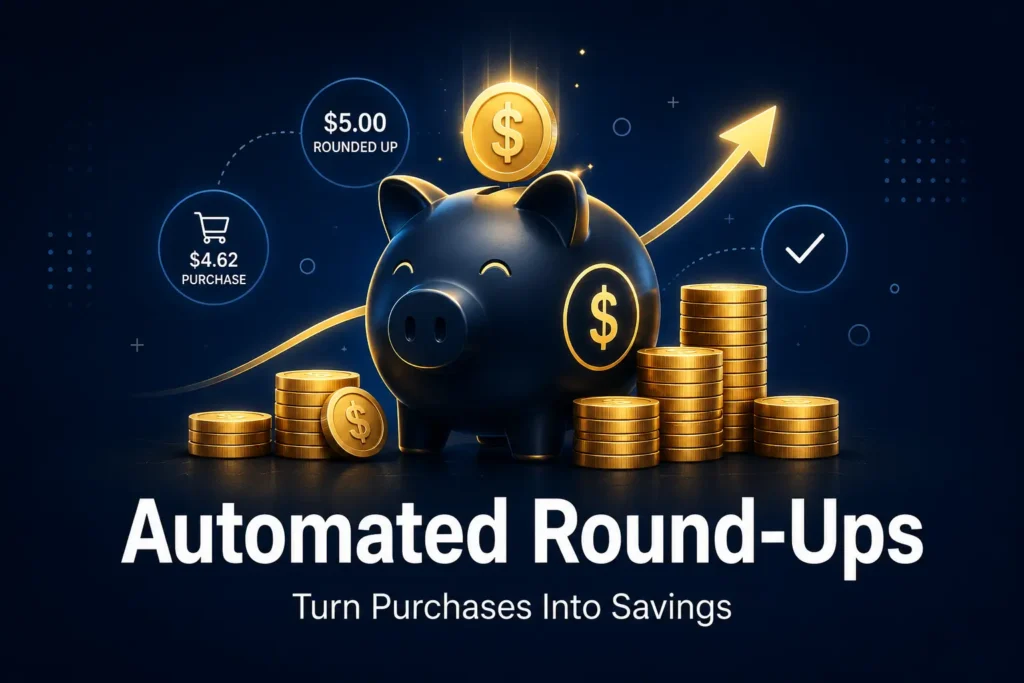
Automated round-ups are one of the easiest ways to start saving without feeling a major lifestyle change.
Here is how it works in practice.
When you buy something for $4.35, the system rounds the purchase up to $5.00. The extra $0.65 goes into your savings account. Buy lunch for $12.20, and it rounds up to $13.00, saving $0.80. Make a coffee purchase for $6.85, and it saves $0.15.
These small amounts seem insignificant. But they add up surprisingly fast.
Apps like Acorns made this method popular. With Acorns, when you round up a purchase, the spare change gets invested or saved. Once your round-ups add up to $5, Acorns invests that amount. The app costs $3 per month for basic service, so you want to make sure you are actually using the app and that your savings exceed the fee.
Why this works in real life:
You do not need to create a full budget. You do not need to track every dollar meticulously. You simply connect your debit or credit card, turn on round-ups, and let the system work. That is it.
How to actually set it up:
Go to your bank’s app or download a round-up app. Connect your debit or credit card. Choose where the money goes (a savings account). Keep the default settings to start. You can do this in less than 10 minutes, probably while waiting for a meeting to start.
Real results from real people:
If your average round-up is $0.50 and you make about 40 purchases per month, that equals roughly $20 per month in savings. Some people who use round-ups extensively save $40 to $80 monthly. This works because it transforms your regular spending behavior into automatic savings behavior.
Best suited for:
This works best for people who use debit or credit cards regularly, busy professionals, and anyone who struggles with traditional manual savings.
Pro tip for maximum impact:
After your first month, if the app allows it, enable a 2x round-up multiplier. This doubles your savings without requiring any additional effort.
2. The 50/30/20 Budget Rule: Structure Without Perfection
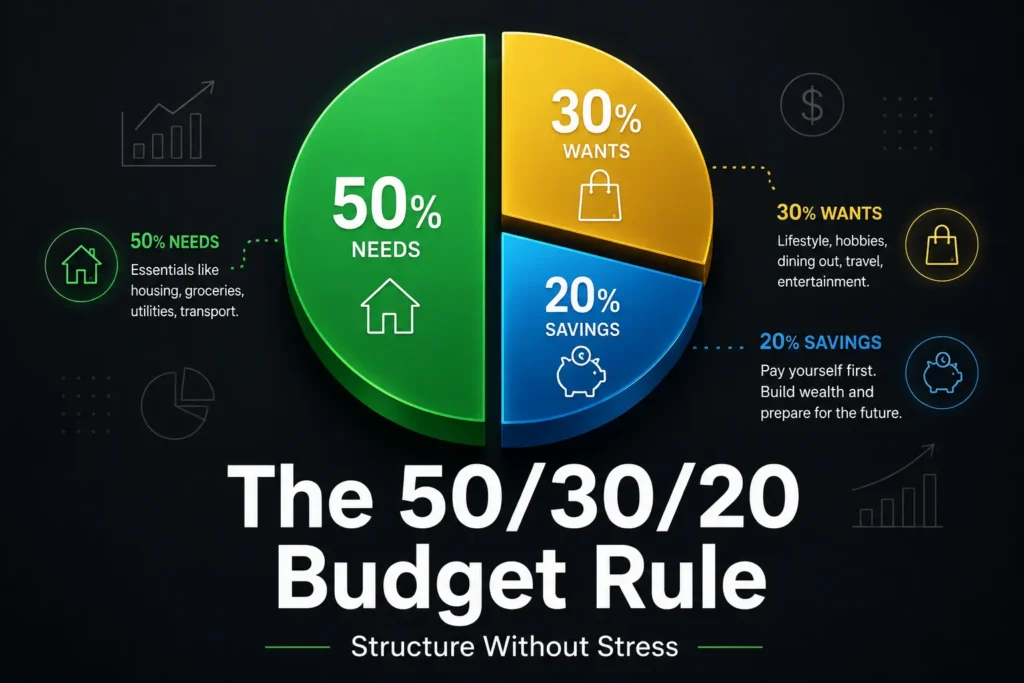
The 50/30/20 rule is one of the simplest budgeting methods because it does not require tracking 25 different spending categories.
The concept is straightforward and practical.
50% of your after-tax income goes to needs. 30% goes to wants. 20% goes to savings and debt repayment. That is it. Three buckets. Three percentages.
Needs include rent or mortgage payments, groceries, utilities, insurance, minimum debt payments, and essential transportation. Wants include restaurants, entertainment, streaming services, shopping, hobbies, and travel. Savings includes emergency fund contributions, retirement savings, extra debt payments beyond minimums, and goals like vacation funds or house down payments.
Why simplicity matters here:
Instead of feeling guilty about every single purchase, this rule gives every dollar a general purpose. You are not aiming for perfection. You are aiming for direction. Most people find this freeing rather than restrictive.
How to set it up immediately:
Calculate your monthly after-tax income (what actually hits your account, not gross salary). Divide it by three. Half goes to needs. Thirty percent goes to wants. Twenty percent goes to savings and debt.
Example with real numbers: If you bring home $4,000 per month, that means $2,000 to needs, $1,200 to wants, and $800 to savings and debt. If your housing is more expensive than the 50% allocation allows (common in many cities), adjust. Use this as a guideline, not a punishment.
Real results people are experiencing:
Many people who have never saved successfully can create progress using this rule. If you currently save zero percent of your income and move toward saving even 10% of what you earn, that is meaningful progress. On a $4,000 take-home income, that is $400 per month or $4,800 per year building up.
Best for which people:
This works for people who want structure but hate detailed spreadsheets and complex tracking. It is especially useful for people overwhelmed by traditional budgeting.
One practical tip:
Use your bank’s automatic categorization feature to see where your money actually goes for the past 30 days. Do not guess. Look at real data.
3. Automated Savings Transfers: The Foundation of Consistent Saving
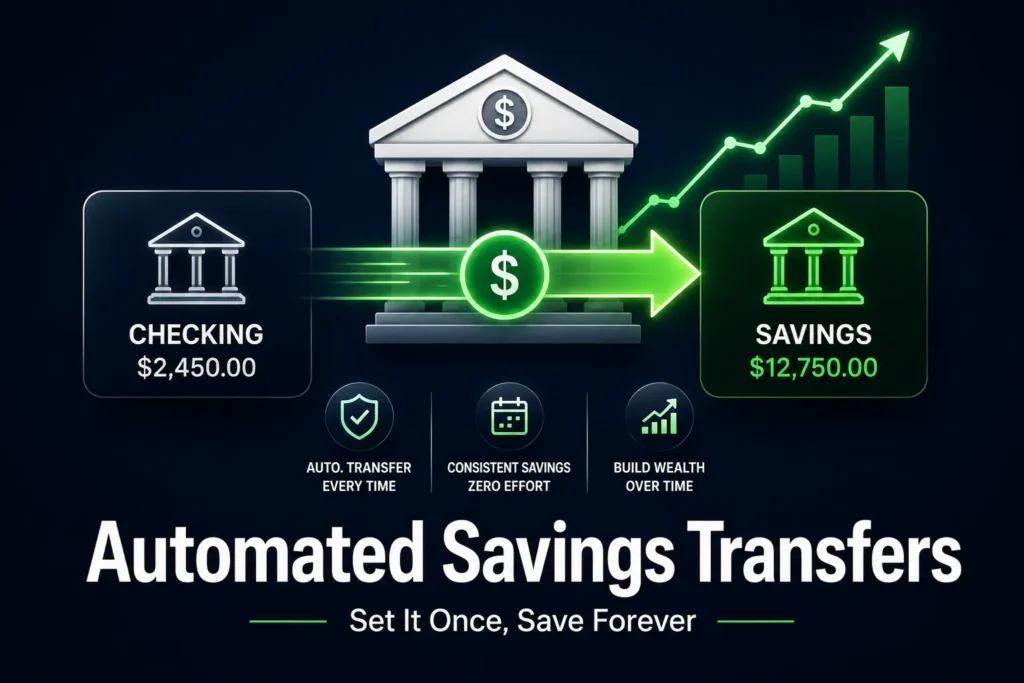
Automated savings transfers are one of the most reliable savings methods because they remove the human decision from the equation.
Instead of hoping to save whatever is left at the end of the month (which is usually nothing), you schedule money to move into savings automatically on a fixed schedule.
For example, $25 every Friday. Or $150 every payday. Or $50 twice per week. The specific amount matters less than the consistency.
Why it is so simple:
Once you set it up, it runs by itself. No remembering. No motivation needed. No willpower required. The money moves automatically whether you think about it or not.
The setup process:
Log into your bank account. Navigate to the transfers section. Select your checking account as the source. Select your savings account as the destination. Pick a small amount to start. Schedule it to happen after payday. That is the whole setup, and it takes about 5 minutes.
Start small if your budget is tight. Even $10 per week is better than $0. You can increase it later once the habit becomes automatic.
Real numbers that actually work:
$25 per week becomes $1,300 per year. $50 per week becomes $2,600 per year. $150 per month becomes $1,800 per year. These are not small amounts. This is real money that most people never miss because it leaves before they see it.
Who benefits most:
This works best for anyone with predictable paychecks. If you are self-employed or have irregular income, you can use percentages instead of fixed amounts.
The timing tip that makes this actually work:
Schedule the transfer for the same day your paycheck arrives. If you wait three or four days, the money will likely already be spent. Same-day transfers remove temptation.
4. High-Yield Savings Account: Your Money Actually Growing

A high-yield savings account is simply a savings account that pays significantly more interest than traditional bank savings accounts.
This matters more than many people realize. Most mainstream banks pay almost nothing on savings accounts. High-yield savings accounts, especially from online banks, pay much better rates while keeping your money accessible.
Current rates in 2026 vary, but top high-yield savings accounts offer rates around 4% to 4.5% depending on the specific bank and economic conditions. Compare this to a typical big bank savings account offering 0.01%. The difference is substantial.
Why this matters for your money:
You are not changing your savings behavior. You are just moving money to a better location where it grows.
Setting up a high-yield account:
Look for FDIC-insured banks or NCUA-insured credit unions. Compare the APY (annual percentage yield), any fees, minimum balance requirements, how fast transfers work, and customer reviews. Open the account online and connect it to your checking account. The whole process takes about 15 minutes.
Real impact on your savings:
If you keep $5,000 in a traditional bank account earning 0.01%, you earn about 50 cents per year. In a high-yield account earning 4.5%, you earn $225 per year. That is not free money falling from the sky, but it is real interest working for you. With $10,000, you earn $450 per year. $20,000 earns $900 per year.
Best use for this tool:
High-yield savings accounts work best for emergency funds, short-term savings goals, and money you do not want to invest but want to protect.
The separation strategy:
Keep your high-yield savings account at a different bank than your checking account. The physical separation reduces the temptation to transfer money back to checking and spend it.
5. Pay Yourself First: Reordering Your Financial Priorities

The pay yourself first system means treating savings like a required bill rather than optional spending.
Most people have this backwards. They pay rent, groceries, insurance, subscriptions, restaurants, and shopping first. Then they hope to save whatever is left. The result is usually nothing left to save.
Paying yourself first flips this completely. Savings happens first as a priority payment. Everything else adjusts around it.
Why it works psychologically:
You are not relying on leftover willpower. You are building savings into the structure itself.
How to implement it:
Pick one specific savings goal. An emergency fund. A vacation fund. A car repair fund. A house down payment. Something concrete that matters to you. Then pick a fixed amount to save every payday. If you are paid every two weeks and save $75 per check, you will have $1,950 saved in a year without any extra effort.
Results from actually doing this:
This method works especially well when combined with automated transfers. You are not hoping that savings happens. You are ensuring it by making it a scheduled payment.
Who benefits most:
This is best for people who have steady income but always wonder why there is never money left at the end of the month. This method forces your budget to adjust around your goals rather than letting your goals disappear.
The naming technique:
Name your savings account after your goal instead of just calling it “Savings.” Account names like “Emergency Fund” or “New Car” or “House Fund” are psychologically harder to raid.
6. Subscription Audit and Cancellation: Finding Hidden Leaks
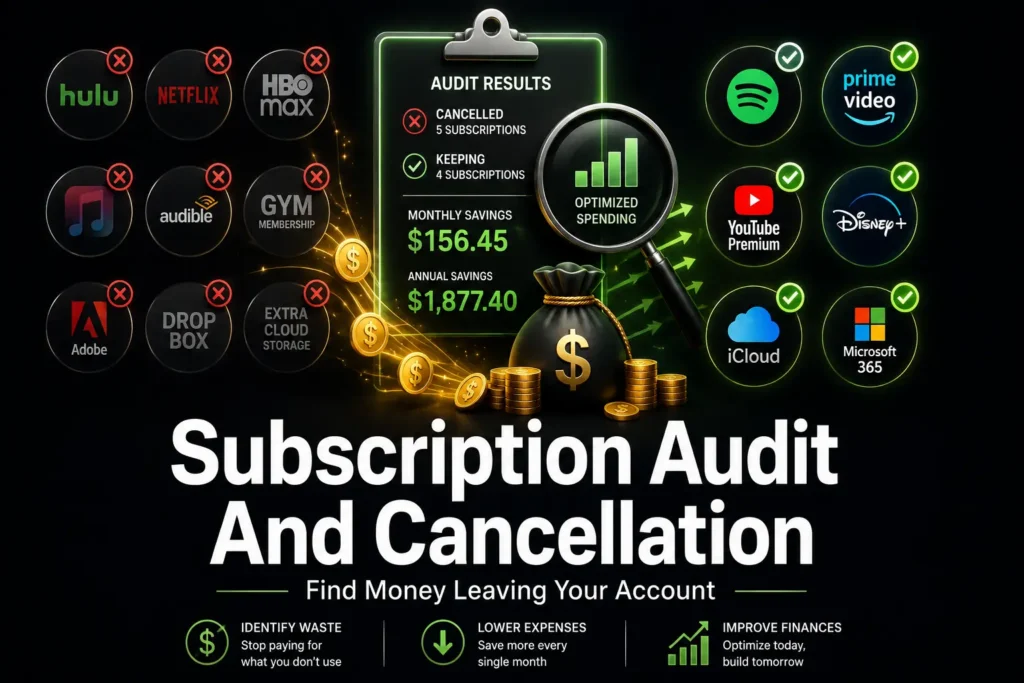
Subscriptions are quiet budget leaks that drain money almost invisibly.
One $9.99 subscription does not hurt. But five, eight, or twelve subscriptions stacked together can quietly drain several hundred dollars per month. Streaming apps, software tools, cloud storage, fitness memberships, meal plan services, delivery memberships, premium newsletters, and forgotten free trials all add up.
Why this is effective:
You are not cutting your lifestyle completely. You are removing things you forgot about, do not use, or do not value anymore.
The actual process:
Open your bank and credit card statements. Look back at the last 60 days. Search for recurring charges that happen monthly or quarterly. Write them all down. For each subscription, ask three specific questions:
Did I use this at least once last week? Would I sign up for this again today if I had to pay for it right now? Is there a cheaper alternative that does the same thing?
Cancel anything that fails even one of these tests.
What people actually find:
Most people can find $30 to $100 per month in unused subscriptions. Some find more. That is $360 to $1,200 per year just sitting there, leaving your account for things you forgot about.
Who should definitely do this:
Anyone with multiple apps, streaming services, memberships, or software subscriptions. Honestly, almost everyone.
The maintenance tip:
Set a calendar reminder every three months called “Subscription Checkup.” Spend 15 minutes reviewing what you are paying for. This takes minimal time but can save thousands per year.
7. The No-Spend Challenge: Interrupting Autopilot Spending

A no-spend challenge is a short period where you intentionally stop spending money on non-essential purchases.
This does not mean stopping bill payments, groceries, medicine, gas, or childcare. It means pausing optional spending like takeout, shopping, entertainment purchases, and impulse buys. You are running an experiment to see what is actually essential and what is habit.
You can do this for a weekend, one week, or 30 days. Start small.
Why it actually works:
It has clear, simple rules. The timeline is short. You are not changing your entire identity. You are testing a hypothesis for a limited time.
Setting up your challenge:
Choose your timeframe. If this is new for you, start with seven days instead of a full month. Write down your allowed spending categories. Rent, utilities, groceries, gas, medicine, debt payments, and essential family needs. Everything else pauses.
Real savings from real experience:
If you normally spend $25 on takeout three times per week, a one-week no-spend challenge saves $75. Add in paused shopping and entertainment, and many households save $100 to $250 per month. That is not theoretical. That is what people report.
Who benefits most:
This works for people who feel money disappears through small purchases. Every coffee, snack, shopping trip, and entertainment purchase adds up without them noticing.
Making it actually sustainable:
Do not make it miserable. Plan free activities before you start. Go for walks. Check out books from the library. Do home workouts. Have movie nights with what you already have. Cook from pantry items. When the challenge does not feel like deprivation, you actually stick with it.
8. Cashback and Rewards Optimization: Making Spending Work for You

Cashback and rewards can help you save money, but only if used correctly. The key is using them on money you are already spending, not spending more to earn rewards.
Cashback comes in many forms. Cashback credit cards offer 1% to 5% back on purchases. Grocery stores offer loyalty rewards. Gas stations offer fuel rewards. Shopping portals give additional cashback online. Some debit cards offer small rewards.
Why this matters:
You are not changing your spending behavior. You are earning rewards on purchases you were going to make anyway.
How to set it up simply:
Look at your biggest regular spending categories. Groceries. Gas. Utilities. Household supplies. Pick one cashback card or rewards program that gives benefits in those categories. Pay the balance in full every month if using a credit card. If you carry a balance and pay interest, the interest charges will wipe out any rewards you earned.
Real results with cashback:
If your household spends $1,500 per month on eligible regular expenses and your card earns 2% cashback, that is $30 per month or $360 per year. That is real money earned just by using the right card.
Important limitations:
This works best for people who already pay their credit card balance in full or prefer using debit rewards instead. If you carry a balance, the interest charges exceed the rewards.
The crucial strategy:
Redeem cashback directly into your savings account instead of spending it. Treat rewards as savings income, not fun money.
How to Actually Combine These Eight Solutions
The real power emerges when you layer these simple systems together.
You do not need to implement all eight at once. That feels overwhelming and often leads to quitting. Instead, build gradually in three layers.
Layer One: Your Foundation (Week One)
Start with one automated savings transfer. Pick a small amount you can handle. $50 per month. $100 per month. $150 per month. Choose whatever fits your budget comfortably. Set it up on payday. This gives your system a reliable base.
Layer Two: Add Easy Automations (Week Two and Beyond)
Once the first automation is running smoothly, add round-ups. Move your savings into a high-yield savings account. Both of these run automatically with minimal effort once set up. You are now saving through multiple channels without additional willpower.
Layer Three: Optimize Your Spending (Month Two)
Now add the optional optimization methods. Do a subscription audit. Set up cashback rewards. Try a no-spend challenge. These require more active decision-making, so start after the first two layers are automatic.
What this actually looks like with real numbers:
Automated transfer: $150 per month
Round-ups: $80 per month
Subscription audit: $75 per month (one-time, then minimal maintenance)
Cashback: $40 per month
No-spend challenge: $100 per month
High-yield interest: varies based on your balance
Total: $445 per month, or $5,340 per year
You may not hit $445 every single month, and that is completely fine. Even hitting half of that would be meaningful progress for most people.
Mistakes That Kill Most Savings Attempts
Mistake One: Trying Too Many Solutions Simultaneously
When people feel motivated, they often try to change everything at once. They set up four different systems, join three apps, commit to a strict budget, and plan multiple challenges. This overwhelms the brain. Life gets complicated. They quit completely.
The fix is simple. Start with one method. Let it run for two full weeks. Only then add a second method. Progress comes from consistency, not intensity.
Mistake Two: Relying on Manual Savings Instead of Automation
Manual saving sounds good in theory. You tell yourself you will move money every week. But life gets busy. Work becomes demanding. You forget. Or you decide this week you need the money.
The fix is automation. Even a small automated transfer beats a large manual savings plan. Automate at least one savings method immediately.
Mistake Three: Constantly Raiding Your Savings Account
Sometimes people save money successfully for a few months, then transfer it back to checking because they want something. This defeats the entire purpose.
The fix is keeping your savings in a completely different bank. The inconvenience of switching banks to access the money prevents impulsive raids.
Mistake Four: Starting With Unrealistic Amounts
If your budget can realistically handle $150 per month in savings, but you try to save $800, you will quit. Your brain knows it is unsustainable.
The fix is starting smaller than you think you need. Consistency matters infinitely more than the amount. Better to save $50 every single month forever than $500 for three months before quitting.
Your 30-Day Savings Challenge
Here is a practical 30-day plan to start today.
Week One: Setup
Pick one solution. Automated savings transfer is usually the best starting point. Choose an amount you can handle. Set it up. Verify it works. Start today, not tomorrow.
Week Two: Optimize
Review your last 30 days of spending. Identify subscriptions, repeated impulse purchases, and easy cuts. If you feel ready, add a second solution like round-ups or a high-yield savings account.
Weeks Three and Four: Build
Let your systems run. Do one no-spend weekend if you want. Move any savings into your account. Review your progress at day 30. Tell one person you trust what you are doing. Accountability helps tremendously.
FAQ: Answering Your Real Questions
Can I afford to save if I am truly struggling?
Yes, but start very small. Even $5 or $10 per week builds the habit and creates momentum. Something is infinitely better than nothing.
How long before I actually see results?
You can see progress in the first month, especially if you automate savings and audit subscriptions. The progress may feel small, but it is real.
Will automated savings feel like I am losing money?
Maybe at first. But after a few paychecks, your brain adjusts because the money leaves before you spend it. You get used to the smaller amount.
Should I do all eight solutions at once?
No. Start with one. Add more only when the first feels easy and automatic.
What if I lose my job?
Pause aggressive savings and focus on essentials. Your emergency fund exists to protect you during difficult times.
Do these work if I have credit card debt?
Yes. You can build a small emergency fund while also paying debt. An emergency fund prevents new debt from being created.
What is the fastest way to save $500 per month?
Combine automated transfer plus subscription audit plus no-spend challenge plus cashback. The exact amount depends on your income and spending patterns.
Can these work with irregular income?
Yes. Use percentages instead of fixed amounts. Save 5% to 10% of every payment you receive.
Conclusion: Your Real Path Forward
You are not struggling because you are bad with money. You may be struggling because your system makes saving harder than it needs to be.
The best savings solutions in 2026 are simple. They are automatic. They are easy to maintain.
Start with one method. Automated transfers work for most people as a first step. Then add round-ups, a high-yield savings account, a subscription audit, a no-spend challenge, or cashback rewards when you are ready.
You do not need to be perfect.
You just need a system that works even when life gets busy, even when you are tired, even when you are stressed. That system exists. These eight solutions are it.
Pick one solution today. Set it up in the next 24 hours. Not tomorrow. Not next Monday. Today. Then track your progress for 30 days.
Small savings become large savings when you let them repeat month after month after month.
You have got this. Now start.









Comments (3)
Best AI Tools for Personal Finance Management in 2026: Top 12 Compared & Reviewed - Trendoutsidersays:
May 21, 2026 at 4:14 pm[…] adjust spending, and make decisions. AI is a tool to help you, not a replacement for personal financial […]
How to Use AI to Manage Money and Save More in 2026: Complete Step-by-Step Guide - Trendoutsidersays:
May 23, 2026 at 11:28 pm[…] and subscriptions, and traditional budgeting methods seem outdated. You probably know you should be saving more, but between work stress and financial complexity, it feels overwhelming. The reality is that […]
Best AI Budgeting Apps for Beginners in USA: Complete Guide to Smart Money Management in 2026 - Trendoutsidersays:
May 24, 2026 at 10:09 pm[…] This article is educational information only and should not be considered financial advice. Always consult a qualified financial professional before making major financial decisions. […]