
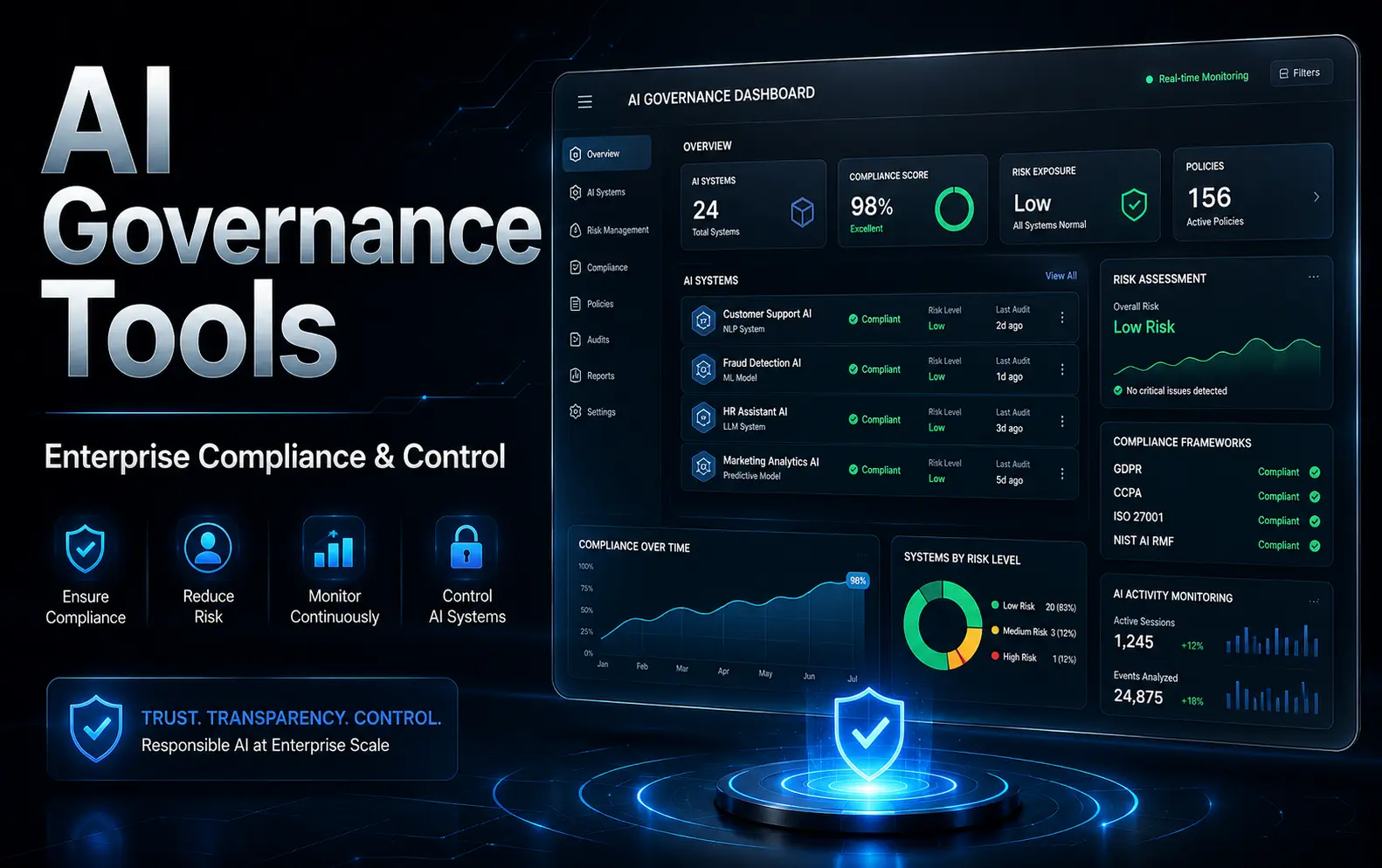
Why Your Company Needs AI Governance in 2026
Something important happened in 2025 that most business leaders missed.
The AI governance market grew 45.3% while the broader AI market grew 30.6%. This wasn’t a coincidence. It was a signal that enterprises stopped asking “should we govern AI?” and started asking “which governance platform should we buy?”
If you’re reading this, you’re probably asking the same question.
Here’s the situation most companies face in 2026. Your organization uses AI every day. Marketing teams use ChatGPT. Developers use code assistants. Customer support uses chatbots. Data teams deploy models. And employees are testing AI tools without telling anyone.
But nobody knows exactly which AI systems are running, what data they access, or whether they’re compliant with regulations.
This gap between AI adoption and AI control is where risk lives. It’s also where compliance violations happen. It’s where data leaks start. And it’s what regulators are now actively enforcing.
The EU AI Act is no longer theoretical. NIST’s AI Risk Management Framework is being implemented across federal contractors. ISO/IEC 42001 is becoming the management system standard for responsible AI. Companies in finance, healthcare, insurance, and government already face mandatory AI governance requirements.
If your company doesn’t have visibility and control over its AI systems, you have a real problem.
AI governance tools solve this problem by creating a structured way to discover, assess, monitor, and control AI systems across your organization.
What Changed in AI Governance Between 2025 and 2026
The market for AI governance platforms expanded dramatically this year, and the platforms themselves became more sophisticated.
In 2025, AI governance was mostly about documenting machine learning models and managing model risk. The questions were: Do we have a registry of our models? Can we assess bias? Do we understand our models well enough to explain them to a regulator?
In 2026, the conversation shifted. AI is no longer just deployed models. It includes generative AI applications, AI agents that take autonomous action, shadow AI usage that happens without approval, and AI features embedded in SaaS tools that employees use without IT knowing about it.
New tools emerged to address this expanded scope. Teramind focuses on workforce AI governance and security. Zenity specializes in agent-level security and monitoring. WitnessAI operates as an enterprise AI firewall. Holistic AI expanded from bias auditing to full lifecycle governance with sentinel agents.
The platforms that succeeded in 2026 were the ones that went beyond visibility and documentation. They actually enforce governance at runtime. They catch policy violations before they become compliance problems. They monitor autonomous agents in action.
This matters for enterprise decision makers because it changes what you should be evaluating when choosing a platform.
Why AI Governance Actually Matters to Your Bottom Line
Enterprise leaders sometimes think of governance as overhead. It’s compliance. It’s bureaucracy. It slows down innovation.
The opposite is true in 2026.
Companies with strong AI governance tools move faster because they reduce uncertainty. They don’t need to pause deployments while legal figures out whether they’re compliant. They don’t have executives sweating during customer calls about whether the company can explain an AI decision. They don’t wake up to news that an AI system leaked customer data.
When governance is working correctly, it’s not a brake on innovation. It’s the foundation that lets your teams deploy AI confidently.
There’s also a direct business advantage. Customers increasingly ask vendors about AI governance before signing contracts. Investors ask about governance in due diligence. Employees want to work for companies that manage AI responsibly.
Companies that can clearly explain their AI governance posture have an advantage over competitors that can’t answer basic questions about how they manage AI risk.
The Problem Most Companies Get Wrong About AI Governance
Most enterprise leaders think the problem is choosing between “open source” governance and “commercial” governance.
That’s not the real problem.
The real problem is this: you need three things simultaneously. First, you need visibility. Second, you need assessment. Third, you need enforcement. Most tools do one or two of these well. Almost none do all three.
For example, some platforms provide excellent visibility into where AI is being used (discovery) but can’t actually enforce policies in real time. They tell you about risk without giving you the ability to stop it.
Other platforms focus on compliance documentation but don’t have real-time monitoring. They help you build audit evidence after the fact.
The best AI governance platforms in 2026 are the ones that handle discovery, risk assessment, and runtime enforcement simultaneously.
15 Best AI Governance Platforms Evaluated for Enterprise Use
The platform that’s right for your company depends on your industry, your AI maturity, your team’s technical capability, and your specific regulatory requirements.
Below are the 15 platforms currently leading the enterprise AI governance market.
Enterprise AI Governance Platforms (Large Organizations)
1. Credo AI
Comprehensive Governance for Every AI System
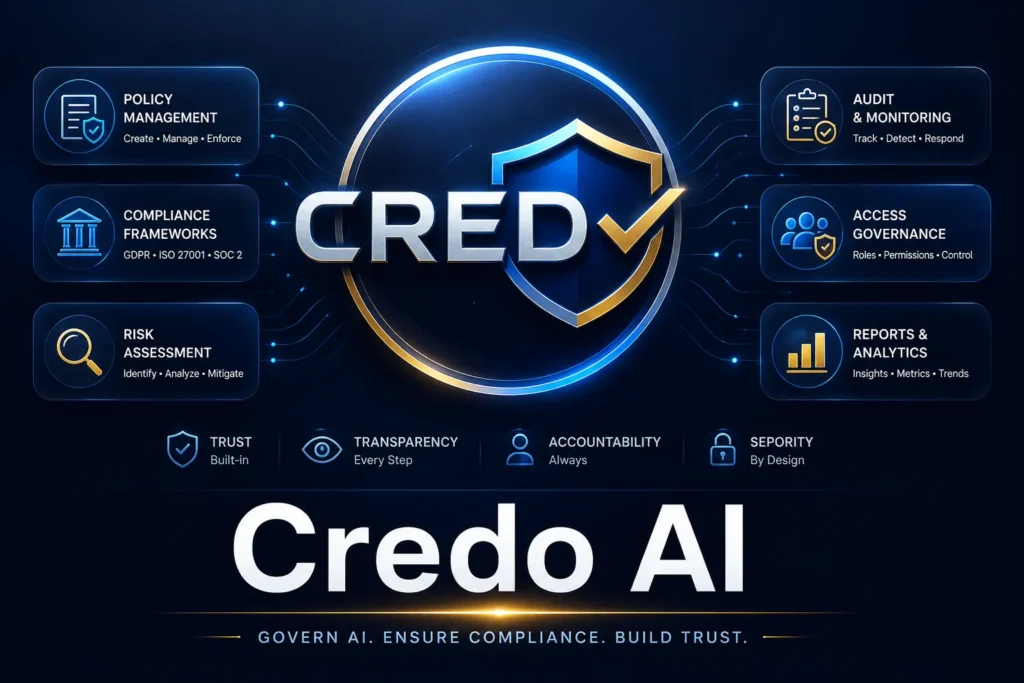
Credo AI positioned itself as the governance platform specifically built for enterprises deploying AI at scale. The platform works across machine learning models, generative AI applications, and increasingly across AI agents.
What makes Credo different from older governance tools is that it wasn’t bolted onto an existing GRC system. It was built from the ground up for AI governance. This shows in how it handles policy management, regulatory mapping, and evidence generation.
The platform maps AI systems to regulatory frameworks including the EU AI Act, NIST AI RMF, ISO 42001, SOC 2, and HIPAA. It automates evidence collection for audits. It maintains an inventory of all AI systems including shadow AI discovery.
Best for: Enterprises with multiple business units running AI, compliance officers, and organizations preparing for regulatory requirements.
Cost: Custom enterprise pricing. Expect $100,000 plus annually depending on scale.
Key capability: Pre-built policy packs for major regulatory frameworks means you can align governance without building from scratch.
2. IBM watsonx.governance
Governance for Mixed AI Environments
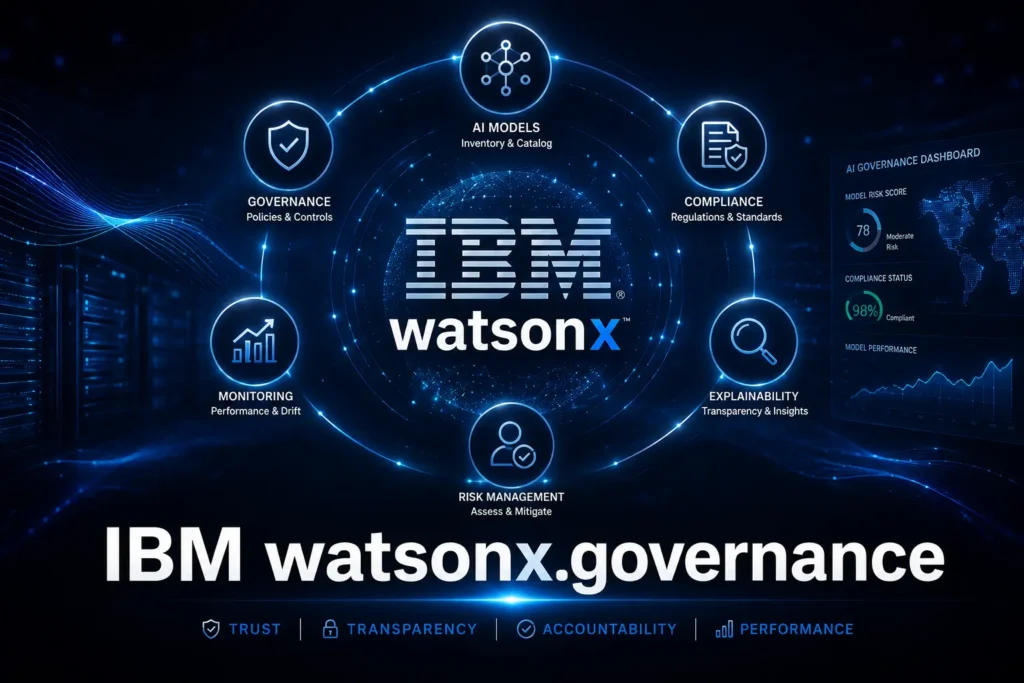
IBM watsonx.governance is the enterprise platform for organizations already invested in IBM’s ecosystem. It handles both traditional machine learning models and generative AI governance in one interface.
The platform provides explainability features, bias and fairness monitoring, and audit-ready reporting. For regulated industries that need to explain AI decisions to regulators, the explainability features are particularly valuable.
Best for: Large enterprises, financial services, healthcare, organizations already using IBM tools.
Cost: Enterprise pricing, varies by deployment model and scale.
Key capability: Strong explainability features for regulated industries where AI decisions must be defensible.
3. DataRobot AI Governance
Full Lifecycle Governance
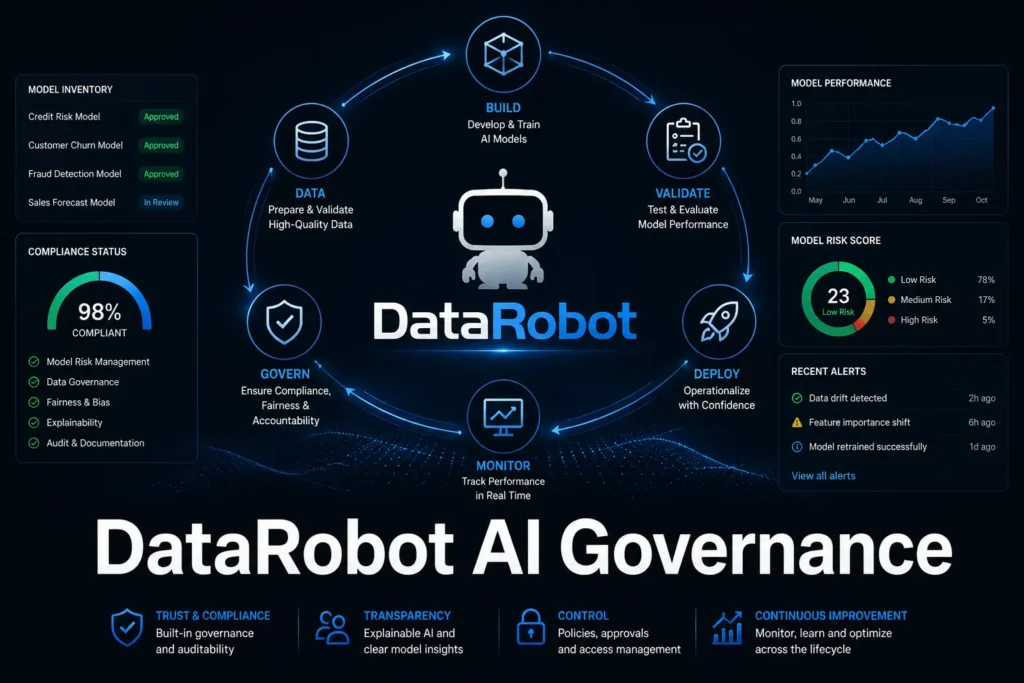
DataRobot brings governance capabilities to its broader AI platform. The solution includes policy enforcement, audit trails, AI risk management, and custom alerts.
DataRobot’s approach positions governance as part of a complete AI operations system rather than a standalone tool.
Best for: Organizations wanting governance integrated with AI model development and deployment.
Cost: Enterprise pricing as part of DataRobot platform.
Key capability: Integration with ML operations workflow.
4. ModelOp
Centralized AI Governance for Complex Portfolios
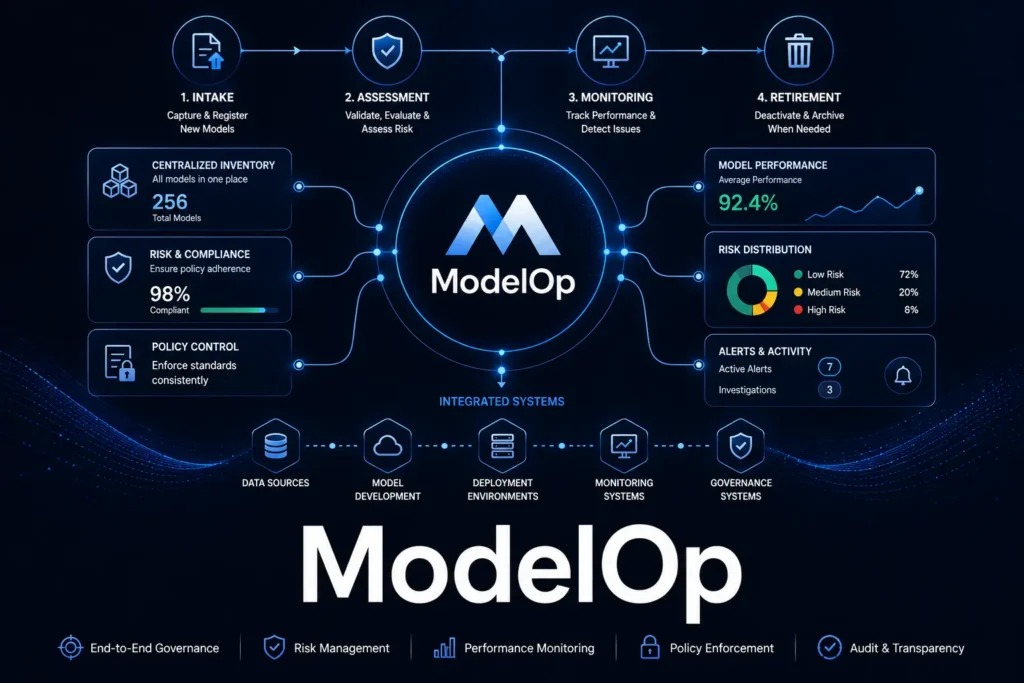
ModelOp creates what it calls “the AI system of record” for large enterprises managing hundreds of AI systems. The platform automates governance from intake through retirement.
For companies that have lost track of how many AI systems are actually running, ModelOp’s inventory and lifecycle automation is a practical solution.
Best for: Large enterprises managing complex AI portfolios across multiple departments.
Cost: Enterprise custom pricing.
Key capability: Centralized governance across internal models, vendor AI, and generative AI applications.
5. Holistic AI
From Bias Auditing to Full Governance
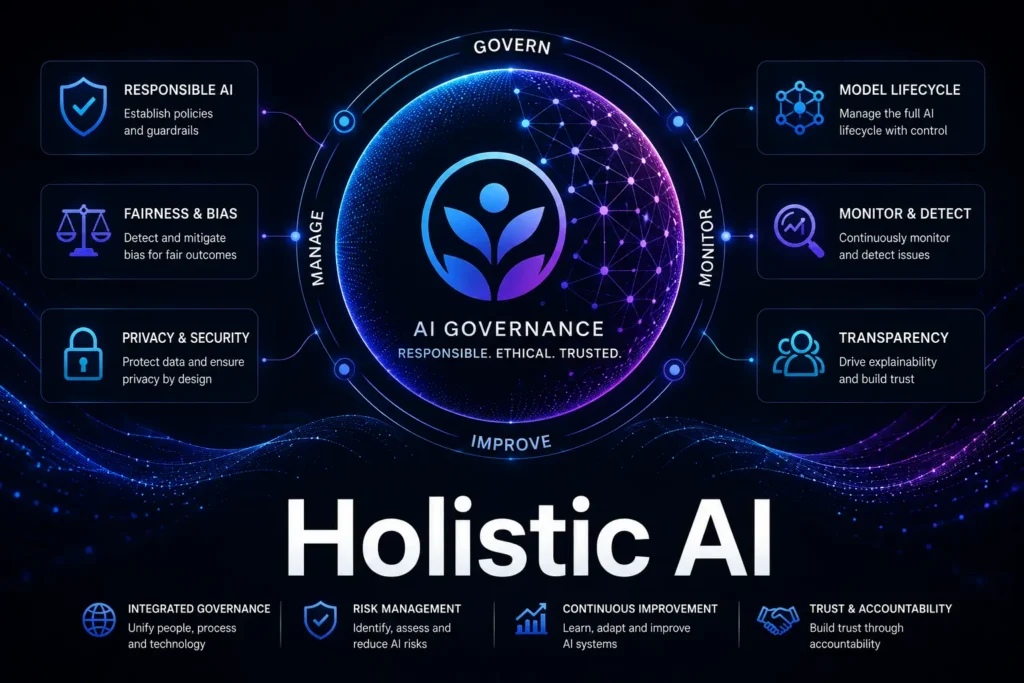
Holistic AI evolved from specialized bias auditing into a comprehensive AI governance platform that includes shadow AI discovery, risk assessment, compliance monitoring, and increasingly real-time enforcement through what they call Guardian Agents.
The platform combines compliance-layer governance with runtime enforcement, which positions it at the intersection of two different types of AI governance needs.
Best for: Organizations whose primary AI risk is fairness and bias, but that need broader governance coverage.
Cost: Custom enterprise pricing.
Key capability: Strong assessment library for bias and fairness testing combined with continuous monitoring.
Mid-Market and Technical AI Governance
6. Fiddler AI
Observability and Explainability for Production AI
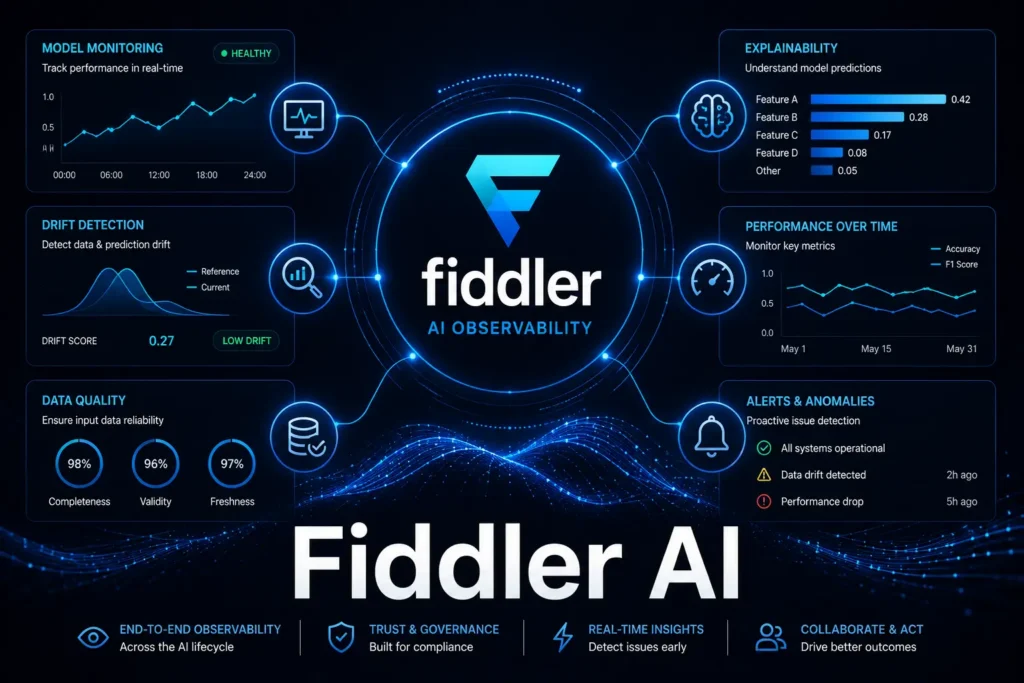
Fiddler focuses on AI observability, which means making AI systems transparent and understandable. The platform monitors deployed models for drift, bias, and performance changes.
For teams that already have models in production and need to understand how they’re behaving, Fiddler provides visibility and root cause analysis.
Best for: Data science teams, organizations with production AI systems, teams needing model monitoring.
Cost: Custom pricing based on usage.
Key capability: Strong explainability and root cause analysis for model behavior.
7. Arthur AI
Continuous Evaluation and Agent Governance
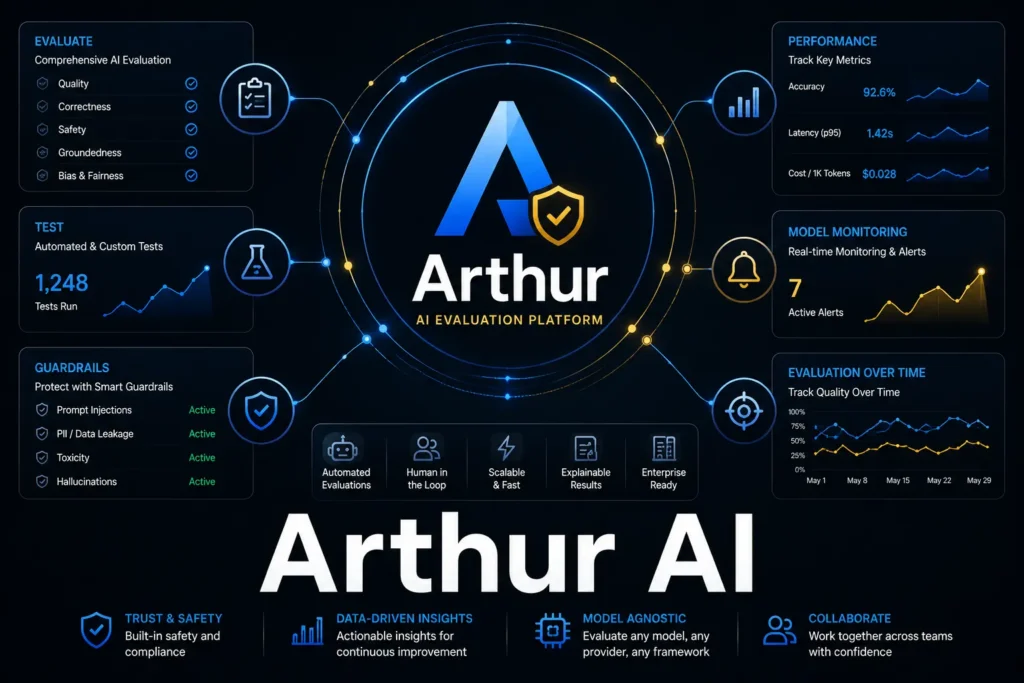
Arthur provides continuous evaluation of AI systems throughout their lifecycle, not just during deployment. As companies move toward AI agents, Arthur’s agent-specific governance becomes increasingly valuable.
The platform includes guardrails, policy enforcement, and runtime protection for AI agents.
Best for: Organizations building and deploying AI agents, teams needing continuous evaluation.
Cost: Custom enterprise pricing.
Key capability: Specific focus on governing AI agents as they become more autonomous.
8. Zenity
Agent-Layer Security and Monitoring
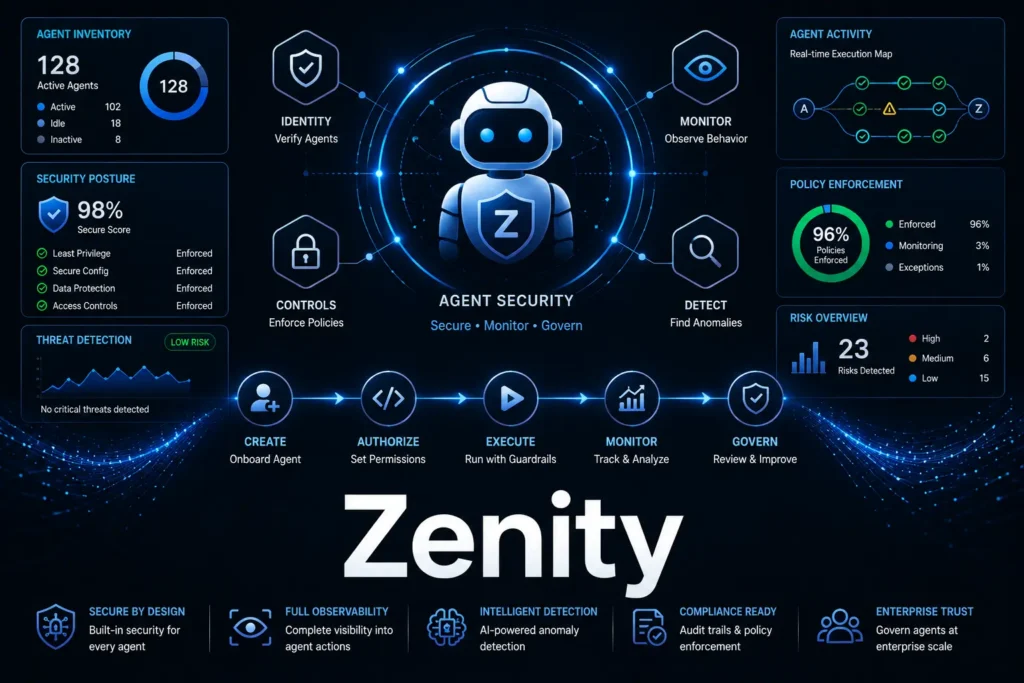
Zenity takes a different approach. Instead of governance at the model level, it operates at the agent level, examining what agents do, what tools they call, what data they access, and where they’re headed next.
This intent-aware approach to agent defense is architecturally different from traditional AI governance that examines individual prompts or model outputs.
Best for: Organizations running autonomous AI agents, particularly Microsoft Copilot Studio or Salesforce Agentforce.
Cost: Enterprise pricing.
Key capability: Agent-level execution path analysis rather than isolated prompt analysis.
9. WitnessAI
Enterprise AI Firewall
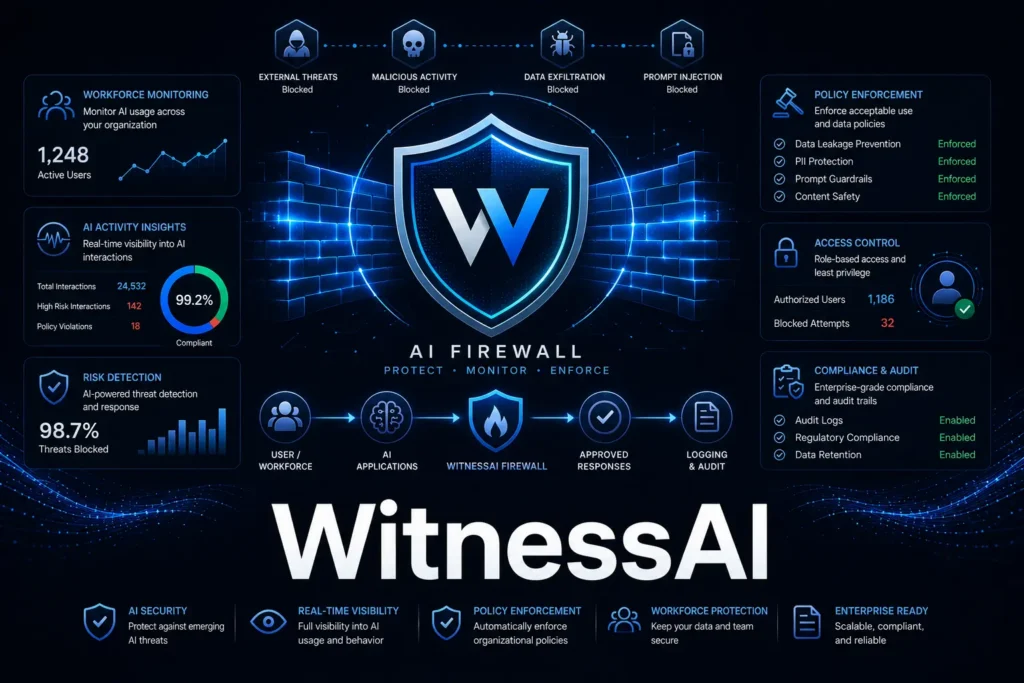
WitnessAI operates as an enterprise AI firewall covering employee AI usage, AI agent behavior, and runtime protection.
The platform works at the identity and integration layer where AI risk actually originates in most organizations.
Best for: Security teams that need visibility into employee AI usage across SaaS tools.
Cost: Enterprise pricing.
Key capability: Network-level workforce AI governance with bidirectional runtime defense.
10. Lumenova AI
Responsible AI Lifecycle Management
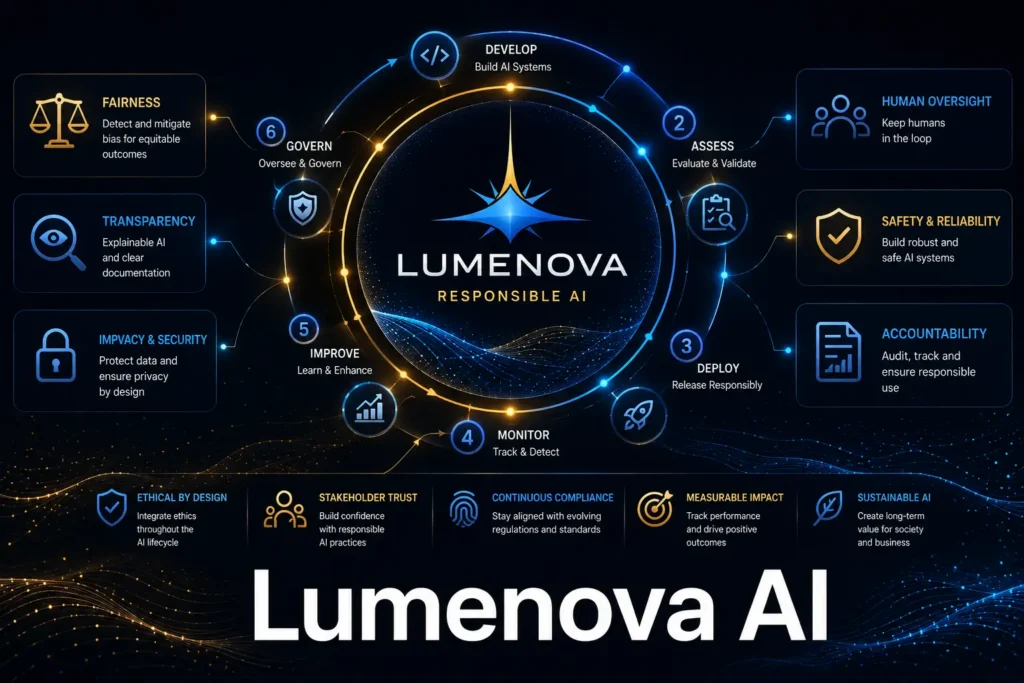
Lumenova automates the governance lifecycle for responsible AI. The platform helps organizations assess AI systems, detect drift, manage risk, and maintain compliance evidence.
The platform includes specific risk management frameworks for generative AI applications.
Best for: Organizations building comprehensive responsible AI programs.
Cost: Custom enterprise pricing.
Key capability: Automated evidence generation for compliance and audit purposes.
Specialized and Developer-Focused Options
11. Lakera Guard
Security for LLM Applications
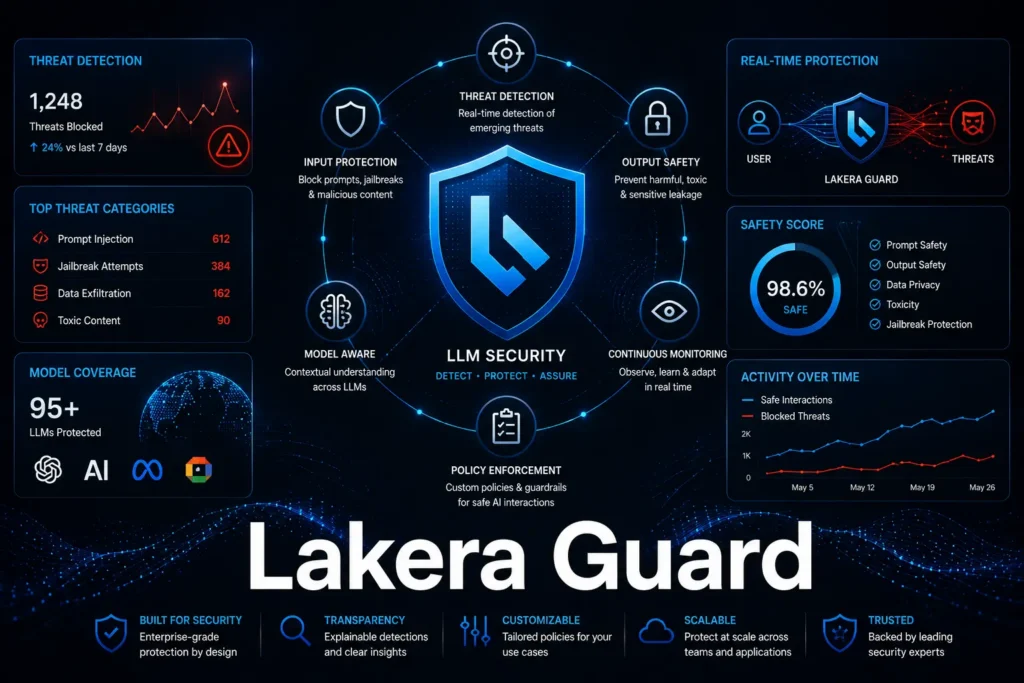
Lakera focuses specifically on AI security for generative AI applications. The platform prevents prompt injection, jailbreaks, data leakage, and other AI-specific threats at runtime.
For companies building customer-facing LLM applications, runtime security matters more than comprehensive governance.
Best for: SaaS companies and enterprises building LLM applications.
Cost: Business and enterprise pricing, typically usage-based.
Key capability: Real-time threat detection for LLM applications.
12. Aporia
AI Guardrails and Reliability
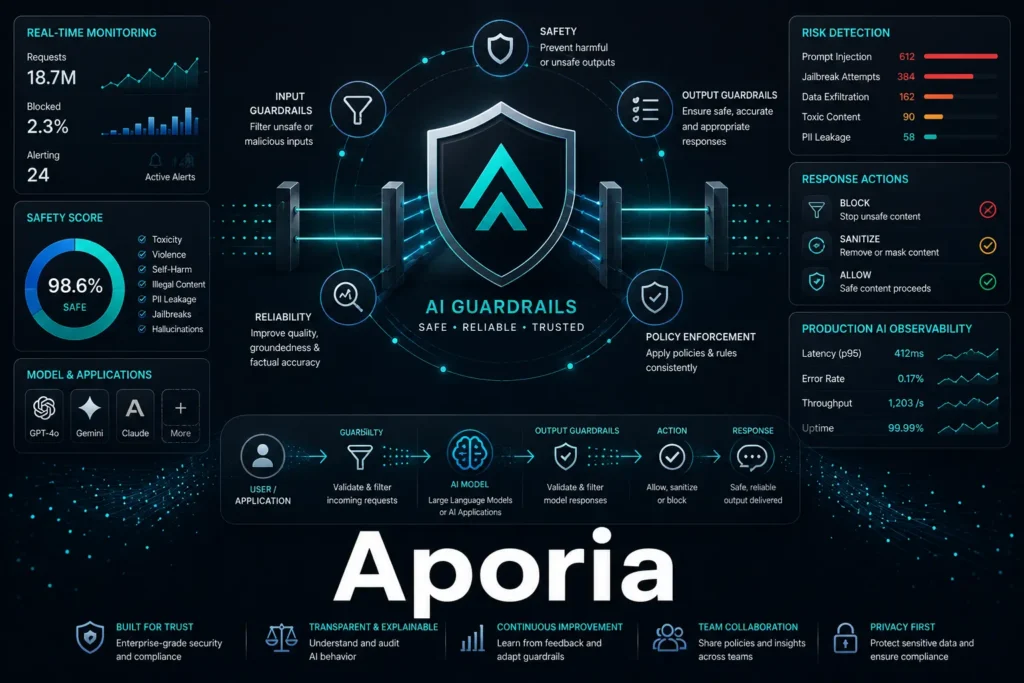
Aporia provides guardrails that intercept risky AI outputs in real time. The platform detects hallucinations, prompt injection, inappropriate responses, and data leakage before customers see them.
For product teams running production AI systems, Aporia works as a safety layer.
Best for: Teams building production AI applications, ecommerce, customer service, any customer-facing AI.
Cost: Custom or usage-based pricing.
Key capability: Real-time response filtering and guardrails.
13. Monitaur
Audit-Focused Governance
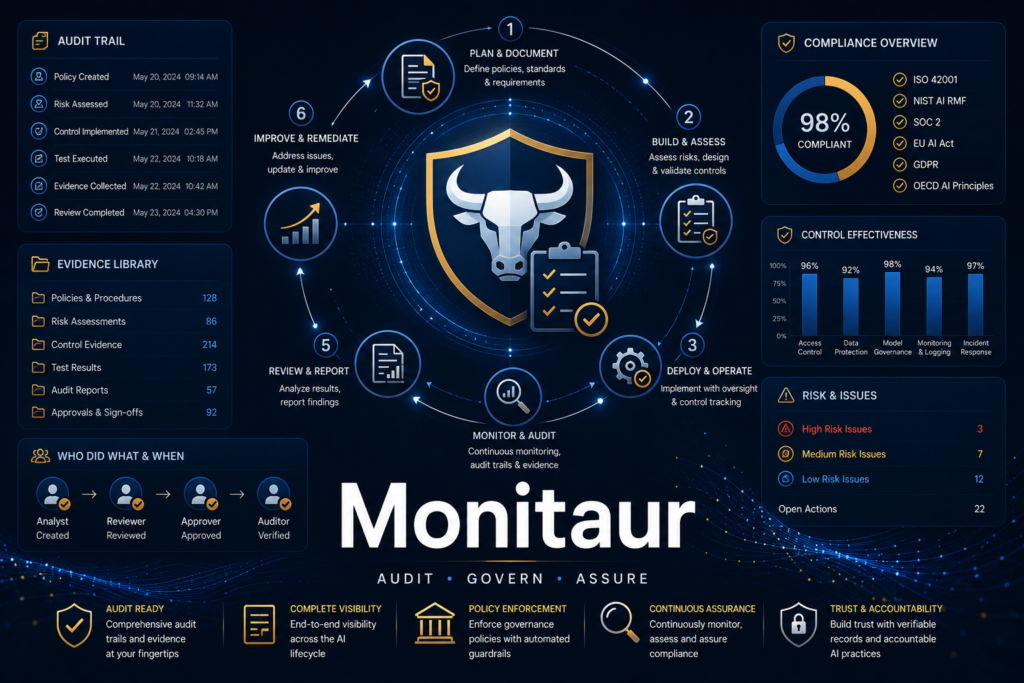
Monitaur takes an audit-first approach to AI governance. Every stage of the AI lifecycle is documented with the rigor of a traditional audit.
For industries like financial services and insurance where model risk management has been mandatory for years, Monitaur’s audit approach is familiar.
Best for: Regulated industries with existing audit processes, financial services, insurance.
Cost: Enterprise pricing.
Key capability: Audit-ready documentation of the complete AI lifecycle.
Open-Source and Affordable Options
14. Evidently AI
Free Open-Source AI Monitoring
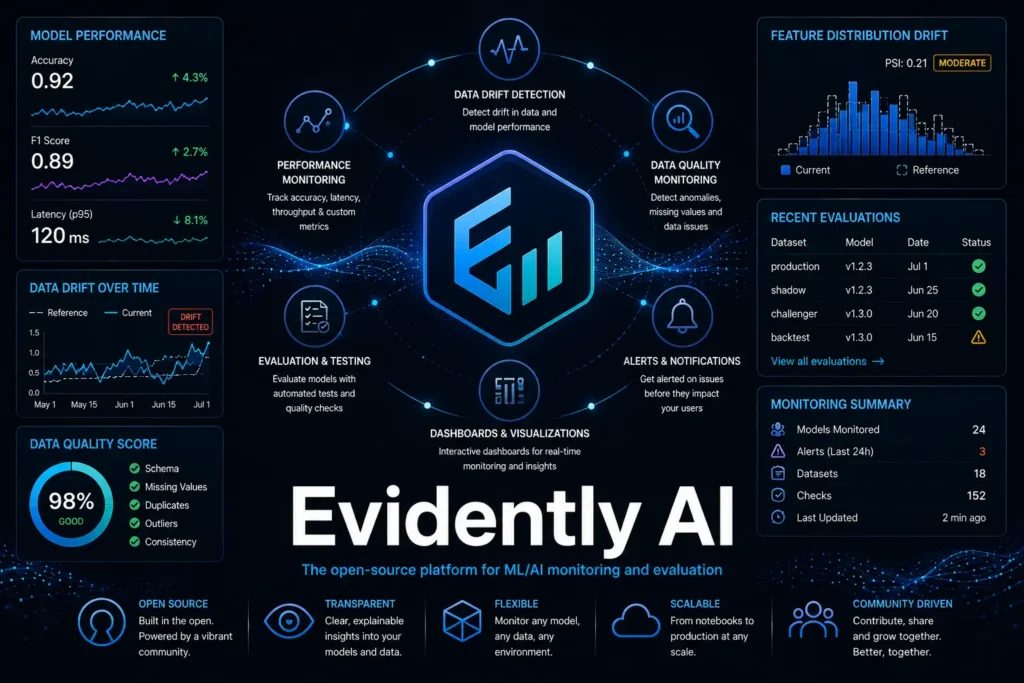
Evidently AI is one of the best free options for technical teams. The open-source version includes monitoring, evaluation, and testing for ML and LLM systems.
The platform includes over 100 evaluation metrics, drift detection, and local dashboards.
Best for: Startups, data science teams, proof-of-concept projects.
Cost: Free (open-source).
Key capability: Comprehensive evaluation and monitoring features without cost.
15. MLflow
Model Registry and Lifecycle Management
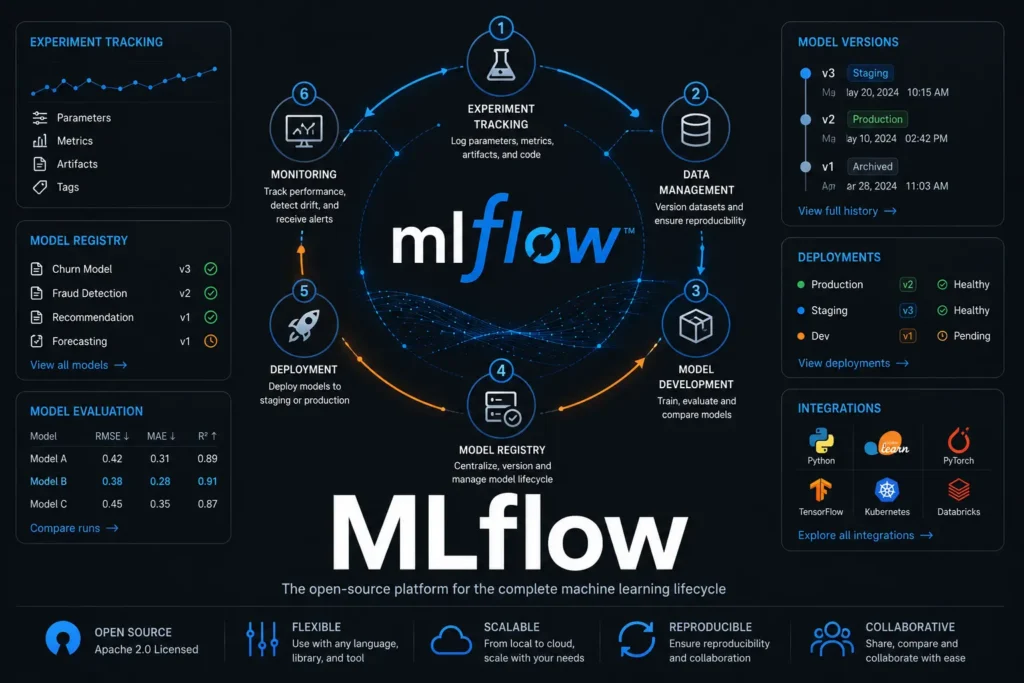
MLflow is the most widely used open-source platform for managing the ML lifecycle. It provides experiment tracking, model registry, versioning, and lifecycle stages.
For teams already using MLflow in their workflow, it provides foundational governance structure.
Best for: Data science teams, ML engineers, organizations building internal models.
Cost: Free (open-source).
Key capability: Popular and well-integrated with ML frameworks.
How to Choose the Right AI Governance Platform for Your Organization
Here’s a practical framework for making the choice.
Start with your biggest pain point. Is it visibility into which AI systems are running? Is it compliance documentation? Is it real-time security? Is it explaining AI decisions to regulators?
Different platforms excel at different problems.
For visibility and inventory, Credo AI and Holistic AI are strong. For compliance documentation, Monitaur and Credo AI excel. For runtime security, Zenity and WitnessAI are specialized. For regulated industries explaining decisions, IBM watsonx.governance is strong.
Next, consider your technical maturity. Can your team operate open-source tools, or do you need managed platforms? Do you have data science expertise, or are you primarily a compliance-driven organization?
Then, evaluate the regulatory frameworks you need to support. If you need EU AI Act compliance, most enterprise platforms now have this built in. If you need HIPAA, healthcare-specific features matter. If you’re in financial services, the documentation and audit capabilities matter more.
Finally, consider your budget. Enterprise platforms cost $100,000 annually and up. Mid-market options range $30,000 to $100,000. Technical teams can start with free options like Evidently AI or MLflow.
What to Look For in an AI Governance Platform
Not every platform has the same capabilities. Here are the features that actually matter.
AI inventory and shadow AI discovery. You need to know every AI system in your organization, including ones running without approval. This is harder than it sounds because AI is embedded in SaaS tools, cloud services, and employee laptops.
Risk assessment and classification. Not every AI system needs the same level of governance. A system used for blog writing is lower risk than a model used for hiring decisions or loan approvals. The platform should help you classify risk levels.
Compliance mapping. The platform should map your AI systems to relevant frameworks like EU AI Act, NIST AI RMF, ISO 42001. This saves months of work.
Model monitoring and observability. For deployed systems, continuous monitoring for drift, bias, performance degradation, and anomalies is essential.
Policy enforcement and runtime controls. The best platforms don’t just document governance. They actively enforce policies and stop violations in real time.
Audit trails and evidence generation. When regulators ask questions, you need to prove what happened and when.
Support for AI agents. As autonomous agents become more common, governance needs to cover agent behavior, tool usage, and decision-making.
AI Governance Implementation: The Practical Steps
Buying a platform is only the first step. Real governance requires organizational commitment.
First, create an inventory of every AI system in your organization. Include approved tools, internal models, vendor AI products, and shadow AI that employees are using.
Second, assign clear ownership. Every AI system should have an owner who is accountable if something goes wrong.
Third, classify risk levels. High-risk systems (hiring, lending, medical recommendations) need strong governance. Low-risk systems (content writing, summarization) need less.
Fourth, define policies. What AI Governance Tools are approved? What data can be shared? Who has to review AI decisions? What happens if an AI system creates risk?
Fifth, choose a platform based on these needs.
Sixth, build approval workflows. Before deploying AI into production, teams should complete governance steps like risk assessment, bias testing, security review.
Seventh, monitor continuously. Governance doesn’t end after launch.
The Bottom Line on AI Governance in 2026
Companies that succeed with AI in 2026 will be the ones that balance three things: innovation speed, safety, and compliance.
AI Governance Tools enable this balance. They let teams move fast while maintaining control.
For large enterprises, platforms like Credo AI, IBM watsonx.governance, and Holistic AI provide comprehensive coverage.
For technical teams, Fiddler, Arthur, and Zenity provide strong monitoring and enforcement.
For startups, Evidently AI and MLflow provide free options to start building governance habits.
The platform you choose matters less than having one. Organizations without governance visibility over their AI systems are facing real regulatory and business risk in 2026.
The time to implement governance is now, before regulators mandate it or customers demand it.
Frequently Asked Questions
What is AI governance and why does it matter in 2026?
AI governance is the system of policies, processes, and tools that help organizations manage AI responsibly. It matters because AI adoption has outpaced governance capability, creating regulatory risk, security risk, and compliance exposure.
What is the difference between AI governance and AI security?
AI governance focuses on managing AI systems responsibly across their lifecycle. It covers policy, documentation, compliance, and risk management. AI security focuses on protecting AI systems from attacks like prompt injection or data theft.
Do small companies need AI governance?
Yes, especially if they use customer data, build AI products, or depend on AI for important decisions. Smaller companies can start with free tools like Evidently AI and MLflow.
What’s the biggest mistake enterprises make with AI Governance Tools?
Focusing on documentation without enforcement. The best platforms actually stop policy violations in real time, not just document them after the fact.
How long does it take to implement AI Governance Tools?
For a small organization, 2 to 3 months. For large enterprises with many AI systems, 6 to 12 months. The time is mostly spent in inventory and assessment, not in selecting tools.
Can AI governance tools guarantee compliance?
No. Tools support compliance, but organizations still need legal review, internal policies, proper implementation, and ongoing monitoring.
Which framework should we start with for AI Governance Tools?
Start with NIST AI RMF if you work with the federal government. Start with EU AI Act if you serve EU customers. Start with your industry’s specific requirements. Most enterprise governance tools support multiple frameworks.
Note: Want to understand how modern AI systems track rankings, visibility, and search intent? Read our detailed guide on Why Use AI Search Monitoring Tools? A Real Answer for Website Owners.







Comments (1)
AI Transformation Is a Problem of Governance | Expert Guide for 2026says:
June 9, 2026 at 9:34 pm[…] AI tools list Data privacy rules Human review before publishing No confidential customer data in public AI […]