
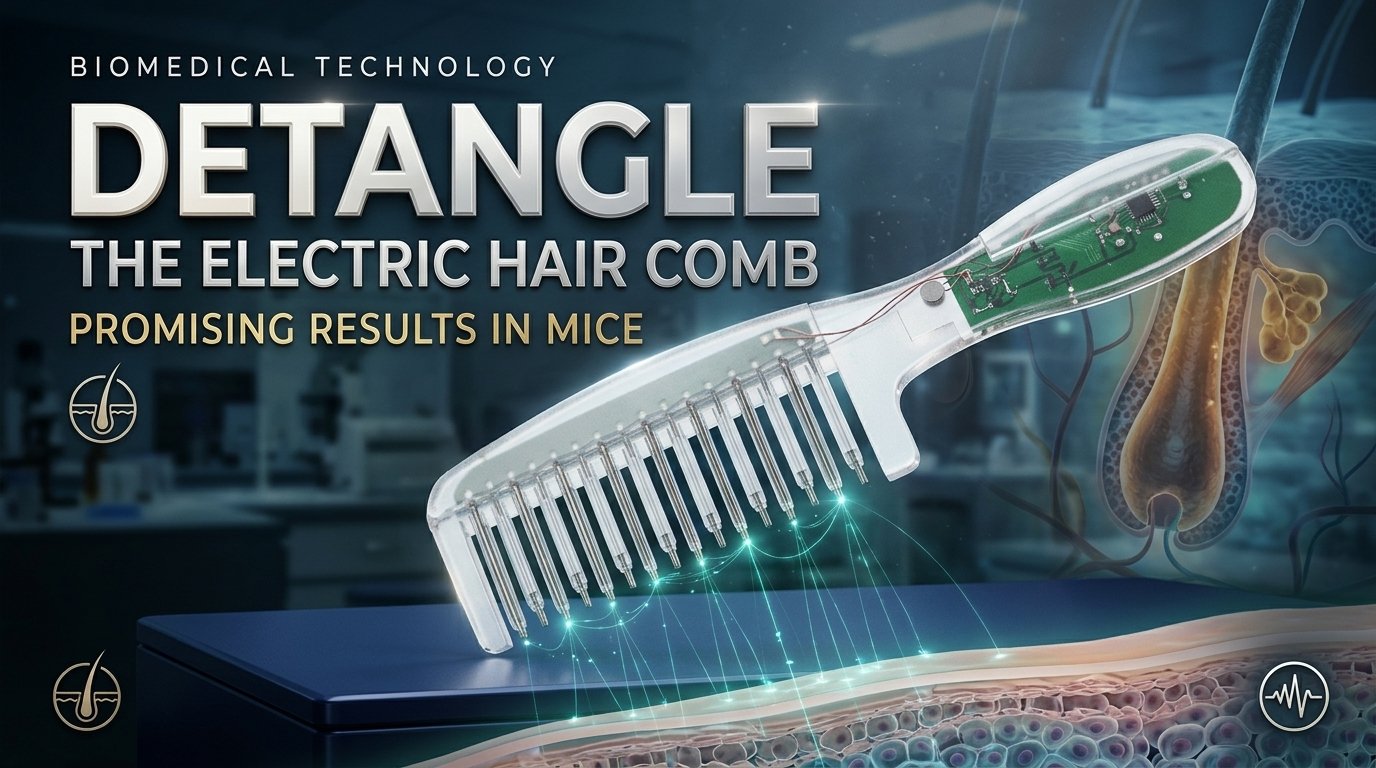
A transparent comb with exposed electronic circuitry might not look like the next major advance in hair loss research. Yet a newly published experiment suggests that a device resembling an ordinary grooming tool could offer a different way to reach hair follicles.
The device is called Detangle.
In a study published on November 3, 2026, in Nature Communications, researchers described an experimental electric comb that combines stimulation of hair follicles with the delivery of molecules designed to influence two biological processes involved in pattern hair loss.
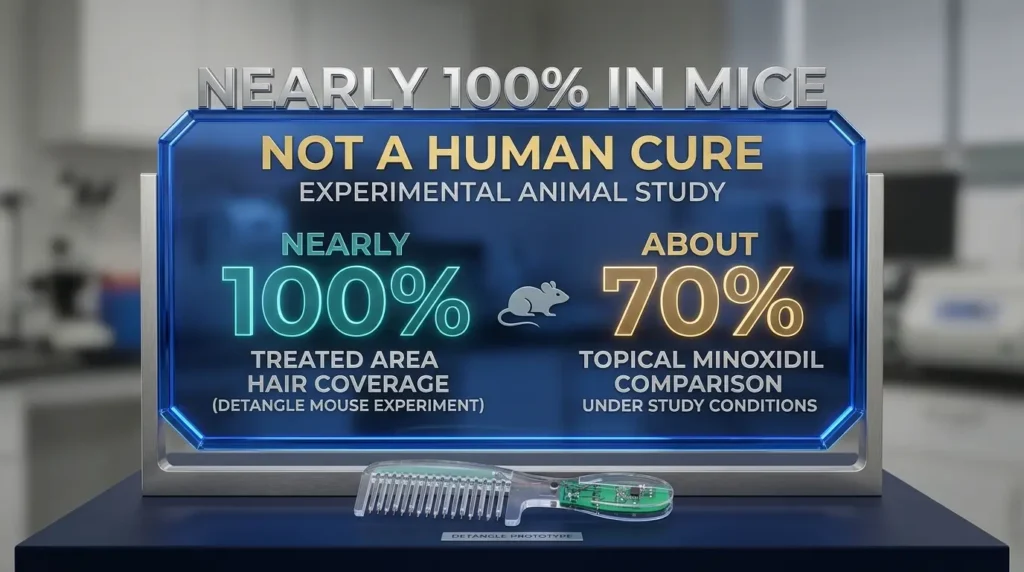
The results were striking. In mice with experimentally induced androgenetic alopecia, the researchers reported hair coverage approaching 100% after approximately one month. The comparison group treated with conventional topical minoxidil achieved around 70% coverage under the study’s conditions.
That sounds extraordinary, especially to anyone who has watched their hairline recede or noticed more scalp becoming visible.
But there is a crucial detail behind the headlines.
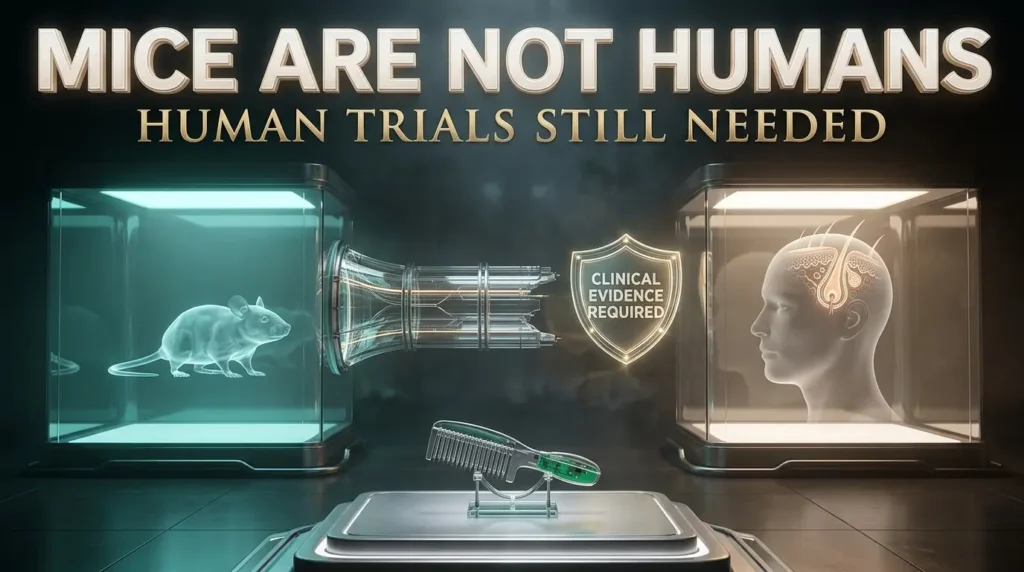
Detangle has not been shown to regrow hair in humans.
The research is an encouraging laboratory development, not evidence that a consumer electric comb can reverse baldness.
Understanding that distinction is essential because Detangle is attracting interest in a market already crowded with laser combs, scalp massagers, hair growth serums and products that promise far more than they can demonstrate.
So what exactly have scientists created? Why did the mouse results look so promising? And how does this technology compare with treatments people can actually use today?
What Is the Detangle Electric Hair Growth Comb?
Detangle is an experimental bioelectronic system developed to deliver electrical stimulation and therapeutic molecules to hair follicles during a combing motion.
The research was led by Feng Liu and colleagues and published in Nature Communications under the title Combing-triggered electrostimulation synchronizing deep delivery for rapid hair regrowth in androgenetic alopecia.
Unlike a conventional detangling brush, the device is not primarily designed to remove knots.
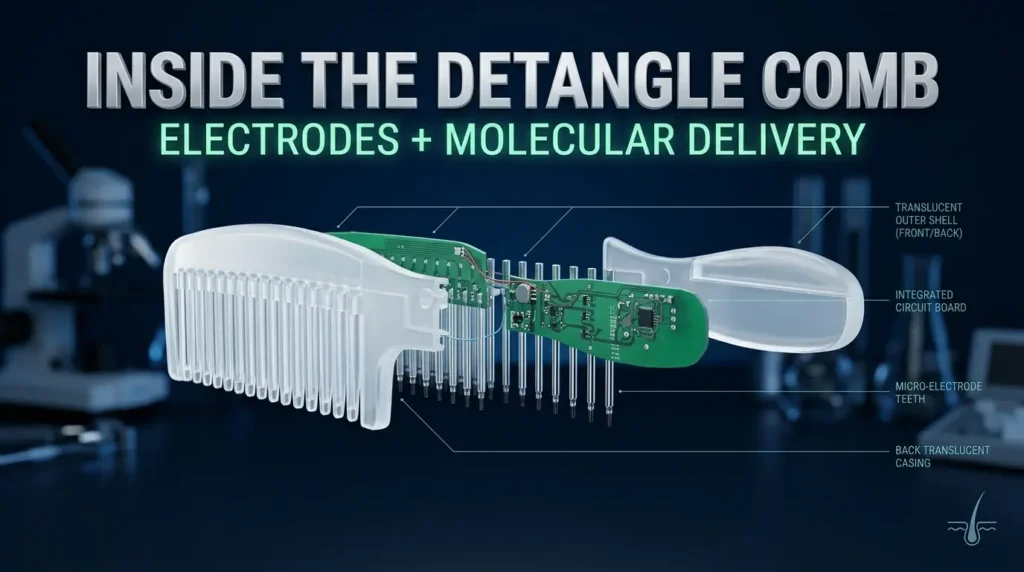
Its comb shaped body contains specially arranged electronic teeth, electrodes and modules that hold the experimental molecular treatments.
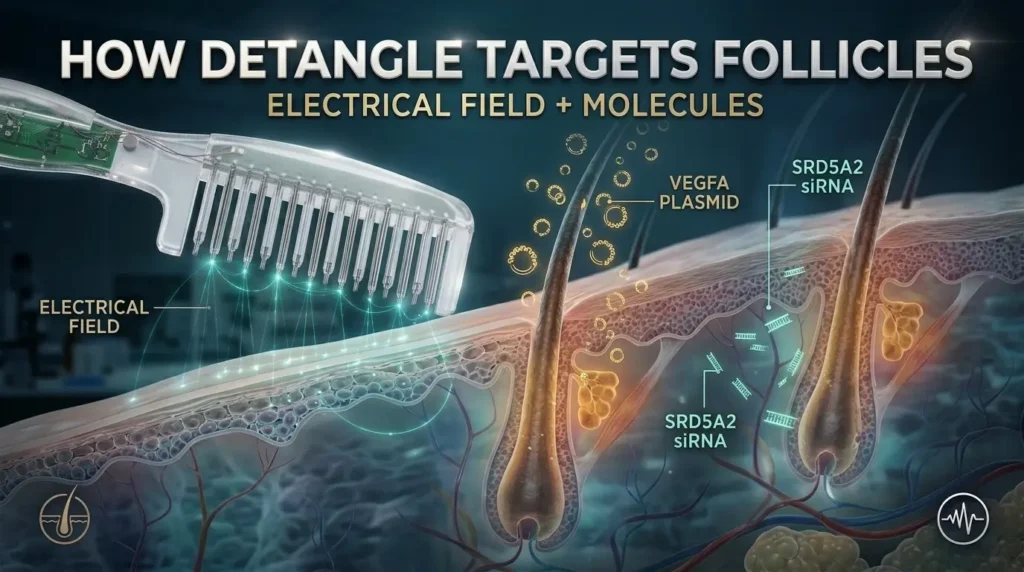
As the device moves across the treatment area, it produces an electric field intended to stimulate follicular tissue and help deliver its therapeutic cargo into cells.
The central idea is to overcome one of the difficulties of treating hair loss: reaching the relevant cells effectively while limiting unwanted effects elsewhere in the body.
Why does it look like a normal comb?
The comb shape is not just a cosmetic decision.
Hair follicles sit within the skin, and the researchers wanted a device that could bring its active components close to the follicular regions.
The study describes electrodes positioned at different heights along the teeth to create a stronger field in the target area.
The authors report that their design achieved electric field penetration approximately nine times deeper than the conventional external application used for comparison in their experimental setup.
That does not mean the comb grows hair nine times faster or is nine times more effective than minoxidil.
It describes a particular physical measurement associated with the device’s delivery mechanism.
The distinction is important because a deeper electric field is only one part of the proposed treatment.
The experimental molecules delivered alongside that stimulation are equally central to the study.
How Does Detangle Work?
To understand why the researchers designed this device, it helps to understand what happens during pattern hair loss.
In androgenetic alopecia, genetically susceptible hair follicles gradually become smaller. Over time, they produce thinner, shorter hairs, making the scalp more visible.
A hormone called dihydrotestosterone, or DHT, plays an important role in this process in susceptible follicles.
Blood supply, cellular signaling and the normal hair growth cycle are also important parts of follicle biology.
Detangle attempts to influence more than one of these processes at the same time.
1. Electrical stimulation of hair follicles
The comb contains electrodes designed to produce a localized electric field.
Electrical stimulation is being investigated in several areas of regenerative medicine because electric signals can influence cellular behavior.
In this experiment, the field was intended to stimulate follicular tissue and assist delivery of the molecular treatments.
However, that does not mean that any electric current applied to the scalp will promote hair growth.
The geometry, electrical conditions, target tissue and accompanying molecules matter.
A vibrating hairbrush or an inexpensive electric scalp massager should not be assumed to reproduce this experimental system.
2. Delivery of VEGFA related genetic material
One of the therapeutic components is a plasmid encoding vascular endothelial growth factor A, usually abbreviated VEGFA.
VEGFA is involved in the formation of blood vessels.
The researchers sought to increase vascular support around hair follicles, a process that could help create conditions favorable to follicle activity.
This is not the same as applying a standard hair serum or vitamin to the scalp.
The study involved delivery of genetic material designed to influence cellular signaling.
3. Reducing a pathway associated with DHT
The second component is a small interfering RNA, or siRNA, targeting SRD5A2.
SRD5A2 encodes an enzyme involved in converting testosterone into DHT.
By targeting that pathway, the researchers aimed to reduce local androgen related signaling associated with follicle miniaturization.
This resembles the broader biological objective of certain established hair loss medications, but the method is different.
Detangle attempts localized molecular delivery using an electrical field.
Its effects, safety and duration in people have not been established.
Why combine these mechanisms?
The researchers proposed that supporting blood vessel formation while reducing an androgen related pathway could work better than targeting a single process.
The electric field serves both as a source of stimulation and as part of the delivery mechanism.
That combination is what makes the research distinctive.
It is also why the results cannot be attributed simply to brushing the scalp with electricity.
The experimental treatment involved a coordinated device and molecular system.
What Did the Study Actually Find?
The most widely discussed result comes from experiments involving mice with a model of androgenetic alopecia.
According to the published paper and independent reporting by Medical Xpress, the researchers applied the treatment every three days over a 28 day period.
They compared the experimental system with conventional approaches, including topical minoxidil.
The researchers reported nearly complete hair coverage in the Detangle treated area, compared with approximately 70% coverage in the topical minoxidil comparison.
They also reported biological changes consistent with their proposed mechanism, including improved vascular support and follicular responses.
The result is promising because it suggests that combining stimulation with localized molecular delivery may influence hair regrowth in an experimental setting.
But there are several reasons to interpret the figures carefully.
Nearly 100% coverage does not mean a 100% cure
The percentage refers to hair coverage of the treated area in the mouse experiment.
It is not a claim that every follicle in a human scalp would recover.
It does not establish permanent regrowth.
And it does not mean the device restored a complete head of hair in a person with longstanding baldness.
A mouse model is not the same as human pattern baldness
Mice and humans differ in skin structure, follicle cycling, hormone biology and the progression of hair loss.
A treatment that works in a controlled animal model may fail to produce the same results in people.
This is especially relevant when the study uses experimentally induced hair loss rather than the full range of naturally occurring human disease.
The comparison has limits
The study’s topical minoxidil group provides a useful experimental benchmark.
It does not prove that Detangle is clinically superior to minoxidil in humans.
Human minoxidil treatment is evaluated over months, with different endpoints, patient characteristics and dosing conditions.
The two sets of evidence cannot be directly equated.
The more accurate conclusion is that Detangle performed strongly within the conditions of this particular animal experiment.
Is Detangle a Cure for Baldness?
No human cure has been demonstrated.
The word “cure” suggests that a treatment reliably eliminates the condition or produces lasting restoration.
The Detangle study does not establish that.
It provides early evidence for an experimental treatment strategy in mice.
Before a device like this could become an established human treatment, researchers would need to answer several questions.
First, can the system deliver its molecular components effectively through human scalp tissue?
Second, what electrical settings and treatment schedules would be appropriate for people?
Third, could the molecular interventions produce unwanted local or systemic effects?
Fourth, how long would any improvement last?
And finally, would the treatment outperform existing options in well designed human trials?
Those questions are not minor technical details.
They determine whether an interesting laboratory prototype can become a safe, useful medical product.
Has Detangle Been Tested on Humans?
The November 2026 research does not establish human clinical effectiveness.
Independent coverage by Medical Xpress also notes that the device has yet to demonstrate its results in people.
That means there is no verified human success rate, no established treatment schedule and no reliable estimate of how much hair a person could regrow using Detangle.
It is also too early to know whether the approach would be suitable for different forms of hair loss.
Androgenetic alopecia is not the same condition as alopecia areata, temporary shedding after illness, scarring alopecia or hair breakage.
A treatment aimed at one biological mechanism may not help conditions caused by entirely different processes.
Is the Detangle comb safe?
The researchers reported encouraging safety findings within their experimental work.
That is not equivalent to demonstrating safety for repeated human use.
A future human evaluation would need to examine the electrical system, the delivered genetic material, local skin reactions, unintended biological effects and longer term outcomes.
Until those questions are answered, it would be misleading to call the device a proven safe treatment for people.
Can You Buy the Detangle Hair Growth Comb?
As of November 14, 2026, the verified research does not establish a commercial release, retail price or authorized consumer purchasing channel for the Detangle experimental system.
The photograph circulating with the story shows a research prototype, not necessarily a finished retail product.
There is also no verified timetable for a public launch.
If a seller advertises a generic electric comb as the same technology, the claim deserves scrutiny.
A vibrating scalp brush, laser comb or ordinary detangling device does not automatically contain the electronic electrode arrangement or molecular delivery system described in the paper.
Consumers should look for the exact manufacturer, published clinical evidence, regulatory status and a clear explanation of what the product actually does.
The existence of a promising scientific paper is not proof that an online listing offers the same technology.
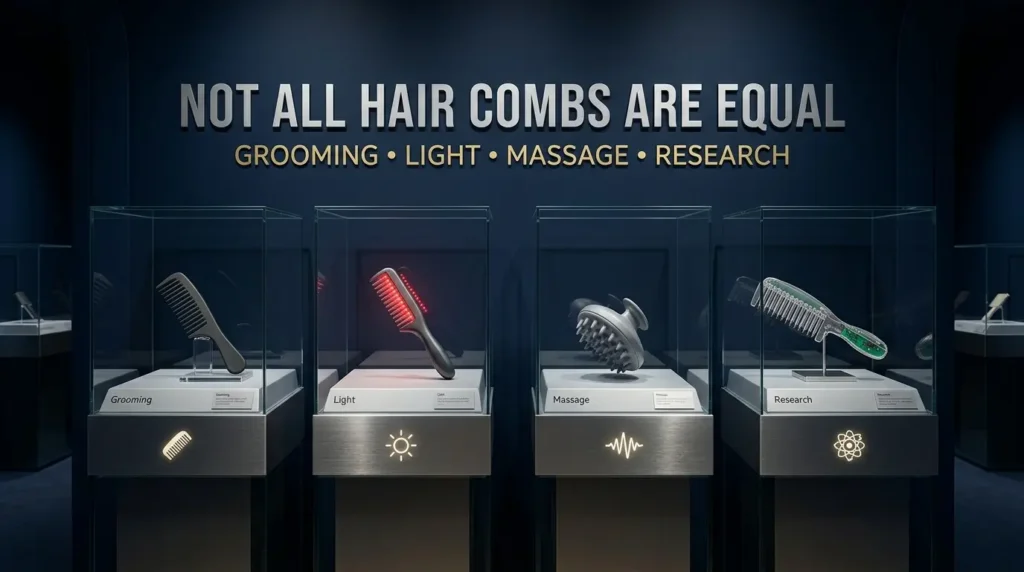
Detangle vs Laser Combs, Scalp Massagers and Ordinary Detangling Brushes
Several products are marketed using similar language, even though their mechanisms differ substantially.
| Device | Main mechanism | What the evidence supports |
|---|---|---|
| Detangle research prototype | Electrical stimulation plus molecular delivery | Promising mouse research; human effectiveness unknown |
| Low level laser comb | Red or near infrared light | Some human evidence for pattern hair loss |
| Vibrating scalp massager | Mechanical stimulation | Insufficient evidence for reliable regrowth |
| Ordinary detangling brush | Reduces knots and friction | May reduce breakage, not proven follicle regrowth |
| Microcurrent scalp device | Electrical stimulation | Effectiveness depends on the specific device and clinical evidence |
The American Academy of Dermatology notes that some laser devices have shown promising results in people with hereditary hair loss, although not everyone responds and more research is needed.
That is a different evidence base from the new Detangle study.
A laser comb uses light.
Detangle uses electrical stimulation and experimental molecular delivery.
They should not be presented as interchangeable technologies.
Does ordinary detangling help hair grow?
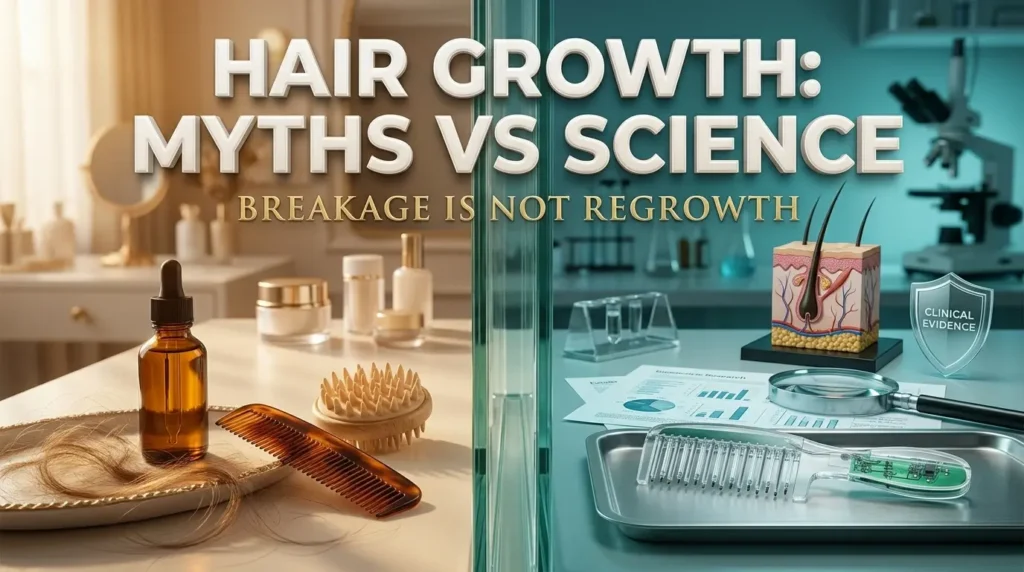
Gentle detangling can help prevent hair shafts from breaking.
That may allow a person to retain more length and reduce the appearance of damaged, thinning hair.
But preserving existing hair is not the same as generating new growth from follicles affected by androgenetic alopecia.
The American Academy of Dermatology recommends conditioners and detangling products as part of gentle hair care because they can reduce breakage and split ends.
It does not claim that brushing alone reverses genetic baldness.
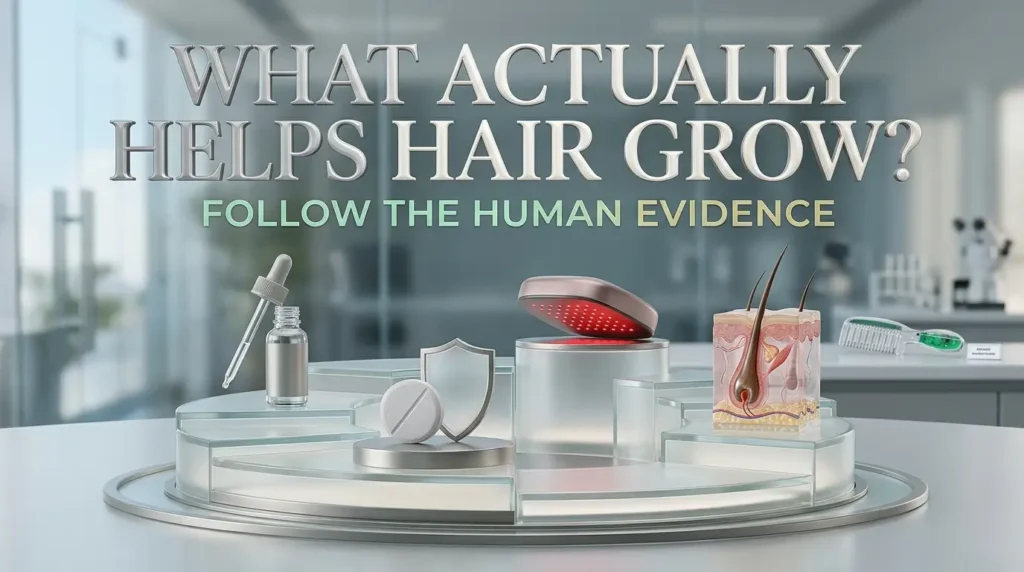
What Actually Works for Hair Loss Today?
The excitement surrounding Detangle is understandable.
Hair loss can affect confidence and wellbeing, and many people find existing treatments inconvenient, slow or disappointing.
But it is important not to abandon established options because of an early animal study.
According to the American Academy of Dermatology’s treatment guidance, treatment should begin with identifying the cause of hair loss.
Minoxidil
Topical minoxidil is an established treatment for certain types of pattern hair loss.
It can help stimulate growth or slow further loss, but results vary.
The AAD notes that visible improvement may take six to twelve months and that continued use is generally needed to maintain benefits.
It does not restore a full head of hair for everyone.
Finasteride
Finasteride is a prescription medication used for male pattern hair loss.
It reduces the formation of DHT, the hormone involved in follicle miniaturization in genetically susceptible people.
It can help some patients slow hair loss or achieve regrowth, but it is not appropriate for everyone and can cause adverse effects.
A clinician should discuss suitability, reproductive precautions and potential side effects before treatment.
Low level light therapy
Some laser combs, caps and related devices have been studied in humans.
The AAD describes promising evidence for certain devices, while emphasizing that results are not universal and that repeated treatments over months may be necessary.
A device should be evaluated on its own clinical evidence rather than the general claim that light stimulates follicles.
Other treatments
Depending on the diagnosis, dermatologists may recommend additional medicines, injections, platelet rich plasma procedures or hair transplantation.
Some types of shedding improve when the underlying trigger resolves.
Others require treatment to prevent progression.
The central lesson is that there is no single treatment that works for every type of hair loss.
Why Does Hair Fall Out in the First Place?
Hair loss is not one disease.
The cause matters because a person with hereditary thinning may need a very different approach from someone experiencing temporary shedding after an illness.
The NHS hair loss guidance explains that losing around 50 to 100 hairs per day can be normal.
Hair loss can also be associated with illness, stress, substantial weight loss, iron deficiency and hereditary factors.
Pattern hair loss
This is the condition most directly relevant to Detangle.
Follicles become progressively smaller, and hair may thin around the temples, crown or central part.
Temporary shedding
Some people notice increased shedding after major stress, illness, childbirth or significant weight changes.
The timing and pattern can help clinicians distinguish temporary shedding from progressive follicle miniaturization.
Hair breakage
Hair can snap because of heat, chemicals, friction or excessive tension.
A person may think their hair is falling out when much of the visible problem is breakage.
Patchy or inflammatory hair loss
Sudden bald patches, scalp pain, redness, scaling or scarring may indicate conditions that need medical evaluation.
A cosmetic comb is not an appropriate substitute for diagnosing these problems.
Why Is Gen Z Losing Hair?
This question appears in Google’s People Also Ask results, but the premise needs care.
Young adults can experience hereditary hair loss, stress related shedding, nutritional deficiencies and hair damage.
However, the existence of viral discussions does not establish that Gen Z has a uniquely high rate of hair loss compared with earlier generations at the same age.
People are also more likely to encounter hair loss content on social media, where before and after photographs, supplements and devices are heavily promoted.
A young person noticing persistent thinning should not assume that age, stress or a particular trend explains it.
A clinician can assess the pattern, history and possible medical causes.
What About Natural Hair Growth Remedies?
The internet is full of claims about rosemary oil, rice water, scalp massage, castor oil, onion juice and special combing techniques.
Some may improve hair condition or make grooming more comfortable.
Others have limited preliminary research.
But they should not be presented as reliable cures for genetic hair loss.
A healthy diet and correcting a genuine nutritional deficiency can support normal hair health.
Taking large doses of supplements without a deficiency is not necessarily helpful and can sometimes be harmful.
The AAD specifically cautions that excessive intake of certain nutrients can worsen hair loss.
Likewise, scalp massage may feel pleasant, but evidence that it reliably reverses pattern baldness remains limited.
There is no established Japanese combing secret that restores lost follicles.
The most useful approach is to separate cosmetic improvements from treatments shown to influence follicle growth.
What Would Need to Happen Before Detangle Becomes a Real Treatment?
The next meaningful milestone would be carefully designed human research.
Investigators would need to establish appropriate treatment settings and assess safety before determining whether the approach produces measurable regrowth.
A credible clinical trial would ideally compare outcomes with suitable controls, use standardized hair measurements and follow participants long enough to understand whether improvements persist.
It would also need to distinguish the contribution of electrical stimulation from the effects of the delivered molecules.
That is particularly important because Detangle combines multiple mechanisms.
If future trials show meaningful benefits, questions about manufacturing, cost, regulatory authorization and clinical delivery would follow.
For now, there is no verified date when consumers will be able to purchase the research system.
Frequently Asked Questions
What is the Detangle electric comb?
Detangle is an experimental bioelectronic comb designed to combine electrical stimulation with delivery of molecules targeting processes involved in androgenetic alopecia.
Did Detangle regrow 100% of hair?
Researchers reported nearly complete hair coverage of the treated area in a mouse model. This is not a 100% human hair regrowth result.
Does Detangle work on humans?
Human effectiveness has not been established by the November 2026 study.
Is the Detangle comb available to buy?
No verified commercial launch, retail price or authorized consumer purchasing channel was established in the sources reviewed as of November 14, 2026.
Is Detangle the same as an electric detangling brush?
No. The research prototype uses specially arranged electrodes and experimental molecular delivery components. Ordinary detangling brushes are designed for grooming.
Can an electric comb cure baldness?
There is no evidence that an ordinary electric comb cures baldness. Detangle’s encouraging results are from animal experiments.
Do laser hair growth combs work?
Some laser devices have human clinical evidence suggesting benefits for certain people with pattern hair loss. Results vary, and not every device has equivalent evidence.
Does detangling help hair growth?
Gentle detangling can reduce breakage and help retain length. It does not directly establish new follicle growth.
What stimulates hair growth best?
That depends on the cause of hair loss. Established treatments such as minoxidil and, for appropriate patients, prescription medications may help certain types of pattern hair loss.
Can hair grow back naturally?
Some temporary forms of hair loss improve after the underlying trigger resolves. Hereditary pattern hair loss often requires treatment to slow progression or encourage regrowth.
Why is my hair suddenly falling out?
Possible causes include illness, stress, medication effects, nutritional deficiencies and medical conditions. Sudden or substantial shedding should be assessed by a healthcare professional.
What age is worst for hair loss?
There is no single age at which everyone experiences the most hair loss. Onset and progression vary with genetics, hormones, health and the underlying condition.
Can scalp massage regrow hair?
Evidence remains limited. Massage may feel beneficial, but it should not be considered a proven treatment for androgenetic alopecia.
What is the Japanese secret for hair growth?
There is no scientifically established single Japanese technique that reliably reverses baldness. Claims about massage and traditional routines need to be assessed individually.
Can Detangle replace minoxidil?
Not on current evidence. Detangle has not demonstrated clinical superiority or safety in humans.
Is Detangle safe for home use?
The study’s experimental safety findings do not establish that the system is safe for unsupervised human use.
The Bottom Line
Detangle is a fascinating piece of hair loss research because it approaches a familiar problem in an unfamiliar way.
Instead of relying only on a medication applied to the scalp, the researchers designed a comb that combines localized electrical stimulation with molecular delivery.
The results in mice were impressive enough to justify further investigation.
But the difference between a promising animal experiment and an effective human treatment is enormous.
There is no verified human success rate, no established consumer price and no confirmed public launch date.
Anyone struggling with hair loss should be wary of products claiming to reproduce the study without the same technology or clinical evidence.
For now, Detangle offers something valuable, but it is not a cure.
It offers a new research direction and a reason to watch what scientists discover next.

The Detangle comb is one example of how experimental technology can open new possibilities while raising important questions about evidence, safety and real world use. If you’re interested in the innovations shaping tomorrow’s products, explore our guide to AI hardware startups and emerging technologies, which examines the challenges of turning ambitious hardware ideas into practical systems. You can also learn more about TrendOutsider’s approach to research and fact checking and our mission to explain emerging technology and everyday trends. Whether a breakthrough involves medical research, intelligent devices or another emerging field, understanding what has actually been demonstrated is more useful than relying on an exciting headline alone.
Editorial note: This article is based on the November 3, 2026 Nature Communications study, independent science reporting and guidance from the American Academy of Dermatology and NHS. TrendOutsider has not tested Detangle, interviewed the research team or independently evaluated its safety. This article is for informational purposes and is not a substitute for medical advice.







Leave a Reply