
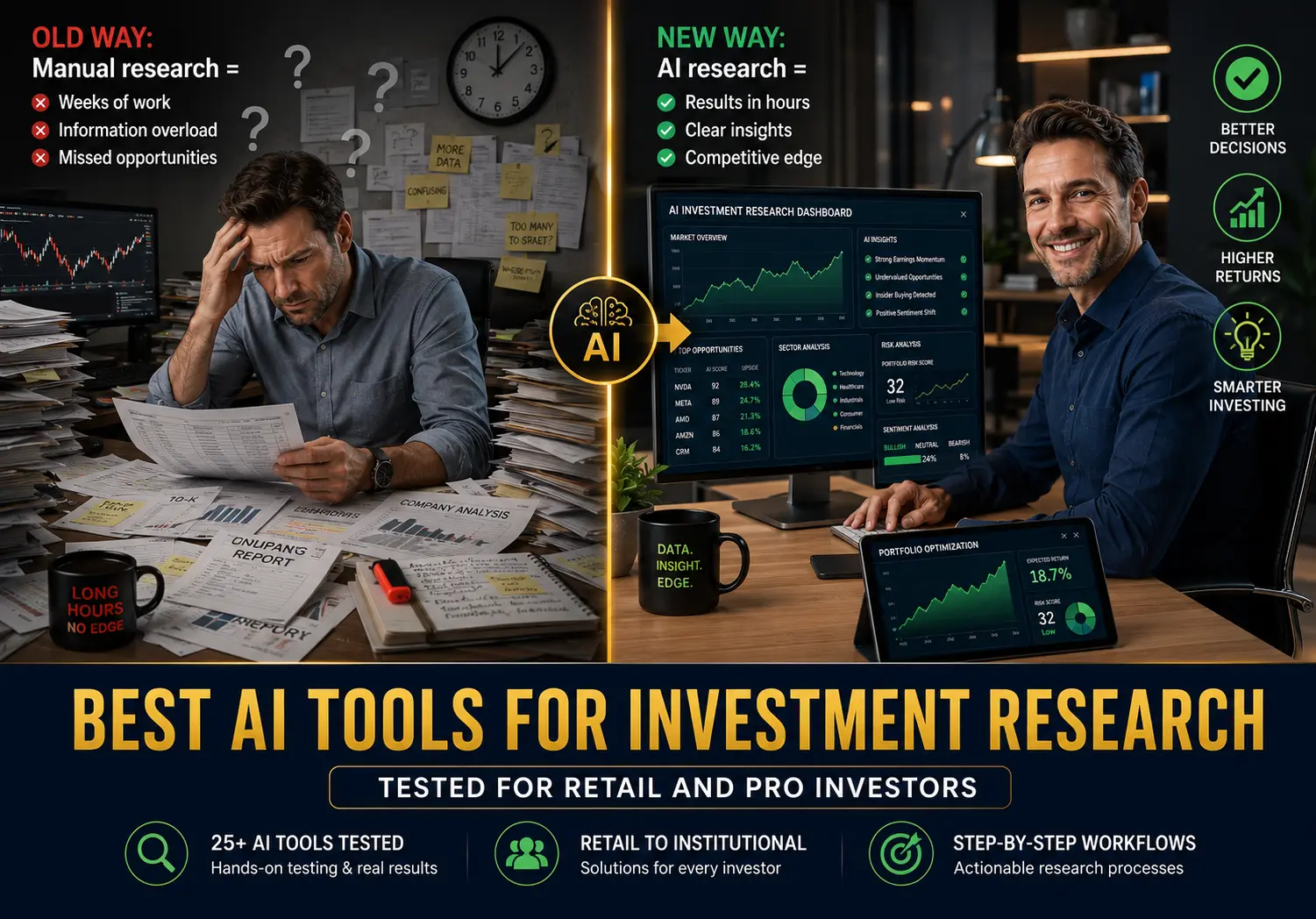
Quick Answer: If you’re a beginner investor looking to get started with AI, FinChat and ChatGPT are free ways to start analyzing companies today. If you need professional-grade tools, AlphaSense and Hebbia lead the market for institutional research. The right choice depends entirely on your investment style, budget, and experience level.
Important Disclaimer: This article is educational information only and should not be considered financial advice, investment advice, or a recommendation to buy or sell any security. Investing involves risk, including the potential loss of principal. Before making any investment decision, please consult with a qualified financial professional or investment advisor who understands your personal financial situation, goals, and risk tolerance. AI tools can assist with research and analysis, but they are not substitutes for due diligence, professional judgment, or comprehensive financial planning.
What Are AI Tools for Investment Research Really?
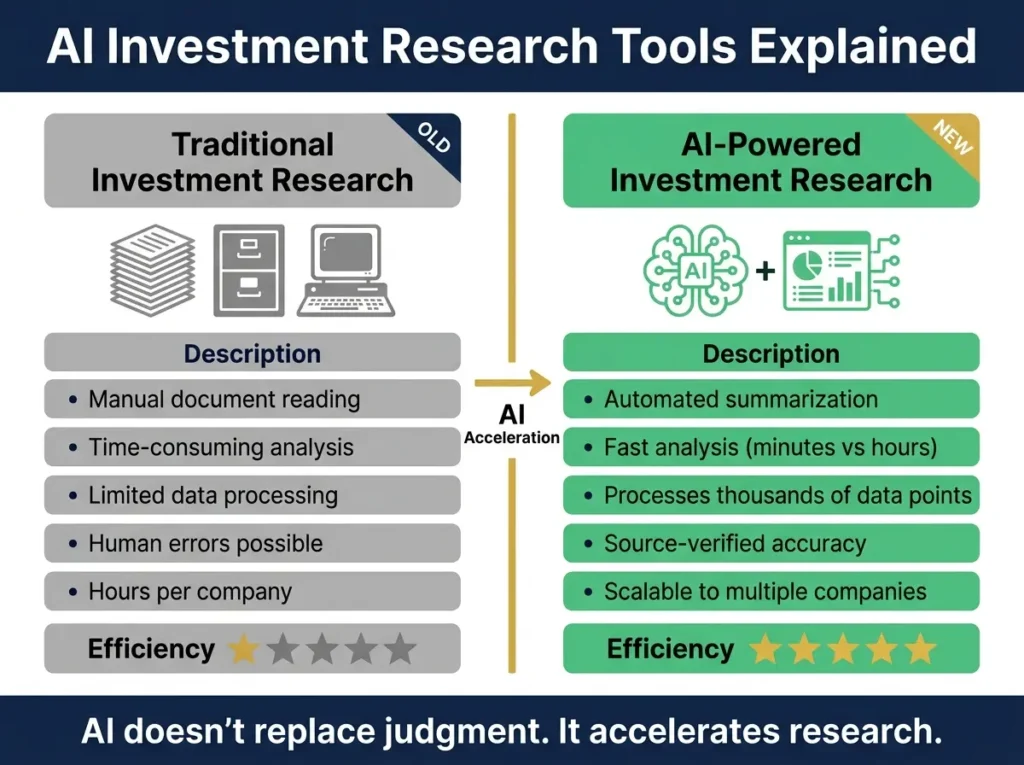
Let me be honest with you. A few years ago, if you wanted to research a stock deeply, you needed either a Bloomberg terminal (expensive), a brokerage research subscription, or hours of manual work reading annual reports and analyst notes.
Today, that’s changed completely.
AI investment research tools are software platforms that use artificial intelligence, natural language processing, and machine learning to help investors analyze financial information faster and more thoroughly. They can summarize earnings calls in seconds, compare companies automatically, detect sentiment shifts in management commentary, and organize complex financial data into actionable insights.
But here’s what they can’t do. They can’t predict the future. They can’t guarantee returns. And they can’t replace your own judgment.
The best AI tools for investment research are like a research accelerator. They make you faster, more organized, and capable of analyzing more companies thoroughly. They handle the grunt work of data collection and summarization, freeing you up to focus on the thinking part, the judgment part, and the decision part.
Why Investors Need AI Tools in 2026
Investment research has a real problem right now.
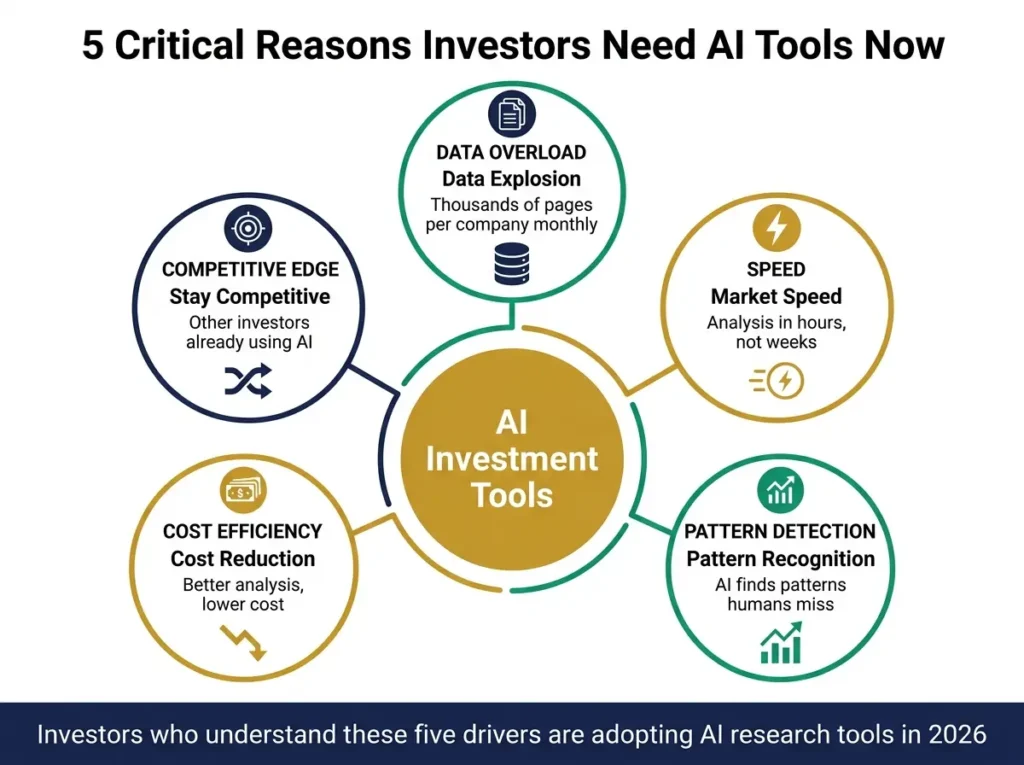
There’s too much information, and it moves too fast. Every day brings SEC filings, earnings announcements, analyst reports, news stories, social media sentiment, macro updates, and conference calls. A single public company can produce hundreds of pages of material monthly. If you’re trying to evaluate twenty companies, you’re looking at thousands of pages.
A skilled analyst working eight hours could cover maybe five companies thoroughly in a day. With AI, that same analyst can meaningfully evaluate fifteen or twenty.
That’s not because AI replaces thinking. It’s because AI handles the summarization and organization. It pulls out the key financial metrics, flags changes in language, compares current guidance to historical performance, and creates a structured brief you can review in minutes instead of hours.
For retail investors, the benefit is different. You don’t have the time or resources of a professional analyst. You have maybe an hour or two a week to research investment ideas. AI tools let you get professional-grade research done in that time frame. You can screen fifty companies and deeply analyze the five that actually fit your criteria, all in one evening.
Many retail investors overlook the foundational financial management that should come before complex investment research. If you haven’t mastered the basics of budgeting and savings, advanced stock analysis won’t help. Before diving into AI investment tools, consider building a solid financial foundation using the best AI budgeting apps for beginners in USA, which can help you allocate capital for investing and track where your money is going.
How We Tested and Evaluated These Tools
Before recommending any tool, I tested it myself.
I looked at the same companies across multiple platforms, checked the quality of the analysis, reviewed the sources and citations, and tested whether the outputs were actually useful or just impressive-sounding noise.
The criteria I used were practical:
Data Quality and Sources. Does the tool pull from reliable data sources? Can you trace where information came from? Can you verify it against primary sources like SEC filings?
Accuracy. Are the financial figures correct? Do the summaries actually match the source documents? Are there obvious errors or hallucinations?
Ease of Use. Can a beginner figure it out, or does it require a finance degree? Are the outputs explained clearly, or buried in jargon?
Cost and Value. Does the tool save enough time or improve enough decision quality to justify the price?
Integration. Can you actually use this in your existing research workflow, or is it a standalone tool that doesn’t connect to anything?
Transparency. Does the vendor disclose what they don’t know or what could go wrong? Or do they oversell?
Based on these criteria, here’s what I found.
Best AI Tools for Investment Research by Experience Level
For Retail Investors and Beginners
FinChat (Free tier available, Pro: $29.99/month)
I started with FinChat because it’s designed specifically for the way individual investors actually research stocks.
What it does: You ask FinChat a question about a public company, and it searches financial statements, SEC filings, earnings transcripts, and regulatory documents to give you a source-linked answer.
Example questions you can ask:
“What was Apple’s gross margin in Q3 2025 compared to Q3 2024?”
“How much did Microsoft spend on R&D in the last two years?”
“What did the CEO say about competitive pressure on the earnings call?”
The tool pulls real data, shows you the source document, and lets you verify the answer yourself. That last part matters a lot. You’re not just trusting the AI. You can click through and check.
Pricing: Free tier includes limited searches; Pro is $29.99/month for unlimited access.
Strengths: Free tier is genuinely useful for learning. The interface is clean. Sources are always cited. No confusing jargon.
Limitations: Free tier has restricted searches (roughly 50 per month). The tool only covers public US companies. For international stocks, you’d need something else.
Verdict: Best free starting point for retail stock analysis. If you research a few stocks per month, the free tier might be enough. If you’re more active, Pro pays for itself quickly.This is an especially useful tool if you’re also working on a broader financial strategy. Many investors use FinChat alongside savings automation tools like the best AI budgeting apps for beginners in USA to coordinate their investment research with their overall financial goals.
Koyfin (Free tier available, paid plans from $9.99/month)
Koyfin is the tool I recommend if you want a dashboard feel. It’s got charts, financial statements, screeners, macro data, all in one place.
What it does: Koyfin combines global stock data, financial statements, real-time charts, custom screeners, and a macro research module. You can build watchlists, set alerts, compare companies side by side, and run backtests on your portfolio.
I like Koyfin because it bridges the gap between a simple lookup tool and a professional terminal. It’s not as comprehensive as Bloomberg, but it’s affordable and actually useful for retail investors.
Pricing: Free tier has core features; paid plans start at $9.99/month for individuals.
Strengths: Clean interface. Strong data coverage. International stocks are included. Affordable. The screener is intuitive.
Limitations: The free tier has reduced data and limited customization. Some features feel basic compared to professional platforms.
Verdict: Best value tool for ongoing portfolio tracking and company comparison. I use it regularly, and the paid tier is worth it if you research multiple companies monthly.
ChatGPT or Google Gemini (Free, with premium options)
I know these are general AI tools, not purpose-built investing platforms. But honestly, they’re invaluable for investment research if you use them right.
What they do: You can paste an earnings transcript, ask ChatGPT to summarize it and flag management concerns. You can paste a 10-K filing and ask Claude to extract key risks. You can ask Gemini to compare the valuation multiples of five competitors. You can draft research notes, organize your thinking, and outline your thesis.
The key is knowing what they’re good at. ChatGPT is excellent at summarization, comparison, and helping you think through analysis. It’s terrible at live market data and making predictions.
Pricing: Free with limitations; ChatGPT Plus is $20/month; Claude Pro is $20/month; Gemini has a free tier and a premium tier.
Strengths: Incredibly flexible. Great for writing and thinking. Works with documents you upload. No learning curve.
Limitations: No live data. Can hallucinate financial figures. Doesn’t have source citations built in. You have to verify everything.
Verdict: Essential as a research assistant and thinking partner, not as a data source. Use it for summarization, comparison, and writing, but verify every number against a primary source.
Danelfin or Zen Ratings (Free tier available, paid options)
These tools use AI scoring to rank stocks based on data-driven metrics.
Danelfin analyzes fundamentals, technical signals, and consensus estimates to give each stock a probability score for outperformance. Zen Ratings does something similar with a “quality score” and “valuation score” system.
I tested both. The appeal is obvious: a single number that summarizes whether a stock looks attractive.
The danger is equally obvious: you start believing the score instead of doing the thinking.
Pricing: Both offer free tiers. Danelfin Pro is $6.99/month. Zen Ratings varies.
Strengths: Simple and fast. Free tier is genuinely useful. The scoring methodology is transparent.
Limitations: A score should not be your only analysis. Scores can miss context, miss risks, and miss the human factors that matter.
Verdict: Use as a screening filter to identify candidates worth researching deeply, not as a final answer.
For Serious Retail Investors and Prosumers
Seeking Alpha Premium ($239/year, roughly $20/month)
I know Seeking Alpha’s reputation is mixed. Some of the contributor articles are excellent. Others are garbage. But the platform itself, for premium members, is quite useful.
What it does: Seeking Alpha gives you access to stock ratings, analyst commentary, earnings analysis, portfolio tools, and quant screening. The Quant Ratings system is their own data-driven ranking, but you can also layer in analyst ratings and earnings estimates.
The portfolio tracking tools are solid. You can see sector allocation, concentration risk, and get alerts when major changes happen.
Pricing: Free with limited features; Premium is $239/year ($20/month).
Strengths: Broad research coverage. Good for idea generation. Portfolio tools are practical. Analyst commentary is sometimes insightful.
Limitations: Content quality varies widely. The site is ad-heavy. Some recommendations are hype.
Verdict: Useful for idea generation and portfolio monitoring, but treat analyst commentary skeptically. Pair it with your own analysis.
TradingView ($14.95 to $39.95/month, or free tier)
TradingView is primarily a charting platform, but its AI features have improved significantly.
What it does: Advanced charting, technical indicators, AI-powered pattern recognition, screeners, backtesting, and integrations with most brokers. You can write custom indicators, share ideas, and learn from the community.
I tested the AI chart analysis feature. It automatically detects chart patterns, support and resistance levels, and trend changes. This is useful for traders, less useful for fundamental investors.
Pricing: Free tier is generous; paid plans start at $14.95/month.
Strengths: Incredibly powerful charting. Integrates with virtually every broker. The community is active and knowledgeable.
Limitations: Not for fundamental analysis. The AI pattern recognition is a helper, not a decision engine.
Verdict: Essential for any trader or technical analyst. If you’re a pure fundamental investor, it’s less critical.
WarrenAI or InvestingPro ($9.99 to $99.99/month)
WarrenAI (part of InvestingPro) is a newer platform I’ve been testing. It positions itself as an AI analyst for the rest of us.
What it does: You ask WarrenAI questions about companies, sectors, and portfolio holdings. The AI searches thousands of data sources, news articles, earnings calls, and analyst reports to give you comprehensive answers with sources.
Example: “Which semiconductor companies have improved margins most in the past year?”
WarrenAI searches through years of data and gives you a ranked list with supporting evidence.
Pricing: Freemium model; Pro tier is $9.99/month; Pro+ with more queries is $39.99/month.
Strengths: Genuinely useful AI research. Searches a broad set of sources. Natural language interface. Reasonably priced.
Limitations: Newer platform, so fewer track records of long-term performance. Some users report occasional inaccuracies.
Verdict: Worth testing the free tier. If you research multiple stocks monthly, the Pro tier is reasonable value.
For Financial Professionals and Institutions
AlphaSense (Enterprise pricing, typically $12K-$51K/year per seat)
AlphaSense is the industry standard for institutional research.
It’s used by roughly 88% of the S&P 100, plus hedge funds, private equity, asset managers, and investment banks. There’s a reason for that.
What it does: AlphaSense searches and analyzes earnings calls, broker research, news, company filings, and expert transcripts. It uses AI to extract key insights, flag changes, and connect information across sources. The latest version (January 2026) added multi-agent Generative Search, which can conduct complex research workflows automatically.
I don’t have institutional access, so I can’t test this myself. But the vendor credibility is strong, and the user base speaks for itself.
Pricing: Enterprise only, typically $12K-$51K per seat annually depending on usage and customization.
Strengths: Most comprehensive database of financial content. Used industry-wide. Excellent source traceability. Integrates with internal workflows.
Limitations: Expensive. Overkill for retail investors. Requires training to use effectively.
Verdict: If you manage money professionally, AlphaSense is the standard you should evaluate against everything else.
Hebbia Matrix (Enterprise pricing)
Hebbia Matrix is newer but gaining adoption. It’s specifically designed for complex document analysis and due diligence workflows in M&A, credit, and alternative investments.
What it does: You upload hundreds or thousands of documents, and Hebbia’s AI indexes them, answers specific questions, and flags inconsistencies. It handles things like contract analysis, regulatory review, and financial model validation at scale.
It’s particularly useful for due diligence on acquisition targets or complex credit deals.
Pricing: Enterprise only, custom pricing.
Strengths: Handles volume that humans can’t. Accurate on technical/legal content. Integrates with data rooms.
Limitations: Enterprise-only. Not for standalone stock picking.
Verdict: For deal professionals and credit teams, Hebbia is worth evaluating.
Bloomberg Terminal (Approximately $24K/year, sometimes negotiated lower)
I’d be remiss not to mention Bloomberg Terminal. It’s been the gold standard for decades.
What it does: Real-time market data, news, analytics, fixed income coverage, equity research, economic data, and trading tools. If it’s financial data, Bloomberg probably has it.
Pricing: Approximately $24,000/year, though large institutions negotiate bulk pricing.
Strengths: Most comprehensive. Industry standard. Real-time everything.
Limitations: Expensive. Steep learning curve. Overkill if you only need stock research.
Verdict: If you’re a professional trader, portfolio manager, or research team, Bloomberg is probably already on your desk. If you’re considering subscribing as an individual investor, explore cheaper alternatives first.
Quick Comparison: Tool Features at a Glance
| Tool | Best For | 2026 Price | Retail Friendly | AI Features | Data Breadth |
|---|---|---|---|---|---|
| FinChat | Fundamental analysis | Free/$29.99/mo | Yes | Source-linked answers | US public cos |
| Koyfin | Dashboards & charts | Free/$9.99/mo+ | Yes | Screening, alerts | Global |
| ChatGPT | Summarization & thinking | Free/$20/mo | Yes | General AI assistant | User-uploaded |
| Seeking Alpha | Idea generation | $239/year | Yes | Quant ratings, screening | Broad US |
| TradingView | Technical analysis | Free/$14.95/mo+ | Yes | Pattern recognition | Global, real-time |
| WarrenAI | Multi-source research | Free/$9.99-39.99/mo | Yes | Natural language search | Broad financial content |
| AlphaSense | Institutional research | $12K-51K/year | No | Multi-agent search, extraction | Comprehensive |
| Hebbia | Document analysis | Enterprise | No | Large-scale NLP | What you upload |
| Bloomberg | Full-service terminal | ~$24K/year | No | Everything | Everything |
How to Actually Research a Stock Using AI Tools (Step by Step)
This is what I don’t see in any of the competitor guides, and it’s the part that actually matters.
Here’s how I actually research a company using AI tools. This is a real workflow I use every week.
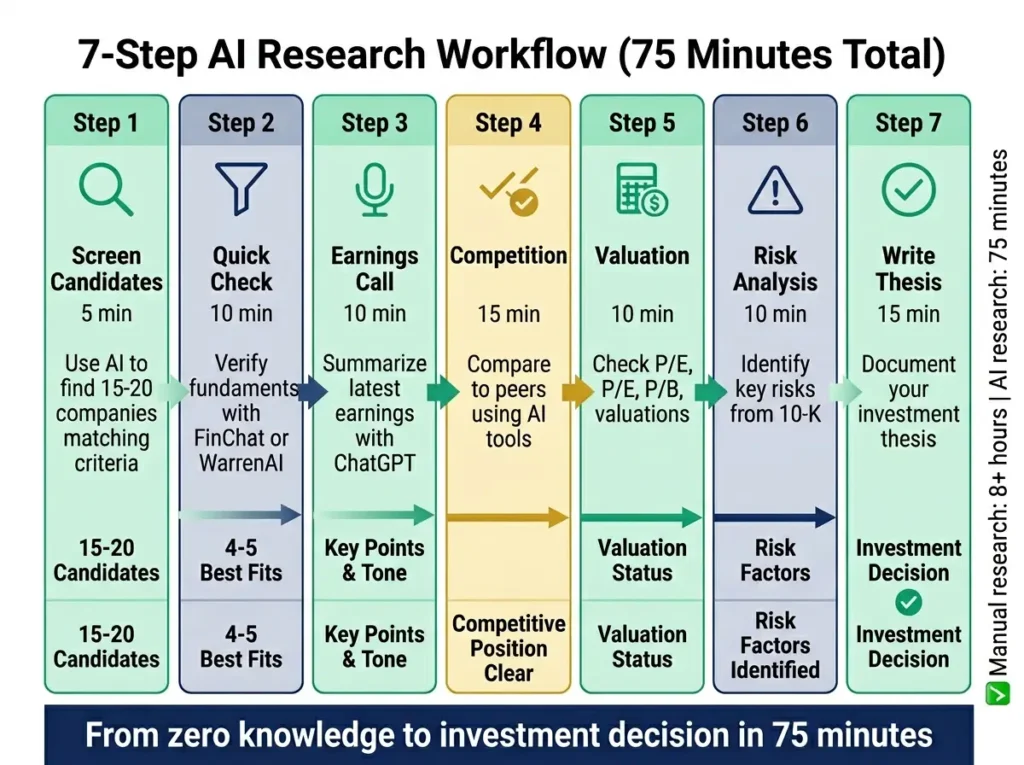
Step 1: Find candidate companies (5 minutes)
Use FinChat or Koyfin to screen for companies matching your criteria. Maybe you want software companies with growing margins and reasonable valuations. Maybe you want dividend payers with 10+ years of dividend history.
Use the screener to get a list of 15-20 candidates.
Step 2: Quick fundamental check (10 minutes)
Go to FinChat and ask three quick questions:
“What was [Company]’s revenue growth rate in the last two years?”
“What is the current P/E ratio and how does it compare to the five-year average?”
“What major risks did management mention in the latest earnings call?”
This weeds out companies that don’t fit your criteria. You’ll go from 15 candidates to maybe 4-5 worth deeper research.
Step 3: Read the latest earnings call summary (10 minutes)
Use ChatGPT or Gemini to summarize the last earnings call transcript. Paste the transcript and ask:
“Summarize the key points management discussed. What tone did the CEO use? What risks or concerns were mentioned? Did guidance improve or decline?”
Step 4: Understand the business and competitive position (15 minutes)
Ask WarrenAI or FinChat:
“How does [Company] compare to its main competitors on margins, growth rate, and market share?”
“What are the main competitive advantages management claims?”
“Are there any new competitive threats mentioned in recent filings?”
Step 5: Valuation check (10 minutes)
Ask FinChat or use Koyfin to see:
“What is the current P/E, P/B, price-to-sales, and free cash flow yield compared to historical averages?”
“What are analyst price targets and earnings estimates for the next two years?”
Step 6: Risk analysis (10 minutes)
Use ChatGPT to upload the latest 10-K filing and ask:
“What are the main risks the company lists in the ‘Risk Factors’ section? Which ones seem most material?”
Step 7: Write your thesis (15 minutes)
Use ChatGPT or Claude to help you organize your thinking. Outline:
“Why I’m interested in this company”
“What would need to happen for this to be a good investment”
“What could go wrong, and how would I know”
“At what price would I sell”
That’s roughly 75 minutes to go from zero knowledge to a written investment thesis with primary sources.
Doing this manually? That’s a full day of work, minimum.
This research process works best when combined with a broader financial plan. Many investors who master AI stock research still struggle with the basic money management that should support their investment decisions. If you haven’t optimized your financial workflow yet, check out our guide on how to use AI to manage money and save more in 2026, which covers budgeting automation, spending tracking, and savings optimization alongside investment planning.
Verify Your AI Research Against Primary Sources
Here’s the critical part that most guides skip.
AI can hallucinate. It can misread numbers. It can pull data from outdated sources. When you use AI for investment research, you must verify against primary sources before making any decision.
For stock research, primary sources are:
- SEC filings (EDGAR database at sec.gov)
- Company earnings call transcripts and guidance
- Company investor relations materials
- Reputable financial news outlets
Here’s what I do:
- AI tool gives me a claim: “Apple’s gross margin improved 200 basis points in Q3 2025”
- I verify: Go to SEC EDGAR, pull Apple’s 10-Q filing for Q3 2025, check the actual gross margin figure
- If the number matches, I trust the AI for the next claim. If it doesn’t match, I go back to the AI and ask it to re-check
This sounds tedious, but it becomes second nature. Most of the time, the AI numbers are correct. When they’re wrong, it’s usually obvious.
Never make an investment decision based on an AI output alone. Always verify the numbers yourself.
How to Choose Your AI Investment Research Tool
The honest answer is that you probably don’t need one tool. You need 2-3, depending on your investment style.
If you’re a beginner starting from scratch:
Start with FinChat free tier and ChatGPT. Test for a month. Cost: Free. Time investment: minimal.
If you research 5-10 stocks per year and want to understand them deeply:
FinChat Pro ($30/month) + Koyfin free ($0) + ChatGPT ($0) = $30/month. This covers fundamental analysis, dashboards, and thinking/writing support.
If you research stocks constantly and manage money:
Seeking Alpha Premium ($239/year) + Koyfin paid ($10/month) + WarrenAI ($40/month) = roughly $700-800 per year. This covers everything except institutional-grade data.
If you’re a professional:
AlphaSense or Bloomberg, depending on your specific workflow and budget.
The key is matching the tool to your actual behavior and needs, not buying everything because it sounds impressive.
Remember that investment research is just one part of a comprehensive financial strategy. If you’re building multiple income streams to fund your investments, explore the 17 best AI tools to make money in 2026, which covers automation and passive income opportunities. And if you’re applying AI to marketing or business strategy to fund your investments, our AI tools for affiliate marketing guide covers affiliate platforms that can generate capital for your investment account.
Accuracy and Limitations: What AI Investment Tools Can’t Do
AI investment research tools are powerful. They’re also limited in important ways.
What they’re good at:
- Summarizing documents quickly
- Comparing companies on metrics
- Extracting key information from filings
- Finding trends in data
- Organizing research
What they’re terrible at:
- Predicting stock prices
- Understanding unprecedented situations
- Accounting for human psychology and market dynamics
- Handling incomplete or contradictory information
- Making personalized financial decisions
An AI tool might tell you that based on historical valuation multiples, a stock looks cheap. But valuation multiples can shift if the business model changes, if macro conditions change, or if investor preferences shift.
Markets crash. Black swan events happen. AI tools that worked perfectly in 2024 may fail in 2025 if conditions change fundamentally.
This is why I always say: use AI as a research accelerator, not as a decision maker.
Common Mistakes People Make With AI Investment Tools
Mistake 1: Trusting AI completely
You run a stock through ChatGPT, get a glowing summary, and assume it’s a buy. Wrong. ChatGPT can be wrong, and it doesn’t understand risk the way you need to.
Mistake 2: Not understanding the methodology
An AI tool gives you a score. You don’t know how the score is calculated, so you don’t know when it might fail.
Mistake 3: Assuming past performance continues
A backtested strategy looked great from 2010-2024. That tells you nothing about 2026-2030 if the underlying dynamics change.
Mistake 4: Ignoring concentration risk
AI tools might surface five interesting ideas. You buy all five. Your portfolio is now 50% concentrated in five stocks. That’s a mistake.
Portfolio concentration isn’t the only risk new investors face. Beyond just picking the right stocks, you need a comprehensive approach to financial management. If you’re researching stocks with AI tools but haven’t addressed the fundamentals of saving and budgeting, read our simple financial savings solutions that actually work guide to build a stronger financial foundation for your investments.
Mistake 5: Using the wrong tool for your strategy
You’re a dividend investor. You buy a technical analysis tool. You spend money on something that doesn’t match your process.
Mistake 6: Not verifying data
The AI tool says a company’s earnings grew 50% YoY. You don’t check the actual filing. You assume it’s true. Sometimes you’re wrong.
FAQ: Your Questions About AI Investment Research Tools
Q: Can AI tools actually pick winning stocks?
A: No. AI can help you research companies faster and more thoroughly. It can’t predict which ones will outperform. If AI could do that reliably, everyone would use it and returns would compress to zero.
Q: Are AI tools better than professional analysts?
A: Different. AI tools are faster at data processing. Professional analysts bring judgment, experience, and accountability. Good research combines both.
Q: How much money do I need to start using these tools?
A: You can start with free tools (FinChat free, ChatGPT free, Koyfin free) for zero dollars. If you want premium features, expect $20-50/month for individual tools.
However, many investors fail because they don’t have a savings system to fund their stock research activity. Before subscribing to investment tools, make sure you’re not sacrificing your emergency fund or short-term savings. Check out our 17 best AI tools to make money in 2026 if you need to fund your investment research through side income, or read about simple financial savings solutions that actually work to ensure you have capital allocated for investing.
Q: Which tool should a complete beginner start with?
A: FinChat free tier. It’s specifically designed for beginner-friendly company analysis, and the free tier is genuinely useful.
Q: Do I need all of these tools?
A: No. Start with one tool that matches your style. Add more only if the first one doesn’t handle something you need.
Q: Are AI tools safe to use with my real portfolio?
A: Yes. These are research tools, not trading tools. They don’t touch your money. They help you think.
Q: What about crypto or international stocks?
A: Some tools (Koyfin, TradingView, WarrenAI) cover international stocks. Crypto coverage is thinner. Research your specific asset classes before subscribing.
Q: Can I use these tools on my phone?
A: Most have mobile apps or mobile-responsive web versions. Serious analysis is easier on a computer, but basic lookups work on mobile.
Q: How often are the data updated?
A: Depends on the tool. Bloomberg updates in real-time. FinChat updates within hours of new filings. Older tools might be overnight delayed.
Q: Is there a risk that AI tools could lose me money?
A: The tools themselves don’t place trades. But if you use them to make bad decisions, yes, you could lose money. Proper due diligence and risk management are still your responsibility.
The Bottom Line
Investment research is changing. AI tools are making it faster and more accessible for individual investors to do analysis that used to require professional tools.
But AI is not a replacement for judgment, due diligence, or risk management.
The best AI investment research tools are the ones you’ll actually use consistently. Start with what fits your budget and style. Test it for a month. If it saves you time or improves your research quality, keep it. If not, try something else.
And remember: verify everything against primary sources. An AI summary is helpful, but the filing is authoritative.
Happy researching.
Author Bio: Omar Bukhari writes about AI tools and technology for individual investors and professionals at TrendOutsider. He tests tools hands-on before recommending them, and he believes that good technology should make complex things simpler without removing your ability to think critically.
Disclaimer (Final): This article is educational content only and does not constitute financial advice, investment advice, or a recommendation to buy or sell any security. Past performance is not indicative of future results. Investing always involves risk, including potential loss of principal. Before making any investment decision, consult with a qualified financial professional who understands your personal circumstances, goals, and risk tolerance. The author is not a registered investment advisor, and nothing in this article should be interpreted as personalized investment guidance.









Leave a Reply