
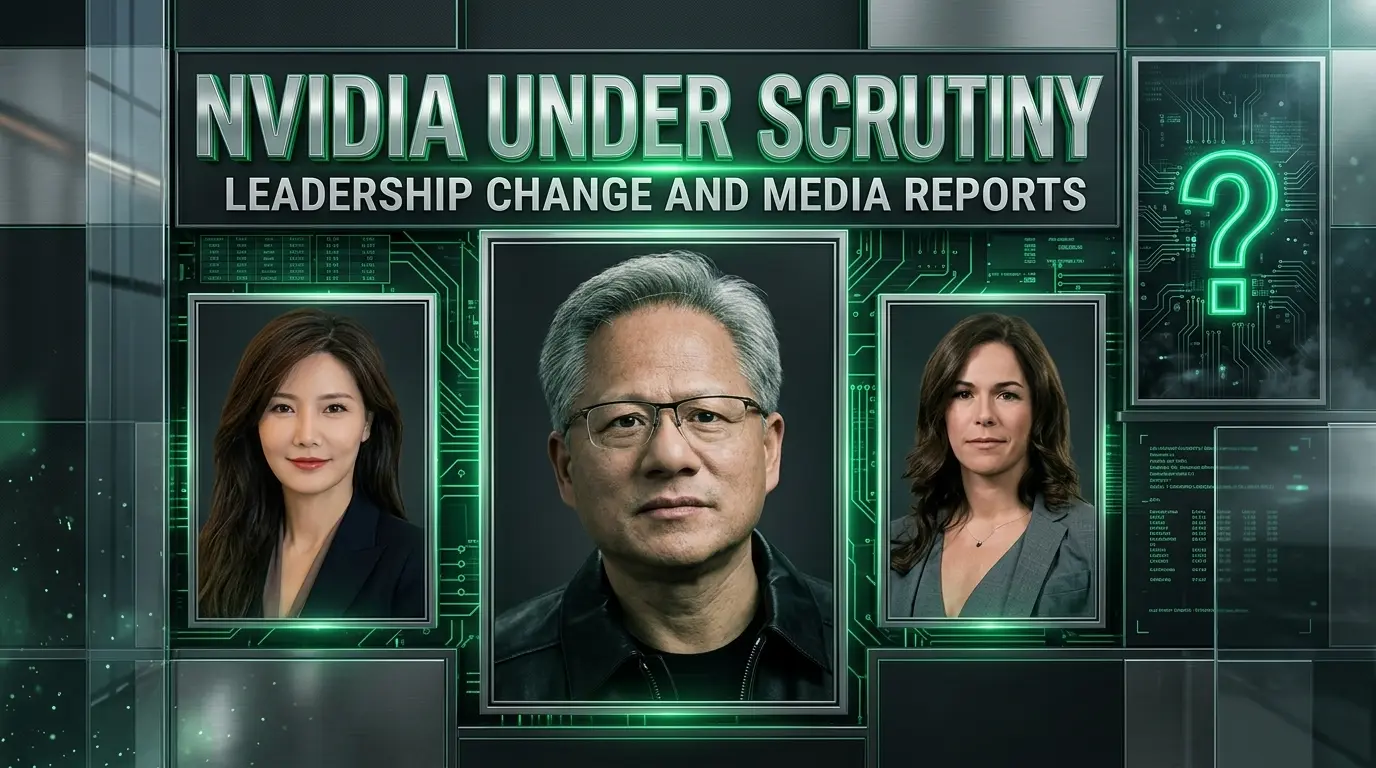
Jensen Huang spent more than three decades turning Nvidia from a graphics chip company into one of the most influential businesses in artificial intelligence. In a matter of days, his personal conduct, questions about national security and growing scrutiny of Nvidia’s leadership brought that extraordinary tenure to an abrupt end.
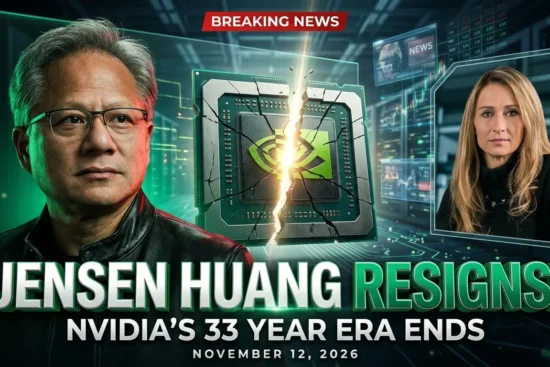
On November 12, Nvidia announced that Huang had resigned as president, chief executive officer and a member of its board. Chief financial officer Colette Kress has taken over as interim CEO while the company searches for a permanent successor.
The announcement followed Huang’s public admission of infidelity and reports concerning his relationship with Alice Huang, a business executive whom US intelligence authorities reportedly suspect of having connections to Chinese intelligence.
Then came another development. Reuters reported that Huang had also been involved with a second Nvidia employee, following separate reporting about a relationship with senior executive Kimberly Powell.
The result is no longer simply a story about a prominent technology executive’s private life. It is a test of corporate governance, executive accountability and the security arrangements surrounding a company whose processors are central to the global AI industry.
Here is what has been officially confirmed, what major news organizations have reported, and what remains unresolved.
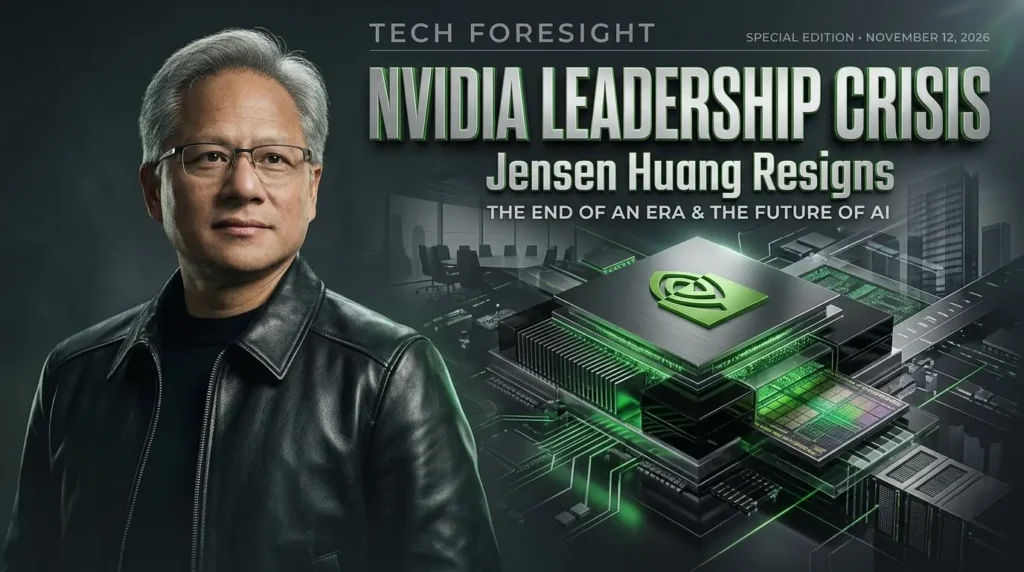
Jensen Huang resigns as Nvidia CEO: The latest developments
The most consequential development is no longer in dispute.
According to Nvidia’s official November 12 announcement, Huang resigned from his executive and board positions. The company’s Form 8-K filed with the US Securities and Exchange Commission specifies that the board accepted his resignation on November 11, effective immediately.
That filing is particularly important because it establishes the formal leadership change independently of the surrounding news coverage.
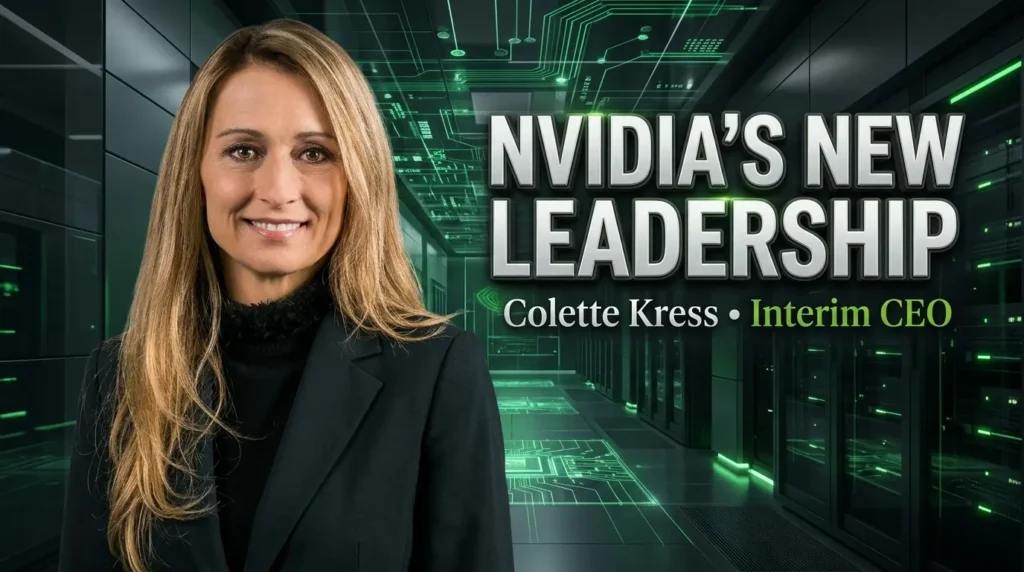
Nvidia appointed Colette Kress, its chief financial officer since 2013, as interim CEO. She will continue serving as CFO while the board considers permanent candidates from inside and outside the company.
Harvey C. Jones, a longtime Nvidia director, was appointed chair of the board.
The company has not identified a permanent successor or published a final conclusion from its independent investigation.
Nor does the SEC filing provide a detailed legal explanation for Huang’s departure. The resignation followed intense scrutiny of his reported relationships and potential security concerns, but the official document should not be treated as proof of every allegation made during the controversy.
That distinction is central to understanding the story.
What happened? The Jensen Huang scandal explained
The controversy developed around two separate questions.
The first concerns Huang’s personal conduct and reported relationships.
The second concerns allegations that a woman linked to him may have been connected to a foreign intelligence operation involving one of America’s most strategically important technology companies.
These questions overlap, but they are not interchangeable.
On November 8, Nvidia published a personal message from Huang in which he acknowledged being unfaithful to his wife and apologized to his family, colleagues and shareholders.
He accepted responsibility for his conduct and said he would cooperate with an independent investigation.
He did not identify the person involved in the relationship in that statement, nor did the apology establish that confidential company information had been disclosed.
On the same day, Nvidia’s board announced an independent investigation into reports that its chief executive had been targeted by a foreign intelligence effort.
At the time, the board expressed confidence in Huang and said it had no reason to believe national security or Nvidia secrets had been compromised.
Four days later, Nvidia announced that its co-founder was leaving.
The speed of that reversal helps explain why the controversy has become a much larger corporate story.
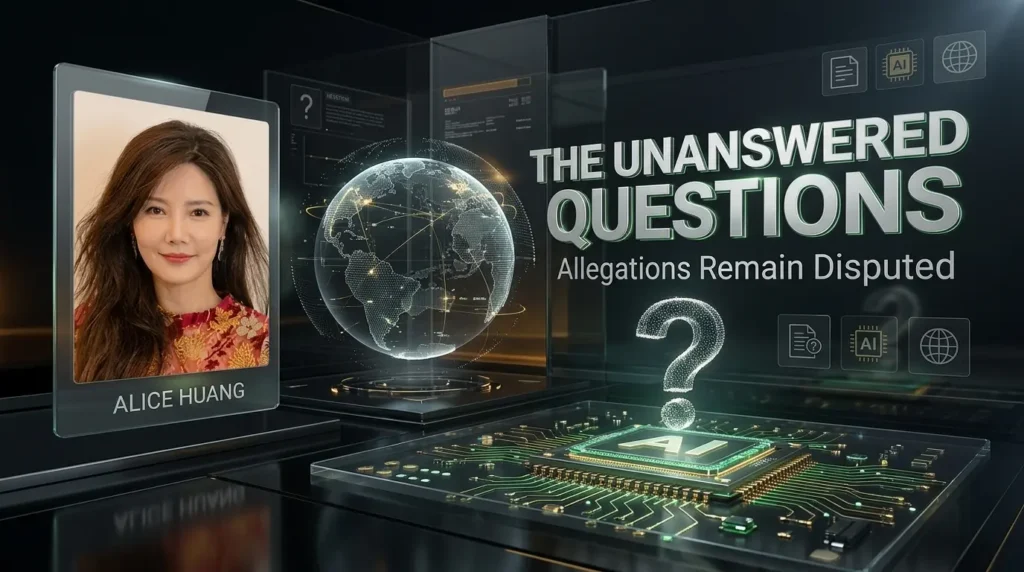
Alice Huang: The relationship and disputed intelligence allegations
Alice Huang, also identified as Huang Le in some reporting, is a businesswoman associated with Singapore-based technology infrastructure company Megaspeed International.
Her reported relationship with Jensen Huang attracted attention because of allegations concerning possible Chinese intelligence connections and access to sensitive technology.
The two share a surname but are not related.
Reporting by major news organizations, including CBS News and Channel NewsAsia, describes US intelligence concerns involving Alice Huang.
But those reports must be read carefully.
An intelligence suspicion is not a criminal conviction. A reported relationship is not proof that confidential information changed hands. And a company’s commercial access to Nvidia hardware does not, by itself, establish an export-control violation.
China has denied the espionage allegations.
Nvidia’s original board statement also said the company had no reason at that stage to believe its secrets had been compromised.
That statement was a preliminary position, not a published final investigative finding.
Readers who want the earlier chronology, Megaspeed background and original intelligence allegations can consult TrendOutsider’s detailed Jensen Huang and Alice Huang investigation explainer.
Why Megaspeed matters
Megaspeed became part of the reporting because it operates in a sector where advanced computing hardware has both enormous commercial value and strategic importance.
Nvidia processors are used to train and operate sophisticated AI systems. They are also subject to US export controls that vary by product, destination, end user and applicable licensing requirements.
The concern raised by reporting is whether business relationships and intermediary companies could have created routes for restricted technology to reach unauthorized recipients.
That is a question for evidence, regulators and investigators, not something that can be settled by the existence of a personal relationship.
The distinction matters because an allegation about chip diversion, an allegation about intelligence activity and an allegation about executive misconduct each require different forms of proof.
Kimberly Powell and the second reported relationship
The controversy expanded on November 11 when The New York Times reported another relationship involving Huang and Kimberly Powell, a senior Nvidia executive.
Powell has been identified in subsequent Reuters reporting as Nvidia’s vice president of healthcare.
This development introduced a different set of governance questions.
A relationship involving a chief executive and a company employee can raise concerns about reporting lines, disclosure obligations, conflicts of interest and whether the organization has effective policies for addressing potential imbalances of power.
Those concerns do not establish that Powell committed wrongdoing or that any particular company policy was violated.
The precise circumstances, including any internal disclosures or findings, have not been publicly established in the official documents reviewed for this article.
Reuters later referred to the reported Powell relationship in its coverage of Huang’s resignation.
Importantly, Powell should not be confused with Colette Kress, the executive now serving as Nvidia’s interim CEO.

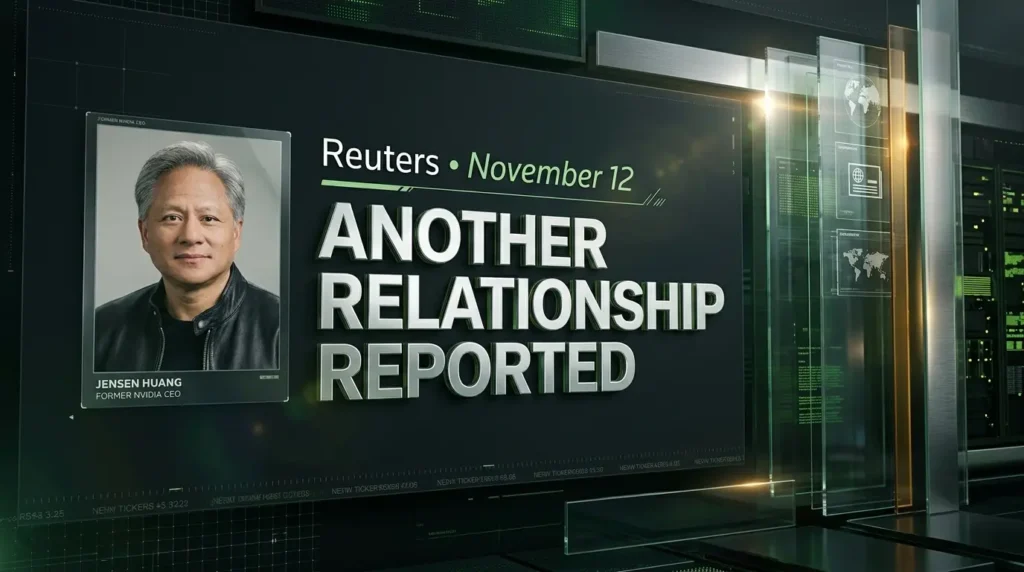
Reuters reports another relationship involving an unnamed Nvidia employee
On November 12, Reuters published an additional report that broadened the controversy.
Citing two people familiar with the matter, the news agency reported that Huang had an intimate relationship with another Nvidia employee.
This was separate from the previously reported relationship involving Kimberly Powell.
Reuters did not identify the employee and reported that attempts to contact her had been unsuccessful.
The agency also said Nvidia declined to comment, while requests for comment to other people involved had not produced responses at the time of publication.
The distinction between the reported relationships is important.
Based on the reporting available as of November 13, the public controversy involves:
- The relationship reported with Alice Huang, whose alleged intelligence connections remain disputed.
- The separately reported relationship involving Nvidia executive Kimberly Powell.
- Reuters’ report of a further relationship involving an unnamed Nvidia employee.
These are three reported relationships, but Huang’s November 8 public apology did not independently identify or confirm each person.
The additional Reuters report is significant because it widens the corporate governance questions facing Nvidia. It does not, on its own, establish coercion, illegal conduct, misuse of company resources or a breach of confidential information.
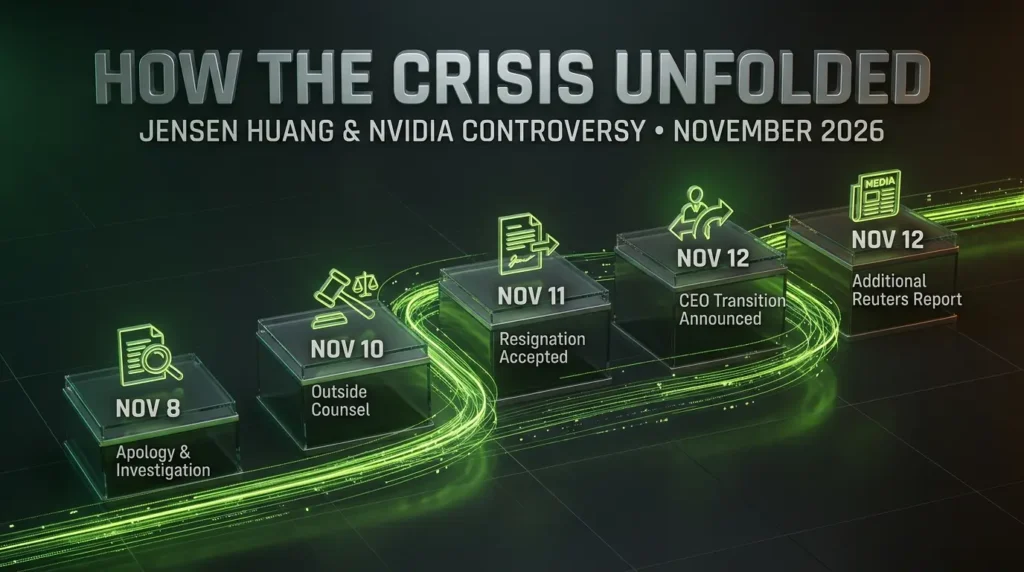
Jensen Huang scandal timeline: How the crisis unfolded
The sequence of events helps explain why the story escalated so quickly.
| Date | Development |
|---|---|
| October 29, 2026 | Major reporting brings intelligence concerns involving Alice Huang and Nvidia into public view. |
| November 8 | Huang publicly acknowledges infidelity. Nvidia’s board announces an independent investigation into reports of a foreign intelligence effort. |
| November 9 | The controversy attracts further political attention and public questions about the intelligence allegations. |
| November 10 | Nvidia’s independent directors announce that they have retained outside legal counsel for the investigation. |
| November 11 | The New York Times reports a separate relationship involving Kimberly Powell. Nvidia’s board accepts Huang’s resignation, according to its later SEC filing. |
| November 12 | Nvidia publicly announces Huang’s departure and appoints Colette Kress interim CEO. |
| November 12 | Reuters reports another relationship involving an unnamed Nvidia employee. |
| November 13 | Nvidia faces a leadership search while the independent investigation remains unresolved in the public materials reviewed. |
The chronology also shows why older articles can quickly become misleading.
As recently as November 8, Nvidia’s board had expressed confidence in Huang’s leadership. By November 12, the company had announced a transition.
The company has not publicly explained every step of its internal deliberations, so the timeline should not be used to invent motives or private conversations.
Nvidia’s independent investigation: What is actually being examined?
Nvidia’s board announced its investigation on November 8, specifically in response to reporting that Huang may have been targeted by a foreign intelligence effort.
The review is overseen by independent directors and assisted by outside counsel.
On November 10, the independent directors announced that they had retained former acting US Attorney Joon H. Kim and the law firm Wachtell, Lipton, Rosen & Katz to conduct the investigation.
That appointment demonstrates the seriousness of the review, but hiring investigators is not equivalent to establishing that a security breach occurred.
Several questions remain relevant:
- Was any confidential Nvidia information accessed or disclosed without authorization?
- Were the company’s security procedures followed?
- Did relevant business relationships create conflicts of interest?
- Were any export restrictions violated by parties involved in reported chip transactions?
- What information did Nvidia’s leadership and board possess at different stages?
- Will the investigation result in findings, corrective actions or additional disclosures?
These are investigative questions, not established conclusions.
The public should also distinguish the company’s internal inquiry from any separate government investigation or congressional scrutiny. Different authorities have different responsibilities, and one investigation’s existence does not determine another’s outcome.
Why the allegations raise questions about AI chip security
Nvidia’s position in the AI industry makes the security dimension especially consequential.
Its hardware supports advanced model training, inference, cloud infrastructure and data centers used by technology companies, research organizations and governments.
For perspective, TrendOutsider’s coverage of Google’s Gemini 4 Carbon and its advanced reasoning capabilities illustrates how increasingly sophisticated AI systems depend on powerful computing infrastructure.
That dependence makes the supply of advanced chips an important economic and geopolitical issue.
The United States has imposed restrictions on certain advanced semiconductor exports, particularly where officials believe the technology could contribute to military or intelligence capabilities.
However, those restrictions are specific. They do not mean every Nvidia transaction involving China is prohibited.
The legal questions depend on the particular chips, entities, destinations, authorizations and transactions involved.
In this case, the reporting has raised concerns about potential links between personal relationships, commercial intermediaries and sensitive technology.
It has not established that Huang knowingly transferred restricted chips or provided classified information to China.
A responsible account must keep those limits visible.

Who is Colette Kress, Nvidia’s new interim CEO?
Colette Kress is not an outsider brought in to rescue an unfamiliar business.
She has served as Nvidia’s chief financial officer since September 2013, overseeing its finances during a period of dramatic expansion.
Before joining Nvidia, she held finance roles at major technology companies including Cisco and Microsoft.
Nvidia’s November 12 announcement says she will remain CFO while serving as interim CEO.
Harvey C. Jones, meanwhile, has become the company’s first board chair.
The board says it will consider both internal and external candidates for the permanent chief executive position.
According to Reuters’ profile of Kress, she has previously served as an important financial counterweight to Huang’s ambitious investment decisions.
That experience may be useful during the transition, but it does not eliminate the challenge of replacing a founder whose influence extended across product strategy, partnerships, engineering culture and public communication.
Can Nvidia continue without Jensen Huang?
Nvidia has an established management team, major customer relationships and extensive engineering capabilities.
Those assets do not disappear because its chief executive changes.
Nevertheless, Huang’s leadership was unusually closely associated with the company’s identity. Investors will now examine how decisions are made, whether strategic priorities change and how effectively the interim team communicates with customers and shareholders.
The company has said it expects operations, commitments and its technology roadmap to continue without interruption.
That is Nvidia’s stated expectation. The longer-term outcome remains to be seen.
What does Jensen Huang’s resignation mean for Nvidia stock and the AI industry?
Investors reacted sharply to the leadership announcement.
The Guardian reported that Nvidia shares closed down approximately 4.3% on November 12 after a much steeper decline earlier in the trading session.
That movement reflects the market’s immediate reaction to a significant event. It does not isolate the financial effect of any one allegation, nor does it establish what the company will be worth months from now.
There are several reasons the transition matters.
Leadership continuity
Nvidia must demonstrate that its strategy and operations can function without the executive who helped build the company and led it for more than three decades.
Customer confidence
Cloud providers, AI developers and enterprise customers depend on Nvidia’s hardware and software ecosystem. They will want clarity about product commitments and operational continuity.
Regulatory exposure
Questions involving advanced chip exports and possible intelligence activity could attract further attention from policymakers and regulators, regardless of whether investigators ultimately substantiate the allegations.
Competition and innovation
Nvidia operates in a fast-moving market. Its competitors and customers will continue developing new hardware, models and infrastructure while the company manages its transition.
The wider AI industry is not standing still. As TrendOutsider’s coverage of Block’s Dessa conversational AI research shows, new model architectures and applications continue to emerge, increasing the importance of reliable computing infrastructure.
The essential question is whether Nvidia can maintain execution and customer confidence while addressing the controversy.
What is confirmed and what remains unproven?
The scandal has generated headlines that sometimes place established facts and unresolved allegations side by side.
They should be separated.
| Confirmed or officially documented | Reported, disputed or unresolved |
|---|---|
| Huang acknowledged marital infidelity. | The full circumstances of each reported relationship. |
| Nvidia launched an independent investigation. | Whether an intelligence operation successfully compromised Nvidia. |
| Nvidia’s board accepted Huang’s resignation. | Whether the board identified specific misconduct beyond what has been publicly disclosed. |
| Colette Kress became interim CEO. | Who will become permanent CEO. |
| Harvey C. Jones became board chair. | Whether further governance changes will follow. |
| Reuters reported an additional relationship with an unnamed employee. | Independent confirmation of that relationship beyond Reuters’ sources. |
| Nvidia initially said it had no reason to believe its secrets were compromised. | The investigation’s eventual findings about security and information access. |
An allegation can be important enough to report without being established as true.
Equally, a denial or preliminary corporate statement does not necessarily resolve every question.
The most useful reporting explains the evidence behind each claim and acknowledges what is still unknown.
What happens next for Nvidia and Jensen Huang?
Nvidia’s immediate priorities are leadership continuity, the independent investigation and communication with investors.
The company has scheduled its fiscal third-quarter 2027 financial results for November 17, 2026.
That announcement and the associated earnings call may provide additional information about operations and the transition, although there is no guarantee that management will discuss the investigation in detail.
The company also faces a search for a permanent CEO.
For Huang, the next developments depend on what the investigation and any relevant government processes establish.
It would be premature to predict criminal charges, legal liability, a return to leadership or a definitive exoneration without supporting evidence.
Frequently asked questions
Did Jensen Huang resign from Nvidia?
Yes. Nvidia announced his resignation on November 12, 2026. Its SEC filing states that the board accepted his resignation on November 11, effective immediately. He also left the board.
Who replaced Jensen Huang as Nvidia CEO?
Colette Kress, Nvidia’s chief financial officer, became interim CEO. The board is searching for a permanent successor.
Did Jensen Huang admit having an affair?
Yes. In a message published by Nvidia on November 8, Huang acknowledged being unfaithful to his wife. He did not name the person involved.
Who is Alice Huang?
Alice Huang is a businesswoman formerly associated with Megaspeed International. News reports have linked her to Huang and to disputed US intelligence allegations. She is not related to Jensen Huang.
Was Alice Huang confirmed to be a Chinese spy?
The reporting describes suspicions attributed to US intelligence authorities. No public criminal conviction or completed investigative finding establishing that allegation was identified in the sources reviewed for this article. China has rejected the claims.
Who is Kimberly Powell?
Kimberly Powell is a senior Nvidia executive identified in news reporting as having had a separate relationship with Huang. The report should not be confused with the appointment of Colette Kress as interim CEO.
Was there a third reported relationship?
Reuters reported on November 12 that Huang had been involved with another Nvidia employee, citing two people familiar with the matter. The agency did not identify the employee.
Did Nvidia confirm that company secrets were stolen?
No. Its board said on November 8 that it had no reason to believe Nvidia secrets or national security had been compromised. The independent investigation was intended to examine the available information.
Has Nvidia named a permanent CEO?
No permanent successor had been announced in the official materials reviewed as of November 13, 2026.
Why is this scandal important to the AI industry?
Nvidia is a major supplier of computing technology used in advanced artificial intelligence. A leadership transition accompanied by governance and security concerns can affect investor confidence, regulatory attention and expectations about the company’s strategy.
The bigger story: Nvidia faces a test beyond its founder
The extraordinary part of Nvidia’s leadership crisis is not simply that a celebrated executive admitted infidelity.
It is that the admission was followed by reported relationships involving employees, disputed intelligence allegations, an independent corporate investigation and the resignation of one of the technology industry’s most influential founders.
Those developments raise different questions, and each deserves a different standard of evidence.
Huang’s resignation is documented. The additional relationship reports are attributed to news organizations and their sources. The intelligence allegations remain disputed. The investigation’s final conclusions are not yet public.
Nvidia now has to demonstrate that its strength extends beyond the person who led it for 33 years.
Colette Kress inherits a company with enormous technical resources, global customers and a central role in the AI economy. She also inherits the challenge of restoring confidence during a period of unusual scrutiny.
For investors, employees and the wider industry, the next meaningful answers will come from official disclosures, investigative findings and the company’s performance under new leadership.
The scandal has already changed Nvidia’s leadership. Whether it changes the company’s long-term direction is a question that evidence, rather than speculation, will answer.
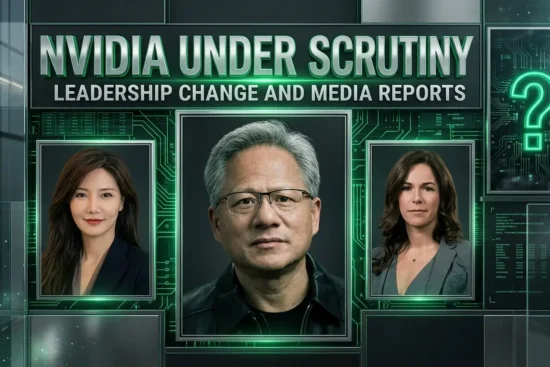
Editorial disclosure: This report draws on public Nvidia announcements, regulatory filings and attributed reporting from Reuters and other established news organizations. TrendOutsider has not independently verified private relationships, intelligence records or disputed allegations. AI-generated visuals accompanying this report are editorial illustrations, not photographs documenting the reported events.





Leave a Reply