
Introduction: Why AI Hardware Startups Matter Now
Here’s something most people miss when they talk about artificial intelligence: almost all the conversation focuses on software.
We discuss ChatGPT, Claude, image generators, coding assistants, and AI agents. Everyone wants to know which AI model is fastest or which chatbot gives the best answers. But behind every single one of those tools sits an enormous physical infrastructure that most people never think about.
That infrastructure is what AI hardware startups are building.
You cannot run a language model without compute power. You cannot generate images without specialized processors. You cannot build a robot that walks, sees, and understands without sensors, actuators, processors, and control systems. You cannot deploy AI at the edge without chips designed specifically for that task.
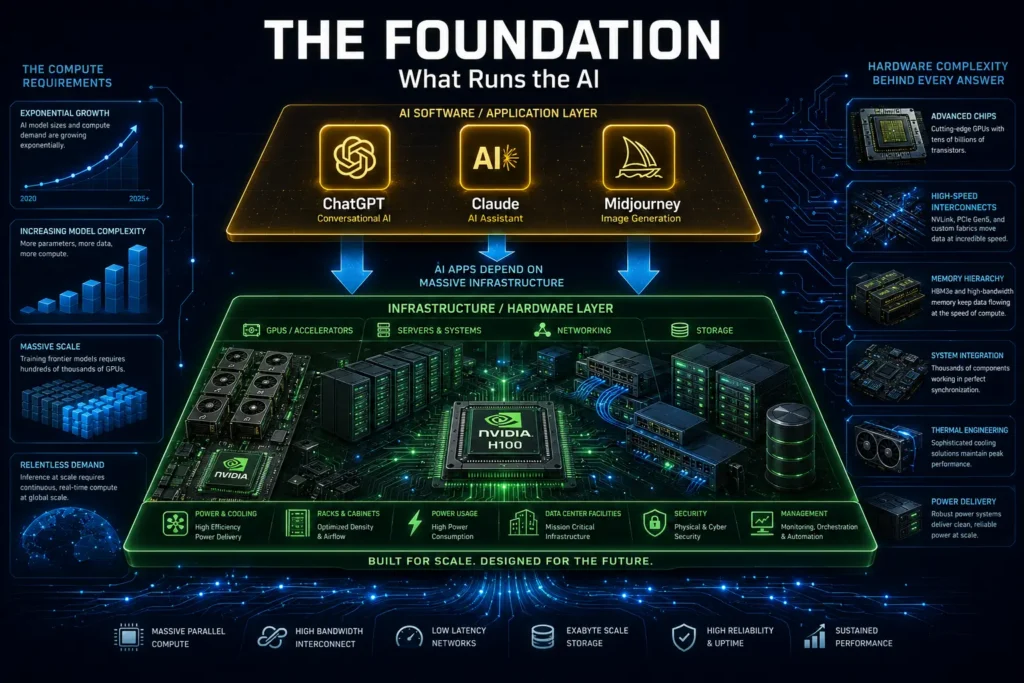
In 2026, this reality has become impossible to ignore. Data centers are running out of GPU capacity. Power consumption from AI is straining electrical grids. Enterprises want AI that runs on devices instead of always communicating with remote servers. Robotics companies are building machines that need special processors to move, sense, and decide. Defense systems require autonomous hardware. Autonomous vehicles need instant processing for safety.
All of this creates enormous opportunity for AI hardware startups that can solve real bottlenecks.
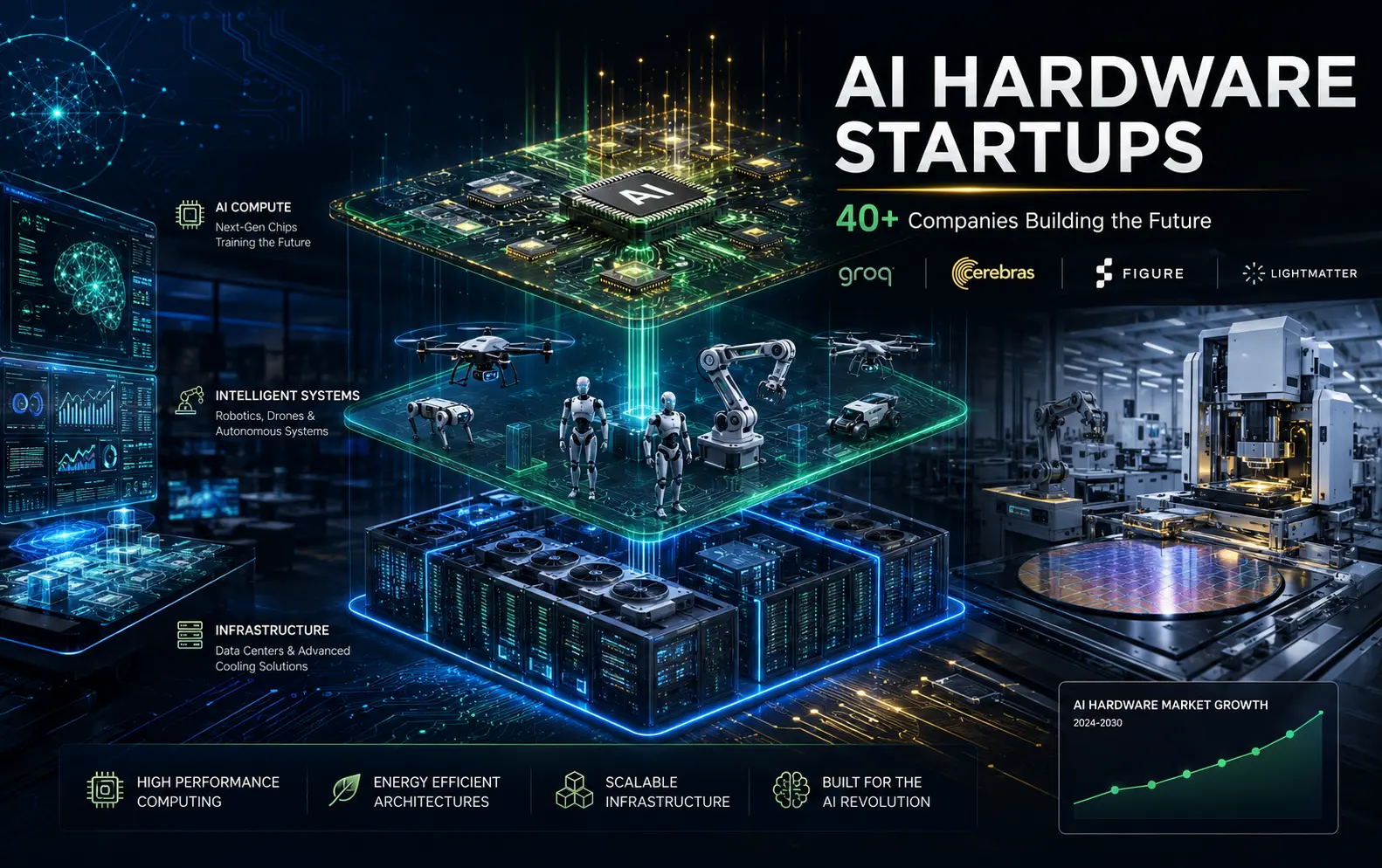
This guide covers 40+ companies building the physical foundation of the AI economy. Some are designing chips. Some are building robots. Some are creating edge devices. Some are working on optical systems. Some are exploring neuromorphic computing.
What they all share is this: they are not trying to build the next ChatGPT. They are building the machines that ChatGPT runs on.
Whether you are an investor looking for the next major technology opportunity, an entrepreneur wanting to understand where innovation is happening, an engineer curious about the cutting edge of hardware, or a business leader trying to make sense of AI infrastructure, this guide gives you the full picture.
The Physical Layer of AI Is Finally Becoming Visible

Most people understand that training large AI models requires enormous computing power. But what many people miss is that inference has become even more important than training.
When a company trains an AI model, they pay that cost once. When millions of people use a trained model every day, the company pays inference costs millions of times over. At massive scale, inference cost becomes the primary business problem.
That’s why AI inference chip startups have suddenly become valuable. The entire market shifted from asking “How do we train faster?” to asking “How do we run models cheaper and quicker?”
But the hardware opportunity goes much deeper than just inference chips.
Enterprises want AI, but not necessarily in cloud data centers. They want edge AI that runs locally for privacy, speed, and reliability. Autonomous vehicles need processors that can make safety decisions instantly without relying on network connectivity. Factories want to run AI on their equipment without sending sensitive data to external servers. Robots need processors that can handle vision, control, decision-making, and movement simultaneously. Defense and security applications require specialized autonomous systems.
This created multiple parallel markets for hardware at the same time: data center AI chips for the cloud, inference accelerators for faster and cheaper model serving, edge AI processors for devices, robotics hardware for embodied AI, specialized processors for autonomous systems, and infrastructure improvements for data movement and power efficiency.
None of these are small markets. Each one is potentially worth billions.
Quick Reference: AI Hardware Categories That Matter Most
| Category | Why It Matters | What It Solves |
|---|---|---|
| AI Chip Startups | Power model training and inference | Expensive compute, slow processing, limited capacity |
| Inference Accelerators | Reduce cost per AI request | High inference costs, slow response times |
| Edge AI Hardware | Run AI on devices, not cloud | Latency, privacy concerns, cloud costs |
| Robotics Hardware | Build intelligent physical systems | Labor shortage, repetitive work, dangerous tasks |
| Photonic AI Chips | Use light for faster computing | Data movement bottlenecks, power consumption |
| Neuromorphic Chips | Brain-inspired efficient computing | Power efficiency, edge device AI |
| Defense AI Hardware | Autonomous military systems | Real-time decision-making, autonomous operations |
| AI Infrastructure | Cloud compute and deployment | Developer access to GPU, compute scaling |
Understanding the Different Types of AI Hardware Startups
Not all AI hardware startups are chip companies.
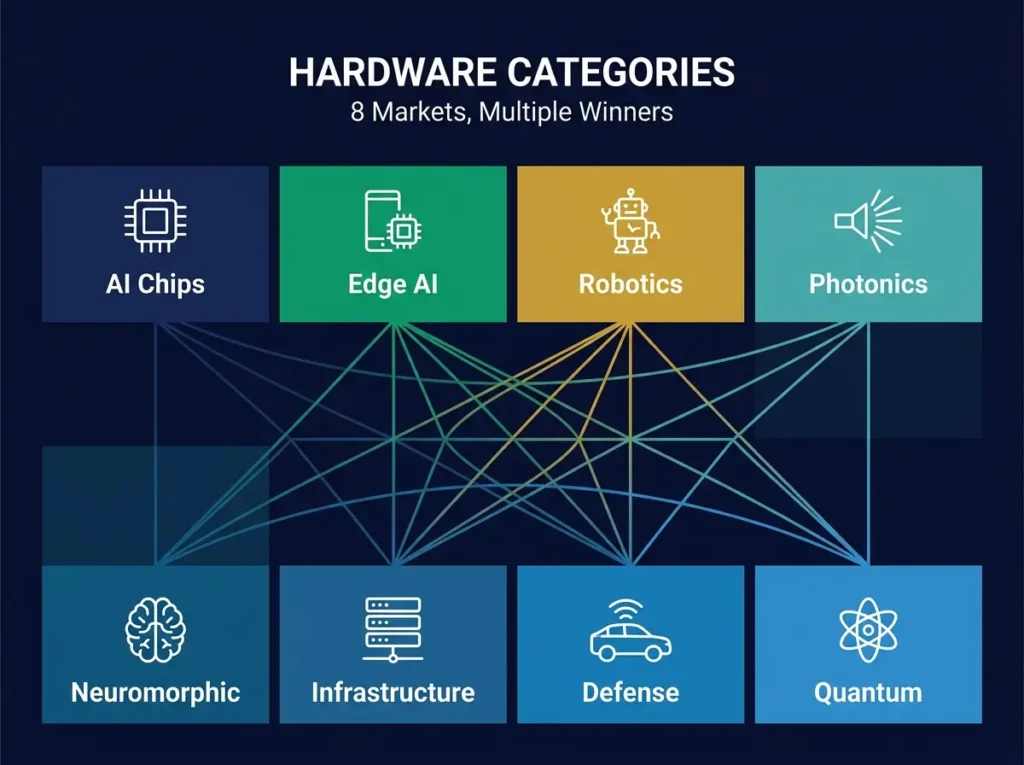
The ecosystem is diverse and includes at least eight major categories, each solving different problems in different ways.
AI Chip and Processor Startups
These companies are building inference chips, data center processors, and custom silicon designed specifically for AI workloads. Groq focuses on low-latency inference. Cerebras builds massive systems for high-performance AI. Tenstorrent designs alternative chip architectures. Etched creates specialized accelerators for Transformers, the neural network architecture powering most modern AI.
What makes this category interesting is that there’s room for multiple winners. Nvidia dominates GPUs, but that doesn’t mean there’s no space for inference specialists, edge-focused chips, or application-specific designs. Each company is trying to find an angle where they can be better than everyone else at something specific that customers actually care about.
Edge AI Hardware Startups
These companies build processors that run AI directly on physical devices. This includes cameras, drones, robots, sensors, and connected devices. Companies like SiMa.ai, Hailo, Axelera AI, and Kneron help organizations run AI locally without constant cloud connectivity.
Edge AI is becoming increasingly important because not every AI computation should happen in cloud data centers. Autonomous vehicles need instant processing for safety. Cameras need local inference for privacy. Factories want data to stay on premises. Retail systems need fast response times. This category is growing faster than many people realize.
Humanoid Robotics Startups
These are companies building general-purpose robots that can perform physical tasks. Figure AI received enormous attention for its progress on humanoid robots that can actually do meaningful work. Agility Robotics built Digit for warehouse automation. Sanctuary AI, 1X, and others are advancing embodied AI.
Unlike many robotics companies that are mostly demo-focused, the best ones are proving that humanoid robots can handle real tasks in commercial environments. This is harder than showing impressive videos. It requires safety, reliability, economics, and customer trust.
Photonic and Optical Hardware Startups
These startups use light instead of only electricity to improve AI system performance. Lightmatter works on optical computing. Celestial AI and Ayar Labs focus on optical interconnects and data movement. This category is emerging but could become important as AI data centers face bandwidth and power bottlenecks.
Neuromorphic Computing Startups
These companies are building brain-inspired processors that operate fundamentally differently from traditional chips. Rain AI, SynSense, and Innatera are exploring ultra-low-power AI computing based on how neurons actually work. The efficiency potential here is enormous, but it’s still early.
AI Infrastructure and Cloud Startups
These companies provide the compute, servers, and cloud systems that AI companies need. CoreWeave, Lambda, and similar companies give developers access to specialized hardware without building their own data centers. This is infrastructure, but infrastructure matters enormously for the entire ecosystem.
Defense AI Hardware
Companies like Anduril, Shield AI, and Skydio are building AI-powered military hardware including autonomous systems, drones, sensors, and decision support platforms. This is a specialized but enormous market with different requirements than commercial AI.
Quantum AI Hardware
Companies like PsiQuantum, IQM, Pasqal, and Quantinuum are building quantum systems that may eventually support certain AI and scientific workloads. This is very early stage, but worth monitoring for the long term.
Each category solves a different piece of the AI hardware puzzle. Understanding which companies matter depends on understanding which problems actually need solving.
Tier 1: The Unicorn AI Hardware Companies

This group includes the most important and visible AI hardware startups. These are the companies that investors watch, enterprises evaluate, and the entire industry follows.
Groq: The Inference Speed Company
Groq is probably the most talked-about AI chip startup right now, and for good reason. The company focuses on one specific problem: how do you run AI models as fast as possible with minimal latency?
This matters because when users are waiting for an AI response, speed becomes a competitive advantage. A chatbot that responds in 100 milliseconds feels instant. A chatbot that responds in 2 seconds feels slow. Speed also reduces costs because faster inference means cheaper per-token serving.
Groq has attracted significant funding, high-profile customers, and developer enthusiasm specifically because it addresses a real market pain point. The company positions itself as the speed play in a market that increasingly cares about response time.
Understanding how these specialized AI chip companies fit into the broader AI startup ecosystem requires looking at the bigger picture. If you want to see how AI hardware companies like Groq compare to the entire landscape of generative AI startups that are reshaping technology in 2026, our comprehensive guide breaks down 40+ software and infrastructure AI companies alongside their hardware enablers.
Why this matters for you: If you are running AI at scale, inference speed directly impacts your bottom line. Companies that reduce inference latency while keeping costs down become incredibly valuable to the ecosystem.
Cerebras: The Wafer-Scale Computing Approach
Cerebras takes a completely different technical approach. Instead of optimizing individual chips, Cerebras built wafer-scale AI systems where the entire chip manufacturing process becomes one giant processor.
This is unconventional architecture. Most chip companies accept that chips have boundaries and that communication between chips creates overhead. Cerebras tried to eliminate that overhead by treating an entire wafer as a single processor.
The company targets enterprises and research labs that need serious computing power and are willing to work with non-standard approaches. This is not a mainstream strategy, but for the right use cases, it could be extremely powerful.
Why this matters for you: Different approaches to hardware problems create opportunities. The industry does not need everyone building the same type of chip. Specialized approaches can win in specific markets.
Figure AI: Humanoid Robotics Becomes Real
Figure AI grabbed headlines because it demonstrated humanoid robots performing real work. Unlike many robot companies that show flashy demos and move on to the next presentation, Figure began proving that humanoid robots could handle meaningful tasks.
The company combines hardware robotics with AI models, creating systems that can see, understand, and move. This is exponentially harder than software AI because physical robots must deal with real-world complexity: movement, balance, objects, humans, safety, power, weather, surfaces, and unexpected situations.
When investors saw Figure robots actually picking up objects, placing them, and operating in warehouse environments, the funding went crazy because this proved the market was real.
Why this matters for you: Robots represent the frontier of AI. When AI moves from pure software to moving physical objects in the real world, the value creation potential grows enormously.
Tenstorrent: Building Alternative AI Architectures
Tenstorrent represents the traditional chip design approach applied to AI. The company was founded by computer architecture experts who decided that the AI chip market needed more options beyond GPU dominance.
Tenstorrent is building AI processors with a focus on performance and flexibility. The company attracts customers who want alternatives to dominant GPU platforms and who value understanding their complete computing stack deeply.
This is the type of company that may not get as much press as Groq, but could end up being incredibly important to the infrastructure layer.
Why this matters for you: In mature tech markets, the first company to solve a problem often becomes dominant. But alternatives always emerge. Tenstorrent shows how strong technical teams can build valuable solutions by offering options.
SambaNova Systems: Enterprise AI Platforms
SambaNova positioned itself differently than pure chip sellers. The company sells complete systems including hardware, software, and support specifically designed for business AI workloads.
This platform approach appeals to enterprises that want simplicity rather than piecing together components. Enterprises prefer to buy from one vendor that takes responsibility for the entire stack rather than managing multiple suppliers.
Why this matters for you: Sometimes the hardware that wins is not the most powerful hardware. It’s the hardware that is easiest to deploy, support, and integrate into existing systems.
Anduril: Defense AI Hardware
Anduril represents defense and autonomous systems. The company builds AI hardware for military applications including autonomous drones, surveillance systems, and decision support. Defense is a specialized market with different requirements, budgets, and adoption cycles than commercial AI.
Why this matters for you: Defense spending on AI is enormous and operates under different rules than commercial tech. Companies serving this market have different economics and longer sales cycles.
Agility Robotics and Sanctuary AI: Industrial Robotics
Agility Robotics focuses on industrial robotics, specifically building Digit, a robot designed for warehouse and manufacturing work. Unlike speculative robotics companies, Agility has begun actual deployments with customers like Amazon, proving that the robots can do real work at commercial scale.
Sanctuary AI is another humanoid robot company with a focus on general-purpose labor automation. The company is advancing the state of robot dexterity and control, working on making robots useful for broader categories of physical work.
Why this matters for you: The robotics market will not be won by the company with the best-looking robot. It will be won by the company that builds reliable robots that do useful work economically.
CoreWeave: AI Cloud Infrastructure
CoreWeave is more of an AI cloud infrastructure company than a chip design startup, but it is part of the AI hardware ecosystem. The company provides cloud infrastructure for AI workloads, especially GPU-based computing.
AI companies need access to compute, and not every company can build its own data centers. AI infrastructure providers help startups and enterprises access the hardware needed for training and inference.
Why this matters for you: Infrastructure companies are often less sexy than hardware makers, but they are incredibly important. Every AI company needs compute access.
Tier 2: High-Growth AI Hardware Companies That Are Gaining Traction
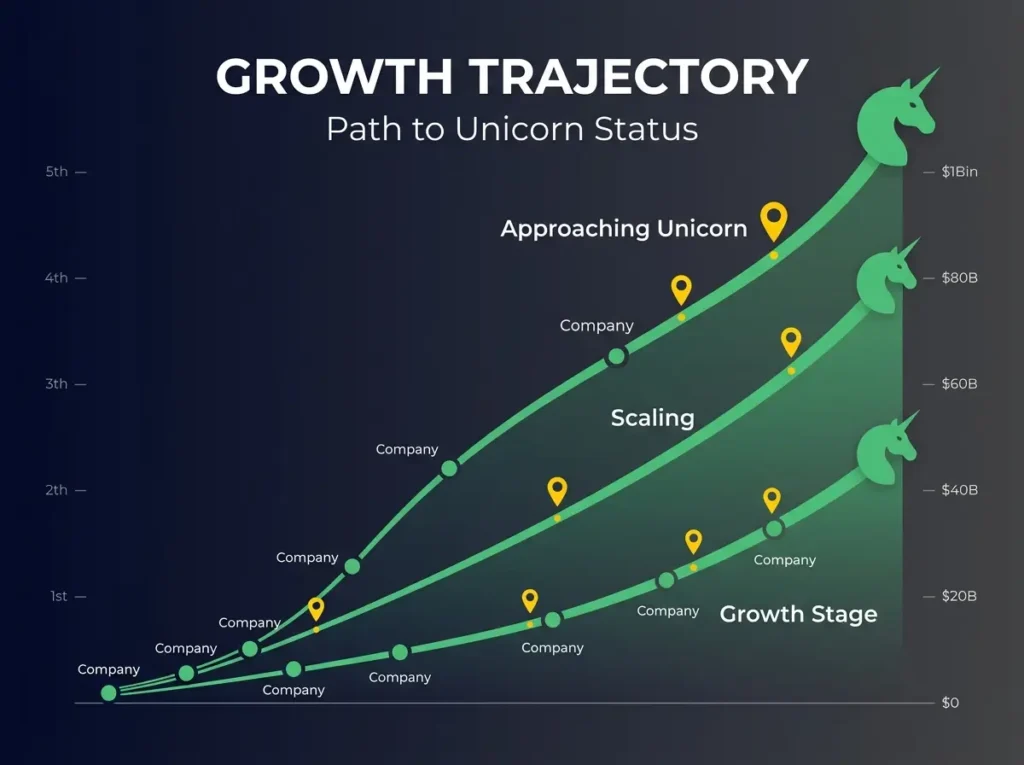
Below the obvious unicorns exists a tier of companies that may not yet have achieved billion-dollar valuations, but they are solving real problems and attracting serious attention from investors and enterprises.
| Company | Category | Main Focus | Market Opportunity |
|---|---|---|---|
| d-Matrix | AI inference chips | Efficient generative AI inference | Running large models cheaply |
| Etched | Specialized AI chips | Transformer-focused acceleration | Deep specialization improves performance |
| EnCharge AI | Analog AI chips | Energy-efficient computing | Lower power consumption for edge devices |
| SiMa.ai | Edge AI hardware | Physical AI and edge ML | Robotics and on-device intelligence |
| Hailo | Edge AI processors | AI chips for edge devices | Strong focus on cameras, vehicles, smart devices |
| Axelera AI | Edge AI chips | Computer vision and edge inference | Cost-efficient AI at the edge |
| Kneron | Edge AI and neural chips | AI on devices | Privacy-friendly local AI processing |
| Blaize | Edge AI computing | AI for automotive and edge | Supports computer vision in vehicles |
| Mythic | Analog AI processors | Edge inference | Low-power AI inference on devices |
| Rain AI | Neuromorphic chips | Brain-inspired AI hardware | Ultra-efficient AI computing |
| Lightmatter | Photonic AI chips | Optical computing | Light-based data movement improvement |
| Celestial AI | Photonic interconnect | Optical data movement | Solves AI data center bandwidth bottlenecks |
| Ayar Labs | Optical I/O | Chip-to-chip communication | Faster data movement in AI systems |
Product managers and engineering leaders at established tech companies are now rethinking their technology strategies because AI hardware has become so important. If you are building AI products within an organization and want to understand how hardware decisions impact your development cycles and go-to-market strategy, our detailed analysis of how AI accelerates product development in 2026 shows specific workflows that help teams ship AI products faster despite infrastructure constraints.
These companies show how broad the AI hardware market has become. Some are chip companies. Some are robotics companies. Some are AI cloud infrastructure providers. Some focus on defense, edge computing, or photonics.
The key insight here is that AI hardware startups do not need to beat Nvidia directly to become valuable.
As AI hardware companies like d-Matrix, Etched, and SiMa.ai grow and attract more funding, they are creating new career opportunities for skilled professionals. Product managers, engineers, and strategy people at these companies often command significant compensation packages as they work to solve critical hardware bottlenecks. For anyone considering a career at an AI hardware startup or trying to understand compensation in this fast-growing sector, our analysis of AI product manager salaries in 2026 breaks down what professionals actually earn at different company stages and in different specializations.
A startup can win enormous value by solving one specific bottleneck better than everyone else at something customers actually care about.
Tier 3: Emerging AI Hardware Startups Worth Watching
Emerging startups are harder to evaluate because they have less public track record, smaller funding rounds, or products still in development. But this is often where future category leaders begin.
These companies deserve attention because today’s emerging startup can become tomorrow’s market leader if they execute correctly.
Neuromorphic and Analog Computing
Innatera and SynSense are exploring neuromorphic chips that operate differently from traditional processors. These brain-inspired systems may unlock ultra-low-power AI computing. Mythic and EnCharge AI are exploring analog approaches to AI acceleration.
Robotics and Embodied AI
1X Technologies, Apptronik, and NEURA Robotics are advancing humanoid robotics beyond Figure and Agility. Skild AI and Physical Intelligence are tackling robot AI from the software angle, building foundation models that multiple robot companies can use.
Sensor and Vision Hardware
Recogni, Aeva, Luminar, and Vayyar are building perception hardware for autonomous vehicles and industrial automation. These sensor companies are critical infrastructure for robots, drones, and autonomous systems.
Defense and Autonomous Systems
Shield AI represents the defense autonomy sector, building AI systems for autonomous military aircraft and decision support systems. Defense spending on AI is enormous and operates under different rules than commercial markets.
Agricultural and Specialized Robotics
Carbon Robotics and Vayu Robotics show how AI hardware extends beyond consumer and enterprise markets. Agricultural automation, food production, and delivery robotics represent emerging categories with real economic opportunity.
Quantum Computing
PsiQuantum, IQM, Pasqal, and Quantinuum are building quantum systems that may eventually support certain AI, optimization, and scientific workloads. This is very early, but worth monitoring for the long term.
Why AI Hardware Becomes More Important Every Month
The AI boom created a simple problem: demand for compute outpaces supply.
Training state-of-the-art AI models requires extraordinary amounts of computing power. The biggest models need hundreds of thousands of GPU hours and special infrastructure to even attempt. Running those models at scale after training also demands serious compute resources.
But the real story is not training. It is inference.
Inference is where economic value actually gets created. When a user asks an AI tool a question, the model is not being trained. It is performing inference, which means processing the model and generating output.
When millions of people use an AI tool daily, inference cost becomes the primary business problem. That creates opportunity for startups that can make inference faster, cheaper, and more efficient.
Beyond inference, AI hardware matters because not all AI needs to run in cloud data centers. Edge AI makes sense for privacy, speed, cost, and reliability. Robotics creates demand for specialized processors, sensors, and control systems. Defense creates its own hardware requirements. Autonomous vehicles need processors that make decisions instantly. Factories want to run AI locally. All of this drives hardware innovation.
How to Evaluate AI Hardware Startups: Key Metrics That Matter
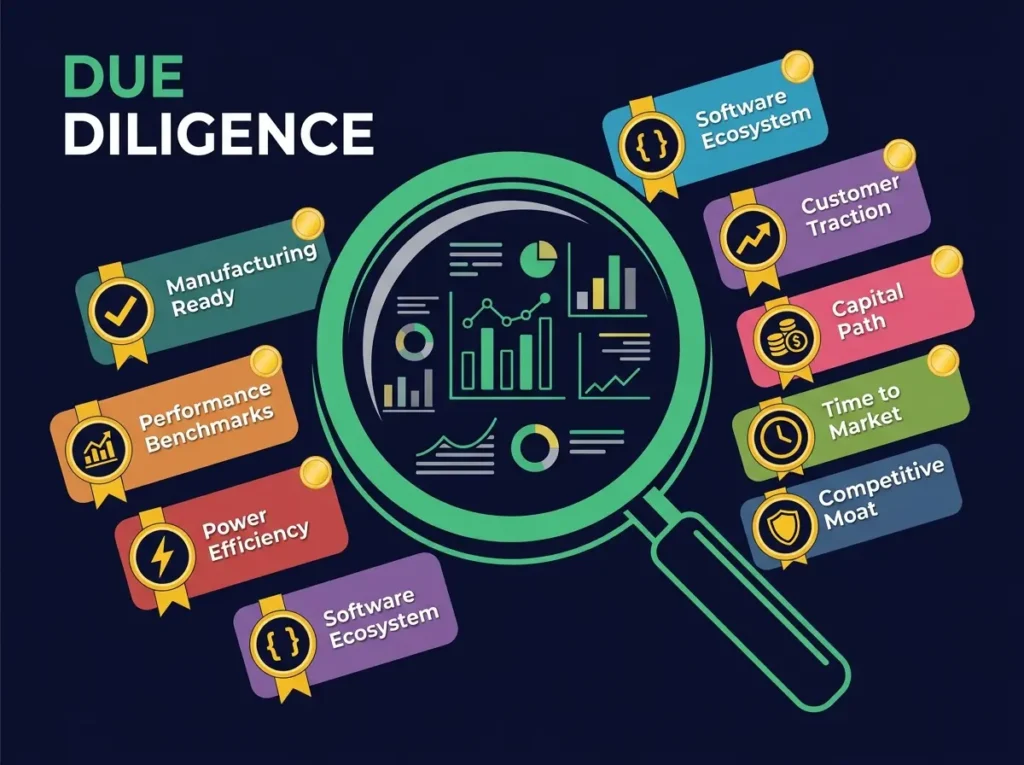
AI hardware startups cannot be evaluated like simple software companies.
A software startup may be judged mainly on users, revenue growth, and product adoption. A hardware AI startup needs those business metrics too, but it also needs technical and manufacturing metrics that software companies do not care about.
Manufacturing Readiness Is Critical
A startup may have a strong prototype but still struggle to manufacture at scale. Ask these questions:
Can the product be manufactured reliably? Does the company have manufacturing partners? Can it meet quality standards? Can it produce units at a competitive cost? Is the supply chain stable?
Manufacturing readiness is one of the biggest differences between hardware and software startups. A software company can deploy bugs and push fixes. A hardware company cannot call back millions of chips.
Performance Benchmarks Must Be Real
For AI chip startups, performance matters deeply. Important metrics include throughput, latency, energy efficiency, cost per inference, memory bandwidth, model compatibility, and developer usability.
But here’s the trap: benchmarks can be misleading. Many companies highlight their best numbers under ideal conditions. Real customer workloads may perform differently.
Power Efficiency Is Non-Negotiable
AI systems consume massive amounts of electricity. If a chip performs well but uses too much power, it may not be practical at scale. This is especially important for edge AI, robotics, mobile devices, and data centers.
Power consumption is not just about performance. It is about viability at commercial scale.
Software Ecosystem Determines Adoption
Hardware without good software is difficult to adopt. Developers need tools, compilers, documentation, APIs, integrations, model support, and debugging systems. Nvidia’s strength is not only its chips. It is also CUDA and the entire software ecosystem.
AI hardware startups need to make their technology easy to use. The best chip in the world does not matter if developers cannot easily build on top of it.
Beyond evaluating AI hardware companies as investments or career opportunities, many people are interested in actually using existing AI tools and hardware accelerators to build products and generate income. Understanding which AI tools create real value is important not just for evaluating companies, but also for seeing where you might create your own value. Our guide to using AI tools to make money in 2026 covers practical ways to leverage these technologies for income generation, including using specialized hardware accelerators and edge AI platforms.
Customer Traction Proves Viability
A strong AI hardware startup should show real customer interest. Signs of traction include paid pilots, enterprise contracts, cloud partnerships, manufacturing agreements, government contracts, developer adoption, repeat purchases, and public customer case studies.
Capital Requirements and Timeline Matter
AI hardware startups need money. Chip design, fabrication, testing, manufacturing, robotics, and hardware supply chains are expensive. Investors should understand how much capital the company needs before reaching commercial scale.
Also, understand the timeline. Hardware takes longer than software. If development takes five years but the market changes in two, the startup may struggle.
Competitive Moat Is Essential
The startup should have a clear competitive advantage. Possible moats include unique chip architecture, proprietary data, manufacturing partnerships, patents, software ecosystem, enterprise relationships, government contracts, power efficiency, cost advantage, or vertical specialization.
Without a moat, AI hardware is difficult to defend against larger competitors.
Table: 40+ AI Hardware Startups by Category and Impact Level
| AI Chips | Edge AI | Robotics | Defense AI | Infrastructure | Emerging |
|---|---|---|---|---|---|
| Groq | SiMa.ai | Figure AI | Anduril | CoreWeave | Rain AI |
| Cerebras | Hailo | Agility Robotics | Shield AI | Lambda | SynSense |
| Tenstorrent | Axelera AI | Sanctuary AI | Skydio | Cerebras | Innatera |
| SambaNova | Kneron | 1X Technologies | Together AI | EnCharge AI | |
| d-Matrix | Blaize | Apptronik | MemryX | ||
| Etched | EdgeCortix | NEURA Robotics | Mythic | ||
| Lightmatter | Mythic | Skild AI | Quadric | ||
| Untether AI | Innatera | Physical Intelligence | Expedera | ||
| Esperanto | SynSense | ANYbotics | Flex Logix | ||
| Unitree Robotics | VSORA |
Real Challenges AI Hardware Startups Actually Face
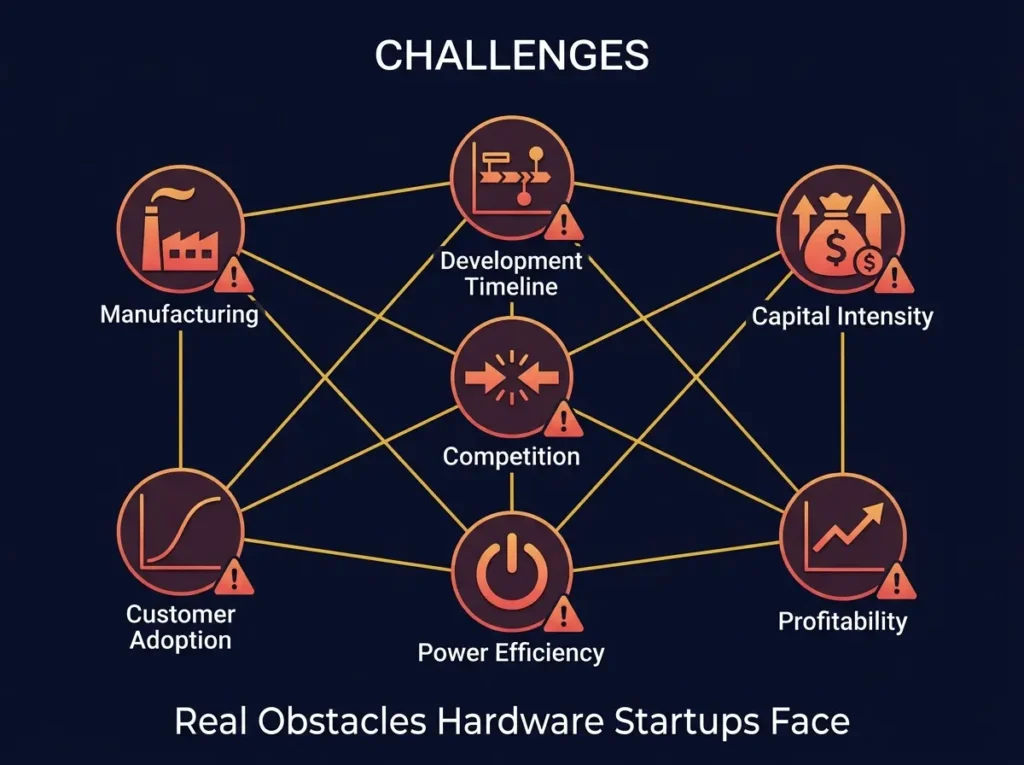
AI hardware is not a sure thing. These companies face real obstacles that can determine success or failure.
Manufacturing Is Incredibly Difficult
Designing a chip is one challenge. Manufacturing millions of chips reliably and at a competitive cost is something else entirely. Supply chain disruptions, yield problems, quality issues, and scaling challenges plague hardware startups constantly. Software companies do not have these problems.
The combination of manufacturing complexity and software requirements means that AI hardware leaders need to understand both domains deeply. For professionals entering the AI hardware space or responsible for AI decisions at your organization, understanding how hardware and software AI intersect becomes increasingly important. If you want to strengthen your knowledge of AI infrastructure, strategy, and the technical aspects of AI hardware deployment, our comprehensive guide to AI courses for product managers in 2026 covers learning resources specifically designed for professionals navigating these complex decisions at the intersection of hardware and software.
Development Takes Years, Not Months
A software startup can ship a product in months and iterate based on feedback. A chip startup needs years to design, test, and fabricate. A robotics company might need three to five years of development before the first commercial product.
This means founders and investors must have patience and discipline. Burn rate matters. The startup must have enough capital to reach commercial viability before money runs out.
Capital Requirements Are Enormous
Building chip companies is expensive. Robotics companies need manufacturing facilities, expensive equipment, and large engineering teams. Infrastructure companies need data center capacity. Most software startups would consider the capital requirements of AI hardware startups absolutely insane.
Competition From Incumbents Is Fierce
Nvidia, Intel, AMD, and other established chip companies have resources, relationships, and decades of expertise. Tesla, Google, Amazon, and Apple are all building custom AI hardware internally. Large enterprises have in-house hardware teams. Startups must find angles that large companies ignore or cannot pursue quickly.
Customer Adoption Is Slow
Enterprises are conservative about hardware. Switching from established solutions carries risk. Startups must prove that their solution is meaningfully better before customers switch. Pilots and initial deployments can take years.
Power and Efficiency Matter in Ways They Do Not for Software
A software company can be inefficient in how it uses resources. A hardware company cannot. Energy efficiency, heat management, physical size, and weight all matter. This creates constraints that software startups never face.
The AI Hardware Market Is About to Explode
Several major trends point toward rapid growth in AI hardware.
Inference Will Become the Main Economic Driver
Everyone is excited about training bigger models, but the real economic value is in running those models at scale with low latency and low cost. Companies that solve inference will become infrastructure providers for the entire AI economy.
Edge AI Will Accelerate
Not every AI computation should happen in cloud data centers. Autonomous vehicles need instant processing. Cameras need local inference. Robots need onboard intelligence. Factories want data privacy. These requirements will drive enormous investment in edge hardware.
Humanoid Robotics Will Attract Serious Capital
The market is fascinated by robots that look and move like humans. As robotics companies prove that humanoid platforms can do real work economically, funding and customer interest will accelerate dramatically.
Power and Efficiency Become Limiting Factors
AI systems consume tremendous electricity. As AI grows, energy consumption becomes a limiting factor. Startups that reduce power consumption while maintaining performance will win. This creates opportunity for neuromorphic chips, analog computing, and photonic systems.
Hardware Specialization Will Increase
Instead of general-purpose chips, the industry will move toward specialized chips for specific workloads. This creates niches where startups can win without competing directly with dominant players.
What Different Groups Should Do Next
If You Are an Investor
Focus on startups that solve real bottlenecks, have manufacturing discipline, show customer traction, and have experienced teams. Avoid companies with impressive demos but no clear path to manufacturing or revenue. Also understand the capital requirements and timeline. Hardware is not a quick exit market.
If You Are an Engineer
Study AI chip design, inference optimization, edge computing, robotics control systems, and power-efficient computing. These are the frontiers where interesting technical work happens.
If You Are an Entrepreneur
Find a painful technical bottleneck that affects many customers. Focus on solving that problem exceptionally well. Build both hardware and software carefully, recognizing that neither alone is sufficient. Secure manufacturing partnerships early.
If You Are a Business Leader
Start small with pilot projects before betting heavily on any new hardware platform. Measure whether the hardware actually delivers the promised benefits. Prioritize stability and support over cutting-edge features. Ask vendors for references and case studies before committing.
FAQ About AI Hardware Startups
What makes AI hardware different from other hardware startups?
AI hardware must interact with rapidly evolving software. A company that built hardware for traditional software can iterate more slowly. AI hardware companies need to update software, support new models, and adapt to changing standards constantly.
Are AI hardware startups profitable?
Some are generating meaningful revenue. Many are still investing heavily in research, manufacturing, and sales. Profitability can take longer than in software because hardware has higher development and production costs.
Can startups compete with Nvidia?
Not head-to-head across all markets. But startups can win in specific niches: inference acceleration, edge AI, robotics, specialized workloads, or geographic markets that Nvidia cannot serve quickly.
How much does an AI hardware startup cost to build?
Chip startups typically need 50 million to 500 million dollars to reach commercial scale. Robotics startups need similar amounts. This is not a bootstrap business.
How long does it take to ship an AI hardware product?
Three to five years is typical from concept to first commercial product. This is one of the biggest differences from software startups.
Which AI hardware categories are growing fastest?
Inference chips, edge AI, robotics, and photonics are all receiving significant capital and attention. Neuromorphic and quantum hardware are earlier stage but attracting interest.
What is an AI inference chip?
An AI inference chip is a processor designed to run trained AI models efficiently. It helps AI applications generate outputs faster and at lower cost.
What is edge AI hardware?
Edge AI hardware runs AI directly on devices such as cameras, drones, robots, cars, and sensors. It reduces latency, improves privacy, and lowers dependence on cloud servers.
What should I look for when evaluating an AI hardware startup?
Look at technology performance, manufacturing readiness, customer traction, power efficiency, software ecosystem, capital requirements, and competitive moat.
Conclusion: Why AI Hardware Matters for Your Future
Most of the conversation about artificial intelligence focuses on software. But this misses the entire substrate that makes modern AI possible.
You cannot train GPT-scale models on regular servers. You cannot run AI at the scale that companies need without specialized chips designed for inference. You cannot build humanoid robots without advanced sensors, actuators, and processors. You cannot achieve the edge AI deployments that enterprises need without edge-specific hardware.
The AI hardware startup ecosystem is young, but it is rapidly becoming obvious that a significant amount of future value lives here.
The companies in this guide are not the final list. More will emerge. Some that exist today will fail or be acquired. The category will evolve. But the fundamental importance of AI hardware will only grow.
For investors, this means allocating capital to hardware alongside software. For engineers, this means studying the physical layer of AI systems. For entrepreneurs, this means recognizing that there is extraordinary opportunity in solving specific hardware bottlenecks. For businesses, this means thinking carefully about which hardware platforms will matter for your long-term AI strategy.
The AI revolution is not just happening in software. It is happening in the physical layer that software depends on. The startups building that physical layer are shaping the future of computing.









Comments (2)
Best AI Tools for HR Professionals: The Complete 2026 Guide to 30+ Tools That Save Time and Money - Trendoutsidersays:
June 2, 2026 at 11:58 am[…] systems, and the physical infrastructure that makes HR AI possible, our complete guide to AI hardware startups shows the infrastructure layer that supports these […]
Generative AI Workflows: The Complete 2026 Guide to 50+ Automation Tools That Save 15+ Hours Per Week - Trendoutsidersays:
June 2, 2026 at 4:52 pm[…] building the chips, processing systems, and infrastructure that make AI workflows possible, our detailed guide to AI hardware startups explains the physical technology […]