

Last January, xAI announced they were hiring over 900 AI tutors to train Grok, their AI chatbot. Each position paid between $35 and $65 per hour. That headline grabbed attention fast. But here’s what most people missed: xAI isn’t the only company paying remote workers to train artificial intelligence right now. In fact, if you’re looking for genuine AI tutor jobs in 2026, you have at least five solid platforms to choose from, each with different pay rates, schedules, and requirements.
I’ve spent weeks researching what these roles actually entail, talking to people who do this work, and mapping out realistic income expectations. The honest truth is this: if you’re looking for a flexible remote income stream between $30 and $65 per hour, AI tutor jobs are genuinely viable. But the work isn’t what most people think it is, and the hiring process is more competitive than job boards suggest.
This guide covers everything you need to decide whether AI tutor jobs are right for you, which companies to apply to, and exactly how to get hired. By the end, you’ll have a clear picture of what this work actually involves, how much you can realistically earn, and the red flags to avoid.
What Is an AI Tutor Job, Actually?
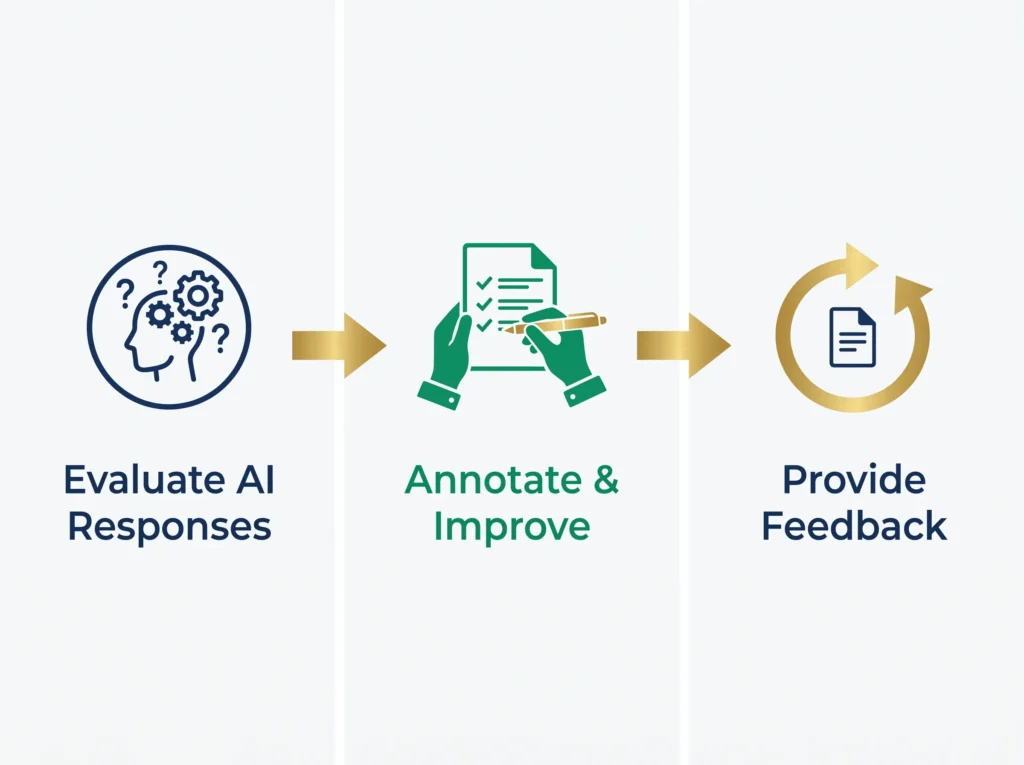
The first misconception about AI tutor jobs is that you’re teaching. You’re not. You’re not explaining calculus to students or grading essays. Instead, you’re providing human feedback to train AI models.
Here’s what you actually do: You evaluate, annotate, and improve AI-generated responses. You might write five different ways an AI assistant should respond to a customer service question. You might rate whether a chatbot’s response is accurate, helpful, and friendly on a scale of 1 to 5. You might flag errors in how an AI model understands code or medical terminology. You might participate in conversations with AI to help it learn how humans naturally interact.
The core value you’re providing is human judgment at scale. AI companies have built incredible models, but those models need human feedback to improve. They need someone to say, “This response sounds robotic” or “This doesn’t apply in this context” or “Here’s a better way to phrase that.” That’s you.
Companies hire AI tutors because they’re scaling faster than they can hire engineers. They need hundreds or thousands of people providing quality feedback simultaneously. The work is temporary, project-based, and flexible by design. You’re not an employee in the traditional sense. You’re a contractor evaluating specific tasks on your schedule while contributing to the development of generative AI workflows.
Real examples of the work look like this:
“Write three different customer service responses to this question. Make one friendly, one professional, and one detailed.”
“Does this image caption accurately describe what you see? Explain why or why not.”
“Rate this code review feedback on accuracy (1 to 5 scale).”
“Flag where this legal document summary misses important information.”
“Is this medical terminology explanation correct for a general audience?”
The work requires attention to detail, clear communication, and the ability to think critically. It doesn’t require a computer science degree or deep technical knowledge. It requires writing skill, domain expertise if you have it (healthcare, law, coding, language), and the ability to follow instructions precisely.
The AI Tutor Job Landscape 2026: Which Companies Are Actually Hiring
Five companies are actively hiring AI tutors right now. They’re not all the same. Pay differs. Schedules differ. Hiring difficulty differs. Here’s the breakdown.
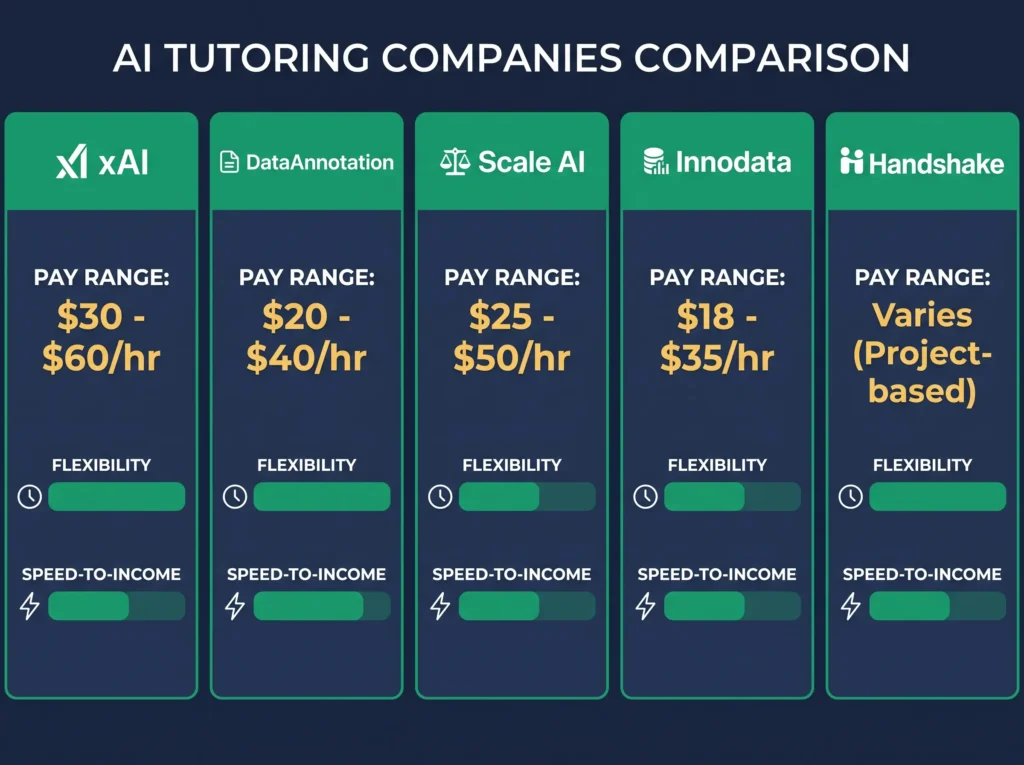
xAI: The Premium Option
xAI made headlines because Elon Musk’s involvement grabbed attention. The company is hiring aggressively to train Grok, its AI chatbot. As of early 2026, xAI had over 900 active tutors and was expanding.
Pay: $35 to $65 per hour depending on specialization. Multilingual tutors and those with specific expertise (coding, legal, healthcare) earn the higher end.
Time commitment: Full-time contracts lasting six months. First two weeks are 9am to 5:30pm PST. After that, you can work your own timezone at your own pace within set hours, though structure remains.
Requirements: Strong writing and communication skills. No degree required for the general role. For specialized roles (medical, legal, multilingual), relevant background is expected.
Application process: Apply at x.ai/careers. You complete a skills assessment focused on writing quality and critical thinking. If you pass, you have an interview. Timeline from application to first day is typically 3 to 4 weeks.
Pros: Highest pay in the market. Working for a high-profile company (good resume line). Documented flexibility after initial period. Structured environment with clear expectations.
Cons: Only six-month contracts (potential instability). High quality bar (underperformers lose access). Projects can be high-pressure. You’re dealing with a rapidly growing startup’s environment.
Real earners at xAI report making $4,000 to $6,000 monthly working 40 hours weekly at the higher rates. Most start lower while they prove themselves.
DataAnnotation: The Flexible Option
DataAnnotation takes a different approach. Instead of hiring you as an employee contractor, they give you access to a project marketplace. You see available projects, choose which ones you want, and work whenever you want.
Pay: $30 or more per hour, project-based. Pay varies by project complexity. Simple writing tasks might pay $30/hour. More complex evaluation work pays $40 to $50/hour.
Time commitment: 5 to 40 hours per week. Genuinely flexible. You can work three hours one week and thirty the next.
Requirements: Writing proficiency and the ability to pass their skills assessment. No degree required. They care about demonstrated writing ability.
Application process: Online application, writing assessment, project assignment. Much faster than xAI. You could go from application to first paid project in one week.
Hiring status: Constantly onboarding new tutors as of mid-2026.
Pros: Most flexible of the options. Fastest path to income. Skill-based qualification (no degree required). No minimum hours. You can pause anytime.
Cons: Pay varies by project (less predictable than xAI). Projects compete for quality (if your work quality dips, fewer projects come your way). Lower average pay than xAI.
Real earners at DataAnnotation typically make $2,000 to $3,500 monthly working 15 to 20 hours weekly. Experienced annotators who consistently pass quality checks earn more.
Scale AI / Outlier: The Writer-Focused Option
Scale AI’s Outlier platform specifically targets writers and people with strong critical thinking skills. If you’re interested in AI freelance writing opportunities, this option works similarly to other writing-focused AI jobs but with better pay structure.
Pay: $15 to $25 per hour on average. Varies significantly based on task difficulty and your demonstrated quality.
Time commitment: Completely flexible. Project-based work. No minimum hours. You start and stop whenever.
Requirements: Strong writing ability. Critical thinking. Expertise in at least one domain (even if it’s just “I write well”). They value portfolio quality.
Application process: Submit writing samples. Pass assessment. Start on projects. Relatively straightforward.
Pros: Extremely flexible. Great for people building writing portfolios. Lowest barrier to entry. No time commitment pressure.
Cons: Lowest pay among the five. Project availability varies. More competition from other writers. Less structured than xAI.
Real earners on Outlier make $1,000 to $2,500 monthly for 10 to 15 hours weekly. The upper end requires consistent high-quality work.
Innodata: The Consistency Option
Innodata takes a more traditional contractor approach. You apply, interview, and get assigned ongoing work. It’s more structured than DataAnnotation but less demanding than xAI.
Pay: $17 to $20 per hour. More predictable than Scale AI or DataAnnotation.
Time commitment: Part-time projects. Flexible but with some consistency expectations.
Requirements: Reliability and attention to detail. Written communication. No specific technical background required.
Application process: Traditional job application, reference checks, background verification. Takes longer (1 to 2 weeks) but feels more legitimate.
Pros: Steady work once you’re in. Predictable income. Part-time structure. Longer contract duration.
Cons: Lowest pay range. Less flexibility than DataAnnotation. Longer hiring process.
Real earners at Innodata make $1,200 to $2,000 monthly for 10 to 15 hours weekly. Work is steady but not glamorous.
Handshake AI Fellowship: For Students
If you’re a student or recent grad, Handshake offers project-based AI training work with access to their student community.
Pay: $20 to $35 per hour depending on project complexity.
Time commitment: Project-based, flexible duration.
Requirements: Current student or recent grad status. Some domain expertise helpful.
Application process: Apply through Handshake platform. Profile review and interview.
Pros: Network with other students. Build professional connections. Flexible projects. Great for early-career building.
Cons: Pay varies by project. More competition from peers. Less consistent work.
Real Income Breakdown: What You Actually Earn
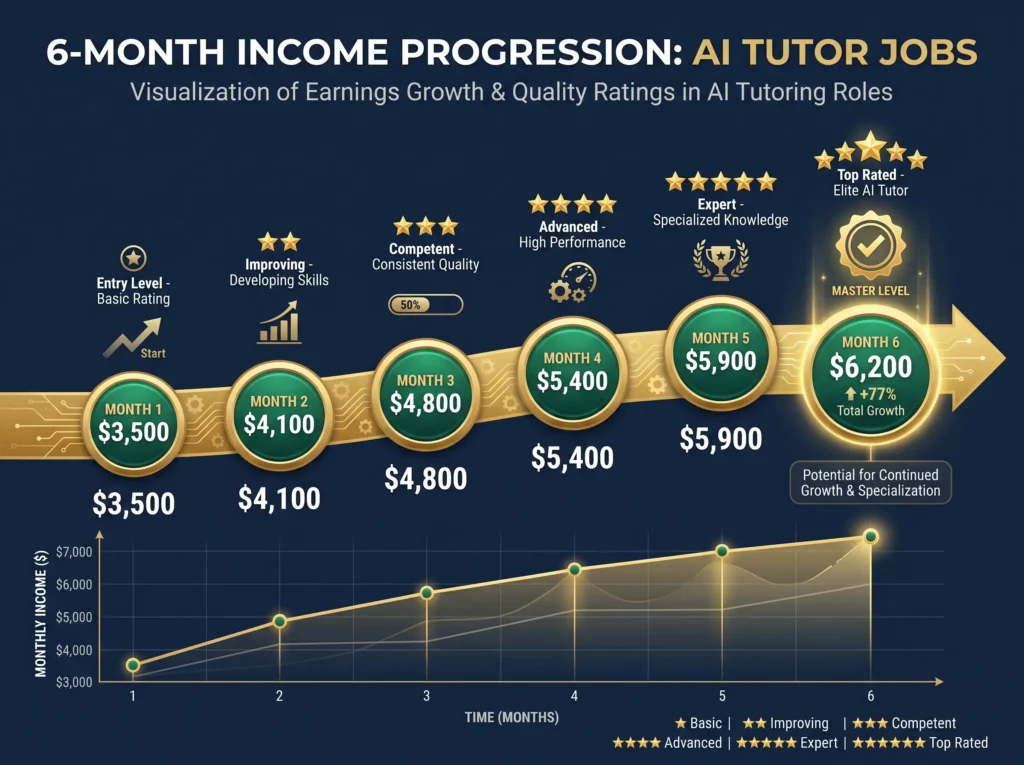
Here’s the honest income picture based on what people actually report earning in 2026. These are illustrative examples based on company pay ranges and typical working patterns. If you’re exploring different ways to make money with AI, AI tutor jobs offer one of the most accessible direct income paths because you earn hourly for time invested.
Hourly Rates Comparison
| Company | Hourly Rate | Starting Rate | Notes |
|---|---|---|---|
| xAI | $35-65/hour | $35-40/hour | Highest overall; increases with quality |
| DataAnnotation | $30-50/hour | $30-35/hour | Varies by project; project-based |
| Scale AI/Outlier | $15-25/hour | $15-20/hour | Lowest range; based on quality |
| Innodata | $17-20/hour | $17-20/hour | Most predictable; flat rate |
| Handshake | $20-35/hour | $20-25/hour | Student-focused; varies |
Monthly Income Scenarios (Illustrative)
Light load (5 hours/week):
- xAI: $700 to $1,300/month
- DataAnnotation: $600 to $1,000/month
- Scale AI: $300 to $500/month
- Innodata: $340 to $400/month
Part-time (15 hours/week):
- xAI: $2,100 to $3,900/month
- DataAnnotation: $1,800 to $3,000/month
- Scale AI: $900 to $1,500/month
- Innodata: $1,020 to $1,200/month
Serious side hustle (30 hours/week):
- xAI: $4,200 to $7,800/month
- DataAnnotation: $3,600 to $6,000/month
- Scale AI: $1,800 to $3,000/month
- Innodata: $2,040 to $2,400/month
Full-time (40 hours/week):
- xAI: $5,600 to $10,400/month (at premium rates)
- DataAnnotation: $4,800 to $8,000/month
- Scale AI: $2,400 to $4,000/month
- Innodata: $2,720 to $3,200/month
The “goldilocks zone” most people land in is 15 to 20 hours per week earning $2,000 to $3,000 monthly. This works for people who want supplemental income without replacing a full-time job.
Income Progression
You don’t start at the top rate. At xAI, you might start at $35 to $40/hour. After six months of consistent quality work, you can move up to $50 to $65/hour depending on your specialization. DataAnnotation works similarly: good work quality gets you higher-pay projects.
This means your first month might be $1,500 at 20 hours/week. By month six, it could be $2,500 to $3,000 at the same hours. Progression depends on your quality metrics and how seriously you take the work.
Disclaimer on earnings: These figures are illustrative based on company rate ranges. Your actual earnings depend on time commitment, quality of work, specialization, and project availability. There are no guarantees.
How to Get Hired: Step-by-Step
Getting hired is competitive but straightforward. Here’s the exact process.
Step 1: Assess Your Qualifications
You don’t need a degree, but you need specific skills. Do you have strong writing ability? Can you communicate clearly? Do you have domain expertise in anything (healthcare, law, coding, languages)? Are you comfortable with technology?
These are the core qualifications. Technical knowledge is nice but not required. Communication ability is non-negotiable. The same attention to detail and communication skills required here also apply to affiliate marketing and AI tools work, where precision and clear messaging directly impact results.
Step 2: Choose Your Strategy
Apply to multiple companies simultaneously. Don’t put all your hope in one. A smart approach is:
- Apply to DataAnnotation first (easiest entry, fastest timeline)
- Apply to xAI if you have specialized skills
- Apply to Scale AI as a backup
- Consider Innodata or Handshake based on your situation
Expect to apply to 2 to 3 companies if you’re serious.
Step 3: Prepare Your Application
Professional email address. Clear profile photo. Resume highlighting: writing skills, accuracy, attention to detail, any relevant background.
For DataAnnotation and Scale AI, have writing samples ready. Three good examples of your writing (doesn’t need to be published; blog posts, long-form work, or even well-written emails count).
For xAI, focus your resume on clear communication, critical thinking, and any relevant expertise.
Step 4: Pass the Skills Assessment
Each company uses different tests. Expect to spend 30 to 60 minutes on an assessment. You might be asked to:
- Write sample responses to prompts
- Evaluate AI-generated text for quality
- Identify errors or improvements
- Demonstrate understanding of instructions
- Show critical thinking ability
Pro tip: Take your time. Show your work. Demonstrate that you think carefully, not just that you’re fast.
Step 5: Interview or Project Assignment
xAI conducts interviews. DataAnnotation might send a paid trial project. Scale AI might ask for more writing samples. This is your chance to show you’re serious.
Trial projects are typically paid ($50 to $200 depending on complexity). This is real money, so treat it seriously.
Success rate: roughly 60 to 70 percent of applicants pass initial screening. Of those, 40 to 50 percent get offered a real position.
Step 6: Onboarding
Once accepted, onboarding takes 1 to 2 weeks. You get training on the specific platform, tools, and quality standards. You complete some practice assignments.
Payment timelines vary. xAI pays biweekly. DataAnnotation pays weekly. Others vary.
You need to complete a W9 form (self-employed contractor classification). You get paid via direct deposit or payment platform.
Timeline expectation: Application to first paycheck is 3 to 6 weeks.
The Reality Check: What Job Boards Don’t Tell You
The headlines say “AI tutors earn $65/hour.” That’s true. It’s also misleading.
Only the top performers earn that. Someone starting out at xAI earns $35 to $40/hour. Only after demonstrating consistent quality do rates increase. Not everyone reaches $65/hour. Some people max out at $45 to $50/hour because the work isn’t their specialty.
Additionally, project availability varies. DataAnnotation doesn’t guarantee you’ll have work every day. xAI has six-month contracts, but what happens after? You’re back to job searching.
Finally, this is 1099 contractor work. That means:
- Self-employment tax roughly 15 percent on your earnings (money you owe the IRS)
- No benefits (health insurance, retirement, unemployment insurance are your responsibility)
- No paid time off
- Quarterly estimated taxes if earning significant income
- Deductible expenses: home office, internet, equipment
If you earn $2,500/month ($30,000 yearly), you’ll owe roughly $4,500 in self-employment tax. Factor that into your income expectations.
Red Flags That Indicate Scams
If anyone asks you to pay upfront (“$50 to get started”), that’s a scam. Legitimate companies never charge workers to start.
If someone guarantees income (“Earn $3,000/month guaranteed”), that’s false. Income varies based on project availability and your quality.
If there’s pressure to recruit others, that’s a pyramid scheme signal.
If they ask for personal information (SSN, bank account) before making an offer, be cautious.
Which AI Tutor Job Should You Choose?
The answer depends on your situation. If you’re comparing multiple income strategies, you might also explore how AI arbitrage compares as an alternative income method before deciding which path works best for your schedule and skills.
If you want maximum income: xAI. But you need either specialized skills or exceptional writing ability to get hired and stay employed.
If you want flexibility and don’t want to specialize: DataAnnotation. Best for people who want to choose their hours and projects.
If you’re testing the waters: Scale AI or Outlier. Lowest barrier to entry, easiest exit if it’s not for you.
If you’re a student: Handshake AI Fellowship. Best for building experience and networking.
If you want consistency and predictability: Innodata. Less exciting but more stable.
Common Mistakes People Make
Mistake 1: Applying only to xAI. Don’t put all your eggs in one basket. xAI is competitive. Apply to DataAnnotation and Scale AI simultaneously.
Mistake 2: Overselling your expertise. Don’t claim medical knowledge you don’t have or fluency in languages you don’t speak. Companies verify this, and dishonesty gets you terminated.
Mistake 3: Rushing through assessments. These aren’t speed tests. Quality is measured. Take your time and show careful thinking.
Mistake 4: Expecting to start at top rates. Most people start at the lower end of the pay range. Expect that and be pleased if rates increase faster.
Mistake 5: Not understanding tax implications. Set aside 25 to 30 percent of earnings for taxes. Talk to an accountant if you’re earning significant side income.
FAQ: Your AI Tutor Job Questions Answered
Do you need a degree? No. Most companies don’t require one. They care about demonstrated writing ability and critical thinking. However, specialized roles (medical, legal, coding) might value relevant credentials.
What if you don’t meet quality standards? Companies have quality metrics. If your work quality dips below standards, you receive warnings. Repeated issues result in loss of access. It’s not permanent, but projects dry up.
How long are contracts? xAI offers six-month contracts (with potential extension). DataAnnotation is ongoing project-based. Others vary. Most aren’t permanent positions.
Can you do this full-time? Technically yes, but it’s risky. Most people treat this as side income because work isn’t guaranteed. Some people successfully go full-time, but that requires consistent quality and multiple platforms.
What if you want to quit? Most platforms let you pause or stop anytime. xAI contracts are six months, so there’s a commitment, but you can generally exit cleanly.
Is this legitimate work? Yes. These are real companies (xAI, DataAnnotation, Scale AI) doing legitimate business. The work helps train real AI models.
How quickly do you get your first paycheck? Most companies pay weekly or biweekly after onboarding. You’ll see your first payment 3 to 6 weeks after applying, assuming you pass screening and complete onboarding.
What skills matter most? Writing clarity, attention to detail, ability to follow complex instructions, and critical thinking. Domain expertise (healthcare, law, coding, languages) is a bonus but not required.
Key Takeaways
- AI tutor jobs are real, legitimate, and offer genuine side-hustle income ($30 to $65/hour)
- Five major companies are actively hiring: xAI, DataAnnotation, Scale AI, Innodata, and Handshake
- Realistic expectation: $2,000 to $3,000 monthly for 15 to 20 hours per week
- Starting rate is typically lower; you earn more as you prove quality
- Best entry point: DataAnnotation (fastest, most flexible)
- Premium pay: xAI (highest rates but most demanding)
- Timeline: 3 to 6 weeks from application to first paycheck
- Tax implications: 1099 contractor status, self-employment tax (15 percent), no benefits
- Avoid upfront fees, guaranteed income claims, and pressure to recruit others
Your Next Step
AI tutor jobs are real, legitimate, and offer solid side-hustle income. The realistic expectation is $2,000 to $3,000 monthly for 15 to 20 hours per week if you’re serious and consistent.
Start with DataAnnotation or Scale AI. Both have low barriers to entry and faster timelines. Pass their assessments, get your first projects, and prove you can deliver quality work. Once you’ve done that, apply to xAI if you want premium pay.
The hiring timeline is 3 to 6 weeks from application to first paycheck. That’s faster than most job searches.
Don’t expect to get rich. Do expect to make genuine side income with zero startup costs and complete flexibility.
Sources to Verify
- xAI careers page and official job listings (January 2026 announcement)
- DataAnnotation official platform and application process
- Scale AI / Outlier program documentation
- Entrepreneur.com article: “Elon Musk’s xAI Is Planning to Hire Thousands of ‘AI Tutors’ With Pay Up to $65 an Hour”
- Business Insider interviews with current xAI tutors
- Glassdoor AI Tutor job reviews and salary reports
- Indeed and ZipRecruiter job listings for AI tutor positions
- Official IRS self-employment tax guidance (Form SE)









Leave a Reply