

I’ve watched hundreds of people try to build AI arbitrage businesses in 2026, and here’s what separates the ones making $2,000-10,000 monthly from those making nothing: they picked one model, understood their real costs, and started without waiting for perfection.
AI arbitrage isn’t a get-rich-quick scheme. It also isn’t as complicated as people think. The barrier to entry is real, but it’s lower than most “make money online” methods if you know what to actually build.
Earnings Disclaimer: Actual earnings depend on effort, specialization, market saturation, and how fast you adapt. The income ranges in this article represent realistic outcomes for dedicated practitioners, not guarantees. Most people earn 20-30% less than the high end; some earn 50% more.
This guide walks you through what AI arbitrage actually is, which model fits your situation, exactly how to get started, and the red flags that separate real opportunities from scams.
What Exactly Is AI Arbitrage? (And What It Isn’t)
At its core, AI arbitrage means exploiting a value gap using artificial intelligence. You find a service, product, or trading opportunity that has a cost-to-deliver far lower than what customers will pay, then you use AI tools to deliver more value than your cost, capturing the difference as your profit margin.
The traditional definition of arbitrage is simple: buy low, sell high. What makes it “AI arbitrage” is that artificial intelligence enables you to do this at scale, speed, and with insights that manual humans cannot achieve. You’re not just finding price discrepancies. You’re automating the discovery process, executing faster, and scaling to serve multiple customers or make thousands of trades daily.
Here’s where the confusion starts. There are exactly two legitimate forms of AI arbitrage in 2026. Understanding both is critical because they require completely different skill sets, time commitments, and capital investments.
- Service-Based Arbitrage: You sell AI-powered services to businesses at premium prices ($2,000-10,000 monthly), then use affordable tools like ChatGPT and Zapier to deliver them. Your margin is the difference between what clients pay and what your tools cost. This is the most accessible model for beginners.
- Trading-Based Arbitrage: Bots detect price discrepancies across exchanges or markets (cryptocurrencies, forex, options) in milliseconds and capture tiny margins repeated thousands of times. This requires technical setup, capital, and is inherently more risky.
Everything else claiming to be “AI arbitrage”—guaranteed daily returns, passive income dashboards, secret algorithms you just fund—is typically a scam. We’ll address this in detail later, but keep this principle in mind: if it sounds too good to be true, it is.
Why 2026 Is Different for AI Arbitrage
Three shifts created opportunity in 2026 that didn’t exist in 2024:
Market Education Gap Still Exists. Businesses understand AI is real and transformational. Ninety-plus percent of companies want to implement AI. But they don’t know where to start. They can’t hire AI engineers at scale. They don’t have time to experiment with tools. And they don’t want to waste resources on trial-and-error approaches. This creates a significant gap in the market—businesses desperately need solutions but struggle to implement them effectively. That gap is pure arbitrage opportunity.
AI Tools Matured and Became Accessible. You don’t need to code. You don’t need five years of technical experience. You don’t need a computer science degree. ChatGPT Pro ($20), Zapier ($50), and Midjourney ($30) are enough to deliver professional-grade work. The barrier to entry shifted from technical mastery to sales ability and niche knowledge.
Margins Compressed at the Bottom, Expanded at the Top. Generic “I use AI to write your content” services now compete on price and get squeezed to $500-1,000 monthly. But specialized “I help dental practices use AI to book more appointments” can still charge $3,000-5,000 monthly because they solve a specific, expensive problem. Specialization is now the only path to premium pricing.
Model 1: Service-Based AI Arbitrage (The Faster Path)
This is the most realistic and highest-probability income path for most people starting today. Why? You don’t need capital upfront. You can start with sales ability alone. You can sign your first client within 30 days if you’re serious. And you can build a business asset worth $30,000-100,000 within 12 months.
How Service Arbitrage Works (Real Example)
A local dental practice pays you $2,500 per month for “AI-powered patient engagement and appointment optimization.” Here’s your cost breakdown: ChatGPT Pro ($20) plus Zapier workflow setup ($50) plus email service ($29). Your total cost is roughly $99 per month. Your margin is $2,401, or 96%.
You’re not delivering magic. You’re leveraging widely available AI tools like ChatGPT and Zapier in a specific, proven way that saves them time, reduces their stress, and generates measurable results. That specificity and results focus is what justifies the premium pricing. Clients aren’t paying for the tools. They’re paying for the problem-solving and the results.
The real work is understanding their specific pain point. A real estate agent’s pain is different from a dentist’s pain. A SaaS founder’s challenge is different from an e-commerce seller’s. Your job is identifying which niche’s pain you can solve with AI, then positioning yourself as the expert in that specific solution.
Realistic Timeline and Income Expectations
Let’s be honest about what happens month by month:
Month 1: $0 earned. You’re in full acquisition mode. You’re researching your niche, crafting your message, and sending outreach messages. Nobody’s paying you yet. This is the hardest month psychologically.
Month 2: $2,500-3,000. Your first client signed. You’re spending 15-20 hours setting up systems and delivering initial work. You’re learning your client’s business. You’re iterating on your process.
Month 3-4: $5,000-7,500. One client is renewing, and maybe a second client has signed. Now you’re managing multiple client relationships. You’re improving your systems. Your efficiency is increasing.
Month 6: $10,000-15,000. You have 3-6 recurring clients. Some clients are paying more than your initial rate because they’ve seen results. Referrals are starting to come in (30-40% of new business).
Month 12+: $15,000-30,000 potential. You have 6-12 clients, or you’ve hired support to scale further. You’re considering whether to hire a VA or just keep it simple with your current client load.
The real work happens in Month 1. If you can’t close your first client by Day 45, your niche selection, messaging, or outreach strategy probably needs adjustment.
The 5-Step Process to Start
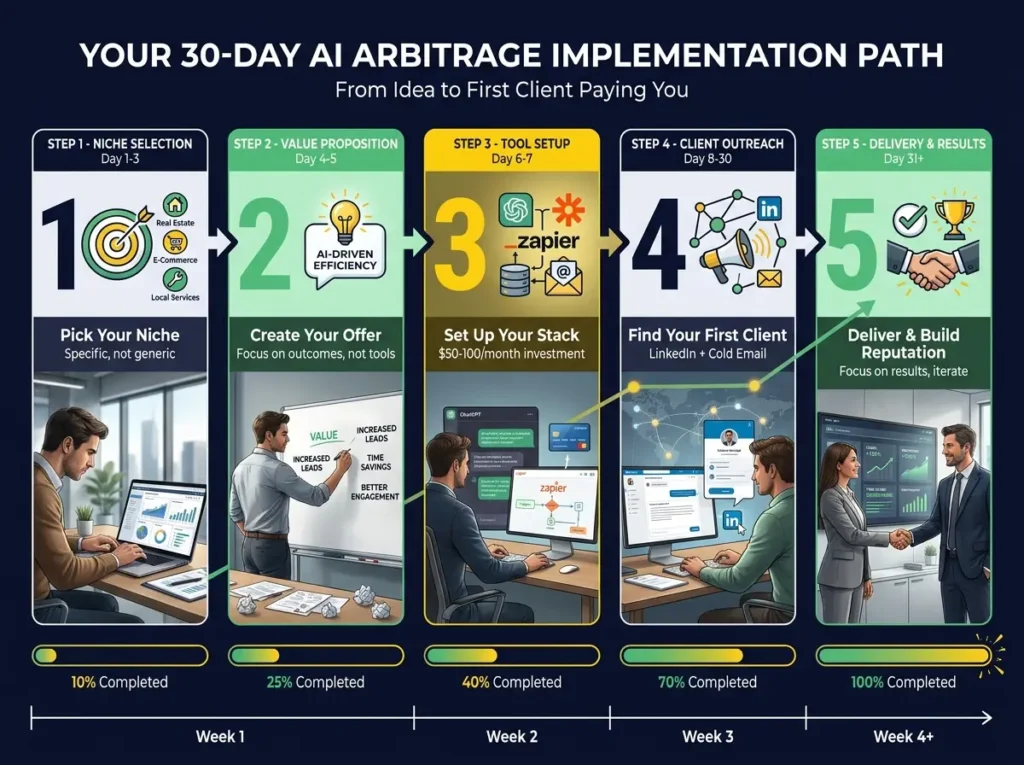
Step 1: Pick Your Niche (The Most Important Decision)
Not “AI services.” Not even “AI marketing.” You need specificity. Think: “AI for dental practices” or “AI lead generation for B2B SaaS founders” or “AI customer service automation for e-commerce.”
How to evaluate a niche:
- Market size at least $50 million – Ensures enough potential customers exist
- Average deal size can support $2,000-5,000 monthly – Filters out price-sensitive buyers
- Client desperation is high – They have a real, expensive problem AI can help solve
- You understand their world – Or can learn quickly and speak their language
Niches that work well in 2026: Real estate agents (desperate for qualified leads), e-commerce sellers (understand ROI, willing to reinvest), local service businesses (plumbers, electricians, HVAC contractors), B2B SaaS founders (highest budgets, best clients), and agencies (managing clients, want efficiency tools).

Step 2: Create Your Value Proposition
Use this template: “I help [specific niche] achieve [desired outcome] by leveraging AI-driven [solution].”
Bad version: “I help businesses use AI.”
Good version: “I help real estate agents book 20% more qualified appointments in 30 days using AI-powered lead scoring and personalized outreach sequences.”
The key shift: Focus on outcomes, not tools. Never lead with “I use ChatGPT.” Always lead with “I deliver qualified leads” or “I increase your conversion rate” or “I save you 10 hours per week on administrative work.”
Step 3: Create Your First Offer
Start with ONE specific deliverable, not a menu of services. Example: “AI-optimized content strategy plus four blog posts per month, SEO-optimized for your target keywords.”
Pricing: $2,000-2,500 per month. At this price point, clients are serious buyers, not tire-kickers. They expect professional results and they’re willing to give you time to deliver.
Critical rule: Never charge by the hour. Always use value-based pricing. Hourly pricing caps your income and encourages inefficiency. Value-based pricing rewards your speed and efficiency.
Step 4: Find Your First Prospects
LinkedIn approach: Search for your niche in your region. Send ten personalized messages daily to prospects. “Personalization” means referencing something specific about their business—not a generic template.
Cold email approach: Use Hunter.io or Apollo.io to find email addresses. Send 30 personalized emails per week. Expect response rate around 2-5%.
Reality check: Your first 50 outreaches will likely yield zero responses. Your first 100 might yield one conversation. Your first 200 might yield one signed client. Expect to spend 2-4 weeks on this phase.
Step 5: Deliver Results and Build Your Reputation
First month: Spend 15-20 hours setting up automations and creating initial deliverables.
Months 2+: Reduce to 3-5 hours per week per client. Most of your time is strategy updates, reviewing analytics, and handling client requests—not grunt work.
What matters most: Results. If your client sees a 40% lead increase, they’ll happily renew. If they see nothing after 90 days, they’ll churn. Results-obsession is your competitive advantage.
Tool Stack for Service Arbitrage (Exact 2026 Costs)
Essential tools you need:
- ChatGPT Pro: $20/month (or Claude Pro $20/month)
- Zapier or Make.com: $50-15/month (automation backbone)
- Email service: $0-30/month (Mailchimp free, ConvertKit $25)
- Project management: $0-15/month (Notion free, Asana $10)
Optional tools if offering specific services:
- Midjourney: $30/month (if offering design services)
- HeyGen: $10/month (if offering video content)
Your Total First-Month Investment: $50-100
Breakeven happens immediately after your first client ($2,500) pays. You profit $2,400+ on day one.
Model 2: Trading-Based AI Arbitrage (The Technical Path)
This model is popular in online marketing because it sounds passive. In reality, it’s highly technical, capital-intensive, and most retail traders never reach profitability. I include it here for completeness, but with a major caveat: this is much harder than service arbitrage.
How Trading Arbitrage Works
A bot scans prices across multiple exchanges simultaneously. Bitcoin trades for $95,000 on Exchange A and $95,038 on Exchange B. The bot buys on A, sells on B, pockets $38 per transaction. Repeat 1,000 times daily and you theoretically earn $38,000 daily. But that’s before exchange fees, slippage, taxes, and the fact that every major market maker and trading firm runs identical bots competing for the same microsecond advantages.
Why most people fail at trading arbitrage:
- Retail traders cannot compete with institutional latency arbitrage (microseconds matter)
- Market makers detect arbitrageurs and adjust prices instantly
- Exchange fees ($0.05-0.2% per side) eat into margins
- Most platforms actively blacklist automated trading
Realistic Income From Trading Arbitrage:
- Month 1-3: $0 earnings, learning platform and setup ($50-200 spent on tools)
- Month 4-6: $200-500/month if optimized for specific pairs
- Month 12: Potential $1,000-3,000/month but 70% of people quit before this
Most people abandon trading arbitrage by Month 3 when they realize it’s heavy technical work with razor-thin margins.
Service Arbitrage vs. Trading Arbitrage: Which Should You Choose?
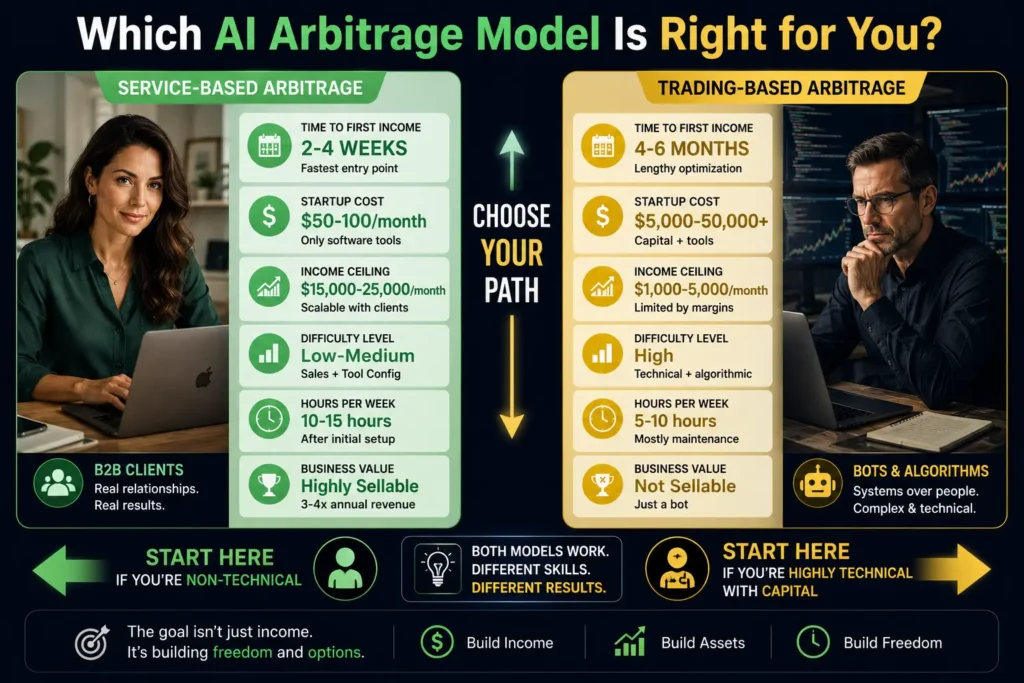
This is the critical decision. Most people choose wrong because they don’t understand what each model requires. Before choosing, understand the difference between arbitrage and traditional freelancing.
The critical distinction: when you compare your options, remember that AI freelance work represents a different but related income stream from arbitrage. Freelancers sell time (hours per dollar). Arbitrageurs sell outcomes (results per dollar). This single difference changes everything about income potential, scaling, and business valuation.
| Factor | Service Arbitrage | Trading Arbitrage |
|---|---|---|
| Startup Capital | $50-200/month in tools | $5,000-50,000+ upfront |
| Time to First Income | 2-4 weeks | 4-6 months |
| Difficulty | Low-Medium (sales + tool config) | High (technical + algorithmic) |
| Income Ceiling | $15,000-25,000+/month | $2,000-5,000/month (realistic) |
| Hours Per Week | 10-15 (after setup) | 5-10 (maintenance only) |
| Recurring Revenue | Yes (monthly retainers) | No (trade-by-trade) |
| Business Asset Value | Very High (can sell for 3-4x revenue) | Low (just a bot) |
| Risk Level | Low (worst case: lose a client) | Medium-High (capital at risk) |
Choose Service Arbitrage if: You’re non-technical, want income in under 30 days, want a scalable business asset, or aim for $2,000-10,000 monthly quickly.
Choose Trading Arbitrage if: You’re highly technical, have $20,000+ capital, enjoy algorithmic trading, and have patience for a 6-month ramp.
Your 30-Day Quick Start Action Plan
Stop planning. Start here.
Week 1: Foundation
- Day 1: Write down your chosen niche (commit to one, no backups)
- Day 2-3: Research 10 businesses in that niche, document their biggest pain points
- Day 4: Create your value proposition statement
- Day 5: Set up LinkedIn profile with niche focus
- Day 6-7: Draft 15 personalized outreach messages
Week 2: Outreach Begins
- Send 50 total outreach messages (LinkedIn and email combined)
- Track responses and conversations in a simple spreadsheet
- Set up Calendly for discovery calls
Week 3: Conversations and Setup
- Continue outreach (aim for 75-100 total by end of week)
- Conduct discovery calls with anyone interested
- Set up your tool stack (ChatGPT Pro, Zapier, email service)
Week 4: Close Your First Client
- Send proposals to qualified prospects
- Close your first client (ideally by Day 30)
- Begin onboarding and setup
If you haven’t signed anyone by Day 45, your messaging or niche selection needs adjustment. Don’t keep pushing a broken strategy.
Comparing AI Arbitrage to Other Income Methods
Let me be honest about where AI arbitrage sits in the broader landscape. When I analyzed AI arbitrage overlaps with other money-making methods but with different positioning, I discovered something important: arbitrage is fundamentally different from freelancing.
Service Arbitrage vs. Freelancing:
Freelancers sell their time. You work X hours, client pays you $Y per hour. Your income is capped by hours available.
Arbitrageurs sell results. You charge $Z monthly for a specific outcome (leads, content, optimization). Income scales with client quality and automation efficiency.
Many practitioners start freelancing and evolve to arbitrage. When you transition from “I charge $50/hour for writing” to “I charge $2,500/month for blog content plus strategy,” you’ve shifted to arbitrage. The dollar value of your effort multiplies.
The Scam Warning: Red Flags You Need to Know
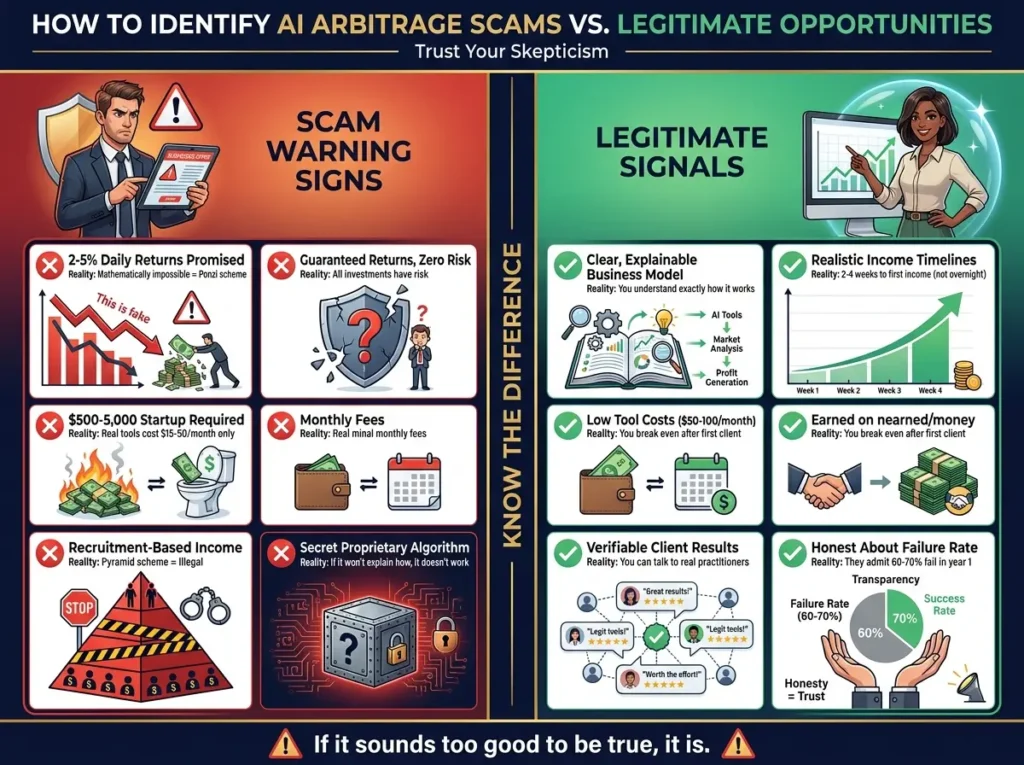
Here’s what separates real AI arbitrage from the scams flooding social media and Reddit right now:
Major Red Flags (Run Immediately):
- Promises of 2-5% daily returns – Legitimate investments average 7-10% yearly. Daily returns at that rate compound to astronomical, mathematically impossible numbers. This is a Ponzi scheme, full stop.
- Guaranteed returns with zero risk – All investments carry risk. Anyone promising otherwise is lying or deluded.
- Expensive starter packages upfront – Real tools cost $15-50/month. If someone wants $500-5,000 upfront, they’re selling a course or recruiting system, not arbitrage.
- Recruitment focus – If most of your income would come from recruiting others, it’s a pyramid scheme. Illegal, unethical, unsustainable.
- Non-existent “proprietary algorithm” – If they won’t explain how it works, it doesn’t work. Transparency is a sign of legitimacy.
How to Verify a Real Opportunity:
- Can they show their client list (with permission)? Real arbitrageurs have clients.
- Can they prove income with tax returns (2+ years)? Ask to see tax documents.
- Are they honest about failure rate? Real practitioners admit 60-70% fail in year 1.
- Do they make money when YOU make money, or do they always get paid first? Fee alignment matters.
- Can you talk to three people who’ve succeeded independently? Talk to real practitioners, not testimonials.
If they won’t answer these, keep looking. There are legitimate opportunities out there—don’t waste your time with the suspicious ones.
Implementation Case Studies: Real Examples
Case Study 1: Sarah’s Real Estate Lead Generation
Sarah was a former teacher who understood marketing principles but had no AI experience. She chose “AI lead generation for real estate agents” as her niche. Month 1, she reached out to 150 agents via LinkedIn and email. By day 35, she had one call. The agent needed qualified buyer leads. Sarah built a Zapier workflow that scraped qualified leads from public listings, scored them with ChatGPT based on agent-specific criteria, and delivered a personalized email campaign. Cost: $50/month in tools. Price charged: $2,500/month. Sarah’s first client paid her $2,500 by day 45. By month 6, she had 4 clients paying $2,500-3,500 each. Year 1 revenue: $150,000. Year 1 profit (after taxes, tools, time): $120,000+.
Case Study 2: Marcus’s E-Commerce Optimization
Marcus understood product optimization but wasn’t technical. He chose “AI product page optimization for e-commerce sellers” as his niche. His value proposition: “I increase your product page conversion rate by 15-25% using AI-powered copy testing and optimization.” He targeted Etsy and Amazon sellers specifically. His first client was an Etsy shop selling artisan candles. Marcus used ChatGPT to generate 10 product description variants, Zapier to schedule A/B testing, and Google Analytics to measure results. Within 60 days, the client saw 18% conversion lift. Marcus charged $2,000/month. The client paid immediately. By month 6, he had 6 e-commerce clients. Year 1 revenue: $144,000. This business is now worth $400,000+ (4x multiple).
What Both Cases Show:
Neither Sarah nor Marcus were AI experts or technical wizards. Both identified a specific niche, understood the pain point deeply, built a repeatable solution using existing tools, and started outreach immediately. Both landed clients within 45 days. Both built profitable businesses within 6 months.
Realistic Income Expectations (No Sugar-Coating)

Service Arbitrage Reality:
- Month 1: $0
- Month 2-3: $2,500-5,000
- Month 6: $8,000-15,000
- Month 12: $15,000-30,000 potential
Hidden reality you should know: Your first client is the hardest. After that, referrals become 30-40% of new business. You’ll probably lose 1-2 clients per year for reasons outside your control (they go out of business, pivot their strategy). Pricing increases as you get more confident and your client quality improves. Quality clients refer quality clients.
The “Job Insurance” Angle Nobody Discusses
If you’re currently employed earning $80K-150K per year, you can run a service arbitrage business in 5-10 hours per week and generate an additional $2,000-5,000 monthly ($24,000-60,000 annually). This is essentially business insurance against job loss. Many successful practitioners keep their W-2 job while scaling a service arbitrage side business until the side business eclipses their salary.
This reframes the entire proposition: you’re not quitting your job to chase an “opportunity.” You’re building income insurance while employed. The psychological safety is completely different.
Understanding the Full Spectrum of AI-Powered Business
Service arbitrage exists within a broader ecosystem. When examining AI business solutions deliver similar outcomes at scale, I noticed successful arbitrageurs are actually implementing parts of larger AI business transformation frameworks.
You’re not inventing new AI solutions. You’re selecting from existing tools and configuring them for specific client needs. Your value is in niche expertise and execution, not innovation.
How to Leverage Automation Frameworks
The backbone of service arbitrage is automation. Understanding automation workflows that underpin successful service arbitrage is critical. You’re not manually doing anything for each client. You’re building a system once, then deploying it across multiple clients.
Zapier and Make.com are the glue. They connect your ChatGPT outputs to your client’s email, CRM, and other business tools. Without automation, you’re a freelancer. With automation, you’re scaling.
The Business Exit (The Angle Everyone Ignores)
Here’s something nobody talks about: successful AI arbitrage agencies are sellable businesses.
If you build a $10,000 monthly service arbitrage business (5-7 clients at $1,500-2,000 each) and it runs relatively smoothly with documented processes, you can sell it for $30,000-40,000 (3-4x annual revenue multiple). The buyer is purchasing recurring revenue and a client list they can expand.
This is why service arbitrage is fundamentally different from freelancing. You’re building an asset with real enterprise value. In 12-18 months, you can have both cash flow ($10K/month) AND a valuable business to sell.
Finding Your First Client: The Exact Process
Theory is useless without execution. Let me give you the exact process for finding your first arbitrage client.
LinkedIn Search: Search for job titles in your niche. If targeting real estate, search “Real Estate Agent” + your city. You’ll find hundreds of profiles. Send personalized messages referencing one specific thing from their profile (recent post, company news, specific achievement).
Cold Email: Use Hunter.io to find email addresses for business owners in your niche. Draft 30-40 emails per week. Format should be: personalized opener, specific problem recognition, brief solution (1-2 sentences, not your whole pitch), CTA for 15-minute call.
Warm Outreach: Ask your network if they know anyone in your niche with the specific pain point you solve. Warm introductions convert 3-5x higher than cold.
Expected conversion: 100 outreaches = 2-3 conversations = 0.5-1 client. So expect to contact 100-200 people to land your first paying client.
Common Mistakes That Kill Arbitrage Businesses
Mistake 1: Picking Too Many Methods at Once
You start with AI content writing, Fiverr gigs, and YouTube channels simultaneously. Result: you’re average at all three, excel at none. You earn nothing. Fix: pick ONE arbitrage method. Master it for 60 days. Once you have predictable client acquisition and delivery, add a second.
Mistake 2: Underpricing Your Work
You charge $50 per blog post because you’re new. Clients assume cheap equals low quality. You get one-off gigs, no repeats, earn $300/month forever. Fix: charge 2-3 times what you think is reasonable. Clients believe higher price signals higher quality. Raise rates as reviews accumulate.
Mistake 3: No Differentiation from Competitors
You position as “AI content writer” just like 10,000 others. Nobody remembers you. Nobody pays premium rates. Fix: specialize ruthlessly. “AI content writer for SaaS companies generating $1M+ ARR” attracts only qualified, wealthy clients. Specialization is your only competitive advantage.
Mistake 4: Not Measuring or Communicating Results
You deliver content but don’t track whether it impacts client metrics. Client doesn’t know if it’s working. Client doesn’t renew. Fix: measure everything. “This month we generated 245 qualified leads for you using the AI system.” Quantified results drive renewals and referrals.
Mistake 5: Inconsistent Execution
You work 40 hours one week, 2 hours the next. Clients notice. Algorithms tank you. You’re forgotten. Fix: set a minimum quota. “I will service 2-3 new prospect conversations per week” or “I will spend 15 hours weekly on outreach.” Build the habit first, income follows.
Final Recommendation: Your Next Step
If you’re a complete beginner: Choose service arbitrage. Commit to one niche. Spend the next 30 days on client acquisition. Start small (one client at $2,500/month) and expand from there. Your goal is Month 2, not Month 12.
If you have technical skills and capital: Try trading arbitrage as a side experiment. Invest 10% of your capital ($2,000-5,000). Treat it as a learning project, not a money printer. Give it six months before expecting profit. Track everything.
If you’re employed and risk-averse: Build service arbitrage on the side. 5-10 hours per week can net you $2,000-5,000 monthly within 90 days. It’s business insurance. Your employer doesn’t need to know. When your side business exceeds your salary, then you decide whether to go full-time.
If you’re comparing this to other income methods: Remember that realistic make money online opportunities across multiple channels exist, but service arbitrage stands out because income starts within 30-45 days, the barrier to entry is genuinely low, and you build business asset value. Most other methods take 3-6 months to generate first income.
The people actually making serious money from AI arbitrage in 2026 aren’t waiting for the perfect system. They picked a niche, started outreach, and iterated based on real feedback from prospects. You can do the same.
Understanding the broader AI transformation landscape helps you see arbitrage as one legitimate path among many. But it’s perhaps the most accessible path for non-technical people who want to build real business income quickly.
Pick your niche today. Send your first three outreach messages tomorrow. You don’t need permission. You don’t need a course. You don’t need perfect. You just need to start.









Leave a Reply