
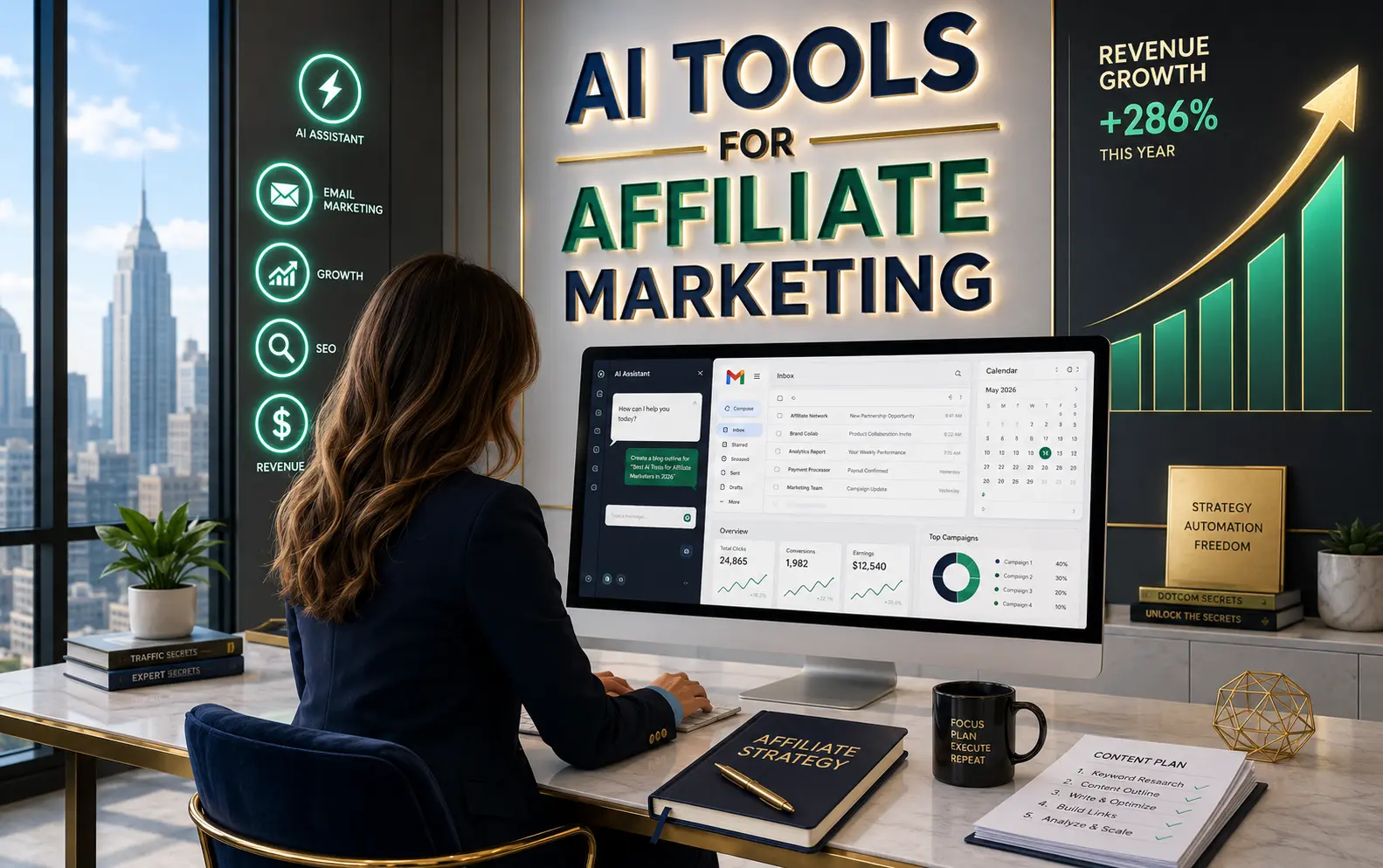
When I started affiliate marketing five years ago, I thought success was simple. Pick a product people wanted, write about it, add some links, and watch the money roll in.
I learned pretty quickly that was naive.
What I discovered instead was that affiliate marketing involves a dozen different tasks running simultaneously. Product research. Keyword analysis. Content writing. Email sequences. Social media posts. Link tracking. Performance analysis. Competitor monitoring. Audience building. And that’s just the baseline stuff.
Most people quit because they get buried under the workload, not because the business model doesn’t work. That’s exactly where I was three years ago, working 60 hours a week just to publish four articles monthly.
Then everything changed when I started experimenting with AI tools for affiliate marketing.
I’m not talking about letting AI write your content and hoping readers click your links. That doesn’t work. What I’m talking about is using AI to handle the tedious, repetitive parts of the business so you can focus on what actually matters: strategy, audience building, and honest recommendations.
The right combination of AI tools transformed my workflow. Suddenly, one article that took three days to research and write took me six hours. Email sequences that used to take a week to develop I could outline in an hour. Social media content that once consumed my entire afternoons I could batch create in an hour on Sunday.
By the end of 2023, my affiliate income had tripled.
This isn’t an accident. It’s what happens when you use the right tools strategically.
In this guide, I’m sharing the 35+ AI tools that affiliate marketers are actually using in 2026 to build profitable businesses. More importantly, I’ll show you exactly which combinations work together, how to implement them without getting overwhelmed, and how to choose the right tools for your specific business model.
This isn’t a list of every AI tool on the market. It’s a practical breakdown of tools that solve real problems affiliate marketers face, including tools for product research, content creation, email marketing, SEO, social media, analytics, and automation.

Why Affiliate Marketers Are Adding AI Tools to Their Workflows in 2026
Let’s be honest about what affiliate marketing actually requires.
Creating a single product review article genuinely takes hours of work. You need to research the product thoroughly, compare it to alternatives, understand what problems it solves, identify who would benefit from it, structure the article for search engines, write it naturally, add screenshots, create comparison tables, and then optimize the whole thing.
If you’re building an email list, you’re also creating lead magnets, designing signup pages, writing welcome sequences, nurturing emails, promotional sequences, and managing segments.
Add social media to the mix and you’re writing captions, creating graphics, scheduling posts, responding to comments, and tracking which content actually drives traffic.
This is why I see affiliate marketers working harder than they should be. It’s not laziness. They’re simply drowning in administrative work that doesn’t directly generate income.
Here’s what most people don’t realize: AI tools don’t write your affiliate business for you. What they do is eliminate the busywork so you can actually focus on business decisions that matter.
When you use AI effectively, your workflow looks completely different.
Instead of spending three days researching and writing a single article, you spend a few hours on strategic decisions and let AI handle the research summarization, content structuring, and first drafts. Instead of manually building email sequences, you use AI to create the copy framework and then refine it with your voice.
The affiliates who succeed with AI aren’t replacing themselves with software. They’re multiplying their output without multiplying their hours. A single affiliate marketer with the right AI tools can now accomplish what used to require a small team.
Consider the numbers. Manual affiliate marketing requires roughly 50+ hours per week across content creation, email, social media, and analytics. With AI tools integrated into your workflow, that same business runs on 15-20 hours per week of human work.
That’s not automation doing everything. That’s automation handling the parts that don’t require judgment, creativity, or trust while you handle strategy, audience building, and genuine recommendations.
Choosing the Right AI Tools for Your Specific Affiliate Business Model
Here’s a mistake I made early on: I tried to use every tool I could find.
I subscribed to six different AI writing tools, three SEO platforms, four email services, and a dozen other software products. My monthly bill hit nearly $500, and I was more confused than when I started.
The real secret isn’t having the most tools. It’s having the right tools for your specific situation.
Think about where you actually spend your time each week. If you’re struggling because content creation is slow, a writing tool solves your problem. If you have traffic but no engaged audience, an email platform is what you need. If you’re creating content but it’s not ranking, SEO tools become your priority.
Start by identifying your bottleneck. That’s the one thing that, if you fixed it, would move your business forward most quickly.
A beginner affiliate marketer typically needs four to six core tools to get started. Someone building authority through SEO might use eight to ten tools. An advanced marketer running multiple traffic channels could use fifteen or more.
But here’s the important part: even advanced marketers don’t use all those tools simultaneously. They added them gradually as their business grew and they identified new bottlenecks.
The decision framework I use is simple: Does this tool solve a real problem I have right now, and will it save enough time or increase revenue enough to justify the cost?
If the answer is no to either question, I don’t buy it. No matter how popular it is or how many other affiliates use it.
Section 1: AI Tools for Finding Products Worth Promoting
The first critical decision in affiliate marketing is choosing what to promote.
I’ve learned this the hard way. I spent three months creating content around a product with low affiliate demand. The article ranked well, got decent traffic, but earned almost nothing because barely anyone who read it was ready to buy.
The right products share certain characteristics. They solve real problems people have. They have enough search volume that people actively look for them. The affiliate commission structure is reasonable. People actually convert at decent rates. And critically, they fit your audience and your authority.
Using AI to validate products before investing weeks of content creation saves enormous amounts of time.
Perplexity AI: Understanding Markets Before You Commit
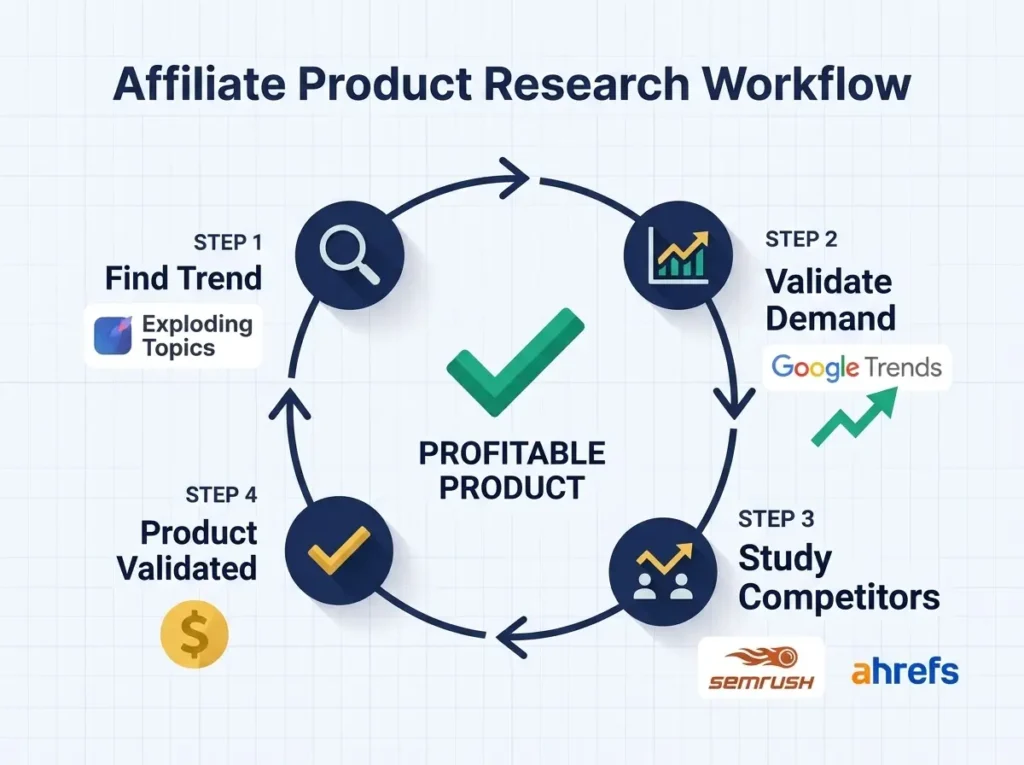
Perplexity is probably my favorite underrated tool for affiliate marketing because it solves a specific problem most affiliates face: understanding a market quickly.
When I’m considering whether to promote a product category, I start with Perplexity. I can ask it questions like “What are the biggest complaints people have about budgeting software?” or “Why do people switch from one password manager to another?” and get solid, source-backed answers.
This takes maybe 20 minutes and gives me confidence that I’m not about to spend weeks writing about a product category nobody really cares about.
ChatGPT and Claude: Organizing Your Research
Once I’ve decided a market is worth pursuing, I use ChatGPT to organize my thinking. I’ll paste my raw research notes and ask it to create a comparison framework, buyer personas, content angles, or question lists that people might search for.
Again, I’m not using these tools to invent information. I’m using them to organize research I’ve already done and identify gaps in my thinking before I start writing.
Google Trends: Validating Search Demand
Before I commit to writing content about a specific product category, I always check Google Trends to see if the search volume is actually there.
“Best AI budgeting apps” has sustained search volume. “Best blockchain budgeting apps” shows declining interest. This takes five minutes and prevents you from building content around a dying topic.
Semrush and Ahrefs: Learning From Competitors
These platforms deserve their reputation. When I’m researching a new niche, I use Semrush to see which keywords competitors are already ranking for, what their search volume looks like, and how difficult they’d be to rank for.
This tells me whether I should focus on content that’s easy to rank for quickly (keywords with lower competition) or build authority first (keywords with higher competition but more traffic).
Section 2: AI-Powered Content Creation for Affiliate Articles
Here’s something most people get wrong about AI writing tools: they’re not meant to replace you.
They’re meant to replace the parts of writing that aren’t actually about being a good writer. Outlining. Structuring. Organizing information. Drafting sections. Rewriting passages. These are all tasks AI can handle reasonably well.
What AI can’t do is decide whether a product is genuinely useful, write from real experience, add your personality and judgment, fact-check claims, disclose affiliate relationships properly, or make recommendations based on understanding your audience.
That’s your job.
Claude: Long-Form Writing That Sounds Human
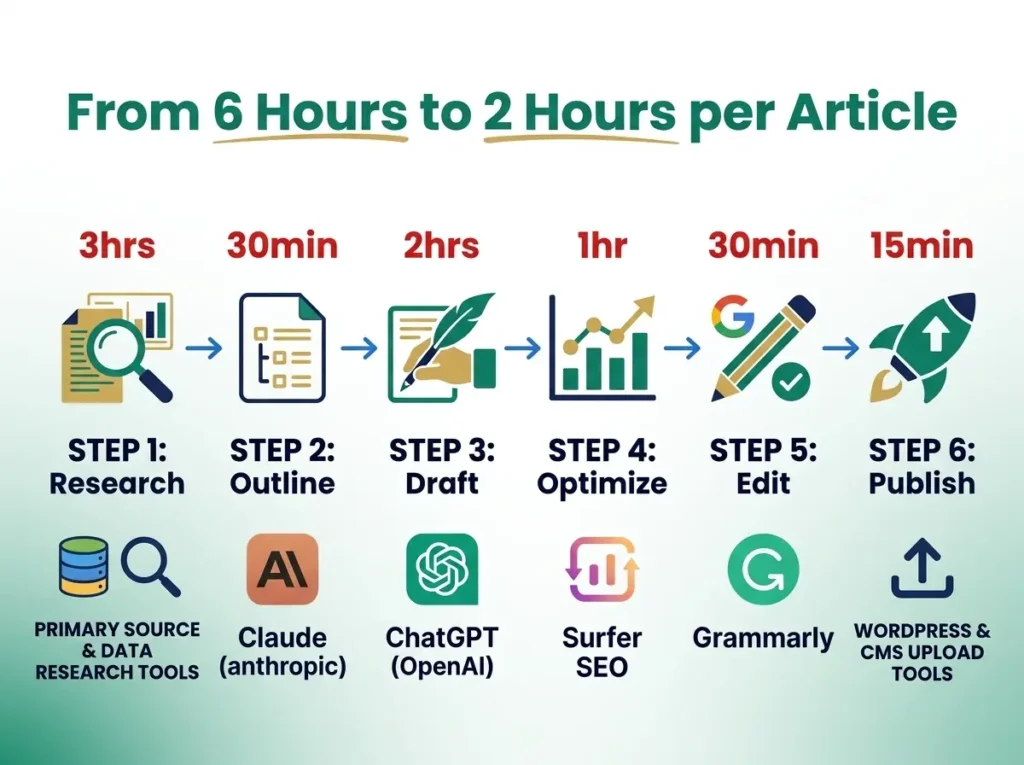
Claude is my go-to tool for taking rough research and turning it into readable content. Not because Claude writes beautiful prose, but because Claude writes in a way that’s relatively easy to edit into your voice.
I typically use Claude when I have solid research notes and an outline but need help with drafting. I give it the outline, key points I want to hit, and sometimes examples from my research, and it creates a rough draft I can then refine.
This cuts my writing time from six hours to maybe two or three hours of actual writing plus another hour of editing.
ChatGPT: Content Planning and Frameworks
ChatGPT is where I start most articles. I use it to create outlines, identify sections that need to exist, brainstorm comparison angles, plan FAQ sections, and think through the structure before I write.
A good ChatGPT prompt that takes five minutes can save an hour of planning time later.
Surfer SEO: Optimizing for What Search Engines Actually Want
Once I have a draft, Surfer SEO helps me understand whether my content is addressing what people actually search for around this topic.
Surfer analyzes the top-ranking pages for your target keyword and shows you how your content compares. Are you covering the topics they cover? Are you using similar semantic keywords? Is your content structure similar?
This isn’t about copying competitors. It’s about understanding whether you’re missing important aspects that searchers expect to find.
Grammarly: Final Polish Without Sounding Edited
After I’ve written and edited, Grammarly catches grammar issues and suggests improvements to clarity. Nothing worse than publishing an article with obvious grammar mistakes because it signals low quality to readers and to search engines.
Section 3: Building an Email Audience That Generates Consistent Affiliate Income
Here’s what most new affiliate marketers get wrong about email: they think it’s optional.
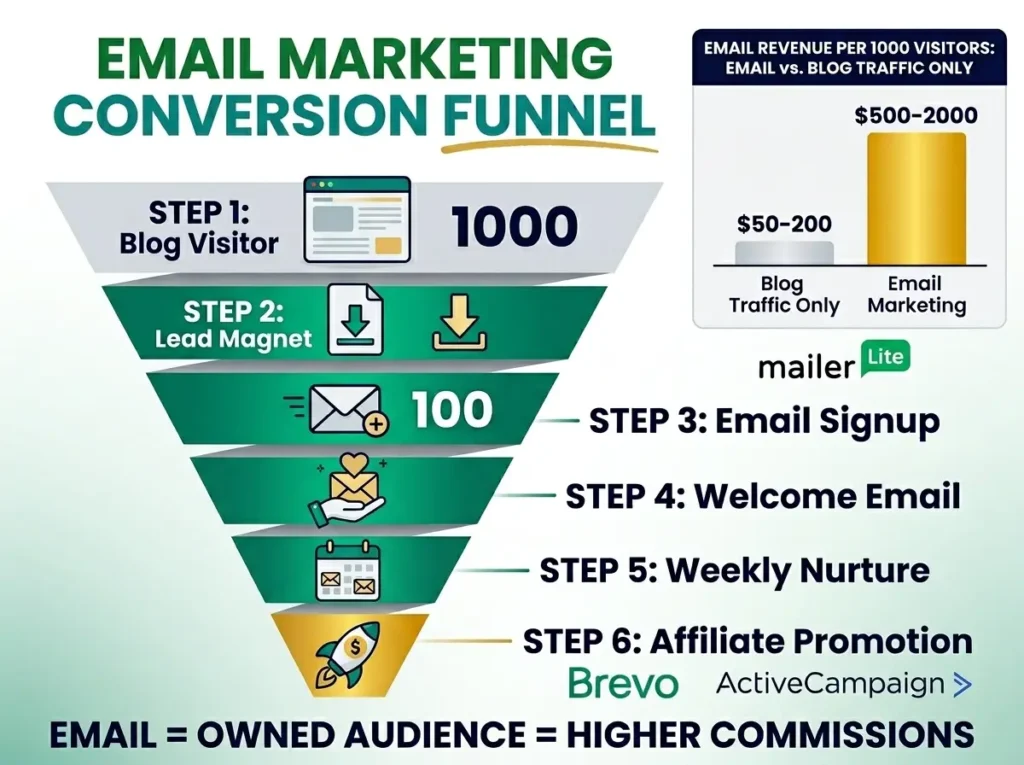
It’s actually the difference between making $500 a month and making $5,000 a month from the same traffic volume. An email subscriber is someone who chose to hear from you repeatedly. That relationship converts at drastically higher rates than random blog visitors.
The email tools you choose matter less than having an email system at all. I started with Brevo because it was free. As my list grew, I upgraded to MailerLite. Other affiliates use Kit or GetResponse. The specific tool matters less than consistency and actually using it.
Brevo: Starting Your Email List on a Budget
If you’re brand new to email marketing, Brevo is genuinely sufficient. You can build your first 5,000 email subscribers completely free. The automation features are basic but they work. You can create welcome sequences, send newsletters, and track opens and clicks.
Brevo’s limitation is that segmentation gets complicated as your list grows, and the free tier has daily send limits. But for a beginner, these limitations push you to focus on quality over quantity, which is actually good.
MailerLite: Growing Beyond the Basics
When your list hits a few thousand subscribers, MailerLite becomes relevant. Their interface is intuitive, their drag-and-drop editor works well, their automation is more powerful than Brevo’s, and they have excellent integrations with other tools.
I moved to MailerLite around 4,000 subscribers and haven’t regretted it.
ActiveCampaign: When You Need Advanced Segmentation
If you’re running multiple affiliate programs, promoting different products to different audience segments, and want sophisticated automation, ActiveCampaign handles that complexity well.
Most beginners don’t need this. Most intermediate affiliates eventually do.
Email Content That Actually Converts
Here’s what you need to understand about email for affiliate marketing: the money comes from trust, not from promotions.
I spend about 80% of my emails educating, helping, and building trust. Twenty percent of my emails are actual promotions. New affiliates usually get this backwards.
Use ChatGPT or Claude to create email outlines and frameworks, but write the actual email yourself. Email is where your personality matters most because readers are subscribing to you, not to a content stream.
Section 4: AI Tools for Ranking on Google and Getting Free Traffic
SEO is the most scalable traffic channel because a ranked article brings visitors for months or years without ongoing advertising spend.
The challenge is that ranking takes time and requires multiple tools working together. You need to find keywords worth ranking for, create content that matches search intent better than competitors, optimize the technical and on-page elements, and then track what happens over time.
Google Search Console: Your Most Important SEO Tool
This is free and it shows you exactly what keywords your pages rank for, how many people see them in search results, how many people click them, and what your average position is.
This data is gold. I audit my top pages monthly using Search Console to identify opportunities. Pages ranking in positions 8-15 are often update opportunities. Pages with good impressions but low click-through rates need better titles. Pages with clicks but no conversions need better content.
Ahrefs and Semrush: Competitive Research
Both tools do similar things: they show you what competitors rank for, which keywords might be opportunities, what content strategies work in your niche, and which websites are generating traffic.
Semrush is slightly more beginner-friendly. Ahrefs has slightly better data. I use Ahrefs but either works.
Surfer SEO: Content Optimization Based on Top Competitors
Before I publish, I run my content through Surfer SEO to compare it with what’s ranking. This isn’t about copying competitors. It’s about making sure I’m addressing the topics my audience actually cares about.
The SEO Workflow That Actually Works
Find an opportunity keyword using Ahrefs or Semrush. Make sure it has real search volume and isn’t too competitive. Create content that’s better than what ranks currently (better research, clearer structure, more practical advice, better examples). Optimize using Surfer SEO. Publish. Monitor in Search Console.
Do this consistently and you’ll rank for dozens, then hundreds of keywords within a year.
Section 5: Growing Your Audience on Social Media
Social media rarely generates direct affiliate sales. What it does generate is traffic to your blog and subscribers to your email list.
The mistake most affiliates make is treating social media like a distribution channel for product links. That doesn’t work. What works is using social media to educate, build authority, and attract people who then consume your content and eventually buy through your recommendations.
Batch Creating Content Across Multiple Platforms
The most efficient approach is to create social content in batches using AI tools. ChatGPT can help you turn one blog post into dozens of social posts across different platforms and formats.
I typically spend one hour on Sunday creating a week of social posts across LinkedIn, Pinterest, and Twitter. This beats creating one post daily and never having consistency.
Buffer and Later: Scheduling Multiple Posts
Buffer handles most social platforms. Later specializes in Instagram and Pinterest visuals. Pick one and use it to schedule batches of content rather than posting manually throughout the week.
This consistency matters more than you’d think. Algorithms reward accounts that post regularly.
Tools for Managing Links and Tracking Clicks
Tools like Pretty Links (for WordPress) or Linktree (for link-in-bio) help you organize where social traffic goes and track which posts actually drive clicks.
Section 6: Understanding Your Affiliate Performance With Tracking and Analytics
This is where affiliate marketing becomes a real business instead of just content creation.
Most affiliate marketers track traffic. Very few track actual profit. A blog post with 1,000 visitors might earn $0 if it’s not matching what searchers want. A blog post with 200 visitors might earn $500 if the audience is right and the recommendations are honest.
Google Analytics 4: Understanding Who Your Visitors Are
GA4 shows you which pages bring engaged visitors, which ones bounce immediately, where your traffic comes from, and whether people actually convert.
Set up conversion goals around email signups and affiliate link clicks. This tells you which content actually works.
Pretty Links or Lasso: Managing Affiliate Links
These WordPress plugins let you create clean, trackable affiliate links, organize them by product or category, and see which links get clicked most.
This is critical information for understanding which products resonate with your audience.
Google Looker Studio: Creating Custom Dashboards
Once you’ve set up tracking in multiple places, Looker Studio pulls all that data together into one dashboard so you can see traffic, engagement, email signups, affiliate clicks, and revenue in one place.
Spending an hour setting this up saves hours every week because you can see your performance at a glance.
The 5 Affiliate Marketing Stacks That Actually Work
Now here’s the practical part: what tools actually work together?
I’ve tested this extensively and narrowed it down to five proven combinations based on different business models.
Stack 1: Beginner Affiliate (Zero to 10,000 Monthly Visitors)
This stack costs $0-30 per month and is entirely capable of building your first affiliate business.
ChatGPT or Claude for writing help. Google Search Console and Google Trends for keyword research. Canva for graphics. Brevo for email. Pretty Links (WordPress plugin) for affiliate links. Buffer for social scheduling.
This combination handles the entire process from research to publishing to email list building to social promotion.
Stack 2: Content-Focused Affiliate (10,000 to 50,000 Monthly Visitors)
Once you’re getting real traffic, you want better SEO data and more advanced optimization tools.
Keep the writing and email tools. Add Ahrefs or Semrush for competitive research. Add Surfer SEO for content optimization. Add Looker Studio for dashboards. Continue using Buffer or upgrade to Later for visual scheduling.
This stack costs $50-150 monthly and builds on what you learned in Stack 1.
Stack 3: Email-Focused Affiliate (Building an Owned Audience)
If your strategy is building an email list and promoting to subscribers, your priorities shift.
You need a more powerful email platform like MailerLite or GetResponse. You need lead magnet tools like Canva. You need chatGPT or Claude for email copy. You need tracking to understand which emails convert.
This stack costs $50-200 monthly and works well for creators, newsletters, and audience-first strategies.
Stack 4: Multi-Channel Affiliate (Diversifying Traffic Sources)
As you grow, you want traffic from multiple sources so you’re not dependent on one algorithm.
Combine tools from Stacks 2 and 3. Add video repurposing tools like Descript so you can turn one article into Pinterest pins, LinkedIn posts, YouTube thumbnails, and email content.
This stack costs $100-300 monthly and requires more active management but scales significantly better.
Stack 5: Advanced Affiliate Business (Scaling Beyond Solo Operation)
At this level, you’re either scaling up significantly or running multiple affiliate properties.
You add project management tools like Airtable or Notion. You add more advanced automation through Zapier or Make. You might add team collaboration tools. You might upgrade to advanced tracking platforms.
This stack costs $300+ monthly and requires understanding exactly what bottlenecks need to be solved.
Real Affiliate Scenarios: How Different Models Implement These Tools
Let me walk you through three real scenarios showing how different affiliate models actually use these tools.
Scenario 1: The SEO-Focused Affiliate
Sarah started a blog about productivity software. Her strategy is to rank for “best” keywords and monetize through affiliate commissions.
Her workflow looks like this: She uses Ahrefs to find keywords with decent volume but low competition. She creates outlines in ChatGPT and writes drafts in Claude, adding her own testing and comparisons. She optimizes using Surfer SEO before publishing. She tracks everything in Google Search Console and builds a dashboard in Looker Studio showing which articles drive the most affiliate clicks.
After six months, she’s ranking for 30 keywords. After a year, she’s ranking for 150 keywords. Her affiliate income has grown to $3,000 monthly from organic traffic alone.
The tool stack that made this possible cost about $50 monthly in total.
Scenario 2: The Email List Affiliate
Marcus teaches beginners how to use AI. His strategy is to build an email list and promote relevant products to subscribers who trust his recommendations.
He created a free guide called “10 AI Workflows for Productivity.” He uses MailerLite for email with a landing page built into the platform. He uses ChatGPT and Claude to outline email sequences but writes them personally. He uses Canva to create graphics for his lead magnet and emails.
His email list grows 500-1,000 subscribers monthly. His email engagement rate is 35%, and he promotes one product per month to this engaged audience. His affiliate income from email alone is $4,000 monthly from significantly less traffic than the SEO affiliate.
Scenario 3: The Multi-Channel Affiliate
Jessica runs a SaaS affiliate site. She publishes blog posts, grows an email list, maintains social media, and creates YouTube content.
One strong blog post becomes: a LinkedIn article, five Pinterest pins, three YouTube video scripts, one email newsletter, a downloadable comparison checklist, and updated versions in her email courses.
She uses Claude for initial writing, Canva for visuals, Buffer for social scheduling, MailerLite for email, and Descript for video repurposing. One piece of content drives traffic across multiple channels, multiplying her reach without multiplying her effort.
If you want to explore the bigger picture of how AI tools are transforming various business models beyond affiliate marketing, check out our detailed guide on generative AI workflows for different business types and organizational structures.
Mistakes I Made So You Don’t Have To
After working with dozens of affiliate marketers using AI tools, I’ve noticed the same mistakes coming up repeatedly.
The biggest one is publishing generic AI content. If your review reads like every other review online, readers have no reason to trust you over anyone else. Use AI for structure and first drafts, but add your judgment, your examples, your testing, and your personality.
The second mistake is promoting products you don’t understand. AI can summarize information about a product. AI cannot replace you actually testing it or understanding the market. I’ve watched affiliates recommend products they’ve never used, and it always blows back on them.
The third mistake is not tracking correctly. You can’t optimize what you don’t measure. At minimum, track which pages get clicks on your affiliate links. Better would be tracking conversion rates and commission per article.
The fourth mistake is using too many tools too early. Choose a simple stack and master it before adding more complexity. Too many tools lead to decision paralysis and wasted monthly fees.
For a broader perspective on free AI tools available to marketers across all industries, including those beyond affiliate-specific use cases, our comprehensive guide to free AI tools for marketing covers 40+ options.
How to Get Started This Week
If you’re reading this thinking “This sounds good but I don’t know where to start,” here’s what I recommend.
Today: Set up Google Search Console and Google Analytics if you haven’t already. These are free and essential.
Tomorrow: Choose your email platform. If you’re brand new, start with Brevo (free). If you want more features, Mailerlite is worth $40-50. If you’re not sure, pick Brevo and upgrade later.
This week: Create one lead magnet related to your niche. It can be a simple checklist, comparison chart, or template. Connect it to your email platform.
Next week: Write your first affiliate content piece using this workflow: research, ChatGPT outline, rough draft, Claude edit, Grammarly final check, publish.
Following week: Set up your dashboard in Looker Studio so you can see your traffic and affiliate clicks.
Do this and you have a functional affiliate marketing system. Now consistency becomes your only job.
For those interested in the deeper technical and strategic aspects of AI-powered workflows across organizations, our article on generative AI workflows explores automation patterns that scale.
Common Questions About AI Tools for Affiliate Marketing
Do I really need AI tools to make money with affiliate marketing?
No, but they help tremendously. Manual affiliate marketing is possible but takes twice the time for half the income. AI tools are a multiplier, not magic.
What if I don’t want to use AI writing tools?
Don’t. Some successful affiliates avoid them completely. Your content actually will be unique. You’ll just work longer hours. Choose what works for your style.
How much should I spend monthly on tools?
A beginner needs $0-30. An intermediate affiliate might spend $50-150. An advanced affiliate might spend $300+. Spend the minimum that solves your current bottleneck.
Can AI tools help me rank faster?
No. They help you create content faster and more efficiently. Ranking still depends on content quality, E-E-A-T signals, and backlinks. AI doesn’t change the fundamentals.
Should I use AI to write entire articles?
I don’t recommend it. Use AI for research synthesis, outlines, drafts, and editing. Write the actual article yourself or hire a human writer. Readers can tell the difference.
If you’re curious about how AI is creating new job opportunities and changing career paths, particularly in product management and marketing roles, you might find our analysis of AI product manager salaries and market trends valuable for understanding your career options in this space
How do I know which tools to buy?
Start with a clear problem you’re trying to solve. If writing is slow, get a writing tool. If traffic is weak, get SEO tools. Add tools only when they solve a real bottleneck.
Conclusion: Multiplying Your Affiliate Income With AI Tools in 2026
AI tools for affiliate marketing aren’t magic. They don’t write your content automatically, find profitable niches for you, or build an audience without effort.
What they do is handle the repetitive, time-consuming parts of the business so you can focus on the parts that actually require human judgment: understanding your audience, choosing quality products to promote, creating genuine recommendations, building trust, and making strategic business decisions.
The affiliates winning in 2026 aren’t using the most tools. They’re using the right tools systematically as part of a clear strategy.
For those building affiliate businesses in the startup or tool-creation space, you might also be interested in understanding the broader landscape of emerging AI companies through our comprehensive guide to generative AI startups that are building the tools themselves.
Start simple. Choose one bottleneck in your business. Find the tool that solves that bottleneck. Master it. Track the results. Then add the next tool.
After a year of consistent application, you’ll have a systematic affiliate business that runs efficiently. After two years, you might be running something that competitors with no systems can’t keep up with.
Affiliate marketing was never supposed to be a side hustle that generates income from barely any work. It’s a real business that requires strategy, execution, and consistency.
AI tools don’t eliminate the work. They make the work you do matter more.









Comments (1)
How to Make Money With AI Arbitrage: Service Model vs. Trading 2026says:
June 21, 2026 at 8:32 pm[…] or trading opportunity that has a cost-to-deliver far lower than what customers will pay, then you use AI tools to deliver more value than your cost, capturing the difference as your profit […]