
It was 4 AM when the startup founder realized he’d spent the last 2 hours updating his CRM manually. Again. Leads came in through multiple channels. He’d copy them into the CRM. Check for duplicates. Update status. Schedule follow-ups. All by hand. All repetitive work that could have been automated.
He wasn’t alone. The average startup founder loses 41 percent of their time to repetitive, low-value tasks like this one. Updating CRMs. Scheduling meetings. Following up with prospects. Answering the same customer questions for the hundredth time. These tasks don’t scale. They drain focus from the work that actually grows the business.
That’s where AI agent startups come in.
Unlike chatbots that just answer questions, AI agents execute workflows autonomously. They book meetings. Process refunds. Write code. Qualify leads. Handle customer support. They take action in real systems without constant human supervision. The market for AI agents has already reached $7.84 billion in 2025, with projections to hit $52.62 billion by 2030 (a 41 percent compound annual growth rate).
For startup founders exploring how these agents fit into broader business opportunity, understanding how AI tools generate revenue becomes critical context. By 2026, 85 percent of enterprises will be deploying AI agents.
But for startup founders, this shift is even more critical. You don’t have large teams, so every hour saved compounds directly to your bottom line.
This guide covers the top 20 AI agent startups reshaping business operations, their funding, founders, and real-world ROI. You’ll learn which companies are winning and why. More importantly, you’ll discover the AI agent stack your startup should build or buy right now.
What Are AI Agents and Why Startups Need Them
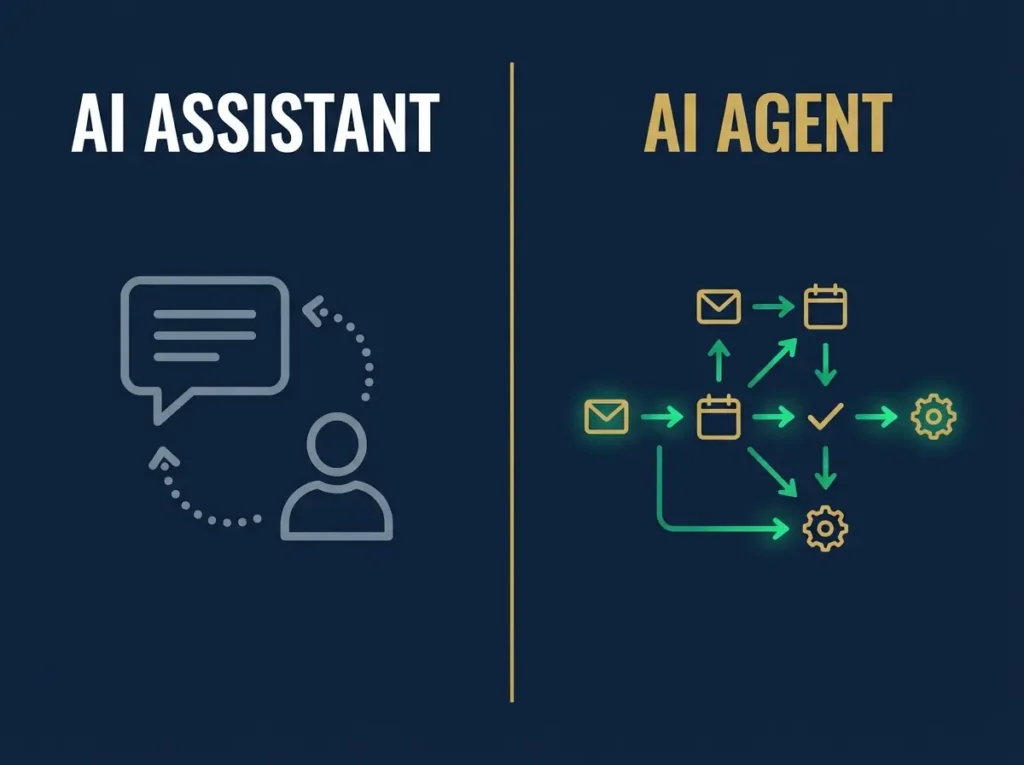
The shift from “AI assistants” to “AI agents” represents a fundamental change in how businesses use artificial intelligence. AI assistants are passive. You ask ChatGPT a question, it responds. You’re in control of every next step. It’s on the read path of your business, analyzing and generating information.
AI agents are proactive. They interpret high-level goals, break them into actionable steps, and execute them independently. They operate on the write path of your business. They change data. They send emails. They process transactions. They make decisions within defined parameters.
Consider the difference: A ChatGPT assistant might help you draft a customer support response. An AI agent in your support queue automatically categorizes tickets by priority, drafts responses for common issues, and escalates complex cases to humans with full context already loaded.
For startups, the value is immediate and measurable. Instead of hiring another team member for support ($60,000 to $80,000 per year, plus benefits and training), you deploy an AI agent ($500 to $5,000 per month depending on the platform). The agent handles 40 to 60 percent of tickets automatically. Your human team handles 60 percent of volume but only the complex, high-value issues. Response time drops from 24 hours to 5 minutes. Customer satisfaction increases by 15 percent in first-month deployments.
That’s not theoretical. That’s what the winning AI agent startups have documented with their customers.
The Top 20 AI Agent Startups by Category
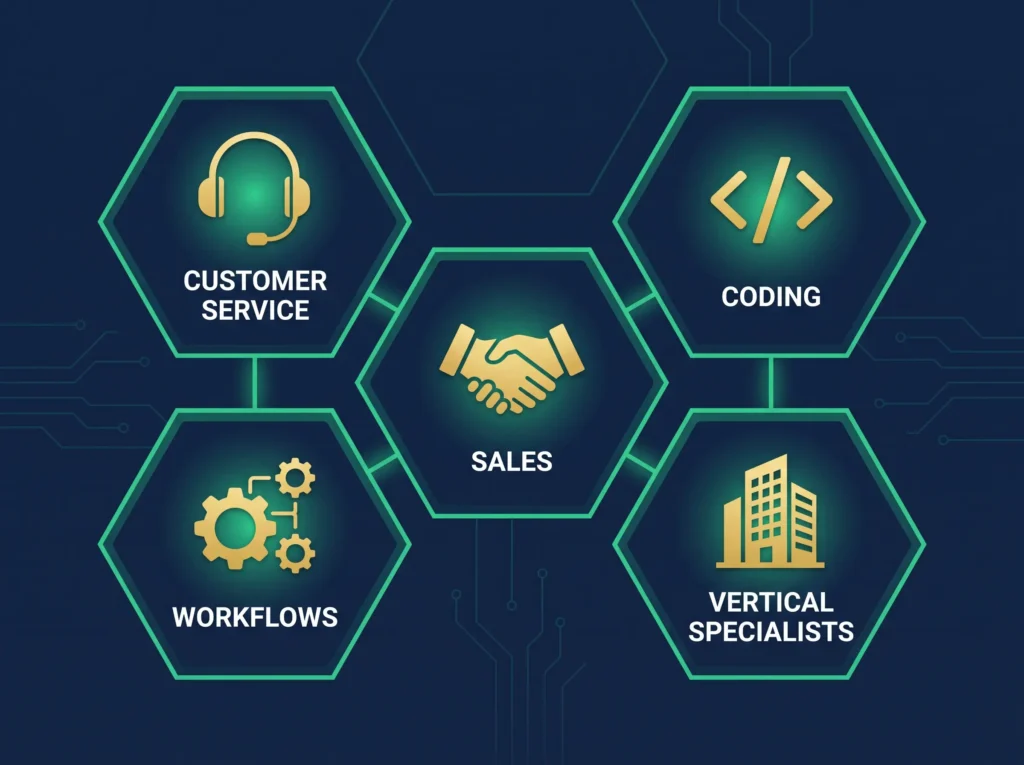
Before listing companies, understand what separates winners from the field. Vertical specialization beats horizontal generalization. A customer service agent built for e-commerce (handling returns, refunds, order disputes) outperforms a general-purpose chatbot. A coding agent built for the developer workflow (with testing, deployment, and code review) beats a generic code suggestion tool.
Here are the top 20 AI agent startups reshaping how businesses operate.
Customer Service and Support Agents
Sierra What it does: Enterprise customer service AI agents that handle complex tasks like patient authentication, processing returns, credit card replacements, and mortgage applications. Works across phone, chat, email, and WhatsApp. Founding date: 2024 Founders: Bret Taylor (former Salesforce co-CEO), Clay Bavor (former Google VP) Total funding: $635 million Latest round: $350 million Series C (September 2025) Investors: Greenoaks Capital, Sequoia, Benchmark, Index Ventures Why they’re winning: Outcomes-based pricing (pay for completed work, not per subscription). Works across heavily regulated industries like healthcare and finance. Already processing complex customer interactions at scale. Customer impact: Illustrated time savings of 68 percent in support response times with 15 percent improvement in satisfaction scores.
Harvey What it does: AI agents specialized for the legal industry. Handles document review, legal research, due diligence, and contract analysis. Valuation: $5 billion Total funding: $230+ million Founders: Scott Wu, Steven Hao, Walden Yan Why winning: Vertical specialization in law (a $200+ billion market). High stakes work means premium pricing power. Endorsed by major law firms and in-house legal departments. Customer impact: Reduces legal document review from weeks to days, cutting research time by over 50 percent.
Yuma AI What it does: Customer support and sales automation for e-commerce. Integrates directly with Shopify, Zendesk, and helpdesk systems. Confirms order status, creates return labels, processes refunds, updates customers automatically. Founding date: 2024 Funding: Early stage (Series A) Why winning: E-commerce is a massive vertical with high support volume. Integrates into existing stacks without rebuilding infrastructure. Customer impact: Resolves 40 to 60 percent of customer support tickets automatically, reducing team burden significantly.
Maven AGI What it does: Customizable AI agents for customer service queries. Powers support teams at ClickUp, Tripadvisor, and fintech startup Rho. Status: Actively deployed in production environments Why winning: Proven in multiple verticals. Handles complex queries by compiling relevant context for human escalation.
Autonomous Coding and Technical Agents
Cognition AI (Devin) What it does: The first AI software engineer that can plan, code, test, and deploy entire applications autonomously. Founding date: 2023 Founders: Scott Wu, Steven Hao, Walden Yan Total funding: $230+ million Latest round: $175 million Series B (December 2024) Why winning: First mover in autonomous software engineering. Can write production-grade code, not just suggestions. Backed by top technical investors. Developer impact: Saves 2 to 4 hours per week on boilerplate code, testing, and deployment for projects with repetitive patterns.
Cursor What it does: AI-powered code editor. Combines inline code generation with refactoring and architectural guidance. Valuation: $29 billion Why winning: Developer-first approach. Integrates into existing IDEs without context switching.
GitHub Copilot (Extensions) Note: While GitHub owns this, Copilot now supports autonomous agents for routine tasks. Saves 30 to 40 percent of time on boilerplate and test code.
Sales and Revenue Operations Agents
Penciled What it does: AI-powered front office assistant for medical and service-based businesses. Manages patient appointment scheduling and confirmations via natural language voice calls. Teams building similar sales and business automation workflows often explore how AI tools power affiliate marketing and sales operations to scale lead management. Integration: Directly works with EMR systems like WebPT Why winning: Solves a specific pain point (scheduling consumes admin time). Natural language means no staff retraining needed. Customer impact: Eliminates manual phone tree workflows, reduces no-shows, improves patient experience.
Sales Agent Platforms (General Category) Many platforms now offer AI agents for sales: lead qualification, follow-up automation, deal closing assistance. These typically save 20 to 30 percent of sales team time on administrative tasks.
Workflow Automation and Orchestration
When implementing AI agents for workflow automation, understanding the broader landscape of generative AI workflows and orchestration helps you design systems that coordinate multiple agents effectively.
Glean What it does: Enterprise knowledge AI agent. Retrieves information across all company systems (email, Slack, documents, etc.) and provides unified answers. Valuation: $7.2 billion Funding: Over $200 million raised Why winning: Solves knowledge silos. As companies scale, finding information becomes the real bottleneck, not generating it. Enterprise impact: Reduces time searching for information by 60 to 70 percent.
n8n What it does: No-code workflow automation with visual agent orchestration. Allows teams to build multi-agent systems by dragging and dropping AI nodes. Founding date: Open-source project with commercial backing Why winning: Democratizes agent building for non-technical founders. Powerful enough for complex workflows, simple enough for beginners. Implementation benefit: Teams can build custom agents without hiring engineers.
Make (formerly Integromat) What it does: Workflow automation platform with growing AI agent capabilities. Connects hundreds of apps and automates data flow between them. Status: Actively competing with Zapier and n8n Why winning: Affordable, visual, with strong emerging AI agent features.
Vertical and Specialized Agents
Brickanta What it does: Construction-specific AI agents for project analysis, insights, tendering, procurement. Funding: $8 million raised from leading AI and construction investors Team: Built by engineers from ABB, Fabege, Husqvarna, IKEA, Konecranes Why winning: Vertical specialization in construction (a massive, underserved market). Uses AI with industry-specific knowledge.
Bravi What it does: AI operating system for home-services businesses. Replaces front office work with AI-powered customer communication. Uses AI copilot for pricing and technical documentation. Status: Live with leading installers and manufacturers in US and Europe Why winning: Home services is fragmented with no modern software. First-mover advantage in this vertical.
Moveworks What it does: IT operations and employee support AI agents. Handles IT ticket resolution, HR queries, access requests. Status: Enterprise deployments across Fortune 500 Why winning: IT support is high-volume, repetitive work. Agents handle tier 1 issues automatically.
Olas What it does: Custom AI agent development platform. Helps enterprises build agents for specific workflows. Status: Early stage but gaining traction Why winning: Enterprise customization matters. Off-the-shelf solutions often don’t fit unique workflows.
Additional Notable Startups
Char – AI notepad that finishes your todos. Types a checkbox, agent picks up the task (researching, drafting, scheduling).
Meteor – Browser-based AI agent that can navigate the web, book calendars, find cheaper flights, and make purchases autonomously.
Remy (by MindStudio) – Product manager AI agent. Automates content research, structure analysis, SEO optimization.
Lovable – AI platform for building custom agents without coding. Customers deploying in production within weeks.
PolyAI – Voice-based AI agents for customer service. Handles conversations in 99+ languages.
What the Top AI Agent Startups Have in Common
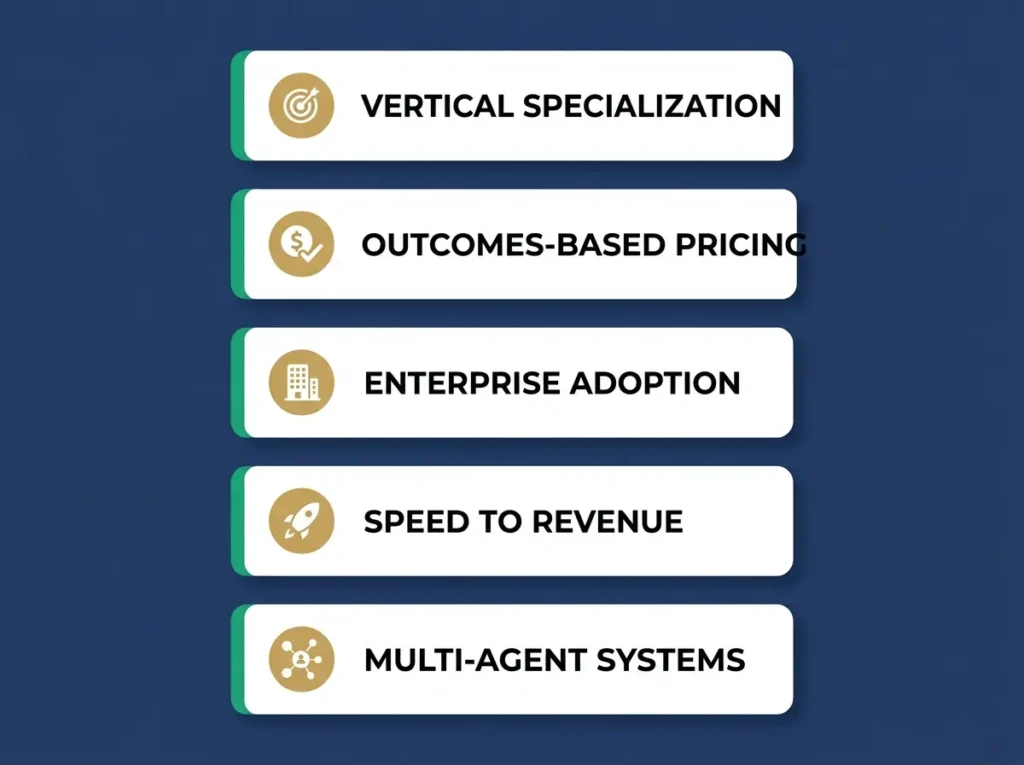
The companies winning the AI agent race share distinct patterns. Understanding these patterns tells you where the market is heading.
Vertical Specialization Over Horizontal Generalization Sierra focuses on customer service. Cognition AI focuses on coding. Brickanta focuses on construction. Harvey focuses on legal. Each dominates their vertical.
The generalist approach (one agent for everything) is failing. Specialized agents have better accuracy, better compliance, and better unit economics. They command premium pricing because they deliver measurable ROI in specific domains.
Outcomes-Based Pricing Over Subscriptions Sierra charges for work completed, not per user per month. You pay when the agent actually resolves a customer service interaction. This aligns incentives. The company wins when the agent works well.
Traditional SaaS (subscription pricing) creates misalignment. The company gets paid whether the agent works or not. Smart enterprises are demanding outcomes-based pricing. Startups offering it are winning contracts.
Enterprise Adoption, Not Consumer The AI agent startups with real traction focus on enterprises and small-to-medium businesses, not consumers. Enterprise buyers have budget for AI. They measure ROI. They deploy at scale.
Consumer AI agents (personal assistants, life coaches) remain nascent. Enterprise AI agents (customer service, coding, operations) are already processing real work.
Speed to Revenue
Sierra reached $100 million annual recurring revenue in 7 quarters (1.75 years). Lovable reached $7 million ARR in 12 months. Understanding the broader landscape of ways to make money with AI provides context for these unprecedented enterprise software growth rates.
The speed comes from solving immediate, high-pain problems. Customer service at scale is painful. Code writing is painful. If your agent saves time or money on a painful problem, enterprises buy immediately and at scale.
Multi-Agent Systems Over Single Agents The winning approach is not one super-intelligent agent. It’s multiple specialized agents collaborating. A research agent feeds findings to a copywriter agent. A code review agent works with a testing agent. A triage agent escalates to a specialized support agent.
This division of labor reduces hallucinations and errors. Each agent stays within its domain. The orchestration happens at the system level.
Your AI Agent Stack for Startups by Role

Most startup resources are limited. You can’t deploy 10 agents at once. You need to know: What’s the minimum viable AI agent stack for my role?
Here’s what founders should consider deploying first.
Founder/CEO Stack If you spend time on: GTM strategy, investor communication, financial tracking Deploy these agents: Orchestration agent (coordinates other agents) + CRM/sales agent (manages pipeline) + analytics agent (pulls financial dashboards) Timeline: 4-8 weeks to implement Illustrative cost: $2,000 to $5,000 per month Time savings: 8-12 hours per week (reduce meetings, automate reporting, delegate research) Payoff: Break-even in 6-8 weeks of founder time saved
Sales Team Stack If you spend time on: Lead follow-up, deal qualification, closing Deploy these agents: Lead qualification agent + follow-up automation agent + deal intelligence agent Timeline: 3-6 weeks to implement Illustrative cost: $1,500 to $3,000 per month Time savings: 20 to 30 percent per sales rep (40+ hours per month for a 2-person team) Payoff: Breaks even immediately if even one deal closes faster
Engineering/Product Stack If you spend time on: Code review, testing, deployments, documentation Deploy these agents: Code review agent (Cognition AI) + test automation agent + deployment agent + documentation agent For product managers specifically, exploring best AI tools for product managers can help integrate agents into your broader product and engineering workflow. Timeline: 6-10 weeks to implement Illustrative cost: $2,500 to $4,500 per month Time savings: 2-4 hours per engineer per week (on boilerplate, testing, documentation) Payoff: Breaks even in 8-10 weeks of engineering time saved
Customer Support Stack If you spend time on: Answering support questions, processing refunds, managing escalations Deploy these agents: Triage agent (categorizes tickets) + knowledge search agent (finds answers) + escalation agent (context for humans) Timeline: 2-4 weeks to implement Illustrative cost: $1,000 to $2,500 per month Time savings: 40 to 60 percent of tier 1 support volume handled automatically Payoff: Breaks even in 1-2 weeks if you have 50+ monthly tickets
Real ROI of AI Agent Startups
Most AI agent marketing focuses on features (“handles complex tasks autonomously”). Founders care about outcomes (“how much time do I get back, and will it pay for itself?”).
Here’s the honest math. Learning how AI tools that save time generate measurable ROI is critical before deploying any agent.
Cost of Implementation
Setting up an AI agent isn’t free. There’s infrastructure, integration, training, tuning.
For a commercial platform (Sierra, Glean, n8n): You’re looking at $500 to $5,000 per month depending on usage. Add 40-60 hours of internal setup time (yours or a contractor’s).
For a custom agent (Lovable, Olas): Build time is 4-12 weeks. Cost: $10,000 to $50,000 depending on complexity. Monthly maintenance: $1,000 to $3,000.
For open-source + DIY (building with Cognition AI or Claude): High engineering time cost (200-500 hours), minimal software cost.
Hours Saved Per Role (Real Data from SERP)
Customer service agents: 68 percent reduction in response time. For a 2-person support team handling 200 tickets/month, that’s 40-50 hours reclaimed per month.
Sales follow-up agents: 20 to 30 percent of sales admin time automated. For a 3-person sales team doing 50 follow-ups weekly, that’s 10-15 hours per month.
Coding agents: 30 to 40 percent of boilerplate and test code time. For 3 engineers, that’s 24-32 hours per month.
Payback Period
Customer service agent: $2,000/month platform cost + 10 hours setup = breaks even in 4-6 weeks of response time savings.
Sales agent: $1,500/month platform cost + 20 hours setup = breaks even in 6-8 weeks if one additional deal closes 1 week faster.
Coding agent: $3,000/month platform cost + 40 hours setup = breaks even in 6-10 weeks of engineer time saved.
Cost vs. Hiring Alternative
This is the real comparison. Not “cost of agent vs. nothing.” It’s “cost of agent vs. hiring another person.”
A junior customer support person costs $35,000-$50,000 per year, plus training, benefits, turnover. An AI agent costs $12,000-$36,000 per year. The agent doesn’t need training, doesn’t leave, and improves over time.
A junior sales development rep costs $40,000-$60,000 plus 3-6 months to productivity. An AI agent costs $18,000-$36,000 per year and is productive immediately.
A junior engineer costs $60,000-$90,000 plus 1-3 months to productivity. An AI coding agent costs $24,000-$48,000 per year and is productive on day one.
The ROI case is straightforward: If an agent saves 30 percent of one person’s time, it pays for itself.
How to Choose an AI Agent Startup
With 20+ companies competing for your attention, how do you pick?
Start with Your Biggest Time-Sink
Don’t choose based on hype. Choose based on your actual problem. Where do you personally lose the most time? Is it customer support? Sales follow-up? Code review? Project management?
Pick the agent category that solves that specific problem first. You can add agents later, but your first one needs to deliver immediate, obvious ROI.
Evaluate Vertical Specialization vs. Horizontal Flexibility
A vertical specialist (Sierra for customer service) will outperform a generalist (ChatGPT for all use cases) in your domain. It’s more accurate. It’s cheaper. It has better compliance.
But vertical specialists lock you in. You’ll need multiple specialists as you grow. The tradeoff is worth it.
Test on Free or Trial Tier First
Most AI agent startups offer free trials or freemium plans. For founders building on a budget, understanding free AI tools available for marketing and operations is valuable context before committing to paid platforms. Use free tiers for 2-4 weeks before paying. Measure actual time saved, not feelings.
Integration Complexity Matters
Does the agent work with your existing tech stack? Does it need custom API work? Integration friction kills adoption. Pick agents that integrate directly with your CRM, email, Slack, or documentation systems.
Ask about implementation support. How hands-on is the onboarding? Who handles custom configuration?
Production-Grade Maturity
Not all AI agents are production-ready. Some are demos that work 70 percent of the time. Production-grade agents work 99%+ of the time, with failover, error handling, and audit trails.
Cognition AI and Sierra are production-grade. Many early-stage startups are not. Ask: “How many production deployments do you have? What’s your uptime? What’s your error rate?”
Security and Data Privacy
Especially important if you’re handling customer data or financial information. Does the startup encrypt in transit and at rest? Do they have SOC 2 certification? Who owns your data?
Outcomes-Based Pricing
If available, prefer outcomes-based pricing over subscriptions. You pay for work completed, not per user per month. It aligns incentives.
Common Mistakes Startups Make With AI Agents
Mistake 1: Choosing a Generalist Agent for Specialist Work
You buy ChatGPT or Claude expecting it to replace your customer support team. It doesn’t. General-purpose models are 70 to 80 percent accurate for specific domains. Vertical specialists are 95%+ accurate. Your customers notice the difference.
Mistake 2: Expecting Production-Ready When Beta Exists
Many AI agent startups are 1-2 years old. They can demo impressive capabilities. They can’t handle production reliability yet. Expect to be an early adopter. Expect bugs. Expect tuning.
Mistake 3: Overestimating Time Savings
The first month, you might save 30 percent of time on your target task. But then friction appears. The agent makes mistakes. You spend time correcting and retraining it. Net savings drop to 15-20 percent.
Be conservative in your ROI estimates. If the math works at 15 to 20 percent improvement, great. If it only works at 50 percent improvement, you’ll be disappointed.
Mistake 4: Deploying Multiple Agents at Once
You get excited. You buy a customer service agent and a sales agent and a coding agent all in month one. Your team is overwhelmed with new workflows. Adoption fails. You blame the agents.
Start with one. Measure results over 4-8 weeks. Then add a second.
Mistake 5: Not Measuring or Tracking Results
You assume the agent is saving time. You never actually measure it. Six months later, it’s costing you money and you don’t know why.
Before deploying, establish a baseline: “Our support team processes 200 tickets/month, takes 2 hours per ticket on average, costs us $6,000 in labor.”
After deploying: Track actual tickets per person, actual time per ticket, total cost.
Comparing Top AI Agent Startups by Use Case
| Use Case | Top Choice | Alternative | Why | Cost Range |
|---|---|---|---|---|
| Customer Service | Sierra | Maven AGI | Production-ready, outcomes-based pricing, enterprise scale | $2K-5K/mo |
| Sales Operations | Dedicated sales platform | n8n + custom config | Vertical specialization, proven with Fortune 500 | $1.5K-3K/mo |
| Coding | Cognition AI | GitHub Copilot | End-to-end (code, test, deploy), first-mover advantage | $2.5K-4.5K/mo |
| E-commerce Support | Yuma AI | Lovable + custom build | Direct Shopify integration, handles refunds/returns natively | $1K-2.5K/mo |
| Legal | Harvey | General legal AI tools | Vertical specialization, trained on legal workflows | $5K-10K+/mo |
| Workflow Orchestration | Glean or n8n | Make | Connects all your systems, finds information, coordinates agents | $1K-3K/mo |
| Mobile/Warehouse Automation | Pixel or custom | N/A | Highly specialized (robotics), requires hardware | Custom pricing |
FAQ: Your Questions About AI Agent Startups
Q: Will AI agents replace my job?
A: No. They replace tasks, not jobs. If you spend 40 percent of your time on support tickets and an AI agent handles 60 percent of tickets, you still have work. You now spend 40 percent of time on complex issues that need human judgment. Your role evolves. Your team size stays the same or shrinks, but your role deepens.
Q: Are AI agents ready for production use?
A: Some are. Sierra, Cognition AI, and Glean have thousands of production deployments. Most early-stage startups (2-3 years old) are production-capable with caveats. Expect to be an early adopter. Expect edge cases and bugs. Plan for human oversight.
Q: What’s the biggest risk with AI agent startups?
A: Startup risk. The company gets acquired, shuts down, or pivots away from agents. You lose your platform. Build on platforms with multiple years of funding and customer count. Avoid single-founder startups or those with only 1-2 customers.
Q: Should I build a custom agent or use a startup’s platform?
A: Use a platform first. Platforms are faster (3-6 weeks vs. 12-16 weeks to build custom). Platforms have production maturity. If after 3 months the platform doesn’t fit your needs, build custom. By then you understand the requirements better anyway.
Q: How long does it take to see ROI?
A: 6-12 weeks for most use cases. Month 1-2: setup and tuning (no savings yet). Month 3-4: agent starts handling 40-50 percent of volume and you see time savings. Month 4-6: agent reaches 60-70 percent accuracy on routine work.
Q: Are there open-source AI agent alternatives?
A: Yes. Tools like n8n, AutoGPT, and LangChain let you build agents using open-source models (Llama, Mistral) and commercial APIs (Claude, GPT-4). Advantage: full control. Disadvantage: 200-500 engineering hours to build and maintain.
Q: What happens if the AI agent makes a mistake?
A: It depends on the mistake. If it misroutes a support ticket, a human handles it. If it processes a refund incorrectly, you reverse it manually. Most agents have human-in-the-loop for high-stakes decisions. Always audit AI agent decisions before they affect customers or money.
Q: Is there a difference between AI agents and workflow automation?
A: Yes. Workflow automation (Zapier, Make) follows rules you define. If X then Y. AI agents interpret goals and figure out the steps. They adapt to new situations. They learn. They make judgment calls within boundaries. AI agents are more flexible but need more oversight.
Key Takeaways
- AI agents are not chatbots. They execute workflows autonomously, not just answer questions.
- Vertical specialization wins over horizontal generalization. Sierra dominates customer service. Harvey dominates legal. Choose agents built for your specific domain.
- The winning startups use outcomes-based pricing. You pay for work completed, not per user per month.
- The market is real. Sierra hit $100 million ARR in 7 quarters. These are unprecedented growth rates for enterprise software.
- Your first AI agent should solve your biggest time-sink. Support? Sales? Coding? Pick one and measure the ROI. Then expand.
- Payback period is typically 6-12 weeks. If an agent saves even 15 percent of one person’s time, it pays for itself.
- Production-grade agents work 99%+ of the time. Early-stage startups work 70-80 percent. Choose based on your tolerance for bugs.
- Start with one agent. Measure for 4-8 weeks. Then add a second. Deploying 5 agents at once causes adoption failure.
- AI agents will reshape the nature of work, not eliminate jobs. Your role evolves from execution to judgment and strategy.
- The AI agent market is consolidating fast. Vertical specialists are winning. Generalists are losing. Invest in platforms with enterprise customers and multiple years of funding.
Your Next Step: Build Your First AI Agent Stack
You now understand the landscape. The next step is implementation.
Pick your biggest time-sink. Define it precisely. “Our customer support team loses 20 hours per week to routine ticket handling.” Not “we need better customer support” but specific, measurable.
Evaluate 2-3 agents in that category. Sierra for customer service. Cognition AI for coding. Yuma AI for e-commerce. Run a 30-day free trial. Measure actual time saved and quality.
If the metrics show 15 percent or better improvement and payback is under 16 weeks, deploy. If not, try another agent or category.
Measurement is everything. Don’t deploy based on demos or vendor pitches. Deploy based on your own 30-day trial data.
The founder who started this article losing 2 hours every night to CRM work? With a CRM agent, that work drops to 30 minutes. He gets 12 hours back per month. He uses that time to close more deals, build better product, or sleep.
That’s the AI agent opportunity. Not hype. Not replacing your job. Giving you your time back.








Leave a Reply