

Published: October 30, 2026 | Category: Finance, Cryptocurrency
A cryptocurrency exchange holding billions of dollars in digital assets is supposed to be one of the most heavily protected places in the industry. Yet on October 29, 2026, Binance became the target of an extraordinary security breach that has raised urgent questions about the safety of cryptocurrency platforms.
Hackers moved an estimated $6.3 billion in assets from Binance wallets, according to the exchange’s disclosures and subsequent reporting. Industry partners have frozen approximately $3 billion, while investigators continue tracing the remaining assets.
The incident is being described as potentially the largest cryptocurrency theft on record.
For Binance users, however, the most pressing question is not how the attack compares with previous hacks.
It is much simpler.
Is the money in my Binance account safe, and when will I be able to withdraw it?
Binance says customer funds are safe and has promised to cover losses using its Secure Asset Fund for Users, known as SAFU, together with company funds. Deposits are operating normally, but cryptocurrency withdrawals remain temporarily suspended while the exchange strengthens its security systems.
The company has indicated that withdrawals could resume around November 1, provided its security checks are completed successfully. That remains a target, not a confirmed reopening.
Here is what happened, how the attack may have worked, what investigators have discovered, and what Binance users should know before taking any action.
Binance Hack 2026: Latest Updates on October 30
The situation is developing, and several details have changed since Binance first acknowledged the security incident.
The most important update concerns withdrawals.
Binance initially suspended deposits and withdrawals as a precaution. In a subsequent official service update, the exchange clarified that deposits were operating normally while withdrawals remained paused.
Its security team is reviewing the withdrawal infrastructure, related wallet addresses and authorization controls before restoring service.
Binance security incident status
| Question | Latest confirmed information |
|---|---|
| When did the attack occur? | October 29, 2026 |
| How much was affected? | Approximately $6.3 billion |
| How much has been frozen? | Approximately $3 billion |
| Are Binance deposits working? | Binance says yes |
| Are withdrawals working? | Still paused in the latest verified update |
| When might withdrawals resume? | Targeted around November 1 |
| Were private wallet keys stolen? | Binance says it has found no evidence of a leak |
| Will Binance cover losses? | The company has committed to covering losses |
| Who carried out the attack? | Investigators suspect North Korean linked actors; attribution remains under investigation |
These details are based on Binance’s October 30 announcements and reporting by Reuters.
A timeline of the Binance security incident
October 29: Unauthorized cryptocurrency transfers begin
Blockchain investigators identified unusual transfers from Binance wallets to addresses controlled by the attackers. Reuters reported that the bulk of the theft occurred within approximately 20 minutes.
October 29 to October 30: Binance suspends services
The exchange temporarily halted withdrawals while its security team investigated the incident and attempted to stop additional unauthorized transactions.
October 30: Binance confirms the scale
Binance disclosed an estimated impact of $6.3 billion and said approximately $3 billion in affected assets had been frozen with the assistance of industry partners.
October 30: Deposits are confirmed operational
The company clarified that deposits remained available, although withdrawals were still suspended.
October 30: Investigation expands
Binance said the incident was more complicated than initially believed. Investigators discovered additional possible breach points beyond the suspected compromised employee laptop.
October 30: Withdrawal restoration target emerges
The company indicated that it hoped to restore withdrawals around Sunday, November 1, after rebuilding and testing security controls.

The key point is that the investigation is still active. Some technical details and recovery figures may change as Binance and independent investigators release additional findings.
Is Binance Safe Right Now After the Hack?
Binance says its users’ funds are safe, but that statement needs context.
There is a difference between an exchange promising to cover losses and independent verification that all affected assets have been restored.
Binance has committed to using company resources and its SAFU reserve to compensate for the incident. The company has also said it will publish updated Proof of Reserves information after remediation.
According to The Block’s October 30 report, Binance said it had allocated more than $6.34 billion in company funds and reserves to offset the incident’s losses.
That is an important financial commitment.
However, users should distinguish between funds allocated to cover losses, assets frozen during recovery, and compensation actually delivered.
Does the hack mean your individual account was compromised?
Not necessarily.
Binance has said it found no evidence that private wallet keys were leaked during the incident.
The reported attack targeted the exchange’s operational infrastructure and wallet transaction authorization process.
That does not establish that every individual account was compromised or that attackers obtained ordinary customers’ passwords.
Nevertheless, the absence of evidence of a private key leak is not proof that every part of the exchange’s infrastructure was unaffected.
Users should continue monitoring official updates and their own account activity.
Should users panic or immediately transfer everything?
Panic is unlikely to improve account security.
At the time of this report, withdrawals remain paused, meaning users may not be able to transfer cryptocurrency until Binance restores the service.
The practical response is to verify account activity, review security settings and avoid making decisions based on rumors or messages from strangers claiming to offer emergency withdrawals.
When withdrawals resume, users should evaluate their own custody preferences, liquidity needs and risk tolerance rather than following blanket instructions circulating on social media.
Are Binance Withdrawals Suspended? When Will They Resume?
Yes. Binance withdrawals remain suspended in the latest verified October 30 update.
The company says it is strengthening the security of its withdrawal infrastructure and related addresses.
In its official withdrawal status update, Binance indicated that it expected to resume withdrawals within approximately 48 hours of the announcement.
Later reporting by CoinDesk indicated that the exchange was targeting Sunday, November 1.
That does not mean every cryptocurrency, network or account will necessarily become available simultaneously.
Binance has not confirmed a complete reopening schedule covering every asset and withdrawal network.
Are Binance deposits working?
Binance says deposits are operating normally.
This is a change from its initial precautionary suspension, which affected both deposits and withdrawals.
Users should still verify the deposit status of their particular cryptocurrency and network before transferring funds.
What happens to a pending withdrawal?
A pending withdrawal may remain incomplete while services are paused, but the exact handling depends on Binance’s transaction status and internal processing rules.
Users should inspect their withdrawal history in the official Binance application or website.
A transaction marked as pending, processing or rejected should not automatically be interpreted as evidence of theft.
If a transaction appears unfamiliar, contact Binance through its official support system.
Where should users check for updates?
The most reliable starting point is the Binance official announcements page.
Users can also consult the company’s verified communication channels and the service status displayed inside their accounts.
Avoid websites that promise early withdrawal access, special compensation registration or private recovery assistance.
How Did Hackers Steal $6.3 Billion From Binance?
One of the most surprising aspects of the incident is that Binance has not reported a confirmed leak of wallet private keys.
Instead, its initial investigation pointed to a compromised laptop belonging to a DevOps engineer.
A DevOps engineer typically works with the infrastructure used to build, deploy and operate software systems.
That can include servers, automated deployment tools, service containers, access permissions and operational environments.
Binance said the compromised computer may have allowed an attacker to access a service container and submit unauthorized withdrawal transactions.
In simple terms, the attacker may have exploited the systems authorized to perform transactions rather than directly stealing the cryptographic secret that controls a wallet.
Why is that distinction important?
Cryptocurrency security is often discussed in terms of private keys.
A private key is a cryptographic secret that allows its holder to authorize transactions from a wallet.
But modern exchanges use complex operational systems around those keys.
These systems determine which transactions are approved, which services may access wallets and which actions require additional authorization.
An attacker who compromises part of that infrastructure may be able to exploit legitimate transaction mechanisms.
That is why protecting a private key is essential but not sufficient on its own.
Investigators discovered additional breach points
The original laptop explanation is not the complete confirmed account of the attack.
According to CoinDesk’s October 30 investigation, Binance executives acknowledged additional breach points and described a more complicated attack.
The reporting also discussed the possible abuse of Ethereum’s EIP 7702 account delegation functionality.
Account delegation can allow an account to execute certain smart contract functionality. It is a legitimate technical feature, but authorization mechanisms can become dangerous when an attacker obtains inappropriate control.
Binance has not yet published a complete independently verified technical reconstruction of the incident.
It would therefore be premature to claim that any single software feature or employee mistake fully explains the theft.
Why the speed of the attack matters
Reuters reported that much of the cryptocurrency was moved in approximately 20 minutes.
That speed suggests extensive preparation and automation.
An attack involving multiple wallets, assets and blockchains can be executed far more quickly when transactions are coordinated by software.
For security teams, the challenge is not merely detecting suspicious activity.
It is stopping unauthorized activity before a large number of transactions have already been completed.
This is one reason the incident may influence how cryptocurrency exchanges design transaction approvals, access controls and monitoring systems.
Readers interested in broader software security risks can also explore TrendOutsider’s report on critical PHP vulnerabilities in 2026, which examines another area where technical weaknesses can create serious security exposure.

Where Did the $6.3 Billion Go? Understanding the Frozen Funds
The financial figures surrounding the Binance hack are enormous, but they should not be treated as interchangeable.
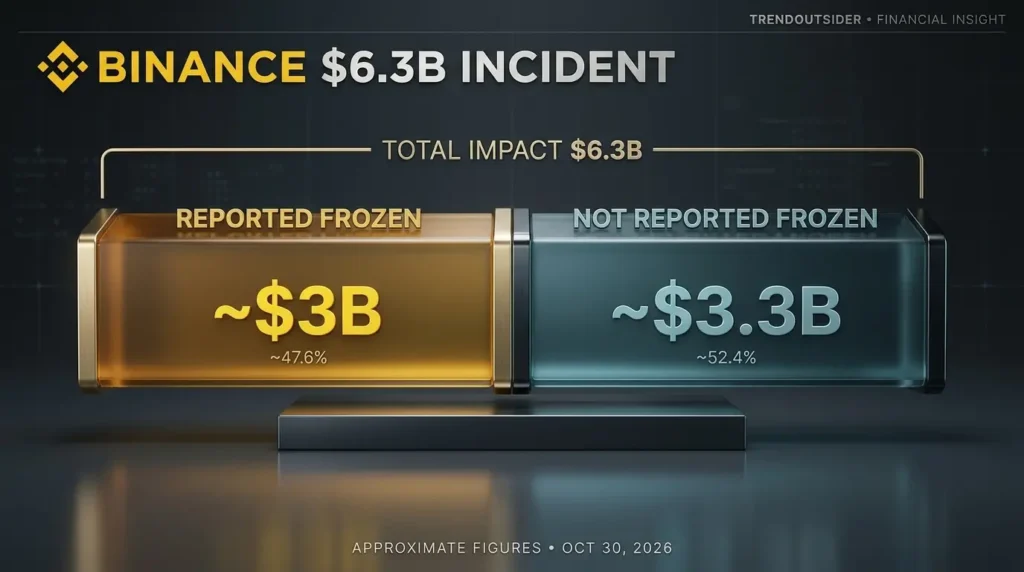
Binance estimates the total impact at approximately $6.3 billion.
The company says roughly $3 billion has been frozen on chain.
That leaves approximately $3.3 billion outside the reported frozen total.
However, this difference does not automatically represent a final, unrecoverable loss.
Binance hack financial breakdown
| Asset category | Approximate value |
|---|---|
| Total estimated incident impact | $6.3 billion |
| Assets reported frozen | $3.0 billion |
| Difference not included in frozen total | $3.3 billion |
| Binance’s reported loss coverage allocation | More than $6.34 billion |
These categories describe different aspects of the incident. The coverage allocation is not an additional stolen amount.
What does freezing cryptocurrency actually mean?
Certain cryptocurrency issuers and blockchain systems have mechanisms that can restrict transfers involving specific assets or addresses.
For example, issuers of centralized stablecoins may be able to freeze tokens associated with suspicious activity.
A freeze can prevent an attacker from moving affected assets through particular mechanisms.
But freezing does not necessarily mean those assets have already been returned to their rightful owner.
Recovery can involve legal procedures, technical coordination, blockchain tracing and cooperation between different organizations.
Why can’t every stolen cryptocurrency be frozen?
Not all cryptocurrencies operate with the same controls.
Some tokens are issued through contracts that include administrative freezing capabilities.
Other digital assets do not have equivalent issuer controls.
As a result, investigators may be able to stop transfers involving some assets while continuing to track others across the blockchain.
The Reuters investigation reported that stablecoin issuers and industry partners played an important role in freezing assets associated with the attack.
Could Binance recover more money?
Potentially.
Blockchain transactions create public records that investigators can analyze.
If stolen funds move through identifiable services or controlled assets, investigators may gain opportunities to freeze or recover them.
However, tracing cryptocurrency does not guarantee successful recovery.
The amount frozen, the amount recovered and the ultimate financial loss should be reported separately as the investigation progresses.
Will Binance Refund Users After the Hack?
Binance has publicly committed to covering losses associated with the security incident.
The exchange says it will use its Secure Asset Fund for Users and company resources.
This is a significant promise because a cryptocurrency exchange does not automatically provide the same legal protections as a regulated bank deposit account.
What is the Binance SAFU fund?
SAFU stands for Secure Asset Fund for Users.
It is an emergency reserve mechanism established by Binance to help address certain exceptional circumstances.
The existence of such a reserve can provide an additional layer of financial protection, but it should not be confused with government guaranteed deposit insurance.
The terms, available assets and practical use of the fund are important when evaluating the company’s commitment.
Has Binance already refunded everyone?
There is no basis in the verified reporting reviewed here to claim that every affected user has already received a completed reimbursement.
Binance has promised to cover losses and has described the financial resources it intends to use.
Those are meaningful developments, but the final reimbursement process and timeline still require confirmation.
Do users need to apply for a refund?
Binance has not announced a universal requirement for users to visit a separate website, connect a wallet or pay a processing fee to receive compensation.
Any message claiming that Binance requires an emergency recovery payment should be treated as suspicious.
Users should rely on instructions published through the exchange’s official website or authenticated support channels.

Who Hacked Binance? Why Investigators Suspect North Korea
The identity of the attackers is one of the most closely watched parts of the investigation.
Blockchain intelligence companies TRM Labs and Chainalysis have linked the incident to North Korean actors, according to reporting by Reuters and the Associated Press.
The suspected group is known as TraderTraitor.
Investigators have pointed to similarities with earlier cryptocurrency thefts, including the major attack on Bybit in February 2025.
However, attribution in cybersecurity requires care.
Similar techniques, blockchain transactions and operational patterns can support an assessment without necessarily proving who personally carried out every step of an attack.
What is TraderTraitor?
TraderTraitor is a name used in cybersecurity investigations involving malicious activity associated with North Korean threat actors.
Such operations have been linked to efforts to compromise cryptocurrency organizations and obtain digital assets.
The Associated Press report describes the assessments made by blockchain intelligence firms concerning the Binance incident.
Binance says it is working with law enforcement to identify those responsible.
Until investigators publish a complete account, the most accurate wording is that North Korean linked actors are suspected, not that every aspect of responsibility has been conclusively established.
Binance Hack vs Bybit Hack: How Do They Compare?
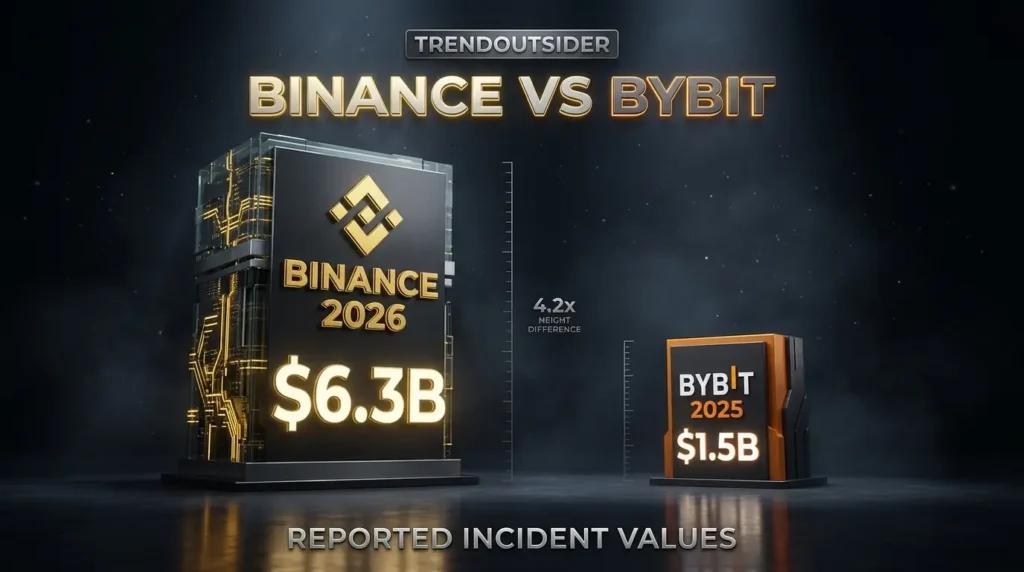
The Binance incident is being compared with the February 2025 Bybit theft, which involved approximately $1.5 billion in cryptocurrency.
Both incidents highlight the risks associated with sophisticated attacks on systems responsible for managing large cryptocurrency holdings.
| Comparison | Binance incident, 2026 | Bybit incident, 2025 |
|---|---|---|
| Approximate reported value | $6.3 billion | $1.5 billion |
| Type of incident | Unauthorized cryptocurrency transfers | Cryptocurrency wallet compromise |
| Suspected actors | North Korean linked actors | North Korean actors attributed by US authorities |
| Major concern | Exchange infrastructure and transaction authorization | Wallet transaction authorization |
| Industry consequence | Large scale asset freezes and withdrawal disruption | Major security and custody concerns |
The Binance incident’s estimated financial impact is approximately 4.2 times the reported value of the Bybit theft.
That comparison illustrates scale, but it does not mean the attacks used identical methods.
The investigation into Binance remains incomplete.
Why this comparison matters beyond the numbers
Both incidents raise a fundamental question.
How can organizations holding enormous amounts of cryptocurrency prevent an attacker from turning a compromised system into authorized looking transactions?
The answer involves more than adding another password or security checkpoint.
It requires careful separation of responsibilities, monitoring, restricted permissions, secure transaction signing and systems capable of responding quickly to abnormal activity.
These challenges become increasingly important as financial organizations adopt automation and artificial intelligence.
TrendOutsider’s AI agents and workflow automation guide explores how automated systems coordinate tasks and why oversight matters when software is permitted to act on behalf of people or organizations.
How Did Bitcoin, Ethereum and the Crypto Market React?
The Binance incident unsettled cryptocurrency markets.
Reuters reported declines in digital asset prices as investors assessed the possible financial and security consequences.
The Wall Street Journal also reported that Bitcoin and Ether fell following the news before recovering some of their losses during Friday trading.
Bitcoin traded near $77,300 in one October 30 market snapshot cited by the publication.
That figure is a historical observation from the reporting period, not a live cryptocurrency price.
Does a major exchange hack automatically cause a market crash?
No.
Cryptocurrency prices respond to many factors, including liquidity, broader financial conditions, investor sentiment and developments specific to individual assets.
A major security incident can contribute to selling pressure and uncertainty.
But it would be misleading to attribute every market movement on October 29 or 30 exclusively to the Binance attack.
The longer term market impact may depend on whether withdrawals resume smoothly, how much cryptocurrency is recovered, and whether Binance demonstrates that the vulnerabilities involved have been addressed.
For the industry, the central issue may be confidence rather than a single day’s price movement.
Seven Security Steps Binance Users Should Take Now
A major cryptocurrency hack often creates a second opportunity for criminals.
Once an incident becomes public, scammers may impersonate customer support representatives, publish fraudulent compensation links or claim that users must urgently transfer assets to a special recovery wallet.
Here are seven practical precautions.
1. Use only the official Binance website and application
Open Binance through a saved bookmark or the application you already trust.
Avoid clicking links in unexpected emails, social messages or search advertisements claiming to provide emergency assistance.
2. Review recent account activity
Check your login history, recent transactions and withdrawal requests.
If you notice activity you do not recognize, contact official Binance support and follow the account security procedures provided there.
3. Review your authentication settings
Use strong, unique account credentials and supported multifactor authentication.
Passkeys or authenticator based methods can offer stronger protection against certain phishing attacks than relying only on SMS verification.
4. Never share your recovery phrase or private keys
A legitimate support representative should not require your wallet recovery phrase.
Anyone requesting it may be attempting to gain control of your assets.
5. Be suspicious of compensation messages
Do not pay a fee to unlock a supposed refund.
Do not connect a wallet to an unfamiliar compensation website.
Do not sign a transaction simply because someone claims it is required to recover stolen funds.
6. Verify withdrawal status before making transfers
When Binance announces that withdrawals have resumed, check whether your particular asset and network are supported.
Avoid repeatedly submitting transactions without understanding their status.
7. Monitor official updates rather than rumors
The investigation is evolving.
Official announcements, authenticated customer support and reputable reporting are more reliable than anonymous messages promising secret information.

These precautions cannot eliminate every risk, but they can reduce the likelihood of becoming a victim of a separate phishing or impersonation attack.
What the Binance Hack Reveals About Cryptocurrency Security
The Binance incident demonstrates why cryptocurrency security cannot be reduced to protecting a password or private key.
Large exchanges operate complex systems involving infrastructure, employee access, transaction signing, software services and blockchain networks.
Every connection between those systems introduces responsibilities and potential failure points.
The incident also highlights the importance of separating authority.
A system that can request a transaction should not necessarily have unrestricted power to approve and execute it.
Organizations must consider what happens when a trusted device, service or employee credential becomes compromised.
Could artificial intelligence help prevent similar incidents?
Artificial intelligence can assist with security monitoring, code analysis and the investigation of unusual activity.
Advanced models are increasingly being evaluated for vulnerability detection and software remediation.
For example, TrendOutsider recently examined Google’s Gemini 4 Carbon cybersecurity benchmarks and capabilities, including the potential role of AI in identifying software weaknesses.
However, AI is not a substitute for secure system design.
Automated monitoring can generate false positives or miss sophisticated attacks.
Human review, independent security testing and carefully designed authorization controls remain essential.
The most important lesson from the Binance incident may ultimately concern the operational systems surrounding cryptocurrency wallets rather than the wallets themselves.
Frequently Asked Questions About the Binance Hack 2026
Was Binance hacked on October 29, 2026?
Yes. Binance disclosed a major security incident involving unauthorized cryptocurrency transfers on October 29, with an estimated impact of approximately $6.3 billion.
How much cryptocurrency was stolen from Binance?
The reported impact is approximately $6.3 billion. The precise final loss may change as investigators trace, freeze and recover affected assets.
How much money has Binance frozen?
Binance says approximately $3 billion in affected cryptocurrency has been frozen on chain with the assistance of industry partners.
Are Binance withdrawals working now?
In the latest verified October 30 update, withdrawals remain suspended while Binance completes security improvements. Users should check official announcements for any subsequent change.
When will Binance withdrawals resume?
Binance has targeted a restoration around November 1, 2026, subject to successful security checks. This is an expected timeline, not a guaranteed reopening.
Are Binance deposits working?
Binance says deposits are operating normally, although users should confirm availability for their particular asset and network.
Are Binance user funds safe?
Binance says customer funds are safe and has committed to covering losses using SAFU and company resources. Independent verification of the completed remediation and reimbursement process remains important.
Will Binance refund stolen funds?
Binance has promised to cover losses associated with the incident. The complete reimbursement process and timing have not yet been publicly established in the sources reviewed.
Did hackers steal Binance private keys?
Binance says it has found no evidence that wallet private keys were leaked. Investigators are examining compromised infrastructure and additional possible breach points.
Was North Korea responsible for the Binance hack?
Blockchain intelligence firms have attributed the incident to North Korean linked actors, including TraderTraitor. The full investigation remains ongoing.
Is the Binance hack bigger than the Bybit hack?
Based on the reported figures, yes. Binance’s estimated $6.3 billion impact is substantially larger than the approximately $1.5 billion reported in the 2025 Bybit incident.
Should I change my Binance password?
If you suspect your credentials have been exposed or notice unauthorized activity, changing your password through the official Binance website or application is prudent. Reviewing authentication and account security settings is also worthwhile.
Final Verdict: What Happens Next After the Binance Hack?
The Binance hack of October 2026 is more than an extraordinary financial loss.
It is a major test of how the cryptocurrency industry responds when sophisticated attackers compromise the operational systems of a leading exchange.
The reported $6.3 billion impact is enormous. So is the effort to freeze approximately $3 billion in affected assets.
Binance has committed to covering losses, rebuilding security controls and restoring withdrawal services once it believes the environment is safe.
But several questions remain unanswered.
How did the attackers gain sufficient control to authorize the transactions? How much of the affected cryptocurrency will ultimately be recovered? Will withdrawals resume according to the expected schedule? And what will the final investigation reveal about the exchange’s security architecture?
For Binance users, the immediate priorities are straightforward.
Check official service updates, protect account credentials, avoid suspicious compensation offers and wait for verified information about withdrawals.
For the wider cryptocurrency industry, the consequences may extend well beyond one exchange.
The next important development will not simply be another estimate of the stolen funds.
It will be whether Binance can restore normal operations, substantiate its financial commitments and demonstrate that the weaknesses behind the attack have been addressed.
TrendOutsider will update this report as new information is verified.
Editorial sources and disclosure
This article draws on official Binance announcements and reporting by Reuters, Associated Press, CoinDesk, The Block and other established publications. Figures and service status reflect information reviewed on October 30, 2026.
TrendOutsider has not independently conducted a blockchain forensic investigation or audited Binance’s reserves. Claims about the attack’s technical mechanisms, recovery progress and suspected perpetrators are attributed to the organizations reporting them.
This article is for general information and is not personalized financial or investment advice.









Leave a Reply