
Google has introduced Gemini 4 Hydrogen, a new artificial intelligence model designed to make sophisticated AI capabilities faster, more accessible and less expensive to use.
Announced on November 12, 2026, Hydrogen arrives with a one million token context window, four configurable thinking levels and API pricing starting at $1.50 per million input tokens. Google is bringing the model to its Gemini app, Search, developer tools and business products.
But the most interesting part of the launch is not simply another benchmark score.
Google is trying to change how people use powerful AI. Instead of relying on its most demanding models for every request, the company wants developers and businesses to combine deeper reasoning models with a faster system capable of writing code, processing documents, calling tools and completing everyday tasks.
That makes Gemini 4 Hydrogen potentially significant for everyone from casual Gemini users to software teams building autonomous AI agents.
The early evidence is encouraging, although it also reveals important limitations. Here’s what Google has confirmed, what independent testing shows and how Hydrogen compares with Gemini 4 Carbon and Argon.
What Is Gemini 4 Hydrogen?
Gemini 4 Hydrogen is a multimodal AI model developed by Google DeepMind and adapted from Gemini 4 Carbon.
According to Google’s official launch announcement, Hydrogen focuses on fast execution across coding, automation, research and everyday assistant tasks.
It belongs to the same model family as Gemini 4 Carbon and Gemini 4 Argon, but Google has given each model a different role.
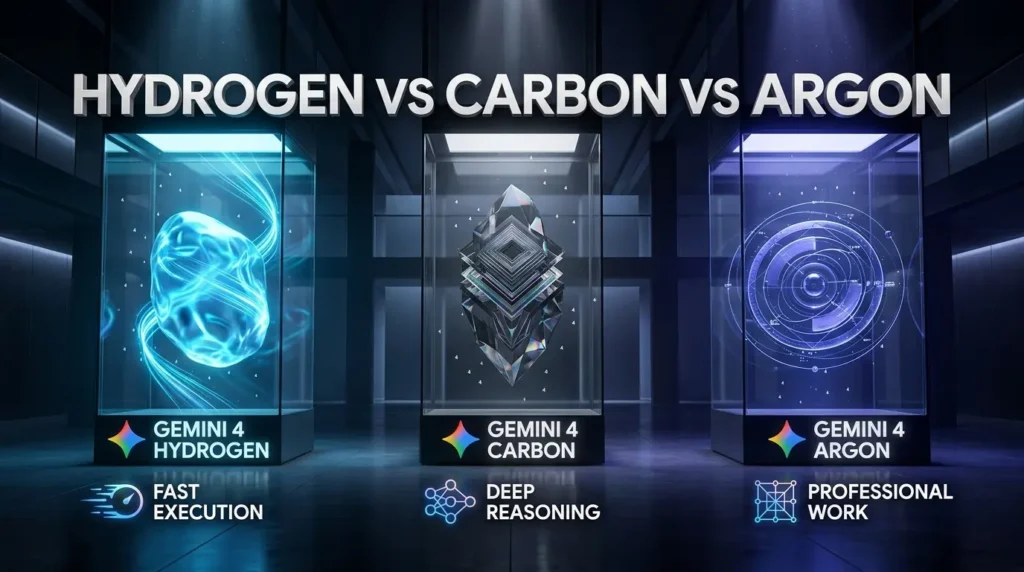
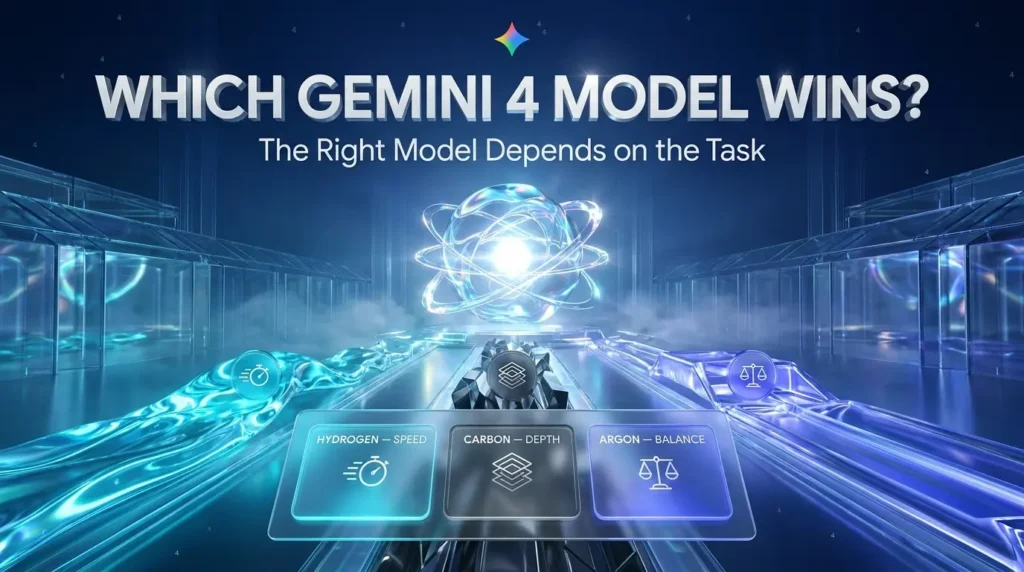
Carbon is intended for particularly difficult, sustained reasoning and engineering problems. Argon targets demanding but more routine professional work. Hydrogen is designed to execute a broad range of tasks quickly while controlling costs.
That distinction matters because the most powerful model on a benchmark is not necessarily the most economical model for running hundreds of daily operations.
A software developer might need Carbon to investigate a complicated architectural problem, then use Hydrogen to implement smaller changes, run tests and organize results. A business could use Hydrogen for document processing and routine workflows without assigning its most expensive model to every step.
Hydrogen can also operate independently. Google is not presenting it exclusively as a secondary model.
Gemini 4 Hydrogen specifications at a glance
| Feature | Gemini 4 Hydrogen |
|---|---|
| Developer | Google DeepMind |
| Official announcement | November 12, 2026 |
| Model family | Gemini 4 |
| Model foundation | Adapted from Gemini 4 Carbon |
| Supported inputs | Text, images, audio and video |
| Context window | Up to 1 million tokens |
| Default synchronous output limit | Up to 64,000 tokens |
| Extended output capability | Up to 1 million tokens through background long decode |
| Thinking levels | Low, Medium, High and Xhigh |
| API input pricing | $1.50 per million tokens |
| API output pricing | $7.50 per million tokens |
| Main use cases | Coding, agents, research, automation and multimodal work |
The specifications are documented in the official Google DeepMind model card.
One detail deserves attention: the one million token context window does not mean ordinary requests automatically produce one million tokens of output. Google’s model card distinguishes the standard synchronous output limit from a separate background long decode capability.
Gemini 4 Hydrogen vs Carbon vs Argon: What’s Different?
Google now offers several Gemini 4 models that appear to overlap in capability, but their intended roles are different.
For users, the important question is not which model has the most impressive name. It is which model offers enough capability for the work being performed.
Gemini 4 Carbon: Deep reasoning and difficult engineering
Carbon is Google’s more demanding frontier model, built for complex reasoning, cybersecurity research, scientific work and long-running software engineering tasks.
Google made Carbon more broadly available on November 10, two days before Hydrogen’s announcement.
Carbon is particularly relevant when an AI system must investigate complicated failures, compare competing explanations or sustain a difficult technical workflow over many steps.
Our earlier TrendOutsider coverage of Gemini 4 Carbon provides additional background on the model’s launch, benchmarks and access.
Gemini 4 Argon: General professional reasoning
Argon occupies a middle position in Google’s lineup, with an emphasis on demanding knowledge work and software engineering.
Google describes it as suitable for many professional tasks that require more reasoning than a basic assistant interaction.
Gemini 4 Hydrogen: Fast execution and everyday intelligence
Hydrogen emphasizes rapid task completion, coding iteration, tool use and large-scale deployment.
It is also positioned for workflows involving several AI agents, where paying for the most expensive reasoning model at every step could become impractical.
| Model | Primary emphasis | Best starting point for |
|---|---|---|
| Gemini 4 Hydrogen | Fast, efficient execution | Everyday assistance, coding, agents and automation |
| Gemini 4 Argon | Strong general reasoning | Professional knowledge work and complex development |
| Gemini 4 Carbon | Frontier reasoning and sustained investigation | Difficult architecture, cybersecurity and scientific research |
These descriptions reflect Google’s intended positioning, not a guarantee that one model will outperform another on every task.
The right choice depends on accuracy requirements, latency, available tools, context length and the total cost of reaching a correct result.
Gemini 4 Hydrogen Benchmarks: How Powerful Is It?
Google says Hydrogen reaches a score of 51 on the Artificial Analysis Intelligence Index at its default High thinking level, increasing to 54 at Xhigh.
Google also reports that Hydrogen exceeds Gemini 4 Argon’s score of 50 at the default High setting.
Those figures suggest that a model optimized for efficiency can still perform competitively on broad intelligence evaluations.
However, a single index cannot establish that Hydrogen is better for every application.
Different benchmarks test different abilities. Coding tests measure something different from computer interaction, scientific reasoning or business automation.
Google’s published model card provides a useful breakdown.
Selected Google-published benchmark results
| Benchmark | Gemini 4 Hydrogen | Claude Sonnet 5.5 | GPT-6.1 Terra |
|---|---|---|---|
| SWE-sweep | 13.5% | 3.1% | 5.8% |
| Terminal-Bench 4.1 | 57.0% | 63.9% | Not listed |
| Agents’ Last Exam v1.1 | 71.6% | 60.4% | 69.8% |
| OSWorld 2.1, offline subset | 77.6% | 83.9% | 74.2% |
| Multimodal Knowledge Agent | 53.4% | 52.0% | 43.8% |
| HLE-Diamond | 58.8% | 53.3% | 47.3% |
Source: Google DeepMind’s November 2026 model card. These are published evaluation results, not tests conducted by TrendOutsider. Methods and settings vary by benchmark.
Hydrogen performs particularly well in some agentic and knowledge-work evaluations, but it does not lead every comparison.
Claude Sonnet 5.5, for example, scores higher in Google’s reported Terminal-Bench 4.1 and OSWorld 2.1 results.
This is why broad declarations that Hydrogen has defeated every competing AI model would be misleading.
What independent testing reveals
An especially useful independent evaluation comes from Zapier’s AutomationBench report.
Zapier tested Hydrogen on 657 simulated business tasks at each of three effort settings. The tasks involved operating software tools and completing workflows across areas such as sales, marketing, finance, support and operations.
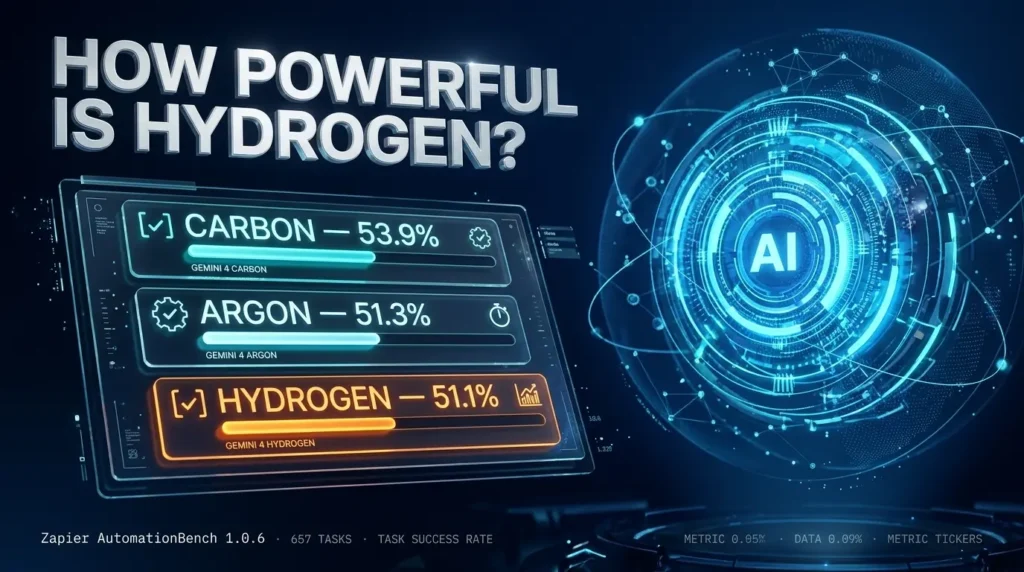
At High effort, Hydrogen completed 336 of 657 tasks successfully, a pass rate of 51.1%.
That was extremely close to Argon’s reported 51.3% on the same benchmark, while the estimated cost per task was substantially lower.
| Model | Strict task success | Estimated cost per task |
|---|---|---|
| Gemini 4 Hydrogen, High | 51.1% | $0.82 |
| Gemini 4 Argon, High | 51.3% | $1.63 |
| Gemini 4 Carbon, High | 53.9% | $1.94 |
Source: Zapier AutomationBench 1.0.6. Costs are modeled estimates using published pricing and caching assumptions, not actual invoices.
The result supports Google’s argument that Hydrogen can offer attractive efficiency.
It also provides a reminder about reliability.
A 51.1% strict success rate means the model failed to complete the full required outcome in approximately 49% of these particular simulated tasks. That does not mean it fails half of ordinary conversations, but it does mean that unsupervised business automation still requires safeguards.
For consequential workflows, developers should use validation, permissions, logging and human review rather than assuming that an intelligent agent will always finish correctly.
Why higher thinking does not automatically mean better value
Zapier’s results also show how the choice of effort setting affects both accuracy and cost.
Hydrogen’s Low setting completed 30.6% of tasks at an estimated $0.18 each. Medium improved success to 46.7% at $0.41. High reached 51.1% at $0.82.
Moving from Medium to High roughly doubled the estimated task cost while improving strict success by 4.4 percentage points.
For some high-value tasks, that additional accuracy may justify the expense. For routine operations, Medium may offer a better balance.
This is a practical reason to evaluate AI systems by successful completed work rather than by token prices alone.
Four Thinking Levels: Low, Medium, High and Xhigh
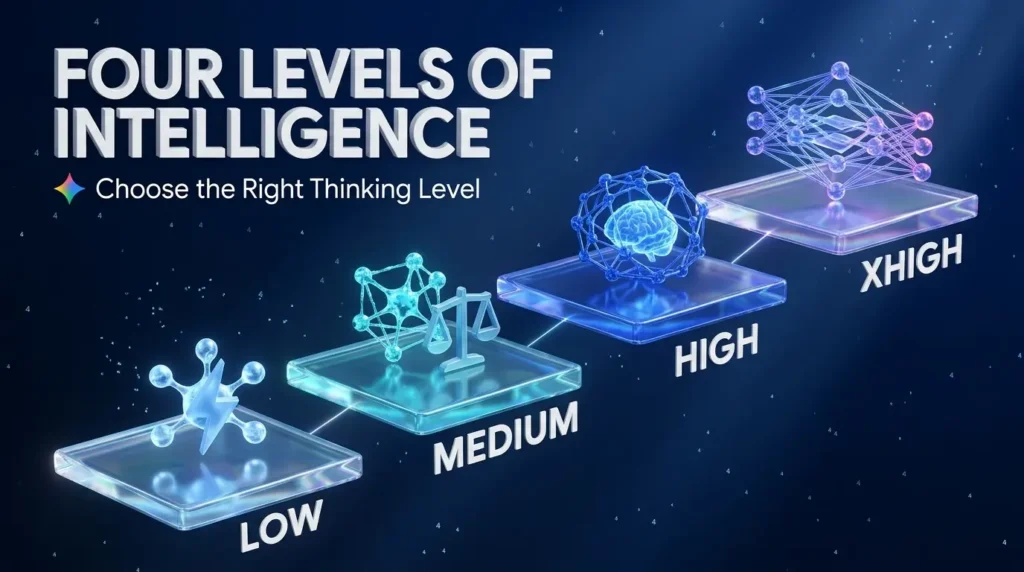
Gemini 4 Hydrogen supports four thinking levels.
These settings allow developers to control how much reasoning effort the model applies before producing a result.
Google describes High as the default, with Xhigh providing additional reasoning capacity for more difficult tasks.
| Thinking level | Intended use | Main consideration |
|---|---|---|
| Low | Simple requests and routine tasks | Prioritizes responsiveness |
| Medium | General work and moderately complex tasks | Balances cost and reasoning |
| High | Demanding coding, research and automation | Greater reasoning effort |
| Xhigh | Particularly difficult problems | May increase latency and token use |
These are practical use recommendations rather than guaranteed performance tiers.
The important distinction is that increasing reasoning effort can improve results on some tasks while increasing costs on others.
Developers should therefore benchmark the same representative tasks at different levels instead of assuming that the highest setting is always optimal.
Gemini 4 Hydrogen Pricing: How Much Does the API Cost?
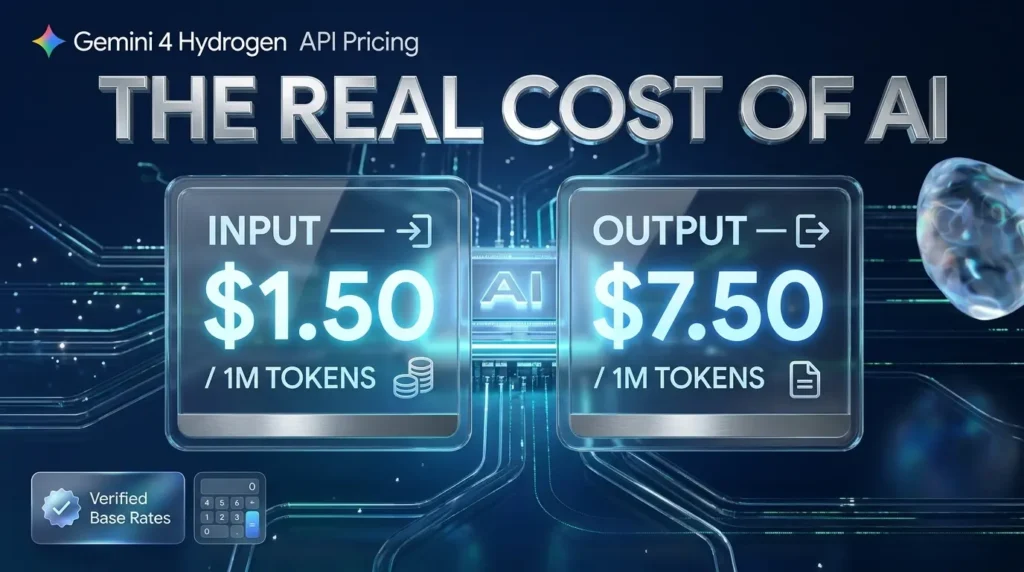
Google’s announced standard API pricing for Hydrogen is:
- Input: $1.50 per million tokens.
- Output: $7.50 per million tokens.
Google says the pricing remains flat across the model’s one million token context window.
That matters for applications processing long documents or extensive conversation histories because the advertised base rate does not increase simply because the request approaches the upper end of the supported context length.
However, the total bill still depends on how many tokens are processed, how much reasoning is generated, whether caching applies and which additional tools are used.
Example API cost calculation
Suppose an application sends 500,000 billable input tokens and generates 100,000 billable output tokens.
| Component | Calculation | Cost |
|---|---|---|
| Input | 0.5 million × $1.50 | $0.75 |
| Output | 0.1 million × $7.50 | $0.75 |
| Total | Input plus output | $1.50 |
This is an illustrative calculation at the published base rates. It is not a prediction of the cost of a real agentic workflow.
A multi-step agent may repeatedly read files, call tools and produce reasoning tokens. Those operations can substantially change the effective cost.
Why cost per successful task matters more
Imagine two models processing the same customer-support workflow.
One costs less per token but requires several retries. Another costs more per token but completes the task correctly on the first attempt.
The first model may be cheaper per request but more expensive per successful resolution.
That is why independent end-to-end evaluations such as Zapier’s are useful. They connect model costs with actual task outcomes rather than measuring token prices in isolation.
Is Gemini 4 Hydrogen Free?
Yes, Google is making Hydrogen available through consumer products that include free access, but free access does not mean unrestricted usage.
Google’s launch announcement explains that free Gemini app users can receive Hydrogen through automatic model selection when it is appropriate for their request.
That is different from a promise that every free user can manually select Hydrogen for unlimited conversations.
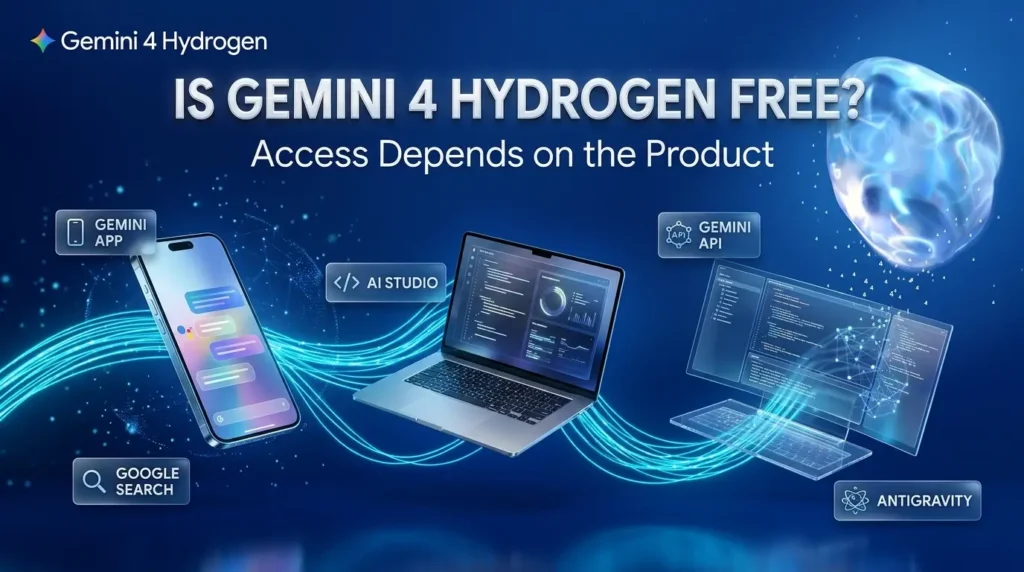
Access also varies between the Gemini app, Google Search, AI Studio, paid developer APIs and Google Antigravity.
Where can you use Gemini 4 Hydrogen?
| Platform | Announced availability |
|---|---|
| Gemini app | Rolling out, including automatic selection for free users |
| Google Search | Global rollout |
| Google AI Studio | Developer access |
| Gemini API | Developer integration |
| Google Antigravity | Eligible Google AI Pro and Ultra subscribers |
| Gemini for business | Eligible enterprise access |
| Google Sheets | Eligible subscription-based access |
The precise limits and model-selection controls can vary by product, subscription and rollout stage.
For developers, API billing and free-tier eligibility should be checked in the current Google AI Studio documentation before deploying a production application.
For everyday users, the simplest starting point is the Gemini app or Google Search.
What Can Gemini 4 Hydrogen Actually Do?
Google is emphasizing several practical capabilities rather than presenting Hydrogen solely as a chatbot.
Coding and debugging
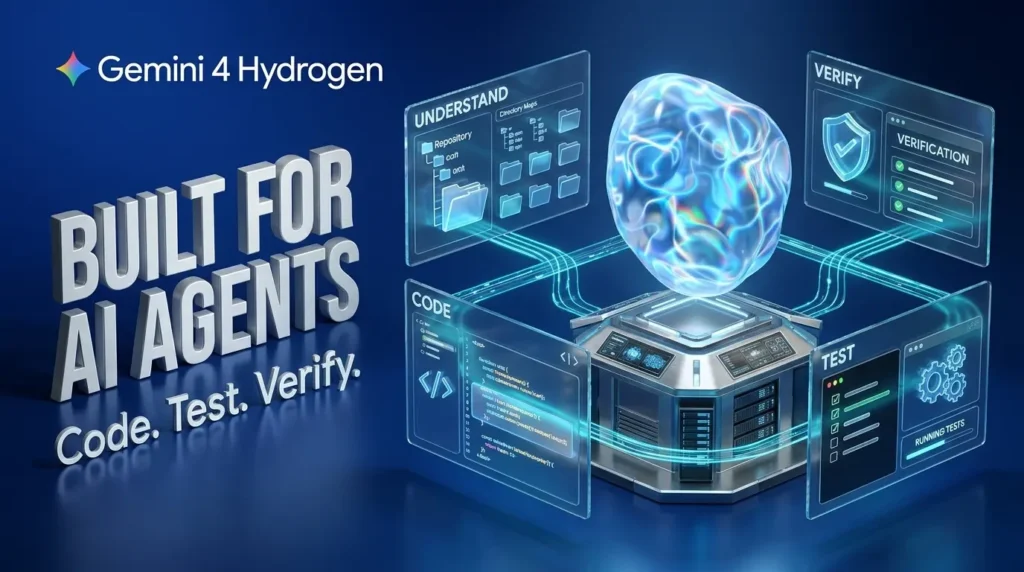
Hydrogen is intended to help developers inspect repositories, write and revise code, investigate errors, run tests and iterate on web interfaces.
Google says the model is particularly effective at batching file-reading and search operations, which can reduce the time spent navigating large codebases.
That could be useful for teams that repeatedly move between code generation, testing and verification.
However, generated code still needs review, especially when it affects authentication, payments, personal data or production infrastructure.
AI agents and workflow automation
An AI agent can use tools to perform actions rather than merely generate text.
For example, a properly authorized agent might inspect a support ticket, retrieve related records, prepare a response and update a tracking system.
Hydrogen is designed for this kind of multi-step tool use.
The challenge is ensuring that the agent selects the correct records, follows instructions, respects permissions and verifies its final changes.
The Zapier results suggest that Hydrogen can perform competitively on simulated business workflows, but they do not justify treating it as an infallible autonomous employee.
Multimodal research and document processing
Hydrogen accepts text, images, audio and video inputs.
Its large context window makes it relevant to tasks involving lengthy documents, technical materials and multiple sources.
Possible applications include analyzing a collection of reports, extracting information from spreadsheets, reviewing visual documents and organizing research findings.
Users should still verify important facts and citations, particularly when documents contain conflicting or outdated information.
Web development and prototyping
Google’s developer announcement highlights interactive web development, design iteration and coding workflows.
For a small development team, the appeal is straightforward: generating an initial prototype is useful, but quickly testing and correcting that prototype is often more valuable.
Hydrogen’s positioning suggests that Google wants the model to handle more of this iterative execution work.
Google Antigravity Orchestrator: Why Multiple Models May Be Better Than One
One of the most consequential announcements accompanying Hydrogen is Google’s Orchestrator system in Antigravity.
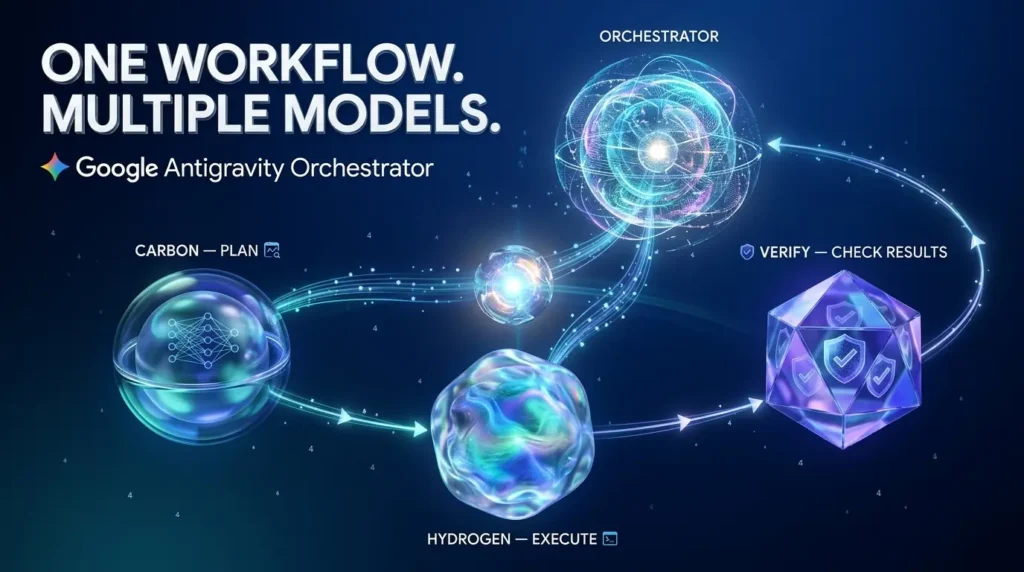
The idea is to use different AI models for different parts of the same workflow.
A deeper reasoning model can handle architecture or difficult decisions, while a faster model performs implementation, testing and verification.
Google reports that, on Terminal-Bench 4.0, Orchestrator approached Carbon’s task success while consuming 24% less quota and completing work 19% faster on average.
Those are Google-reported results for a particular evaluation, not a universal guarantee.
Still, the underlying approach is important.
Consider a development project with several connected tasks. A powerful reasoning model might decide how the components should fit together. Hydrogen could then implement individual changes, run tests and report results. The coordinating system could send difficult failures back to the stronger model.
This structure can reduce unnecessary use of expensive reasoning, provided that task delegation, verification and error recovery work correctly.
The challenge is not merely choosing models. It is maintaining a trustworthy record of what each agent did, what succeeded and what still requires attention.
Gemini 4 Hydrogen in Google Search
Hydrogen’s arrival also affects people who never use an AI development tool.
Google announced that the model is being introduced into Search to help answer complex, multi-part questions.
According to Google’s Search announcement, the system can break down difficult requests, conduct simultaneous searches across relevant subtopics and present structured responses with useful links and visual information.
This could make certain research tasks easier, especially when a question involves comparing several options or connecting information from multiple sources.
However, AI-generated Search answers still require scrutiny.
A confident summary can omit important context, misunderstand a source or present an incomplete answer. Readers should follow original links when decisions depend on accuracy.
For publishers, the change reinforces the importance of producing genuinely useful reporting, clear explanations, original analysis and verifiable sources rather than rewriting announcements without adding value.
Safety, Hallucinations and the Limits of Automation
Google says Hydrogen incorporates improvements to agentic safety, instruction following and resistance to prompt injection.
Its launch announcement reports stronger performance on selected internal safety evaluations.
These findings are relevant because AI agents increasingly interact with documents, websites and tools that may contain misleading or malicious instructions.
But safety benchmark improvements should not be mistaken for complete protection.
The Google DeepMind model card explicitly acknowledges that Hydrogen can hallucinate, experience delays or timeouts, and consume more tokens at higher thinking settings.
Its stated knowledge cutoff is March 2026, meaning that information about later events may require access to current sources.
For production use, developers should establish clear permission boundaries, validate external information, keep audit logs and require additional confirmation before consequential actions.
A model that can operate tools quickly is useful. A system that can verify whether those actions were correct is more dependable.
Should You Choose Hydrogen, Carbon, Argon or Another AI Model?
There is no single answer for every user.
Hydrogen is an appealing starting point for everyday assistance, coding iteration, document analysis and high-volume workflows where responsiveness and cost matter.
Argon remains relevant for more demanding professional reasoning.
Carbon is better aligned with tasks requiring sustained investigation and particularly deep technical analysis, although its additional reasoning can increase resource consumption.
Competing models also deserve consideration. Google’s own benchmark table shows areas where Claude Sonnet 5.5 outperforms Hydrogen, and independent testing continues to evolve.
A sensible model-selection process starts with representative tasks, measures correct outcomes and records total costs.
For developers building agents, that means testing not only whether the model produces a plausible answer, but whether the final application state is correct.
For ordinary users, it means choosing the tool that reliably completes the work without unnecessary complexity.
Frequently Asked Questions
When was Gemini 4 Hydrogen released?
Google officially announced Gemini 4 Hydrogen on November 12, 2026, with a rollout across developer, business and consumer products.
Is Gemini 4 Hydrogen free?
Google says free Gemini app users can access Hydrogen through automatic model selection when appropriate. API usage and advanced product features may have separate eligibility and billing requirements.
How much does Gemini 4 Hydrogen cost?
Google announced API pricing of $1.50 per million input tokens and $7.50 per million output tokens. Actual costs depend on usage, reasoning, caching and any additional services.
Is Gemini 4 Hydrogen better than Gemini 4 Carbon?
Not universally. Hydrogen emphasizes efficient execution, while Carbon is designed for especially difficult reasoning and sustained technical work. The better model depends on the task and its total cost.
How large is the Gemini 4 Hydrogen context window?
Google documents a context window of up to one million tokens, with separate limits and mechanisms for ordinary synchronous output and extended background output.
Can Gemini 4 Hydrogen build websites and applications?
Google positions Hydrogen for coding, debugging, interface development and iterative prototyping. Generated applications still require testing, security review and deployment controls.
Is Gemini 4 Hydrogen the best AI model?
No single benchmark establishes that. Hydrogen performs competitively on several evaluations, but other models lead on particular tests. Independent task-based testing is the best basis for a specific recommendation.
Final Verdict: Google’s Most Interesting Move Is About Efficiency
Gemini 4 Hydrogen is more than another addition to Google’s growing AI lineup.
Its significance lies in the attempt to combine substantial intelligence, fast execution and accessible pricing within a model that can work independently or alongside more demanding systems.
The early results make that strategy credible. Hydrogen approaches Argon’s performance on Zapier’s business automation benchmark at a much lower estimated task cost, while Google’s published evaluations show competitive results across several categories.
Yet the same evidence reveals the limits of today’s AI agents. Impressive benchmark performance does not eliminate failures, and lower token prices do not automatically guarantee cheaper completed work.
For developers and businesses, Hydrogen deserves serious evaluation. For everyday users, its broader availability could make Gemini more capable without requiring everyone to select a premium reasoning model.
The real test will be whether Hydrogen consistently delivers correct, useful results in the workflows people actually depend on.
That is where the next stage of AI competition will be decided.







Leave a Reply