
Nvidia is preparing to report one of the most closely watched earnings announcements of the year, and the numbers could influence far more than the share price of the world’s leading artificial intelligence chipmaker.
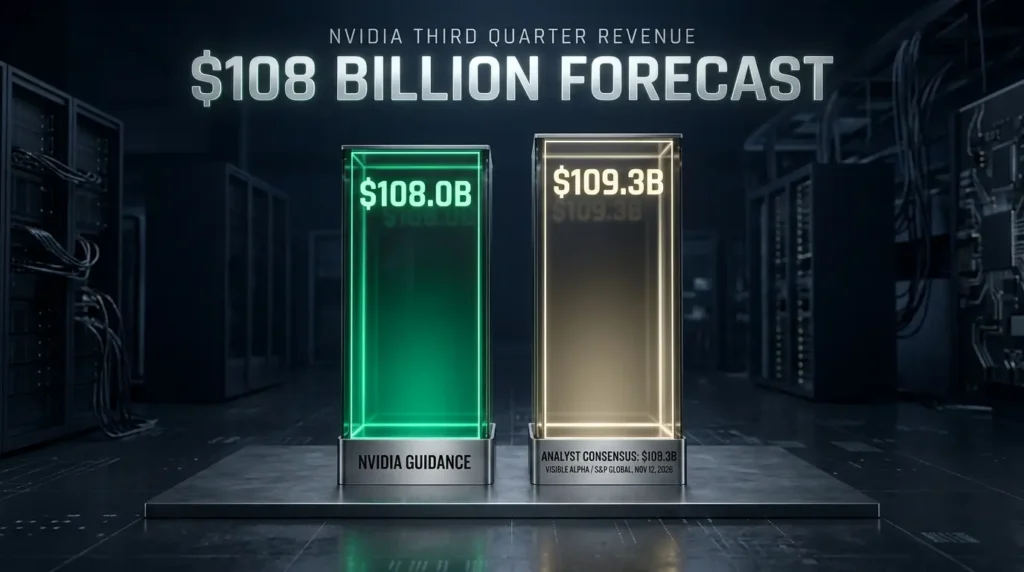
The company will release its third quarter fiscal 2027 results on Tuesday, November 17, 2026, after the US stock market closes. Nvidia has already guided for approximately $108 billion in quarterly revenue, while analysts tracked by Visible Alpha expect about $109.3 billion.
Those are extraordinary figures for a company that reported less than half as much revenue in the comparable quarter a year earlier.
But this earnings announcement arrives in unusual circumstances.
Investors have become increasingly nervous about the enormous cost of building AI data centers. Technology stocks have faced renewed selling pressure. And Nvidia is preparing to explain its business outlook under interim chief executive Colette Kress following Jensen Huang’s resignation on November 12.
For years, Nvidia has been a central beneficiary of the global rush to build artificial intelligence infrastructure. Its chips power training systems, inference services, cloud platforms and the increasingly complex computing operations behind AI applications.
Now investors want to know whether the growth behind that investment story remains as strong as its supporters expect.
Here is when Nvidia will report, what Wall Street is forecasting, which numbers matter most and why the results could influence confidence throughout the AI industry.
When Are Nvidia’s November 2026 Earnings?
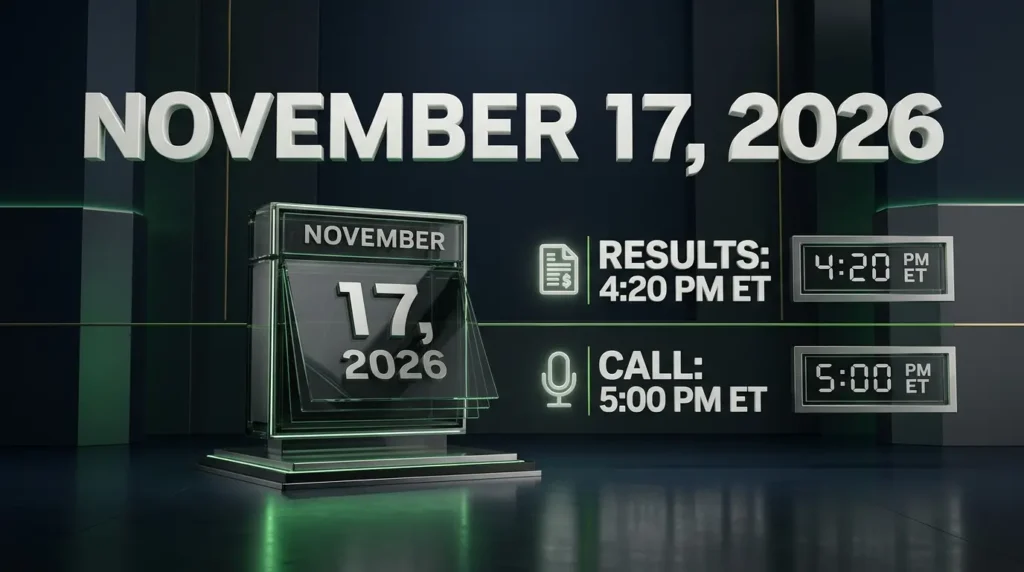
Nvidia will announce its fiscal third quarter 2027 earnings on Tuesday, November 17, 2026.
The company confirmed the schedule in its October 28 investor relations announcement.
The reporting period ended October 25, 2026.
Nvidia expects to release its financial results at approximately 4:20 p.m. Eastern Time, followed by a conference call at 5 p.m. Eastern.
For readers in Pakistan, that translates to approximately 2:20 a.m. on Wednesday, November 18 for the results, followed by the call at 3 a.m.
| Event | US Eastern Time | Pakistan Standard Time |
|---|---|---|
| Earnings release | Nov 17, 4:20 p.m. | Nov 18, 2:20 a.m. |
| Earnings call | Nov 17, 5:00 p.m. | Nov 18, 3:00 a.m. |
Nvidia will make the earnings webcast available through its official investor relations website.
The company also plans to publish written commentary from Colette Kress ahead of the conference call.
Why is Nvidia reporting fiscal Q3 2027 in November 2026?
The year in Nvidia’s financial reports refers to its fiscal calendar, not the calendar year in which the announcement is released.
The company’s third quarter of fiscal 2027 ended on October 25, 2026.
That is why both terms, Nvidia earnings November 2026 and Nvidia Q3 FY2027 results, refer to the same upcoming report.
Nvidia’s $108 Billion Revenue Forecast: What Does Wall Street Expect?
The number receiving the most attention is $108 billion.
That is Nvidia’s own revenue forecast for its third fiscal quarter, issued alongside its previous financial results in August.
The company expects revenue of $108 billion, plus or minus 2%.
That implies a guidance range of approximately $105.84 billion to $110.16 billion.
Nvidia also projected gross margins of around 74%, with a tolerance of half a percentage point, on both a generally accepted accounting principles basis and an adjusted basis.
These are management forecasts. They are not the company’s actual third quarter results.
Analyst expectations are slightly higher
An S&P Global Market Intelligence earnings preview published November 12 reported that analysts tracked by Visible Alpha expect total quarterly revenue of approximately $109.3 billion.
Its data center revenue estimate is approximately $101.8 billion.
MarketBeat separately lists a revenue consensus near $108.72 billion and non-GAAP earnings expectations around $2.47 per share.
Differences between consensus providers are normal. Each may include a different analyst population, update schedule or calculation method.
For readers trying to understand expectations, the essential comparison is between Nvidia’s company guidance, the forecasts available before the release and the actual results that will be published on November 17.
| Metric | Guidance or expectation |
|---|---|
| Nvidia revenue guidance midpoint | $108 billion |
| Company revenue guidance range | $105.84B to $110.16B |
| Visible Alpha total revenue consensus | $109.3 billion |
| Visible Alpha data center revenue consensus | $101.8 billion |
| MarketBeat revenue consensus | $108.72 billion |
| MarketBeat EPS consensus | $2.47 |
These are forecasts or consensus estimates as reported before the announcement.
An earnings result above estimates may be welcomed by investors, but that does not guarantee the share price will rise.
Markets respond to future expectations as well as past performance.
A company can exceed the current quarter’s forecasts and still disappoint investors if its next quarter outlook is weaker than anticipated.
How Strong Was Nvidia’s Previous Quarter?
Nvidia’s latest published quarterly results provide the clearest starting point for assessing the upcoming report.
On August 26, the company announced revenue of $96.221 billion for its second quarter of fiscal 2027.
That represented an 18% increase from the previous quarter and a 106% increase from the same period a year earlier.
Its data center division generated approximately $89 billion in revenue, growing 117% year over year.
The company also reported GAAP diluted earnings of $2.46 per share and non-GAAP diluted earnings of $2.22 per share.
These figures come directly from Nvidia’s official second quarter earnings release.
Nvidia’s previous results at a glance
| Metric | Q2 fiscal 2027 result |
|---|---|
| Total revenue | $96.221B |
| Data center revenue | Approximately $89.0B |
| Year over year revenue growth | 106% |
| Year over year data center growth | 117% |
| GAAP gross margin | 75.0% |
| Non-GAAP diluted EPS | $2.22 |
The data center segment accounted for more than nine tenths of Nvidia’s total revenue in that period.
That concentration explains why the market pays such close attention to AI infrastructure demand.
Nvidia is still involved in gaming, professional visualization, automotive technology and other markets.
Yet the financial performance of its data center business has become the dominant factor in the company’s recent growth.
Why Nvidia’s Data Center Revenue Matters So Much
Nvidia occupies an unusual position in the AI economy.
It supplies crucial computing hardware and software platforms to cloud providers, AI laboratories, enterprise technology companies and infrastructure developers.
These customers need powerful processors to train increasingly capable models and to serve AI applications to millions of users.
As AI usage grows, the demand for computing capacity may also increase.
But there is an important difference between demand for artificial intelligence services and profitable investment in the infrastructure required to provide them.
A cloud company can experience rising AI usage while still facing questions about the profitability of its data center expansion.
The same distinction applies to companies buying Nvidia’s systems.
They may need more hardware, yet investors could simultaneously become less willing to pay high valuations for their businesses.
That tension is central to this earnings report.
The wider AI infrastructure selloff
A November 15 Financial Times investigation reported that a selected group of businesses connected to AI data center construction had lost approximately $4.2 trillion in market value since June.
The downturn has affected businesses supplying equipment, electricity, engineering services and other infrastructure essential to computing expansion.
As TrendOutsider explained in its earlier report on the AI infrastructure stock selloff, declining share valuations do not automatically mean construction demand has vanished.
The market may be reassessing how much future growth is already reflected in stock prices.
Nvidia’s results could provide important new evidence about orders, revenue and demand for advanced computing.
However, strong chip sales would not by themselves establish that every data center project is economically sustainable.

Blackwell and Vera Rubin: Nvidia’s Next Big Growth Drivers
Nvidia’s business is not simply about selling individual graphics processors.
Its strategy increasingly involves complete computing platforms combining accelerators, central processors, networking equipment, software and large integrated systems.
Two generations of hardware are especially relevant to the November earnings discussion.
Blackwell and the current demand cycle
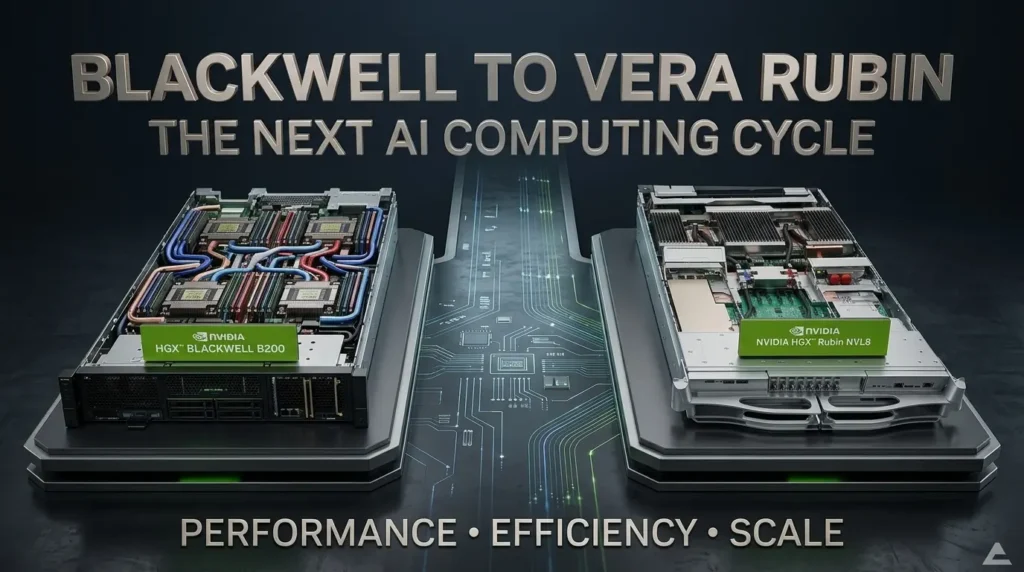
The Blackwell architecture has played a major role in Nvidia’s recent data center expansion.
The company has reported strong demand for its systems as cloud providers and AI developers build greater capacity for model training and inference.
S&P Global’s November earnings preview identifies expectations for continued Blackwell strength as an important driver behind the latest analyst estimates.
The important questions now concern product deliveries, customer demand, manufacturing capacity and profitability.
A high volume of orders is useful only if products can be manufactured, delivered and recognized as revenue under the appropriate accounting rules.
Vera Rubin and the next generation
Nvidia has also been expanding its Vera Rubin computing platform.
In its August earnings announcement, the company said Vera Rubin was ramping into full production, with systems running at partners including Google Cloud, Microsoft Azure, CoreWeave, Oracle Cloud Infrastructure and Nebius.
The architecture combines computing and networking technologies intended to support increasingly demanding AI workloads.
For investors, Vera Rubin represents both a potential future revenue opportunity and an execution challenge.
New systems must deliver meaningful performance benefits while meeting demanding manufacturing, deployment, networking and power requirements.
The earnings call may provide further commentary on customer adoption and the company’s technology roadmap.
However, the timing or scale of future commercial success should not be assumed before management provides updated information.
Nvidia’s Margins Could Matter as Much as Its Revenue
Revenue growth tells investors how much the company sells.
Margins help show how much money remains after relevant costs.
Nvidia reported GAAP and non-GAAP gross margins of approximately 75% in the previous quarter.
For the upcoming quarter, management guided for about 74%.
That difference may appear small, but even one percentage point can represent a considerable amount of money when quarterly revenue exceeds $100 billion.
Several factors may influence profitability.
Advanced AI systems require complex chips, high bandwidth memory, networking components and sophisticated manufacturing processes.
Changes in component costs, production yields, system configurations and product mix can affect gross margins.
Argus Research, in its November market update, highlighted the possibility of margin pressure from higher memory costs in subsequent quarters.
That is an analyst assessment, not a confirmed outcome for the upcoming release.
Investors should compare Nvidia’s actual reported margins with company guidance and examine management’s explanation of any difference.
Why a revenue beat might not be enough
Suppose Nvidia reports revenue above the $109.3 billion Visible Alpha consensus.
That might indicate stronger sales than analysts expected.
But investors could still focus on a weaker margin, disappointing future guidance or concerns about costs.
Conversely, results close to expectations might be viewed more favorably if management provides a convincing explanation of improving capacity and sustained demand.
The market’s reaction depends on the complete financial outlook, not one headline number.
Nvidia’s Leadership Transition Adds Another Question
This earnings announcement is also the first major quarterly financial event following Nvidia’s November 12 leadership transition.
The company confirmed that Jensen Huang stepped down as president, chief executive and board director.
Longtime finance chief Colette Kress became interim CEO while continuing her responsibilities as chief financial officer.
Harvey C. Jones was appointed board chair.
TrendOutsider’s reporting on Jensen Huang’s resignation and Nvidia’s leadership transition provides the verified chronology and background.
The transition matters because Nvidia’s customers make major technology decisions involving product roadmaps, long term supply agreements and substantial infrastructure investments.
Investors will be listening for evidence that the company’s commercial relationships and technical strategy remain stable.
Nvidia’s official statement said that management expects operations, customer commitments and the technology roadmap to continue without interruption.
Will Colette Kress discuss the investigation?
The company has not promised a detailed discussion of the separate investigation during the earnings call.
The primary purpose of the event remains the presentation of financial results and business outlook.
It would be inappropriate to predict specific findings, disclosures or legal outcomes before the relevant authorities and company representatives provide verified information.
For investors evaluating Nvidia’s near term performance, the most useful evidence will be its actual results, management’s guidance and confirmed operational developments.

What Does Nvidia’s Earnings Report Mean for the Wider AI Industry?
Nvidia’s importance extends beyond its own shareholders.
Its hardware forms part of the infrastructure used by many leading AI companies.
Developers of advanced models need access to computing resources, while cloud providers must make long term decisions about capacity and investment.
Anthropic is one example of the scale involved.
Its recent IPO disclosures describe substantial computing commitments extending over many years.
TrendOutsider’s analysis of the Anthropic IPO and its financial risks explains why rapid AI revenue growth must be considered alongside infrastructure costs and long term obligations.
Nvidia sits on the supplier side of that equation.
Strong sales can indicate that demand for computing hardware remains substantial.
Yet the economics of the wider industry ultimately depend on whether AI applications generate enough value to support ongoing spending.
Three outcomes investors should consider
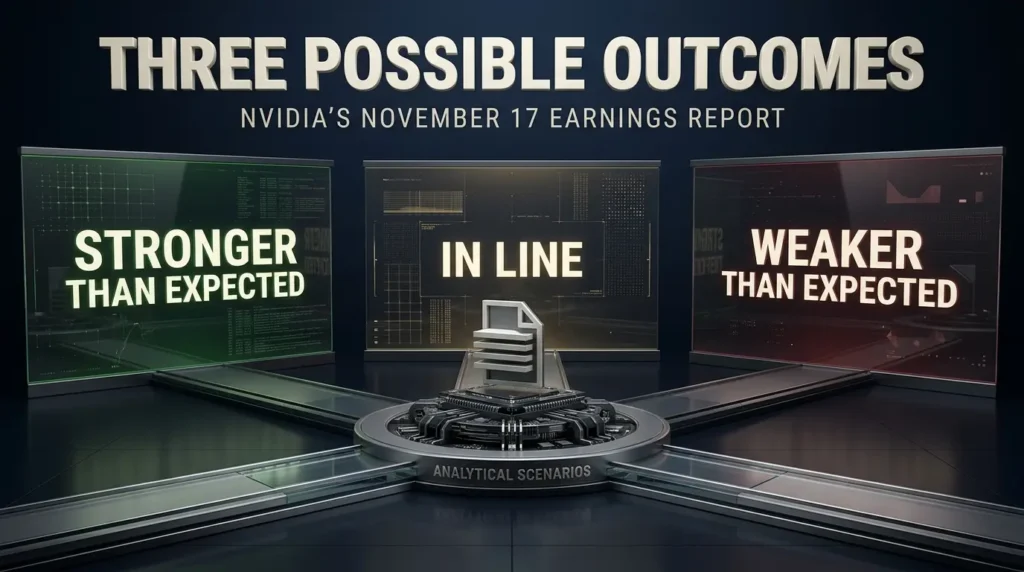
The following are analytical scenarios, not predictions.
Scenario one: Strong results and stronger guidance
Nvidia could report revenue above expectations and provide an encouraging outlook for the following quarter.
That would support the argument that demand remains robust despite recent stock market weakness.
However, it would not guarantee a rise in NVDA shares or a recovery across the entire technology sector.
Scenario two: Results broadly match expectations
The company could deliver results near consensus forecasts, with guidance indicating continued growth.
Investors might then focus on margins, product delivery commentary, leadership continuity and the valuation already reflected in the share price.
Scenario three: Revenue or guidance disappoints
Nvidia could report weaker than expected sales, margins or forward guidance.
That would likely raise questions about the pace of AI infrastructure spending and the timing of customer deployments.
But one disappointing quarter would not establish that artificial intelligence lacks commercial value or that every AI infrastructure project is failing.
Could Nvidia Earnings Move NVDA Stock?
Nvidia’s shares have already experienced a turbulent November.
MarketBeat recorded a closing price of approximately $162.85 on Friday, November 13, down about 2% for that session.
That is a historical quotation, not the live price at the time of reading.
Investors are weighing several developments simultaneously: elevated expectations for AI revenue, uncertainty surrounding leadership, export restrictions, competition and broader questions about data center investment.
This creates the conditions for a potentially significant market reaction.
But the direction and size of that reaction cannot be known in advance.
A company’s shares may decline despite strong reported earnings if investors expected even better results.
They may also rise after mixed results if future guidance proves more encouraging than feared.
What should ordinary readers watch?
Rather than focusing solely on whether Nvidia beats a headline earnings forecast, consider the following:
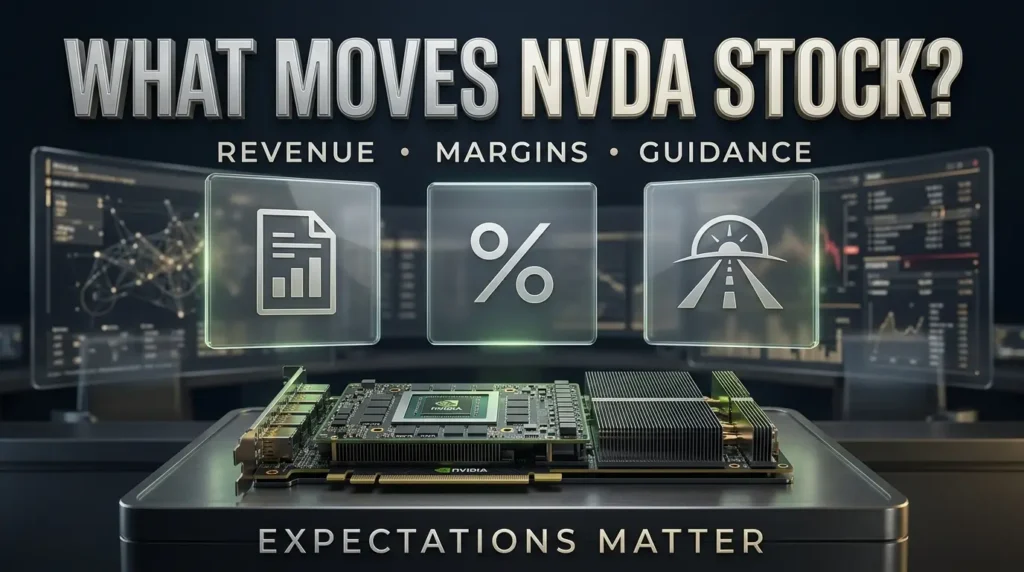
- Total revenue compared with the company’s guidance and current consensus.
- Data center revenue and how it changes from the preceding quarter.
- GAAP and non-GAAP gross margins, with the two measures kept distinct.
- Earnings per share compared with estimates using the same accounting basis.
- Forward revenue guidance and any comments about customer demand.
- Product deliveries, Blackwell demand and Vera Rubin deployment progress.
- Management statements about operations and leadership continuity.
These indicators provide a more complete picture than a stock price movement viewed in isolation.
Where to Watch Nvidia’s Earnings Live
Nvidia’s official investor relations website is the most reliable destination for the earnings release and conference call webcast.
The company has confirmed the following schedule.
Tuesday, November 17, 2026, United States Eastern Time
Earnings announcement: approximately 4:20 p.m.
Conference call: 5 p.m.
The conference call will be streamed through Nvidia Investor Relations.
The live webcast is scheduled to be listen only for the public, with questions limited to financial analysts and institutional investors.
A recording is expected to remain available for replay afterward.
Readers should use the official release to verify figures before relying on social media screenshots, informal summaries or AI generated commentary.
Frequently Asked Questions
When is Nvidia’s next earnings report?
Nvidia will report its third quarter fiscal 2027 results on Tuesday, November 17, 2026, after the US market closes.
What time are Nvidia earnings released?
The company expects to publish results at approximately 4:20 p.m. Eastern Time on November 17, followed by its conference call at 5 p.m.
What is Nvidia’s revenue forecast for Q3 FY2027?
Nvidia guided for approximately $108 billion in revenue, plus or minus 2%. This was management’s forecast, not the actual result.
What does Wall Street expect Nvidia to earn?
Visible Alpha analysts, according to S&P Global’s November 12 preview, expect approximately $109.3 billion in revenue. MarketBeat lists non-GAAP earnings expectations near $2.47 per share.
How much was Nvidia’s previous quarterly revenue?
Nvidia reported $96.221 billion in revenue for its second quarter of fiscal 2027, including approximately $89 billion from its data center segment.
Who will lead Nvidia’s earnings call?
Colette Kress is Nvidia’s interim chief executive and chief financial officer. Nvidia has confirmed that she will provide written financial commentary. The exact speaking roles during the call should be confirmed when it takes place.
Will Nvidia stock rise after earnings?
There is no guaranteed outcome. The stock’s movement will depend on reported results, forward guidance, valuations and broader investor expectations.
Why are Nvidia earnings important for AI stocks?
Nvidia supplies hardware and software platforms used to build advanced AI infrastructure. Its sales and guidance provide information about computing demand, although they cannot establish the profitability of every business operating in the AI industry.
What is the difference between fiscal Q3 2027 and November 2026?
Fiscal Q3 2027 is Nvidia’s financial reporting period, which ended October 25, 2026. The results are being published in November 2026.
Nvidia’s November 17 Earnings Could Reveal the Next Phase of the AI Boom
Nvidia enters this earnings announcement with a remarkable financial record and an unusually demanding set of expectations.
The company has reported extraordinary growth in its data center business. Its products remain central to the systems powering advanced artificial intelligence.
But the environment surrounding that growth has become more complicated.
Investors are questioning the economics of enormous data center projects. AI related shares have faced significant selling pressure. Nvidia is also navigating a consequential leadership transition.
A strong earnings report could reinforce confidence in computing demand and the company’s execution.
A disappointing outlook could intensify concerns about the pace and profitability of AI investment.
Neither outcome will settle every question about the future of artificial intelligence.
What matters is whether the financial evidence continues to support the expectations built around the technology.
On November 17, Nvidia will provide its latest answer.
Editorial methodology: This earnings preview is based on Nvidia’s official financial disclosures and conference call announcement, S&P Global Market Intelligence, analyst research and financial reporting available through November 15, 2026. No unpublished third quarter results were assumed or fabricated.
Financial disclaimer: This article is provided for news and educational purposes. It is not investment advice or a recommendation to buy, sell or hold NVDA shares.
Image disclosure: AI generated images accompanying this article are editorial illustrations. They must not be presented as verified product photographs, actual market charts or photographs of corporate events unless the assets are authentic and separately credited.







Leave a Reply