
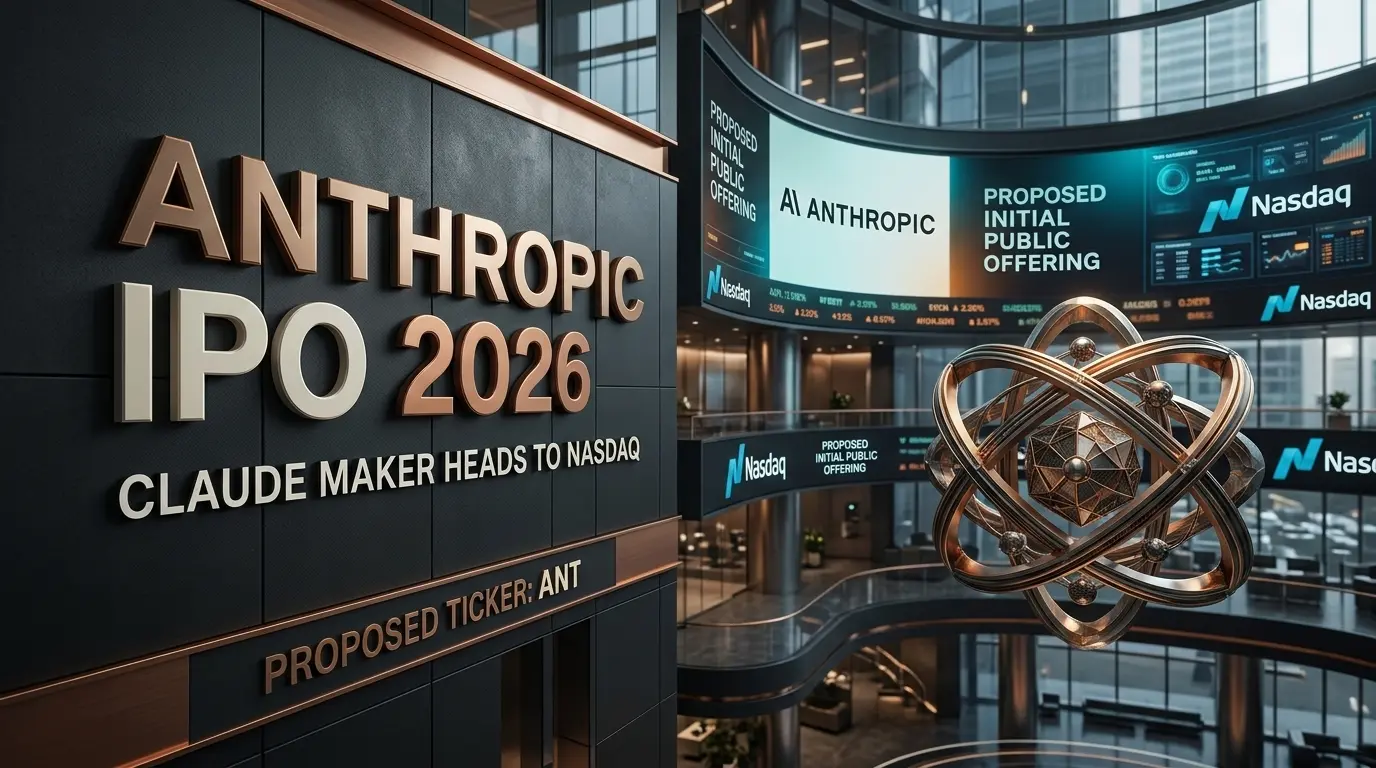
For years, Anthropic has been one of the most closely watched private companies in artificial intelligence. Its Claude models have attracted businesses, developers and consumers, while its rapid growth has drawn billions of dollars in support from some of the world’s largest technology companies.
Now the company is preparing to face a different kind of scrutiny: the public stock market.
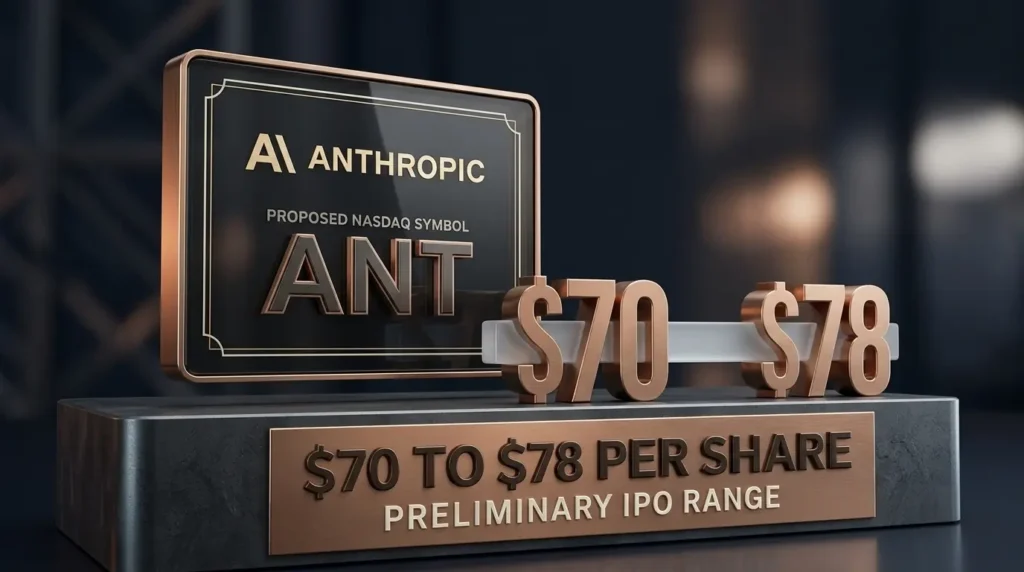
Anthropic’s proposed initial public offering, or IPO, could become one of the defining financial events of the AI boom. The company has filed an amended prospectus with US regulators proposing a share price between $70 and $78, with plans to list its Class A stock on Nasdaq under the symbol ANT.
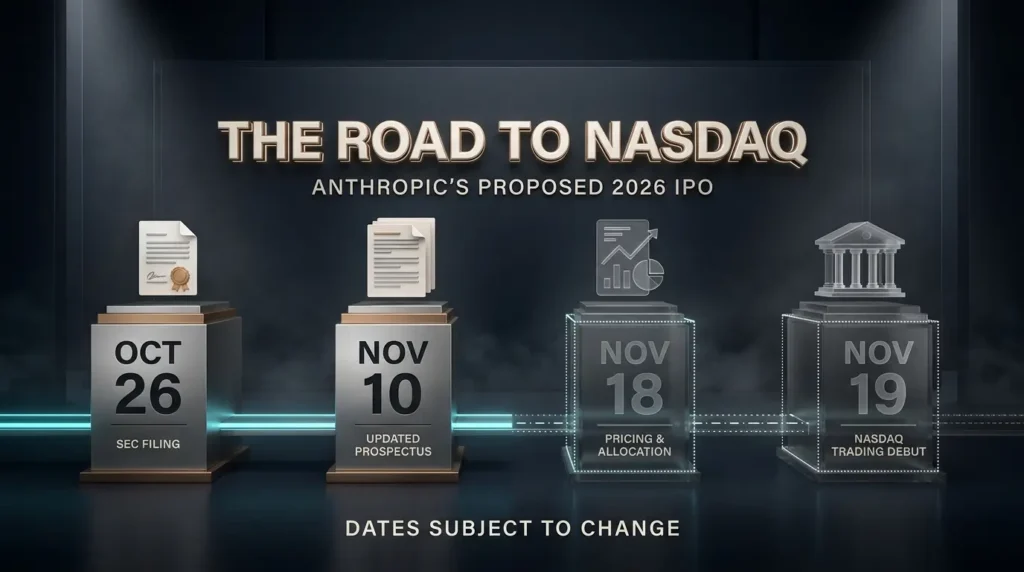
The anticipated trading debut is November 19, 2026, according to the company’s European offering timetable. That date remains subject to final pricing, regulatory effectiveness and completion of the offering.
The scale is extraordinary. Anthropic plans to offer 825 million Class A shares, including shares sold by existing investors. At the top of the proposed price range, the offering would have a gross value of approximately $64.35 billion before underwriting arrangements and other adjustments.
Yet the largest figures in the company’s disclosures are not limited to the IPO itself.
Anthropic reported more than $33 billion in revenue during the first nine months of 2026 and an annualized revenue run rate of approximately $81 billion at the end of October. Its offering materials also describe roughly $900 billion in computing commitments extending over many years.
Those figures reveal both the appeal and the uncertainty surrounding frontier AI.
Anthropic is growing at an extraordinary pace. It is also preparing to spend enormous sums on the infrastructure needed to develop and serve increasingly capable models.
For potential investors, the central question is no longer whether Claude has become a significant AI product. It is whether Anthropic can convert remarkable growth into durable profits while competing in one of the world’s most expensive technology markets.
Anthropic IPO 2026: What Has Been Announced?
Anthropic filed its initial registration statement with the US Securities and Exchange Commission on October 26, 2026. It subsequently updated the filing, with an amended preliminary prospectus dated November 10.
The official SEC registration statement confirms the proposed public offering and identifies Goldman Sachs and Morgan Stanley among the leading underwriters.
The company plans to list Class A common stock on the Nasdaq Global Select Market.
Its preliminary terms are summarized below.
| IPO detail | Announced terms |
|---|---|
| Company | Anthropic, PBC |
| Business | Artificial intelligence models and applications, including Claude |
| Proposed exchange | Nasdaq Global Select Market |
| Proposed ticker | ANT |
| Preliminary price range | $70 to $78 per share |
| Total Class A shares offered | 825 million |
| Shares sold by Anthropic | 801,351,354 |
| Shares sold by existing stockholders | 23,648,646 |
| Indicative first trading day | November 19, 2026 |
| Offering status | Preliminary; not completed as of November 15 |
The total number of shares includes newly issued company shares and stock sold by existing shareholders.
That distinction matters because Anthropic does not receive the proceeds from stock sold by those existing holders.
The company has also disclosed an underwriters’ option to purchase up to an additional 123.75 million shares, subject to the offering terms.
The preliminary prospectus warns that its information is incomplete and may change. Investors should not confuse a proposed price range with a confirmed final offer price.
Is Anthropic already a publicly traded company?
No.
As of November 15, Anthropic is still preparing for its public offering.
Although the ticker ANT has been proposed, a ticker symbol in a prospectus does not mean that shares are already trading on a stock exchange.
Any website claiming to show an active public trading history for Anthropic’s ANT shares before the actual debut deserves careful scrutiny.
When Is the Anthropic IPO Date?
The current indicative schedule points toward November 19, 2026, for the start of Nasdaq trading.
Anthropic’s November 11 European offering documentation states that the offer period is expected to close around November 18, with the final offering price and results to be published after the relevant process is completed.
Trading is then expected to commence on Nasdaq on November 19.
Here is the documented sequence.
| Date | Development |
|---|---|
| October 26, 2026 | Initial US IPO registration filed |
| November 2, 2026 | First amended registration |
| November 10, 2026 | Second amended prospectus with $70–$78 indicative range |
| November 11, 2026 | European offering documentation published |
| Around November 18, 2026 | Expected pricing and allocation milestone |
| November 19, 2026 | Indicative Nasdaq trading debut |
All future milestones remain subject to change.
The company could revise the proposed price range, alter the number of shares offered or change its timetable.
Readers should confirm the final details through Anthropic’s official IPO information and its SEC filings rather than relying on an outdated social media post.
Anthropic IPO Price: How Much Could ANT Stock Cost?
Anthropic’s preliminary prospectus estimates an IPO price between $70 and $78 per share.
The midpoint of that range is $74.
However, the final price will depend on the offering process and investor demand. The shares could also trade above or below their offer price when public trading begins.
There is another distinction worth understanding.
The number printed on an individual share certificate does not tell investors whether a company is cheap or expensive.
A stock priced at $74 can represent a far more highly valued business than a stock trading at $300 if the two companies have very different numbers of outstanding shares.
That is why Anthropic’s valuation matters more than the proposed share price alone.
How much money could Anthropic raise?
The proposed offering includes 825 million shares.
At $70 per share, their aggregate gross value would be approximately $57.75 billion.
At $78, that amount would rise to approximately $64.35 billion.
But these are calculations of the total offering value, not the exact net proceeds that Anthropic itself will receive.
Approximately 801.35 million shares are being sold by the company, while about 23.65 million are being sold by existing shareholders.
Anthropic receives proceeds from the shares it sells, after the relevant underwriting discounts and expenses.
Existing stockholders receive proceeds from the shares they sell.
The actual figures will become clear only after the final price and completed offering terms are disclosed.
Why Is Anthropic’s IPO Valuation So Enormous?
The proposed IPO arrives after an exceptional period of growth for the company behind Claude.
Anthropic is no longer merely a research laboratory developing advanced language models.
Its products now serve customers through Claude subscriptions, enterprise contracts, developer APIs and distribution relationships with major cloud providers.
That growth has encouraged expectations that frontier AI could become an essential business platform.
Reports surrounding the IPO have referred to valuations around $1 trillion on some share count measures and approximately $1.4 trillion on broader fully diluted assumptions.
These numbers should not be treated as interchangeable.
Basic valuation versus fully diluted valuation
A company’s equity market capitalization is generally calculated by multiplying the share price by an applicable count of outstanding shares.
A fully diluted valuation considers additional securities that could become shares under specified assumptions, including certain options, restricted stock units and convertible instruments.
Anthropic has a complex capital structure involving multiple share classes, convertible financial instruments, employee equity and a concurrent private placement.
Different calculations may therefore produce different headline valuations.
For example, simply multiplying a provisional IPO share price by one carefully selected share count may exclude securities included in a wider fully diluted calculation.
A responsible comparison should identify which measure is being used.
The prospectus is the appropriate primary source for those calculations. Until the final offering is priced, all proposed valuations remain estimates.
Does a $1 trillion valuation mean Anthropic has earned $1 trillion?
No.
A valuation represents the price investors place on ownership interests in a company.
It is not the same thing as revenue, profit, cash reserves or the money the company has already collected.
A company can command an enormous valuation because investors anticipate substantial future growth.
Whether that valuation ultimately proves justified depends on future business performance.
For Anthropic, that means the expansion of Claude, the economics of running AI models and the company’s ability to retain customers in a highly competitive market.

How Much Revenue Does Anthropic Make?
The financial figures in Anthropic’s prospectus are among the most striking parts of the offering.
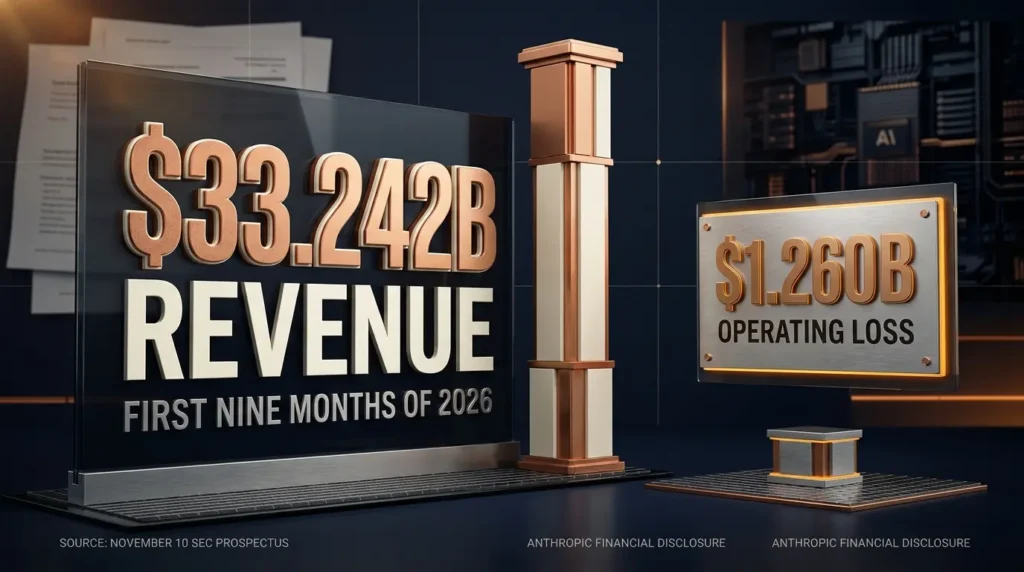
For the first nine months of 2026, the company reported $33.242 billion in revenue, compared with $2.545 billion during the corresponding period in 2025.
That is an increase of approximately 1,206%, according to its SEC filing.
Revenue growth at that scale is extraordinary, although the comparison begins from a much smaller previous base.
The company also reported approximately $81 billion in annualized revenue run rate as of October 31, 2026.
That run rate is not the same as revenue already earned for a completed calendar year.
It represents an annualized measure based on the company’s definition and recent business activity.
Investors should not compare it mechanically with a competitor’s audited annual revenue without accounting for differences in reporting periods and definitions.
Anthropic’s revenue and operating results
The prospectus provides the following consolidated financial figures.
| Financial metric | Full year 2025 | First nine months of 2026 |
|---|---|---|
| Revenue | $4.585B | $33.242B |
| Compute and infrastructure expense | $7.326B | $18.808B |
| Total operating expenses | $12.645B | $34.502B |
| Operating loss | $8.060B | $1.260B |
Source: Anthropic’s November 10 SEC prospectus. Full year 2025 is not directly comparable with a nine month reporting period in 2026.
These numbers tell an important story.
Anthropic is still reporting an operating loss, but its revenue has increased dramatically relative to the costs recorded during the period.
That is encouraging for investors who believe the economics of frontier AI could improve as usage grows.
However, it does not prove that the company has reached lasting profitability.
Future model development, infrastructure expansion, competition and pricing pressures could change those economics.
Why does Anthropic report such a large net loss?
Anthropic’s prospectus reports a net loss of approximately $104 billion for the first nine months of 2026.
At first glance, that sounds like an extraordinary operating collapse.
But the financial statement shows that the figure was heavily affected by changes in the fair value of convertible notes and related financial instruments.
The filing reports approximately $94.3 billion in losses from such fair value changes during the period, alongside other nonoperating adjustments.
These accounting effects are distinct from the costs of operating Claude or buying computing services.
It would therefore be misleading to claim that Anthropic consumed $104 billion of cash through normal operations during those nine months.
Operating losses, net losses and cash outflows measure different things.
The distinction is especially important for companies that have raised substantial financing through complex instruments before entering public markets.
Why Claude’s products matter to the investment case
Anthropic’s future revenue will depend on whether its models remain useful enough for customers to keep paying for them.
The company has expanded beyond ordinary chatbot conversations into programming, document creation, enterprise data analysis and collaborative work.
TrendOutsider recently examined Anthropic’s Claude Whiteboards, Sheets, Data and Meetings expansion, which illustrates how the company is positioning Claude as a broader workplace platform.
This kind of product expansion matters because businesses may be willing to pay for tools that become part of their daily workflows.
Yet product innovation alone does not guarantee attractive profit margins.
For a frontier AI provider, every successful new use case can create both a revenue opportunity and additional computing demand.
The $900 Billion Question: Anthropic’s Computing Commitments
Perhaps the most consequential number in Anthropic’s offering materials is not its proposed valuation or revenue.
It is the company’s enormous future computing commitments.
Anthropic’s official IPO factsheet describes approximately $900 billion in compute commitments, including about $451.6 billion expected before the end of 2030, with substantially all of the remainder expected between 2031 and 2045.
These figures describe commitments extending over time. They should not be presented as an immediate $900 billion cash payment or a single year’s expense.
The distinction matters.
Building and operating frontier AI requires access to increasingly powerful chips, enormous data centers, networking systems, electricity and specialized technical infrastructure.
The costs can be substantial even before considering the research and personnel needed to develop new models.
Why AI companies need so much computing power
Training advanced AI systems requires large amounts of computational work.
But serving those systems to users can also be expensive.
Every request that produces a response, analyzes a document or performs a complicated task consumes computing resources.
When usage increases dramatically, companies must find ways to improve efficiency while expanding capacity.
That makes the cost of computing central to the business model.
Anthropic’s model portfolio includes products designed for different workloads and price points. Its development of smaller, more economical models is one approach to serving customers without using the most expensive model for every task.
Our guide to Claude Haiku 5.5 pricing and capabilities explains how model size, token pricing and workload selection can influence the economics of AI applications.
The wider financial question is whether improvements in efficiency can keep pace with the expansion of usage.
Why compute commitments are an investment risk
Long term infrastructure agreements can provide the capacity a rapidly growing AI business needs.
But they may also create financial obligations that become difficult if future revenue falls short of expectations.
If demand grows more slowly than projected, the company could face substantial committed costs.
If demand accelerates, Anthropic may need even more infrastructure.
If computing becomes cheaper, its cost per task might improve, but competitive pricing could also reduce the amount customers are willing to pay.
These outcomes are not mutually exclusive.
Computing costs, revenue growth and competitive pressure will interact over many years.
That is why Anthropic’s IPO should be considered partly as an investment in a software business and partly as exposure to the economics of large scale computing infrastructure.

Why Google, Nvidia and Other Technology Giants Are Involved
Anthropic’s IPO documents describe a concurrent private placement valued at approximately $26 billion.
The participating companies include Google, Nvidia, AMD, Broadcom, Micron, Microsoft and TSMC Partners.
These investments are separate from the public offering and are contingent on the relevant transaction conditions.
The arrangement highlights an unusual feature of the frontier AI industry.
Some of the companies supplying essential computing technology are also investors in the companies that buy or use that technology.
That can strengthen strategic relationships and provide access to capital.
It also raises reasonable questions about how investment, computing supply and customer relationships influence each other.
Are strategic investments the same as customer revenue?
No.
A technology company investing in Anthropic is not automatically equivalent to that company purchasing Claude services.
Similarly, financing commitments from infrastructure partners should not be counted as operating revenue.
The SEC disclosures distinguish these arrangements for a reason.
Investors need to understand where the company’s revenue originates, who supplies the computing resources and which relationships could create dependencies.
Reuters has previously examined Anthropic’s reliance on major technology partners, including the role of cloud distribution.
The relationships can offer significant commercial advantages.
But concentrated partnerships may also expose a company to changes in pricing, technology access, competition or negotiating power.

Anthropic’s Unusual Governance: Who Will Control the Company?
One of the less obvious but highly consequential parts of Anthropic’s IPO involves its governance structure.
Anthropic is incorporated as a public benefit corporation.
Under this structure, the company must consider its stated public benefit purpose alongside the financial interests of shareholders and the interests of people materially affected by its conduct.
Its declared purpose centers on the responsible development and maintenance of advanced AI for humanity’s long term benefit.
The company also intends to use a special class of stock to preserve founder voting control.
According to the prospectus, a single Class F share held by a founder controlled entity will carry voting power equal to 50.1% of the company’s total voting power on matters generally submitted to shareholders.
That share has no economic rights.
The arrangement separates economic ownership from voting control.
What does founder control mean for ordinary shareholders?
People buying Class A shares may participate in the company’s financial performance, but they will not necessarily have voting influence proportionate to their economic ownership.
Founders may retain control over important corporate decisions even after large amounts of public capital are raised.
Supporters of this approach may argue that it protects Anthropic’s long term mission from short term market pressure.
Critics may worry that it reduces the ability of ordinary shareholders to influence management or challenge strategic decisions.
Both perspectives are relevant.
Investors should read the prospectus rather than assuming that all publicly traded companies offer identical shareholder rights.
Anthropic’s governance structure is a material part of what its public stock represents.
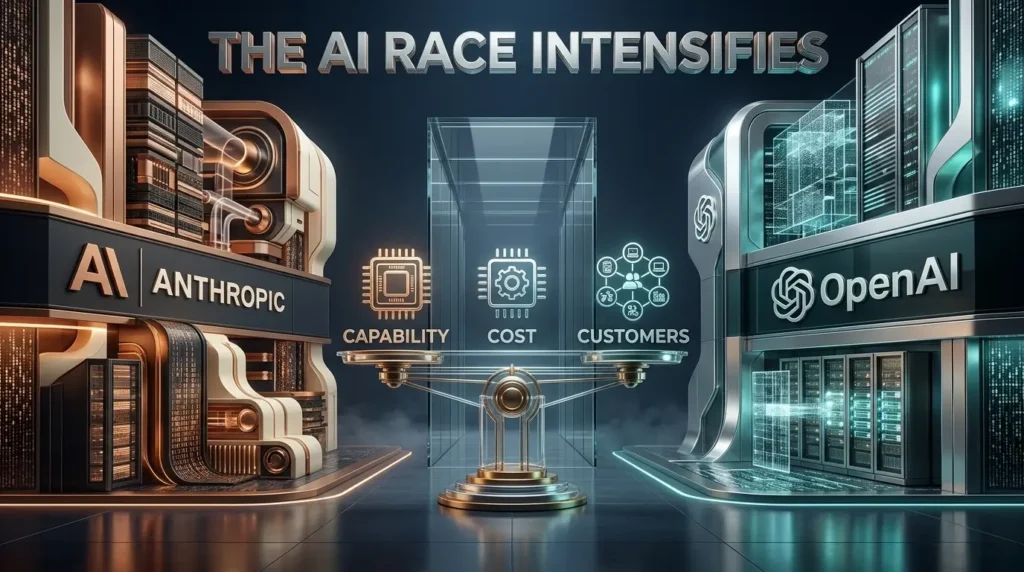
Anthropic IPO vs OpenAI: What Are Investors Really Comparing?
Anthropic and OpenAI are prominent developers of frontier artificial intelligence.
Both compete to build capable AI models, attract enterprise customers, recruit researchers and secure sufficient computing power.
But evaluating them requires more than comparing chatbot popularity.
An investor looking at Anthropic’s public offering must examine its own financial statements, pricing, distribution relationships, technology costs and governance.
OpenAI’s business model and products may provide useful competitive context, but a private company valuation should not automatically be treated as equivalent to a publicly determined share price.
The companies may also use different reporting conventions, financing instruments and revenue definitions.
Anthropic’s potential strengths
Claude has established a presence in business productivity, coding and enterprise workflows.
Anthropic has also developed an ecosystem of model APIs and products intended for different combinations of capability, speed and operating cost.
Its relationships with major cloud and chip suppliers may support expansion.
Anthropic’s major competitive challenges
Frontier models are expensive to develop.
Competitors can release more capable or less expensive alternatives.
Enterprise customers may adopt several models rather than commit to one provider.
Open source models may also reduce the cost of certain applications and place pressure on proprietary offerings.
As AI becomes more integrated into traditional software, established technology platforms may gain advantages through existing customer relationships and distribution.
None of these outcomes can be predicted precisely from the IPO prospectus alone.
For investors, the relevant question is whether Anthropic can preserve strong customer demand and pricing power despite intense competition.
How Can Retail Investors Buy Anthropic Stock?
Buying shares in a new public offering is different from purchasing a stock that has traded for years.
Before the IPO completes, ordinary investors generally cannot simply enter the proposed ANT ticker into every brokerage account and purchase publicly traded Anthropic shares.
Access to the initial offering depends on eligibility, jurisdiction, allocation procedures and the brokerage or intermediary involved.
Can investors buy shares at the $70 to $78 IPO price?
Some eligible investors may be able to participate through an approved offering process.
However, expressing interest does not guarantee an allocation.
The final offering price may differ from the preliminary range.
Retail investors who are not allocated shares may need to wait until public trading begins.
At that point, the market price can be above or below the IPO price.
What should investors check before buying?
The first step is to confirm that Anthropic’s public offering has actually completed.
Next, verify that the ANT ticker is live on Nasdaq and that the security displayed by a brokerage is the correct listed Class A stock.
Review the final prospectus, pricing announcement and official trading information.
Investors should also consider the company’s revenue growth, profitability, financial commitments, governance and the valuation implied by the actual market price.
TrendOutsider’s guide to AI tools for investment research discusses how investors can compare financial data and trace claims back to primary filings.
Tools can help organize research, but they should not replace the underlying prospectus or independent judgment.
Can international investors participate?
The answer depends on their country, brokerage access, applicable laws and the specific offering arrangements.
Anthropic has published documentation for several jurisdictions, including European markets and other regions.
That does not mean every international investor is eligible for the same allocation process.
People outside the United States should check the rules of their jurisdiction and the arrangements of a properly regulated intermediary.
Be cautious of websites or social accounts claiming to sell guaranteed pre IPO shares without credible documentation.
Is Anthropic’s IPO a Good Investment?
There is no reliable way to establish that from the proposed share price alone.
The bullish argument begins with Anthropic’s extraordinary revenue growth, expanding enterprise adoption and potentially valuable position in advanced AI.
The company has attracted major strategic partners and built products used across software development, research and workplace tasks.
Supporters may believe those advantages can produce substantial long term earnings.
The cautious argument begins with the other side of the financial picture.
Anthropic operates in a fast changing market, requires enormous amounts of computing power and faces formidable competitors.
Its proposed valuation reflects significant expectations for future performance.
Its governance structure also limits the influence ordinary shareholders may exercise.
A company can continue growing revenue rapidly while its share price falls if investors decide that earlier expectations were too optimistic.
Likewise, a large IPO can be commercially successful without guaranteeing attractive returns for people who buy the stock afterward.
A balanced assessment should examine the actual final valuation, profitability trends, cash flows, financing obligations, competitive position and governance rights.
It should not rely on a prediction that every major AI company must rise in value simply because artificial intelligence is becoming more widely used.
What Happens Next?
Several developments will determine the next chapter of Anthropic’s public market story.
First comes final pricing.
The company and its underwriters are expected to determine the final share price and allocations after the relevant offering process.
Second comes the anticipated start of public trading.
The November 19 date remains indicative and should be confirmed through updated official information.
Third comes the company’s first phase of public market reporting.
Investors will be able to examine future financial disclosures, operating trends and management explanations as a public company.
And finally, there is the longer test: whether Anthropic can build an economically sustainable business around frontier AI while meeting its financial commitments and stated mission.
The IPO will create a public market valuation. It will not settle every question about the future of artificial intelligence.
Frequently Asked Questions
When is the Anthropic IPO?
Anthropic’s current offering timetable indicates an anticipated Nasdaq trading debut on November 19, 2026. The date remains subject to final pricing and completion.
What is Anthropic’s IPO price?
Its November 10 preliminary prospectus proposes a price range of $70 to $78 per Class A share. The final price has not yet been confirmed.
What is Anthropic’s stock ticker?
Anthropic has applied to list its Class A common stock on Nasdaq under the ticker ANT.
Is Anthropic publicly traded yet?
No. As of November 15, 2026, its offering remains proposed and the shares have not begun public trading.
How much is Anthropic valued at?
Reports describe valuations around $1 trillion on some share count measures and roughly $1.4 trillion on broader diluted assumptions. The exact valuation depends on the final offering price and the securities included in the calculation.
How much revenue does Anthropic generate?
Anthropic reported $33.242 billion in revenue during the first nine months of 2026. It separately reported approximately $81 billion in annualized revenue run rate as of October 31. These are different financial measures.
Is Anthropic profitable?
Anthropic reported an operating loss of approximately $1.260 billion for the first nine months of 2026. Its much larger net loss includes significant accounting adjustments to financial instruments.
Does Anthropic have $900 billion in debt?
No. Its offering materials discuss approximately $900 billion in computing commitments extending over many years. Those commitments should not automatically be characterized as conventional outstanding debt.
Can ordinary investors buy Anthropic shares?
Eligible investors may participate through approved offering channels, subject to allocation and jurisdiction. Once trading begins, access depends on the listed security and brokerage availability.
Will Anthropic stock rise after the IPO?
There is no guarantee. Market prices can move above or below the offer price based on demand, valuation and changing expectations.
The Bigger Picture: AI’s Public Market Test Has Arrived
Anthropic’s IPO is about more than the company behind Claude.
It is an opportunity for public market investors to examine the economics of a frontier AI business in far greater detail.
The prospectus reveals extraordinary revenue growth, substantial computing commitments, influential strategic partners and a capital structure designed to preserve founder control.
Each of those elements may prove important to Anthropic’s future.
The company is entering a market where technological progress can be rapid, competition can be relentless and the cost of remaining at the frontier can be enormous.
A successful IPO could give Anthropic substantial additional resources and a new class of shareholders.
But a public listing does not guarantee that every ambitious projection will become reality.
Ultimately, the question is whether Claude’s commercial success can support the enormous investments required to keep building advanced AI.
For investors, that matters far more than whether the first trading day produces an impressive headline.
Editorial disclosure: This report is based on Anthropic’s SEC registration materials, official IPO disclosures and publicly available financial reporting as of November 15, 2026. Preliminary offering terms can change. TrendOutsider has not independently audited Anthropic’s financial statements or participated in the IPO process.
Financial disclaimer: This article is for news and educational purposes, not personalized investment advice or a recommendation to buy, sell or hold shares. Readers should consult appropriate licensed professionals for consequential financial decisions.
Visual disclosure: AI generated editorial graphics accompanying this article are illustrative. They do not depict authentic IPO trading sessions, verified exchange screens or real corporate events unless separately identified as such.






Leave a Reply