
Your iPhone may already know how you slept last night, how far you walked yesterday and what your resting heart rate looked like over the past month. Understanding what those numbers mean is another matter.
Apple now wants to study whether artificial intelligence can help people make better sense of health information without pretending to replace the doctor who knows their medical history.
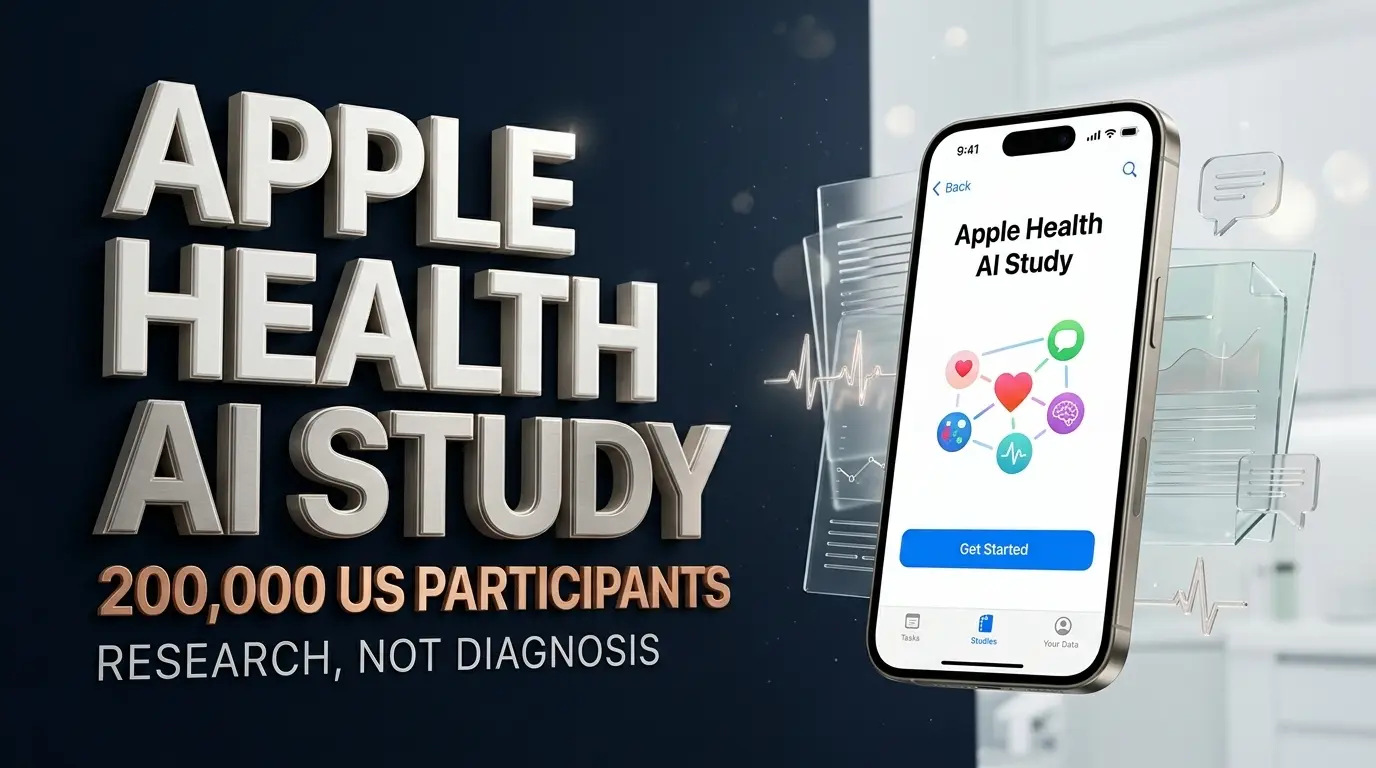
On November 15, 2026, the company launched the Apple Health AI Usage Study, a research project developed with clinical AI company OpenEvidence. Up to 200,000 eligible adults in the United States can join through a dedicated iPhone app, ask health questions and evaluate answers supported by published medical research.
Participants may also choose to share information from Apple’s Health app, including sleep, activity, resting heart rate and laboratory results.
The study is notable for what Apple is trying to measure: not simply whether a chatbot can generate a plausible answer, but whether a real person understands that answer, trusts it appropriately and finds it useful when making everyday health decisions.
There is a distinction worth making immediately.
Apple has not launched a public AI doctor, added medical diagnosis to Siri or announced an AI system that can independently monitor emergencies. The new app is part of a research study, and Apple explicitly says it cannot diagnose or treat medical conditions.
Here’s what the study offers, how enrollment works, what OpenEvidence contributes and what prospective participants should understand about their health information before joining.
What Is the Apple Health AI Usage Study?
The Apple Health AI Usage Study is a virtual research project designed to examine how people interact with conversational AI when they have questions about their health.
According to Apple’s November 15 announcement, the research focuses on several related issues: the quality of AI responses, how understandable those responses are, what influences users’ trust and whether the information helps them take appropriate next steps.
The study uses a dedicated app called Apple Health AI Study App, available through the US App Store to compatible iPhone users.
It is separate from the ordinary Apple Health app. That distinction matters because a person does not automatically become a research participant merely by owning an iPhone or using Apple Health.
Participants must enroll and accept the applicable study terms.
The study at a glance
| Detail | Confirmed information |
|---|---|
| Official name | Apple Health AI Usage Study |
| Announced | November 15, 2026 |
| Collaborator | OpenEvidence |
| Enrollment | Up to 200,000 eligible people |
| Country | United States |
| Age | 21 or older |
| Device | Apple Intelligence enabled iPhone, iPhone 15 Pro or later |
| Software | iOS 26 or later |
| App | Apple Health AI Study App |
| Optional personal data | Selected HealthKit information |
| Primary purpose | Research on trust, understanding and use of health AI |
| AI training | Apple says study data will not be used to train AI models |
| Medical diagnosis | Not supported as an intended purpose |
The participant limit is an enrollment ceiling, not a statement that 200,000 people have already joined.
Apple has not published study results or established that the app improves health outcomes.
Why Apple Is Studying Health AI Now
People are increasingly turning to conversational AI when they encounter medical language they do not understand.
A laboratory report might contain a measurement that looks unfamiliar. An appointment summary might mention a condition in complicated terminology. Someone might want to understand why a doctor recommended a particular follow up.
AI appears well suited to explaining difficult information in ordinary language.
But a reassuring answer is not necessarily an accurate one.
A system might omit an important caveat, misunderstand the context of a question or provide advice that sounds more certain than the available evidence supports.
The study is intended to examine that gap between what an AI system says and what a person understands.
In its coverage of the announcement, ABC News described Apple’s interest in whether participants understand the information they receive and whether it helps them prepare for interactions with clinicians.
That makes this project more than a demonstration of a new chatbot interface.
The research may reveal where conversational health tools help people understand medical information, where they create confusion and which safeguards matter in everyday use.
It may also show why an answer that performs well in a technical evaluation does not necessarily lead to a sound decision in the real world.

What Is OpenEvidence, and Why Did Apple Choose It?
OpenEvidence is a clinical AI platform focused on medical information and research.
Its technology helps healthcare professionals search and interpret medical literature, including material published in respected clinical journals.
Apple identifies sources such as The New England Journal of Medicine, JAMA and Nature as examples of the research available to support the study app’s answers.
That is one of the major differences between this project and an ordinary conversation with a general purpose chatbot.
The study app is designed to present explanations with links to relevant, peer reviewed clinical sources.
A participant may be able to follow those references and understand which published information supports a particular explanation.
However, the presence of a citation does not automatically guarantee that the answer is correct.
A cited study may have limitations. Its findings may apply to a specific group of patients. Newer research might qualify an earlier conclusion. And an AI system can still misinterpret a valid source.
The value of clinical citations is that they create a route for verification, not that they remove the need for judgment.
Is OpenEvidence replacing the doctor?
No.
OpenEvidence contributes the clinical AI technology used within the research app. It is not becoming the participant’s personal physician.
The study is interested in whether conversational explanations help people arrive at medical appointments better prepared.
For example, someone might want to understand a term appearing in an appointment summary so they can ask a clearer question at their next visit.
That is very different from an AI deciding which medication a person should take or determining whether emergency care is necessary.
Healthcare publications including STAT have emphasized that the project is experimental and intended to study how consumers use clinical AI information.
The results may influence future design decisions, but they cannot be assumed in advance.
How the Apple Health AI Study App Works
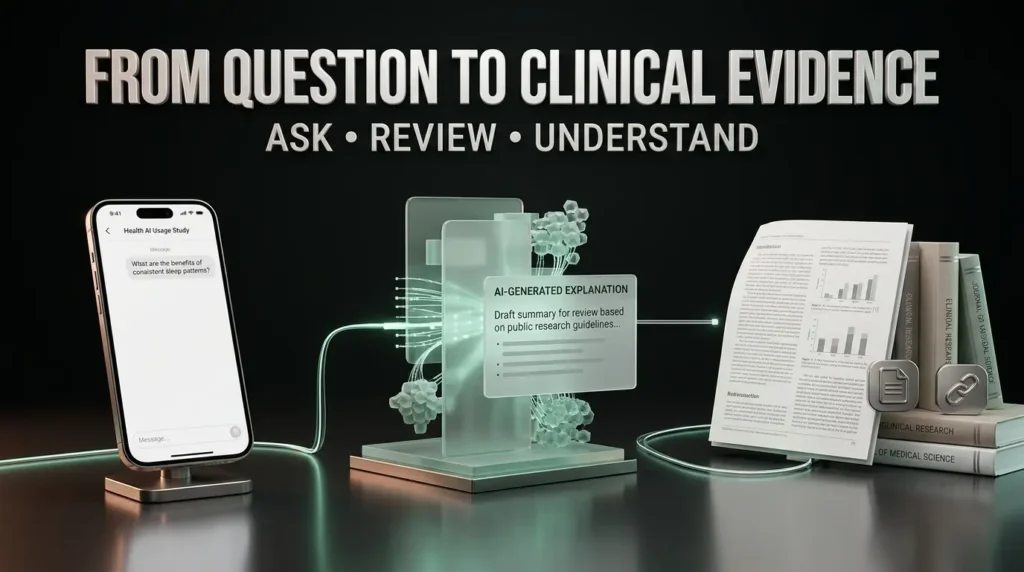
The app is intended to let participants ask ordinary health questions in a conversational format.
A question could concern sleep patterns, activity, information in a medical report or a topic someone wants to discuss with their clinician.
The system then generates an explanation using OpenEvidence technology and includes links to supporting medical research.
Participants can evaluate responses and provide feedback.
Apple is interested not only in whether an answer appears useful but also in whether it is understandable and whether the participant trusts it appropriately.
Example 1: Understanding unfamiliar medical terminology
A participant could ask for an explanation of a term appearing in a medical record.
The app may describe the concept in plain language and point toward relevant literature.
The person should still ask their clinician what that information means in the context of their individual medical history.
Example 2: Preparing for a medical appointment
Someone might use the app to organize questions before a scheduled visit.
For example, they could ask which aspects of a health topic are commonly discussed during a clinical consultation.
The purpose is preparation, not an AI generated treatment plan.
Example 3: Exploring personal health metrics
If a participant chooses to share selected HealthKit information, the app may use those measurements to provide more relevant context.
For instance, a question about sleep could be considered alongside data the person has authorized the study to access.
That does not mean the app has established why a particular sleep pattern occurred or can diagnose a sleep disorder.
Personal context can make an answer more relevant without making it medically conclusive.
Example 4: Evaluating the explanation itself
Participants can rate responses and complete study surveys.
That feedback is central to the research.
If a response is difficult to understand, seems incomplete or leaves someone unsure what to do next, the experience may still provide researchers with valuable information.
The study is therefore testing the interaction between people and AI, not merely displaying medical knowledge on a screen.
Who Can Join the Apple Health AI Study?
Apple’s eligibility rules are specific.
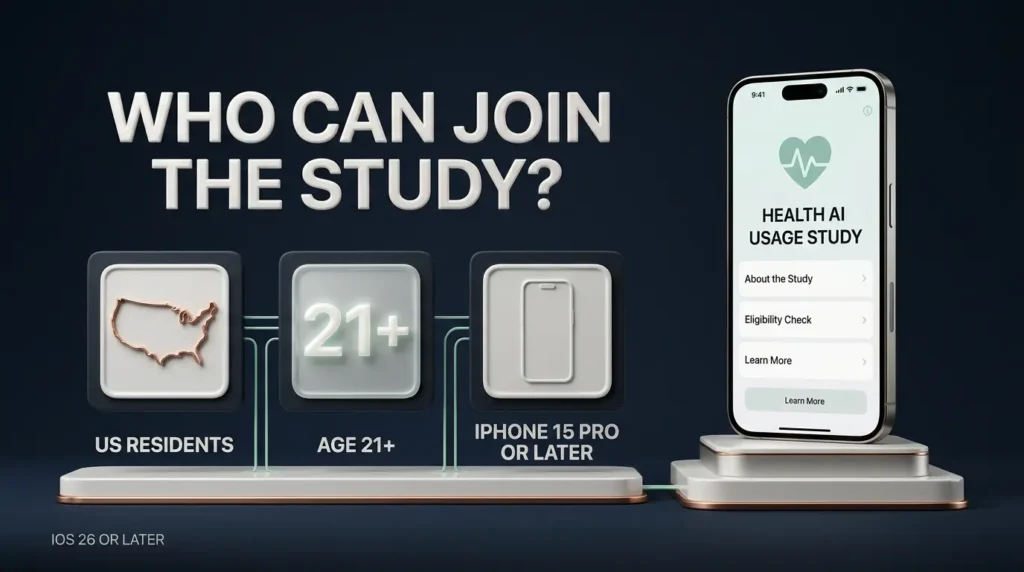
The study is open to adults aged 21 or older living in the United States, up to the announced enrollment limit.
Participants need an Apple Intelligence capable iPhone, starting with the iPhone 15 Pro, running iOS 26 or later.
The device requirement is not the same as saying every iPhone released in 2023 or later is eligible.
For example, the standard iPhone 15 is not equivalent to the iPhone 15 Pro for Apple Intelligence support.
People should check their exact model rather than relying only on the release year.
Does the App Store’s 18+ rating mean an 18 year old can enroll?
No.
The App Store listing may display an age rating of 18+, but Apple’s study eligibility minimum is 21.
An app content rating and a research study’s enrollment requirements serve different purposes.
Is the study available outside the United States?
Not under the initial eligibility rules.
Apple’s announcement describes a US research study.
An eligible device alone is insufficient if someone does not meet the geographic and study requirements.
There is no confirmed international enrollment timetable.
Do participants need an Apple Watch?
Apple does not list Apple Watch ownership as a universal enrollment requirement.
The required hardware is a compatible iPhone.
However, the availability of individual HealthKit measurements depends on the data a participant has collected or imported into Apple Health and chooses to share.
Some measurements may come from a watch or other compatible service. Others may originate from connected health records or manually entered information.
A participant without every possible metric should not assume that the app will somehow generate missing health measurements.
How to Join the Apple Health AI Usage Study
Apple directs eligible users to the dedicated study app.
The official Apple Health AI Study App listing identifies Apple as the developer and describes the research experience.
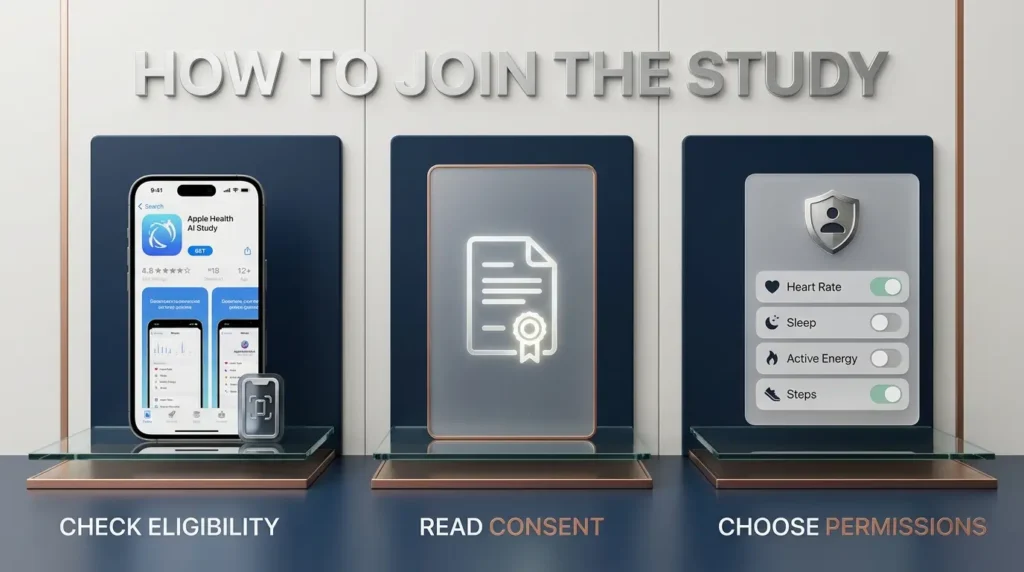
Step 1: Confirm your eligibility
Check that you are at least 21 years old, reside in the United States and have an eligible iPhone running iOS 26 or later.
Make sure the device supports Apple Intelligence.
Step 2: Open the official App Store listing
Use Apple’s official listing rather than a link from an unfamiliar advertisement or social media post.
Verify that the app is published by Apple.
Step 3: Read the study information
The app provides more information about participation.
Read the research consent materials, privacy explanations and any questions about how information may be collected, retained or used.
Do not assume that an ordinary app privacy notice covers every part of a research study.
Step 4: Decide whether to enroll
If you meet the requirements, choose whether to participate through the app’s enrollment process.
Downloading the application does not itself mean that you have agreed to every possible use of personal health information.
Step 5: Review optional HealthKit permissions
Apple says sharing selected HealthKit information is optional.
Consider carefully which types of information you are comfortable contributing.
A person may be interested in the study while still wanting to limit sensitive data access.
Step 6: Use the research app and provide feedback
Participants can submit health questions, review explanations and contribute feedback according to the study’s procedures.
Apple and independent reporting describe surveys as part of the research experience.
The exact participation commitments should be confirmed in the consent materials shown to each prospective participant.
What HealthKit Information Can the Study Access?
Apple’s HealthKit framework allows compatible applications to request access to health information, subject to user permissions.
For this study, Apple specifically mentions examples including resting heart rate, activity, sleep and laboratory results.
The company says participants can choose whether to share information.
That is an important distinction: connecting health data is not described as mandatory for every participant.
What is the difference between HealthKit and the study app?
HealthKit is Apple’s framework for handling health and fitness information across compatible applications and devices.
The Health app is the familiar interface where an iPhone user can view supported health information.
The new Apple Health AI Study App is a separate research experience.
It may use authorized HealthKit information to provide context for a conversation, but it should not be confused with the standard Health app becoming an AI physician.
Should participants share every available metric?
Not automatically.
Health information can be deeply personal, and different people will have different levels of comfort with sharing it for research.
A useful principle is to examine the requested data categories and decide whether each one is necessary for the experience you want.
Review what the consent materials say about storage, processing, withdrawal and previously collected information.
Those details matter more than a general promise that the app is designed with privacy in mind.
Why does data context matter?
A generic response about sleep is different from an explanation that uses a participant’s authorized sleep history.
Context may make a response more relevant, but it may also introduce new risks if an AI system interprets an incomplete record as a complete picture.
A person’s health cannot reliably be reduced to a few measurements recorded by their phone or watch.
The research will help explore how useful personalized information feels to users, but its clinical value is not an established outcome.
Is Apple Using Participants’ Health Data to Train AI?
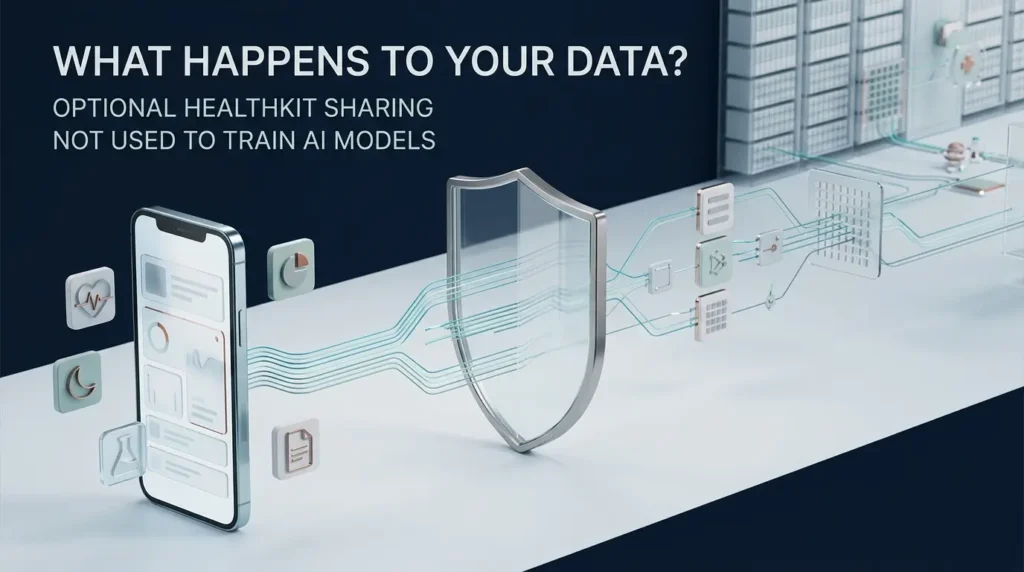
Apple says study data will not be used to train AI models.
That is an explicit statement in the company’s launch announcement.
However, the phrase should be understood precisely.
It does not mean the study processes no information, retains nothing, or has no research data collection.
The research necessarily examines how people interact with the system and what they think of its answers.
What happens to a health question?
According to ABC News reporting on Apple’s privacy arrangements, the system processes questions to remove identifying information before they reach OpenEvidence.
Independent coverage also describes an intermediary study environment and additional steps intended to separate participant identity from the information sent for an answer.
Apple told reporters that OpenEvidence deletes the question and response data it receives within 24 hours.
That 24 hour statement concerns OpenEvidence’s copy of the interaction under the reported arrangement. It should not be interpreted as confirmation that Apple and every other research participant or contractor delete all study information after 24 hours.
Can a participant withdraw?
Research participation should be evaluated under the actual consent materials.
A prospective participant should inspect how withdrawal works, whether future collection stops immediately and what happens to research information already contributed.
Apple’s general launch announcement does not provide enough detail to promise that withdrawing erases every prior research record.
Why privacy requires more than an AI training promise
Medical questions may reveal conditions, concerns or personal circumstances that someone would not want disclosed widely.
Useful safeguards can include separating direct identifiers from research records, limiting access, retaining information only as necessary and explaining what participants can control.
But the exact protections matter.
The broader principle is familiar from other connected AI services: a claim about model training is not a complete description of data handling.
TrendOutsider has examined a related distinction in its guide to Google Gemini Wallet’s connected data and privacy controls. The services are different and their policies must not be conflated, but both demonstrate why readers should examine permissions and retention rules rather than rely on a single privacy slogan.
Can the Apple Health AI Study App Diagnose or Treat Conditions?
No.
Apple’s announcement explicitly states that the study application is not intended to diagnose or treat conditions or replace healthcare professionals.
The distinction matters because an AI system can produce a clear explanation while still missing information that would change a medical assessment.
A clinician may need to consider symptoms, examination findings, medical history, current medications, test results and circumstances that a chatbot does not know.
A research app cannot safely be assumed to have access to all that information.
What about potentially dangerous questions?
Apple says the app includes safeguards intended to identify certain concerning questions and encourage a participant to seek professional assistance or other appropriate resources.
Those safeguards are not the same as real time monitoring.
The app should not be used as an emergency service.
If someone has a potentially serious or rapidly worsening health problem, they should seek appropriate medical care rather than wait for a chatbot to respond.
Do clinical citations guarantee medical accuracy?
No.
A trustworthy journal can publish research with limitations. Findings can differ across patient populations, and AI can misread a source even when the source itself is reliable.
Clinical citations make verification easier, but they are only part of responsible health communication.
The crucial question is whether the answer accurately represents what the research shows and communicates uncertainty where necessary.
Apple’s decision to study comprehension and user trust makes this issue central to the project.

How Is This Different From Apple Health, Siri and Ordinary AI Chatbots?
The new study app does not replace Apple’s existing health and assistant products.
| Product or experience | Main purpose | Important distinction |
|---|---|---|
| Apple Health | Organize and display supported health information | Not the same as enrolling in the AI research study |
| Apple Health AI Study App | Investigate how people use and understand conversational health AI | Research participation, with eligibility and consent |
| Siri | General voice assistance across supported Apple devices | Apple has not announced this study as a new Siri medical feature |
| General AI chatbot | Respond to a broad range of questions | Source grounding, policies and safety limitations vary |
| Clinical care | Medical evaluation, diagnosis and treatment by qualified professionals | Not replaced by a research chatbot |
This distinction also matters when comparing Apple devices.
Hardware supporting Apple Intelligence does not mean that every experimental Apple research experience is automatically included.
Readers exploring the wider product ecosystem can see TrendOutsider’s coverage of Apple’s latest iPad mini and its AI capabilities. That device article concerns a separate product; it should not be read as evidence that the iPad is eligible for this iPhone only study.
Could Apple eventually put health AI inside Siri?
It is possible that research will inform later product development.
But Apple has not confirmed a public launch date, specific Siri integration or a consumer diagnostic assistant arising from this project.
Speculation about a future product should not be presented as an announcement.
Why Trust and Understanding May Matter More Than an Impressive AI Answer
The most interesting part of the study is its focus on human behavior.
Imagine two people receive exactly the same AI explanation.
One finds the information clear and knows which question to ask their doctor.
The other mistakes a general explanation for a personal diagnosis.
The model’s text is identical, yet the outcome of the interaction is very different.
That is the kind of problem health AI developers need to understand.
Measuring the factual quality of a response is important. So is understanding how users interpret uncertainty, whether they look at citations and when they decide to seek professional advice.
The research may help identify interface designs that communicate caution without making helpful information unnecessarily difficult to access.
It may also reveal cases where conversational AI makes complicated information feel more understandable without actually improving understanding.
These questions are related to the wider challenge of AI governance: how organizations establish boundaries, evaluate risks and remain accountable for the effects of technology.
TrendOutsider’s earlier examination of why AI transformation requires governance rather than technology alone provides broader context for that discussion.
In healthcare, those issues become particularly consequential because the information may influence decisions about someone’s wellbeing.
What Could the Study Change About the Future of Health AI?
Apple has not announced the study’s findings, and it has not promised any particular product.
The practical value of the project will depend on the quality of its research design, the diversity of participants, the measures it uses and how its results are analyzed and reported.
The eligibility requirements themselves raise questions worth examining.
People who own Apple Intelligence compatible iPhones and are willing to participate in digital research may not represent the full range of people who need understandable health information.
Age, access to compatible hardware, comfort with technology and willingness to share health data can all influence who joins.
That does not make the project unhelpful.
It means that findings will need to be interpreted in the context of the people studied.
For now, the most defensible conclusion is that Apple is investigating whether medically grounded conversational AI can support clearer health communication and more productive interactions with clinicians.
It has not yet established that the experience improves diagnoses, outcomes or long term health behavior.

Frequently Asked Questions
What is the Apple Health AI Usage Study?
It is a US research study launched by Apple with OpenEvidence on November 15, 2026. It examines how participants use, understand and evaluate AI generated health information.
Is Apple releasing an AI doctor?
No. The study app is a research tool and is not intended to diagnose or treat medical conditions.
How many people can join?
Apple says the study is open to up to 200,000 eligible participants.
What is the minimum age?
Participants must be 21 or older. The App Store’s age rating does not replace the study eligibility rule.
Which iPhones are eligible?
An Apple Intelligence enabled iPhone, starting with the iPhone 15 Pro, running iOS 26 or later.
Is the app free?
The official US App Store lists the Apple Health AI Study App as free. Joining remains subject to the study’s eligibility and consent requirements.
Is an Apple Watch required?
Apple has not listed Apple Watch ownership as a universal requirement. A compatible iPhone is required, while sharing HealthKit data is optional.
Does Apple use study data to train AI models?
Apple states that study data will not be used to train AI models.
Is the study available in Pakistan, India or the UK?
The initial study is restricted to eligible participants in the United States. Apple has not announced a general international enrollment date.
Can it read my laboratory results?
Participants may choose to share supported HealthKit information, including laboratory results. Availability depends on the data present and the permissions granted.
Does OpenEvidence keep my health questions forever?
ABC News reports that OpenEvidence deletes question and response data it receives within 24 hours under the study arrangement. That should not be confused with the retention policies of every other organization handling study data.
Does the new app work through Siri?
No. It is a dedicated study app. Apple has not announced a general Siri health AI launch through this project.
When will Apple publish the study results?
Apple has not confirmed a public results date in its November 15 announcement.
The Bottom Line
Apple’s Health AI Usage Study asks a more important question than whether artificial intelligence can produce a convincing explanation of a medical topic.
It asks whether people understand that explanation, know its limitations and use it in ways that genuinely help them navigate healthcare.
OpenEvidence brings a clinical research focus. Apple’s Health ecosystem offers the possibility of using personal information with permission. The study combines those elements within a controlled research experience rather than launching a new medical service to the general public.
That approach deserves attention, but its success cannot be assumed.
The real evidence will come from how the research is conducted, what participants experience and whether the eventual findings withstand scrutiny.
Until then, the most useful way to understand the new app is simple.
It is an experiment in better health communication, not a substitute for medical judgment.

Editorial disclosure: This article is based on Apple’s November 15, 2026 announcement, the official App Store listing and independent reporting from ABC News, STAT, TechCrunch and healthcare publications. TrendOutsider has not enrolled in or independently evaluated the study app. No study outcomes or clinical effectiveness claims are implied.
Medical information disclaimer: This article explains technology research and does not offer medical advice. Readers should consult qualified healthcare professionals about personal medical concerns. Do not use a research chatbot for emergencies.
Visual disclosure: Images created for this article are conceptual editorial illustrations unless specifically identified and credited as authentic Apple materials. Any illustrated interfaces are not genuine screenshots of study results.








Leave a Reply