
For years, smart glasses have faced an awkward question: why would someone put a computer on their face when the phone in their pocket already does so much?
Google believes the answer is artificial intelligence that can understand what you are looking at, respond without making you reach for your phone and fit into ordinary eyewear.
The company’s latest attempt is no longer just a demonstration.
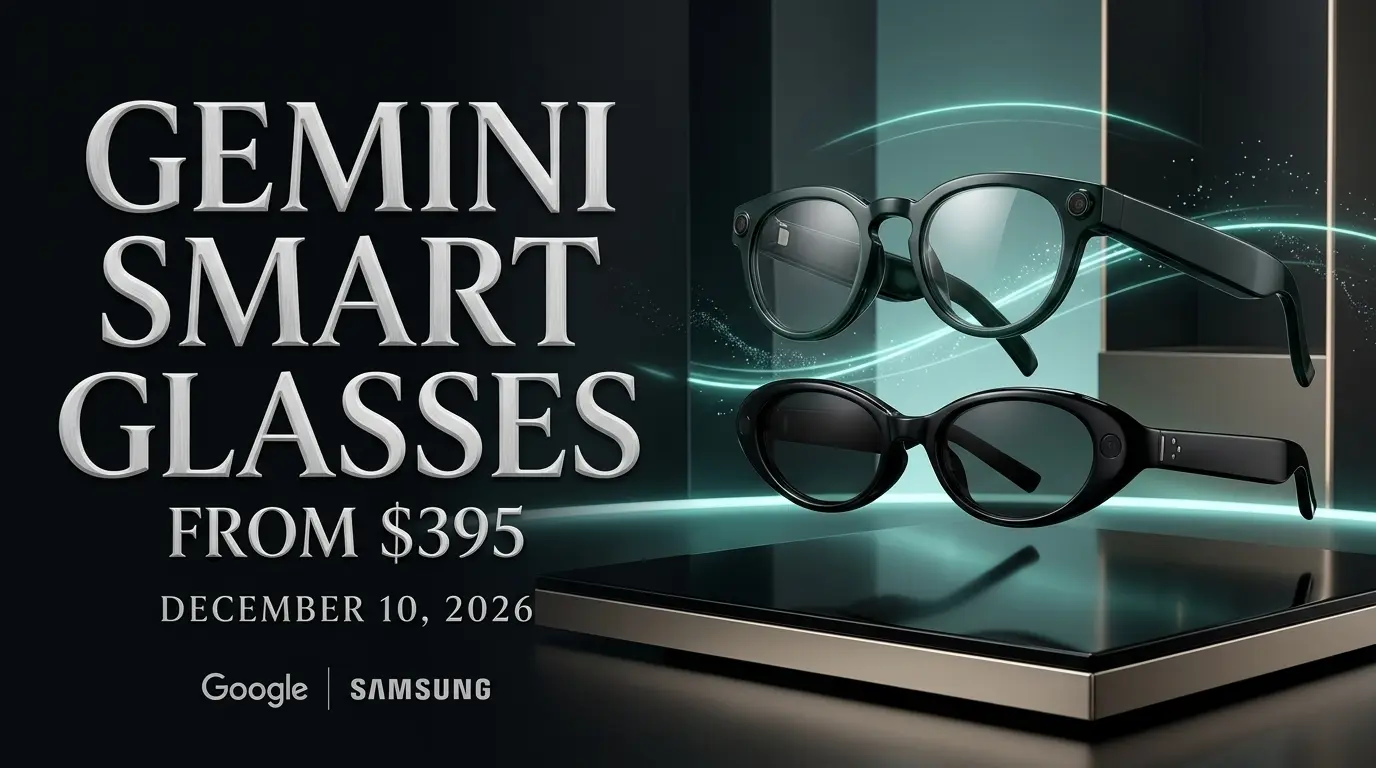
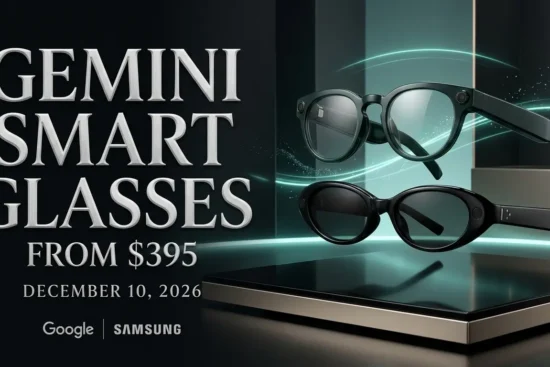
On November 12, Google and Samsung opened preorders for a new collection of Gemini powered smart glasses created with eyewear designers Warby Parker and Gentle Monster. Prices start at $395, and the first models are scheduled to reach customers on December 10, 2026.
The glasses promise hands free conversations with Gemini, real time translation, navigation, photo and video capture, music, messages and information about objects in your surroundings.
But there is a detail buyers should understand immediately.
These first Gemini smart glasses do not have a display inside their lenses. They are camera and audio devices, with AI assistance delivered primarily through their speakers, microphones and a connected smartphone.
That makes them a direct challenge to Ray-Ban Meta glasses rather than an immediate replacement for a full augmented reality headset.
Google’s launch also raises practical questions about which phones work, whether prescription lenses are available, how private camera recordings really are and whether the new glasses offer enough value to justify their price.
Here is what Google’s announcement, Samsung’s technical specifications and early independent reporting actually tell us.
What Are Google Gemini Smart Glasses?
The official name is Intelligent Eyewear with Gemini.
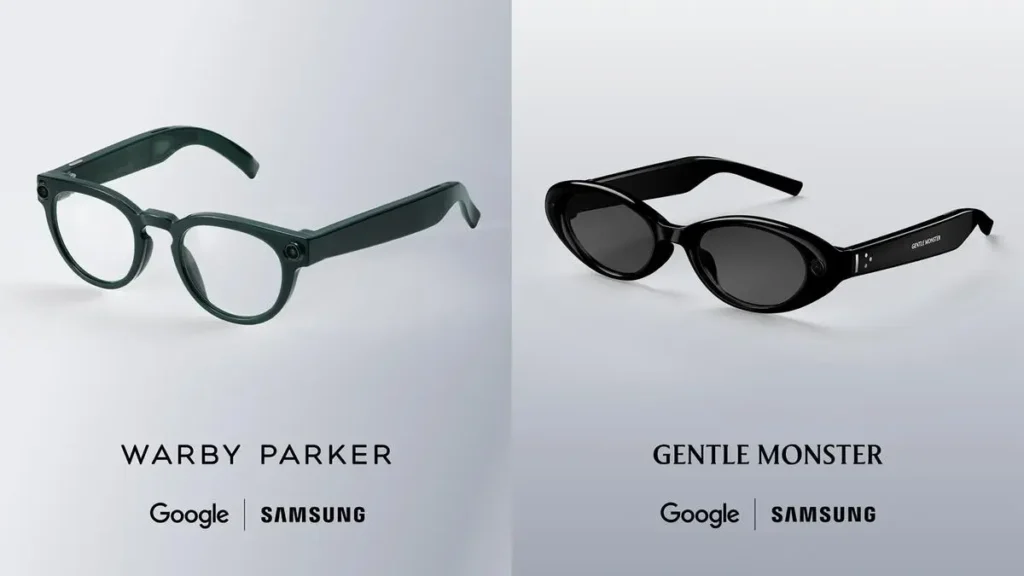
The product combines Google’s Gemini AI assistant, Samsung engineered electronics and frames designed by Warby Parker and Gentle Monster.
Google supplies the Android XR ecosystem and AI experience. Samsung contributes mobile engineering expertise, while the eyewear brands focus on frame styles, lenses, fit and retail support.
In its November 12 announcement, Google described the glasses as a way to receive useful assistance without constantly looking down at a smartphone.
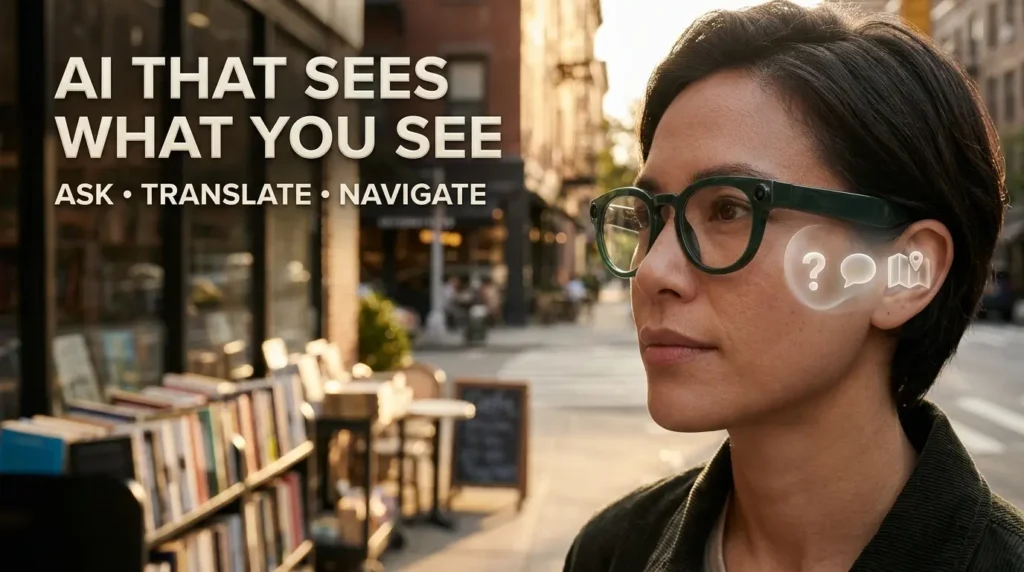
You can say “Hey Gemini,” ask about something in front of you, request a translation or respond to a message using voice.
The built in camera gives Gemini additional context. Rather than describing an object in a text prompt, you can look toward it and ask a question.
That is a meaningful difference from using an AI assistant on a laptop.
But it comes with limitations. AI visual answers can be wrong, some functions depend on the connected phone and not every Google service works identically across Android and iOS.
The glasses also do not replace a smartphone. They are designed to work with one.
Google Gemini Smart Glasses Price and Release Date
Preorders opened on November 12, with general availability scheduled for December 10, 2026.
The two eyewear collections have different prices and styles.
| Collection | Starting US price | Frame options | Launch market |
|---|---|---|---|
| Warby Parker Intelligent Eyewear | $395 | Alden, Reid and Wren | United States |
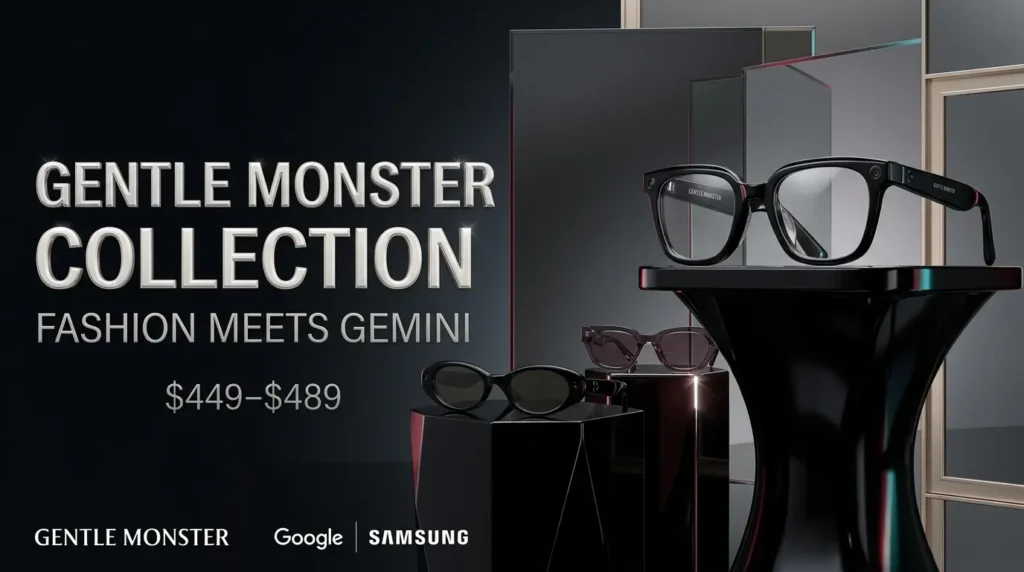
| Gentle Monster Intelligent Eyewear | $449 | Six frame styles, up to $489 | United States and South Korea |
Warby Parker’s collection emphasizes familiar optical and sunglass silhouettes, with Pine, Saddle and Jet Black colorways.
Gentle Monster takes a more experimental fashion direction, with bold shades including dark red, pink, gray and yellow and several lens treatments.
According to Samsung’s official announcement, the combined collections offer 30 design variations across their frames, lenses and sizes.
That does not mean there are 30 different electronic platforms. The underlying hardware is shared across the two eyewear brands.
Where can you preorder the glasses?
Google directs customers to the official Warby Parker and Gentle Monster retail channels, with demonstrations offered at participating locations.
You can begin from Google’s Intelligent Eyewear product site to review current availability and connected retailer information.
Warby Parker is also offering guided demonstration opportunities through hundreds of its retail locations.
Buyers considering prescription lenses should verify the price of their specific frame, lens type and options before checkout. The starting price does not establish the final cost of every prescription configuration.
Are Gemini smart glasses available worldwide?
No.
The initial launch is limited to eligible accounts and supported sales markets.
Warby Parker’s collection launches in the United States. Gentle Monster’s collection launches in the United States and South Korea.
Google says the glasses require a compatible Google Account associated with a supported market and an adult user.
Buying a pair from another country is not the same thing as being eligible to activate it. Samsung’s support information says a device activated in a supported region may work while traveling elsewhere, although some functions can remain restricted.
Google has not announced a general worldwide release date.

Warby Parker vs Gentle Monster: Which Frames Are Different?
The choice is largely about appearance, fit, lenses and buying experience rather than different AI chips.
Warby Parker offers three main styles: Alden, Reid and Wren.
Its designs use more traditional eyewear shapes, making them worth considering for people who want smart glasses that resemble the frames they already wear.
The availability of optical and sun versions also helps distinguish the collection from sunglasses only gadgets.
Gentle Monster offers six more fashion focused frame designs.
Its range includes bolder colors and lens combinations, which may appeal to buyers who treat eyewear as part of their personal style.
The more important practical issue is fit.
A frame can look excellent in a product photograph and still feel uncomfortable after an hour. Smart glasses also contain batteries, cameras, speakers and other components, which affect weight and balance.
That is a reason to try the frames at a participating retailer where possible rather than choosing solely from promotional images.
Google and Samsung claim the glasses weigh roughly 40 to 44 grams depending on the model, before any configuration related differences.
We have not independently tested long term comfort, so there is no basis to declare either eyewear brand more comfortable.
Google Gemini Smart Glasses Specifications
Samsung has published detailed technical information for the new glasses.
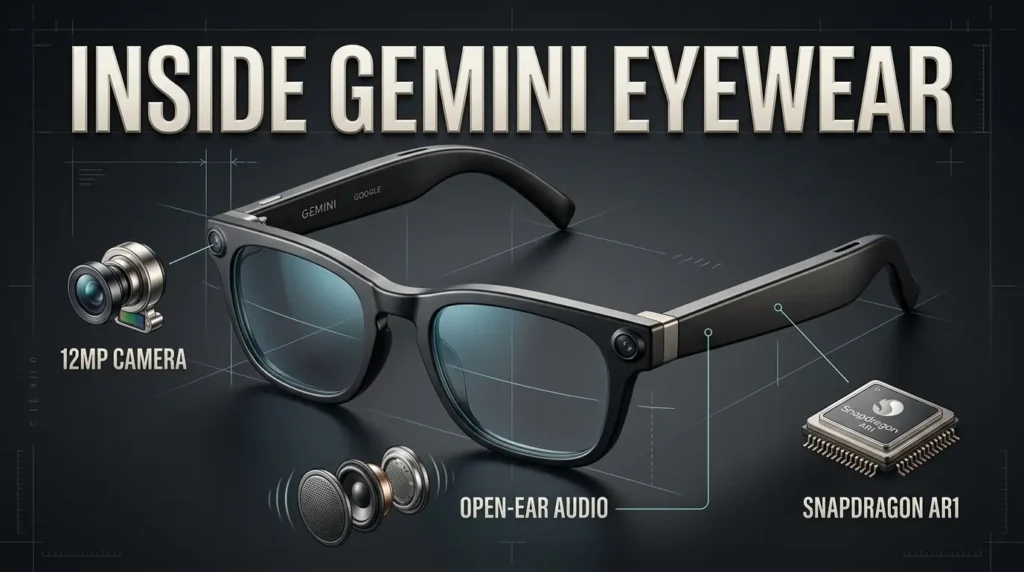
The lineup is powered by Qualcomm’s Snapdragon AR1 Gen 1 platform and includes a 12 megapixel camera, open ear audio, microphones and onboard storage.
| Feature | Official specification |
|---|---|
| Processor | Snapdragon AR1 Gen 1 |
| Camera | 12MP HDR |
| Video | 3K at 30 fps or supported 1080p modes |
| Speakers | Two open ear speakers |
| Microphones | Four |
| Memory | 2GB RAM |
| Storage | 64GB |
| Battery | 245mAh |
| Advertised use | Up to nine hours per charge |
| Charging case | Up to 72 hours total claimed usage |
| Wi-Fi | Wi-Fi 6E |
| Bluetooth | 5.4 |
| Splash resistance | IPX4 |
| Controls | Voice and touch |
| In-lens display | None |
These are manufacturer specifications, not laboratory results obtained by TrendOutsider.
Is nine hours of battery life realistic?
Google and Samsung advertise up to nine hours of use on a single charge.
That is a useful reference point, but actual battery life will depend on whether you spend most of the day receiving notifications, listening to audio, recording video or continuously asking Gemini questions.
A person making frequent video recordings may experience very different battery performance from someone who mainly receives occasional voice notifications.
The charging case increases the total time available between wall charges, but it does not make the glasses themselves run continuously for 72 hours.
That distinction is worth remembering when comparing marketing claims.
What does IPX4 mean?
IPX4 indicates protection against splashing water under the relevant test conditions.
It does not make the glasses suitable for swimming, immersion or extreme weather.
If you plan to wear them outdoors regularly, consult the manufacturer’s care instructions rather than treating splash resistance as waterproofing.
What Can Gemini Smart Glasses Actually Do?
The biggest selling point is not a better camera or another way to listen to music.
It is the possibility of asking an AI assistant about the world directly in front of you.
Ask Gemini about what you see
Imagine looking at an unfamiliar building and asking what it is.
Or standing in a bookstore, looking at several titles and asking Gemini which might suit your interests.
Google says the glasses can use visual context to help answer these questions and continue the conversation naturally.
This could be useful for everyday exploration.
But the answers are still generated by AI. They can contain mistakes, particularly when objects are ambiguous or the camera does not capture enough information.
Translate conversations and signs
Google is promoting live translation as one of the product’s central features.
According to the launch announcement, Google Translate supports speech translation with automatic language detection across more than 70 languages.
The glasses can deliver translated audio while you continue looking toward the person speaking.
Independent demonstrations reported by WIRED found the feature promising in controlled conditions, while also noting that performance depends on surrounding noise and how well the system hears the speaker.
That makes translation a useful possibility rather than a guarantee of flawless communication in every situation.
Google’s current product documentation also says some translation capabilities require the Google Translate app.
Get navigation guidance
The glasses can provide spoken guidance through Google Maps.
Instead of repeatedly checking directions on your phone, you can hear relevant instructions while moving.
However, this is not an invitation to rely on AI for safety critical navigation.
Users should continue paying attention to traffic, crossings, signs and their surroundings.
The glasses do not have an in-lens map display.
Handle everyday messages and calls
The assistant can help with notifications, messages and phone calls.
Google says it can prioritize or summarize information, making it easier to respond when your hands are occupied.
That could be useful while carrying shopping bags or moving between meetings.
For professionals evaluating whether wearable AI improves their routines, TrendOutsider’s existing guide to AI tools for product managers and workplace productivity explores the broader question of which AI tools genuinely reduce everyday work.
The important principle is the same: convenience matters only when the tool fits the task.
Capture photos and videos
The built in 12 megapixel camera can take photographs and record videos.
Samsung lists 3K recording at 30 frames per second, along with supported lower resolution modes.
Capture can be initiated through the controls or supported voice commands, and recording indicators help alert the wearer and people nearby.
The glasses should not be confused with a dedicated professional camera. Image quality, stabilization, low light performance and ease of use need real world testing before making definitive comparisons.
Listen to music and audiobooks
The open ear speakers can handle music, calls and spoken responses while leaving the ears physically uncovered.
Google names services such as Spotify, Apple Music and YouTube Music.
Audible support is available with compatible Android pairings at launch, according to Google’s documentation.
Open ear audio may help users remain aware of their surroundings, but it also introduces compromises compared with sealed headphones, especially in noisy environments.
Do Google Gemini Smart Glasses Have an AR Display?
No, not in the first models launching December 10.
This is among the most important distinctions in the entire product announcement.
Google’s Android XR plans include multiple types of wearable devices. Some are intended to provide audio assistance, while future display equipped glasses could place visual information directly into the wearer’s field of view.
The first Intelligent Eyewear collection uses cameras, microphones and speakers, without an image display built into the lenses.
That means users will not see floating text messages, holographic maps or visual Gemini responses projected in front of their eyes through these frames.
WIRED reports that Google continues testing display equipped eyewear, but there is no confirmed consumer release date for that separate class of product.
If your main reason for buying smart glasses is to see directions or captions in a lens, this first release may not match your expectations.
Which iPhones and Android Phones Work With Gemini Glasses?
Compatibility is more restrictive than simply owning a recent smartphone.
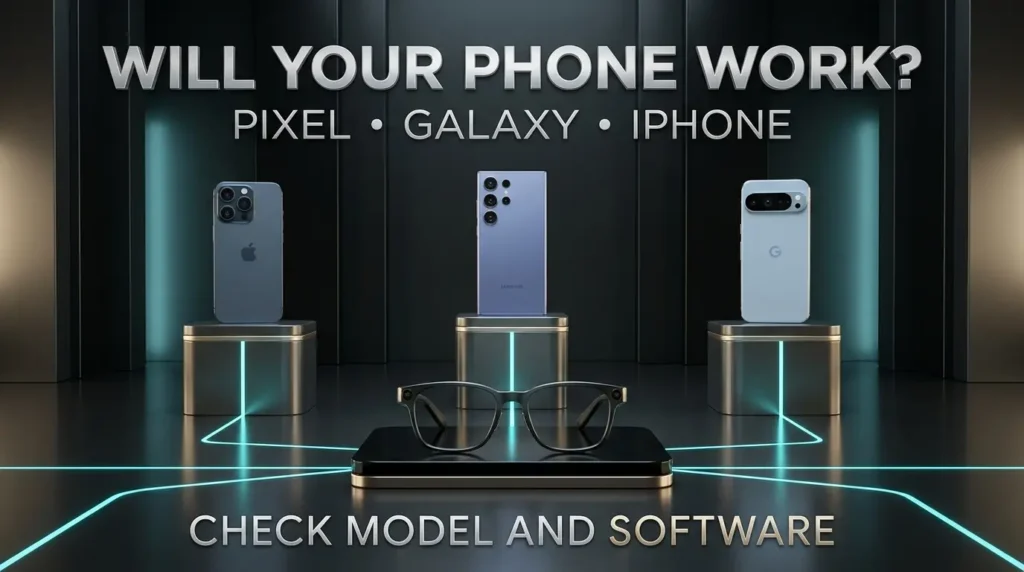
Google lists supported Pixel and Galaxy devices, plus certain iPhones.
The November launch documentation specifies Pixel 7 and newer with an appropriate Android 17 update, eligible Galaxy S and Galaxy Z devices on One UI 9 or newer, and iPhone 13 Pro and newer.
There is an important documentation difference: Google’s current product compatibility FAQ describes iPhone 13 and newer with at least 6GB RAM and iOS 26.6 or later.
Because these descriptions are not identical, buyers with a borderline device should confirm the exact model and software requirements with the official retailer or companion app before ordering.
| Phone family | Officially described support |
|---|---|
| Google Pixel | Pixel 7 series and newer, with required Android update |
| Samsung Galaxy | Supported Galaxy S, S FE and Galaxy Z models on One UI 9+ |
| Apple iPhone | Selected newer iPhones; verify the exact model and iOS version |
| Other Android brands | Not broadly supported at launch |
This is particularly important for owners of midrange Android phones.
A phone being technically capable of Bluetooth audio does not prove that it supports Gemini’s full eyewear experience.
Google also requires a compatible adult Google Account associated with an approved market.
Will all features work on iPhone?
Not necessarily.
Google says the glasses work with supported iPhones, but some features are restricted to Android at launch.
For example, Guided Vision and Aira access are initially limited to compatible Android phone pairings.
Some media integrations also have platform specific restrictions.
If a particular feature is the reason you are buying the glasses, verify its availability on your phone rather than relying on a general “works with iPhone” claim.
Google Gemini Smart Glasses vs Ray-Ban Meta: What Is Different?
Google is entering a market where Meta already has several generations of consumer smart glasses.
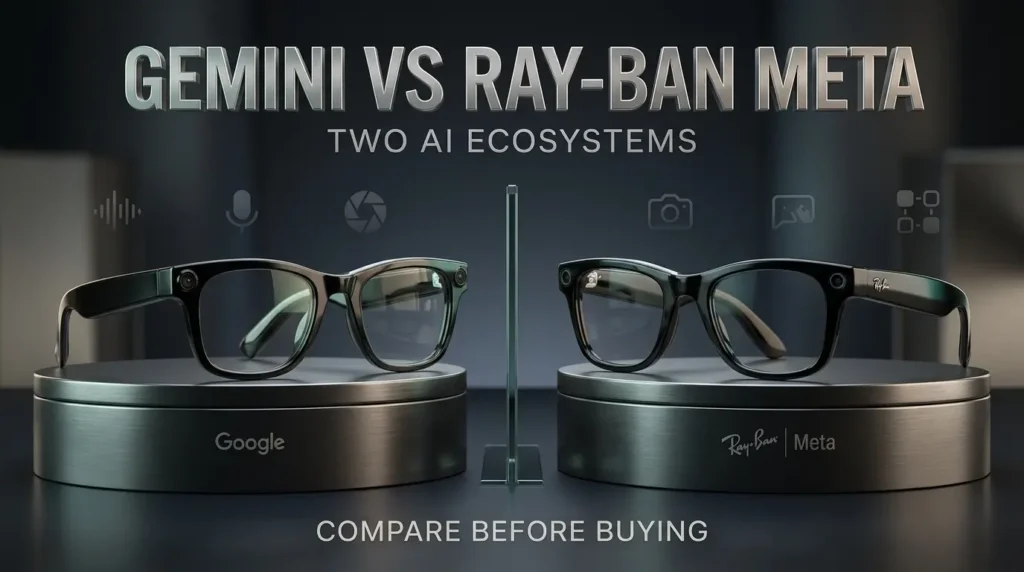
The most relevant direct comparison is Ray-Ban Meta Gen 3, rather than an older discounted product or Meta’s separate display equipped glasses.
Ray-Ban’s official US catalog lists Gen 3 models starting at $449, while Google’s Warby Parker collection begins at $395.
Both offer hands free audio, cameras and AI assistants, but the surrounding ecosystems differ.
| Feature | Google Gemini Intelligent Eyewear | Ray-Ban Meta Gen 3 |
|---|---|---|
| Starting US price | $395 | $449 |
| AI assistant | Gemini | Meta AI |
| Camera | 12MP | 12MP |
| 3K video | Yes | Yes |
| Advertised battery | Up to 9 hours | Up to 9 hours |
| Microphones | Four | Six |
| Storage | 64GB | 32GB |
| Water resistance | IPX4 | IPX4 |
| In-lens display | No | No |
| Main ecosystem | Google services and Android XR | Meta services and connected apps |
Specifications are manufacturer published and may vary by model, region and updates. No independent head to head performance testing was conducted.
The comparison is not just about the component list.
Google’s advantage may lie in its assistant, translation services, Maps and wider application ecosystem.
Meta’s offering has its own ecosystem, established retail presence and integrations with services such as Instagram, WhatsApp and Messenger.
Whether one works better for a particular person depends on the phone they own, the applications they use and their priorities.
What about Meta’s display glasses?
Meta also sells a separate display equipped product.
That is not the same as Ray-Ban Meta Gen 3, which is the direct camera and audio comparison used here.
If visual information inside a lens is essential, compare display enabled products separately. Treating all smart glasses as though they offer the same kind of augmented reality experience would be misleading.
Are Google glasses cheaper than Meta?
At the quoted US starting prices, the Warby Parker collection begins $54 below Ray-Ban Meta Gen 3.
However, model selection, prescription lenses, taxes, promotions and availability can change actual costs.
The lowest advertised price is useful, but it should not be the only deciding factor.
Are Google Gemini Smart Glasses Safe and Private?
Smart glasses create two distinct privacy questions.
One concerns the person wearing them: what data is collected and how can it be controlled?
The other concerns everyone nearby: how will they know whether a camera is recording?
Google has put considerable attention into both issues in its official privacy announcement.
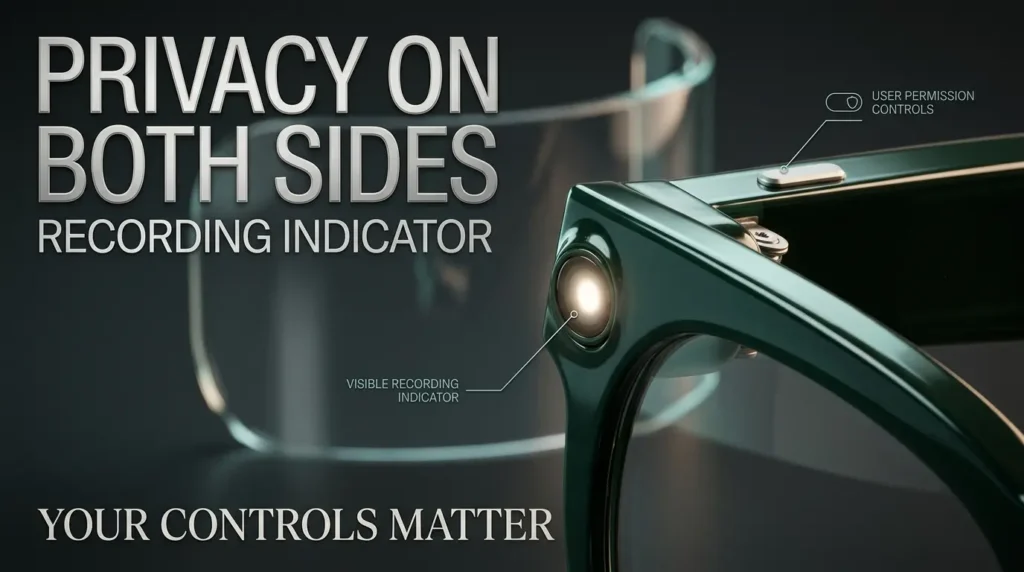
Camera recording indicators
The glasses include an outward facing indicator light.
When the wearer records video or captures photographs, the light is intended to inform nearby people that the camera is active.
Google says the hardware is designed to prevent recording if the indicator is covered or tampered with.
The glasses also have a physical power switch that can disable their electronic functionality.
These are meaningful design safeguards.
They are not a reason to record people without consent or disregard restrictions in schools, workplaces, medical settings or other sensitive environments.
What happens when Gemini sees through the camera?
Google says visual information captured to answer Gemini questions is not saved in Gemini History and is not used to train AI models or target advertisements.
The company also describes automated face redaction for bystanders before relevant visual data is processed.
But there is an important distinction between an AI visual query and a photograph deliberately saved to the user’s gallery.
When someone asks Gemini to capture a photo or video, that media may be stored in the gallery under the relevant application and storage policies.
Google also says conversations and activity settings remain manageable through Gemini controls.
Readers should not assume that every kind of audio, photo, video and conversation receives identical retention treatment.
Are the glasses suitable for accessibility?
Google has introduced Guided Vision, which provides spoken descriptions intended to assist people who are blind or have low vision with selected everyday tasks.
It has also partnered with Aira for access to trained human visual interpreters.
These capabilities may be valuable, but the limitations are crucial.
Google explicitly says Guided Vision is not a medical device, a mobility aid, an obstacle detection system or a replacement for a white cane.
It is not intended for safety critical navigation.
At launch, Guided Vision and Aira access are also restricted to compatible Android phone pairings, and some services may have additional membership requirements.
For businesses considering camera equipped AI devices, privacy policies should extend beyond the device itself. TrendOutsider’s guide to AI governance and responsible deployment explores the wider issues of permission, oversight and organizational accountability.
Should You Preorder Google Gemini Smart Glasses or Wait?
The decision becomes easier when you start with what you expect the glasses to do.
If you already use Google services extensively, have a supported smartphone and want spoken AI help throughout the day, the concept may be appealing.
The ability to ask questions about a physical object, translate speech or review a message without holding a phone is genuinely different from sitting in front of a chatbot.
But early adoption comes with uncertainties.
We do not yet have long term independent evidence about reliability, everyday battery performance, heat, camera quality, fit over several hours or how consistently Gemini responds in noisy places.
Those details matter because glasses are worn rather than carried.
A slightly uncomfortable frame or unreliable voice interaction can become more frustrating than a comparable limitation in an app.
Who might find them useful?
They may appeal to commuters, frequent travelers, people interested in hands free productivity, and technology enthusiasts who want to experiment with AI beyond phone screens.
The product could also interest people who enjoy photography from a first person perspective, provided they respect privacy expectations.
Who should wait?
Waiting is reasonable if your phone is not officially supported, you live outside the activation markets, you need a visual AR display or you rely on a specific accessibility feature that has platform restrictions.
It may also make sense to wait for genuine customer reviews if comfort and all day endurance matter more than being among the first buyers.
Organizations planning to deploy wearable AI at work should consider support, data policies and measurable usefulness rather than assuming that a new form factor automatically improves productivity. Our existing AI business solutions implementation guide provides a broader framework for assessing whether AI tools solve real problems.
Frequently Asked Questions
How much do Google Gemini smart glasses cost?
Warby Parker Intelligent Eyewear starts at $395 in the United States. Gentle Monster models are listed from $449 to $489. Prescription options and final configurations may change the price.
When are Google Gemini smart glasses coming out?
Google and Samsung have scheduled general availability for December 10, 2026. Preorders opened November 12.
Do Google smart glasses have a screen?
No. The first Gemini Intelligent Eyewear models use cameras, microphones and audio without an integrated display inside the lenses.
Can Google Gemini smart glasses work with an iPhone?
Yes, with selected supported iPhone models and appropriate software. Google’s launch and current compatibility pages differ slightly on the exact minimum model, so buyers should verify compatibility before ordering.
Can the glasses translate languages?
Google advertises real time translation using Google Translate, with automatic language detection across more than 70 languages. Actual performance can vary by language, environment and connectivity.
Can I use Gemini smart glasses in Pakistan or India?
The initial activation markets are the United States and South Korea, subject to collection availability. Google has not confirmed general activation support for Pakistan or India.
Can I get prescription Gemini smart glasses?
Yes. Warby Parker provides prescription and other lens options, while Gentle Monster offers prescription support for most of its frames. Individual availability and prices vary.
How long does the battery last?
Google and Samsung advertise up to nine hours on a single charge and up to 72 hours of total usage with the charging case, depending on use.
Are Google Gemini smart glasses waterproof?
No. Their IPX4 rating provides splash resistance, not full waterproofing or immersion protection.
Can they secretly record someone?
The glasses include recording indicators and anti-tampering safeguards. Their design does not remove the wearer’s responsibility to obtain consent where appropriate and comply with applicable laws and venue rules.
Are they better than Ray-Ban Meta?
There is no verified overall winner. Both provide camera and audio AI experiences, with different ecosystems and model options. A proper decision should consider phone compatibility, fit, features, pricing and independent testing.
Should I wait for Google’s display glasses?
If a lens display is essential, waiting may be sensible. Google has discussed display equipped eyewear, but has not announced a confirmed consumer release date for those models.
The Bigger Question: Will AI Glasses Become Everyday Technology?
Google’s return to smart glasses is significant because the company is approaching the category differently from the original Google Glass era.
The first Gemini eyewear is designed to look like familiar glasses, work with existing phones and let AI respond to the world without requiring a separate screen.
Samsung’s hardware expertise and the involvement of established eyewear brands may help address some of the practical problems wearable technology has faced.
But the product still has to justify its place in people’s everyday lives.
The real test will not be whether Gemini can impress someone during a short demonstration.
It will be whether the glasses remain comfortable, useful, trustworthy and convenient after the novelty fades.
For now, Google’s December launch gives consumers another serious option in a category that is becoming more competitive.
The most useful questions are also the simplest: Does your phone work with the glasses? Do you need a display? Will you use the features regularly? And are you comfortable with the privacy responsibilities of wearing a camera?
Those answers matter far more than the excitement surrounding a new AI product.
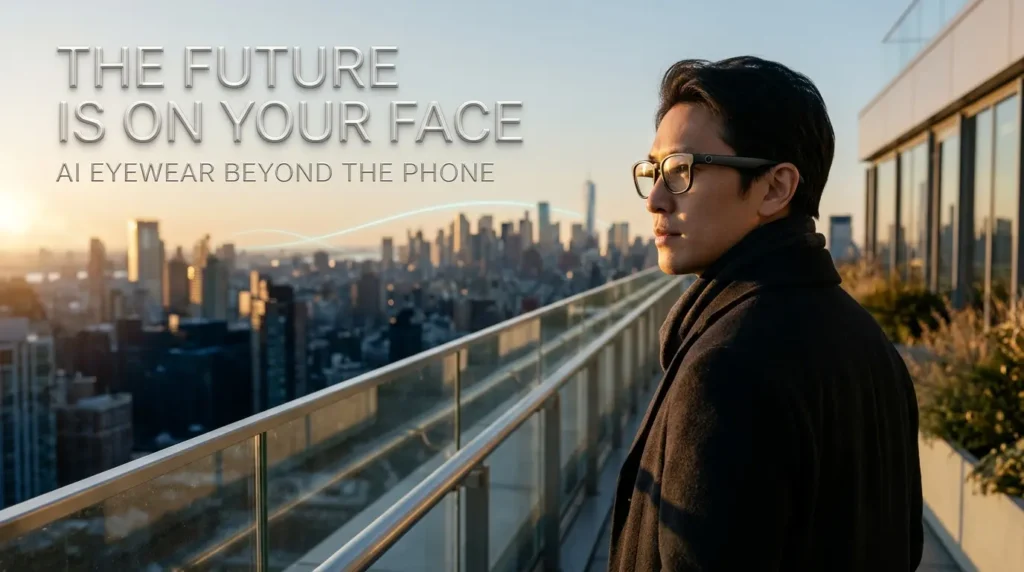
Editorial note: This article is based on Google’s and Samsung’s November 12, 2026 announcements, official product documentation and independent industry reporting. Specifications and availability can change. TrendOutsider has not independently purchased, worn, tested or benchmarked these glasses.
Privacy and safety note: Respect recording consent and local law. AI guidance may be inaccurate and should not replace attention to surroundings or qualified accessibility and medical assistance.
Visual disclosure: AI generated editorial images are illustrations, not authenticated hardware photographs or actual user interface screenshots unless clearly credited as such.







Leave a Reply