

A business owner needs a better website. A creator needs fifty short videos edited. A sales team is drowning in spreadsheets. An online store has thousands of product descriptions that are inconsistent, outdated or difficult to translate.
These are ordinary business problems. They are also examples of where artificial intelligence can help someone deliver a useful service.
That distinction is the starting point for understanding how to make money with AI in 2026.
The opportunity is not simply to ask ChatGPT for an answer and sell whatever comes out. Customers can do that themselves. They pay people who understand a problem, use the right tools, check the output and deliver something worth using.
Some opportunities require little more than strong writing, organization and a reliable laptop. Others involve coding, data security, marketing budgets or years of professional experience.
A few can grow into software businesses or reusable digital products. Most begin as ordinary work that still requires finding customers and delivering on promises.
This updated guide examines 100 distinct ways to make money with AI, organized into ten categories. For each opportunity, you will learn what you can sell, who might buy it, which tools can help, how to start and what could go wrong.
You will also find a realistic method for pricing your work, a thirty day starting plan and warnings about offers that promise effortless income.
The most important thing to know: AI can reduce the effort involved in certain tasks, but it cannot guarantee a customer, a sale or a profit.
Quick Answer: Which AI Income Opportunities Make Sense?
If you are starting from zero, the most approachable routes generally involve a service you can demonstrate without building an entire business first.
You could produce edited presentation slides, organize spreadsheet data, prepare newsletter drafts or create short videos for a business.
If you already understand marketing, design or software, AI can help you deliver more specialized work. Examples include website integrations, automated reporting, customer support systems and original training materials.
If you want something that can be sold repeatedly, consider a well designed template, a small software subscription or a specialist educational product. Those models can scale, but they usually need more validation and distribution work before the first sale.
| Your situation | Good places to investigate | Main challenge |
|---|---|---|
| Beginner with a computer | Virtual assistance, reporting, transcription editing, presentation services | Building demonstrable quality and finding customers |
| Writer or marketer | Specialist blog writing, email campaigns, SEO updates, research briefs | Differentiating from generic AI output |
| Designer or video editor | Product visuals, short videos, animations, brand assets | Commercial rights, taste and final production quality |
| Developer | Website integrations, AI agents, document search, SaaS | Reliability, security, engineering and maintenance |
| Subject expert | Training, consulting, research, evaluation | Demonstrating expertise and trust |
| Entrepreneur with an audience | Templates, courses, newsletters, software | Distribution, retention and repeatable demand |
What the 2026 demand research says
In February 2026, Upwork reported that skills explicitly involving AI grew 109% year over year on its marketplace. AI video generation and editing grew 329%, AI integration 178%, and data annotation and labeling 154%.
Those percentages refer to Upwork activity. They do not predict how much an individual freelancer will earn.
By September, the platform’s monthly hiring research identified particular interest in AI video, SaaS development, agent developers and workflow automation.
A November 2026 study from OpenAI and Upwork also found that AI related client projects increasingly combine several skills and tend to involve larger budgets and more work hours.
The practical lesson is not to chase every fashionable tool. It is to identify work somebody needs completed.
How to Choose From These 100 Ideas
Before looking at the list, ask four questions.
What can I already do well? Writing, designing, teaching, selling and programming are different starting points. AI is more helpful when paired with a skill you understand.
Who would pay? A product without an identifiable customer is still an experiment. Try to name a particular buyer rather than “everyone who uses AI.”
What will I deliver? Define the finished article, video, automation, website, dashboard or file the customer receives.
What could it cost to deliver? Include subscriptions, API usage, hosting, advertising, transaction fees, support, taxes and your time.
Choose one idea to investigate first. Reading one hundred possibilities is useful. Attempting all of them at once rarely is.

Part One: AI Freelancing and Professional Services
These methods work by selling a defined service. AI may accelerate research, drafting and preparation, but you remain responsible for the result.
1. Research backed SEO content briefs
What you sell: A clear plan for an article or website page, including search intent, competing coverage, useful sources, headings and content gaps.
Customers: Publishers, marketing agencies and businesses with established websites.
Tools: Search engines, Google Search Console when clients provide access, spreadsheets and a capable AI assistant.
How to start: Create a sample brief for a topic you know, verify its sources and explain why each proposed section helps readers. Offer a small paid pilot to a relevant business.
Revenue and caution: Charge per approved brief or monthly content plan. AI generated keyword claims need verification, and invented search volumes can damage client trust.
2. Human edited B2B blog writing
What you sell: Original articles that explain a business topic accurately and match a client’s editorial standards.
Customers: Software companies, service firms and industry publications.
Tools: ChatGPT, Claude, source documents and an editing system.
How to start: Choose one industry, build two strong samples and pitch a specific article angle rather than offering generic AI writing.
Revenue and caution: Work can be priced per article or ongoing editorial contract. You must verify facts, permissions and claims. A specialist writer’s value lies in judgment and reporting, not merely drafting speed.
For a deeper look at this route, read TrendOutsider’s AI freelance writing guide.
3. Email newsletter production
What you sell: A regularly prepared email newsletter with sourced updates, clear writing and suitable links.
Customers: Consultants, publishers, professional associations and ecommerce businesses.
Tools: Research assistants, email platforms and editorial checklists.
How to start: Prepare a sample edition for one niche and demonstrate how you would verify and summarize important developments.
Revenue and caution: A recurring production fee is possible. Sending emails, obtaining consent and managing subscriber data must follow applicable marketing and privacy requirements.
4. Sales email sequence writing
What you sell: A sequence of prospecting or customer follow up emails, tailored to an approved audience and offer.
Customers: B2B sales teams and small businesses.
Tools: AI writing tools, customer research and CRM software.
How to start: Build a sample welcome or reengagement sequence using a fictional company, then approach businesses needing campaign improvements.
Revenue and caution: Charge for the campaign and revisions. Avoid deceptive personalization, fabricated testimonials and unlawful bulk outreach.
5. Resume and LinkedIn profile services
What you sell: Clearer descriptions of someone’s real experience, achievements and professional goals.
Customers: Job seekers and career changers.
Tools: AI drafting, formatting and editing tools.
How to start: Make before and after samples using invented profiles. Offer a structured consultation and a final editable document.
Revenue and caution: Charge per package. Never invent qualifications, employment history, achievements or endorsements to make a candidate appear stronger.
6. Presentation and pitch deck design
What you sell: Well structured, visually consistent slides that communicate a client’s actual information.
Customers: Startup founders, teachers, consultants and sales teams.
Tools: PowerPoint, Canva, design assistants and AI research support.
How to start: Redesign a fictional presentation and demonstrate clearer hierarchy, charts and storytelling.
Revenue and caution: Price by scope, complexity and revision rounds. Financial forecasts, market size and investor claims must come from defensible sources.
7. AI assisted translation and localization
What you sell: Translated and culturally appropriate websites, product information or business materials.
Customers: Exporters, ecommerce stores and software companies entering new markets.
Tools: Machine translation, terminology databases and human editing.
How to start: Work in a language pair you genuinely know. Prepare a short portfolio showing corrected translations and cultural adaptations.
Revenue and caution: Charge per project or ongoing language support. Legal, medical and other critical translations require appropriately qualified reviewers.
8. Podcast show notes and content repurposing
What you sell: Episode summaries, chapter markers, article drafts and social posts derived from an authorized recording.
Customers: Podcasters, media studios and business creators.
Tools: Transcription, AI summarization and editorial software.
How to start: Obtain permission to use a sample recording, prepare a complete episode package and show how you checked quotations and timestamps.
Revenue and caution: Sell per episode or monthly. Transcription errors can turn into misleading quotes.
9. Virtual executive assistance
What you sell: Research preparation, document organization, meeting notes and administrative support.
Customers: Entrepreneurs, managers and consultants.
Tools: AI assistants, office suites, calendar software and approved workflow automations.
How to start: Offer a limited set of tasks with clear turnaround times and access permissions.
Revenue and caution: Hourly or retainer arrangements are possible. Confidential messages, account access and personal information require careful handling.
10. Spreadsheet reporting and business dashboards
What you sell: Clean reporting workbooks, understandable charts and recurring business performance summaries.
Customers: Small businesses, agencies and operations managers.
Tools: Excel, Google Sheets, Python and AI formula assistance.
How to start: Create a sample dashboard from synthetic sales data and document the formulas.
Revenue and caution: Charge for setup plus optional monthly updates. Always reconcile totals and verify AI suggested formulas against the underlying data.
Part Two: AI Video, Design and Creator Services
Creative work is one of the areas where current freelance research identifies notable interest. But image and video generation are only parts of the production process. Editing, storytelling, rights and client feedback still matter.
11. Short video editing for businesses
What you sell: Polished vertical videos for advertising and social channels.
Customers: Retailers, agencies, educators and creators.
Tools: CapCut, Premiere Pro, transcription tools and approved AI editing features.
How to start: Build three sample edits from licensed or original footage, demonstrating pacing, captions and clean transitions.
Revenue and caution: Charge per video or batch. Verify licensed music and footage, and avoid promising viral performance.
12. AI assisted creator style advertising
What you sell: Clearly disclosed creator style advertising concepts and finished promotional videos.
Customers: Ecommerce brands and marketing agencies.
Tools: Video generation, scripting, editing and audio tools with commercial permissions.
How to start: Produce a fictional product ad using an invented brand and demonstrate transparent synthetic media labeling.
Revenue and caution: Package by concept and deliverable. Do not fabricate genuine customer experiences or impersonate real creators without permission.
13. YouTube video repurposing
What you sell: Short clips, captions, descriptions and teaser material from a creator’s existing long videos.
Customers: YouTubers, interview channels and educational publishers.
Tools: Transcript search, AI editing and captioning software.
How to start: Obtain rights to a sample video and prepare five distinct clips designed for different audiences.
Revenue and caution: Monthly packages suit regular channels. Never remove contextual qualifications in ways that misrepresent the speaker.
14. Product demonstration videos
What you sell: Short demonstrations showing real product functions and customer use cases.
Customers: Software firms, manufacturers and ecommerce sellers.
Tools: Screen recording, motion graphics, AI scripting and video editing.
How to start: Produce a demonstration for a product you own or have permission to film.
Revenue and caution: Charge per deliverable and revisions. AI generated scenes should not misrepresent actual product behavior.
15. Multilingual video localization
What you sell: Subtitled or dubbed versions of an approved video for new audiences.
Customers: Training providers, software companies and publishers.
Tools: Speech transcription, translation, caption editing and approved dubbing tools.
How to start: Create a short sample with source and target language transcripts for quality checking.
Revenue and caution: Price by video duration and complexity. Obtain permission for voice reproduction and have fluent reviewers validate the meaning.
16. Podcast editing and clip packages
What you sell: Clean audio episodes, short video excerpts, captions and promotional artwork.
Customers: Business podcasts and independent creators.
Tools: Audio restoration, speaker separation, transcript search and editing suites.
How to start: Demonstrate noise cleanup and a complete promotional pack using authorized material.
Revenue and caution: Charge per episode or production season. Avoid excessive processing that changes the speaker’s intended sound.
17. Ecommerce product photography enhancement
What you sell: Retouched product photographs, background removal and approved lifestyle composites.
Customers: Online stores, jewelry sellers and consumer brands.
Tools: Photo editing software, AI masking and image generation.
How to start: Obtain permission to edit real product photographs and prepare before and after examples.
Revenue and caution: Charge per product set. The final image must accurately represent the item a customer will receive.
18. Brand identity and social design kits
What you sell: A consistent visual system with logos, typography recommendations and social media templates.
Customers: New companies, independent professionals and local businesses.
Tools: Design software, AI ideation and mockup tools.
How to start: Create a coherent fictional brand across several formats, then explain your design decisions.
Revenue and caution: Use a fixed scope and revision agreement. Check originality, trademark conflicts and licensing before handing over assets.
19. Custom educational animations
What you sell: Short animations that explain concepts, processes or products.
Customers: Course providers, schools and training businesses.
Tools: Storyboarding, motion graphics, AI image assistance and narration.
How to start: Produce a short explainer about a factual topic with a storyboard and source list.
Revenue and caution: Price by length and production complexity. Review scientific and technical accuracy before delivery.
20. AI enhanced motion graphics
What you sell: Animated titles, infographics, video backgrounds and campaign graphics.
Customers: Agencies, broadcasters and online publishers.
Tools: After Effects, Blender, animation software and AI assisted asset creation.
How to start: Build a reel demonstrating smooth motion, clear text and consistent branding.
Revenue and caution: Charge per asset package. Generated graphics still need quality control, and client licenses must cover the finished use.

Part Three: Business Automation and AI Agents
This section is particularly relevant to companies paying for less repetitive work, faster response times and more reliable internal processes. Automation needs tests, permissions and ongoing maintenance.
21. Lead intake automation
What you sell: A system that collects incoming inquiries, classifies them and routes them to the right person.
Customers: Agencies, property businesses and service companies.
Tools: Form builders, n8n, Make, Zapier and an approved AI service.
How to start: Build a demo with fictional leads and show how exceptions reach a human.
Revenue and caution: Charge implementation plus maintenance. Protect personal data and avoid scoring people using inappropriate sensitive attributes.
22. Customer support chatbot setup
What you sell: A chatbot answering supported questions from approved help documents.
Customers: Online shops, SaaS businesses and service providers.
Tools: Knowledge bases, chatbot platforms and retrieval systems.
How to start: Create a small demo using publicly available fictional help articles and test unsupported questions.
Revenue and caution: Sell setup and a monitoring plan. The chatbot must be able to admit uncertainty and escalate to a person.
23. Appointment booking automation
What you sell: A booking workflow handling availability, reminders and rescheduling.
Customers: Salons, consultants and local service businesses.
Tools: Scheduling software, calendar integrations and automation services.
How to start: Build a test calendar with dummy appointments and verify time zone handling.
Revenue and caution: Setup fees and monthly support are possible. Double bookings, cancellations and personal information require safeguards.
24. CRM cleanup and follow up workflows
What you sell: Contact deduplication, field standardization, follow up reminders and reporting.
Customers: Sales organizations and agencies.
Tools: CRM platforms, spreadsheets, matching algorithms and workflow automation.
How to start: Demonstrate a cleanup of a synthetic dataset and show reversible changes.
Revenue and caution: Charge by records or project scope. Incorrect merges can permanently damage real customer records.
25. Email triage automation
What you sell: A workflow that categorizes inbound mail, summarizes requests and drafts replies for approval.
Customers: Busy support teams and professional service firms.
Tools: Email integrations, classification models and approval queues.
How to start: Test against fabricated messages covering routine and unusual cases.
Revenue and caution: Monthly monitoring can be valuable. Do not authorize automatic replies or sensitive actions without suitable controls.
26. Internal knowledge base assistants
What you sell: Searchable assistants that answer questions from a company’s approved documents.
Customers: Human resources, operations and internal support teams.
Tools: Document indexing, vector search, retrieval systems and AI APIs.
How to start: Build a demo from fictional policies with citations linking to exact document passages.
Revenue and caution: Charge for configuration and updates. Respect document permissions and test misleading answers.
27. Invoice and document processing
What you sell: Extraction and validation of fields from invoices, forms and receipts.
Customers: Bookkeepers, logistics firms and small businesses.
Tools: OCR services, document processing models and accounting integrations.
How to start: Use synthetic invoices to test extraction, duplicate detection and manual approval.
Revenue and caution: Charge per volume or implementation. Human verification remains important before recording payments or financial obligations.
28. AI powered reporting automation
What you sell: Recurring reports that collect data, identify changes and summarize business metrics.
Customers: Marketing teams, operations managers and founders.
Tools: Database connectors, spreadsheets, business intelligence tools and AI summaries.
How to start: Connect mock data sources and verify the reported totals.
Revenue and caution: Sell setup and recurring maintenance. A convincing narrative is useless if its underlying calculations are wrong.
29. Sales call summaries and CRM updates
What you sell: Approved call summaries, action items and structured CRM updates.
Customers: Sales teams and account managers.
Tools: Recording systems, transcription, AI summarization and CRM APIs.
How to start: Use consented sample calls, create a structured output template and verify names and commitments.
Revenue and caution: Charge per user or deployment. Call recording laws and organizational consent policies must be respected.
30. AI workflow audits and optimization
What you sell: A review of existing workflows, bottlenecks, automation opportunities and risk controls.
Customers: Small and medium sized businesses.
Tools: Process maps, interviews, activity logs and automation analysis.
How to start: Offer a scoped audit of one low risk process with a concrete improvement proposal.
Revenue and caution: Charge for assessment and optional implementation. Avoid claiming savings before baseline measurements and real results exist.
For more detail on automation design, see TrendOutsider’s AI agents workflow automation guide.

Part Four: Websites, Apps and AI Software
Software can create recurring revenue, but it also brings responsibilities for uptime, security, billing, support and maintenance. These methods are suitable for people with development skills or reliable technical collaborators.
31. Small business website development
What you sell: Fast, accessible, mobile friendly business websites with accurate content and working forms.
Customers: Local businesses, consultants and service providers.
Tools: Website frameworks, CMS platforms, coding assistants and testing tools.
How to start: Build a complete demonstration site for a fictional local business and test it on mobile.
Revenue and caution: Charge by project and ongoing support. AI generated code still requires security and accessibility review.
32. AI feature integration for existing apps
What you sell: A specific feature such as document summarization, searchable help or structured data extraction.
Customers: Software businesses with existing products.
Tools: APIs, backend frameworks, retrieval systems and logging.
How to start: Create a small working demonstration with clear input, output and error handling.
Revenue and caution: Project fees and support contracts are possible. Privacy, latency, model costs and reliability must be addressed.
33. Industry specific micro SaaS
What you sell: A narrowly focused subscription tool solving one recurring problem.
Customers: A particular professional or business niche.
Tools: App frameworks, databases, payment systems and selected AI APIs.
How to start: Interview potential users, build a minimum useful version and seek real paid interest.
Revenue and caution: Subscription revenue depends on retention. A product without buyers is a development expense.
34. Customer facing AI chat applications
What you sell: A branded application that provides a defined conversational service.
Customers: Businesses, communities or specialized consumer audiences.
Tools: Web frameworks, AI APIs, moderation and usage controls.
How to start: Choose one narrow use case and test the assistant with realistic scenarios.
Revenue and caution: Charge for development or operate a subscription product. Budget for abuse prevention, response errors and model usage.
35. Internal business dashboards
What you sell: Secure dashboards combining business data and useful AI assisted explanations.
Customers: Operations teams, agencies and founders.
Tools: Database queries, visualization libraries and AI summaries.
How to start: Build a demonstration with synthetic data and verified metric definitions.
Revenue and caution: Implementation and support fees are possible. Access control and accurate calculations are mandatory.
36. AI document search tools
What you sell: Search tools that retrieve relevant passages from contracts, manuals or approved company records.
Customers: Consulting firms, operations teams and technical support organizations.
Tools: Retrieval augmented generation, indexing and permission aware search.
How to start: Index a small public document library and test whether citations actually support answers.
Revenue and caution: Charge setup and hosting. Do not promise legally reliable interpretations without qualified review.
37. Ecommerce personalization implementations
What you sell: Better product discovery, recommendations or assisted shopping experiences.
Customers: Online retailers.
Tools: Catalog data, recommendation systems, analytics and storefront integrations.
How to start: Build a limited demo using a sample catalog and measurable recommendation rules.
Revenue and caution: Project fees or recurring optimization contracts are possible. Respect privacy choices and do not fabricate product ratings or availability.
38. Website accessibility remediation
What you sell: Accessibility improvements supported by testing and expert review.
Customers: Organizations with websites or web applications.
Tools: Automated accessibility scanners, browser tools and AI coding assistance.
How to start: Audit a demonstration site and manually verify fixes for keyboard use, semantics and contrast.
Revenue and caution: Charge for scoped remediation. Automated checks alone do not prove legal compliance or full accessibility.
39. AI enabled customer portals
What you sell: Secure portals where customers can access documents, request support or review account information.
Customers: Agencies, education providers and professional service businesses.
Tools: Authentication, database systems, web frameworks and AI APIs.
How to start: Build a sample portal with dummy users and strict permission separation.
Revenue and caution: Project and maintenance income is possible. Authentication flaws can expose private customer information.
40. Custom API integration services
What you sell: Reliable connections between existing business systems.
Customers: Teams using several applications that do not communicate well.
Tools: APIs, webhooks, integration platforms and AI assisted coding.
How to start: Connect two sandbox systems and document error recovery.
Revenue and caution: Charge per integration and ongoing monitoring. Account for API limits, credential security and provider changes.

Part Five: Marketing, SEO and Growth Services
Marketing services are attractive because businesses can often define the outcome they need. AI can improve research and production, but it cannot guarantee search rankings, advertising returns or sales.
41. Local SEO implementation
What you sell: Improved business information, locally useful pages and search visibility fundamentals.
Customers: Local service businesses and shops.
Tools: Search research, business profile tools and AI content assistance.
How to start: Audit a business’s publicly visible details and propose accurate corrections.
Revenue and caution: Charge for an audit and implementation. Never create fake reviews or promise first place rankings.
42. SEO content refresh services
What you sell: Improved existing pages with updated facts, clearer structure and stronger internal links.
Customers: Publishers and companies with established websites.
Tools: Search Console access, crawling tools and source verification.
How to start: Produce an example update plan showing a page’s missing answers and outdated information.
Revenue and caution: Charge per page or group of pages. Do not fabricate experience or merely rewrite text to appear fresh.
43. Paid advertising creative testing
What you sell: Several creative concepts, variations and a structured testing plan.
Customers: Brands and performance marketing teams.
Tools: Design software, AI image and video production and advertising analytics.
How to start: Develop mock creative options for a fictional product and explain the hypotheses they test.
Revenue and caution: Charge for creative production and analysis. Conversion results depend on many factors beyond the advertisement.
44. Email marketing operations
What you sell: Audience segmentation, campaign production, scheduling and reporting.
Customers: Online stores, membership businesses and service firms.
Tools: Email platforms, data analysis and AI drafting.
How to start: Build a sample lifecycle campaign including consent and unsubscribe handling.
Revenue and caution: Charge monthly or by campaign. Privacy compliance and list quality are essential.
45. Social media calendar management
What you sell: A coordinated schedule of useful posts with captions, assets and publication guidance.
Customers: Small brands, agencies and creators.
Tools: Planning systems, AI brainstorming and approved scheduling software.
How to start: Create a two week calendar for a fictional business with distinct content formats.
Revenue and caution: Monthly retainers are common business arrangements. Do not promise engagement or automate misleading comments.
46. Conversion rate optimization audits
What you sell: Analysis of why a website loses visitors before they complete an intended action.
Customers: Ecommerce stores and SaaS firms.
Tools: Analytics, heatmaps, survey summaries and AI assisted analysis.
How to start: Prepare a demonstration audit of a sample checkout or signup flow.
Revenue and caution: Charge for the audit and experimental plan. Recommendations are hypotheses until tested.
47. Product feed and catalog optimization
What you sell: Cleaner product titles, descriptions, attributes and category data.
Customers: Online retailers and marketplace sellers.
Tools: Catalog exports, spreadsheet tools and AI data cleaning.
How to start: Improve a synthetic catalog of fifty items and document the rules.
Revenue and caution: Charge per batch or recurring catalog management. Product attributes must remain factually accurate.
48. Marketing analytics reporting
What you sell: Monthly analysis of traffic, campaigns, leads and conversion outcomes.
Customers: Agencies, retailers and business owners.
Tools: Analytics platforms, dashboards and AI explanations.
How to start: Build a sample report with actual formulas and clearly fictional data.
Revenue and caution: Monthly reporting contracts are possible. Never invent campaign results or confuse correlation with causation.
49. Lead research and qualification services
What you sell: A researched list of relevant companies or accounts with documented suitability.
Customers: B2B sales organizations and agencies.
Tools: Public business data, research assistants and CRM systems.
How to start: Select one industry and produce ten thoroughly checked sample account profiles.
Revenue and caution: Charge per research project. Respect privacy, data provider terms and outreach rules.
50. Review response and reputation workflow management
What you sell: Draft responses to genuine customer reviews and a system for routing concerns.
Customers: Hotels, restaurants, retailers and local services.
Tools: Review dashboards, sentiment analysis and AI writing assistance.
How to start: Build examples using fictional reviews covering praise, complaints and unresolved issues.
Revenue and caution: Charge per location or monthly service. Never purchase fake reviews or disclose private customer details.
Part Six: Digital Products and Education
Digital products can be sold more than once, but they are not automatically passive income. Discoverability, support, updates and refunds can consume substantial time.
51. Specialized spreadsheet templates
What you sell: Useful calculation, planning or tracking workbooks.
Customers: Freelancers, small business owners and professionals.
Tools: Excel, Google Sheets and AI formula assistance.
How to start: Create a budget or project tracker for a narrow audience, test the formulas and provide instructions.
Revenue and caution: Sell individual templates or bundles. Ensure formulas work across the advertised software versions.
52. Professionally designed Notion systems
What you sell: Customizable workspaces for project tracking, content planning or client management.
Customers: Students, creators and small teams.
Tools: Notion, workflow research and AI content assistance.
How to start: Design one complete system and provide a realistic demonstration.
Revenue and caution: Sell templates or customization services. Avoid reselling someone else’s layout without permission.
53. Reusable automation templates
What you sell: Documented workflow configurations for common business processes.
Customers: Small businesses and automation freelancers.
Tools: n8n, Make, Zapier and supporting documentation.
How to start: Build a tested example with dummy data and explain required connections.
Revenue and caution: Sell templates or installation support. API changes and varying permissions can break imported workflows.
54. Niche prompt packs with tested examples
What you sell: Carefully designed prompt systems, example inputs and quality control guidance for a specialized task.
Customers: Teachers, writers and business teams.
Tools: AI assistants, evaluation spreadsheets and documentation software.
How to start: Test prompts on multiple representative cases and show both good outputs and limitations.
Revenue and caution: Charge for the packaged training resource. Generic prompts are easy to copy and may have little standalone value.
55. Original ebooks and workbooks
What you sell: A coherent educational publication with original exercises and useful explanations.
Customers: Readers with a particular learning goal.
Tools: Research, writing, illustration and layout software.
How to start: Validate a narrow topic, outline the curriculum and complete a well edited short book.
Revenue and caution: Sell directly or through a permitted bookstore platform. Follow Amazon KDP’s AI content disclosure requirements where applicable.
56. Industry specific mini courses
What you sell: A short, structured learning experience that teaches a practical outcome.
Customers: Professionals and beginners in a specific field.
Tools: Screen recording, AI lesson preparation and learning platforms.
How to start: Teach one demonstrable skill, create exercises and obtain feedback from real learners.
Revenue and caution: Sell course access or licenses. Keep lessons updated and do not promise career or income outcomes.
57. Paid professional workshops
What you sell: Live instruction and exercises for a small group.
Customers: Teams, industry associations and professionals.
Tools: Presentation software, AI demonstrations and video meeting platforms.
How to start: Design a ninety minute workshop with practical activities and a clear participant outcome.
Revenue and caution: Charge per session or seat. Teach only within your expertise and protect participant information.
58. Language learning resources
What you sell: Vocabulary exercises, conversation practice, pronunciation materials or guided study plans.
Customers: Language learners, tutors and education businesses.
Tools: AI lesson drafting, audio generation and human language review.
How to start: Build a small level appropriate resource and check the language with a competent speaker.
Revenue and caution: Sell downloads or subscriptions. Inaccurate grammar and pronunciation can undermine learner trust.
59. Printable educational resources
What you sell: Original worksheets, classroom activities and learning games.
Customers: Teachers, parents and educational publishers.
Tools: Illustration software, AI ideation and layout tools.
How to start: Make a small resource pack tied to a specific age group and learning objective.
Revenue and caution: Sell printable files or classroom licenses. Validate answer keys and check child appropriate content.
60. Specialist training memberships
What you sell: Ongoing practical lessons, updated resources and community sessions.
Customers: Professionals seeking continuing skill development.
Tools: Membership platforms, video tools and AI curriculum support.
How to start: Build a small foundational library and test demand before committing to monthly releases.
Revenue and caution: Subscription income requires ongoing value. Retention can be difficult if the content becomes repetitive.

Part Seven: Content Businesses and Publishing
These models depend on building an audience. AI can assist production, but the durable asset is useful original work and the trust readers place in it.
61. Niche content websites
What you sell: Useful information that can eventually support advertising, affiliate relationships or sponsorships.
Customers: Readers first, then advertisers or partners.
Tools: Research, content management systems, analytics and AI editorial support.
How to start: Choose a subject you understand and publish distinctive material that answers real questions.
Revenue and caution: Advertising or referral income requires traffic and eligibility. Google warns against generating large amounts of low value content for ranking manipulation.
62. Original YouTube educational channels
What you sell: Helpful videos that attract viewers and potentially earn through eligible platform monetization or sponsorship.
Customers: A defined audience interested in a particular topic.
Tools: Scripting, original recording, editing and AI assistance.
How to start: Publish a small series based on questions you can answer accurately.
Revenue and caution: Revenue depends on eligibility and audience response. Reused or repetitive low quality content may not meet platform requirements.
63. Specialized email newsletters
What you sell: Curated, original reporting or analysis delivered regularly.
Customers: Readers and organizations needing a particular information service.
Tools: Research systems, email platforms and editorial assistance.
How to start: Produce several strong sample issues, then invite interested subscribers.
Revenue and caution: Monetize with memberships or relevant sponsors after demonstrating value. Subscriber acquisition is not automatic.
64. Independent research publications
What you sell: Original, well documented studies and industry briefings.
Customers: Businesses, researchers and decision makers.
Tools: Public datasets, analytics software and AI research organization.
How to start: Publish one rigorous sample report with reproducible methodology.
Revenue and caution: Charge per report or subscription. Sources and methods must support every significant claim.
65. Podcast publishing businesses
What you sell: Original episodes, interviews and specialist audio reporting.
Customers: Listeners and future sponsors.
Tools: Recording equipment, editing software and AI transcription.
How to start: Choose a topic, publish several episodes and test whether the audience returns.
Revenue and caution: Advertising and sponsorship require an engaged audience. Secure music and guest permissions.
66. Affiliate comparison websites
What you sell: Independent product comparisons that may generate referral commissions when readers purchase through eligible links.
Customers: Readers choosing between products or services.
Tools: Research tools, testing records, comparison tables and AI organization.
How to start: Select a narrow category and compare products using current, sourced information.
Revenue and caution: Disclose affiliate relationships clearly. Do not invent personal testing, ratings or product ownership.
67. Paid resource libraries
What you sell: A maintained collection of useful files, checklists, data and guides.
Customers: Professionals or hobbyists with recurring needs.
Tools: Content management, search and AI categorization.
How to start: Assemble a small original library and test whether users find it valuable.
Revenue and caution: Charge subscriptions or access fees. Content must be licensed appropriately and kept current.
68. Community supported expert content
What you sell: Educational discussions, exclusive analysis and member activities.
Customers: A community sharing a specialized interest.
Tools: Community platforms, AI moderation support and publishing systems.
How to start: Establish clear rules, useful public content and a small engaged group.
Revenue and caution: Memberships require moderation and dependable participation. AI should not impersonate human experts or members.
69. Original stock illustration collections
What you sell: Licensed visual assets for publishers, educators and businesses.
Customers: Designers, agencies and content creators.
Tools: Illustration software, AI image assistance and asset management.
How to start: Create a coherent collection with usable file formats and explicit rights.
Revenue and caution: Sell direct licenses or use suitable marketplaces. Check originality, commercial use rights and platform policies.
70. Licensable training and explainer content
What you sell: Original instructional videos, diagrams or learning modules that organizations can license.
Customers: Companies, publishers and educational providers.
Tools: AI assisted storyboarding, illustration and production software.
How to start: Build a small module with instructor notes and clear licensing terms.
Revenue and caution: Charge for usage rights or custom production. Keep claims accurate and avoid using third party copyrighted materials without authorization.
Part Eight: Ecommerce and Selling
AI can help merchants with product information, design, analytics and customer service. It cannot eliminate manufacturing, shipping, returns or customer expectations.
71. AI assisted product listing optimization
What you sell: Accurate product titles, descriptions and structured listings.
Customers: Online retailers and marketplace sellers.
Tools: Catalog exports, AI drafting and quality control sheets.
How to start: Improve a sample set of listings while preserving actual attributes.
Revenue and caution: Charge per catalog batch. Never invent features, safety claims or certifications.
72. Ecommerce merchandising consulting
What you sell: Recommendations about catalog structure, navigation and product presentation.
Customers: Small online stores and ecommerce brands.
Tools: Analytics, product data and AI assisted analysis.
How to start: Audit a sample storefront and propose a focused merchandising improvement.
Revenue and caution: Charge per audit or engagement. Recommendations need real customer and sales evidence to prove results.
73. Product recommendation content and affiliates
What you sell: Helpful buying guides and comparisons that may produce legitimate referral income.
Customers: Readers researching products.
Tools: Product databases, manufacturer sources and AI research support.
How to start: Choose a category where you can accurately evaluate options and maintain availability information.
Revenue and caution: Affiliate commissions are conditional. Disclose incentives and avoid presenting advertisements as impartial research.
74. Print on demand original designs
What you sell: Original artwork printed on appropriate products through a fulfillment partner.
Customers: Buyers seeking particular styles or themes.
Tools: Illustration software, AI design assistance and ecommerce tools.
How to start: Build a small collection around one defined audience and order samples where feasible.
Revenue and caution: Profit depends on fulfillment, returns, fees and marketing. Respect trademarks and artistic rights.
75. Personalized stationery and gifts
What you sell: Customized invitations, stationery, artwork or gift designs.
Customers: Individuals and small event businesses.
Tools: Design software, AI illustration and a suitable production partner.
How to start: Create a catalog of original customizable examples.
Revenue and caution: Charge by item or package. Secure permission before reproducing photographs or personal likenesses.
76. Custom digital invitations
What you sell: Personalized invitations for weddings, birthdays and other events.
Customers: Event organizers and individuals.
Tools: Canva, illustration tools, layout software and AI design assistance.
How to start: Make a small collection in different styles with editable text fields.
Revenue and caution: Charge per design and revision. Confirm dates, names and venue details carefully.
77. Shopify store setup and operations
What you sell: An operational store with product pages, navigation, policies and tested checkout.
Customers: Entrepreneurs and retail businesses.
Tools: Shopify, design software, catalog tools and AI coding assistance.
How to start: Build a demonstration store using sample products.
Revenue and caution: Charge setup plus optional maintenance. Payment security, taxes, consumer rights and product fulfillment remain essential.
78. Multilingual ecommerce catalogs
What you sell: Accurate translated catalogs adapted to target markets.
Customers: Retailers expanding across language regions.
Tools: Translation tools, product databases and native language review.
How to start: Translate a small sample category and show terminology consistency.
Revenue and caution: Charge per batch or language. Misleading sizing, technical details and safety instructions can cause real harm.
79. Product photography retouching
What you sell: Consistent color correction, cropping, background cleanup and image optimization.
Customers: Retailers, photographers and catalog managers.
Tools: Editing software and AI assisted masking.
How to start: Prepare a portfolio using authorized product photographs.
Revenue and caution: Charge per item or catalog set. Do not materially change product appearance.
80. Shopping assistant implementations
What you sell: A system that helps customers find products through questions and catalog search.
Customers: Ecommerce stores and marketplace operators.
Tools: Product databases, search services, AI APIs and storefront integrations.
How to start: Build a prototype using a fictional catalog and test unavailable products.
Revenue and caution: Charge implementation and support. Answers must reflect real pricing, stock and restrictions.
Part Nine: Research, Data and Specialized Work
These opportunities value careful analysis and quality control. Many are particularly suitable for people with domain knowledge, strong reasoning and attention to detail.
81. Human AI response evaluation
What you sell: Assessment of AI responses for accuracy, usefulness, instruction following and safety.
Customers: AI developers, evaluation contractors and research organizations.
Tools: Evaluation platforms, guidelines and comparison interfaces.
How to start: Seek legitimate evaluation roles and prepare for quality assessments.
Revenue and caution: Payment may be task based or hourly. Availability and rates vary, and passing screening is not guaranteed.
See TrendOutsider’s AI tutor jobs guide for background on related opportunities. Verify current vacancies directly with employers.
82. Data annotation and labeling
What you sell: Correctly labeled text, images, audio or other authorized datasets.
Customers: AI development firms and data service providers.
Tools: Annotation platforms and detailed guidelines.
How to start: Practice on permitted sample tasks and demonstrate consistency.
Revenue and caution: Compensation depends on task type and acceptance. Avoid platforms demanding suspicious upfront fees.
83. Dataset cleaning and validation
What you sell: Clean datasets with duplicates, errors and inconsistent formats corrected.
Customers: Analytics teams and researchers.
Tools: Python, spreadsheets, database tools and AI assistance.
How to start: Prepare a before and after sample using synthetic records.
Revenue and caution: Charge per dataset or project. Preserve original versions and document every transformation.
84. Market research reports
What you sell: Structured evidence about customers, competitors and market conditions.
Customers: Entrepreneurs, investors and corporate strategy teams.
Tools: Public sources, survey analysis and AI research organization.
How to start: Publish a short research sample with source dates and methodology.
Revenue and caution: Charge per report. Never present AI generated estimates as surveyed market facts.
85. Competitive intelligence monitoring
What you sell: Regular summaries of publicly observable competitor developments.
Customers: Product teams and business leaders.
Tools: Public websites, company announcements, monitoring systems and AI summarization.
How to start: Track a small set of public company pages and prepare a sourced weekly briefing.
Revenue and caution: Recurring contracts are possible. Respect legal access restrictions and avoid confidential information gathering.
86. Customer feedback analysis
What you sell: Categorized themes, recurring complaints and useful recommendations derived from customer feedback.
Customers: Product managers and support teams.
Tools: Survey exports, tagging systems and AI clustering.
How to start: Analyze a synthetic feedback dataset and show the method.
Revenue and caution: Charge per study or ongoing dashboard. Preserve context and anonymize personal data where appropriate.
87. Financial data visualization
What you sell: Accurate charts and dashboards derived from client supplied financial records.
Customers: Business owners and finance teams.
Tools: Excel, Power BI, Python and AI coding assistance.
How to start: Create a sample revenue and expense dashboard with fictional data.
Revenue and caution: Project fees and updates are possible. Do not provide regulated personalized investment advice without appropriate authorization.
88. Sales forecasting dashboards
What you sell: Sales pipeline and scenario planning tools based on documented assumptions.
Customers: Sales managers and operations teams.
Tools: CRM data, spreadsheets, statistics and visualization.
How to start: Build a synthetic pipeline forecast showing best, central and conservative scenarios.
Revenue and caution: Charge setup and maintenance. Forecasts are uncertain and should never be presented as guaranteed revenue.
89. Research literature mapping
What you sell: Organized summaries of academic research, themes and evidence gaps.
Customers: Researchers, professional analysts and educational institutions.
Tools: Scholarly databases, citation software and AI literature assistance.
How to start: Prepare a small evidence map with verified papers and accurate citations.
Revenue and caution: Charge for research assistance. Avoid invented references and respect academic integrity rules.
90. Quality assurance for AI generated outputs
What you sell: Systematic review of generated text, images, audio, code or structured data.
Customers: Agencies, software companies and publishers.
Tools: Test checklists, domain references and evaluation software.
How to start: Build a repeatable review protocol and demonstrate errors it can detect.
Revenue and caution: Charge per batch or ongoing review. Some tasks require specialized professional qualifications.
Part Ten: Advanced AI Business and Licensing Models
These opportunities offer more complex revenue structures. They also carry greater expectations for delivery, legal compliance, technical reliability and continuing support.
91. AI implementation consulting
What you sell: Advice and hands on support for adopting AI in a defined business process.
Customers: Small and medium sized businesses.
Tools: Process analysis, vendor evaluation, pilot design and AI tools.
How to start: Build expertise in one industry and offer a narrowly scoped implementation assessment.
Revenue and caution: Fixed consulting fees are possible. Avoid promising cost savings or performance without measuring a baseline.
92. Fractional AI operations management
What you sell: Part time oversight of a company’s AI tools, procedures, budgets and quality checks.
Customers: Organizations that need AI capability without a full internal specialist team.
Tools: Monitoring dashboards, process documentation and administration systems.
How to start: Document your operational experience and propose a specific recurring responsibility.
Revenue and caution: Retainers require genuine expertise and accountability. Do not accept access beyond what is needed.
93. AI governance and policy documentation
What you sell: Draft policies, inventories, approval procedures and review frameworks.
Customers: Businesses deploying AI across departments.
Tools: Risk templates, policy research and documentation software.
How to start: Create an illustrative governance pack and tailor it to a clearly defined industry.
Revenue and caution: Charge per engagement. Legal and regulatory compliance may require qualified counsel and domain experts.
94. Private enterprise knowledge assistants
What you sell: Restricted AI assistants that retrieve and explain information from approved internal documents.
Customers: Businesses with sensitive or specialized knowledge repositories.
Tools: Access controlled retrieval, identity management and suitable AI infrastructure.
How to start: Demonstrate a secure system on fictional internal documentation.
Revenue and caution: Implementation and hosting contracts are possible. Audit permissions and data flows carefully.
95. Vertical AI SaaS subscriptions
What you sell: Specialized software serving one profession or business process.
Customers: A well defined industry segment.
Tools: App development, AI APIs, billing systems and monitoring.
How to start: Interview potential customers and validate one recurring problem before building extensively.
Revenue and caution: Subscriptions depend on retention, support and trustworthy service. Technical and operational costs continue after launch.
96. White label automation systems
What you sell: Automation solutions that agencies can configure and offer to their own clients.
Customers: Agencies and business service providers.
Tools: Workflow platforms, integration APIs and administration systems.
How to start: Build a documented package with clear deployment and licensing terms.
Revenue and caution: Charge licenses or maintenance. Verify that third party software permits resale or white labeling.
97. AI API products
What you sell: A developer facing service for a specialized extraction, classification or content task.
Customers: Software developers and companies needing a narrow capability.
Tools: APIs, backend infrastructure, authentication and billing.
How to start: Develop one reliably measured endpoint with documentation and usage limits.
Revenue and caution: Charge by usage or subscription. Monitor inference expenses, abuse, reliability and security.
98. Industry specific AI agent solutions
What you sell: Agents that perform narrowly authorized workflows for a specific industry.
Customers: Businesses with repeated operational tasks.
Tools: Agent frameworks, workflow engines, integrations and human approval controls.
How to start: Begin with a supervised task that has clear success criteria and safe failure handling.
Revenue and caution: Charge setup and management. Autonomous actions require limits, logs and appropriate oversight.
99. License original AI assisted software
What you sell: Original software components, extensions or applications under suitable license terms.
Customers: Developers, agencies and companies.
Tools: Coding assistants, version control, test frameworks and licensing documentation.
How to start: Build a useful component, test it and publish accurate documentation.
Revenue and caution: License per customer or usage where appropriate. Check dependency licenses, ownership and security before distribution.
100. Managed AI service retainers
What you sell: Continuing responsibility for a client’s defined AI enabled service, such as reporting, support automation or content operations.
Customers: Businesses needing consistent delivery and maintenance.
Tools: A carefully selected combination of AI software, workflows, monitoring and reporting.
How to start: Deliver one scoped project successfully, then propose maintenance and improvement with clear service levels.
Revenue and caution: Monthly retainers can support recurring revenue, but they also create recurring obligations. Account for support, incidents, subscriptions and customer expectations.
How Much Can You Actually Earn With AI?
There is no reliable universal monthly earnings figure for any of the one hundred methods.
Income depends on customer demand, experience, pricing, quality, time, location, competition and the cost of delivering the service.
A freelancer working on one project a month has a different business from a developer selling a subscription to hundreds of customers.
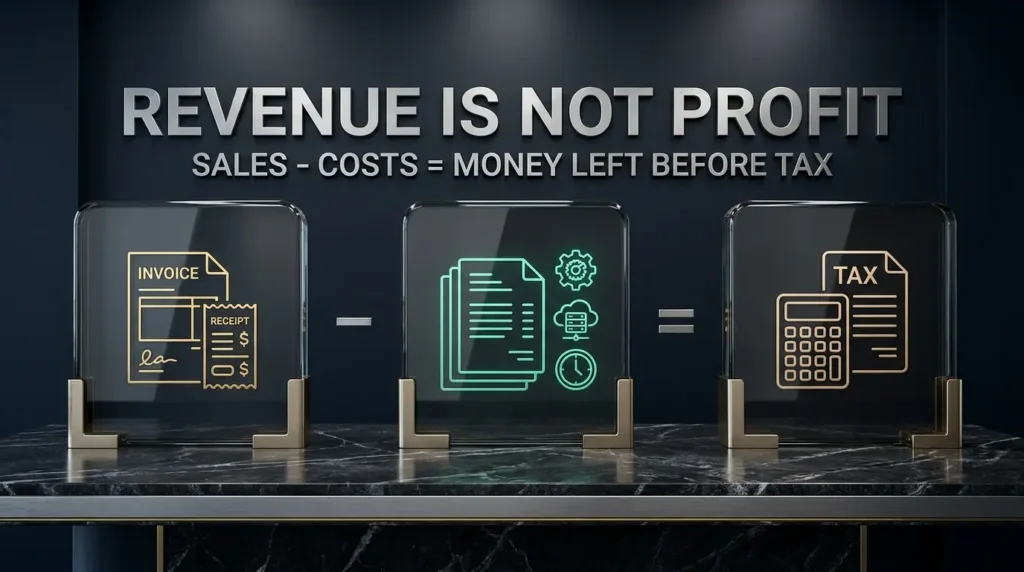
The useful distinction is between revenue, direct costs and profit.
Example: A fixed price service project
Suppose a freelancer agrees to a project for $500.
The direct software and service expenses total $50.
Before tax, transaction fees and other overhead, that leaves $450.
If the work requires 15 hours, the amount remaining per hour is $30.
That is a hypothetical calculation, not a market rate.
It also does not include time spent finding the client, learning software, preparing proposals or providing support after delivery.
Example: A subscription product
Suppose a digital tool has 20 paying customers at $15 per month.
Monthly subscription revenue would be $300.
If hosting, API usage, support and payment processing total $120, the amount remaining before tax and other costs would be $180.
A new product may generate no paid subscriptions at all.
The point is to test whether users want the product before spending heavily on infrastructure.
Choosing a price
For services, calculate the scope, expected hours, revisions, expenses and value to the client.
For digital products, account for platform fees, refunds, updates and acquisition costs.
For software, include hosting, API calls, security, monitoring and support.
If you cannot explain why a customer should pay the requested price, reconsider the offer before spending money promoting it.
Where to Find Your First Customer
The most practical acquisition method depends on the work you sell.
Freelance marketplaces can help you discover real project descriptions, but competition can be intense and access is not guaranteed.
Direct outreach can work when you identify an actual business problem and offer a relevant solution. It should be personal, lawful and respectful rather than automated spam.
A professional portfolio can demonstrate quality before you have testimonials.
For example, an automation specialist could build a demonstration that routes fictional support tickets and provides a clear error report.
A video editor could publish three short samples made from authorized footage.
A spreadsheet consultant could show how an untidy dataset becomes a useful dashboard.
A prospective customer should be able to see exactly what they would receive.
A first outreach example
Imagine a small ecommerce store with inconsistent product descriptions.
A useful message would explain the specific issue you observed, offer to improve a small sample and define the proposed deliverable.
It should not claim you already increased the store’s revenue.
Avoid vague statements such as “I can automate your entire business with AI.”
Business owners are more likely to understand an offer describing a particular result, such as “I can standardize fifty product listings and document the changes.”
A Practical 30 Day Starting Plan
Days 1 to 5: Choose one opportunity
Select a method aligned with your existing skills.
Identify ten organizations or buyer types that might need the deliverable.
Write one sentence explaining what problem you solve.
Research the tools and costs. Do not subscribe to several platforms before verifying that you need them.
Days 6 to 10: Build a sample
Create one complete portfolio example with fictional data, licensed assets or your own materials.
Evaluate the output manually.
Check factual accuracy, accessibility, security and the rules relevant to the service.
Days 11 to 15: Test your offer
Show the sample to suitable prospective customers or experienced professionals.
Ask whether the service solves a real problem and which parts need improvement.
Be willing to change the offer if feedback reveals little demand.
Days 16 to 22: Seek a narrowly scoped first project
Prepare a clear proposal describing the deliverable, price, completion conditions and revisions.
Contact relevant prospects through lawful, appropriate channels.
A first payment is possible, but no particular timeline or result should be assumed.
Days 23 to 30: Review the evidence
If you secure a client, deliver carefully, request feedback and document the time and costs.
If you do not secure a client, examine the quality of the offer, the target market and the effectiveness of your portfolio.
Do not automatically solve a lack of customers by buying more AI subscriptions.
The Most Common AI Money Traps
A business opportunity becomes risky when its promoter claims that technology removes ordinary commercial uncertainty.
The US Federal Trade Commission has pursued cases involving companies that allegedly promised unusually high earnings through AI supported ecommerce and other business opportunities.
In March 2026, the FTC announced a settlement concerning Air AI, involving allegations of deceptive earnings, refund and business performance claims.
That does not mean legitimate AI services are scams. It means buyers should demand evidence before paying for expensive income systems.
Warning signs
Be cautious of guaranteed daily earnings, promises that income will arrive without customers, invented partnerships, pressure to purchase expensive coaching and claims that a business can be fully automated with no oversight.
Other risks are less dramatic but still expensive.
You can lose money paying for unused subscriptions.
You can damage your reputation by delivering inaccurate content.
You can violate platform rules by selling copied material or misleading advertising.
You can expose customer information through poorly configured AI tools.
And you can spend months developing a product that nobody wants.
Understand content rights
AI generated content is not automatically free of copyright, privacy or contractual restrictions.
If you publish books through Amazon KDP, review its official AI content rules. The platform requires disclosure of AI generated text, images or translations while distinguishing those from qualifying AI assisted creation.
If you use AI for website publishing, Google Search Central emphasizes helpful content and warns against scaling low value pages solely to manipulate rankings.
If you work with customer data, permissions and privacy law matter.
If you use a person’s likeness or voice, obtain appropriate rights and consent.
The business model is not sustainable if it relies on deception.

Frequently Asked Questions About Making Money With AI
Can a beginner make money with AI?
Yes, beginners can investigate services such as administrative support, presentation preparation, data labeling and simple content editing. However, they still need sufficient skills to deliver correctly, and finding paid work is not guaranteed.
Can I make money with AI without coding?
Yes. Writing, design, education, video production and many administrative services do not require custom software development. Some still require specialist knowledge.
What is the fastest way to make money with AI?
There is no verified universal fastest method. Offering a service using a skill you already possess may require less preparation than building a new SaaS product, but customer acquisition can still take time.
Can I start for free?
Some tools offer free access and some work can begin with existing software. However, internet access, equipment, time and other expenses still have economic value. Free plans may also restrict commercial usage.
Is AI passive income real?
Some digital products, licensing businesses and software subscriptions can generate revenue without performing the entire original service repeatedly. They still require creation, marketing, maintenance and support.
Do I need ChatGPT Plus or another paid chatbot?
Not necessarily. Start with a tool that fits your deliverable and test its limitations. Upgrade only when there is a clear reason.
Which AI skills are currently in demand?
Upwork’s 2026 research identifies notable activity in AI integration, video production, data annotation, chatbot development and related specialist implementation work. Demand varies by market and does not guarantee employment.
How much should I charge?
Calculate expenses, time, scope and revisions, then compare with relevant current offers. Do not adopt someone else’s earnings figure without confirming its basis.
Can AI build a business for me automatically?
It can assist with research, production, development and workflow execution. It cannot guarantee customers, commercial success, compliance or reliable operation without human oversight.
Is selling AI generated content allowed?
That depends on ownership, permissions, applicable law and the platform’s rules. Commercial use eligibility does not eliminate obligations to respect copyrights, likeness rights and customer contracts.
Can I make money training or evaluating AI?
Some organizations contract people to label data or evaluate AI responses. Qualification, location, project availability and payment vary.
Is selling AI art legal?
It can be, subject to applicable rights, platform terms and the actual content created. You should not imply ownership of protected works or use recognizable people’s likenesses without appropriate permission.
Can I use AI to create YouTube channels?
Yes, but content still needs genuine audience value and must follow YouTube’s current policies, including relevant synthetic media disclosure and monetization eligibility rules.
What is better, freelancing or selling digital products?
Freelancing can help validate demand through direct customer work. Digital products can scale to additional buyers, but distribution and support may be difficult. Neither is universally superior.
Should I start an AI agency?
An agency may make sense if you can consistently deliver a defined service, manage clients and maintain quality. A business name and AI subscriptions alone do not establish an agency’s capabilities.
Do AI agents eliminate the need for employees?
No general conclusion follows from using AI agents. Some tasks can be automated, while supervision, exception handling, engineering and customer relationships may still require people.
How do I avoid AI income scams?
Demand evidence of earnings claims, check independent regulatory records, read contracts and refund terms, avoid unnecessary upfront commitments and remain skeptical of guaranteed profits.
Which opportunity should I choose from the 100?
Choose the one with the closest match between your skills, a reachable customer, a clear deliverable and a manageable cost of failure.
Final Thoughts: Sell a Result, Not the Fact That You Use AI
There are genuine opportunities to earn money with artificial intelligence.
Some are familiar services made more efficient. Others are new software products, automation systems or specialist roles that were less common a few years ago.
The strongest common feature is not a particular chatbot.
It is the ability to complete useful work that someone values enough to pay for.
That requires understanding a customer, defining a deliverable, checking the output and managing the business responsibly.
One hundred ideas can help you explore the possibilities. They should not leave you chasing one hundred opportunities.
Start with one.
Build something credible.
Find out whether anyone wants it.
Measure what it costs to deliver.
Then decide whether the evidence supports doing more.
AI can help you work. It does not remove the work of building a business.

Editorial methodology: This updated guide combines desk research from Upwork, OpenAI, the Federal Trade Commission, Amazon KDP, Google Search Central and documentation of established business models. The 100 opportunities are editorially identified service and product models, not 100 independently tested profitable businesses.
Income disclosure: No individual earnings, client acquisition time, platform approval or business outcome is guaranteed. Illustrative calculations are not market averages, actual case studies or personal financial advice.
Authorship and research integrity: The original article was published by Omar Bukhari. This revision should receive an accurate editorial review or update credit. No interviews, customer results, hands on tests or personal earnings are claimed for this revision.
Visual disclosure: Artwork is editorial illustration. Any fictional dashboard, client project, business scene or revenue concept must not be presented as an actual result.








Leave a Reply