

Black Friday or Cyber Monday? It sounds like a simple choice until you’re staring at a laptop you’ve wanted for months, a winter coat in your exact size, and a television with a discount that seems almost too good to be true.
Buy now, and you might wonder whether Monday would have been cheaper. Wait until Monday, and the product you wanted might disappear from stock.
The good news is that you don’t have to guess.
Black Friday falls on November 27, 2026, while Cyber Monday arrives on November 30. Adobe’s latest holiday shopping forecast offers useful clues about which product categories are expected to see their strongest discounts on each day.
The short answer: Black Friday is expected to be better for televisions, clothing, toys, appliances and furniture. Cyber Monday is expected to offer the deepest discounts on electronics and computers.
But those are broad shopping forecasts, not promises about individual products. The better deal is ultimately the one that gives you the exact item you need at the lowest reasonable total cost.
Here’s how to decide what deserves a place in your shopping cart, what can wait until Monday, and which apparent bargains aren’t worth buying at all.
Black Friday vs Cyber Monday 2026: The Quick Comparison
The difference between Black Friday and Cyber Monday is no longer as dramatic as it used to be.
Black Friday became famous for crowded stores and early morning bargains. Cyber Monday emerged as the online shopping counterpart, particularly for electronics and technology.
Today, both events are heavily digital. Retailers often begin promotions days or weeks earlier, and many discounts run across the entire Thanksgiving weekend.
Still, the latest forecasts suggest meaningful differences in where shoppers should concentrate their attention.
| Product category | Expected better day | What shoppers should know |
|---|---|---|
| Televisions | Black Friday | Compare exact model numbers and display specifications |
| Laptops and computers | Cyber Monday | Check processor, RAM, storage and model year |
| Consumer electronics | Cyber Monday | Compare prices on accessories, headphones and other devices |
| Winter clothing and fashion | Black Friday | Popular sizes and colors may sell out |
| Major appliances | Black Friday | Include delivery, installation and removal costs |
| Furniture | Black Friday | Check dimensions, materials and delivery fees |
| Toys | Black Friday | Availability may matter more than a small additional discount |
| Sporting goods | Thanksgiving, according to Adobe’s forecast | Compare offers throughout the weekend |
| Beauty products | Depends on retailer and promotion | Compare sets, unit prices and promotional codes |
Source: Adobe’s 2026 U.S. holiday shopping forecast. Category predictions describe expected discount patterns across the market, not guaranteed prices from individual retailers.
The most useful thing about this comparison is that it gives you a starting point.
If you’re shopping for a television, focus your research on Black Friday. If you need a laptop, pay particularly close attention to Cyber Monday.
But don’t ignore a genuinely excellent earlier offer because a forecast says another day might be stronger.

When Are Black Friday and Cyber Monday in 2026?
The dates are worth keeping close because deals are already appearing before the main shopping weekend.
- Thursday, November 26: Thanksgiving
- Friday, November 27: Black Friday
- Saturday, November 28: Small Business Saturday
- Sunday, November 29: Thanksgiving weekend promotions continue
- Monday, November 30: Cyber Monday
The dates are based on the U.S. holiday calendar. International retailers may participate in the same events, but availability, pricing, currencies and promotions can differ by country.
Black Friday also isn’t necessarily the first time you’ll see a promotional price.
Adobe expects discounts to increase as Thanksgiving approaches. In its September 2026 forecast, it projected that peak discounts across selected categories could reach approximately 30% off listed prices during Cyber Week.
That does not mean every product will receive a 30% discount. Some items may have smaller reductions, while others may already be competitively priced before the official event.
A shopper who begins comparing prices in November has an advantage over someone who only starts researching when a countdown timer appears.
Why Cyber Monday Could Be the Bigger Online Shopping Day
There is an interesting distinction between the amount people spend and the quality of an individual bargain.
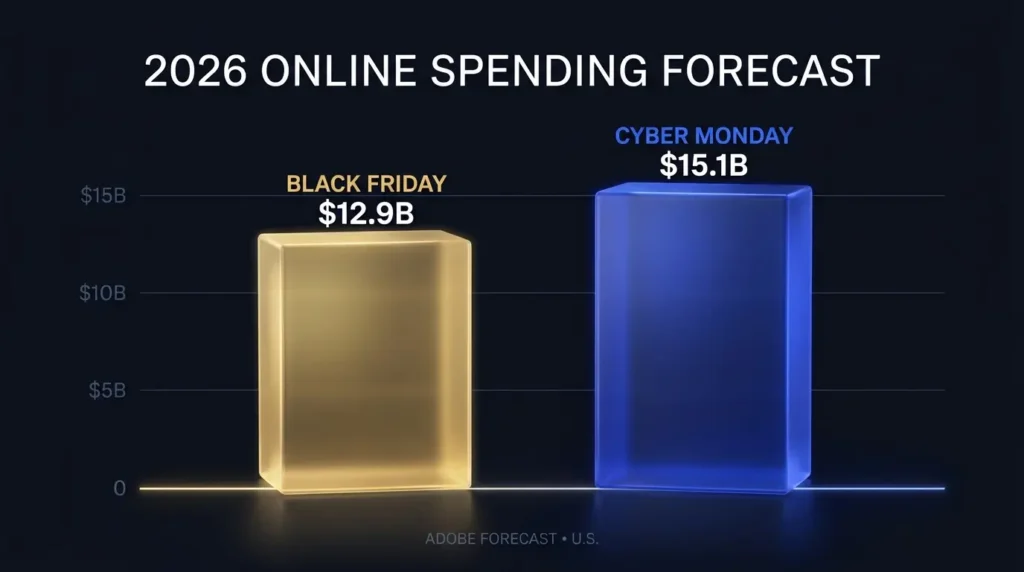
Adobe predicts that Cyber Monday will generate $15.1 billion in U.S. online spending, compared with approximately $12.9 billion on Black Friday.
That would make Cyber Monday the larger online shopping day, even though Black Friday is expected to grow faster than Cyber Monday compared with the previous year.
Adobe also forecasts approximately $47.5 billion in online spending across Cyber Week, the five days from Thanksgiving through Cyber Monday.
These numbers are projections, not finalized sales results.
Why does this matter to someone buying a pair of headphones or a new coat?
Because retailers are competing for attention across several days rather than relying on one major shopping morning.
A promotion might start before Thanksgiving, continue through Friday, change during the weekend and return with a different offer on Monday.
The result is more choice, but also more confusion.
The sensible response isn’t to monitor every retailer obsessively. It’s to research a small list of products and decide what you’re willing to pay before the promotions begin.
What Should You Buy on Black Friday 2026?
According to Adobe’s category forecasts, Black Friday is expected to have the strongest discounts for televisions, toys, clothing, appliances and furniture.
That makes Friday especially relevant for households preparing for Christmas, refreshing winter wardrobes or planning a major home purchase.
1. Televisions: Look Beyond the Screen Size
A television with a dramatic markdown can be tempting, particularly if you’ve been waiting to upgrade.
But two similarly sized televisions can offer very different experiences.
Before buying, compare resolution, panel technology, brightness, refresh rate, HDMI connections and the exact model number.
A television advertised as a spectacular bargain may simply have fewer features than another model available at a similar price.
If you play video games, features such as 120Hz support, low input lag and compatible HDMI connections might matter more than the advertised discount.
If you mainly watch movies, contrast, color reproduction and viewing angles may deserve more attention.
Black Friday is a sensible day to start checking television deals, but the best choice is still the one that meets your actual needs.
2. Winter Clothing: Shop for What You’ll Wear
This is one category where waiting can become frustrating.
A winter coat might be available at a good price on Friday, but your preferred size or color could be gone by Monday.
Adobe expects apparel discounts to be strongest on Black Friday at the category level. That is especially useful information for shoppers buying pieces where fit and availability matter.
Start with the basics: a dependable winter coat, comfortable boots, quality knitwear or clothing that fills an actual gap in your wardrobe.
Our existing guide to Black Friday fashion deals for 2026 explores 15 wardrobe essentials, including coats, boots and versatile winter clothing.
The important question isn’t whether a product is fashionable enough to buy during a sale.
It’s whether you would still want it without the discount.
3. Appliances: The Final Price Matters Most
Refrigerators, washing machines, dryers and other major appliances are substantial purchases.
A small percentage difference can represent meaningful savings, but the advertised price may not tell the full story.
A washing machine that costs less initially could become more expensive once delivery, installation and removal of the old appliance are included.
Check dimensions, electrical requirements, warranty coverage, energy use and the seller’s service arrangements.
Also make sure the product will actually fit your space.
There is little value in saving money on an appliance that cannot be installed properly.
4. Toys: Availability Can Be More Important Than Waiting
Christmas shopping introduces a complication that doesn’t apply to every product.
Children often want a particular toy, game or character. A different model or color may not be an acceptable substitute.
Adobe expects toy discounts to favor Black Friday.
If an age appropriate toy on your list reaches a genuinely competitive price on Friday, waiting until Monday could mean risking availability for an uncertain additional saving.
That doesn’t mean every toy should be purchased immediately.
For less specific gifts, it may be worth comparing prices across the weekend.
If you’re looking for alternatives to electronics, TrendOutsider’s collection of screen free Christmas gift ideas for kids, teens and adults offers creative options beyond phones, tablets and gaming devices.
5. Furniture: Think About the Room, Not the Discount
Furniture sales can make a major purchase appear suddenly affordable.
But a sofa, dining table or bed should fit both your space and your long term needs.
Check the measurements, material specifications, delivery window, assembly requirements and return conditions.
An inexpensive sofa with costly delivery or poor durability may not be the bargain it initially appears to be.
For large items, the practical costs of a wrong purchase can easily outweigh the excitement of a temporary sale.

What Should You Wait to Buy on Cyber Monday?
Cyber Monday is expected to offer the deepest category discounts on electronics and computers, according to Adobe.
That makes November 30 particularly relevant for shoppers interested in computing hardware, accessories and other technology.
But buying technology wisely requires more than finding the largest percentage reduction.
1. Laptops: Check the Actual Configuration
Imagine finding a laptop advertised at a discount of several hundred dollars.
The price looks excellent, and the listing says it’s a powerful machine.
Then you discover it has less memory than you expected, a smaller storage drive or a previous generation processor.
The name on the listing may be similar to the model you researched, but the configuration could be completely different.
Before purchasing, verify the exact processor, RAM, storage, screen specifications, battery information, warranty and model identifier.
Think about what you’ll use the computer for.
Someone who primarily writes documents and attends video meetings has different requirements from someone editing 4K footage or working with demanding design software.
A more expensive model isn’t automatically the better purchase, and a lower price isn’t automatically good value.
2. Headphones and Audio Devices: Consider Comfort and Compatibility
Headphones, earbuds and wireless speakers are popular technology purchases because there are options across many price ranges.
Before comparing discounts, decide which features matter.
Noise cancellation, microphone quality, battery life, comfort, water resistance and compatibility can influence whether you’ll enjoy the product.
For wireless earbuds, check the specific generation and whether the features you want work with your phone.
A discounted older product may still be excellent. It simply needs to be compared honestly with current alternatives.
3. Tablets, Monitors and Computer Accessories
Cyber Monday may also be a useful time to evaluate tablets, monitors, keyboards, storage devices and other technology accessories.
The category forecast is favorable to electronics and computers generally, but it doesn’t establish the best day for every accessory.
For a monitor, screen resolution, panel type, refresh rate, connectivity and warranty deserve attention.
For a tablet, look at software support, storage, compatibility with accessories and the tasks you expect it to handle.
For external storage, read the actual capacity and transfer-speed specifications rather than relying on the promotional language.
The best technology deals are often the ones where you know the precise specifications before you open the sale page.

How Much Could You Actually Save in 2026?
Adobe’s holiday forecast provides estimates of peak discounts across major online shopping categories.
Here is how its projections compare.
| Category | Forecast peak discount from listed price |
|---|---|
| Electronics | 30% |
| Toys | 29% |
| Televisions | 23% |
| Computers | 23% |
| Apparel | 23% |
| Sporting goods | 19% |
| Appliances | 18% |
| Furniture | 18% |
Source: Adobe Digital Insights, September 28, 2026. These are predicted category peak discount levels, not guaranteed average savings or discounts for individual products.
The distinction between a listed price and a good historical price matters enormously.
Suppose a retailer advertises a product for $140, reduced from $200.
That’s a 30% reduction from the stated reference price.
But imagine the same product normally sold for $150 during the weeks before the promotion.
Your practical saving compared with that recent price would be just $10.
Both numbers describe a price difference, but they tell very different stories about value.
This is why discount percentages alone are poor shopping guides.
What you really want to know is whether the product’s final price is competitive compared with what it has genuinely cost in the recent past.

How to Tell Whether a Black Friday or Cyber Monday Deal Is Actually Good
There is a simple way to make seasonal shopping much less stressful.
Treat a sale like a purchasing decision, not a race.
Step 1: Build a Short Wishlist
Write down the products you genuinely need or have already planned to buy.
Include the exact model, size, color or specifications where relevant.
Avoid adding something to the list simply because an advertisement says it’s popular.
Step 2: Set a Maximum Price
Decide what you’re comfortable paying before the promotion appears.
That gives you a reference point independent of countdown clocks and dramatic discount labels.
If a product drops below your target price and meets your requirements, you may already have a good reason to buy.
Step 3: Check Historical Prices
Compare the advertised offer with previous prices whenever reliable data is available.
Google offers a price tracking feature for supported products and markets. Availability varies by country and device.
Other reputable price tracking services may provide additional historical information, but their product coverage and accuracy differ.
Use the data as evidence, not as a guarantee that a price cannot fall further.
Step 4: Compare the Final Checkout Total
A product listed for $180 with $25 shipping costs more than a similar eligible offer priced at $195 with free shipping, before any differences in tax or other fees.
Also check that you’re comparing the same item.
The Federal Trade Commission’s online shopping guidance recommends checking model details, seller information, total costs and return conditions before purchasing.
Step 5: Read the Return Policy
A great price is less appealing if returning the item involves substantial fees or restrictions.
This matters especially for clothing, footwear, furniture and major electronics.
Check whether holiday promotions change the normal return rules.
Step 6: Verify the Seller
An unfamiliar website offering an unusually low price deserves extra scrutiny.
Look for independent information about the business and read its contact, delivery and refund policies.
Don’t assume a professional looking website is necessarily trustworthy.
Step 7: Keep Your Purchase Records
Save receipts, order confirmations and relevant retailer communications.
If something arrives damaged, never arrives or doesn’t match the description, those records may be important when contacting the seller or payment provider.
The goal is simple: know what you’re buying, know what it normally costs, and know what happens if something goes wrong.
Should You Buy on Black Friday or Wait Until Cyber Monday?
This is where the decision becomes personal.
A broad market forecast cannot know whether the exact pair of boots you want will still be available on Monday.
It also cannot predict every retailer’s inventory, pricing strategy or weekend promotions.
A practical decision framework looks like this:
Buy on Black Friday when:
- The product is in a category expected to receive stronger Friday discounts.
- You’ve confirmed that the price is already competitive.
- Your preferred size, color or model is important.
- Stock appears limited, based on credible retailer information.
- You would be satisfied with the purchase even if a slightly better price appeared later.
Consider waiting until Cyber Monday when:
- You’re shopping for computers or electronics.
- The Friday price is above your planned budget.
- You have several comparable options.
- Product availability is not a major concern.
- You can comfortably accept the possibility that the price might stay the same or stock could sell out.
And remember that you do not have to buy on either day.
A discounted product you don’t need still costs money.

Can AI Help You Find Better Black Friday Deals?
Artificial intelligence is becoming part of the holiday shopping experience, but it’s important to understand what these tools can and cannot reliably do.
The National Retail Federation’s November 19 survey found that 59% of Thanksgiving weekend shoppers plan to use AI to support their holiday shopping.
Respondents identified uses such as product recommendations, gift brainstorming, budget tracking and finding prices.
That doesn’t mean AI always knows the lowest current price.
An AI assistant can help organize a wishlist, compare specifications or identify questions worth asking before buying. But its information may be outdated, incomplete or based on limited retailer coverage.
If you use an assistant to compare laptops, for example, ask it to explain the differences in RAM, processor, battery, screen and warranty.
Then visit the actual retailer pages and verify the current price and product details.
AI is also moving closer to the payment process. TrendOutsider recently examined ChatGPT Wallet and how AI assisted purchasing works, including its availability restrictions and the need for explicit user approval.
That development is interesting, but the same shopping rule still applies.
Use AI to help with research. Don’t outsource the responsibility of checking what you’re buying.
Five Black Friday and Cyber Monday Shopping Mistakes Worth Avoiding
1. Buying Something Because the Discount Looks Huge
A 50% discount isn’t a saving if the product has no real value to you.
Start with usefulness. Evaluate the price second.
2. Comparing Different Product Versions
This is particularly risky with laptops, televisions, earbuds and appliances.
Always compare exact model numbers and configurations.
3. Ignoring Shipping and Returns
Delivery fees, installation charges and return restrictions can turn an attractive offer into an inconvenient purchase.
Check everything before checkout.
4. Trusting Every Social Media Promotion
Scammers can imitate legitimate retailers and use enticing product images to attract shoppers.
The FTC’s holiday shopping scam guidance explains why unusually low prices and unfamiliar sellers warrant caution.
5. Waiting for a Perfect Discount That May Never Arrive
There’s no reliable way to identify the absolute lowest price every product will reach.
If you’ve done your research and the product meets your needs at a fair price, buying with confidence can be better than spending an entire weekend chasing a hypothetical extra reduction.

What About Christmas Gifts and Holiday Shopping?
For many households, Black Friday and Cyber Monday aren’t just about upgrading technology.
They’re a chance to prepare for Christmas without leaving every purchase until December.
The National Retail Federation expects clothing, accessories, gift cards and toys to remain important gift categories in 2026.
But the most thoughtful gifts are not always the most expensive.
If you’re buying for someone who enjoys cooking, reading, crafting or relaxing at home, a small themed collection may be more personal than an expensive gadget.
Our guide to affordable Christmas gift basket ideas for 2026 offers practical ways to build personalized presents without treating a large budget as a requirement.
Plan your gift list first. Then use holiday promotions for the items you already intend to purchase.
Buying all your Christmas presents during one weekend isn’t necessary.
A calm, thoughtful purchase in December can be better than a rushed purchase in November.
Frequently Asked Questions
Is Black Friday or Cyber Monday better in 2026?
Adobe forecasts that Black Friday will offer stronger discounts for televisions, toys, clothing, appliances and furniture, while Cyber Monday will favor electronics and computers. Individual retailer prices can differ, so compare the exact products you want.
When is Black Friday 2026?
Black Friday takes place on Friday, November 27, 2026.
When is Cyber Monday 2026?
Cyber Monday takes place on Monday, November 30, 2026.
Are laptops cheaper on Black Friday or Cyber Monday?
Adobe expects the deepest computer discounts on Cyber Monday in 2026. However, a specific laptop could still have a better Black Friday offer. Compare the exact configuration and final price.
Is Black Friday better for clothes?
Adobe expects apparel discounts to peak on Black Friday. Shopping earlier may also help you find popular sizes and colors, although individual retailer promotions can vary.
Should I wait until Cyber Monday to buy a TV?
Black Friday is expected to offer stronger television discounts overall. If the television you want is already at a competitive price on Friday, waiting until Monday may not be worthwhile.
Are Cyber Monday deals online only?
Cyber Monday is primarily associated with online promotions, although retailers may run overlapping offers in stores and across their websites throughout Cyber Week.
Do Black Friday deals start before November 27?
Yes. Some retailers already advertise early holiday promotions. Check the dates and terms of specific offers rather than assuming all discounts begin on the official shopping day.
How do I know whether a discount is real?
Compare the exact product’s recent prices, check other trustworthy sellers, review the total checkout cost and read the return policy. A large percentage reduction from a listed reference price doesn’t necessarily mean the product is at its lowest historical price.
Is Cyber Monday cheaper than Black Friday on everything?
No. Shopping forecasts identify category trends, not guaranteed prices on every product. Retailer promotions, stock availability and product versions can change the outcome.
Are Black Friday and Cyber Monday deals available outside the United States?
Many international retailers participate in these promotions. However, dates, regional inventory, taxes, consumer rights and discounts can vary. The Adobe forecasts discussed here primarily concern U.S. online retail.
The Bottom Line: The Best Shopping Day Depends on What You Need
Black Friday and Cyber Monday are no longer two completely separate shopping experiences. They are closely connected parts of a much larger holiday retail season.
For 2026, Adobe’s forecasts give shoppers a useful starting point.
Focus on Black Friday for televisions, clothing, toys, furniture and appliances. Give Cyber Monday special attention if you’re shopping for laptops, computers and electronics.
But don’t confuse a forecast with a promise.
The smartest shopping strategy is to choose products carefully, research their usual prices, compare exact specifications and decide how much you’re comfortable spending.
Some purchases are worth making on Friday. Others can wait until Monday.
And sometimes, the smartest deal is the one you decide not to buy.

Editorial note: This article was researched using Adobe’s September 28, 2026 holiday shopping forecast, the National Retail Federation’s November 19, 2026 shopping survey and official FTC and Google shopping guidance. All projected spending figures and category discounts are forecasts, not verified completed sale results. Prices and regional promotions may change.
TrendOutsider has not independently tested the prices of individual 2026 Black Friday or Cyber Monday products for this article. Accompanying AI generated visuals are editorial illustrations, not documentary photographs or verified retailer advertisements.








Leave a Reply