
Imagine spending months building a music project.
You write lyrics, experiment with melodies, generate recordings, design album covers and finally distribute the finished songs to streaming services.
Then one morning, the platform hosting your music announces that an entire category of recordings will soon disappear.
For musicians using artificial intelligence, that scenario is no longer hypothetical.
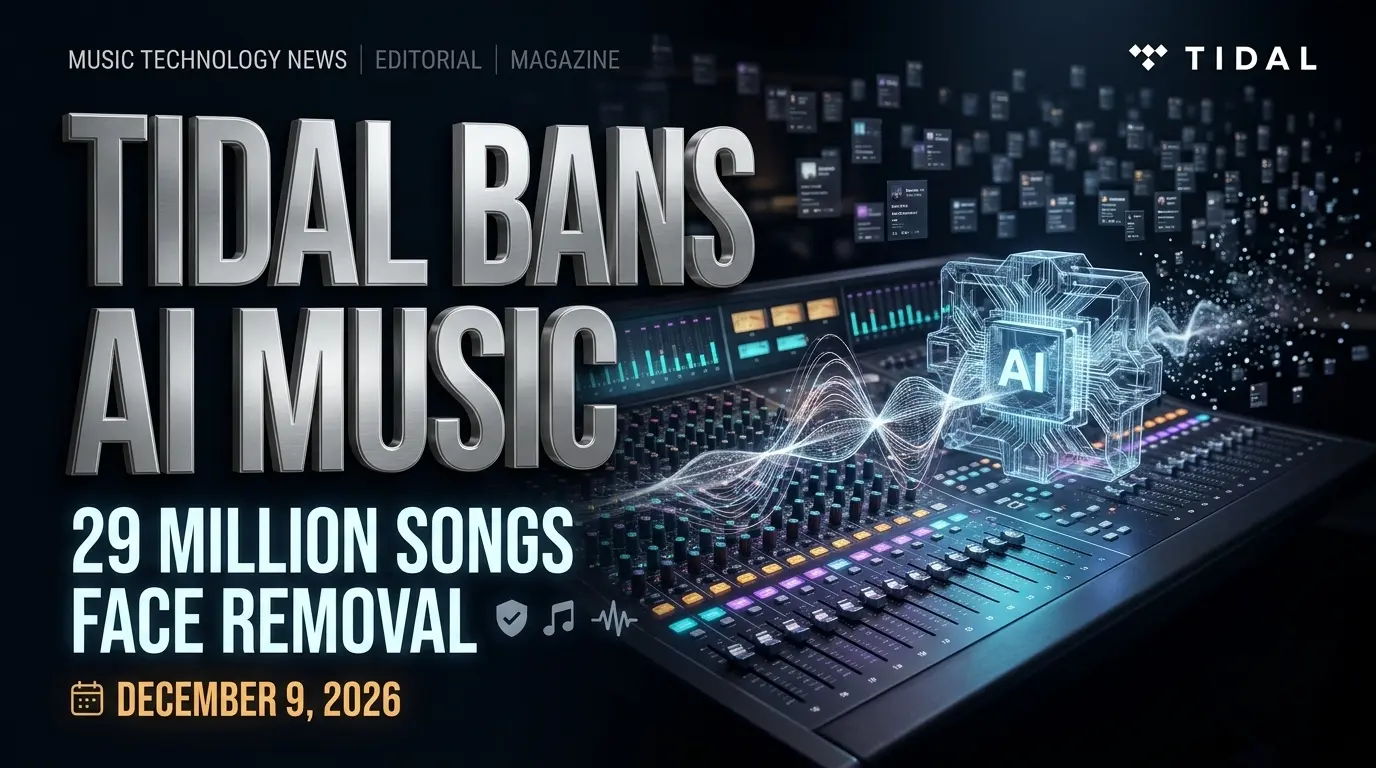
On November 24, 2026, Tidal announced one of the most aggressive responses yet to the explosion of AI-generated music.
Beginning December 9, the streaming service plans to remove recordings it identifies as entirely created by generative AI. It will also reject new submissions that fall into the same category.
The numbers are enormous.
Tidal expects approximately 29 million songs to be removed by the beginning of 2027, while an estimated 80,000 to 85,000 new submissions could be rejected every day.
But there is an essential detail missing from some of the most dramatic reactions to the news.
Tidal is not banning every song made with the help of artificial intelligence.
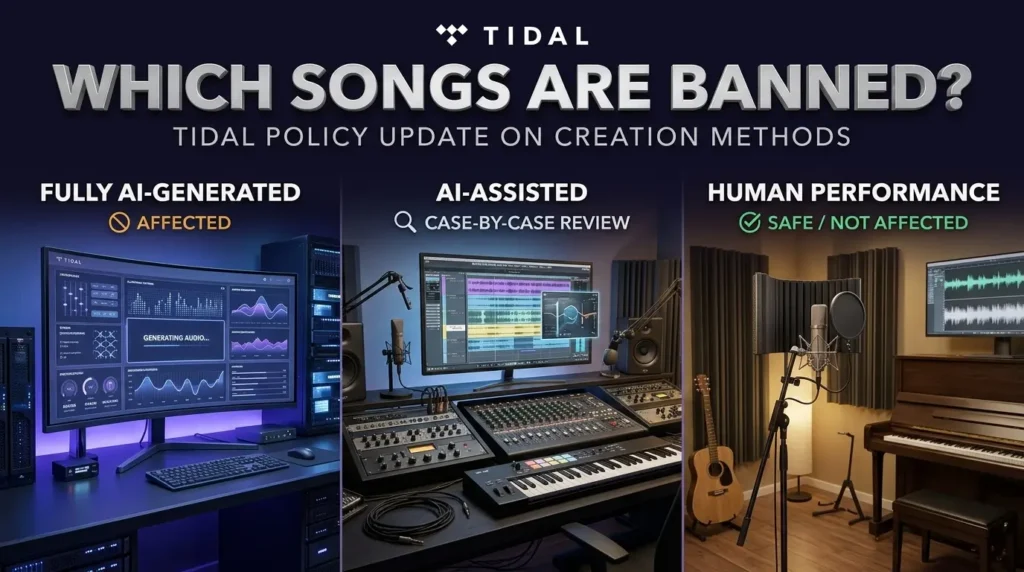
The announced restriction focuses on recordings wholly generated by AI. Human-created music that incorporates AI assistance may remain eligible, subject to Tidal’s other rules and the circumstances of its creation.
That distinction matters enormously to independent musicians, producers, distributors and people experimenting with platforms such as Suno and Google’s Lyria.
It also creates an urgent new question for creators:
If you wrote the lyrics, generated the vocals with AI, edited the arrangement and mastered the recording yourself, is the final song human-made, AI-assisted or wholly AI-generated?
The answer may determine whether it survives on Tidal.
And the issue reaches far beyond one streaming service. Spotify, Apple Music, YouTube Music, Deezer and Bandcamp have each developed a different approach to synthetic music.
Some permit it with labels. Some restrict recommendations and royalties. Others prohibit entire categories of AI-generated recordings.
The industry is moving toward a future in which the tools used to create a song may matter almost as much as the song itself.
Here is what Tidal actually announced, what the figures mean, where the major platforms stand and what AI music creators should do before December 9.
What Tidal Announced on November 24, 2026
Tidal has decided that labeling and refusing royalties to fully AI-generated recordings is no longer enough.
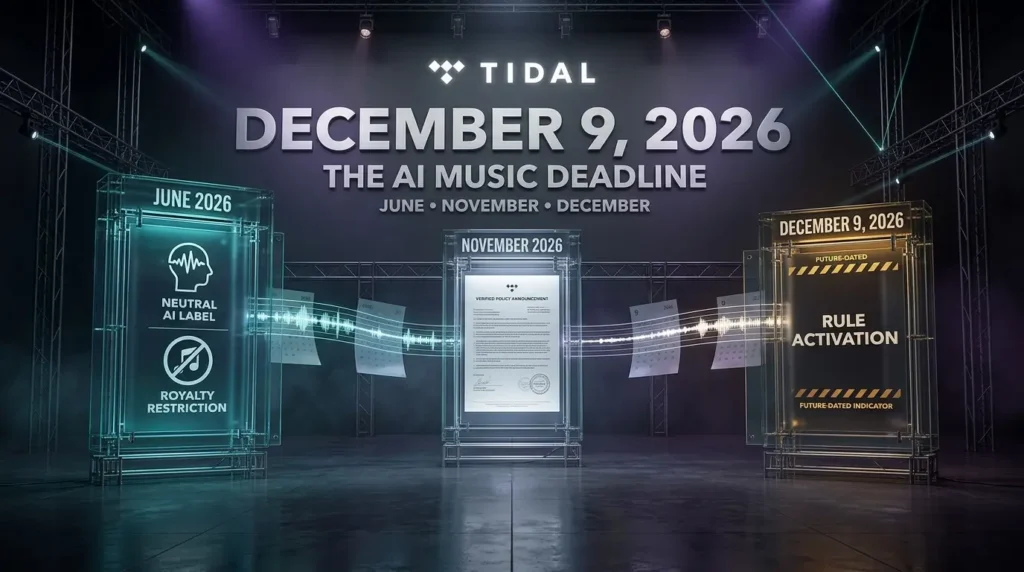
Its updated official AI Policy identifies December 9, 2026, as the date its new restrictions take effect.
From then onward, wholly AI-generated tracks will be rejected and removed from the service.
Tidal’s leadership says the cleanup is expected to continue through the remainder of the year.
The service intends to prevent distributors from delivering new tracks that are entirely generated using AI, including submissions where the delivery metadata identifies the music as fully synthetic.
It will also use detection technology to identify recordings that were not accurately disclosed.
The policy builds on measures the company introduced earlier in 2026.
In June, Tidal announced that wholly AI-generated music would no longer qualify for royalty attribution. It subsequently introduced labels identifying recordings it determined were fully AI-generated.
The company had also committed to restricting content associated with misleading artist identities, suspicious upload behavior and fraudulent activity.
The latest announcement moves further.
Instead of allowing identified fully synthetic tracks to remain on the service without royalties, Tidal plans to remove them.
The Timeline
| Date | What happened |
|---|---|
| January 13, 2026 | Bandcamp announces restrictions on music wholly or substantially generated by AI. |
| June 29, 2026 | Tidal’s initial AI policy takes effect, addressing labeling, monetization and fraudulent content. |
| July 2026 | Tidal begins implementing visible AI labels and associated restrictions. |
| October 2026 | Spotify reports major removals and recommendation changes targeting spam and AI-related deception. |
| November 24, 2026 | Tidal announces that wholly AI-generated recordings will be prohibited. |
| December 9, 2026 | Tidal’s new removal and rejection policy is scheduled to begin. |
| Beginning of 2027 | Tidal expects the identified wholly AI-generated catalog cleanup to be completed. |
The December 9 date is a future enforcement milestone, not evidence that every affected recording has already disappeared.
Why Is Tidal Planning to Delete 29 Million Songs?
The most revealing part of the announcement isn’t merely the number of songs affected.
It’s how rapidly synthetic music has been arriving.
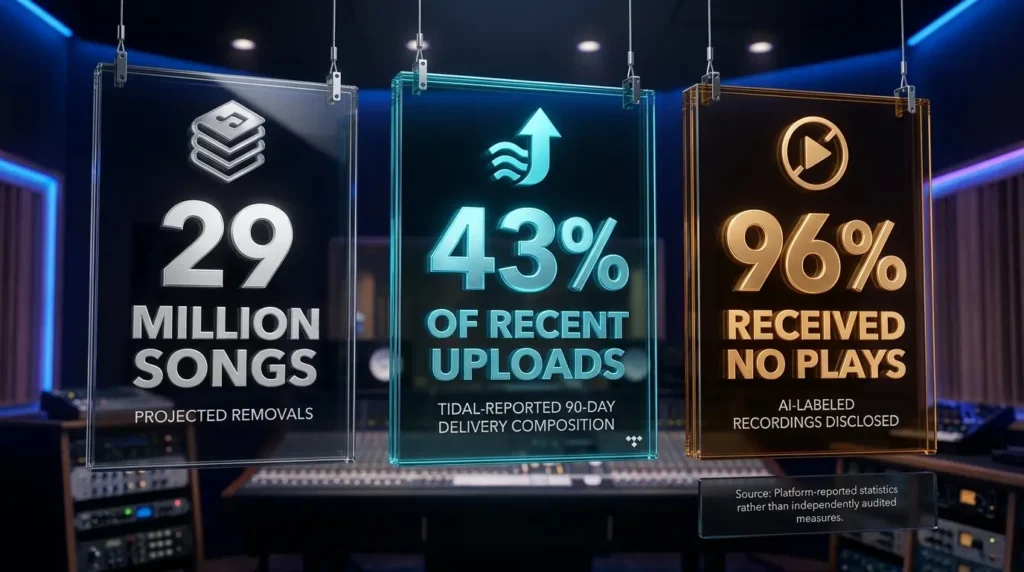
According to figures disclosed by Tidal, 43% of tracks delivered to the platform over the preceding 90 days were identified as wholly AI-generated.
On November 6 alone, the company reported that the share reached approximately 60%.
For a streaming service built around music discovery, those figures represent an enormous change in the composition of incoming material.
A person can now generate recordings much faster than a traditional artist could write, perform, record and produce an album.
Automated systems can potentially deliver large quantities of tracks with relatively little human involvement.
Not all of those tracks are fraudulent.
Some are creative experiments. Some are personal projects. Others may be attempts to build legitimate audiences for new forms of synthetic music.
But mass production also makes it easier to overwhelm catalogs with repetitive content, impersonate artists or manipulate discovery systems.
Tidal believes the scale has become a problem for listeners and musicians trying to find one another.
The Difference Between 27 Million and 29 Million
This is an important detail because two figures are circulating in the coverage.
Tidal says approximately 27 million recordings were already identified and labeled as wholly AI-generated.
That represented around 6.3% of its catalog, according to the company’s figures.
The larger figure, approximately 29 million, is the projected total number of tracks expected to be removed during the planned cleanup.
The first is a reported inventory figure.
The second is a forward-looking removal estimate.
They should not be presented as two contradictory measurements of exactly the same thing.
Nor should readers be told that 29 million recordings have already been deleted.
As of November 25, the broad removal process is still scheduled to begin on December 9.
Did 96% of AI Songs Really Receive Zero Plays?
Tidal reports that 96% of the AI-labeled songs it measured received no plays during the preceding 90 days.
That is an extraordinary statistic.
But its meaning is narrower than the claim that nobody listens to AI music.
It refers to Tidal’s identified AI recordings and a particular measurement period.
It does not establish the listening habits of every person on Spotify, YouTube or other music platforms.
Nor does it prove all AI-generated music is inherently unpopular.
A newly uploaded human song can also receive no streams.
Still, when millions of automated recordings arrive and almost none receive attention, platforms face a practical question.
How much catalog space, processing, moderation and discovery infrastructure should be devoted to content that listeners rarely select?
That question becomes particularly contentious when automated uploads can also be used to manipulate royalties or impersonate genuine artists.
Is Tidal Banning Suno Music?
Tidal’s new rules will prohibit wholly AI-generated recordings, including finished songs created entirely through tools such as Suno.
The distinction is based on the recording’s creation, not simply the software name.
Suno can generate musical performances, instrumentation and vocals from prompts and other creative inputs.
Someone using it to generate an entire finished recording may produce something that falls within Tidal’s prohibited category.
Writing an original prompt doesn’t automatically make the resulting audio a human-performed recording.
The same is true when someone writes the lyrics but uses an AI system to generate every audible musical component.
However, projects involving meaningful human performance, production or other creative work require more careful classification.
The platform’s updated policy focuses initially on wholly AI-generated recordings because detection technology has limitations.
It has not provided a universal formula establishing exactly how much human involvement makes a particular hybrid recording eligible.
Four Examples That Explain the Difference
Consider these hypothetical situations.
Example 1: A complete song generated from a text prompt
Someone enters a description into Suno and receives a finished song with synthetic instruments, vocals and arrangement.
They upload the result without further substantive production.
This is the clearest example of the type of recording Tidal intends to prohibit.
Example 2: Human lyrics, entirely AI-generated performance
A songwriter writes the words but asks a model to generate the finished musical recording, including vocals and instrumentation.
The human contribution to the composition is real.
But the sound recording may still be wholly AI-generated.
Under Tidal’s focus on recordings, writing the lyrics alone should not be assumed to guarantee eligibility.
Example 3: A recorded human singer using AI cleanup
A musician performs and records an original song, then uses AI-assisted tools for noise reduction, restoration or other production tasks.
This is not the same as having a model generate the entire recording.
The announced prohibition does not automatically apply simply because AI software helped with production.
Example 4: Human instrumentals with generated vocals
A producer records instruments and creates an original arrangement but uses AI to generate a vocal performance.
This is a hybrid case.
It may fall outside a narrow definition of wholly AI-generated recordings, but it could still raise issues about artist impersonation, permissions, disclosures and future policy changes.
Tidal has not publicly established a comprehensive decision rule for every hybrid scenario.
That uncertainty is important.
A creator should not assume that adding a short human recording to an otherwise generated track will automatically make it acceptable.
The correct approach is to document the actual creative process and obtain clarification from the distributor or Tidal when classification is uncertain.
What Happens to AI Music That Is Already on Tidal?
Tidal plans to remove tracks it identifies as wholly AI-generated.
That includes recordings previously labeled under its earlier system.
The company has said it expects the cleanup to be completed around the beginning of 2027.
For creators, the practical implications could extend beyond the disappearance of a particular track.
When a recording is no longer available on a streaming platform, listeners may lose access through playlists, saved albums or artist pages.
Creators may also need to update links from their websites and social channels.
Exactly how a removal affects an account, release identifiers, historical reporting or future submissions depends on Tidal’s process and the relevant distributor agreement.
The public policy reviewed here does not establish that every affected creator will receive the same advance notice.
It also does not promise that any specific recording will remain available during the entire transition period.
What Should Creators Do Now?
If you have music distributed to Tidal, the most useful immediate action is to establish exactly how each recording was made.
Keep the original project files, recordings, production sessions and relevant documentation.
Identify which portions were generated by AI and which involved your own creative performance.
Review the information you supplied to your distributor.
Check whether you used cloned vocals, borrowed audio, copyrighted material or names and imagery belonging to another artist.
And confirm your distributor’s current Tidal delivery policy before scheduling a new release.
Do not misrepresent a fully generated track as human-made to avoid detection.
That could create additional distribution and account problems.
For creators who combine music with AI-generated promotional videos, our guide to AI video creation tools explains how production technology can support a broader creative workflow. But using AI in a music video and generating an entire sound recording are separate policy questions.
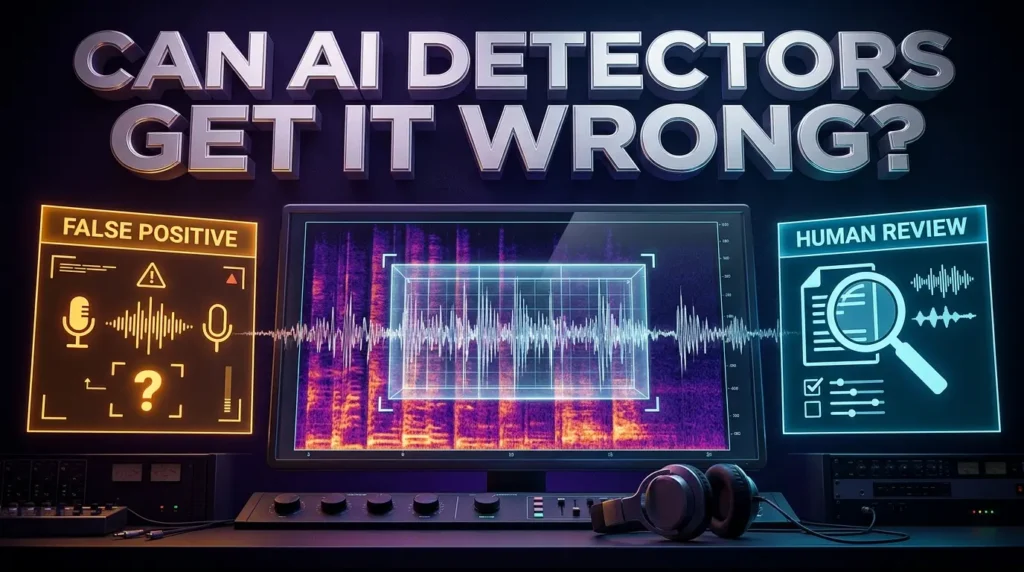
Can Tidal’s AI Detection System Get It Wrong?
Yes. That is one of the most serious unresolved questions.
Tidal is working with French audio technology company Ircam Amplify to identify synthetic recordings.
The company has promoted high accuracy for its detection technology.
But even a very accurate classifier can make mistakes.
A false positive occurs when genuinely human-made content is incorrectly identified as AI-generated.
A false negative occurs when fully AI-generated content escapes detection.
Both matter.
False negatives allow prohibited recordings to remain available.
False positives risk penalizing people who created music legitimately.
Why a 1% False Positive Rate Could Be Enormous
Pitchfork highlighted a hypothetical calculation based on Ircam Amplify’s advertised performance figures.
If a 1% false-positive rate applied directly to 29 million removals, the arithmetic would produce 290,000 potentially incorrect classifications.
That number is a useful illustration of why error rates matter at scale.
It is not an independently verified prediction that Tidal will wrongly delete 290,000 human-made songs.
The actual number depends on how the detector is tested, which recordings it evaluates, how its thresholds are configured and whether independent metadata or human review influences the final decision.
The published accuracy figures cannot automatically be applied to the entire Tidal catalog as though every recording had the same characteristics.
Why AI Detection Is Hard
Generated audio is changing.
New models can produce increasingly realistic instruments, voices and acoustic textures.
Human producers can heavily process performances until they sound synthetic.
And AI-assisted tracks may contain both recorded and generated elements.
Those situations complicate attempts to classify music based solely on the final waveform.
A platform may also examine distribution metadata, reported provenance, patterns of mass uploading and other contextual evidence.
That creates a stronger enforcement process than relying on one automated score.
But it also raises transparency questions.
What evidence should a musician receive when a recording is removed?
Can an artist challenge the decision?
What happens if the distributor and platform disagree?
And will there be a process for restoring legitimate recordings?
Does Tidal Have an Appeal Process?
Tidal’s existing AI Policy support documentation describes an appeal route for creators who believe a recording was wrongly identified as wholly AI-generated.
The process involves contacting support and selecting the relevant AI flag review category.
However, the company has not yet publicly established every operational detail of how those appeals will work during a cleanup involving millions of recordings.
Creators should preserve evidence of their production process and check the latest support instructions rather than assuming the previously described workflow guarantees a particular result.
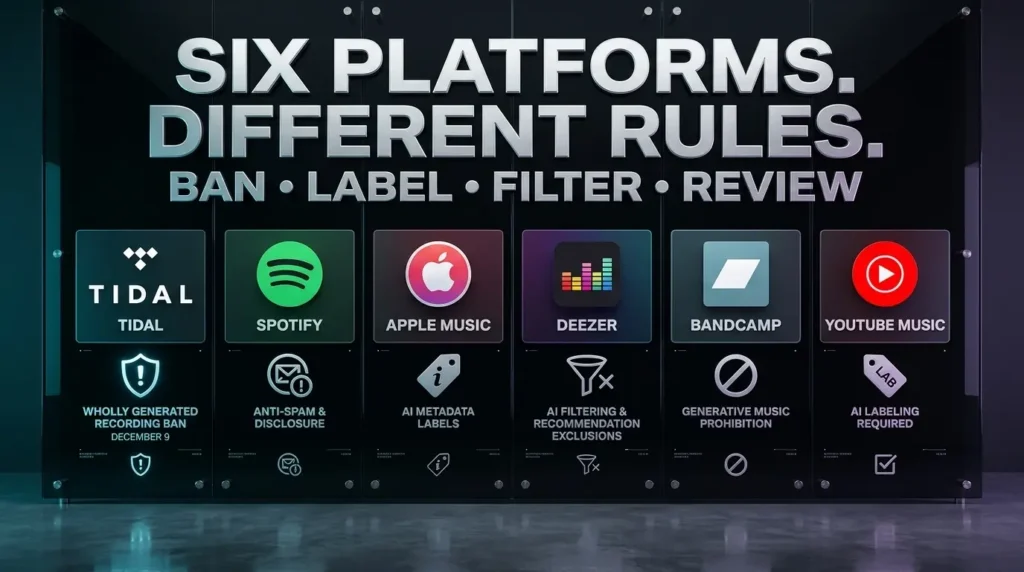
Tidal vs Spotify vs Apple Music vs Deezer vs Bandcamp vs YouTube Music
Perhaps the most important consequence of Tidal’s decision is that music platforms are no longer taking the same approach.
A creator can have a recording accepted by one service, labeled by another, excluded from recommendations by a third and rejected outright by a fourth.
Here is the policy landscape based on official statements and reporting available through November 25, 2026.
| Platform | Approach to fully AI-generated music | Important distinction |
|---|---|---|
| Tidal | Ban and removal scheduled from December 9 | Focuses on wholly AI-generated recordings; some AI-assisted work remains permitted |
| Spotify | No universal ban established | Uses spam restrictions, AI credits, artist identity labels and recommendation controls |
| Apple Music | Transparency and disclosure approach | Requires metadata disclosures for materially generated content, with public labels being introduced |
| Deezer | Detects and labels synthetic tracks | Excludes identified AI music from recommendations and is introducing a listener filter |
| Bandcamp | Prohibits music wholly or substantially generated by AI | Its policy is broader than Tidal’s initial wholly generated threshold |
| YouTube Music | Labels primarily AI-generated music | Disclosure and other platform policies still apply |
These are broad platform positions, not guarantees that any specific song will be accepted.
Copyright, impersonation, spam, distributor agreements and other restrictions can independently affect eligibility.
Spotify: AI Music Is Not Automatically Banned
Spotify’s approach is more selective.
In its October 20 update on protecting human artistry, the company said it had removed more than 75 million spammy tracks for serious or repeated violations and excluded more than 50 million spam or low-quality tracks from recommendations during 2026.
Those figures cover spam and content integrity enforcement.
They should not be described as counts of all fully AI-generated music being deleted solely because it was generated by AI.
Spotify has also introduced AI Credits, artist profile verification and AI Persona badges.
The AI Persona badge identifies artist profiles representing an AI-generated photorealistic identity.
Importantly, a badge about an artist’s identity does not necessarily mean every recording associated with that artist was generated by AI.
Spotify also restricts unauthorized vocal impersonation and works to prevent music being falsely attached to real artists’ profiles.
Its approach combines disclosure, identity protection and abuse prevention instead of a universal prohibition on synthetic recordings.
Apple Music: The Industry Moves Toward “Made With AI” Labels
Apple Music has been developing a metadata disclosure system.
Its AI Transparency Tags can distinguish AI involvement in recordings, compositions, artwork and music videos.
In August, Apple informed music industry partners that materially AI-generated content would require appropriate tagging and that consumer-facing “Made With AI” labels would be introduced.
As reported by Music Business Worldwide, the system depends substantially on labels and distributors correctly supplying the information.
Apple Music has not announced a Tidal-style blanket removal of all wholly AI-generated songs.
That means the key question for distributors is often disclosure rather than automatic prohibition.
However, other content and intellectual property rules still apply.
Deezer: Let Listeners Decide What They Want to Hear
Deezer has been particularly active in detecting AI-generated recordings.
Its October 2026 announcement described a forthcoming option allowing listeners to exclude fully AI-generated music from search results.
The company said its detection system had identified and excluded more than 42 million AI-generated tracks from algorithmic and editorial recommendations between January 2025 and August 2026.
It also reported receiving close to 90,000 fully generated tracks daily.
But removing a recording from recommendations is different from deleting it from the catalog.
Deezer’s approach emphasizes detection, labeling, royalty protection and user choice.
The company expects its new filter to roll out globally before the end of 2026.
Bandcamp: Human Creation Is a Core Requirement
Bandcamp took a significantly stricter stance earlier in the year.
Its January 13 policy prohibits music generated wholly or in substantial part by AI.
It also prohibits AI tools used to impersonate other artists or violate intellectual property rules.
This wording is broader than Tidal’s initial prohibition of wholly AI-generated recordings.
A heavily AI-generated work that might require closer classification under Tidal’s rules could already be disallowed under Bandcamp’s policy.
Bandcamp is therefore not an automatic alternative destination for music removed from Tidal.
YouTube Music: Labeling Rather Than a Universal Ban
On October 14, YouTube announced new AI music labels.
The labels identify tracks where generative AI played a significant role, including recordings created primarily through AI composition or vocal generation.
The platform said the information would appear on the player page and expand into the main YouTube experience.
YouTube uses partner information and detection methods to support its approach.
A label does not guarantee a recording is free of copyright, impersonation or monetization problems.
Nor does the current labeling approach establish that YouTube Music has adopted Tidal’s comprehensive ban on wholly AI-generated recordings.
What Happens to Artists Using Suno, Udio, Lyria and Other Music Generators?
For creators working with AI music systems, the new rules make distribution strategy more complicated.
It is no longer enough to ask whether the software allows commercial use.
Creators also need to check whether a music platform will accept the recording.
Those are different questions.
A generative music service may offer a subscription allowing commercial exploitation under specified terms.
That does not mean Tidal, Bandcamp or another distributor has agreed to host every resulting recording.
Similarly, a streaming platform accepting an upload does not automatically establish that the creator owns all relevant intellectual property rights.
Can You Still Make Music With Suno?
Yes.
Tidal’s policy does not prohibit people from using Suno itself.
It regulates what Tidal will host.
A creator can continue experimenting with AI music tools where permitted by the service’s own terms and applicable law.
But fully generated recordings may no longer qualify for Tidal distribution after the December 9 rule takes effect.
Other platforms may continue accepting eligible work under different conditions.
Can You Upload AI Music Directly to Spotify Instead?
Spotify has not announced a comparable universal prohibition on wholly AI-generated music.
However, its spam, impersonation and content integrity rules remain relevant.
A creator should not interpret Spotify’s position as permission to upload unlimited duplicate songs, impersonate musicians, manipulate streams or conceal required information.
In addition, independent distributors may have their own policies.
The practical answer depends on the specific recording, its rights, its metadata and the services involved.
Can You Keep Music on YouTube?
YouTube has a different content ecosystem from subscription music streaming.
Uploading a video, distributing a recording to YouTube Music and qualifying for monetization are separate processes.
AI generated music can raise copyright, likeness and disclosure questions even when a platform does not prohibit it categorically.
Creators should check the relevant YouTube and distributor rules for their intended use.
The Key Business Lesson
A modern AI music project may involve several separate agreements:
The generative model’s terms.
The distributor’s delivery rules.
The streaming platform’s content policies.
Licenses governing samples, lyrics or other incorporated material.
And any agreements covering voices, performances or artist identities.
One agreement cannot automatically override the others.
For creators building automated media workflows, our guide to generative AI workflows explains why each stage of production and publication needs its own checks. The Tidal announcement illustrates why those checks must include distribution eligibility, not just successful content generation.
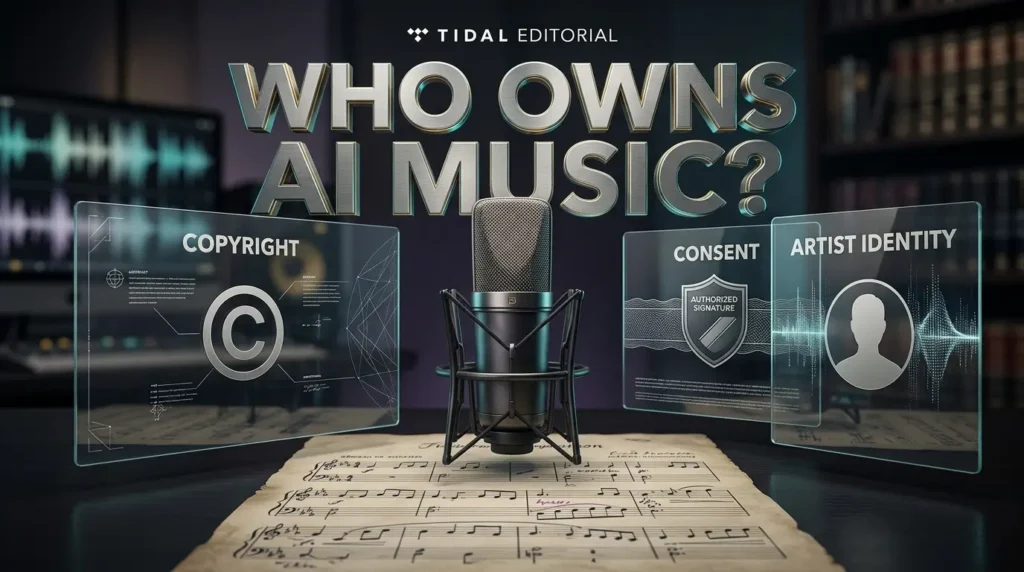
The Copyright Question: Who Owns a Fully AI-Generated Song?
This is one of the biggest unresolved issues surrounding AI music.
There are at least three questions that should not be confused.
Who has permission to use the AI tool commercially?
Who owns any copyright in the resulting work?
And does the work infringe someone else’s rights?
The answers can differ.
In the United States, copyright generally requires sufficient human authorship.
The US Copyright Office has explained that purely machine-generated expression is not protected merely because someone entered a prompt.
But human-created elements in a mixed work may qualify for protection when they meet the applicable requirements.
That means writing lyrics, composing music, arranging performances or making original creative choices may matter legally.
It does not follow that every output from a paid AI subscription automatically receives full copyright protection.
Nor does a lack of copyright protection automatically mean that every possible use of the output is prohibited.
What About AI Singing in a Famous Artist’s Voice?
A generated voice that imitates a recognizable performer can create additional legal and ethical questions.
Those may involve publicity rights, unfair competition, contractual rights or other protections depending on the jurisdiction and facts.
Copyright law alone does not answer every voice imitation question.
Spotify explicitly restricts unauthorized vocal impersonation.
Bandcamp also prohibits impersonation through AI tools.
Tidal’s earlier policy identifies content exploiting artists’ names or likenesses as an enforcement concern.
A creator who obtains permission to use a voice or performance may be in a different position from someone who imitates a singer without consent.
But permission to use a voice still does not override Tidal’s prohibition on wholly AI-generated recordings.
Could Licensed AI Music Be Allowed?
Licensing can help resolve some copyright and training concerns.
It does not necessarily resolve a platform’s content eligibility rules.
Tidal’s announcement is significant precisely because the new restriction is not limited to recordings found to infringe copyright.
It also covers recordings identified as wholly generated by AI.
A song might be noninfringing yet still fail Tidal’s updated acceptance policy.
That is why creators should treat copyright clearance and distribution approval as separate decisions.
Why Are Streaming Platforms Worried About AI Music and Royalties?
Music streaming is not simply a system where every song earns the same fixed amount every time someone presses play.
Revenue distributions depend on platform rules, licensing arrangements, markets, rightsholder agreements and other factors.
Fraud becomes a problem when automated systems exploit that ecosystem.
A bad actor might upload enormous numbers of recordings, manipulate listening activity or distribute misleading material under the name of an existing artist.
AI makes some forms of mass production cheaper and faster.
That does not mean every AI musician engages in fraud.
The distinction is essential.
An artist using a new creative tool is not automatically equivalent to a company operating a streaming manipulation network.
But large scale automated submissions can make enforcement more difficult.
Why Tidal Says Demonetization Wasn’t Enough
Tidal had already restricted royalty attribution for recordings it identified as wholly AI-generated.
The new upload figures suggest that the earlier deterrent did not substantially reduce the flow of such recordings.
If millions of tracks receive almost no plays, direct royalties may not be the main incentive behind every upload.
Some creators may be experimenting.
Some may be using automated content pipelines.
Others may be positioning recordings for future discovery or taking advantage of low distribution costs.
Tidal’s response is to change what can enter and remain in the catalog.
Why Human Artists Care
Music discovery is competitive.
Even if an artificial recording receives no streams, it may consume part of a platform’s ingestion, moderation or search infrastructure.
When generated material is promoted through fake artist identities or manipulated listening patterns, the potential effect on legitimate artists becomes more serious.
Platforms argue that stronger enforcement can protect listeners’ attention and the integrity of royalties.
Critics of broad bans may respond that legitimate AI creators also have artistic intentions and audiences.
Both concerns deserve consideration.
The difficult challenge is creating fair standards without treating every use of AI as deception.
Will This Kill AI Music?
No.
It may significantly change how some AI music reaches listeners.
Tidal’s planned restriction is one of the strongest positions taken by a major subscription streaming platform.
Bandcamp has adopted a similarly restrictive policy, though its wording differs.
But Spotify, Apple Music, Deezer and YouTube Music have not announced identical wholesale bans.
AI music generation tools also continue developing.
Professional producers are increasingly using AI for tasks that range from restoration and editing to sound design and composition.
Some uses are minor.
Others shape almost the entire finished recording.
A single label such as “AI music” cannot adequately describe all of them.
The more likely immediate outcome is a fragmented marketplace.
Creators will have to navigate platform-specific definitions and distribution rules.
Listeners may receive more controls and disclosures.
Distributors may need more detailed metadata.
And artists may be asked to prove how parts of a recording were made.
The Risk of an Unfair Classification
An important question is how platforms will handle artists whose work falls between the extremes.
A musician may write and perform original material while using AI for a limited part of production.
Another may write the lyrics and develop the arrangement but generate the vocals.
A third may create the entire performance through a text prompt.
Treating all three identically would hide meaningful differences.
But trying to draw a precise line between human and synthetic contributions is not straightforward either.
Tidal’s decision to focus initially on wholly generated recordings acknowledges that difficulty.
Its future policy revisions will be worth watching.
The Questions Tidal Still Needs to Answer
The announcement provides a clear direction but leaves operational questions.
How will artists be notified before their recordings are removed?
What evidence will be available to people who believe a detector made a mistake?
How quickly will disputed classifications be reviewed?
What happens to existing playlists and artist profiles?
How will songs with substantial human work and substantial AI contribution be categorized?
And how will rules evolve when music generation becomes increasingly difficult to detect from audio alone?
These questions matter because enforcement at the scale of tens of millions of tracks is not just a technical challenge.
It is also a question of fairness and trust.
A listener wants to know what they’re hearing.
An artist wants to know whether their work is eligible.
A distributor wants clear requirements.
And a streaming platform wants to prevent abuse without damaging legitimate creativity.
Frequently Asked Questions
Is Tidal banning all AI music?
No. Beginning December 9, 2026, Tidal plans to reject and remove recordings wholly generated by AI. Music made with AI assistance may remain eligible under the announced distinction.
When will Tidal start deleting AI songs?
The scheduled start date is December 9, 2026. Tidal expects the broader cleanup to be completed around the beginning of 2027.
Has Tidal already deleted 29 million AI songs?
No. The 29 million figure is the projected number of removals announced on November 24. The broad new removal policy has not yet taken effect as of November 25.
Why are some reports saying 27 million songs?
Tidal reported that about 27 million tracks were already identified and labeled as fully AI-generated. The 29 million figure refers to the larger projected cleanup.
Will Tidal ban Suno songs?
A finished recording generated entirely through Suno would fall within the category Tidal plans to prohibit. Hybrid projects require a closer look at how the recording was created and whether other policies apply.
Can I upload Suno music to Spotify?
Spotify has not announced a universal ban on all fully AI-generated music. Its rules against spam, deceptive practices, unauthorized impersonation and other violations still apply, as do distributor requirements.
Does writing my own lyrics make an AI song eligible on Tidal?
Not necessarily. Tidal’s announced prohibition focuses on the sound recording. Human-written lyrics alone do not establish that an entirely generated musical recording meets the policy.
Can AI-assisted human music stay on Tidal?
The new prohibition is aimed at wholly AI-generated recordings. Some AI-assisted music can remain eligible, subject to Tidal’s broader content and rights requirements.
Is Bandcamp banning AI music too?
Yes. Bandcamp’s January 2026 policy prohibits music wholly or substantially generated by AI, which is broader than Tidal’s initially announced wholly generated threshold.
Does Apple Music allow AI-generated songs?
Apple Music has not adopted Tidal’s universal removal rule. It has introduced AI transparency metadata and plans visible labeling for materially AI-generated content.
Does YouTube Music label AI songs?
Yes. YouTube announced player labels for music created primarily with generative AI in October 2026.
Can Deezer users block AI music?
Deezer has announced a filter allowing users to exclude fully AI-generated music from search results, with a global rollout planned before the end of 2026.
How does Tidal detect AI music?
Tidal uses AI detection technology from Ircam Amplify alongside submission information and other policy checks. Detection methods have limitations, including false positives and false negatives.
What if my human-made song is wrongly identified as AI?
Tidal’s existing support guidance describes an AI flag appeal process. Creators should retain original recordings and production evidence and verify the latest process with the platform or distributor.
Does a paid Suno subscription guarantee streaming rights?
No. Tool licensing terms and streaming platform eligibility are different matters. The relevant subscription, distributor and platform agreements must all be considered.
Can AI-generated music be copyrighted?
Copyright eligibility depends on jurisdiction and the nature of human authorship. In the United States, purely AI-generated expression generally does not qualify for copyright protection simply because a person supplied prompts, while qualifying human-created elements may receive protection.
Did 96% of AI songs get no streams?
Tidal reported that 96% of its identified AI recordings received no plays during the measured 90 day period. This is not a universal statistic for every AI song across streaming services.
Will Spotify ban AI music next?
Spotify has not announced a Tidal-style universal ban as of November 25, 2026. Future policy changes remain possible, but should not be presented as confirmed.
The Bigger Story Is About Who Gets to Be Heard
Music has always changed when new tools arrive.
Recording technology changed performance.
Synthesizers changed sound.
Digital production made professional tools accessible to people without expensive studios.
Artificial intelligence is another major change, but it introduces a particularly difficult question.
What happens when creating an enormous number of finished recordings becomes almost effortless?
For some people, generative music opens doors that previously seemed closed.
For others, it threatens to bury years of musicianship under a flood of automated content.
Streaming services are now deciding how those competing interests should be managed.
Tidal has chosen one of the clearest boundaries so far.
Starting December 9, recordings created wholly by AI will no longer be welcome on its platform.
That decision may reduce automated catalog growth and protect certain aspects of music discovery.
But it also places a heavy responsibility on Tidal to classify recordings fairly and correct mistakes.
The future of music is unlikely to be a simple contest between humans and machines.
It will probably involve many forms of collaboration, new licensing arrangements and more detailed disclosure.
The question is whether creators, listeners and platforms can agree on rules that preserve trust without closing the door on legitimate experimentation.
Reporting cutoff: November 25, 2026. The December 9 enforcement date and projected removal figures describe future actions.
Editorial methodology: TrendOutsider reviewed Tidal’s public AI policy and November 24 announcement coverage, alongside published rules and statements from Spotify, Deezer, Bandcamp, YouTube and reporting concerning Apple Music. We have not independently tested Tidal’s AI detection software, interviewed affected artists or verified individual song classifications.
Legal and creator notice: Copyright, publicity rights, licensing and platform requirements vary by jurisdiction and circumstance. This article offers general information rather than legal advice.
Visual disclosure: Illustrations accompanying the article are conceptual artwork, not authentic documentation of deleted tracks, fraudulent artists or technical detections.








Leave a Reply