
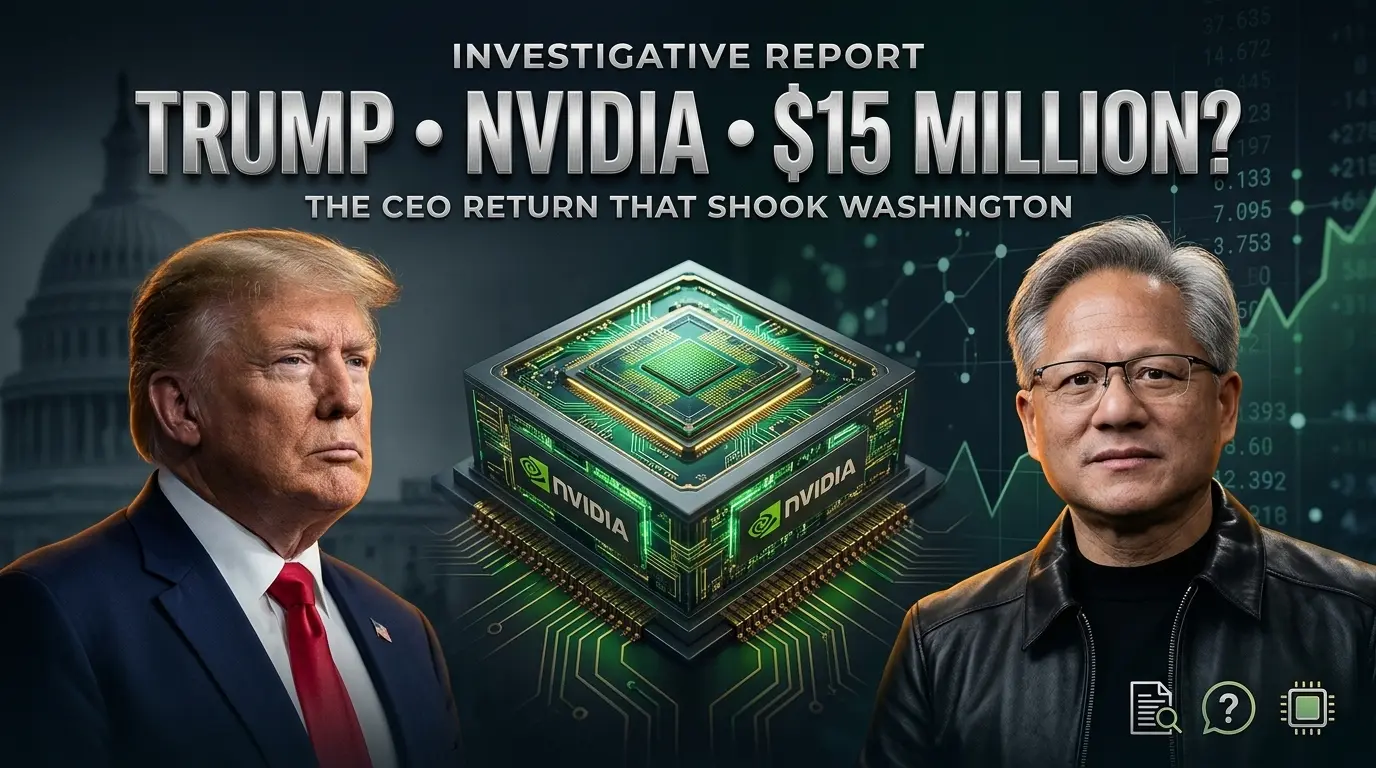
For 11 days, Nvidia was forced to contemplate something that had seemed almost unthinkable: life without Jensen Huang.
The cofounder who helped turn a graphics chip company into the central supplier of the artificial intelligence boom had resigned amid a personal scandal and questions about national security. The company’s board had appointed a temporary successor. Investigators were examining sensitive relationships and possible violations involving advanced AI chips.
Then the president of the United States intervened.
Donald Trump openly urged Nvidia to bring Huang back. He spoke with company directors, offered assurances about national security and later claimed he had personally helped secure the reversal.
On November 23, Nvidia announced that Huang was returning as chief executive.
Its shares surged more than 30 percent.
And another extraordinary detail soon emerged.
According to a November 24 Financial Times analysis of Trump’s financial disclosures, the president’s Nvidia holdings may have increased in value by as much as $15 million during Monday’s rally.
That is an estimate, not proof that Trump made a $15 million cash profit. The filings do not show his precise holdings at the time of the reinstatement or whether he bought or sold shares immediately before the announcement.
But the overlap is difficult to ignore.
A sitting president advocated for a leadership decision at one of America’s most strategically important technology companies. The company reversed its earlier position. Its market value soared. And the president had disclosed substantial financial exposure to the same business.
At the same time, Nvidia was facing scrutiny over reported intelligence concerns, semiconductor export controls and its dealings with a Singapore based company under investigation. The chipmaker had also committed $25 million to Trump’s White House ballroom project, according to documents obtained by The Washington Post.
None of those facts, individually or together, proves that an illegal agreement took place.
They do, however, raise questions that deserve detailed answers.
Why did Nvidia’s board change its mind? What role did the White House play? What happened to the national security concerns? How might Trump have benefited financially? And can investors trust a board’s independence when the president personally intervenes in its most important leadership decision?
This is what the documentary record and reporting available through November 24, 2026, establish.
The Nvidia Reinstatement: What Actually Happened?
The clearest evidence is Nvidia’s own regulatory filing.
In a Form 8-K submitted to the US Securities and Exchange Commission on November 23, Nvidia disclosed that its board had reinstated Jen-Hsun Huang, widely known as Jensen Huang, as president, chief executive officer and a director.
The decision became effective on November 22.
This was not a rumor or a proposed arrangement.
It was a formal corporate action.
Nvidia’s accompanying November 23 announcement said directors had voted unanimously after discussions with Huang. The board described itself as satisfied with his candor and ability to lead.
It also acknowledged receiving input from senior levels of the United States government.
That last detail is crucial.
Companies frequently consult government officials about regulation, contracts and national security. What makes this case unusual is that the consultation concerned whether a particular individual should return to the chief executive position after a board had already taken the opposite course.
The decision ended a brief but tumultuous leadership transition.
Colette Kress, Nvidia’s longtime chief financial officer, had served as interim CEO. After Huang’s return, she resumed her full focus on the CFO role.
Harvey Jones remained chairman.
The board also said its investigation would continue, even while Huang returned to work.
In other words, Nvidia restored its leader before the independent inquiry had reached its publicly announced conclusion.
That is one of the central unresolved tensions in the case.
A Reversal That Followed a Public Rejection
The reinstatement was particularly striking because Nvidia’s board had recently communicated the opposite position.
During the company’s November financial reporting period, chairman Harvey Jones said the board did not intend to reinstate Huang.
The statement came after Huang had resigned following disclosures about personal conduct that the board considered inconsistent with its standards.
Less than a week later, the same company welcomed him back.
A board is permitted to reconsider a decision. New evidence, shareholder interests and changed circumstances can justify a reversal.
But when the president of the United States personally lobbies for that reversal, the public is entitled to ask how the decision was reached.
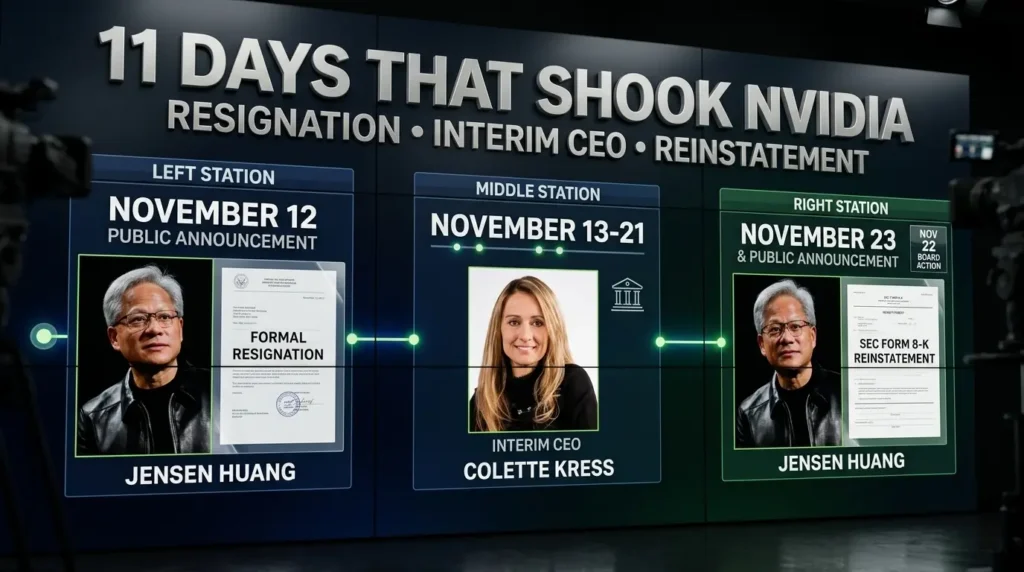
November 11 to November 24: The Full Timeline
The sequence matters because several separate stories developed almost simultaneously.
| Date | Confirmed event or reported development |
|---|---|
| November 8 | Huang publicly acknowledges infidelity, while Nvidia announces an independent investigation concerning reported foreign intelligence targeting. |
| November 10 | Nvidia’s independent directors announce the appointment of outside legal counsel to assist their investigation. |
| November 11 | Nvidia’s board accepts Huang’s resignation, according to its SEC filing. |
| November 12 | Nvidia announces the leadership change publicly. Colette Kress becomes interim CEO and Harvey Jones becomes board chair. |
| November 16 | The US Commerce and Justice departments issue a joint statement describing their investigation into Megaspeed. |
| November 17–19 | Huang’s possible return becomes the subject of board, investor and political debate. Nvidia’s chairman publicly rules out reinstatement during the company’s earnings discussions. |
| November 20–22 | Trump publicly and privately supports Huang’s return. The board ultimately reverses course. |
| November 22 | Nvidia’s directors formally reinstate Huang, effective immediately. |
| November 23 | Nvidia publicly announces his return. Trump acknowledges lobbying directors. Nvidia shares jump more than 30 percent. |
| November 24 | The Financial Times reports its estimate of the potential change in Trump’s Nvidia holdings. Singapore confirms that the Megaspeed investigation remains active. |
| December 1, scheduled | Huang is expected to appear before three House committees. |
| December 2, scheduled | Nvidia general counsel Tim Teter is expected to appear before the same committees. |
| December 3, scheduled | Huang is listed as a witness at a public Senate Banking Committee hearing on AI export controls. |
The resignation was accepted on November 11, publicly announced on November 12 and reversed by board action on November 22.
That distinction explains why different reports describe the absence as 10 or 11 days.
For the original allegations and the developments before the resignation, TrendOutsider’s earlier report, Jensen Huang Affair: Alice Huang, Nvidia Investigation and the China Spy Allegations Explained, provides the background.
Our subsequent report on Jensen Huang’s resignation and Nvidia’s leadership crisis explains the initial transition and why the company’s future suddenly appeared uncertain.
This investigation examines the extraordinary political and financial developments that followed.
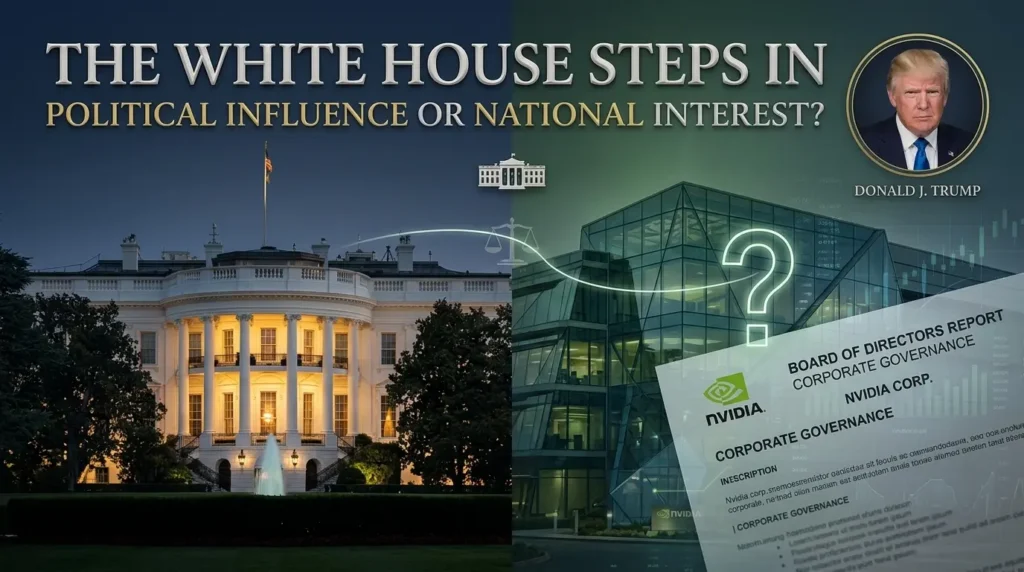
Trump Says He Personally Convinced Nvidia’s Board
The White House’s involvement is not merely an accusation made by political opponents.
Trump himself described his role.
In a November 23 CNBC interview, the president said he had been communicating with Nvidia’s board directly and indirectly.
He then said he had convinced the directors to restore Huang.
Trump also explained that directors had requested assurances about national security and that his administration had provided them.
His public position was that Huang had exercised poor personal judgment but should not be excluded from leading a company vital to American technological strength.
The president presented the intervention as a matter of national interest.
His argument was essentially this: losing Huang would be more damaging to the United States than returning him to the company.
There is a recognizable policy rationale behind that position.
Nvidia supplies the accelerators and integrated systems used by many of the world’s most advanced artificial intelligence developers. Disruption at the company’s top could affect investors, suppliers, cloud providers and customers involved in major infrastructure investments.
Huang has also become a prominent voice in debates over American technological leadership and access to Chinese markets.
That makes him an unusually consequential corporate leader.
But the government’s interest in Nvidia does not automatically justify direct intervention in its internal governance.
What Did Trump Tell the Directors?
According to reporting on the CNBC interview, Trump said the board wanted assurance that reinstating Huang would not endanger national security.
He indicated that his administration had reviewed the available information and concluded that Huang’s return posed no such risk.
Nvidia’s own statement echoed that position.
The company said the input from senior government officials gave the board confidence on the security question.
What remains unclear is exactly what information was shared with directors, who supplied it, whether any written assessment was provided and how the government reconciled its assurances with investigations that remained open.
Those details matter.
A national security assessment based on confidential intelligence may be legitimate. But outside observers cannot independently evaluate an assessment that has not been made public.
There is also a distinction between the government’s assessment of Huang personally and ongoing inquiries into other people or companies.
Clearing one person of known wrongdoing would not automatically resolve every investigation into possible chip diversion.
Why Critics See a Governance Problem
Corporate boards are supposed to make decisions in the interests of the company and its shareholders while fulfilling their legal duties.
They can take government information into account.
They can reconsider earlier judgments.
But their independence becomes more difficult to evaluate when political leaders publicly demand a particular outcome and later celebrate having secured it.
The question is not whether a president may express an opinion about a major company.
It is whether government pressure shaped a decision that was supposed to follow an independent corporate process.
That is a serious governance concern regardless of which political party controls the White House.
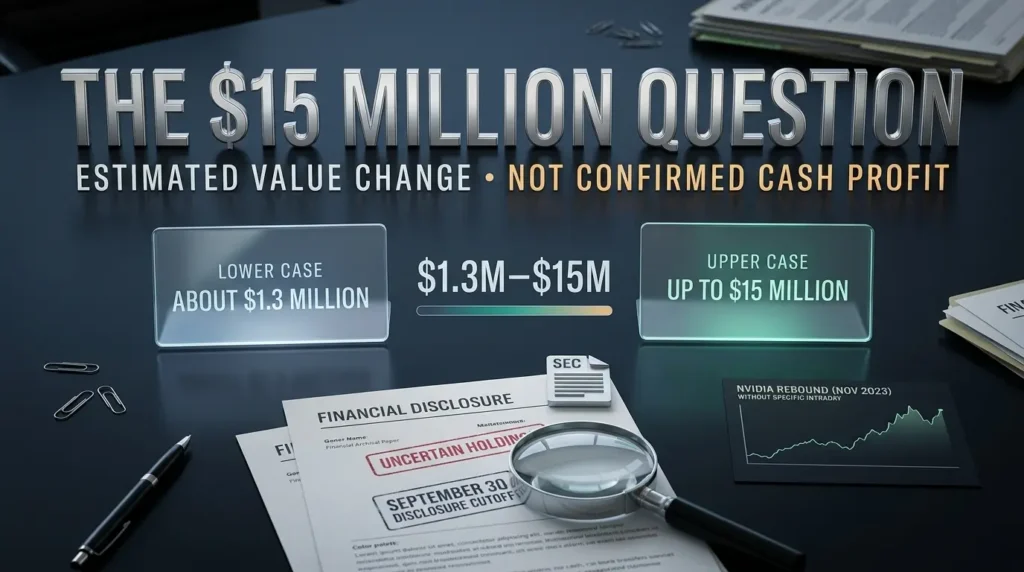
The $15 Million Question: How Much Did Trump Actually Gain?
The stock market reaction was dramatic.
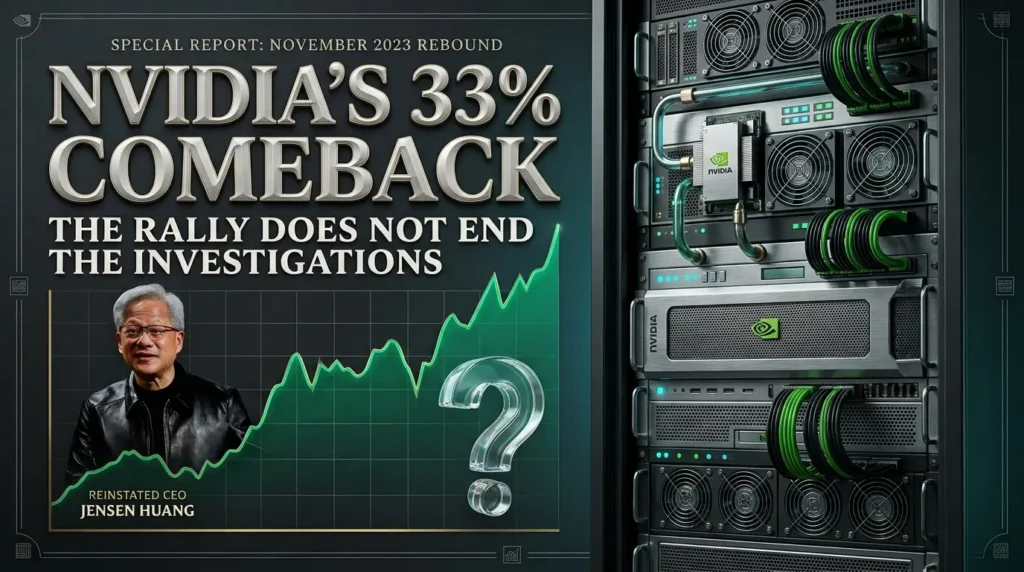
Reuters reported that Nvidia shares surged around 33 percent following the news of Huang’s return, helping lift the wider US technology market.
That rally had consequences for anyone who owned Nvidia shares.
Trump was among the people whose financial disclosures indicated exposure to the company.
According to the Financial Times’ November 24 analysis, the latest available disclosures suggest Trump might have held between approximately 32,000 and 370,000 Nvidia shares as of September 30, depending on how the reported transaction ranges are interpreted.
Applying Monday’s stock movement to those possible holdings yields a wide estimate for the value increase.
| Financial Times scenario | Estimated Nvidia shares | Estimated increase in portfolio value |
|---|---|---|
| Lower disclosed holding scenario | About 32,000 | About $1.3 million |
| Upper disclosed holding scenario | Up to 370,000 | Up to $15 million |
There are several reasons to be cautious with these figures.
First, financial disclosures use ranges rather than exact quantities for certain transactions.
Second, the latest referenced reporting period ended September 30.
Third, the disclosures do not establish every purchase or sale during October and November.
And fourth, an increase in the market value of shares is not the same as a realized profit from selling those shares.
We cannot establish from the available disclosures that Trump owned 370,000 Nvidia shares when Huang returned. We also cannot establish that he sold shares and personally received $15 million.
The estimate is newsworthy because of the president’s documented involvement in the corporate decision.
It is not a substitute for the missing transaction records.
Why the Financial Interest Matters
A president who helps set semiconductor policy can influence the business environment for companies like Nvidia.
A president who personally encourages a board to restore a chief executive may also influence investor expectations.
If that president owns a substantial stake in the affected company, a possible conflict of interest arises.
The ethical question does not require proof that the president sold stock immediately after the announcement.
It begins with the possibility that public decisions and private financial interests overlap.
But establishing illegal insider trading, a deliberate market manipulation scheme or a corrupt bargain would require much more evidence.
Investigators would need to examine actual transactions, timing, authority over the accounts, communications, intent and the laws applicable to the conduct.
What the White House Says About the Portfolio
The White House has said that Trump’s stock and bond portfolio is managed by independent third party financial institutions.
According to ABC News’ November 23 review, a White House spokesperson said the accounts are discretionary and use computer based model portfolios designed to replicate established market indexes.
That explanation is relevant.
Nvidia is a major component of widely followed equity indexes, so holding the stock is not unusual for a diversified portfolio.
The explanation also does not independently identify all trades, decision makers or restrictions governing the accounts.
Those details are necessary to assess the extent of any conflict.
The Rally Did Not Erase Every Earlier Loss
The Financial Times also noted that Nvidia’s shares had fallen substantially before Monday’s rebound.
Under its maximum holding scenario, Trump could still have been sitting on a significant decline relative to the value of those holdings before the recent turbulence.
So the correct story is not that the president necessarily emerged $15 million richer than he had been before the crisis.
The narrow, defensible finding is that Monday’s rally could have increased the value of his possible holdings by as much as $15 million compared with their value immediately before that rally.
That is striking enough without overstating it.
Nvidia’s $25 Million Ballroom Commitment Adds Another Conflict Question
The shareholding issue is not the only financial connection that deserves examination.
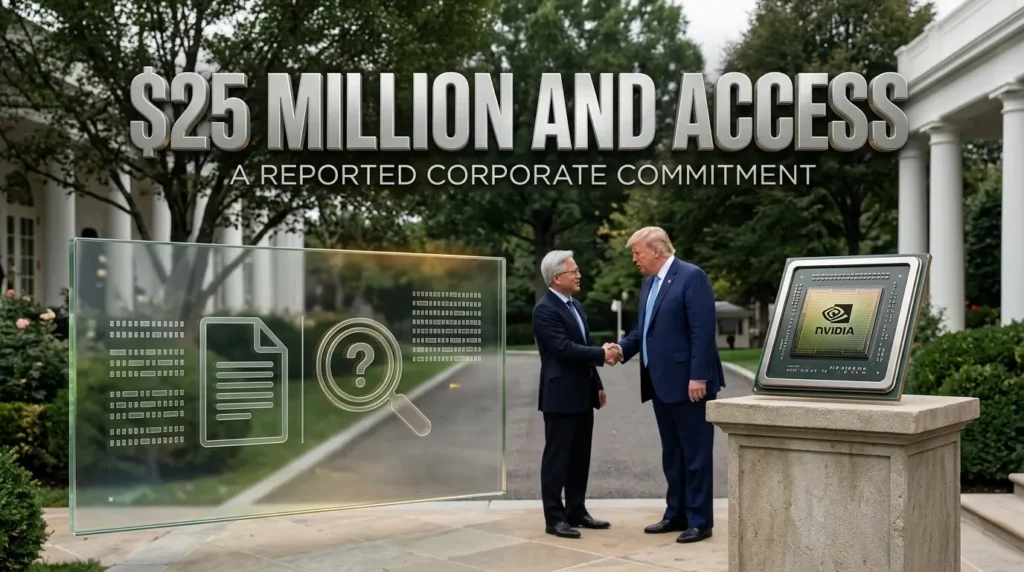
In October, The Washington Post reported that documents concerning the fundraising campaign for Trump’s White House ballroom showed Nvidia had committed $25 million.
The contribution was among the largest amounts disclosed in the newspaper’s investigation.
According to that reporting, Nvidia had requested that its contribution remain anonymous.
The company nevertheless acknowledged supporting the project.
Its spokesperson said the donation was made to a nonpartisan trust and was independent of business interests.
Those are important parts of the record.
A corporate contribution does not, by itself, prove a company purchased political influence.
But the circumstances invite scrutiny.
Nvidia operates in a sector where the federal government controls access to sensitive overseas markets, reviews exports, shapes industrial policy and makes consequential national security decisions.
The company had made a substantial contribution to a presidential project.
And weeks later, the president was personally involved in urging its board to reverse a leadership decision.
The public evidence reviewed here does not establish that the donation bought Huang’s reinstatement.
Nor does it establish that the ballroom donation was exchanged for export policy concessions.
The legitimate question is whether safeguards existed to keep political fundraising, corporate requests and official decision making separate.
Why Secrecy Around Donations Matters
The Washington Post reported broader concerns about the fundraising campaign’s transparency and the identities of major donors.
The problem is not simply that wealthy individuals and corporations make contributions.
It is that public officials may exercise enormous discretion over businesses seeking regulatory or commercial outcomes.
When companies that depend on government decisions make substantial contributions connected to political leaders, transparency becomes especially important.
The public needs to know who gave money, when they gave it and what decisions were being considered.
Without that information, it is difficult to distinguish ordinary civic contributions from situations involving potential improper influence.
The Alice Huang Allegations: What Is Proven and What Is Not?
The national security concerns surrounding Jensen Huang’s return cannot be understood without examining the reporting about Alice Huang.
Alice Huang, also known as Huang Le, is a business executive previously associated with Singapore based Megaspeed International.
She is not related to Jensen Huang.
Reports have described an extramarital relationship between the two.
More seriously, news organizations including The New York Times have reported suspicions among US authorities that Alice Huang had connections to Chinese intelligence.
Reuters subsequently reported those allegations while emphasizing that it could not independently verify them.
China has denied the claims.
A suspicion of espionage is not a criminal conviction, and the reporting reviewed for this article does not establish that Alice Huang was convicted of spying for China.
That distinction is particularly important because allegations involving intelligence agencies can be difficult for the public to verify.
Some underlying information may be classified.
Other claims may depend on anonymous sources.
A person can be the subject of an investigation without being guilty of the suspected conduct.
What Singapore’s Government Has Actually Said
Singapore’s Ministry of Home Affairs published an unusually detailed statement on November 12.
The statement said police and customs authorities had investigated Megaspeed and several individuals over possible false declarations connected to servers and related transactions.
Alice Huang was among those examined because of her former role at the company.
Singapore explicitly stated that it was not investigating her for espionage.
In February 2026, authorities concluded there was insufficient evidence to establish that she had committed the suspected declaration offences.
The government did, however, say she had knowingly provided inaccurate information to police about her role in Megaspeed.
Authorities issued a stern warning, barred her from reentering Singapore and returned her passport.
The distinction matters.
Singapore did not prosecute her for the suspected declaration offences.
It did not announce a finding that she was a Chinese intelligence operative.
But it also did not describe every aspect of her conduct as beyond criticism.
Meanwhile, Singapore’s investigation into Megaspeed and several other individuals continued.
As of November 24, Prime Minister Lawrence Wong said the country’s investigation remained active.
Why This Still Matters for Nvidia
Nvidia’s leadership, suppliers and customers operate in a global semiconductor market where national security and export controls have become central issues.
An executive’s reported personal relationship becomes a corporate concern when it overlaps with sensitive commercial relationships or access to confidential information.
That is the reason for scrutiny.
It is not evidence by itself that trade secrets were passed to anyone, that Huang knowingly assisted espionage or that Nvidia violated the law.
Nvidia has said its independent inquiry will continue.
Until investigators publish findings, the remaining allegations must remain allegations.
For a fuller account of the initial reporting and disputed claims, see TrendOutsider’s earlier investigation into Alice Huang and Nvidia.
The Megaspeed Investigation and the AI Chip Export Question
The underlying commercial investigation is separate from the allegations about a personal relationship.
Megaspeed operated in the international AI computing industry, where access to Nvidia’s most powerful processors has become strategically important.
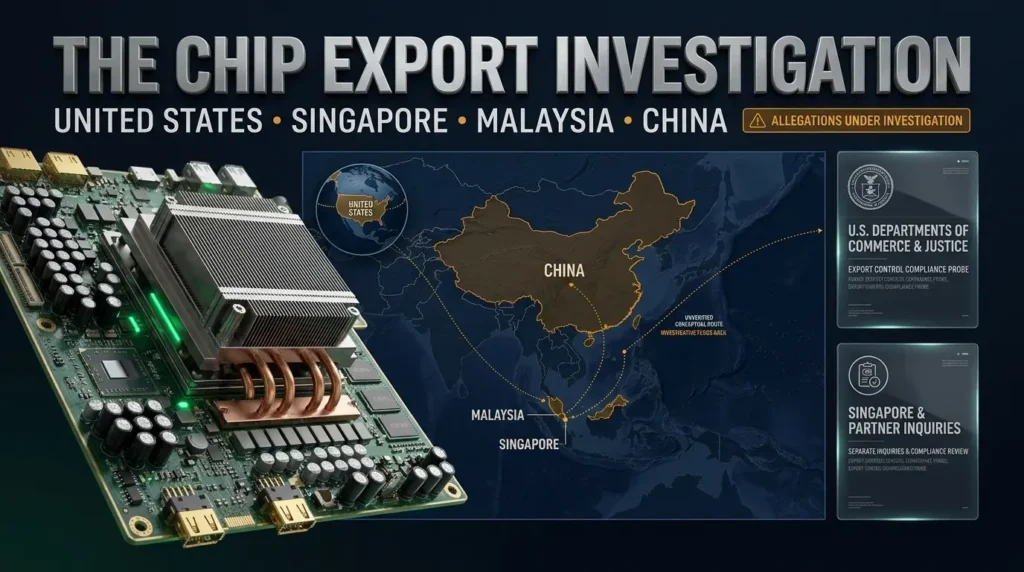
US export controls restrict certain advanced semiconductor transactions involving China.
Authorities have been investigating whether equipment was diverted through intermediary businesses.
In a joint statement dated November 16, the US Departments of Commerce and Justice described the history of their Megaspeed investigation.
According to the departments:
- Commerce began investigating Megaspeed in 2024 over possible export control violations.
- Investigators requested relevant Nvidia records in May 2025.
- Nvidia placed Megaspeed on its no sell list in June 2025.
- US investigators conducted an on site end use check with Singaporean authorities in June 2025.
- Justice subsequently took the lead in the criminal investigation.
That chronology is important because it establishes that official scrutiny was underway well before the November leadership crisis.
It also shows that Nvidia had taken at least one documented commercial restriction against Megaspeed.
What Investigators Still Need to Establish
Investigators must distinguish between lawful international hardware purchases and unlawful diversion of restricted technology.
They may need to identify buyers, intermediaries, payment records, physical shipments, server locations and the ultimate destination of controlled components.
A company appearing in a chain of transactions does not automatically mean its executives knowingly participated in an illegal export scheme.
Similarly, the fact that Nvidia had commercial dealings connected to Megaspeed does not prove Nvidia intentionally violated export controls.
The ultimate findings may depend on records that are not yet public.
Washington and Singapore Are Not Investigating Exactly the Same Thing
The US inquiry focuses on possible violations of American restrictions concerning sensitive semiconductor technology.
Singapore’s inquiry concerns possible offences under Singaporean law, including questions about commercial declarations.
The two jurisdictions may cooperate, but their legal questions and evidence requirements are not identical.
That helps explain why an absence of sufficient evidence for charges in one Singaporean inquiry does not automatically settle every question under US export control law.
On November 24, reporting also said Washington had placed Megaspeed on a trade restriction list, subjecting future relevant exports to additional licensing controls.
Such restrictions are consequential, but a listing is not equivalent to a criminal conviction.
Why the White House Says Huang Must Lead Nvidia
Trump’s defense of Huang is closely connected to the administration’s industrial and national security priorities.
Nvidia does not simply sell gaming graphics cards.
Its technology is foundational to the infrastructure used for advanced AI training and inference.
Cloud providers, AI research laboratories and major technology companies depend on Nvidia systems.
The company also sits at the center of a difficult policy debate: how much advanced American technology should be permitted to reach China?
Supporters of a more restrictive approach argue that access to powerful AI processors could strengthen China’s military and intelligence capabilities.
Others argue that broad restrictions may reduce US companies’ revenue, weaken commercial relationships and encourage foreign competitors to develop alternatives.
The debate is not imaginary.
Government decisions affect which processors Nvidia can sell, to whom and under what conditions.
Huang has strongly advocated maintaining access to international markets where legally permitted.
Trump, meanwhile, has pursued policies balancing American AI leadership, export restrictions and commercial competitiveness.
The Broader Question of Presidential Favoritism
When a president publicly champions one corporate leader, it can create the appearance that access to political power matters as much as ordinary corporate governance.
The question is especially serious when that company is directly affected by government permissions and enforcement decisions.
Yet there is also a plausible policy defense for Trump’s position.
A sudden loss of leadership at a critical chip supplier could create uncertainty across an industry of national importance.
Trump argues that restoring Huang strengthens American competitiveness.
Critics argue that the president should not personally shape a company’s internal leadership outcome, particularly where his own financial interests may overlap.
Both positions should be evaluated against the documented decisions and their consequences, not against political slogans alone.
Nvidia’s Stunning Market Rebound: What Investors Were Really Buying
The company’s share price response was immediate.
Reuters reported a surge of approximately 33 percent following the announcement.
The wider Nasdaq and S&P 500 also rallied sharply as enthusiasm returned to technology stocks.
But investors were reacting to more than Huang’s personal popularity.
The previous weeks had raised uncertainty about Nvidia’s leadership, its dealings with regulators, the future of AI spending and the enormous value assigned to semiconductor companies.
Reinstatement removed one obvious leadership uncertainty.
It did not remove every business or regulatory risk.
Nvidia’s Business Remains Enormous
Nvidia’s November 17 fiscal third quarter results reported revenue of $115.8 billion, according to the company’s official earnings announcement.
That reinforced the scale of demand for its computing systems.
But a strong quarter does not guarantee future profit growth or insulate the company from changing market expectations.
Investors are also evaluating the immense cost of data centers, energy requirements, customer financing and competition.
TrendOutsider previously examined those concerns in AI Infrastructure Stocks Lose $4.2 Trillion as Wall Street Questions the Data Center Boom.
That earlier selloff is important context.
The market’s November 23 rebound followed a period of pronounced anxiety across the AI investment cycle. One day’s rally should not be interpreted as proof that every underlying concern has disappeared.
What Does This Mean for Ordinary Shareholders?
For Nvidia shareholders, the reinstatement creates two competing realities.
The return of an experienced and influential founder may reassure customers and investors.
At the same time, unresolved investigations and questions about the board’s independence can create new governance risks.
An investor can welcome Huang’s return while still expecting transparency about the decision.
Those positions are not contradictory.
Is This Corruption? What the Evidence Supports
The word corruption carries a serious accusation.
Political opponents have used it to describe the overlap among Trump’s intervention, his financial holdings and corporate contributions.
Senator Ruben Gallego called for scrutiny of stock positions around the announcement and characterized the White House in sharply critical terms.
Those reactions are newsworthy.
But a political accusation is different from an established legal conclusion.
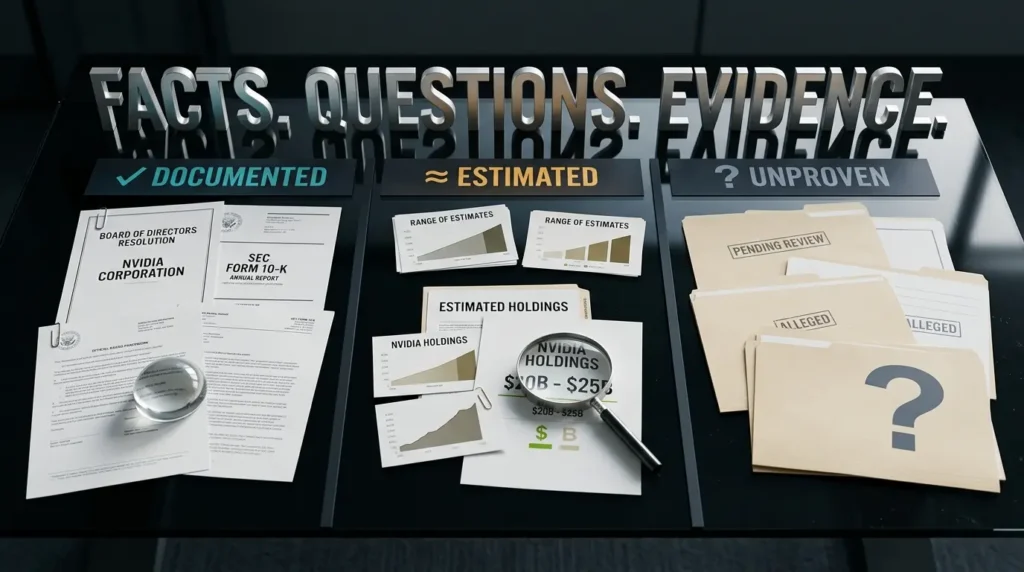
The available evidence supports a series of specific findings.
Trump personally advocated for Huang’s return.
Nvidia’s board acknowledged receiving input from senior US government officials.
The company reversed its decision.
Its shares surged.
Trump’s financial disclosures indicated potentially substantial Nvidia holdings.
And Nvidia had reportedly committed $25 million to a presidential ballroom project.
Together, those facts create substantial potential conflict of interest questions.
They do not prove that Trump directed trades using confidential information, that Nvidia bought a presidential favor or that the reinstatement was the result of bribery.
Five Questions That an Independent Inquiry Could Examine
1. Who owned and controlled Trump’s Nvidia holdings on November 22 and 23?
That requires precise account records, not estimates based only on disclosure ranges.
2. Did any accounts trade Nvidia shares before the reinstatement became public?
The timing and authorization of transactions would be critical to evaluating allegations of improper trading.
3. What exactly did Trump or other officials communicate to Nvidia’s directors?
A full record would help distinguish ordinary policy consultation from pressure that materially affected independent decision making.
4. Was any government action connected to Nvidia’s political contributions?
That would require evidence of a relationship between the contribution and an official act, not simply proof that both events occurred.
5. Were national security conclusions documented and consistent with ongoing investigations?
The public should know whether the board’s assurances were based on formal assessments and how those assessments related to the unresolved inquiries.
The Difference Between an Ethical Conflict and a Criminal Offence
Government ethics and criminal law are related but distinct.
A situation may create an appearance of conflict even when no criminal law has been broken.
Conversely, a criminal case requires evidence satisfying the applicable legal standards.
Questions about recusals, financial transparency, government influence and corporate governance can be legitimate subjects of scrutiny even before criminal findings exist.
For TrendOutsider readers, that distinction is more useful than declaring a verdict before the records are available.
What About Broader Trump Family Wealth and Crypto Deals?
Other investigations have examined the Trump family’s cryptocurrency businesses, overseas arrangements and payments involving political advisers.
Those stories raise their own questions about conflicts of interest during Trump’s second presidency.
But amounts reported as business revenue, changes in asset value, realized gains and consulting income are different financial categories.
They should not be added together as if every dollar were an illicit payment to the president.
A separate, fully documented investigation is the right place to evaluate those transactions in depth.
For this Nvidia story, the most direct financial questions concern Trump’s reported Nvidia holdings, the timing of the company’s share price surge and Nvidia’s ballroom commitment.
Congress Is Preparing to Question Jensen Huang
The story is far from finished.
Congressional committees had already arranged interviews relating to Nvidia, sensitive AI hardware and national security concerns.
According to the House Intelligence Committee’s November 17 announcement, Huang agreed to appear before three House panels on December 1.
Nvidia general counsel Tim Teter is expected to appear on December 2.
The Senate Banking Committee has scheduled a public hearing for December 3 on oversight of US export controls, with Huang named as the witness.
These events have not yet taken place as of November 24.
They may provide further details about relationships, company compliance systems and the government’s handling of sensitive technology.
They may also leave important questions unanswered, particularly where classified intelligence or confidential commercial information is involved.
What Should Lawmakers Ask?
The most useful questions would address the documentary record rather than amplify unproven personal allegations.
What did Nvidia know about Megaspeed and when?
How did the board assess any national security concerns involving its chief executive?
What changed between the board’s rejection of reinstatement and its unanimous reversal?
What assurances did government officials provide?
Was the board’s independent investigation allowed to proceed without interference?
And what safeguards protect export control decisions from political favoritism?
For investors, the central issue is whether Nvidia’s corporate governance mechanisms remain capable of independent scrutiny.
For national security officials, the question is whether advanced semiconductor restrictions are being enforced consistently.
For the public, the issue is whether a president can intervene in a company while holding a financial interest in its stock without sufficient disclosure or oversight.
What Happens Next for Nvidia, Trump and the Investigations?
There are several immediate developments worth watching.
Nvidia’s independent investigation has not reached a public conclusion.
Its newly announced national security and export control oversight arrangements will need to demonstrate that they are more than a response to public pressure.
Federal and Singaporean inquiries into relevant semiconductor transactions remain active.
Congress is preparing to question Huang and Nvidia’s legal leadership.
And the public still lacks a complete picture of Trump’s Nvidia transactions in the weeks surrounding the reinstatement.
The next substantive evidence could change the story.
A formal investigative finding might clarify who knew what, when and whether any laws were broken.
Detailed trading records could narrow or eliminate the uncertainty surrounding the potential financial gain.
Congressional testimony could explain the government’s role in the board reversal.
Until those records become public, no responsible investigation should fill the gaps with certainty.
Frequently Asked Questions
Did Trump force Nvidia to reinstate Jensen Huang?
Trump publicly acknowledged lobbying Nvidia’s board and said he helped convince directors to restore Huang. Nvidia confirmed it received input from senior US government officials. The available evidence does not establish the full private decision making process or prove that directors had no independent choice.
Is Jensen Huang Nvidia’s CEO again?
Yes. Nvidia’s SEC filing confirms that its board reinstated Huang on November 22, 2026, with the company publicly announcing the decision on November 23.
Did Trump make $15 million from Nvidia?
The Financial Times estimated that Monday’s rally could have increased the value of Trump’s possible Nvidia holdings by as much as $15 million. The precise holdings and any realized trading profit have not been established.
Why is Trump’s Nvidia stock ownership controversial?
The concern is that the president advocated for a corporate leadership outcome while potentially holding a financial interest that benefited from the market reaction. That raises conflict of interest questions but is not, by itself, proof of a crime.
How much did Nvidia donate to Trump’s ballroom?
The Washington Post reported that Nvidia committed $25 million to the White House ballroom project. Nvidia said its donation was independent of business interests.
Was Alice Huang proven to be a Chinese spy?
No publicly established criminal finding reviewed for this article proves that allegation. US intelligence suspicions have been reported, but Reuters said it could not independently verify them. Singapore separately said it had not investigated her for espionage.
Is Alice Huang related to Jensen Huang?
No. Despite sharing a surname, they are not related.
What is Megaspeed being investigated for?
US authorities are examining possible semiconductor export control violations. Singapore has separately investigated possible false declarations involving servers and related transactions.
Has Jensen Huang been charged with espionage?
The available public sources reviewed for this article do not establish that Huang has been criminally charged with espionage.
Has Nvidia’s board completed its investigation?
No public conclusion was announced alongside Huang’s reinstatement. Nvidia said the independent committee’s work would continue.
Why did Nvidia stock jump?
Investors welcomed Huang’s return after a turbulent leadership crisis. Reuters reported a rally of approximately 33 percent, although market movements reflect multiple factors and can change rapidly.
When will Jensen Huang testify before Congress?
House committee interviews are scheduled for December 1, 2026, and a public Senate Banking Committee hearing is scheduled for December 3.
Has Trump been found guilty of corruption in the Nvidia case?
No criminal finding establishing such a conclusion was identified in the public sources reviewed through November 24. The documented events raise significant ethical and conflict of interest questions that warrant scrutiny.
What could this mean for US AI chip policy?
The case intensifies questions about export controls, corporate access to government decision makers, national security oversight and the relationship between technology companies and the White House.
The Bigger Question Is Who Holds the Power
Nvidia’s reinstatement of Jensen Huang may ultimately be remembered as a dramatic return for one of the most influential executives in modern technology.
But the episode is about more than one executive.
It has exposed the complicated relationship between private corporations, national security authorities, political leaders and financial markets.
A company central to American AI infrastructure faced a leadership crisis.
The president personally advocated for its founder’s return.
The board reversed its decision.
The stock market rallied.
And public financial disclosures suggested that the president himself might have benefited from the rebound.
Those are documented developments.
Whether they amount to unlawful conduct is a different question, one that cannot be settled by a headline, a political accusation or a dramatic stock chart.
The unanswered questions concern how the decision was made, what information influenced it and whether public power was kept sufficiently separate from private interests.
Congress, investigators and Nvidia’s own directors now have an opportunity to provide those answers.
For one of the world’s most consequential technology companies, restoring its founder may have reassured investors for the moment.
Restoring confidence in the independence of its governance could prove much harder.
Reporting cut off: November 24, 2026. This article may require updates as official investigations, financial disclosures and congressional proceedings develop.
Editorial methodology: TrendOutsider reviewed Nvidia’s SEC filings and corporate statements, official US and Singapore government materials, congressional notices and reporting from Reuters, the Financial Times, The Washington Post and ABC News. TrendOutsider has not independently obtained confidential intelligence records, full presidential brokerage statements or internal Nvidia board communications.
Important distinction: Allegations of espionage, improper trading, bribery or unlawful corporate influence must not be treated as proven findings. The estimated change in Nvidia holdings is not a verified realized cash profit.
Financial disclaimer: This article is for journalism and public information, not investment advice.
Visual disclosure: Editorial images are conceptual illustrations. They must not be presented as photographs documenting unobserved meetings, private conduct, espionage or crimes.






Leave a Reply