
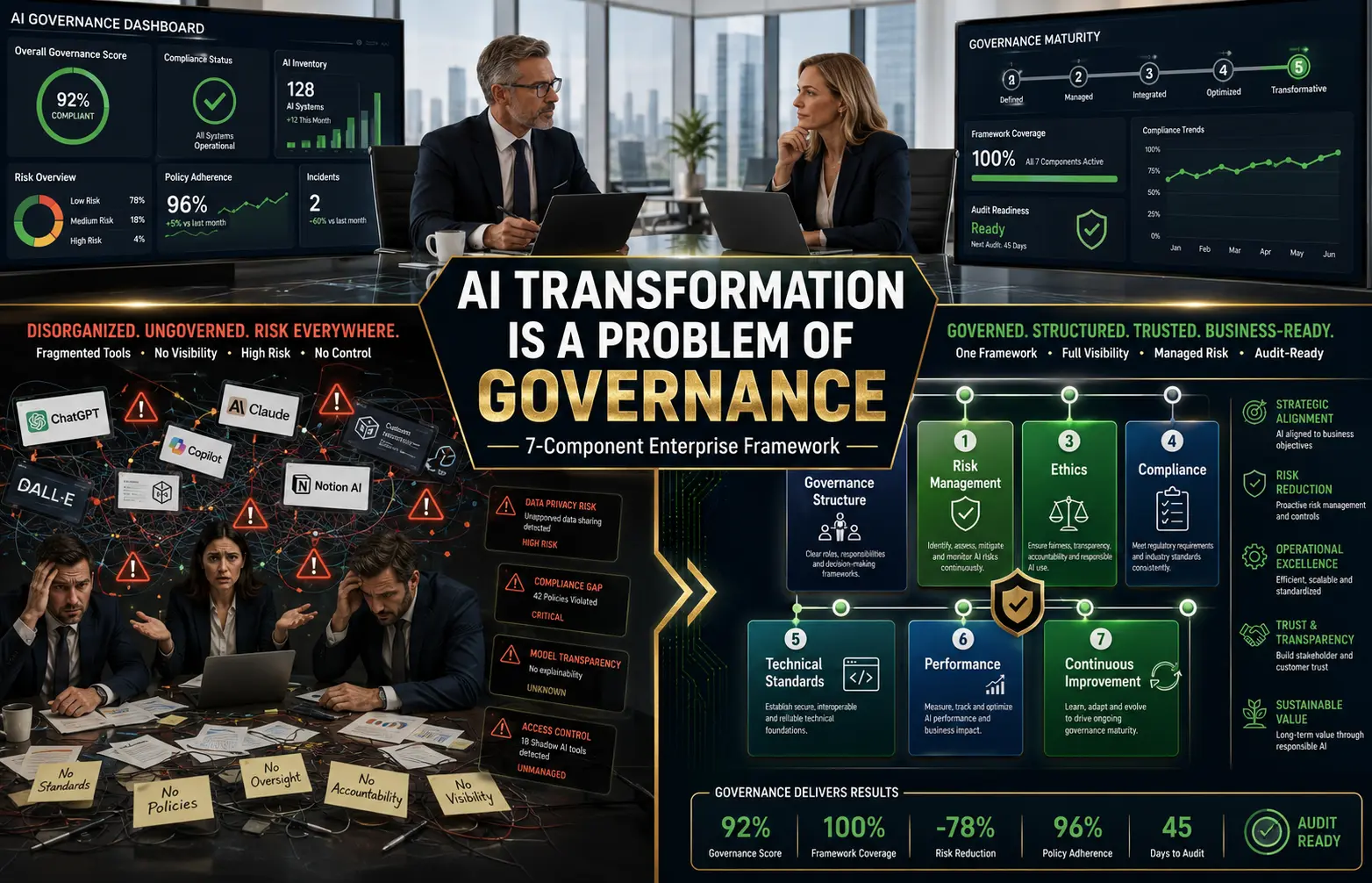
The Quick Answer: Focus on Governance, Not Just Technology
AI transformation is a problem of governance, not a technology problem. When 73 percent of AI deployments fail to deliver promised return on investment, the underlying cause is rarely poor algorithms. It is governance failure. When organizations lack clear ownership, risk frameworks, compliance processes, and measurement systems, AI becomes a source of risk instead of value. The solution is implementing proper governance structures before, during, and after AI deployment.
Why People Say AI Transformation Is a Problem of Governance

You hear it in boardrooms across the country. “AI transformation is a problem of governance.” But what does that really mean?
Here is the reality: companies have more AI capability than they have ever had. The algorithms work. The infrastructure exists. Cloud computing is cheap. Data is abundant. Yet most organizations still struggle to extract real value from their AI investments.
The difference is not the technology. The difference is governance.
A company can have the smartest data scientists and the most sophisticated AI models, but without clear governance structures, it still fails. Teams deploy AI systems without asking who owns them. Departments build competing tools without coordination. Data flows through systems without proper controls. Risk accumulates in silence until a public failure forces action.
This is why experts keep saying the same thing: AI transformation is a problem of governance.
It is not about whether you can build an AI system. It is about whether you can govern it responsibly once it exists.
What It Means When AI Transformation Is a Problem of Governance
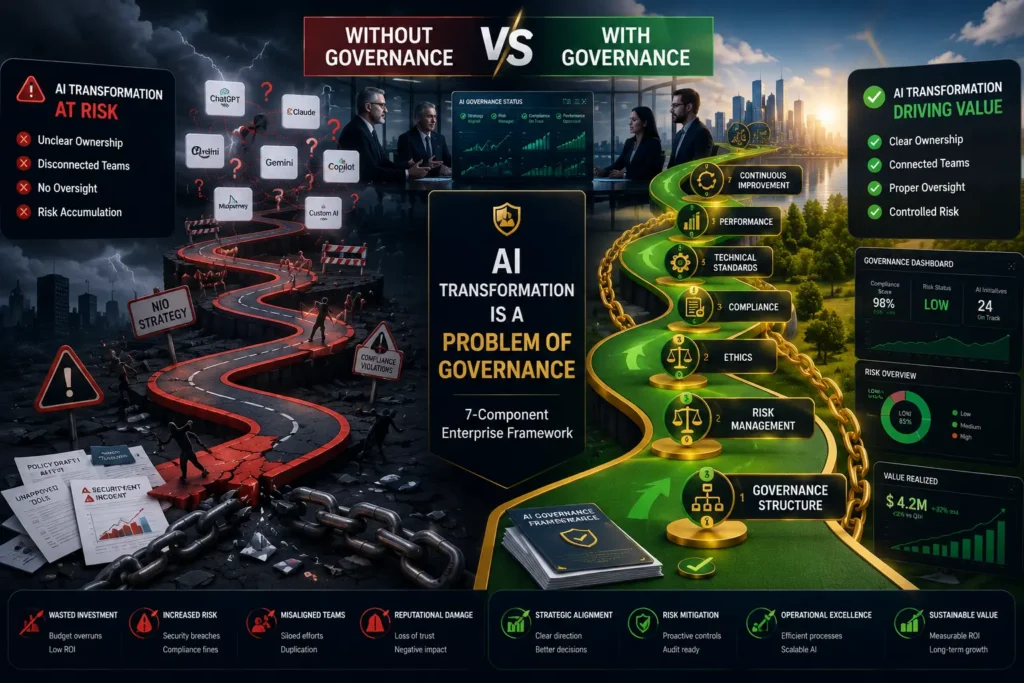
AI transformation being a governance problem means several specific things.
First, it means the issue is not technical. Organizations do not fail at AI because they lack powerful algorithms or computing infrastructure. They fail because they lack clear decision structures, risk management processes, ethical frameworks, and accountability mechanisms.
Second, it means governance is not optional. You cannot build a strong AI practice without governance any more than you can build a strong organization without financial controls, legal compliance, or risk management.
Third, it means governance must be built into AI adoption from day one, not added as an afterthought when problems emerge.
When organizations understand that AI transformation is a problem of governance, they stop treating governance as a compliance checklist. They start treating it as the operating system for how the organization manages AI throughout its lifecycle.
A bank that understands AI transformation is a governance problem requires fairness testing and regulatory documentation before deploying a credit model. A healthcare organization that understands this requires human oversight and safety controls before using AI in clinical workflows. An HR department that understands this requires bias testing and transparency about hiring algorithms.
These organizations move faster with AI, not slower. Why? Because they know the rules. They catch problems early. They prevent expensive failures.
The Five Failure Patterns That Prove AI Transformation Is a Governance Problem
Understanding why AI transformation fails helps you prevent failure.
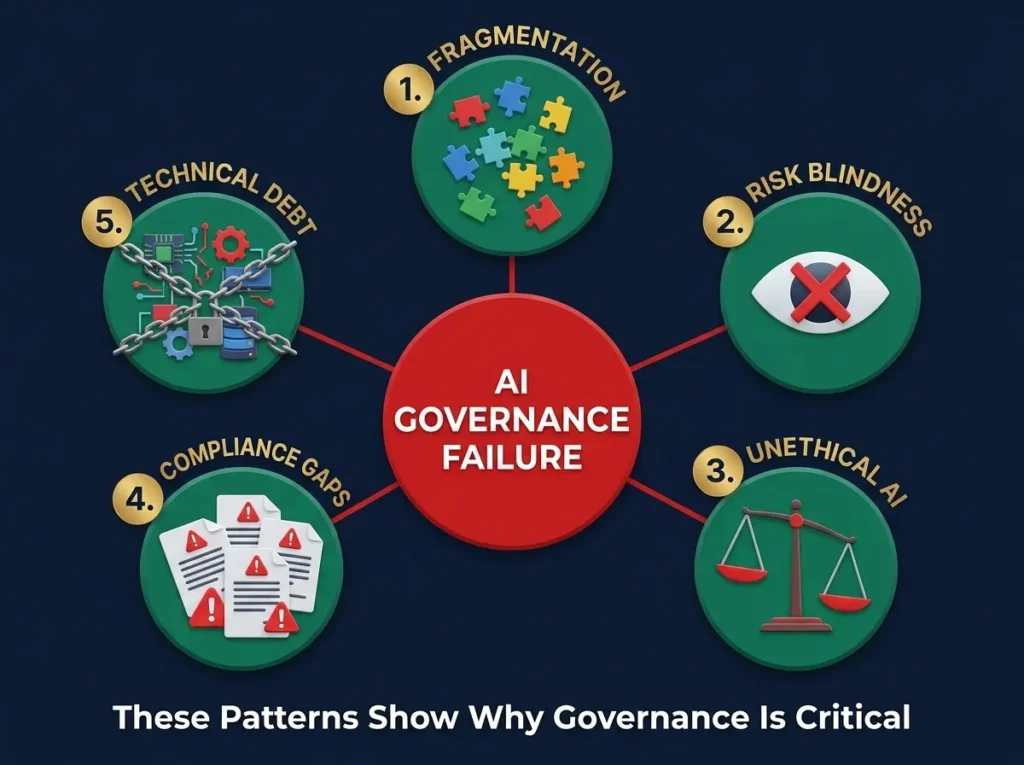
Pattern One: Fragmentation Without Clear Ownership
When there is no governance, ownership becomes unclear.
Marketing launches an AI chatbot. Customer service chooses a different platform. HR tests a resume screening tool. Finance implements forecasting software. Product adds AI to customer features.
Each department thinks they are solving a local problem. None of them realizes they are creating organizational chaos.
Without ownership, accountability disappears. When the HR AI system discriminates against protected groups, who is responsible? When the finance model produces incorrect forecasts, who is accountable? When customer data gets exposed through a vendor AI tool, who owns the consequence?
Clear governance creates clear ownership. Low-risk tools can be approved quickly. High-risk systems require proper oversight.
Pattern Two: Risk Blindness
Many AI deployments fail because organizations never ask “What could go wrong?”
Risk assessment should happen before deployment, not after public failure.
A bank deploying an AI credit model needs fairness testing to ensure decisions are not discriminatory. It needs documentation to prove compliance. It needs audit trails to explain decisions to regulators.
A healthcare organization deploying AI for diagnosis needs safety controls to prevent patient harm. It needs human oversight to maintain clinical judgment. It needs privacy protections to comply with HIPAA.
An HR team deploying AI for hiring needs bias testing to prevent discrimination. It needs transparency about how decisions are made. It needs human authority to override algorithms when appropriate.
Organizations that skip risk assessment deploy AI systems that look efficient but create serious harm. Discriminatory hiring algorithms. Credit systems that unfairly reject protected groups. Customer service bots that give offensive responses. Medical AI that performs poorly on certain populations.
The costs are real: regulatory fines, lawsuits, brand damage, employee departures, customer loss.
Pattern Three: Unethical AI Systems
AI can be technically possible but ethically questionable.
An AI system might monitor employees too aggressively. A hiring tool might reject candidates based on patterns that reflect historical bias. A credit system might discriminate based on zip code. A recommendation system might amplify harmful content. A sales AI might manipulate vulnerable customers.
Without an ethical framework, employees are left to make difficult decisions alone. Different teams reach different conclusions. Inconsistent approaches create risk.
Governance should define ethical principles before deployment. These principles should cover fairness, transparency, privacy, accountability, human oversight, safety, and respect for users.
Ethical failure becomes legal failure. It becomes brand failure. It becomes employee trust failure.
Pattern Four: Compliance Gaps and Regulatory Exposure
Regulation is catching up with AI fast.
The EU AI Act imposes requirements for high-risk systems. GDPR mandates data privacy. CCPA requires transparency. SEC rules cover AI in financial decisions. HIPAA applies to AI in healthcare. Employment law restricts AI in hiring.
A company that does not map regulatory requirements early creates expensive problems later. Regulatory fines average $5 million to $50 million. Litigation averages $2 million to $10 million. Brand valuation impact reaches 5 to 15 percent.
Compliance does not mean every AI idea gets blocked. It means the organization knows which rules apply and designs controls before deployment.
Pattern Five: Technical Debt and Poor Integration
AI systems generate technical debt quickly when governance is absent.
A data science team builds a model using messy data, and it gets deployed. Later, data quality changes. The model degrades. Nobody monitors it. The organization discovers six months later that outputs are wrong.
A department uses a vendor AI tool without understanding security implications. The vendor has a breach. The company’s data is exposed.
A team creates workflows that depend on one data pipeline. When it breaks, the AI breaks. There is no contingency plan.
Technical debt accumulates. The organization has spent millions on AI systems that are fragile, inefficient, and poorly integrated.
Governance prevents this by including technical standards. These standards define approved architectures, data quality rules, security requirements, integration patterns, and monitoring.
Why Your Organization Probably Treats AI Transformation as a Technology Problem (When It Is a Governance Problem)
Here is the typical pattern.
Leadership becomes excited about AI. They hire a chief data scientist or chief AI officer. They invest in computing infrastructure. They fund data science teams.
These are all good investments. But they treat AI as a technology problem.
The real problem emerges later when the organization has multiple AI initiatives across departments. Different teams use different tools. Inconsistent standards create security gaps. Risk accumulates. Compliance gaps emerge. Data flows uncontrolled. Nobody is accountable when systems fail.
Only then does the organization realize: AI transformation is a governance problem, not a technology problem.
By then, they are fixing problems instead of preventing them. They are spending millions on remediation instead of thousands on prevention.
The organizations that win with AI are the ones that understand from the start that governance is not optional. Governance is the foundation.
The Governance Framework That Works
Successful organizations use a seven-component framework.
Component One: Governance Structure
Every AI system needs an owner.
A practical governance structure defines decision authority:
Low-risk tools (internal helpers, productivity tools) need basic governance checklist approval from department leadership.
Medium-risk tools (customer-facing chatbots, marketing automation) need compliance review, security review, and bias testing.
High-risk systems (hiring decisions, credit decisions, healthcare decisions, safety-critical systems) need governance committee approval, legal review, ethics review, detailed testing, documentation, and monitoring.
This risk-based approach gives teams flexibility while maintaining control where it matters.
Component Two: Risk Assessment Framework
Every AI deployment needs documented risk assessment.
Risk assessment answers: What could go wrong? What is the probability? What is the impact? Who is affected? What regulations apply? What data is involved? Are there fairness concerns?
Organizations that ask these questions before deployment catch problems early. Organizations that deploy first and ask questions later face expensive remediation.
Component Three: Ethical Review Process
Ethics must be built into the AI lifecycle from the beginning.
An ethical review should ask: Is this system fair? Can outcomes be explained? Are there transparency requirements? Is human oversight maintained? Does it respect privacy? Could it discriminate?
For high-risk systems, formal ethics review is essential. For low-risk internal tools, a simple ethics checklist may be sufficient.
The key is that ethical review happens before deployment, not after public failure.
Component Four: Data Governance
AI systems are only as good as their data.
Data governance asks: Where does data come from? Who owns it? Is it clean? Is it representative? Could it contain bias? Who has access? How is it secured? How long is it retained?
Messy data creates messy AI. Biased data creates biased AI. Insecure data creates vulnerable AI.
Component Five: Compliance and Documentation
High-risk AI systems need documentation that proves compliance.
Documentation should include: use case description, regulatory requirements, risk assessment, testing results, bias testing, fairness metrics, data sources, vendor information, approval chain, monitoring plan, and incident response procedures.
This documentation helps teams understand systems, proves compliance to regulators, and creates accountability.
Organizations that properly document AI systems can integrate them into complete workflow automation. Our guide to generative AI workflows shows how governance-managed AI systems can be embedded into enterprise workflows while maintaining compliance and control.
Component Six: Performance Monitoring
AI systems do not stay static.
Monitoring tracks model performance, detects drift, identifies bias emergence, and alerts to problems before they impact users.
Unmonitored AI is unmanaged AI.
Component Seven: Accountability and Escalation
Someone must be responsible when AI systems fail.
Accountability structures define who owns each system, who investigates problems, who decides about pausing or modifying systems, and who communicates with affected parties.
Clear accountability reduces blame shifting and speeds resolution.
How Organization Size Affects Governance Approach
One-size-fits-all governance does not work.
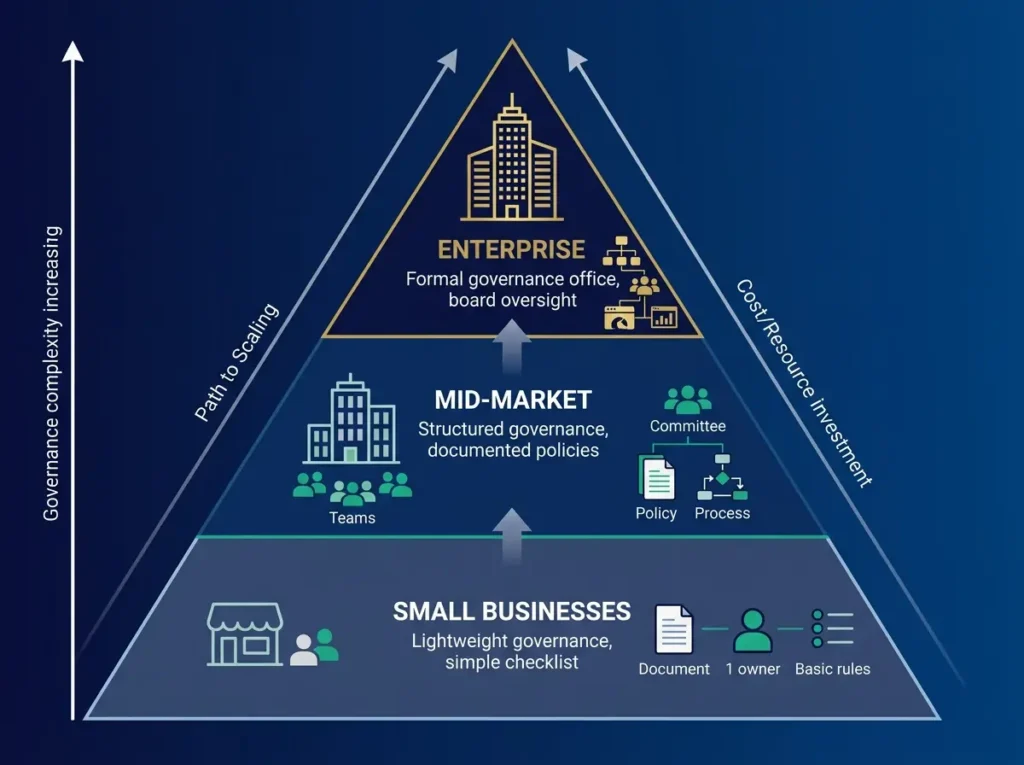
Small Businesses and Startups
Small companies need lightweight governance:
Approved AI tools list Data privacy rules Human review before publishing No confidential customer data in public AI tools Simple risk checklist Basic documentation Clear owner for each decision Monthly review meeting
Mid-Market Companies
Mid-market organizations need more structure:
Cross-functional governance committee Documented AI policies Vendor review process Risk assessment template Approved tool registry Data governance rules Compliance checklist Quarterly review meetings Incident escalation process Training program
Mid-market companies often use AI tools for marketing, content creation, and performance analysis. When these tools are used across departments, governance becomes critical. Our guide on AI tools for affiliate marketing shows how to evaluate and select marketing AI tools within a proper governance framework.
Enterprise Organizations
Enterprises need formal governance:
Chief AI officer or responsible AI office Board-level oversight Enterprise AI standards Central vendor management Data governance integration Risk-based approval processes Model inventory and monitoring Formal compliance reporting Annual governance assessment
The Five-Phase Implementation Roadmap
Organizations that implement governance successfully follow a structured roadmap.
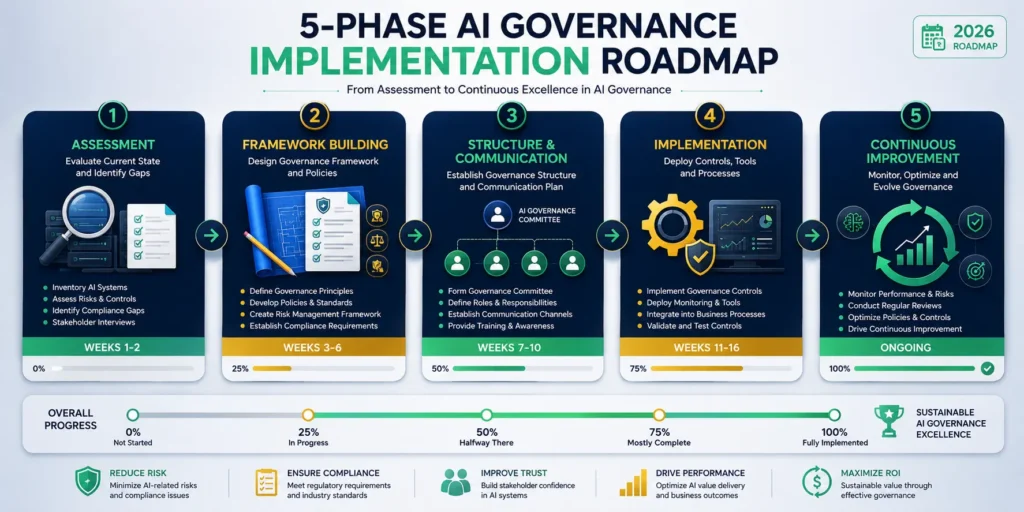
Phase One: Assessment (Weeks 1 to 2)
Understand what is already happening.
Create an AI inventory of all tools and systems in use. Interview department leaders. Map data flows. Identify regulatory requirements. Assess security and compliance gaps. Understand baseline metrics.
The goal is to answer: where is the organization exposed?
Phase Two: Framework Building (Weeks 3 to 6)
Draft governance documents.
Create AI usage policy. Draft risk assessment template. Document approval process. Define compliance requirements. Create data governance rules. Draft ethical guidelines.
Keep the first version practical. A useful framework that teams will follow beats a perfect document nobody reads.
Phase Three: Structure and Communication (Weeks 7 to 10)
Establish governance roles and communicate the strategy.
Create AI governance committee. Assign decision makers. Form ethics review team. Name system owners. Launch internal communication campaign.
Leadership must signal that governance is strategic, not punitive.
Phase Four: Implementation (Weeks 11 to 16)
Apply governance to real systems.
Review existing AI tools and decide which can continue. Apply governance to new initiatives. Complete documentation. Set up monitoring. Create audit trails. Begin training.
This is where governance becomes real, not theoretical.
Phase Five: Continuous Improvement (Ongoing)
Governance improves over time.
Track governance KPIs. Review major decisions quarterly. Update policies annually. Monitor regulations. Train continuously. Benchmark against peers.
The best governance programs learn and improve.
Real-World Examples: When AI Transformation Is a Governance Problem and How to Fix It
Example One: Hospital System Builds Confidence Through Governance
A hospital system wants to use AI across clinical departments. Different departments begin testing tools independently. Leadership worries about patient safety, HIPAA exposure, vendor risk, and inconsistent review.
The organization creates an AI governance committee with clinical leaders, IT, legal, compliance, privacy, cybersecurity, and patient safety representatives.
This cross-functional governance approach applies across industries. In HR departments, similar governance structures ensure hiring AI systems are fair and compliant. Our comprehensive guide on AI tools for HR professionals demonstrates how governance frameworks apply to HR technology decisions.
Before any AI system goes live, it must pass clinical risk review, data privacy review, vendor security review, human oversight definition, bias and performance testing, documentation review, and monitoring plan approval.
The result is not slower deployment. It is more confident deployment. Teams know the rules. Vendors know requirements. Clinicians understand when AI assists and when human judgment is required.
Example Two: Financial Institution Learns From Failure
A financial services company deploys an AI model for loan application prioritization without testing for fairness. After complaints, the organization discovers the model produces discriminatory outcomes.
The company faces regulatory investigation, significant fines, public backlash, and an 18-month halt on AI projects.
After this failure, the company rebuilds governance with formal fairness testing, independent validation, regulatory documentation, and board-level reporting.
The lesson: in finance, speed without governance becomes expensive.
Example Three: Software Company Scales Safely With Risk-Based Governance
A software company has many teams building AI features. Engineers want speed. Legal and security teams worry about risk.
Instead of forcing every project through slow custom review, the company creates a risk-based governance accelerator.
Low-risk internal tools follow a lightweight checklist. Medium-risk tools use standard templates and review gates. High-risk customer-facing AI requires full review, testing, legal approval, and monitoring.
This allows low-risk innovation to move quickly while serious risks receive proper attention.
Governance becomes an enabler instead of a bottleneck.
Real-world examples demonstrate this principle. Real estate organizations that implement governance around marketing automation tools see significant ROI improvements. Our guide to automated real estate marketing shows how governance frameworks enable organizations to confidently deploy complex automation systems across workflows.
Common Governance Mistakes to Avoid
Mistake One: Governance Theater
Creating a committee that cannot actually block deployments.
Teams deploy without approval. Risk reviews become optional. Documentation is incomplete. Leadership ignores warnings.
Solution: Give governance real authority.
Mistake Two: Technology-First Governance
Focusing only on technical controls while ignoring business impact, ethics, user trust, legal exposure, and human consequences.
Solution: Balance technical, legal, ethical, business, and operational review.
Mistake Three: Governance That Kills Innovation
Governance so strict that teams cannot move quickly or experiment.
Solution: Use risk-based governance. Low-risk projects move fast. High-risk systems get rigorous review.
Mistake Four: Inconsistent Application
Governance rules applied to some teams but not others.
Solution: Apply governance consistently across departments and use cases.
Mistake Five: One-Time Implementation
Setting up governance once, then neglecting it.
Regulations evolve. Tools change. Models drift. New vendors appear. Business risks shift.
Solution: Review quarterly. Update annually. Adjust faster when risks emerge.
Mistake Six: Top-Down Only
Governance imposed without input from implementation teams.
Solution: Build governance collaboratively. Teams that help create governance actually follow it.
Mistake Seven: No Enforcement
Policies exist but violations have no consequences.
Solution: Define escalation rules and enforce them consistently.
Tools and Technologies That Support Governance
As AI use grows, governance tools become valuable.
Organizations need specialized tools to implement and manage governance at scale. Our detailed article on AI governance tools reviews specific platforms available in 2026, comparing capabilities, costs, and best-use scenarios to help you select the right governance infrastructure.
Governance Platforms
Tools like Alteryx Governance, H2O Governance, DataRobot Governance, and others manage policies, approvals, documentation, risk assessment, model inventories, and audit trails.
Cost: $50,000 to $500,000+ annually. Best for: Mid-market and enterprise organizations.
(For a comprehensive review of available tools, see our article on AI governance tools, which details specific platforms, capabilities, and pricing.)
Risk Assessment Tools
Tools for AI risk identification and scoring.
Cost: Free to $200,000+ depending on scope. Best for: Any organization deploying AI.
Compliance Management Tools
Tools for tracking regulatory requirements and proving compliance.
Cost: $50,000 to $500,000+ annually. Best for: Regulated industries and enterprises.
Model Monitoring Tools
Tools for monitoring deployed models and detecting drift, bias changes, and performance degradation.
Cost: $20,000 to $300,000+ annually. Best for: Organizations with deployed machine learning systems.
The Business Case for AI Governance
Leaders sometimes see governance as overhead. That is too narrow.
AI governance is an investment in safer, faster, more valuable AI adoption.
Without governance, companies risk regulatory fines, lawsuits, failed projects, technical debt, customer distrust, security incidents, employee resistance, and wasted spending.
With governance, companies deploy AI with more confidence.
Quantifiable Benefits
Organizations with governance deploy AI 30 to 40 percent faster because teams know the approval path.
This speed advantage also applies to business use cases. Organizations that implement governance frameworks around revenue-generating AI can deploy faster while maintaining compliance. Our guide to AI tools for making money shows how proper governance enables organizations to select and implement AI tools for business outcomes more efficiently.
Governance reduces rework by 50 to 70 percent because problems are caught early.
Governance improves model quality by 20 to 30 percent because testing is standardized.
Governance enables scaling because standards are documented and repeatable.
Avoided Costs
Regulatory fines for non-compliant AI: $5 million to $50 million Litigation from AI-caused harm: $2 million to $10 million Brand valuation impact from ethical failure: 5 to 15 percent Failed AI projects in organizations without governance: 30 to 50 percent of AI spending
If governance prevents one major compliance failure, the savings exceed $20 million. The ROI becomes obvious.
Building a Culture Where AI Transformation Is Governed Responsibly
Governance frameworks are important, but culture matters more.
If leadership signals that governance is bureaucratic, teams will work around it. If leadership signals that responsible AI is strategic, teams will embrace it.
Building governance culture requires:
Clear executive communication about why governance matters Training so employees understand requirements Psychological safety so people can raise concerns Recognition when teams implement governance well Easy escalation paths for questions Transparent communication about governance decisions External credibility by publishing your governance approach
When governance is part of the culture, it becomes natural. Teams do not see it as overhead. They see it as the foundation for sustainable AI adoption.
Future of AI Governance: What Is Coming in 2026 and Beyond
The governance landscape is changing.
Board-level AI oversight will become standard. Boards are expected to understand AI risk, strategy, compliance, and accountability.
AI auditing will become common. Organizations will need to prove that AI systems are tested, monitored, documented, and governed.
Industry-specific standards will develop. Financial services, healthcare, HR, insurance, legal, government, and education will face specific governance expectations.
Industry-specific governance is already emerging. Real estate, for example, must govern how AI chatbots and conversational tools interact with customers in high-value transactions. Our article on conversational AI tools for real estate agents demonstrates industry-specific governance considerations in practice.
Third-party AI risk will increase. Companies using vendor AI tools need vendor agreements, audit rights, and security controls.
Governance automation will expand. As AI adoption grows, manual governance becomes difficult. Organizations will use automated tools, model inventories, monitoring platforms, and compliance dashboards.
Human oversight will remain critical. Even as AI improves, human oversight remains essential for high-impact decisions.
Organizations that build strong governance now will be positioned to navigate this changing landscape.
Organizations that skip governance today will face expensive remediation later.
FAQ: Common Questions About AI Governance
Why do people say AI transformation is a problem of governance?
Because 73 percent of AI deployments fail due to governance failures, not technical failures. Organizations lack clear ownership, risk management, compliance processes, and measurement systems.
Does every company need AI governance?
Yes, but the level depends on size and risk. A small company needs lightweight governance. An enterprise needs formal governance. The key is having some governance rather than no governance.
Does governance slow down AI adoption?
Poor governance slows innovation. Good governance speeds it up by giving teams clear rules, fast approval for low-risk projects, and confidence to deploy responsibly.
How is AI governance different from traditional IT governance?
Traditional IT governance focuses on processes, access controls, and compliance. AI governance addresses AI-specific risks like bias, fairness, explainability, model drift, and unintended consequences at scale.
Who should lead AI governance?
A cross-functional team including business, legal, compliance, security, data, and operations. Leadership may come from a Chief AI Officer, risk leader, technology leader, or responsible AI office.
What is the difference between governance and compliance?
Compliance means meeting legal requirements. Governance is broader. It includes compliance, plus ethics, strategy, risk management, accountability, technical standards, measurement, and culture.
How much does AI governance cost?
Small companies can implement governance with internal effort. Enterprises may spend $500,000 to $2 million annually on infrastructure. Compare that to the cost of failed AI projects, regulatory fines, and reputation damage.
Can small companies implement AI governance?
Yes. Small companies should use lightweight governance with simple policies, basic risk assessment, clear ownership, and regular review. Complexity is not required.
What documents are most important for governance?
AI usage policy, risk assessment template, AI system inventory, vendor review checklist, data governance rules, ethical guidelines, incident response process, and monitoring plan.
How often should governance be updated?
Quarterly reviews and annual full updates. Update faster when regulations change, new vendors emerge, or new risks appear.
Conclusion
When experts say AI transformation is a problem of governance, they are describing a fundamental truth.
Technology is not the constraint. Algorithms work. Infrastructure exists. Data is available.
The constraint is governance. Clear ownership. Risk management. Ethical frameworks. Compliance processes. Performance measurement. Accountability.
Organizations that understand that AI transformation is a problem of governance stop building random experiments. They start building controlled transformation.
They move faster because they know the rules. They catch problems early. They prevent expensive failures. They build trust with customers, employees, and regulators.
Start now.
Create an AI inventory. Identify high-risk use cases. Assign ownership. Build a governance committee. Draft practical policies. Train teams. Add monitoring. Review progress regularly.
The organizations that succeed with AI will not be the ones that adopt AI fastest. They will be the ones that adopt AI responsibly, measure it clearly, and govern it well.
Responsible AI governance is not just a compliance requirement. It is becoming a competitive advantage.








Leave a Reply