
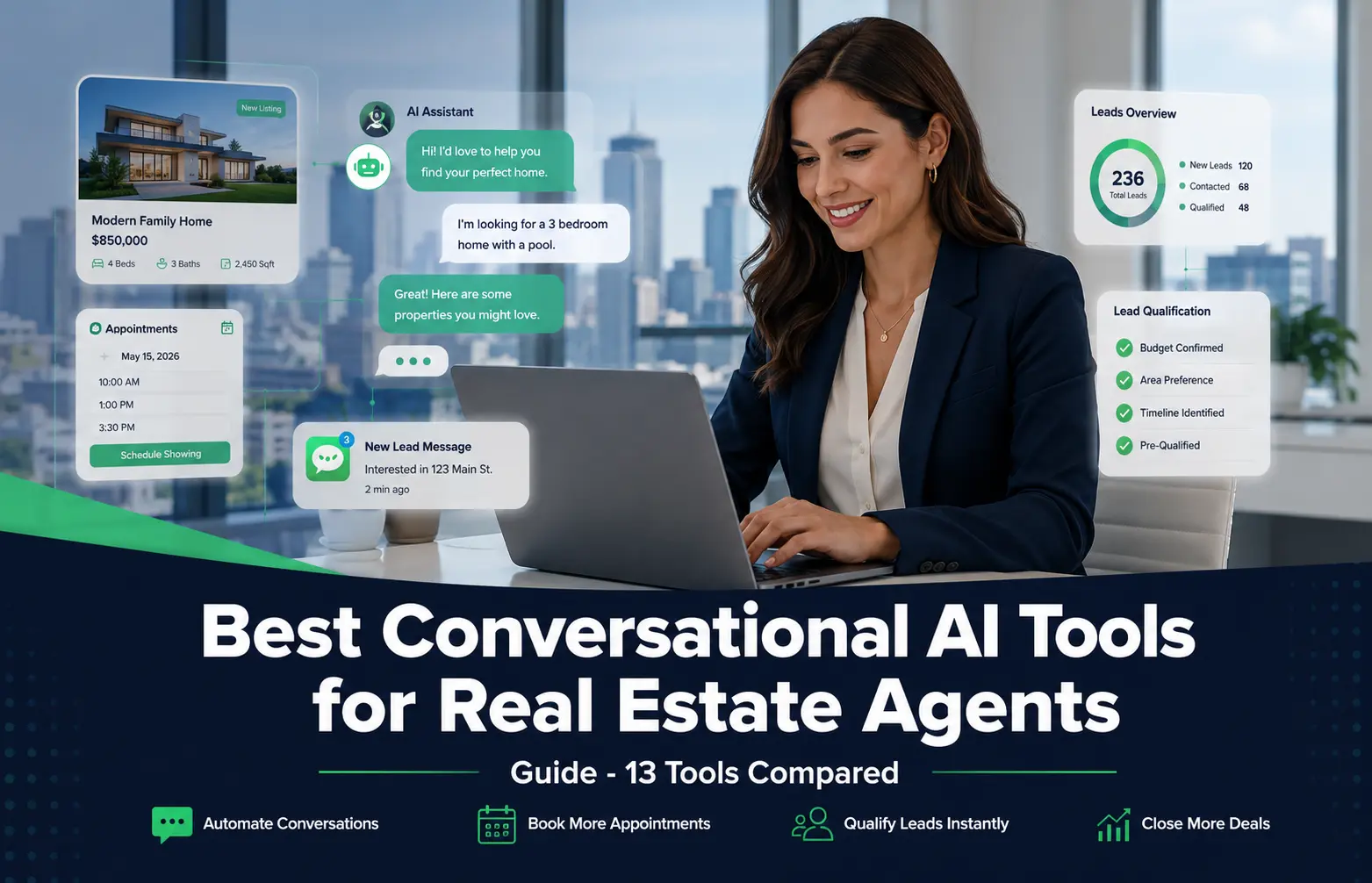
Real estate is a relationship business, but most agents are buried in admin work before they ever get to the relationship part.
A buyer sends a property inquiry at 10:30 p.m. You’re in a showing. A seller fills out a valuation form while you’re on another call. A renter asks the same three questions about availability, pet policy, and move-in date for the tenth time this week. A warm lead replies after two weeks, but the message gets lost between calls, texts, emails, and CRM reminders.
This is why conversational AI for real estate is becoming one of the most practical technology trends for agents, teams, brokers, and property managers in 2026.
The problem is not that real estate agents don’t want to follow up. The problem is that manual follow-up is hard to maintain consistently. Real estate professionals are expected to respond fast, qualify leads, schedule showings, answer listing questions, nurture old contacts, manage open houses, update CRM records, and still spend time face-to-face with clients. That’s an impossible workload for any one person.
Real estate conversational AI tools help solve this problem by automating the early parts of communication. They can respond to new leads instantly, ask qualification questions, send reminders, route leads to the right agent, answer common property questions, book appointments, summarize conversations, and keep leads warm until a human agent steps in.
The goal is not to replace agents. A buyer still needs trust. A seller still wants a confident advisor. A client still needs local market knowledge, negotiation skill, and human judgment. But conversational AI chatbots for real estate agents can reduce repetitive work so agents can spend more time on real conversations that actually close deals.
This guide compares 13 conversational AI tools for real estate professionals in 2026. You’ll see what each tool does, who it’s best for, key features, pricing, pros, cons, and realistic use cases.
You’ll also get a decision framework to help you choose, a comparison table, pricing breakdown, ROI examples from actual real estate scenarios, common mistakes to avoid, and a 30-day implementation roadmap.
By the end, you should know exactly which real estate conversational AI tool fits your situation, whether you’re a solo agent handling a few leads daily, a team leader managing multiple agents, a broker overseeing dozens of salespeople, or a property manager handling hundreds of inquiries.
Why Real Estate Professionals Are Adopting Conversational AI in 2026
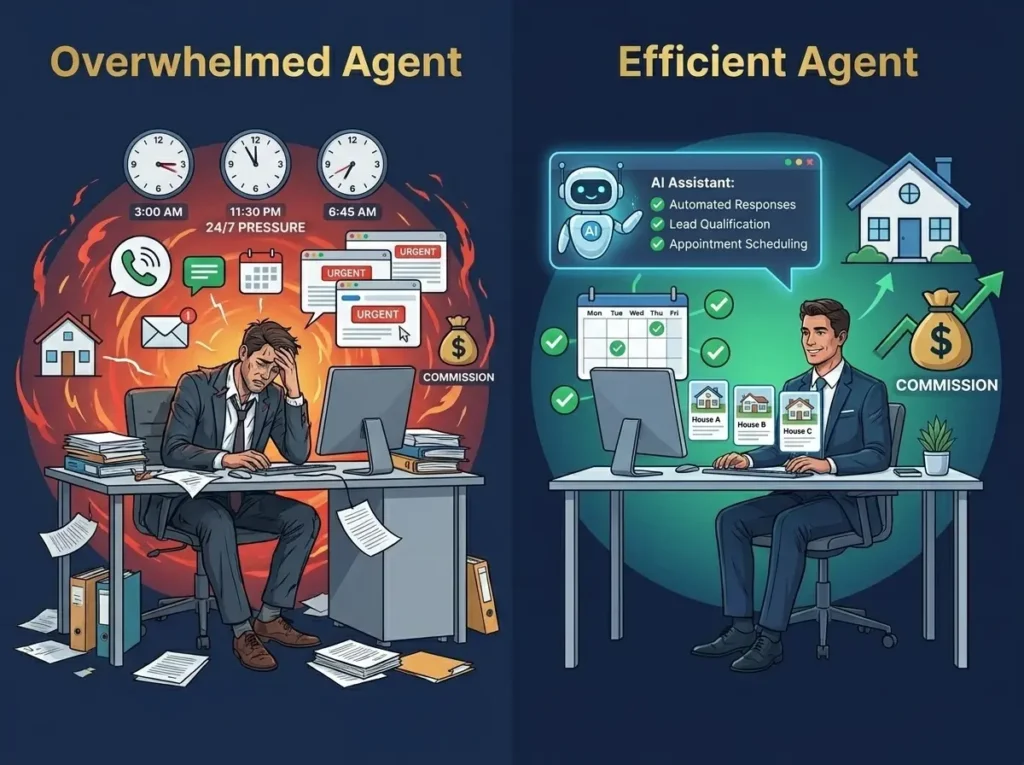
Real estate leads have a short attention span, and that’s the core reason AI adoption is accelerating.
When someone asks about a property online, they’re usually not waiting patiently for one specific agent. They may have submitted the same inquiry on Zillow, Realtor.com, a brokerage website, Facebook, Google, or a listing portal. The agent who responds first often gets the best chance to start the conversation. This isn’t opinion, this is how the market works.
Lead response time matters more in real estate than in almost any other business. A slow reply can turn an expensive lead into a lost opportunity. A quick reply doesn’t guarantee a deal, but it keeps the conversation alive. This is one of the main reasons agents are adopting conversational AI for real estate lead generation and follow-up.
The second reason is availability. Most agents cannot personally answer every lead 24 hours a day, 7 days a week. Buyers search at night. Sellers fill forms on weekends. Investors message during lunch breaks. Renters ask questions after office hours. A 24/7 real estate support chatbot can handle the first response immediately and collect useful information before the agent takes over.
The third reason is qualification. Not every lead is ready to buy or sell. Some are browsing casually. Some are already working with another agent. Some aren’t financially ready. Some want a showing tomorrow. Conversational AI for real estate lead qualification can ask simple questions about timeline, budget, location, financing, selling status, and preferred appointment time. This saves agents from wasting time on window shoppers.
The fourth reason is follow-up consistency. Many real estate agents lose leads not because the lead was bad, but because the follow-up system was weak. AI follow-up automation can send reminders, check in after a showing, ask if the buyer wants similar homes, or re-engage old database contacts. This consistency alone can recover 15 to 30 percent of lost leads.
This is why real estate teams are adopting broader conversational AI workflows. Our complete guide to generative AI workflows covers how automation extends beyond lead response to property management, email sequences, document generation, and entire business process optimization. When you combine conversational AI with broader workflow automation, you can recover 20-30 hours per week across your entire operation.
The fifth reason is team management. Brokers and team leaders need visibility. They want to know which agents respond fast, which leads are being ignored, which sources produce appointments, and where opportunities are slipping through cracks. Real estate CRM automation and conversation analytics can help teams manage leads more intelligently than individual agent best efforts.
Conversational AI is not a magic solution. If your listings are weak, pricing is wrong, or your service is poor, AI can’t fix that. But if your main bottleneck is response time, lead qualification, scheduling, or follow-up consistency, real estate AI chatbots can create a real operational advantage that translates to closed deals.
Decision Framework: Choosing the Right Conversational AI for Real Estate
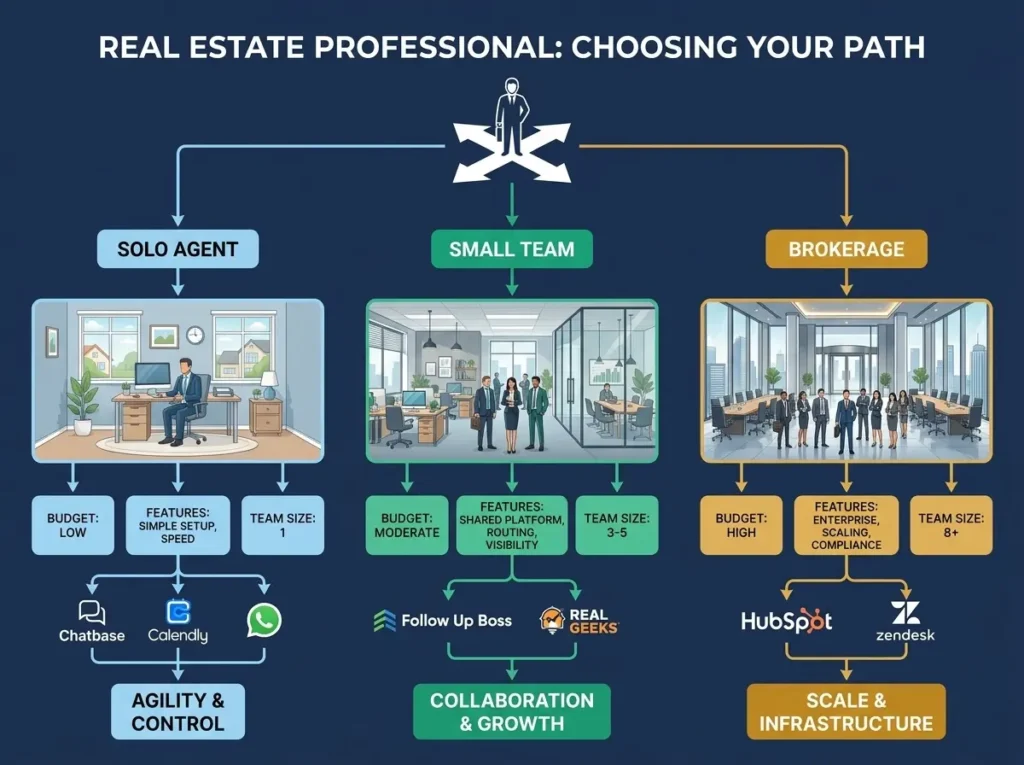
Before choosing a tool, start with your actual situation. This matters more than any feature list.
A solo agent does not need the same system as a fifty-agent brokerage. A property manager handling rental inquiries does not need the same workflow as a luxury listing agent. A broker managing Zillow leads needs different automation than an investor working off-market seller leads.
Ask yourself these questions honestly before you evaluate any conversational AI real estate solution.
Are you a solo agent, small team, or brokerage?
Solo agents usually need speed and simplicity. They need automated lead response, appointment scheduling, SMS follow-up, and CRM reminders that don’t require a tech team to set up.
Small teams need lead routing, follow-up accountability, pipeline visibility, and shared CRM workflows so every agent knows what the others are doing.
Brokerages need standardization, reporting, integrations, agent adoption support, compliance controls, and scalable automation that works across multiple locations or office styles.
What do you want to automate first?
Do not automate everything on day one. Start with your biggest pain point. That’s where you’ll see ROI fastest.
Common real estate automation goals include lead response automation, real estate lead qualification, follow-up automation, showing scheduling, open house follow-up, buyer inquiry response, seller inquiry response, CRM updates, lead routing, text message follow-up, website chatbot conversations, and property management inquiries.
Pick one. Master it. Then add the next.
Do you need CRM integration?
If your AI tool doesn’t connect with your CRM, your team may end up copying data manually. That defeats the entire purpose of automation.
Look for real estate CRM integration with tools like Follow Up Boss, Real Geeks, HubSpot, Salesforce, Pipedrive, Gmail, Outlook, Calendly, Zapier, Make, or native real estate platforms.
What’s your realistic budget?
Free and low-cost tools can work for testing. A solo agent may start with Chatbase, Calendly, WhatsApp Business, or ChatGPT-based workflows costing nothing or under fifty dollars monthly. A serious team may need Follow Up Boss, Structurely, HubSpot, Real Geeks, or Zendesk at higher price points.
To explore more budget-friendly options beyond just lead qualification, check out our guide on free AI tools for marketing. Many of these same tools support real estate marketing, lead capture, email automation, and content creation for listings. Understanding the broader free AI ecosystem helps you build a complete stack without large upfront investment.
Know your budget before you start. This eliminates half your options immediately.
How technical are you?
If you’re not technical, choose tools with templates and support. If you’re comfortable with automation, a ChatGPT or Claude workflow with Zapier, Make, or n8n can become very powerful.
Do you need compliance control?
Real estate communication involves fair housing rules, privacy requirements, advertising regulations, local rules, texting concerns, and client trust. AI should support communication, not make risky claims or discriminatory decisions.
The best conversational AI tool is the one that fits your workflow, integrates with your systems, and keeps humans involved where judgment matters most.
The 13 Best Conversational AI Tools for Real Estate
1. Paradym: Listing Marketing and Property Storytelling

Paradym is a real estate marketing platform built around property storytelling, visual tours, listing promotion, and marketing automation. It’s not a pure conversational AI chatbot in the same way Structurely or Chatbase is, but it can support agent communication by creating listing-focused digital experiences and lead response opportunities.
For agents who rely on property tours, visual marketing, and listing promotion, Paradym can help create a more organized marketing system. The conversational AI angle comes when agents combine Paradym’s property marketing assets with automated lead capture, text response, email follow-up, or CRM workflows.
Best for: Solo agents and brokers who want listing marketing, visual tours, and automated property promotion.
Key features: Property tour creation, listing marketing assets, social media promotion support, real estate storytelling tools, lead capture opportunities, and marketing automation support.
Pricing: Paradym generally uses demo or quote-based pricing, so check the official site for current rates.
Pros: Strong real estate focus, useful for listing promotion, good for visual property marketing, helps agents create better property presentation assets.
Cons: Not a dedicated AI lead qualification chatbot, may need another tool for SMS and scheduling, better for marketing than conversation management.
Verdict: Paradym is best for agents who want listing marketing automation and visual property storytelling. If your main need is a real estate chatbot for lead qualification, pair it with a CRM or AI conversation tool.
2. Zillow Premier Agent: Leading with Marketplace Integration
Zillow Premier Agent is one of the biggest lead generation ecosystems for U.S. real estate agents. It connects agents with buyers and sellers through Zillow’s marketplace. It is not a standalone conversational AI tool, but it matters because many real estate conversations start with Zillow leads.
For agents who already buy Zillow leads, conversational AI becomes valuable when connected to lead response workflows. The goal is simple. When a lead comes from Zillow, it should be captured, routed, followed up, and tracked quickly.
Best for: Agents and teams already using Zillow as a primary lead source.
Key features: Buyer and seller lead connections, calls and emails, tours and lead inquiries, Zillow profile visibility, integration potential with CRM systems.
Pricing: Zillow Premier Agent pricing depends on market, competition, and advertising spend.
Pros: Major source of buyer and seller inquiries, strong brand recognition with consumers, useful for agents who want paid lead flow, can support high-intent conversations when followed up properly.
Cons: Not itself a real estate AI chatbot, lead costs can vary widely, requires strong follow-up system to avoid waste.
Verdict: Zillow Premier Agent is best treated as a lead source, not a complete conversational AI solution. If you use Zillow, connect it with a CRM and AI follow-up workflow.
3. Follow Up Boss: The Real Estate CRM Standard
Follow Up Boss is one of the most popular real estate CRM platforms for agents and teams. It is built to capture leads, organize contacts, track communication, automate follow-up, and help teams manage pipeline activity.
For conversational AI real estate workflows, Follow Up Boss matters because it becomes the central operating system. Leads from websites, Zillow, Realtor.com, Facebook, Google, and other sources can flow into the CRM. From there, agents can use automations, smart messages, communication history, reporting, and integrations.
Best for: Real estate teams, brokers, and serious solo agents who need lead management and CRM automation.
Key features: Real estate CRM, lead routing, follow-up automation, email and text workflows, calling and communication history, reporting and accountability, integration ecosystem.
Pricing: Plans generally start around entry-level monthly pricing for solo or small teams, with higher plans for larger teams.
Pros: Built specifically for real estate, strong lead management workflow, good for teams and brokerages, works with many real estate lead sources.
Cons: Not the cheapest option for beginners, AI features may vary by plan, requires consistent team usage to get value.
Verdict: Follow Up Boss is one of the best real estate CRM automation platforms for teams that want faster follow-up, better accountability, and a central place to manage conversations across all lead sources.
4. Real Geeks: All-in-One Real Estate Platform
Real Geeks is an all-in-one real estate platform that combines IDX websites, lead generation, CRM, marketing tools, and AI follow-up features through its broader ecosystem.
It is useful for agents and teams who want website, lead capture, CRM, and follow-up in one connected system. Instead of stitching together a website builder, CRM, lead form, and chatbot separately, Real Geeks provides a real estate-specific platform built for how agents actually work.
Best for: Agents and teams that want a website plus CRM plus lead management system in one place.
Key features: IDX website tools, lead capture, real estate CRM, AI follow-up support, marketing automation, buyer and seller lead workflows, property search experience.
Pricing: Real Geeks often uses quote-based or plan-based pricing, so verify current plans directly.
Pros: Real estate-specific platform, combines website and CRM needs, useful for buyer lead generation, good fit for agents who want one connected system.
Cons: May be more expensive than simple chatbot tools, less flexible than building a custom stack, can be too much for agents who only need basic automation.
Verdict: Real Geeks is a strong option if you want a full real estate lead generation and CRM platform, not just a chatbot.
5. Loom: Video Communication for Trust
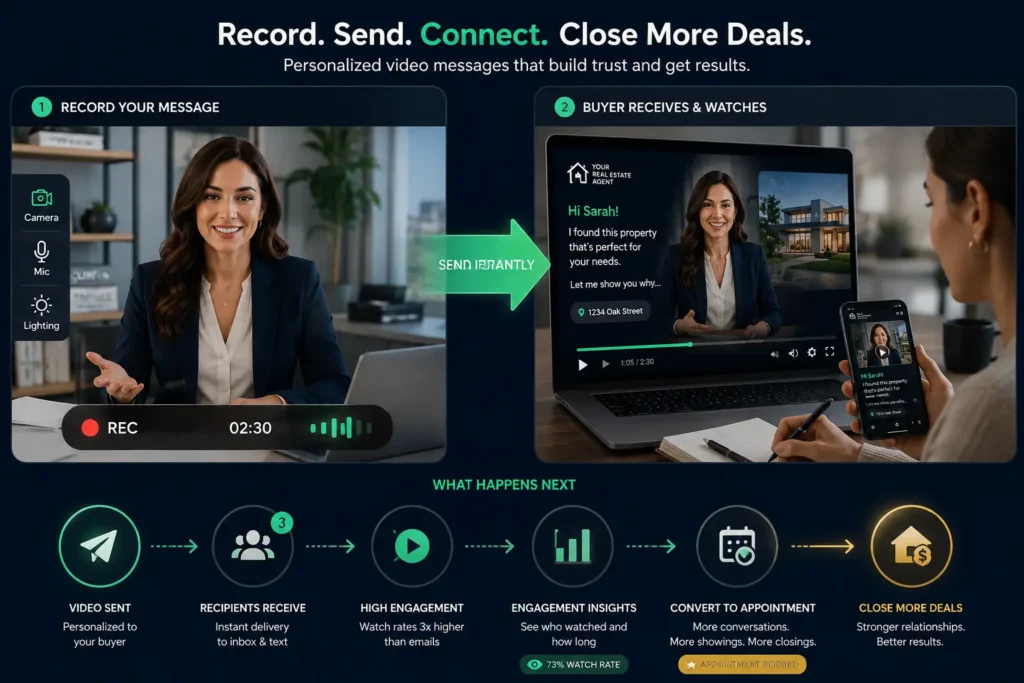
Loom is not a real estate chatbot, but it deserves a place in this conversation because video is becoming a major part of client communication. A buyer may not always want another text. A seller may appreciate a short personalized video explaining pricing strategy. A remote client may need a quick walkthrough of a document, map, or listing comparison.
Loom helps agents record quick screen and camera videos. When combined with AI summaries, CRM notes, email automation, and follow-up tools, it becomes a useful conversational layer that builds trust.
Best for: Agents who want async video communication, walkthroughs, tutorials, and personalized client updates.
Key features: Screen recording, camera recording, video sharing, transcripts and summaries, client walkthroughs, internal team updates.
Pricing: Loom has free and paid plans depending on recording limits, features, and team needs.
Pros: Very easy to use, great for explaining listings and offers, useful for remote buyers and sellers, adds a human touch to automated workflows.
Cons: Not a chatbot, doesn’t qualify leads automatically, needs another tool for CRM and scheduling automation.
Verdict: Loom is best as a supporting communication tool. Use it when a real estate conversation needs trust, clarity, and personal explanation.
6. Zendesk: Enterprise Support Operations
Zendesk is a customer service platform with AI agents, support ticketing, automation, messaging, routing, and knowledge base tools. It’s not built only for real estate, but it can work well for larger brokerages, property management firms, real estate marketplaces, and agencies handling many inquiries.
For real estate, Zendesk can help manage property inquiries, rental questions, maintenance requests, buyer questions, seller inquiries, and support tickets across different channels all in one place.
Best for: Brokerages, property management companies, and real estate businesses with support teams.
Key features: AI agents, ticketing system, messaging support, email and chat automation, knowledge base, customer context, routing and analytics.
Pricing: Zendesk has per-agent pricing and AI agent usage options depending on plan and outcomes.
Pros: Strong customer support platform, good for high-volume inquiries, useful for property management, scalable for larger teams.
Cons: Not real estate-specific, may require setup and customization, too advanced for many solo agents.
Verdict: Zendesk is best for real estate companies that treat inquiries like customer service operations and need structured support workflows.
7. Drift: Website Conversion Chatbot
Drift is a conversational marketing and website chat platform focused on converting website visitors into pipeline. For real estate agents, teams, and brokerages with strong website traffic, Drift can help qualify visitors, start conversations, and route leads.
It is especially useful if your website already receives traffic from SEO, ads, listing pages, or paid campaigns. A Drift-style chatbot can greet visitors, ask what they’re looking for, capture contact information, and route serious prospects to an agent.
Best for: Real estate websites, brokerages, developers, and agencies with meaningful inbound traffic.
Key features: Website chat, lead qualification, conversation routing, AI chat assistance, meeting booking, sales pipeline support, CRM integration.
Pricing: Drift is usually positioned for business and enterprise teams, so pricing may be higher than beginner tools.
Pros: Strong for website lead capture, good for qualification and routing, useful for inbound marketing teams, works well for business-style real estate services.
Cons: Not real estate-specific, may be expensive for small agents, needs strong website traffic to justify cost.
Verdict: Drift is best for real estate companies with active website traffic and a need for conversational lead qualification at scale.
8. HubSpot: Full Marketing Automation Ecosystem
HubSpot is a full CRM, marketing, sales, service, and automation platform. Its AI tools make it useful for real estate teams that want more than a chatbot. HubSpot can support lead capture, CRM workflows, email automation, prospecting, customer service, landing pages, content, and reporting.
For real estate brokers and agencies, HubSpot works well when the business is more than one agent managing personal contacts. It can organize buyer leads, seller leads, investor leads, developer inquiries, rental inquiries, and long-term nurture campaigns.
Best for: Real estate teams, agencies, brokerages, and companies needing full marketing automation.
Key features: CRM, AI agents, email automation, lead scoring, pipeline tracking, landing pages, forms, customer service tools, reporting dashboards.
Pricing: HubSpot has free tools, Starter plans, and higher professional or enterprise plans. AI agent usage may run on credits depending on product.
Pros: Full marketing and CRM ecosystem, scales from small teams to larger companies, strong automation options, good reporting and pipeline visibility.
Cons: Can become expensive as needs grow, not real estate-specific by default, requires setup discipline to use properly.
Verdict: HubSpot is best for real estate businesses that want a complete CRM and marketing automation system with AI support.
9. WhatsApp Business and SMS Automation: Mobile First
Many real estate conversations happen through mobile messaging. Buyers want quick replies. Sellers want updates. Tenants ask about availability. Agents coordinate showings, documents, and reminders through text. WhatsApp Business, SMS tools, and CRM-connected messaging workflows can support this communication effectively.
Best for: Agents who rely heavily on mobile communication, WhatsApp, SMS, and quick follow-up.
Key features: Business messaging, quick replies, labels and organization, catalog or profile information, automated greetings and away messages, CRM or automation integrations through third-party tools.
Pricing: WhatsApp Business app is free to download; advanced API and automation costs depend on provider.
Pros: Familiar communication channel, useful for fast lead response, good for international and mobile-first clients, easy for solo agents to start.
Cons: Not a full AI chatbot by itself, advanced automation needs integrations, compliance and consent matter for messaging.
Verdict: WhatsApp Business and SMS automation are best for agents who want fast mobile-first communication. Pair them with CRM automation or AI response workflows for stronger results.
10. Structurely: The AI Lead Qualification Specialist
Structurely is one of the most direct conversational AI tools for real estate lead qualification. It focuses on AI conversations across call, text, and email to engage leads, qualify them, and keep follow-up moving forward.
For agents and teams who struggle with lead response and qualification, Structurely can act like an AI inside sales assistant. It can ask questions, identify intent, follow up repeatedly, and transfer qualified leads to humans.
Best for: Lead qualification, real estate follow-up automation, and inside sales workflows.
Key features: AI lead qualification, voice AI, text follow-up, email follow-up, appointment setting, live transfers, CRM integrations, lead nurturing.
Pricing: Structurely uses usage-based pricing and sales-led plans, so verify current pricing directly.
Pros: Strong real estate and sales focus, built for qualification and follow-up, useful for teams with many inbound leads, can reduce manual lead nurturing.
Cons: May be more than a solo agent needs, requires careful conversation setup, AI should not fully replace human judgment.
Verdict: Structurely is one of the best conversational AI tools for real estate lead qualification and follow-up automation.
11. Chatbase: Custom AI Chatbot Builder
Chatbase is a custom AI chatbot builder that lets users create AI agents trained on website content, documents, FAQs, and knowledge bases. It’s not real estate-specific, but it can be a low-cost way to add a real estate chatbot to your website.
A real estate agent could train Chatbase on FAQs, neighborhoods, buying process, selling process, rental policies, property inquiry steps, and service pages. The chatbot can then answer common questions and capture leads.
Best for: Agents, small brokerages, and property managers who want a custom website chatbot.
Key features: Custom AI agents, website chatbot, knowledge base training, lead capture, embeddable chat widget, free plan with limits, paid plans for higher usage.
Pricing: Chatbase offers a free plan with message and agent limits, plus paid plans for more usage.
Pros: Affordable starting point, easy to test, can be trained on your own content, good for website FAQs and lead capture.
Cons: Not built specifically for real estate, needs strong source content to answer accurately, may require integrations for CRM and scheduling.
Verdict: Chatbase is a strong budget-friendly option for agents who want a custom AI chatbot without buying a large real estate platform.
12. Calendly: Scheduling Automation Made Simple
Calendly is not a full conversational AI platform, but it’s one of the most useful scheduling automation tools for real estate agents. With routing forms, qualification questions, calendar integrations, and booking rules, it can help agents reduce back-and-forth scheduling.
For real estate, Calendly can be used to qualify and schedule buyer consultations, seller valuation calls, rental tours, investor calls, open house follow-ups, and team meetings.
Best for: Scheduling automation, buyer consultation booking, and seller appointment booking.
Key features: Booking links, routing forms, qualification questions, calendar integration, team scheduling, automated reminders, CRM and marketing integrations.
Pricing: Calendly offers free and paid plans. Advanced routing and team features usually require paid access.
Pros: Very easy to use, saves time on scheduling, works well with lead forms, good for solo agents and teams.
Cons: Not a chatbot, doesn’t replace follow-up automation, needs another tool for AI conversation and CRM management.
Verdict: Calendly is best for scheduling automation. Combine it with Structurely, HubSpot, Follow Up Boss, Chatbase, or WhatsApp automation for a complete workflow.
13. ChatGPT or Claude With Integrations: Custom Automation
ChatGPT and Claude are flexible AI assistants that can become powerful real estate automation tools when connected with the right workflow. On their own, they’re not real estate CRMs. But when paired with Zapier, Make, n8n, Google Sheets, Airtable, Gmail, Calendly, HubSpot, or a real estate CRM, they can support custom conversational AI workflows.
This option is best for technical agents, agencies, brokers, and marketers who want more control over their workflows.
Many of the conversational AI startups listed in our guide to generative AI startups started exactly this way: entrepreneurs built custom solutions by combining ChatGPT or Claude with Zapier, then turned them into dedicated products. If your brokerage is building a competitive advantage through specialized workflows, understanding the startup landscape helps identify which emerging tools might eventually serve your specific needs.
Best for: Custom real estate AI workflows, content, lead qualification, emails, scripts, summaries, and automation.
Key features: Lead qualification prompts, email and SMS draft generation, CRM note summaries, listing description support, client FAQ generation, conversation summaries, follow-up templates, integration through automation platforms.
Pricing: ChatGPT and Claude both offer free and paid plans. Integration costs depend on tools used.
Pros: Very flexible, affordable starting point, great for custom workflows, useful beyond chatbots including marketing and admin.
Cons: Requires setup and testing, not a ready-made real estate CRM, needs compliance and human review.
Verdict: ChatGPT or Claude with integrations is best if you want a custom conversational AI real estate workflow and have the skill or support to build it properly.
Feature Comparison Table for Real Estate Professionals
| Tool | Best For | Lead Qualification | Follow-Up Automation | Scheduling | CRM Integration | Price Range |
|---|---|---|---|---|---|---|
| Paradym | Listing marketing | Limited | Marketing automation | No focus | Via workflow | Quote-based |
| Zillow | Paid leads | No | Via CRM | Tour requests | Works with CRM | Market-based |
| Follow Up Boss | Real estate CRM | Yes | Strong | With integrations | Strong native | Entry tier up |
| Real Geeks | Website/CRM | Yes | Strong | Some integrations | Built-in CRM | Quote/plan |
| Loom | Video communication | No | No | No | Manual integration | Free/paid |
| Zendesk | Support operations | Some | Strong | With integrations | Strong | Per-agent |
| Drift | Website chat | Strong | Some | Yes | Strong | Business/enterprise |
| HubSpot | Full automation | Strong | Strong | Strong | Native CRM | Free to enterprise |
| WhatsApp/SMS | Mobile follow-up | Basic to strong | Strong with tools | Via links | Via third-party | Free/paid |
| Structurely | Lead qualification | Very strong | Very strong | Strong | Strong | Usage-based |
| Chatbase | Website chatbot | Basic to medium | Limited | Via integrations | Via integrations | Free/paid |
| Calendly | Scheduling | Basic | Reminders | Very strong | Strong | Free/paid |
| ChatGPT/Claude | Custom workflows | Custom | Custom | Custom | Custom | Free/paid |
Real Estate Conversational AI Use Cases and Realistic ROI
Conversational AI for real estate works best when it solves a specific operational problem. Below are realistic example scenarios from actual real estate professionals.
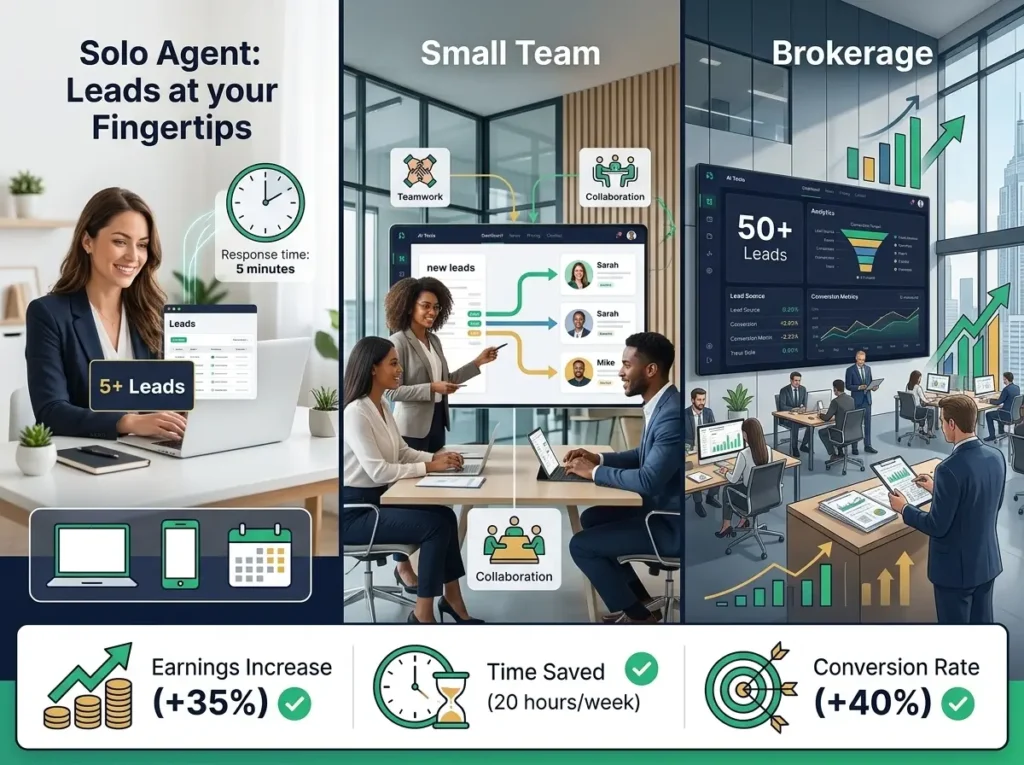
Scenario 1: Solo Agent Handling 1 to 2 Leads Per Day
Problem: A solo agent receives leads from Zillow, Facebook, Google, referrals, and website forms. Some leads arrive during showings or late at night. The agent often replies several hours later, losing the lead to a faster agent.
Suggested stack: WhatsApp Business or SMS automation, Calendly for appointment booking, Chatbase for website FAQ, ChatGPT or Claude for follow-up templates.
Workflow: A lead comes in. The system sends an instant response. The chatbot asks whether the buyer is looking to buy, sell, rent, or invest. If the lead wants a showing, Calendly offers available times. The agent gets a summary before calling back.
Potential impact: Faster first response (within minutes instead of hours), less manual scheduling, better lead organization, more consistent follow-up across all leads.
Expected results: Response time improves from 4-8 hours to under 5 minutes. Lead-to-appointment rate increases 20-30 percent.
Solo agents using conversational AI as income automation are essentially leveraging AI to multiply their earning potential. Instead of trading hours for dollars, they’re using chatbots to capture more leads and qualify them while they sleep. Our broader guide to AI tools for making money shows how conversational AI for real estate is just one example of this leverage strategy used across different industries and professions.
Scenario 2: Small Team With 5 to 10 Agents
Problem: Leads are coming in, but follow-up quality depends on the agent. Some agents respond fast. Others forget. Team leaders don’t know which leads are being ignored or slipping through.
Suggested stack: Follow Up Boss, Structurely, Calendly, WhatsApp/SMS integration, basic reporting.
Workflow: All leads flow into Follow Up Boss. Structurely starts qualification and follow-up automatically. Qualified leads are routed to the right agent based on specialty or availability. Calendly handles appointment scheduling. Team leaders track response rates and follow-up completion daily.
Smart teams also monitor where leads come from using AI search monitoring. Understanding which search keywords or which lead sources produce the highest-quality conversations helps you refine your conversational AI strategy. Our guide on why you should use AI search monitoring tools explains how data about search patterns informs whether your conversational AI should emphasize buyer qualification versus seller qualification.
This same approach is used by affiliate marketers and business opportunity promoters who need to qualify high-intent leads. Real estate agents with affiliate partnerships (recommending mortgage companies, home inspectors, insurance providers) can use conversational AI to pre-qualify affiliate opportunity recipients. Our guide to AI tools for affiliate marketing shows how conversations can identify which referral partners fit each lead, dramatically improving affiliate commission rates.
Potential impact: More consistent lead handling, fewer leads slipping through, better agent accountability, cleaner CRM data, visibility into which agents are performing.
Expected results: Team closes 20-40 percent more deals from same lead volume. Admin time per agent reduces 10-15 hours per week.
Scenario 3: Brokerage With 50+ Agents
Problem: A brokerage needs standardization. Leads come from multiple sources. Agents use different follow-up styles. Management needs reporting, routing, and compliance-friendly communication across all agents.
Suggested stack: HubSpot or Follow Up Boss, Zendesk for support or property management workflows, Structurely for qualification, Calendly routing, custom ChatGPT/Claude workflows, reporting dashboard.
Workflow: All leads are captured, scored, routed, and tracked in one system. AI handles initial qualification and common questions. High-value inquiries go to experienced agents. Managers monitor lead source ROI, agent response time, and pipeline outcomes daily.
Potential impact: Standardized follow-up across all agents, better lead distribution, more visibility for brokers, reduced admin burden, improved team accountability, compliance with fair housing standards.
Expected results: Brokerage increases overall conversion rate 15-25 percent. Agent satisfaction improves due to better lead routing. Management gains real-time visibility into operations.
Pricing Breakdown and ROI Analysis for Real Estate Teams
Conversational AI pricing in real estate varies widely. Some tools are free or low-cost. Others are enterprise platforms. The right choice depends on lead volume, team size, and how much revenue one extra closed client is worth to you.
Free and Low-Cost Starting Options
Good for testing before investing:
Chatbase free plan, Calendly basic plan, WhatsApp Business app, ChatGPT or Claude free plans, Google Sheets and manual CRM workflows.
Best for: Solo agents, beginners, small property managers, and agents testing AI before investing large amounts.
Budget Options ($20-100/month)
Good for agents who want simple automation:
Chatbase paid plan, Calendly paid plans, basic website chatbot tools, light CRM automation, WhatsApp and SMS tools, entry-level AI assistant workflows.
Best for: Solo agents or small teams with low to moderate lead volume who are building their systems.
Mid-Range Options ($100-500/month)
Good for serious agents and growing teams:
Follow Up Boss entry or team plans, Real Geeks, HubSpot Starter or Professional depending on needs, Structurely for qualification, Drift or similar website chat tools.
Best for: Agents and teams where lead response and follow-up directly affect revenue and team performance.
Enterprise Options ($500+/month)
Good for brokerages, property management firms, and large teams:
HubSpot Professional or Enterprise, Zendesk Suite and AI agents, custom AI workflows, large CRM integrations, dedicated real estate automation setup, advanced reporting and compliance systems.
Large enterprise solutions increasingly rely on specialized AI hardware for processing conversational data at scale. If your brokerage is processing thousands of conversations daily, edge computing and optimized hardware infrastructure become cost factors. Our guide to AI hardware startups shows how organizations are optimizing infrastructure for conversational AI workloads, which impacts total cost of ownership for enterprise deployments.
Best for: Brokerages managing many agents, multiple offices, high lead volume, or support operations.
Simple ROI Formula
Monthly tool cost compared with hours saved plus additional converted leads.
Example: If a tool costs three hundred dollars per month and saves ten hours of admin work, that may already be valuable. If it also helps convert one additional client per quarter, the ROI could be much higher.
For agents tracking the financial impact of conversational AI implementation, using AI budgeting apps to log time savings and deal values helps quantify true ROI. Our guide to best AI budgeting apps includes tools that track business metrics alongside personal finance, helping you measure automation investment payoff month by month.
Track these metrics: First response time, lead-to-appointment rate, appointment-to-client rate, number of ignored leads, follow-up completion rate, agent adoption rate, cost per lead, cost per appointment, closed deals by lead source.
Common Mistakes When Implementing Conversational AI
Mistake 1: Buying a Tool Without Knowing Your Workflow
Many agents buy software because it sounds modern, then never use it properly. This is waste.
Better approach: Identify one workflow first. For example, respond to new buyer leads within five minutes, or qualify seller leads before booking calls.
Mistake 2: Not Connecting the Tool to Your CRM
If AI conversations don’t update your CRM, you create more manual work than you save.
Better approach: Choose tools with real estate CRM integration or use Zapier, Make, or native integrations to connect everything.
Mistake 3: Expecting AI to Do Everything
AI can respond, qualify, summarize, and schedule. It should not replace serious client advice, negotiation, pricing strategy, or legal judgment.
Better approach: Let AI handle early communication. Let agents handle high-value decisions and relationship building.
Mistake 4: Poor Qualification Questions
Bad questions create bad leads that waste agent time.
Better approach: Ask simple, useful questions about timeline, location, budget, financing, property type, and appointment preference.
Mistake 5: Not Training Agents
If agents don’t understand the system, they ignore AI-generated alerts and miss qualified leads.
Better approach: Train agents on how to read summaries, take over conversations, update status, and follow up properly.
The same training challenges real estate teams face mirror what large organizations experience with HR automation. If you’re managing a large brokerage with dozens of agents, you’re essentially running an HR operation. Our guide to best AI tools for HR professionals includes training management, change adoption, and organizational communication strategies that apply to real estate team onboarding with new AI systems.
Mistake 6: Ignoring Compliance
Real estate communication must be careful. AI should not make discriminatory comments, guarantee results, give legal advice, or mishandle private data.
Better approach: Review scripts, conversation flows, privacy practices, and fair housing compliance before launching.
Mistake 7: Not Measuring Results
Without metrics, you won’t know if the tool actually works.
Better approach: Track response time, appointments, conversions, and agent adoption weekly for at least 30 days.
30-Day Implementation Roadmap
Week 1: Assessment
Start by identifying your biggest communication bottleneck. Ask yourself: Are leads going unanswered? Are showings hard to schedule? Are old leads being ignored? Are agents inconsistent with follow-up? Are website visitors leaving without contacting you?
Choose two or three tools to test. Don’t buy a complex system immediately. Use free trials where possible and assign one person to manage the test.
If you’re rolling out conversational AI across your entire organization, having someone trained on AI product management helps. Our guide to AI courses for product managers covers how to evaluate tools, manage implementation timelines, and measure AI adoption success. Many brokers now have someone in this specialized role managing their AI tech stack.
Week 2: Integration
Connect the tool to your CRM, website form, calendar, or lead source. Create basic conversation flows for new buyer inquiry, new seller inquiry, rental inquiry, open house follow-up, appointment booking, general FAQ, and old lead reactivation.
Keep the questions simple. The goal is to start a useful conversation, not interrogate the lead.
Week 3: Optimization
Review real conversations from the first two weeks. Look for where leads drop off, which questions confuse people, which replies sound robotic, which leads need faster human takeover, which agent is not responding, and which lead source performs best.
Adjust the conversation flow. Add better FAQs. Improve routing rules. Train agents on how to take over quickly.
Week 4: Full Rollout
Roll out the workflow to all agents or all lead sources. Create simple rules about who gets each lead, when AI stops and human takes over, what counts as qualified, how fast agents should respond, and how often managers should review performance.
Plan phase two after the first month. This may include AI call summaries, database reactivation, property management chatbot workflows, or advanced reporting.
FAQ: Conversational AI for Real Estate
Will conversational AI replace real estate agents?
No. Conversational AI can handle first response, basic questions, qualification, scheduling, and follow-up reminders. It cannot replace local expertise, negotiation, pricing strategy, emotional judgment, or trust building that clients need.
What happens when a client wants a human agent?
A good AI workflow makes handoff easy. The system routes the lead to an agent, notifies the team, and provides a conversation summary so the agent can continue naturally without repeating questions.
Can real estate AI chatbots answer complex property questions?
They can answer common questions if trained properly, but complex questions should go to a human. Questions about legal terms, offers, disclosures, financing, inspections, or local regulations should be reviewed by an agent.
Is conversational AI safe for real estate compliance?
It can be safe when implemented carefully. Review scripts, avoid discriminatory language, protect personal data, follow advertising rules, and keep humans involved in important decisions.
What’s the best conversational AI for real estate lead qualification?
Structurely is one of the strongest dedicated options. Follow Up Boss, HubSpot, Real Geeks, and custom ChatGPT or Claude workflows can also support qualification depending on your setup.
What’s the best AI chatbot for a solo real estate agent?
For a solo agent, Chatbase, Calendly, WhatsApp Business, and ChatGPT or Claude workflows can be a practical starting point. If the agent has more lead volume, Follow Up Boss or Real Geeks may be better long-term.
What’s the best tool for real estate teams?
Follow Up Boss is strong for real estate teams because it’s designed around CRM, lead routing, follow-up, and accountability. Add Structurely for AI qualification and nurturing.
What’s best for a large real estate brokerage?
HubSpot, Follow Up Boss, Zendesk, Structurely, and custom integrations are better suited for brokerages because they support scalability, reporting, lead routing, and team workflows across multiple agents.
Can conversational AI integrate with my existing CRM?
Many tools integrate directly or through Zapier, Make, APIs, or native integrations. Before buying, confirm integration capability with your current CRM.
How long does it take to see ROI from conversational AI?
You may see time savings quickly, but revenue ROI can take longer. Track first response time, booked appointments, qualified leads, and lead source conversion for at least 30 to 90 days before deciding.
Is conversational AI cheaper than hiring an assistant?
It depends. AI can be cheaper for repetitive first responses and qualification, but a human assistant may still be better for complex client support, document coordination, and relationship building.
The Best Conversational AI Tool for Your Real Estate Business
The best tool depends entirely on your situation. There’s no one winner for everyone.
For solo agents, start simple. Chatbase, Calendly, WhatsApp Business, and ChatGPT or Claude can cover website questions, scheduling, and basic follow-up without large software budgets.
For real estate teams, Follow Up Boss is one of the strongest CRM-centered options because it helps manage lead flow, follow-up, routing, and agent accountability. Add Structurely if lead qualification is your biggest bottleneck.
For brokerages, HubSpot, Zendesk, Follow Up Boss, Structurely, and custom integrations make more sense because they support larger teams, reporting, and standardized workflows.
Larger real estate organizations often need to build custom conversational AI solutions tailored to their specific workflows. If your brokerage requires specialized automation, understanding AI in product development helps you brief technical teams on your requirements. Our guide on accelerating product development with AI shows how organizations scope, design, and deploy custom solutions faster and cheaper than traditional approaches.
For property marketing, Paradym and Real Geeks help create stronger listing presentation and lead capture systems.
For client explanation and video-based trust, Loom supports personalized communication that builds relationships.
For technical users, ChatGPT or Claude with Zapier, Make, n8n, Airtable, Google Sheets, and CRM integrations can create a highly customized real estate conversational AI workflow.
The smartest path is not to buy the most expensive system first. Start with the problem that costs you the most money: slow lead response, weak follow-up, poor scheduling, poor lead qualification, or messy CRM data.
Then choose the tool that solves that one problem best.
Conclusion: The Conversational AI Opportunity in Real Estate 2026
Conversational AI for real estate is becoming more important because modern clients expect fast, clear, and consistent communication.
A buyer doesn’t want to wait a day for a property answer. A seller doesn’t want to chase an agent for updates. A renter doesn’t want to call three times to confirm availability. A broker doesn’t want expensive leads disappearing because no one followed up.
The right AI tools can help agents and brokers respond faster, qualify leads, automate follow-up, schedule appointments, manage inquiries, and keep the CRM cleaner.
But AI should support the agent, not replace the agent. Real estate still depends on trust, local knowledge, negotiation, pricing judgment, and human connection.
Start small. Pick one workflow. Test one or two tools. Track response time, appointment rate, and lead quality. Improve the system before scaling.
This is why brokerages are hiring AI-focused roles. If you’re implementing conversational AI at scale, understanding market rates for AI product managers and automation specialists helps you build the right team. Our breakdown of AI product manager salaries shows that companies prioritizing AI automation now are willing to pay premium salaries for talent. Real estate firms that want to compete will need similar expertise.
The agents and brokers who win in 2026 will not be the ones using AI randomly. They will be the ones using conversational AI to remove repetitive work so they can spend more time doing what actually closes deals: talking to real people, solving real problems, and building real trust.
Building a complete real estate AI strategy means combining conversational chatbots with SEO-optimized content and search ranking tools. Your website needs to rank for real estate keywords to bring traffic. Your chatbots need to convert that traffic into conversations. Our guide to best AI search optimization tools shows how these strategies work together to create a complete lead generation flywheel.









Comments (2)
Automated Real Estate Marketing: 35+ Tools and Strategies to Close 40% More Deals in 2026says:
June 8, 2026 at 2:37 pm[…] real estate specifically, conversational AI takes automation further. Our article on conversational AI tools for real estate agents shows how agents are using AI chatbots to qualify leads even before email sequences […]
AI Business Solutions: 50+ Tools & ROI Strategies for 2026says:
June 15, 2026 at 5:33 pm[…] conversational AI tools are becomingpopular in specialized fields. For instance, our article on conversational AI for real estateagents shows how real estate professionals are using AI-powered chat to qualify serious buyersand schedule […]