

You spend an afternoon writing an article. You check the facts, add images, fix the formatting, and finally hit Publish.
Then comes the frustrating part.
You open Google Search Console, inspect the new URL, and discover that Google hasn’t indexed it yet.
You wait.
Maybe you request indexing. Maybe you check again the next morning. And perhaps you start wondering whether you’ve done something wrong.
Meanwhile, a popular discussion platform can publish thousands of new conversations in a single day. Some of those discussions cover breaking events, emerging products, or questions people are searching for right now.
How does Google keep up with all that fresh content?
A newly documented program offers part of the answer.
On October 8, 2026, Google added official documentation for its Google UGC Fresh Data Program, a specialized system that allows approved platforms to send fresh user-generated content and interaction signals through a dedicated data pipeline.
It sounds like an indexing shortcut. But there’s an important detail that many website owners could easily miss.
The program isn’t intended for ordinary blogs, company websites, or standard WordPress publishers.
It’s designed for large platforms built primarily around content created by their users.
So what exactly is Google offering, who qualifies, and what can smaller website owners do instead?
Let’s unpack the announcement without the usual instant-indexing hype.
What is Google’s UGC Fresh Data Program?
The UGC Fresh Data Program is a Google Search initiative designed to help eligible platforms share fresh, authentic user-generated content more efficiently.
UGC stands for user-generated content.
Think of forum discussions, social posts, and other material created by independent users rather than written by the company operating the platform.
According to Google’s official program documentation, approved platforms can submit fresh content and interaction signals through a dedicated ingestion pipeline.
In simpler terms, instead of waiting entirely for Google’s ordinary web-crawling process to discover every new conversation, a participating platform can proactively provide certain information about new posts.
The objective is to help Google process timely, firsthand content.
But two things need to be clear from the beginning.
First, Google must approve the platform before it can participate.
Second, sending content through the program does not guarantee that Google will show it in Search.
Those limitations are central to understanding what the program actually does.
Why Google is interested in fresh user discussions
Imagine a major software update is released.
Within minutes, users may begin discussing installation problems, new features, or unexpected changes.
A large forum might have dozens of relevant threads before a traditional technology publication has finished writing its article.
Those conversations can contain firsthand experiences that are useful to people searching for answers.
But they can also be messy.
Some posts are inaccurate. Some repeat the same information. Others contain spam, harassment, or misleading claims.
Google’s challenge is not simply to discover these conversations quickly. It also needs to decide which information is useful and appropriate to surface.
The UGC Fresh Data Program appears designed to help with the freshness and data-sharing side of that problem.
It should not be interpreted as Google’s endorsement of everything a participating platform publishes.
What changed on October 8, 2026?
Google’s Search Central documentation updates list October 8, 2026, as the date it added the UGC Fresh Data Program documentation.
That distinction matters.
The confirmed news is that Google publicly documented the program and its application requirements on that date.
It does not necessarily mean Google created the underlying technology on October 8 or began operating it for the first time that day.
Google’s documentation describes the program’s purpose, eligibility criteria, technical expectations, and application process.
It also makes clear that the system is separate from both the standard Google Indexing API and ordinary organic crawling.
For SEO professionals, that last point is particularly important.
The UGC Fresh Data Program is not simply a new name for an existing WordPress indexing tool.
It is a different program with a different intended audience.
How does the UGC Fresh Data Program work?
Google hasn’t publicly released every implementation detail.
Detailed technical documentation is provided to platforms accepted into the program.
However, the public documentation gives us enough information to understand the basic workflow.
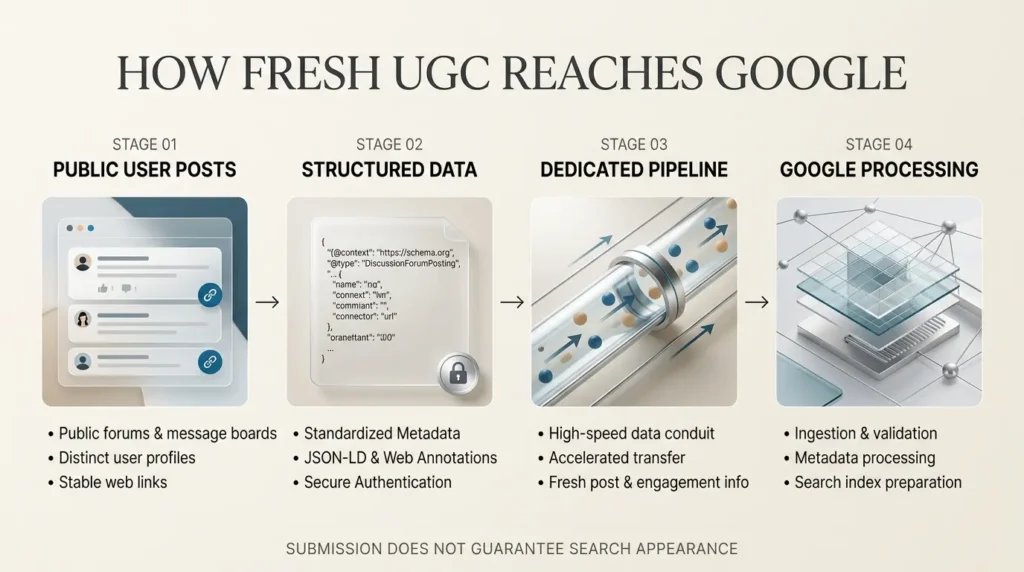
Step 1: A user publishes a new post
A person creates a discussion or social post on an eligible platform.
The post needs its own stable URL and must be publicly accessible.
A private message or content hidden behind a login would not meet the stated accessibility requirements.
Step 2: The platform prepares the content data
The platform needs the technical capability to construct validated JSON-LD payloads and use secure OAuth 2.0 authentication.
JSON-LD is a structured way of representing information.
OAuth 2.0 is an authorization framework commonly used to control access to APIs.
Google also expects appropriate structured data on the public pages themselves.
Step 3: Fresh content is submitted
Google says submitted content should be as fresh as possible, ideally arriving within minutes of publication.
That makes sense for rapidly changing discussions.
A conversation about a breaking technology issue may be most useful while people are actively searching for solutions.
Step 4: Engagement information is updated
The program also involves updates to engagement counters.
Google expects participating platforms to be able to submit relevant updates within 72 hours of content creation.
The documentation does not establish that more likes or replies automatically produce better rankings.
Engagement data is part of the information the program can receive; it is not a public ranking formula.
Step 5: Google processes the information
Google can use the submitted data within its Search systems.
But Google still determines what appears in Search.
Participation does not bypass Google’s broader evaluation processes or create a guaranteed ranking position.
Who is eligible for the UGC Fresh Data Program?
Google sets several requirements.
They are much more specific than simply owning a website that allows comments.
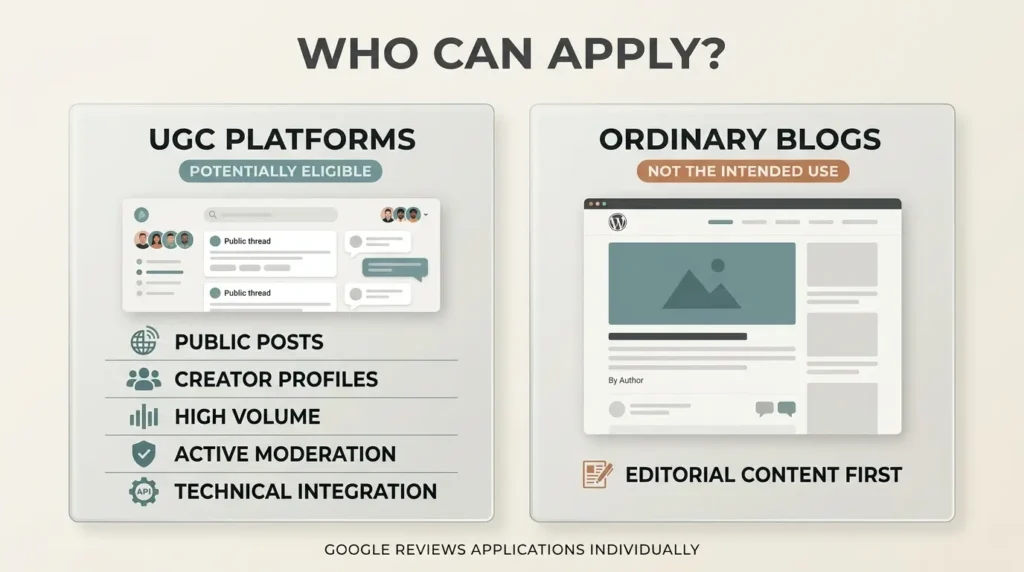
1. The platform must primarily host user-generated content
The core purpose of the website should be hosting material created by independent users.
Examples of potentially relevant platform types include:
- Large public discussion forums.
- Social posting platforms.
- Communities built around public user contributions.
- Other high-volume services where independent users create the main content.
These are examples of platform categories, not a list of automatically approved websites.
Google reviews applications individually.
2. It needs substantial content volume and an audience
Google requires a high volume of user-generated content and a significant user base.
Importantly, the public documentation does not specify a minimum number of users, daily posts, or monthly page views.
If someone claims that every website with 10,000 users automatically qualifies, that isn’t supported by Google’s published requirements.
Eligibility is based on Google’s review, not an invented traffic threshold.
3. Posts must have stable, public URLs
Google wants content hosted on dedicated pages with stable URLs.
The documentation specifically distinguishes these from profile or feed pages.
That matters because an individual discussion needs to be accessible and identifiable.
Content hidden behind a login or paywall is ineligible under the stated criteria.
4. Content must be attributed to a public creator profile
User-generated posts need to be associated with identifiable public creator profiles.
This doesn’t mean every user must disclose their legal identity.
It means the platform must provide the public attribution structure Google requires.
5. The platform needs moderation systems
Google requires active content moderation and a mechanism through which users can report problematic content.
This is an important part of the program.
A platform publishing thousands of unmoderated posts could introduce spam, illegal material, or harmful misinformation.
The program is not intended to reward volume without responsibility.
6. It needs technical integration capabilities
Applicants must be able to implement secure OAuth 2.0 authentication and validated JSON-LD payloads.
They also need appropriate schema.org structured data on their public pages.
Google mentions examples such as SocialMediaPosting and DiscussionForumPosting, including relevant interactionStatistic properties.
7. The content and engagement updates must be timely
Google expects new content to be submitted as quickly as practical, ideally within minutes.
Engagement counters must be updated within the stated 72-hour window.
This makes the program more demanding than simply publishing a sitemap once a day.
Eligibility at a glance
| Requirement | Google’s stated expectation |
|---|---|
| Primary content | Independent user-generated posts and discussions |
| Scale | High content volume and significant audience |
| URLs | Stable, dedicated public pages |
| Access | Crawlable without login or paywall |
| Attribution | Public creator profiles |
| Moderation | Active moderation and user reporting |
| Authentication | OAuth 2.0 capability |
| Data format | Validated JSON-LD |
| On-page markup | Relevant schema.org structured data |
| Freshness | New posts ideally submitted within minutes |
| Engagement | Counter updates within 72 hours |
The requirements are substantial because the program is intended for specialized platforms, not ordinary content websites.
Can a WordPress blog join Google’s UGC Fresh Data Program?
For a typical WordPress blog, the answer is no—not under the program’s stated intended use.
A technology publication that publishes articles written by its editorial team is not primarily a user-generated-content platform.
Even if readers leave comments, those comments usually aren’t the main product of the website.
That distinction matters.
Imagine two websites.
Website A: A technology blog publishes five researched articles per week and receives occasional comments.
Website B: A large public discussion platform hosts thousands of user-created conversations, each with its own URL and creator attribution.
Website B is much closer to the type of service Google describes.
Website A is not.
There may be WordPress-based communities that operate more like dedicated forums than traditional blogs. But using WordPress does not establish eligibility either way.
The deciding factors are the nature of the content, the platform’s scale, public accessibility, moderation, technical readiness, and Google’s review.
What about websites with comment sections?
Allowing comments does not automatically make a website eligible.
Google’s definition focuses on platforms that primarily host user-generated material.
A blog with twenty comments below an editorial article is fundamentally different from a large community where users create the primary content.
What about small discussion forums?
A smaller forum may meet some of the structural requirements.
But Google’s documentation also calls for high content volume and a significant user base.
Because Google hasn’t published numerical thresholds, a small forum cannot confidently assume it qualifies.
The sensible approach is to evaluate the published criteria before considering an application.
UGC Fresh Data Program vs Google Indexing API vs XML sitemaps
This is where the confusion becomes expensive.
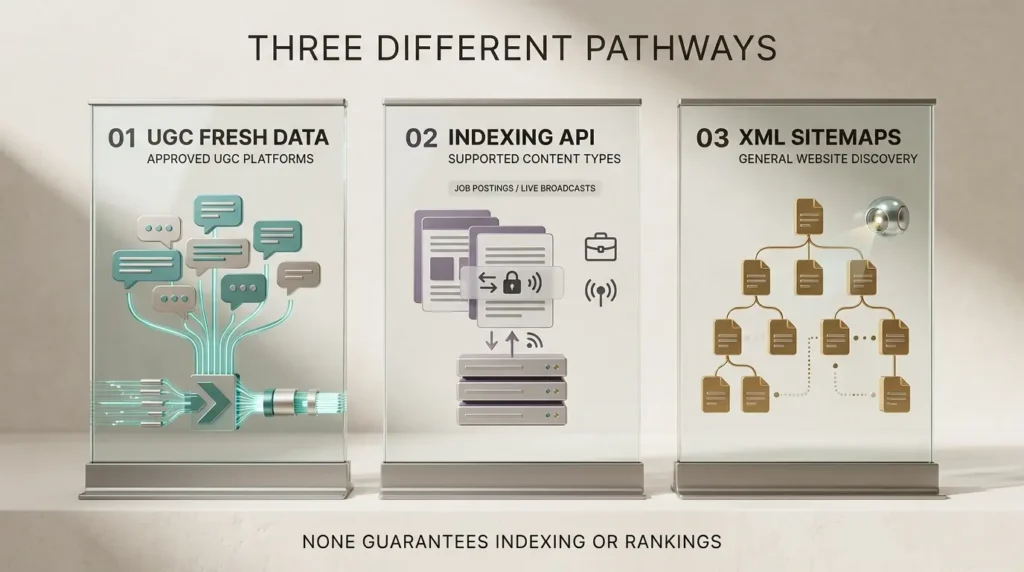
Several different Google systems are often discussed as if they do the same thing.
They don’t.
| Method | Intended use | Who can use it? | Guarantees indexing? |
|---|---|---|---|
| UGC Fresh Data Program | Fresh posts and engagement data from eligible UGC platforms | Approved applicants | No |
| Google Indexing API | Supported pages with specific content types | Sites with eligible content and API access | No |
| XML sitemap | Helps Google discover website URLs | Ordinary website owners | No |
| URL Inspection request | Requests recrawling of an individual URL | Authorized Search Console users | No |
| Normal crawling | Google’s discovery and processing of accessible web pages | Public websites | No |
Let’s look at the differences.
The UGC Fresh Data Program
This is an application-based ingestion pipeline.
It is intended for eligible platforms that primarily host fresh, public user-generated content.
The program requires specialized integration and Google’s approval.
Google’s Indexing API
The Google Indexing API documentation describes an API for notifying Google about updates or removals involving supported page types.
Google’s documented use is limited to pages with JobPosting or BroadcastEvent embedded in VideoObject.
It is not a general-purpose instant-indexing API for ordinary blog posts.
Some third-party tools advertise broad instant-indexing capabilities.
Before using one, check whether its method is supported for your actual content type.
A plugin’s ability to send an API request does not mean Google supports that request for every page.
XML sitemaps
An XML sitemap is a structured list of URLs that helps search engines discover pages.
For WordPress publishers, this is a normal and useful part of technical SEO.
Google’s sitemap documentation explains that submitting a sitemap is a hint, not a guarantee that Google will crawl or index every listed URL.
URL Inspection requests
Google Search Console allows authorized users to inspect individual URLs and request indexing.
This can be useful after publishing an important new article or making a substantial update.
However, Google explicitly warns that repeated requests for the same URL won’t make crawling happen faster.
Ordinary crawling
Googlebot can discover pages through links, sitemaps, and other supported mechanisms.
For most publishers, maintaining a technically accessible, well-connected website remains the appropriate approach.
Does faster content ingestion mean better rankings?
No.
And this is the most important misconception to avoid.
There are several distinct stages between publishing content and receiving visitors from Google.
Discovery
Google becomes aware that a URL exists.
Crawling
Googlebot requests the page and examines the available content.
Indexing
Google processes the page and may store information about it in its index.
Ranking and serving
When someone searches, Google determines which results are relevant and useful enough to display.
A faster route for providing data does not automatically control the later stages.
Google’s UGC documentation explicitly says participation doesn’t guarantee content will appear in Search.
So the program should not be described as a guaranteed ranking boost.
Why speed still matters
Freshness can be important when information changes rapidly.
A discussion about a newly discovered software bug may be more useful while users are actively experiencing the problem.
A conversation about a breaking news event can also lose some of its immediate value after the situation changes.
But speed and quality are not interchangeable.
A quickly discovered page that contains inaccurate or repetitive information may still offer little value.
Google’s people-first content guidance emphasizes usefulness, reliability, and original value.
How can an eligible platform apply?
Google provides an application route on its official UGC Fresh Data Program page.
Before applying, a platform should evaluate whether it genuinely meets the requirements.
A sensible preparation process would include reviewing its content structure, moderation policies, public creator profiles, structured data, and technical capabilities.
Step 1: Review the official requirements
Start with Google’s program documentation.
Don’t rely on third-party summaries that promise automatic acceptance.
Step 2: Check your platform’s content model
Is the majority of the content genuinely created by independent users?
Does each important post have a stable public URL?
Can Googlebot access those pages?
Step 3: Review moderation and reporting
Make sure the platform has meaningful moderation processes and a way for users to report problematic material.
Step 4: Assess technical readiness
Confirm that the development team can support OAuth 2.0, validated JSON-LD, and relevant on-page structured data.
Step 5: Submit the application
Use the form linked from Google’s official program page.
Google states that it expects to respond with an application status within six to eight weeks.
That’s a stated response window, not a guarantee of acceptance.
Step 6: Wait for integration instructions
Selected platforms receive detailed developer documentation and onboarding instructions.
Because the full integration details are not publicly available, it would be misleading to publish invented endpoints, authentication procedures, or payload specifications.
What ordinary publishers should do instead
If you run a blog, news website, affiliate publication, or small business site, you probably don’t need the UGC Fresh Data Program.
You need a dependable publishing and indexing process.
Here’s a practical approach.
1. Make sure the article is actually indexable
Before worrying about speed, confirm that the page isn’t accidentally blocked.
Check for:
- A
noindexdirective. - Robots.txt restrictions that prevent crawling.
- Password protection or login requirements.
- Broken URLs or server errors.
- An incorrect canonical URL.
- Redirects that send Google elsewhere.
A page can be published and still be technically unsuitable for indexing.
2. Verify the URL in Search Console
Open Google Search Console and select the correct property.
Paste the full article URL into the URL Inspection tool.
Google’s URL Inspection documentation explains how to inspect the indexed version of a page and test its current live state.
Look at the reported status before making changes.
3. Submit the correct sitemap
If you use Rank Math, review its sitemap settings.
Many Rank Math installations use a sitemap index at a URL such as:
That is an example, not a guarantee of your site’s configuration.
Open the actual sitemap and confirm that it loads.
Then submit the appropriate sitemap URL in Search Console.
A sitemap helps discovery, but Google does not promise to index everything it contains.
4. Request indexing when appropriate
For a newly published important article, the URL Inspection tool provides a way to request indexing.
Google’s recrawling guidance says crawling can take days to weeks.
It also makes clear that requesting indexing does not guarantee immediate inclusion.
Repeatedly clicking the button isn’t a useful strategy.
5. Link to the new article from relevant existing pages
Internal links help readers and crawlers navigate a website.
A new article should not exist as an isolated page that can only be reached through its exact URL.
For example, a guide about technical SEO might naturally link to a related article about Search Console or website indexing.
The link should make sense for the reader.
Don’t add unrelated links merely to increase the number of internal links.
6. Make the article worth indexing
A page with a unique URL is not automatically a useful page.
Ask yourself:
Does it answer a real question?
Does it add information beyond what competing pages already say?
Are the claims supported?
Is the headline accurate?
Does the article provide examples, explanations, or original analysis?
These questions matter more than finding another submission shortcut.
7. Check caching and publishing settings
WordPress publishers sometimes make updates that don’t immediately appear on the public page because of caching.
If you use a caching plugin or CDN, confirm that the public URL serves the current article.
Check the page in a private browser session.
Make sure the title, canonical URL, content, and metadata match what you intended to publish.
8. Monitor the results without obsessing over the clock
Indexing can take time.
Check Search Console periodically.
If the page remains unindexed, investigate the reason rather than repeatedly submitting it.
An article that isn’t indexed after a reasonable period may need a technical or editorial review.
There is no universal number of hours after which every new article should appear.

A realistic publishing example
Imagine a small technology blog publishes a researched article about a new software feature.
The editor finishes the draft, checks the sources, adds original explanations, and publishes the page.
The URL is included in the site’s sitemap.
The article is linked from a relevant category page and another related guide.
The editor checks Search Console and requests indexing once.
Then the team moves on to promoting the article through its newsletter and social channels while monitoring the indexing status.
That is a reasonable workflow.
What wouldn’t be reasonable is promising that the article will appear in Google within five minutes.
Nor would it make sense to apply for a specialized UGC program that the website doesn’t qualify for.
The better approach is to build a repeatable process that supports discovery, quality, and technical consistency.
For teams managing many publishing steps, TrendOutsider’s generative AI workflows guide explores how structured workflows can help organize recurring tasks without replacing editorial judgment.
Can AI automation help with indexing?
AI can help with parts of the publishing process.
For example, an automated workflow could check whether a new article has a title, meta description, canonical URL, featured image, and internal links.
It could alert an editor when a page appears to be missing important information.
A monitoring system might also collect Search Console data and flag URLs that need investigation.
But AI cannot force Google to index a page.
And an AI agent should not repeatedly submit URLs to unsupported indexing services simply because someone calls the process automation.
Our AI agents workflow automation guide explains why useful automation needs clear permissions, validation, and human oversight.
For publishing, the goal should be fewer preventable mistakes—not a fictional guarantee of instant rankings.
Seven mistakes publishers should avoid
1. Confusing crawling with indexing
Google discovering a page doesn’t guarantee it will be indexed.
2. Assuming an indexing request is a ranking signal
Requesting a crawl does not establish that a page deserves to rank.
3. Using unsupported API methods
Google’s Indexing API has documented content-type restrictions.
A third-party tool cannot change those rules simply by advertising faster indexing.
4. Publishing near-duplicate pages
Creating many similar articles with minor wording changes can make it harder to offer meaningful value.
5. Blocking important URLs accidentally
Incorrect noindex, robots.txt, or canonical settings can undermine discovery and indexing.
6. Ignoring internal links
A useful article should be connected to related pages where readers can naturally find it.
7. Treating speed as the only success metric
A page that is indexed quickly but never satisfies a reader has not achieved much.
Frequently asked questions
What is the Google UGC Fresh Data Program?
It’s a specialized program that allows approved platforms hosting high volumes of user-generated content to send fresh posts and interaction signals through a dedicated Google data-ingestion pipeline.
When did Google announce the program?
Google added public documentation for the program on October 8, 2026. That is the confirmed documentation date, not necessarily the date the underlying technology was first developed.
Is the UGC Fresh Data Program free?
Google’s public documentation does not publish a participation fee. However, it also does not provide a complete commercial or integration-cost schedule. Platforms should confirm applicable terms during the application process.
Can any website apply?
The program is intended for platforms that meet specific UGC, scale, accessibility, moderation, and technical requirements. Applying does not guarantee acceptance.
Can a WordPress blog use the program?
A typical editorial WordPress blog does not fit the stated intended use. A WordPress-based platform built primarily around large-scale public user discussions would need to be evaluated against the same eligibility requirements as other platforms.
How many users do I need?
Google has not published a numerical minimum in the public documentation. It requires a significant user base and high content volume.
Does the program guarantee instant indexing?
No. Google explicitly states that participation does not guarantee that content will appear in Search.
Is it the same as the Google Indexing API?
No. Google says the UGC Fresh Data Program is independent of the Indexing API and traditional organic crawling.
How quickly must posts be submitted?
Google says fresh posts should ideally be submitted within minutes. Engagement counter updates are expected within 72 hours of creation.
Does the program improve rankings?
Google does not promise a ranking boost or guaranteed visibility. Faster ingestion should not be confused with higher rankings.
How long does the application review take?
Google says applicants should expect a response on their application status within six to eight weeks.
What should I do if Google hasn’t indexed my blog post?
Inspect the URL in Search Console, check technical accessibility and canonical settings, confirm sitemap inclusion, request indexing when appropriate, and review the article’s usefulness and internal linking.
Can Rank Math guarantee faster indexing?
No. Rank Math can help manage SEO settings and sitemaps, but it cannot guarantee Google’s crawling, indexing, or ranking decisions.
Final verdict: Faster discovery is not a shortcut around good publishing
Google’s UGC Fresh Data Program is an interesting development because it recognizes a real challenge: large communities generate useful conversations faster than traditional crawling can always discover them.
For eligible platforms, a dedicated ingestion pipeline may provide a more direct way to share that information with Google.
But this isn’t a universal instant-indexing feature.
It isn’t an invitation for every WordPress blog to submit articles through a new API.
And it doesn’t guarantee that submitted content will appear in Search.
For independent publishers, the practical lesson is less exciting but more valuable.
Make your pages accessible.
Maintain accurate sitemaps.
Use Search Console properly.
Build meaningful internal links.
Publish information people actually need.
Then monitor the results and improve what isn’t working.
Getting a page discovered matters. Giving Google and readers a good reason to value that page matters more.
Sources and editorial methodology
This article is based on Google’s published program requirements and existing Search Central documentation. It does not claim firsthand participation in the UGC Fresh Data Program or access to unpublished integration specifications.
Seven authoritative external sources:
- Google — UGC Fresh Data Program
- Google — Search Central documentation updates
- Google — Indexing API usage documentation
- Google — Build and submit a sitemap
- Google — URL Inspection tool
- Google — Ask Google to recrawl your URLs
- Google — Creating helpful, reliable, people-first content
Editorial disclosure: This is a researched explanation and practical guide. Illustrative publishing scenarios are not claimed as real TrendOutsider experiments. No indexing timeline, ranking improvement, or traffic result is guaranteed.









Leave a Reply