
Imagine talking to an AI assistant and suddenly forgetting what you were about to say.
You pause. The assistant waits.
Then you remember, interrupt its answer, laugh at your own mistake and change the subject.
A normal conversation barely notices these little moments. But for artificial intelligence, getting them right is surprisingly difficult.
That is what makes Dessa AI interesting.
On October 23, 2026, Jack Dorsey’s financial technology company Block introduced Dessa, an experimental voice AI model that can listen and speak at the same time.
In the company’s demonstrations, Dessa laughs, hesitates, reacts to interruptions and changes its speaking style during a conversation. At moments, it sounds remarkably natural.
But the most unusual part isn’t the voice itself.
Block says Dessa learned to communicate entirely from recordings of human conversations, without training on written text or starting with an existing language model.
That is a different approach from many familiar AI systems.
And it raises an intriguing question.
Can artificial intelligence learn to hold a conversation by listening to people talk, rather than first learning language through text?
Here is what Block has revealed about Dessa, what its demonstrations actually show, whether you can try it, how it compares with ChatGPT Voice and why the technology deserves attention.
What Is Dessa AI?
Dessa AI is an experimental conversational voice model developed by Block, the company behind Square and Cash App.
It was announced on October 23, 2026, as a research preview.
The system is designed to receive spoken audio and respond with spoken audio while maintaining the rhythm of a natural conversation.
Block describes Dessa as a model trained from scratch using human conversational speech, without written text or a previously trained language model.
It also supports something called full duplex conversation, which means it can continue listening while it is speaking.
That matters because real conversations rarely follow a perfectly organized sequence.
People interrupt each other.
They laugh while someone else is talking.
They say things like “right,” “really?” or “go on” to show that they’re listening.
They change their tone when they’re confused, excited or uncomfortable.
Block is trying to make those behaviors part of the AI’s conversational abilities rather than treating speech as a simple way to read text aloud.
The company has published demonstrations on its official Dessa project page.
Dessa AI at a Glance
| Question | What we know |
|---|---|
| What is Dessa? | An experimental conversational voice AI model |
| Who developed it? | Block’s AI research team |
| Who announced it? | Block, with public comments from Jack Dorsey and the research team |
| Announcement date | October 23, 2026 |
| Training approach | Human conversational audio, according to Block |
| Uses written text for training? | Block says no |
| Uses a pretrained language model? | Block says no |
| Can listen and talk simultaneously? | Yes, according to Block’s demonstrations |
| Can it run locally? | Block says yes, on sufficiently powerful hardware |
| Example local hardware | MacBook Pro with M4 Max or better |
| Training hardware | One NVIDIA GB200 NVL72 system, according to Block |
| Public app available? | No confirmed general release |
| Public API available? | Not announced |
| Open source? | No public model weights or open license announced |
| Price | Not announced |
| Independent benchmark results | Not published |
These details describe the research preview as of October 27, 2026. They are not a claim that TrendOutsider has independently tested the model.
Why Is Everyone Talking About Dessa AI?
The first reason is how naturally it appears to speak.
In published demonstrations, Dessa doesn’t always sound like an assistant reading a carefully prepared answer.
It can pause, laugh, hesitate and respond to the other speaker while the conversation continues.
The second reason is its training approach.
Block says the model learned from speech alone.
That challenges the assumption that a conversational AI needs to build its abilities primarily from enormous collections of written text.
The third reason is the hardware claim.
Block says Dessa was trained using a single NVIDIA GB200 NVL72 rack and can run locally on a sufficiently powerful consumer computer.
If those capabilities hold up under independent testing, they could influence how developers think about future voice assistants.
There is also a fourth reason, and it is less comfortable.
An AI voice that sounds highly human raises questions about deception, consent and how people will know whether they’re speaking with another person.
The launch has attracted both excitement and concern. TechCrunch and The Verge have reported on the demonstrations and the unusual nature of the technology.
But the available recordings are still company selected examples.
They are not a substitute for independent evaluation.
How Does Dessa AI Work?
To understand why Dessa is different, it helps to think about what happens during an ordinary conversation with an AI assistant.
In a traditional voice pipeline, several separate systems may be involved.
First, software converts your speech into text.
Next, a language model processes that text and generates a written answer.
Finally, another system converts the answer into spoken audio.
That approach can work extremely well.
But it also creates a problem.
When speech becomes text, some of the information carried by the original voice may be lost or simplified.
A transcript can preserve the words someone said.
It doesn’t always preserve how they said them.
Consider the sentence:
“That’s great.”
Spoken with excitement, it sounds positive.
Spoken slowly with a frustrated tone, it might mean the opposite.
The words are identical.
The emotional meaning is not.
Dessa is designed around the idea that an AI should learn directly from spoken interactions and process the audio itself.
A Simple Comparison
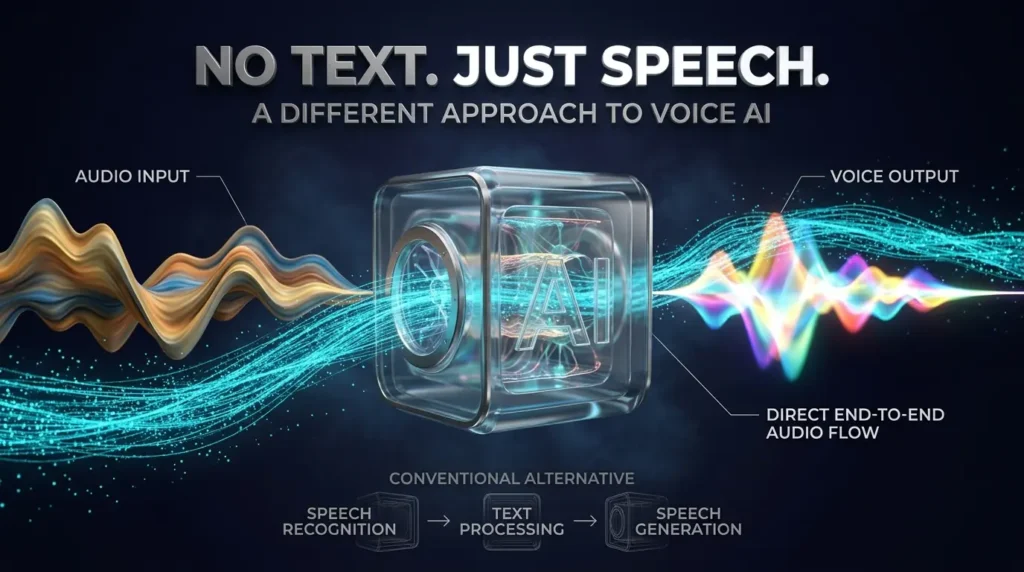
Traditional text mediated voice pipeline
Your voice → speech recognition → written text → language model → speech generation → spoken answer
Dessa’s reported approach
Your voice → speech based conversational model → spoken answer
This simplified diagram illustrates the architectural difference Block is emphasizing.
It does not reveal Dessa’s complete internal implementation, which has not been publicly documented in sufficient detail for independent technical reproduction.
The important distinction is that Block says Dessa does not depend on an intermediate text representation or pretrained text language model.
What Does Full Duplex Mean in AI Voice Technology?
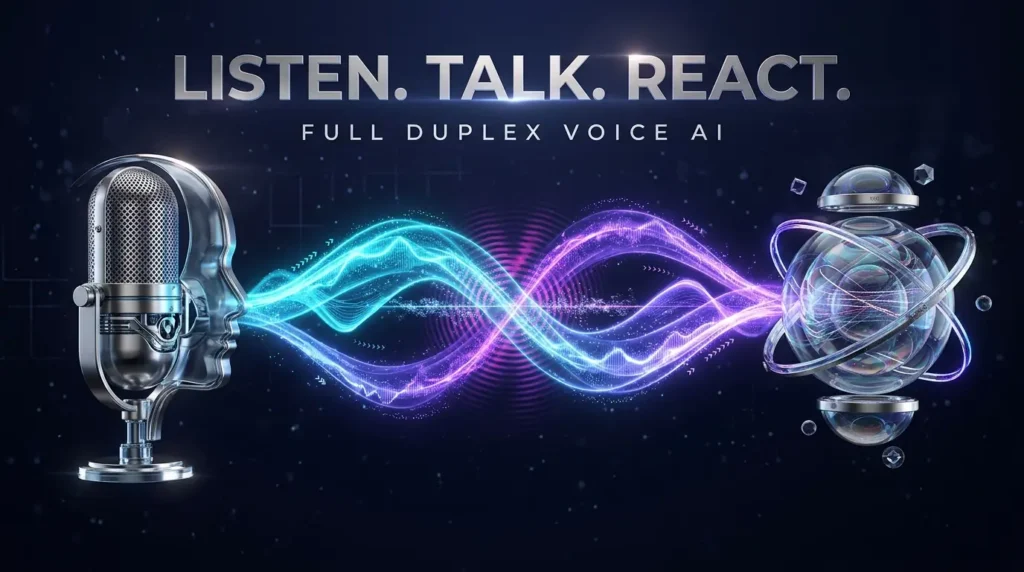
Full duplex is one of the most important terms in this announcement.
Imagine a telephone conversation.
You can hear the other person while you’re speaking.
If they interrupt, you can stop.
If they make a surprised sound, you might react before finishing your sentence.
That ability to send and receive information simultaneously is the basic idea behind full duplex communication.
For voice AI, the challenge is more complicated.
The system needs to decide whether a sound is an interruption, a brief acknowledgment, background noise or the beginning of a new question.
It also needs to decide when to continue speaking and when to yield.
Full Duplex vs Half Duplex
| Feature | Half duplex interaction | Full duplex interaction |
|---|---|---|
| Listening while speaking | Typically limited | Supported |
| Handling interruptions | Often requires turn switching | Can respond during ongoing speech |
| Short acknowledgments | Less natural in rigid systems | Can occur during conversation |
| Overlapping speech | Usually discouraged | Can be part of the interaction |
| Conversational timing | Often organized into turns | More flexible |
Not every existing voice assistant uses a rigid half duplex design.
Modern systems, including OpenAI’s live voice technology, already support sophisticated real time conversations.
Dessa’s distinguishing claim is the combination of full duplex interaction with training entirely from conversational audio.
Why Does This Matter?
Because people don’t speak like chat messages.
We hesitate.
We interrupt ourselves.
We use sounds to communicate interest.
Sometimes silence means we’re thinking.
Sometimes it means we’re finished.
A voice assistant that understands these distinctions may feel more comfortable to talk with.
That could be useful for language practice, accessibility, education and customer service.
But natural timing is only one part of a useful assistant.
The system must also provide accurate information and complete tasks reliably.
Did Dessa Really Learn Without Reading Any Text?
That is Block’s central research claim.
The company says Dessa was trained from scratch using human conversation recordings, without text training data or pretrained models.
If accurate, it suggests that a model can develop meaningful conversational abilities directly from spoken language.
Think about how young children begin learning.
They hear people talking long before they can read.
They gradually recognize sounds, patterns, intentions and connections between words.
Dessa’s research direction explores a related idea in machine learning, although an AI training process should not be confused with human childhood development.
Does This Mean Dessa Understands Everything?
No.
Learning from speech doesn’t automatically establish human level reasoning, factual reliability or emotional understanding.
Block says the model acquired knowledge and reasoning abilities through conversational audio.
Its demonstrations include ordinary discussions and guessing games.
But the company has not released a comprehensive public benchmark showing how Dessa performs across factual questions, mathematics, languages, complex reasoning or safety evaluations.
That means we cannot responsibly say it is smarter than ChatGPT, Gemini or another leading AI model.
We can say its training approach is unusual and worth studying.
Is Dessa the First AI Ever Trained Without Text?
That claim needs qualification.
Research into speech models that avoid written transcripts existed before Dessa.
For example, Meta researchers published work on textless spoken dialogue generation in 2022.
Other research teams have also developed real time conversational speech systems.
Block’s narrower claim is that, as far as it knows, Dessa is the first system capable of realistic live conversation after being trained entirely from human speech.
That is the company’s position, not a universally established historical verdict.
The more meaningful question is whether its approach delivers measurable improvements over existing systems.
Independent testing will help answer that.
What Do the Dessa AI Demonstrations Show?
Block has released recordings designed to illustrate different aspects of the model’s behavior.
The examples include ordinary conversations, expressive reactions and a guessing game.
Some clips highlight laughter and conversational pauses.
Others demonstrate the system responding while the other participant is still talking.
The company also published an example involving a conversation with OpenAI’s GPT Live voice model.
These examples are interesting because they focus on interaction rather than simply asking an assistant to recite information.
Does Dessa Sound Human?
In some demonstrations, it sounds unusually natural.
Its timing and vocal expressions can make the interaction feel less scripted.
But natural speech is subjective.
A voice can sound convincing in a short recording while still struggling with longer conversations, difficult questions or unexpected interruptions.
The Verge also noted awkward moments in the demonstrations, including conversational mistakes.
That is worth remembering.
A system can sound emotionally expressive without understanding a situation as a person would.
Are the Demos Independent Tests?
No.
The public recordings are demonstrations selected and published by Block.
They provide evidence of what the company has shown the model doing.
They do not establish how consistently it performs across thousands of conversations or unfamiliar situations.
To make stronger comparisons, researchers would need repeatable testing conditions, documented evaluation methods and access to the model.
Dessa AI vs ChatGPT Voice: What’s the Difference?
This is probably the comparison most readers will want to understand.
ChatGPT already offers live voice conversations, and OpenAI’s GPT Live technology supports natural interaction and interruptions.
Dessa is entering an area where sophisticated voice AI already exists.
The difference is not simply that one can speak and the other cannot.
It is the underlying research approach and the maturity of the available product.
| Feature | Dessa AI | ChatGPT Voice |
|---|---|---|
| Developer | Block | OpenAI |
| Primary focus | Research into natural conversational speech | General purpose conversational assistance |
| Training approach | Block reports speech only training | OpenAI has not described its system as trained exclusively from speech |
| Full duplex interaction | Yes, according to Block | Supported in modern live voice experiences |
| Public availability | Limited research preview | Available through ChatGPT, subject to plan and feature limits |
| General purpose assistance | Not fully established | Established product capability |
| Local consumer hardware | Block claims local inference on suitable hardware | Consumer ChatGPT voice is generally delivered through the service |
| Public pricing | Not announced | Depends on ChatGPT plan |
| Independent head to head results | Not available | No verified direct comparison with Dessa |
Is Dessa Better Than ChatGPT Voice?
There isn’t enough evidence to say that.
Dessa may demonstrate impressive conversational timing and expressiveness.
ChatGPT Voice, meanwhile, is an available product that people can use for a much broader range of everyday tasks.
A voice model’s quality cannot be measured only by how human its laughter sounds.
Useful comparisons should consider accuracy, response time, interruption handling, multilingual performance, safety, task completion and reliability over long conversations.
Those results have not yet been published for Dessa.
If you’re interested in how AI tools fit into everyday work, our AI and productivity tools guide explores the practical differences between available AI products.
Could Dessa Eventually Compete With ChatGPT?
Potentially.
But that depends on what Block builds around the model.
A conversational voice engine is not automatically a complete assistant.
A useful assistant may also need access to current information, calendars, business systems, tools and permissions.
Dessa’s public preview has not established a comparable general purpose ecosystem.
Can You Use Dessa AI Right Now?
Not through a generally available public app or API as of October 27, 2026.
This is one of the most important things to understand.
Dessa has been introduced as a research preview.
Block is seeking participation from a small group of AI safety researchers.
The official project page also discusses broader access, but a general public release has not been confirmed.
How to Find the Official Dessa AI Project
- Visit block.xyz/dessa.
- Read the company’s explanation of the research.
- Listen to the official demonstration recordings.
- Check whether the page offers an active waitlist or research access application.
- Follow Block’s official updates for any public release announcement.
Do not assume that an unrelated website offering a “Dessa AI download” is distributing the official model.
Block has not announced publicly downloadable model weights or a general release package.
Is Dessa AI Free?
There is no announced public pricing model.
Because the product is not generally available, it is too early to describe it as a free alternative to ChatGPT or a paid voice service.
Does Dessa AI Have an App?
No official generally available Dessa consumer app has been confirmed.
Is There a Dessa AI API?
Block has not announced a public API with developer documentation and pricing.
Developers should not plan production applications around access that has not been released.
Is Dessa Open Source?
Not at this stage, based on the publicly available information.
Block has not released model weights under an open source license.
A research demonstration and an open source model release are different things.
What Hardware Does Dessa AI Need?
Block says the model can run locally on a MacBook Pro equipped with an M4 Max chip or better.
That is an interesting claim because running a sophisticated conversational model locally could reduce dependence on a remote server for inference.
However, the company has not published all the details developers would need to assess hardware requirements independently.
These include the model’s parameter count, memory requirements, supported operating systems and practical latency measurements across different devices.
Can Dessa Run on Windows?
No verified Windows support has been announced.
Can Dessa Run on a Normal Laptop?
That remains unclear.
A MacBook Pro with M4 Max is powerful consumer hardware.
It is not representative of every laptop.
Until Block releases specifications or independent testers receive access, it would be misleading to claim Dessa runs well on ordinary budget computers.
Was Dessa Trained on One NVIDIA Rack?
Block says it used a single NVIDIA GB200 NVL72 system.
That is substantial AI computing hardware.
The claim is notable because large AI research projects often rely on extensive computing infrastructure.
But a single rack does not mean inexpensive training.
Block has not published a complete training cost, energy use or comparable cost analysis.
Who Created Dessa AI?
Dessa was developed inside Block’s AI research organization.
The research team includes people associated with an earlier company also called Dessa.
That company was a Toronto based artificial intelligence startup known for work on synthetic speech.
Square, now part of Block, acquired the startup in 2020.
The name therefore has a history that predates the October 2026 voice model announcement.
The current project is associated with researcher Ragavan Thurairatnam and a team working on speech generation and conversational AI.
Jack Dorsey publicly supported the launch, but it would be inaccurate to describe him as the sole developer or inventor of the model.
He is the prominent company leader associated with its announcement.
Wasn’t Dessa Involved in Voice Cloning Years Ago?
Yes, the earlier Dessa startup became known for research into realistic synthetic speech, including a widely discussed demonstration involving a simulated public figure’s voice in 2019.
That history helps explain why the team has experience with speech technology.
But the new Dessa model should not automatically be described as a publicly available voice cloning tool.
Its announced purpose is conversational speech modeling.
Can Dessa AI Clone Someone’s Voice?
Block has not presented Dessa as a general public voice cloning service.
The model’s natural speech generation raises questions about identity imitation, but that does not prove it can clone arbitrary voices from a short sample.
Those are different capabilities.
A system that produces realistic speech is not necessarily capable of reproducing a particular person’s voice on demand.
No public evidence currently establishes a general purpose voice cloning feature for Dessa.
Anyone claiming otherwise should provide a verified technical demonstration and official documentation.
Why Does Dessa AI Raise Safety Concerns?
The more convincing synthetic voices become, the more important it is to know who is speaking.
Imagine receiving a call from someone who sounds friendly, emotionally aware and completely comfortable interrupting you.
If that voice belongs to an AI, the person receiving the call should know.
This matters especially in customer service, financial conversations and situations involving vulnerable users.
Three Important Risks
Impersonation and fraud
Highly natural synthetic voices could make deceptive calls more persuasive if misused.
Emotional manipulation
A system that sounds concerned or empathetic may encourage people to trust it more than its actual capabilities justify.
Consent and transparency
People should understand when they’re interacting with AI and how their voice data is handled.
These concerns are reasons for careful evaluation, not proof that Dessa has already been used for fraud.
Block says it wants safety researchers to examine risks the development team may not have anticipated.
That is a sensible step, but independent access and published findings will be necessary to judge the results.
Can AI Really Understand Emotion From Voice?
Speech carries information about tone, timing, emphasis and other vocal characteristics.
A model may learn to recognize patterns associated with different emotional states.
But detecting vocal patterns is not the same as knowing exactly what someone feels.
People express emotions differently across cultures, languages and situations.
An AI could misread sarcasm, nervousness or distress.
For sensitive applications, a convincing voice should never replace appropriate human judgment.
Where Could Dessa AI Be Used in the Future?
The most promising applications are situations where conversation itself matters.
Customer Service
An AI system that can handle interruptions naturally might make routine phone support less frustrating.
But a business assistant would still need reliable access to customer information, clear escalation procedures and safeguards against incorrect actions.
For a broader view of how businesses build automated systems, see our AI agents workflow automation guide.
Language Learning
A conversational tutor that responds naturally could help learners practice speaking and listening.
The benefit would depend on pronunciation accuracy, supported languages and the quality of corrections.
Those capabilities have not been comprehensively demonstrated for Dessa.
Accessibility
Voice interfaces can help people who find typing difficult or prefer spoken interaction.
More natural interruption handling may improve usability.
But accessibility requires careful testing with different speech patterns, disabilities and real world conditions.
Education
A voice tutor could potentially make learning feel more interactive.
However, natural speech is not enough.
Educational systems must also provide accurate explanations and age appropriate safeguards.
Personal Assistants
A future assistant might handle conversations while people cook, drive or perform other activities.
To become genuinely useful, it would need dependable tools, permissions and the ability to complete tasks.
For context on building these kinds of systems, TrendOutsider’s generative AI workflows guide explains how language models and automation can work together.
These are potential applications, not announced Dessa products.
What Has Block Not Revealed About Dessa?
This may be the most useful section for anyone considering the technology seriously.
As of October 27, Block has not publicly established several important details.
| Unanswered question | Why it matters |
|---|---|
| How large is the model? | Helps evaluate computing and memory needs |
| How many hours of audio were used? | Helps assess the training approach |
| What languages are supported? | Determines who could use it |
| What are the measured response times? | Important for live conversation |
| How accurate are its answers? | Essential for trustworthy assistance |
| Can it use external tools? | Important for real business tasks |
| What are the safety benchmark results? | Needed to evaluate risk |
| When will the public get access? | Determines practical availability |
| Will developers get an API? | Needed for integrations |
| Will the weights be released? | Determines whether independent local deployment is possible |
| What will it cost? | Needed for commercial planning |
These missing details don’t invalidate the research.
They establish the limits of what we can conclude today.
A company demonstration can reveal an interesting capability.
A mature product requires much more evidence.
Does Dessa AI Represent the Future of Voice Assistants?
It may represent an important direction.
For years, people have become accustomed to typing messages into AI systems and receiving text in return.
Voice interfaces make that interaction more immediate.
But the goal isn’t simply to make an AI sound human.
It is to make conversation more useful.
An assistant should recognize when someone has finished speaking, respond accurately, handle interruptions gracefully and know when it needs clarification.
It should also be transparent about being artificial.
Dessa is interesting because it challenges the idea that written language must be the foundation of conversational intelligence.
Whether that approach becomes a major breakthrough will depend on independent research and what happens after the preview.
Frequently Asked Questions About Dessa AI
What is Dessa AI?
Dessa is an experimental conversational voice AI model developed by Block and announced on October 23, 2026.
Who owns Dessa AI?
The current model is developed by Block, the financial technology company associated with Square and Cash App.
Did Jack Dorsey create Dessa?
Jack Dorsey publicly promoted the project as Block’s leader. The model was developed by Block’s research team, not by Dorsey alone.
Is Dessa AI available to the public?
Not generally as of October 27, 2026. Block is providing a research preview and discussing limited early access.
How can I try Dessa AI?
Visit Block’s official Dessa project page to explore demonstrations and check for research access or waitlist updates. A general public demo or downloadable app has not been confirmed.
Is Dessa AI free?
No public pricing or free access plan has been announced.
Can I download Dessa AI?
There is no verified public model download as of October 27, 2026.
Is Dessa AI open source?
Block has not announced a public open source release of the model weights.
What does full duplex mean?
It means a voice system can listen and speak simultaneously, allowing more natural interruptions and overlapping conversation.
Was Dessa trained without text?
Block says the model was trained entirely from human conversational speech, without written text or pretrained models. Independent technical verification remains limited.
Is Dessa better than ChatGPT Voice?
There is no independent benchmark establishing that. Dessa has demonstrated expressive conversational behavior, while ChatGPT Voice is an available general purpose product.
Can Dessa AI clone voices?
A general public voice cloning capability has not been established by Block’s announcement.
Does Dessa support multiple languages?
Block has not published a verified comprehensive language support list.
Can Dessa run on a MacBook?
Block says it can run locally on a MacBook Pro with M4 Max or better. Public independent testing is not yet available.
Can Dessa run on Windows?
No verified Windows support has been announced.
Does Dessa have an API?
No public API has been announced.
Why is Dessa important?
Its central research claim is that a conversational AI can learn directly from speech while supporting natural simultaneous listening and speaking, without relying on text training.
Final Verdict: Should You Be Excited About Dessa AI?
Dessa is one of the more interesting voice AI announcements of October 2026.
Not because it has already replaced existing assistants.
It hasn’t.
And not because it has proven that AI understands emotions like a human.
It hasn’t done that either.
What makes Dessa compelling is the research question behind it.
What happens when an AI learns conversation from conversation itself?
Block’s demonstrations suggest that this approach can produce expressive speech, flexible timing and interactions that feel less mechanical.
That is worth paying attention to.
But the next stage matters more than the launch videos.
We need independent tests, technical documentation, safety results, clear hardware requirements and an actual public release.
Until then, Dessa is best understood as a promising research preview rather than a product ready to replace ChatGPT Voice.
If you want to hear what the excitement is about, start with the official recordings at Block’s Dessa project page.
Then keep one distinction in mind.
An AI that sounds more human isn’t necessarily an AI that understands more.
The future of voice AI will depend on achieving both natural conversation and dependable intelligence.
Sources and Editorial Methodology
This article was researched using publicly available information as of October 27, 2026.
Primary source: Block’s official Dessa research preview.
Additional reporting:
- TechCrunch: Block’s new voice model sounds eerily human
- The Verge: Jack Dorsey’s Block made an AI model that talks to you like an awkward new friend
- CoinDesk: Block’s voice AI sparks excitement and scam concerns
- Meta research: Textless spoken dialogue generation
Editorial disclosure: TrendOutsider has not independently tested Dessa or obtained access to its model. Company demonstrations and technical claims are attributed to Block. Product availability, pricing and specifications may change. Future applications discussed in this article are possibilities, not confirmed features.








Leave a Reply