

Published: May 2026 | Category: AI Tools | Reading Time: ~12 minutes
If you’ve been trying to grow a website in 2026 and wondering why your traffic feels flat even though you’re publishing content, this article is for you.
The truth? SEO has changed more in the last 18 months than it did in the previous five years. And if you’re still using the same old playbook , stuffing keywords, chasing backlinks, and calling it a day you’re fighting a battle with outdated weapons.
Search is no longer just about ranking on Google’s blue links. Today, a massive portion of your potential audience is getting answers directly from ChatGPT, Perplexity, Google AI Overviews, and Gemini without ever clicking through to a website.
That’s the new reality. And the good news? There are tools built specifically to help you win in this new landscape.
In this guide, I’m going to walk you through the 10 best AI search optimization tools in 2026 — what they do, who they’re for, and how they can help you grow real, sustainable traffic. Whether you’re a blogger, a freelancer, a small business owner, or someone trying to earn from a content website, there’s something here for you.
Let’s get into it.
What Are AI Search Optimization Tools — and Why Do They Matter in 2026?
Before we dive into the list, let me quickly explain what these tools actually are and why they’re no longer optional.
AI search optimization tools are platforms that help your content get found — not just on traditional Google search, but also inside AI-generated answers. They combine two powerful disciplines:
- SEO (Search Engine Optimization): Getting ranked in Google search results
- GEO (Generative Engine Optimization): Getting cited by AI engines like ChatGPT, Perplexity, and Google AI Overviews
Why does this matter? Because the numbers are staggering.
According to EMARKETER’s 2026 forecast, 31.3% of the U.S. population now uses generative AI search. ChatGPT alone processes over 2.5 billion prompts every single day. Gartner predicted that traditional search volume would decline by 25% as AI chatbots substitute for conventional queries, and that’s already happening.
If your content isn’t showing up in those AI-generated answers, you’re invisible to a huge and growing segment of your audience. That directly affects your traffic, your ad revenue, and your ability to monetize your website.
The right AI search optimization tools help you:
- Understand what your audience is actually searching for
- Create content that Google ranks AND AI tools cite
- Optimize your articles faster with data-backed suggestions
- Track whether your content is appearing in AI answers
- Stay competitive without spending hours guessing what works
Before we dive into each tool individually, it’s worth understanding that choosing the right SEO tool depends on multiple factors—your budget, your workflow, and what you’re trying to optimize for.
If you haven’t already thought through your overall SEO strategy and which tools would save you the most time, check out our comprehensive guide to AI SEO tools that actually work. It breaks down the free vs paid tools, shows you exactly how much time each saves, and helps you decide which tools
match your specific situation. Then come back here to see the detailed breakdown of the top
10 tools available today.
Now, let’s look at the tools themselves.
10 Best AI Search Optimization Tools in 2026
1. Surfer SEO — Best for Real-Time Content Optimization
If there’s one tool that has consistently delivered results for content creators over the past few years, it’s Surfer SEO. And in 2026, it’s evolved significantly beyond just traditional on-page optimization.

Surfer analyzes the top-ranking pages for your target keyword and gives you a real-time Content Score as you write. It tells you which topics to cover, which keywords to include, how long your article should be, and how to structure your headings — all based on what’s actually working in the search results right now.
What’s new in 2026? Surfer has added an AI Search Visibility tracker, so you can monitor not just your Google rankings, but how your brand and content are performing inside AI-generated answers.
Best for: Bloggers, content writers, and website owners who want clear, step-by-step guidance while creating articles.
Key Features:
- Real-time content scoring as you write
- SERP-based keyword and topic suggestions
- AI search visibility monitoring
- Content editor with NLP optimization
- Competitor content gap analysis
Why it helps you earn: When your articles score higher on Surfer’s scale, they tend to rank higher on Google. Higher rankings = more traffic = more AdSense earnings.
2. Ahrefs — Best for Deep Research and AI Brand Monitoring
Ahrefs has been a trusted name in SEO for years, and its 2026 version is stronger than ever. While it’s known for keyword research and backlink analysis, its standout new feature is Brand Radar — a module that tracks how your brand is mentioned and cited across AI engines like ChatGPT, Perplexity, and Google AI Overviews.

This is incredibly valuable because it answers a question most website owners don’t even know to ask: Is AI recommending my content when people search for my topic?
Ahrefs’ data is backed by one of the most powerful web crawlers available, which means the insights you get are accurate and reliable. For anyone serious about understanding their search performance, it’s an indispensable tool.
Best for: Intermediate to advanced website owners, SEO professionals, and anyone building a long-term content strategy.
Key Features:
- Brand Radar for AI visibility tracking across ChatGPT, Perplexity, and AI Overviews
- Keywords Explorer with billions of keyword suggestions
- Site Audit for technical SEO issues
- Backlink analysis and competitor research
- Content gap identification
Pricing: Starts at $99/month for the Lite plan.
One honest note: Ahrefs has a slight learning curve for beginners. But once you get used to it, the data it provides is unmatched.
3. SEMrush — Best All-in-One Platform with AI Capabilities
SEMrush is one of the most comprehensive SEO platforms available, and in 2026 it holds the G2 #1 AEO (Answer Engine Optimization) Tool designation. That recognition didn’t come from nowhere.
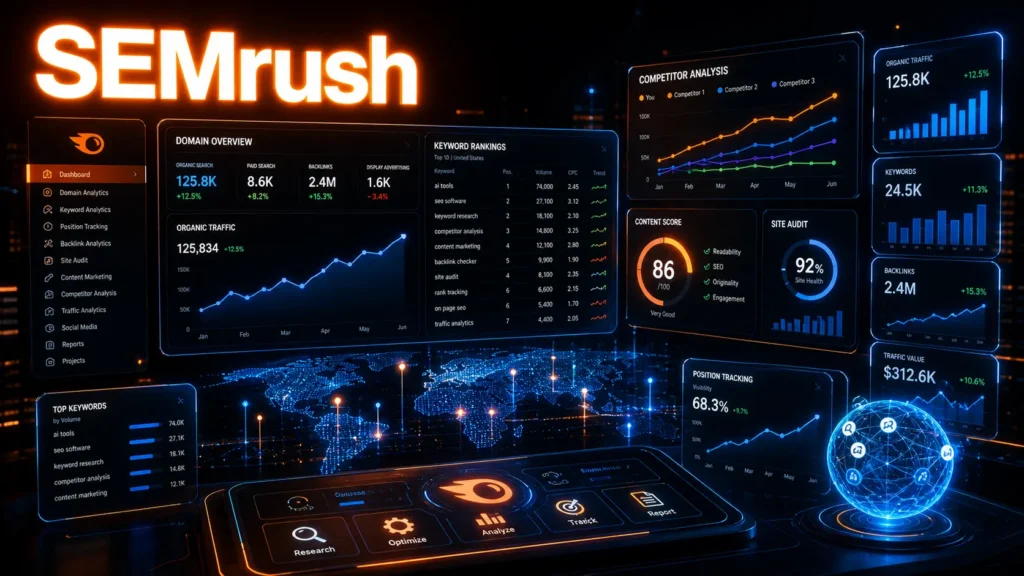
What makes SEMrush stand out is how much it can do in one place. You get keyword research, competitor analysis, content optimization, backlink tracking, technical SEO audits, and AI-powered writing assistance — all under one roof.
Their Content Marketing Toolkit is particularly useful for bloggers targeting U.S. audiences. It helps you find content ideas, optimize existing articles, and track how your content performs over time. If you’re trying to earn from a content website, having a complete picture of your entire SEO strategy in one dashboard saves a lot of time.
Best for: Website owners who want a complete toolkit without juggling multiple subscriptions.
Key Features:
- AI-powered content optimization assistant
- Keyword tracking with position monitoring
- Topic Research tool for content ideas
- SEO writing assistant (integrates with Google Docs and WordPress)
- Competitor traffic and keyword analysis
- AI Overviews tracking
Pricing: Plans start around $139/month. The investment pays off quickly if you’re serious about ranking.
4. Frase — Best for Matching Content to Search Intent
Here’s a tool that doesn’t get talked about as much as it deserves: Frase.
Frase is laser-focused on one thing: making sure your content perfectly matches what people are actually looking for when they search your keyword. That’s called search intent, and in 2026, it’s one of the most important ranking factors.
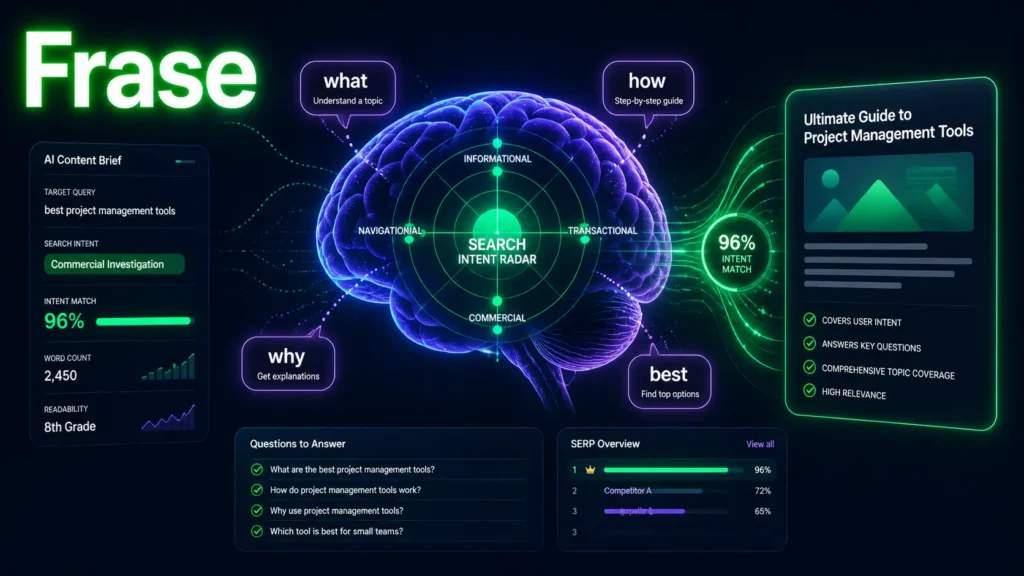
What Frase does brilliantly is analyze the questions people ask around your keyword and help you build content that answers all of them. This is exactly the kind of content that shows up in featured snippets and AI-generated answers — which is where you want to be.
For budget-conscious creators, Frase is also one of the most affordable options on this list. It’s packed with features without the steep price tag of some enterprise tools.
Best for: Solo bloggers, freelancers, and small website owners who want smart optimization without breaking the bank.
Key Features:
- Automatic content brief generation
- Question and topic research from real search data
- Content scoring and optimization
- SERP analysis and competitor comparison
- GEO-friendly content structuring
- AI writing assistant built in
Why this matters for earning: Frase helps you write articles that answer questions completely. Google rewards comprehensive answers with better rankings — and AdSense rewards higher traffic with better earnings.
5. Clearscope — Best for Content Relevance and Depth
If your articles feel thin or surface-level, Clearscope is the tool that fixes that problem.
Clearscope uses IBM Watson’s natural language processing to analyze top-ranking content and tells you exactly which related terms and concepts your article needs to cover in order to be considered “complete” by search engines. This isn’t about stuffing keywords — it’s about building semantic depth that tells Google your article is genuinely authoritative on its topic.
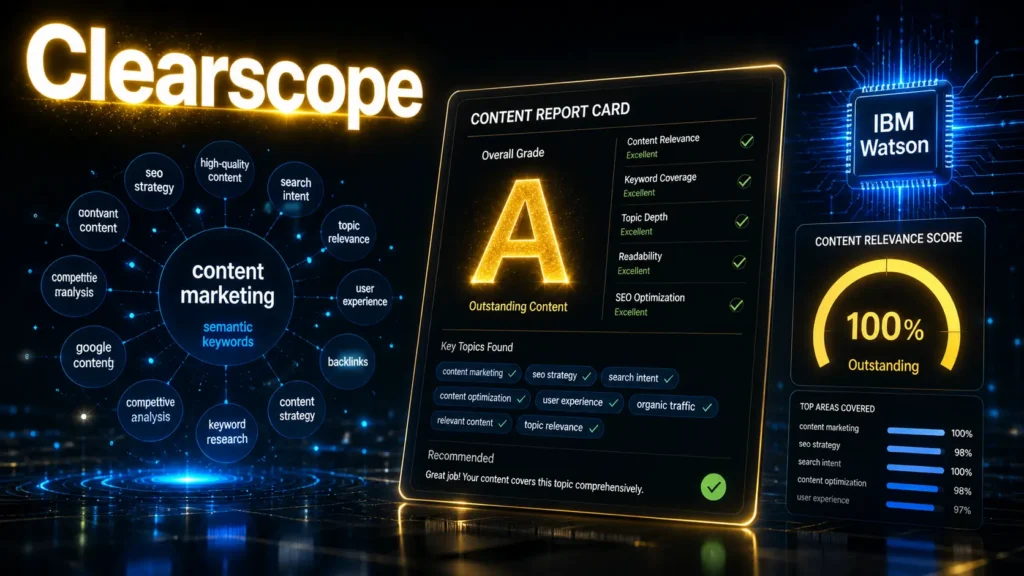
The tool is clean, simple, and very easy to use, even if you’re not a technical SEO expert. You write your article, run it through Clearscope, and it gives you a grade from A to F. The goal? Get to an A.
Best for: Writers and content teams who want to improve content quality and relevance scores.
Key Features:
- Content grading system (A to F)
- Related keyword and topic suggestions
- Competitor content analysis
- Readability scoring
- Google Docs integration
6. SE Ranking — Best Value Tool for Beginners
If you’re just getting started and you want a solid, affordable tool that covers all the basics, SE Ranking is one of the smartest choices in 2026.
SE Ranking has been around for years as a traditional SEO tool, but it has since added an AI visibility layer that lets you monitor how your brand performs in AI-generated search results. That means you get both old-school SEO features and new-world GEO tracking without paying enterprise prices.
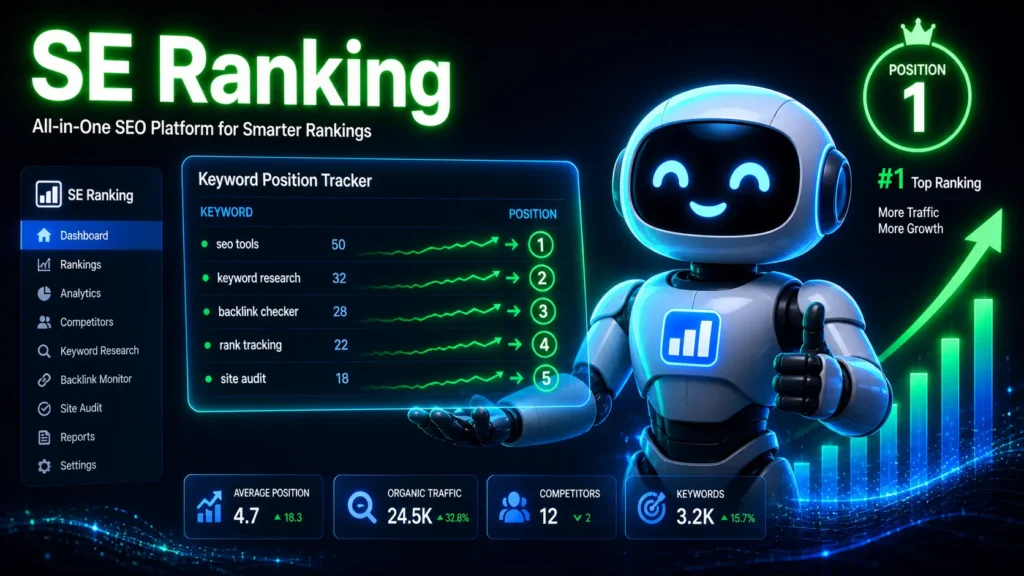
The interface is beginner-friendly, the data is reliable, and the keyword tracking feature is among the most accurate in its price range. For someone building a new content website and trying to get Google AdSense approval, SE Ranking gives you the reporting you need to track your progress clearly.
Best for: Beginners, bloggers, and small business owners who want a complete tool without the enterprise price tag.
Key Features:
- Keyword position tracking (daily updates)
- AI search visibility monitoring
- Competitor analysis and keyword gap tools
- Website audit tool
- Backlink monitoring
- On-page SEO checker
7. MarketMuse — Best for Long-Term Content Strategy
MarketMuse thinks differently from most tools on this list. Instead of focusing just on individual articles, it looks at your entire website and figures out where you have knowledge gaps — and what topics you need to cover to build genuine authority in your niche.
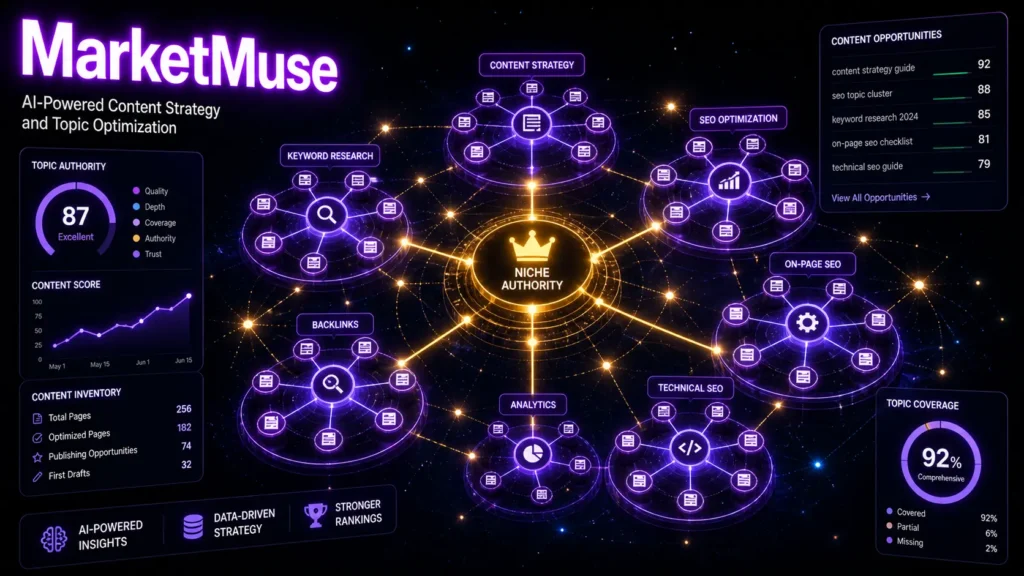
This is called topic clustering, and it’s one of the most effective long-term SEO strategies available. The idea is that Google doesn’t just rank individual pages — it ranks websites that demonstrate deep expertise across a topic area. MarketMuse helps you build that expertise systematically.
For someone running a niche blog or an AI tools review site, this approach is incredibly powerful. It tells you not just what to write next, but why — and how it fits into a bigger content strategy.
Best for: Website owners building a long-term content authority play in a specific niche.
Key Features:
- Topic authority scoring
- Content gap analysis across your entire site
- Content briefs with competitive benchmarks
- Personalized difficulty scores based on your existing authority
- AI-powered content planning
8. WriterZen — Best for Finding Low-Competition Keywords
Finding keywords that you can actually rank for — especially as a new website — is one of the biggest challenges in SEO. That’s exactly where WriterZen shines.
WriterZen is built specifically for keyword research and keyword clustering. It helps you find long-tail, low-competition keywords that have real search volume but not many strong competitors. This is the sweet spot for new websites trying to get their first rankings.

The tool also groups related keywords together, so instead of writing ten separate articles, you can write one comprehensive piece that targets multiple related keywords at once. This is more efficient and often performs better in search.
Best for: New website owners and bloggers who want to find content opportunities that are actually winnable.
Key Features:
- Keyword discovery with competition scoring
- Topic clustering and grouping
- Content brief creation
- Golden ratio keyword identification (low competition, real traffic)
- Plagiarism checker built in
9. Peec AI — Best for Tracking AI Search Visibility
Peec AI is a newer tool, but it’s one that deserves serious attention in 2026 — especially if you care about showing up in AI-generated answers.
While most tools on this list focus primarily on traditional Google rankings, Peec AI is purpose-built for Generative Engine Optimization (GEO). It tracks your brand’s visibility across all the major AI platforms: ChatGPT, Google AI Mode, Google AI Overviews, Microsoft Copilot, Perplexity, Gemini, Grok, Claude, Meta AI, and DeepSeek.
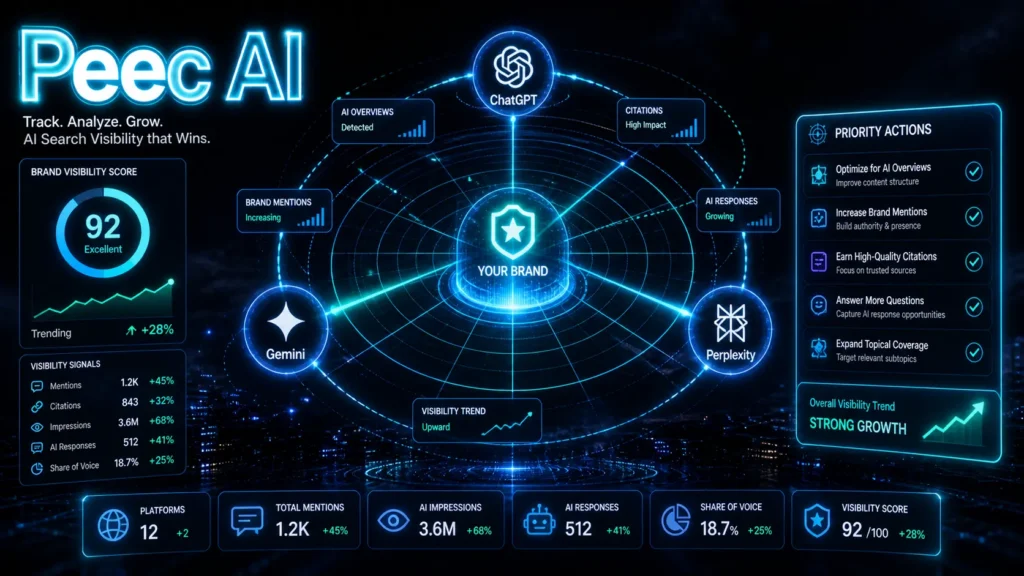
Its standout feature is called Actions — instead of just showing you data, it turns that data into a prioritized to-do list. It tells you exactly what to fix and in what order, so you’re never left staring at a dashboard wondering what to do next.
For content creators who want to make sure their articles are being cited by AI systems, Peec AI provides the clearest picture available.
Best for: Content creators and marketers who want to dominate AI-generated search results, not just Google.
Key Features:
- Daily tracking across 10+ AI platforms
- Prioritized action recommendations
- Competitor AI visibility comparison
- Source and citation analysis
- Country-specific visibility tracking
10. NeuronWriter — Best Budget Tool for Beginners
Rounding out our list is NeuronWriter — and if you’re on a tight budget but still want professional-quality content optimization, this is the tool for you.
NeuronWriter is affordable, beginner-friendly, and surprisingly powerful for its price point. It analyzes your competitors, suggests the right keywords and topics to include, and gives your content a score that helps you gauge whether your article is ready to compete.
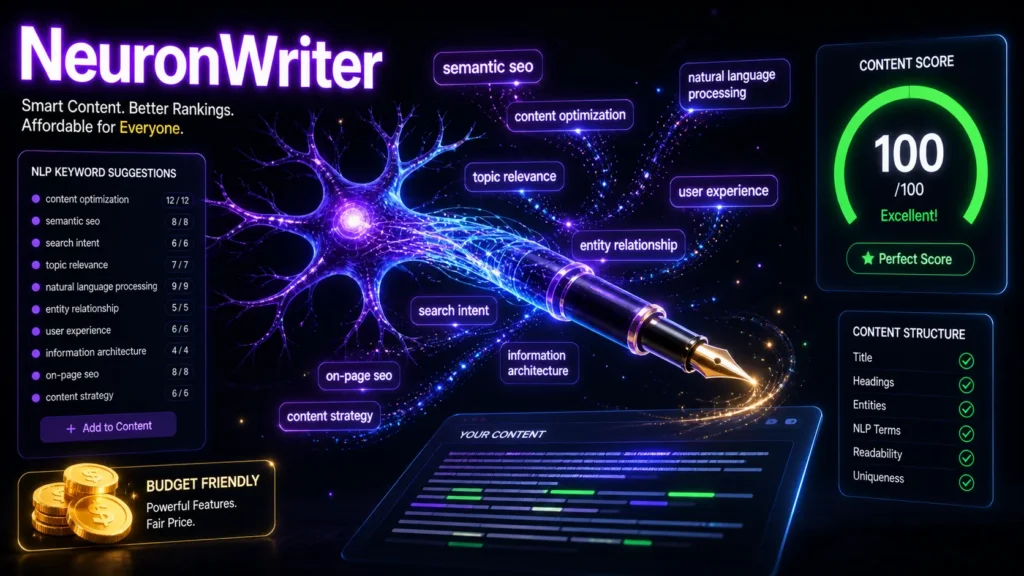
It may not have all the bells and whistles of Surfer SEO or SEMrush, but for someone just starting their content journey — trying to get their first articles ranking and working toward AdSense approval — NeuronWriter delivers real value without the premium price.
Best for: Complete beginners, solo bloggers, and anyone who needs solid optimization on a budget.
Key Features:
- Content scoring and optimization
- NLP-powered keyword suggestions
- SERP analysis
- Competitor content comparison
- Internal linking recommendations
- Affordable monthly pricing
I’ve given you detailed reviews of the 10 best AI search optimization tools available in 2026.
But here’s what matters most: choosing the right tool for your specific situation, budget, and goals.
One person starting out needs a completely different tool than an agency managing 50 websites.
A blogger who writes one article per week has different priorities than someone publishing daily.
A freelancer with a $50 monthly budget needs different recommendations than someone with $500
to invest.
Our guide to AI SEO tools that actually work includes comparison tables, decision trees, and “tools by situation” breakdowns that help you figure out exactly which tools from this list—or which combination of them—will work best for you. It also shows you the actual time savings you can expect from each tool and the real ROI.
How to Actually Use These Tools to Earn Money from Your Website
Knowing the tools is one thing. Knowing how to use them to actually build income is another. Here’s a practical strategy that works for content websites in 2026.
Step 1: Pick Your Niche and Target Low-Competition Keywords First
If you’re a new website, don’t go after competitive keywords right away. Use tools like WriterZen or Frase to find long-tail questions your audience is actually asking, the kind that have real search volume but not many strong articles competing for them.
For example, instead of targeting “AI tools” (highly competitive), target “best free AI tools for students in 2026” (much more specific and winnable).
Step 2: Create Content That Answers Questions Completely
Google and AI engines both reward articles that give complete, helpful answers. Use tools like Surfer SEO or Clearscope to make sure your article covers every relevant subtopic. Structure your content with clear headings, short paragraphs, and bullet points where appropriate — this makes it easier for both readers and AI systems to understand.
Step 3: Optimize for Both Google and AI Search
This is the big shift in 2026. You’re not just writing for Google anymore. You’re writing for ChatGPT, Perplexity, and Google AI Overviews too. To get cited by these systems, your content needs to:
- Be written in clear, factual language
- Include Q&A sections and FAQs
- Use authoritative data and statistics
- Be structured so AI can easily extract answers
Tools like Peec AI and Surfer’s AI visibility tracker help you measure how well you’re doing in this area.
Step 4: Monitor Your Rankings and Update Regularly
Search engines reward fresh content. Set up keyword tracking in SE Ranking or SEMrush and check your rankings weekly. When an article drops, update it with new information, better examples, or additional sections. This keeps your content competitive and tells Google your site is actively maintained.
Step 5: Build Consistency
One article won’t make you money. Ten might not either. But 50 well-optimized, genuinely helpful articles? That’s where traffic starts to compound. Consistency is what separates websites that earn from ones that don’t.
Mistakes to Avoid When Using AI Search Optimization Tools
Even with the best tools, a few common mistakes can undermine your results.
Mistake 1: Treating AI-generated content as a finished product. AI writing tools are incredible for drafting, but always review, edit, and add your own voice. Google rewards authenticity and genuine expertise — and readers can tell the difference.
Mistake 2: Chasing keywords without considering intent. A keyword with 10,000 monthly searches means nothing if everyone who searches it wants something different from what you’re offering. Always check what the top-ranking pages look like before targeting a keyword.
Mistake 3: Ignoring technical SEO. Content optimization is important, but so is site speed, mobile-friendliness, and proper indexing. Run regular site audits using tools like SEMrush or SE Ranking to catch issues before they hurt your rankings.
Mistake 4: Focusing only on Google and ignoring AI search. In 2026, this is a critical oversight. If 31% of your potential U.S. audience is getting answers from AI tools and your content isn’t showing up, you’re leaving a massive amount of traffic on the table.
Mistake 5: Giving up too early. SEO takes time. Most new websites see their first meaningful traffic within 3–6 months of consistent publishing. Tools accelerate the process, but they don’t replace patience.
What’s the Future of AI Search Optimization?
The direction is clear. AI-generated answers are becoming the first thing users see — before the traditional blue links, before the ads, before anything else. Google’s AI Mode, ChatGPT Search, and Perplexity are all growing rapidly and eating into conventional search traffic.
Experts predict that by 2027, AI-generated answers will account for a majority of informational queries. That means the websites that survive and thrive will be the ones that optimize for both traditional search and AI citation simultaneously.
The good news is that the core principles remain the same: create genuinely helpful, well-structured content that answers real questions thoroughly. AI tools just make it easier to do that at scale, with better data, and with a clearer picture of whether it’s working.
Quick Comparison: Which Tool Should You Choose?
| Tool | Best For | Price Starts At |
|---|---|---|
| Surfer SEO | Real-time content optimization | ~$79/month |
| Ahrefs | Deep research + AI brand monitoring | $99/month |
| SEMrush | All-in-one suite | $139/month |
| Frase | Search intent + affordability | ~$44/month |
| Clearscope | Content depth and relevance | ~$189/month |
| SE Ranking | Beginners on a budget | ~$52/month |
| MarketMuse | Long-term content strategy | Free plan available |
| WriterZen | Low-competition keyword research | ~$23/month |
| Peec AI | AI search visibility tracking | Custom pricing |
| NeuronWriter | Budget beginners | ~$19/month |
Final Thoughts
If you take one thing away from this article, let it be this: the way people find information has fundamentally changed in 2026, and your content strategy needs to reflect that.
It’s not enough to write a decent article and hope Google notices. You need to understand what your audience is searching for, create content that genuinely serves them, and make sure that content is visible in both traditional search results and AI-generated answers.
The tools in this guide are the best in the business for doing exactly that. Some are built for beginners, some for advanced users, some for content optimization, and some for tracking your AI visibility. The right combination depends on your budget, your goals, and where you are in your journey.
Start simple. Pick one tool that matches where you are right now. Learn it, use it consistently, and let the results guide your next steps. That’s how real, sustainable growth happens.
Frequently Asked Questions
What is AI search optimization?
AI search optimization (also called Answer Engine Optimization or Generative Engine Optimization) is the process of making your content appear not just in traditional Google results, but also in AI-generated answers from platforms like ChatGPT, Perplexity, Google AI Overviews, and Gemini.
Are these tools suitable for beginners?
Yes, many of them are designed with beginners in mind. Tools like NeuronWriter, SE Ranking, and WriterZen are particularly beginner-friendly. You don’t need to be an SEO expert to get value from them.
Do I need all 10 tools?
Absolutely not. Start with one or two that match your current needs and budget. For most beginners, a combination of a content optimizer (like Surfer SEO or NeuronWriter) and a keyword research tool (like WriterZen or Frase) is more than enough to get started.
Can these tools help me get Google AdSense approval?
Indirectly, yes. These tools help you create high-quality, well-structured, SEO-optimized content — which is exactly what Google looks for when reviewing AdSense applications. The better your content quality and the clearer your site’s value to readers, the better your chances of approval.
How long does it take to see results?
Most new websites start seeing measurable organic traffic within 3–6 months of consistent, optimized publishing. AI optimization tools can accelerate this by helping you create better content faster, but patience is still essential.
Is GEO (Generative Engine Optimization) really necessary in 2026?
Yes. With over 31% of U.S. users now relying on AI search platforms for answers, ignoring GEO means ignoring a major and rapidly growing traffic source. The websites that optimize for both SEO and GEO today will have a significant advantage over those that don’t.
Found this article helpful? Share it with someone building their first website. And if you want more guides on AI tools, content strategy, and earning from your website, explore more on TrendOutsider.
Want to understand how AI tracks your visibility in search? Read our detailed guide on Why Use AI Search Monitoring Tools? (A Real Answer for Website Owners)









Comments (4)
Why Use AI Search Monitoring Tools? A Real Answer for Website Owners in 2026 – Trendoutsidersays:
May 3, 2026 at 7:04 pm[…] search monitoring tools are platforms that help you see how your website performs inside modern, AI-driven search environments. They go beyond telling you where you rank for a keyword. They help you understand whether your […]
15 Best Uncensored AI Tools in 2026: Free & Paid Options Reviewed - Trendoutsidersays:
May 16, 2026 at 5:02 pm[…] you want freedom from restrictive AI companies, more privacy, more control, or just different models to choose from, the options exist and […]
AI SEO Tools That Actually Work: Save 50% Time on Content Optimization - Trendoutsidersays:
May 30, 2026 at 2:02 pm[…] tools that are actually built for this new environment, check out our guide to the 10 best AI search optimization tools, which shows you exactly which platforms help with both traditional rankings and AI […]
AI in Product Development: How to Cut Time-to-Market by 50% in 2026 - Trendoutsidersays:
May 30, 2026 at 3:18 pm[…] teams that need help with the specific AI tools mentioned here, our comprehensive review of the best AI search optimization tools includes detailed comparisons of platforms that support product analytics and monitoring, which we […]