
Google has introduced Gemini 4 Carbon, and the numbers behind its announcement are attracting attention across the AI industry.
The new model ranks first on the Artificial Analysis Intelligence Index version 5, with a score of 59. Google also reports major improvements in software engineering, cybersecurity and the ability to complete complicated tasks that can stretch across hours or even days.
That sounds impressive. But there is one detail that changes the story.
Most people cannot use Gemini 4 Carbon yet.
Unlike a typical Gemini update that appears inside an app, Carbon is beginning with a restricted rollout to selected cybersecurity defenders. Google plans to expand access to trusted partners before making it available more widely.
That creates an unusual situation. One of the most capable AI models announced this year is generating excitement before most developers and consumers can test it themselves.
So what makes Gemini 4 Carbon different? Is it actually better than Claude or GPT 6? How much will it cost? And when will ordinary users be able to try it?
Here is what Google has confirmed, what independent evaluations tell us, and what remains unanswered.
Gemini 4 Carbon at a Glance
| Question | What we know |
|---|---|
| Model name | Google Gemini 4 Carbon |
| Developer | Google DeepMind |
| Announcement date | October 28, 2026 |
| Model family | Gemini 4 |
| Main strengths | Coding, complex AI agents, cybersecurity and advanced reasoning |
| Artificial Analysis Intelligence Index v5 | 59, ranked first at announcement |
| SEC bench Pro | 88.2% |
| ExploitGym | 54.8% |
| CWE bench | 71.0% |
| Initial availability | Selected cybersecurity defenders |
| Public Gemini app access | Not generally available at announcement |
| Public API availability | Broader rollout not yet announced |
| Introductory input price | $2 per million tokens |
| Introductory output price | $10 per million tokens |
| Later announced input price | $4 per million tokens |
| Later announced output price | $20 per million tokens |
The short answer: Gemini 4 Carbon is Google’s newest frontier AI model, designed to handle demanding software engineering and cybersecurity tasks. Its early benchmark results are strong, but general access and extensive public testing are still limited.
What Is Google Gemini 4 Carbon?
Gemini 4 Carbon is a frontier artificial intelligence model developed by Google DeepMind.
It follows Gemini 4 Argon, which Google introduced roughly two weeks earlier.
Carbon is designed for tasks that require more than generating a quick answer or writing a short piece of code. Google is emphasizing sustained reasoning, complicated software projects, advanced AI agents and cybersecurity work.
Think about the difference between asking an AI to write a function and asking it to investigate a mysterious software failure.
Writing a function might take a few seconds.
Investigating a software failure could involve reading thousands of lines of code, tracing dependencies, identifying an unexpected interaction, testing several explanations, proposing a fix and checking whether that fix introduces another problem.
That second type of task is where Carbon is intended to stand out.
Google says its internal teams have observed the model working through engineering problems over extended periods, including situations where the first approach fails and the system must reconsider its strategy.
This is part of a broader shift in artificial intelligence.
The question is no longer simply whether a model can answer a difficult question.
Increasingly, developers want to know whether it can complete a difficult assignment without losing track of the objective, inventing results or taking actions it was never authorized to perform.
Why is it called Carbon?
Carbon is the model’s official name within the Gemini 4 family.
Google has not established a detailed public explanation connecting the name to a particular technical architecture or training method.
It would therefore be misleading to assume that Carbon uses a special carbon based computing system or that the name reveals anything about its hardware.
For readers, the important distinction is its capabilities and availability, not the naming convention.

What Makes Gemini 4 Carbon Different?
Google is highlighting several areas where Carbon improves on its predecessor.
Some of these improvements are visible in published benchmarks. Others come from internal engineering evaluations that have not yet been reproduced across a broad public user base.
1. More capable AI coding agents
AI coding assistants are becoming increasingly useful at tasks beyond autocomplete.
They can inspect repositories, suggest code changes, run tests and explain errors.
However, completing an entire engineering assignment is considerably harder.
A model might identify the correct problem but change the wrong file. It might repair one bug while introducing another. Or it might report that testing succeeded when the test never actually ran.
Carbon is designed to handle these longer sequences more reliably.
Google reports improvements in agentic coding benchmarks, including Terminal Bench 4.0 and SWE sweep.
On Google’s published comparison, Carbon scores 65.2% on Terminal Bench 4.0, compared with 57.1% for Gemini 4 Argon.
That is a meaningful difference within the evaluation, although it does not mean Carbon will successfully complete 65.2% of every real software development task.
Benchmark environments are controlled. Production systems are not.
2. Better performance on long engineering tasks
One of Google’s more interesting claims is that Carbon can continue working on complicated engineering problems for days.
That does not mean every user will be able to start a task and leave the model running unattended for several days.
The claim describes capabilities observed in Google’s internal development environments.
Still, the direction is significant.
Imagine a software team maintaining an application that has grown over several years.
A bug appears only when a particular combination of user actions occurs.
Finding the cause could require reviewing database queries, application logs, network requests and several related services.
A capable AI agent could help investigate the evidence, narrow down possible causes and prepare a proposed correction.
The real value would not come from typing code faster.
It would come from maintaining a coherent understanding of the problem while moving through a long sequence of decisions.
For a deeper explanation of how these systems coordinate tools, decisions and human approvals, read our AI agents workflow automation guide.
3. Stronger cybersecurity capabilities
Cybersecurity is the centerpiece of the Carbon announcement.
Google reports substantial improvements across three connected activities:
Finding software vulnerabilities.
Determining whether those vulnerabilities present a practical risk.
Producing corrections that address the underlying problem.
These are related tasks, but they are not interchangeable.
Finding suspicious code is only the beginning.
A security team must still determine whether the issue is exploitable, how serious it is and whether the proposed fix actually works.
Carbon’s reported benchmark results suggest progress across this broader process.
We will examine the individual scores below.
4. Improved web development
Google also reports gains in full stack web development.
On WebDev Arena, Carbon reached an Elo score of 1769 and placed fourth at the time of Google’s announcement.
The company reports an improvement of 89 Elo points.
This matters because producing a working web interface requires several kinds of reasoning at once.
A model must understand layout, functionality, styling, user interactions and technical constraints.
A page that looks attractive but has broken buttons is not a successful application.
Neither is a technically functional page that ignores the user’s requirements.
Carbon’s reported improvements suggest that Google is working on both visual quality and functional execution.
But fourth place is not first place. The result should not be described as proof that Carbon is the best web development model in every situation.
5. Better handling of complicated instructions
Google says Carbon is less likely to invent unsupported claims or overstep instructions during extended tasks.
According to its internal evaluations, unsupported claims were reduced by approximately half compared with Argon.
The company also reports reductions in both excessive action and failure to complete authorized work.
This may sound less exciting than a new benchmark record.
In practical use, however, it could be one of the most important improvements.
An AI assistant that produces excellent code but ignores a critical restriction can create serious problems.
The same applies to an agent that says a task is complete when several steps remain unfinished.
Reliable collaboration requires the model to understand not only what the user wants, but also what it is permitted to do.
These improvements are encouraging, although independent testing will be needed to establish how consistently they appear outside Google’s environments.
Gemini 4 Carbon Benchmarks Explained
Benchmark numbers are often presented as if they provide a universal ranking of intelligence.
They do not.
Different evaluations test different abilities. Some measure coding, others measure reasoning, and others focus on tasks that resemble professional work.
A model can lead one benchmark while another performs better on a different test.
That distinction matters when evaluating Carbon.
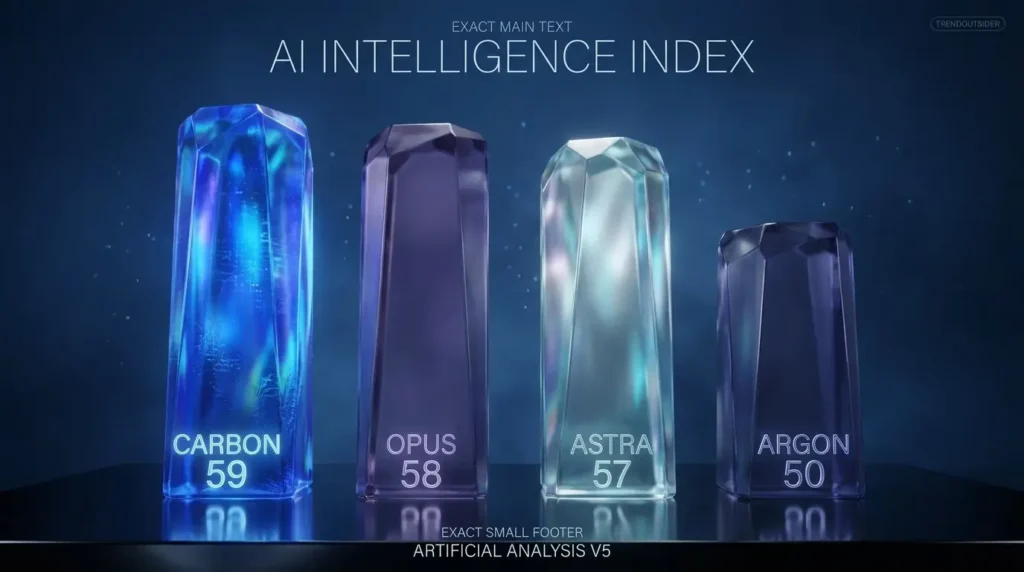
Artificial Analysis Intelligence Index: Carbon scores 59
Google reports that Gemini 4 Carbon achieved a score of 59 on version 5 of the Artificial Analysis Intelligence Index.
At announcement, this placed it ahead of the models shown immediately below it in Google’s comparison.
| Model | Intelligence Index v5 |
|---|---|
| Gemini 4 Carbon | 59 |
| Claude Opus 5.5 | 58 |
| GPT 6 Astra | 57 |
| Gemini 4 Argon | 50 |
Source: Google DeepMind’s Gemini 4 benchmark comparison, October 2026.
The most striking comparison is with Argon.
Carbon scores nine points higher on the same index.
That supports Google’s claim of a meaningful generational improvement within the Gemini 4 family.
But notice something else.
The difference between Carbon and Claude Opus 5.5 is only one point.
The difference between Carbon and GPT 6 Astra is two points.
Those are narrow margins. They should not be turned into claims that Carbon is dramatically smarter than every competing model.
A composite intelligence index is useful evidence, not a complete description of real world performance.
Cybersecurity benchmarks: three different challenges
Google reports three particularly notable cybersecurity results.
| Benchmark | Carbon result | What it evaluates |
|---|---|---|
| SEC bench Pro | 88.2% | Finding real software vulnerabilities |
| ExploitGym | 54.8% | Validating vulnerabilities through controlled exploitation tasks |
| CWE bench | 71.0% | Producing fixes for identified software weaknesses |
These figures come from Google’s announcement and benchmark disclosures.
The evaluations were reported without the model’s deployment guardrails.
That qualification matters because a restricted real world product may behave differently from the model configuration used in a research benchmark.
SEC bench Pro: 88.2%
Finding a vulnerability requires more than recognizing a suspicious line of code.
Some weaknesses depend on interactions between several components.
A function may be safe when used correctly but dangerous when another part of the application supplies unexpected input.
Google reports that Carbon achieved 88.2% on SEC bench Pro.
The result suggests strong performance on the vulnerability discovery tasks included in that evaluation.
It does not establish that Carbon can find 88.2% of all security problems in any software system.
ExploitGym: 54.8%
Not every vulnerability represents the same practical risk.
Security teams often need to determine whether an identified weakness can actually be exploited under specific conditions.
ExploitGym evaluates aspects of this problem.
Carbon’s reported result is 54.8%.
The score is lower than its vulnerability discovery result, illustrating how much harder it can be to move from identifying a possible problem to validating its practical impact.
For defenders, that distinction is important when deciding which issues deserve immediate attention.
CWE bench: 71.0%
Finding a security issue is not enough.
The issue needs to be fixed without damaging the application.
Google reports that Carbon reached 71.0% on CWE bench, which evaluates software weakness remediation.
This result is relevant to developers maintaining large applications where security patches must be accurate, reviewable and compatible with existing functionality.
Human review remains essential, especially for changes affecting authentication, payments, infrastructure or sensitive information.
What independent evaluators found
An independent evaluation from Vals AI offers a useful second perspective.
Vals reported that Gemini 4 Carbon scored 70.36% on Vals Index version 2.2, placing second among 29 evaluated models.
Claude Sonnet 5.5 ranked ahead with 70.85%.
Carbon also performed strongly on several professional research benchmarks, including legal research and finance related evaluations.
That result adds an important qualification to the launch narrative.
Carbon can lead one major intelligence index without leading every independent evaluation.
Vals also reported a 63.13% result for Carbon on its Terminal Bench 4.0 evaluation, which differs from the 65.2% listed in Google’s comparison.
Differences in evaluation configuration, provider settings and methodology can produce different results.
The sensible conclusion is that Carbon is highly competitive, not that one number settles the question of which AI model is best.
Gemini 4 Carbon vs Gemini 4 Argon
Carbon arrives unusually soon after Argon.
That makes the comparison particularly interesting.
Google is not introducing an entirely separate product category.
It is advancing an existing model family with a stronger emphasis on demanding engineering and security tasks.
| Feature | Gemini 4 Carbon | Gemini 4 Argon |
|---|---|---|
| Announcement | October 28, 2026 | Approximately two weeks earlier |
| Intelligence Index v5 | 59 | 50 |
| Terminal Bench 4.0 in Google’s table | 65.2% | 57.1% |
| SEC bench Pro | 88.2% | 83.4% |
| ExploitGym | 54.8% | 42.0% |
| CWE bench | 71.0% | 68.0% |
| General availability at Carbon announcement | Restricted initial rollout | Broader availability |
| Main distinction | Stronger advanced coding and security results | Earlier, more accessible Gemini 4 model |
The clearest difference is not a completely new type of interface.
It is improved performance on difficult tasks.
Carbon performs better across the selected benchmark results in Google’s published comparison.
Google also says its internal secure code generation success rate is more than twice that of Argon.
That is a notable claim, but it comes from Google’s own evaluation.
For someone already using Argon successfully, the practical question is whether Carbon’s additional capability justifies its eventual cost and access requirements.
Until broader testing is possible, that answer remains uncertain.
Gemini 4 Carbon vs Claude Opus 5.5 and GPT 6 Astra
The competition between major AI developers is becoming harder to summarize with a single leaderboard.
Google’s published comparison shows Carbon ahead on the Artificial Analysis Intelligence Index.
But other models lead on individual tasks.
Consider a few examples from Google’s table.
| Benchmark | Gemini 4 Carbon | Claude Opus 5.5 | GPT 6 Astra |
|---|---|---|---|
| Intelligence Index v5 | 59 | 58 | 57 |
| FrontierSWE 2 | 61.2% | 62.3% | 65.5% |
| Terminal Bench 4.0 | 65.2% | 59.6% | 59.1% |
| OSWorld 2.1 offline subset | 81.5% | 87.2% | 80.9% |
| GraphWalks long context | 96.2% | 66.8% | 71.8% |
Source: Google DeepMind’s published Gemini 4 Carbon comparison. These are benchmark results under the stated evaluation configurations, not independent TrendOutsider tests.
Carbon leads in several areas shown here.
GPT 6 Astra performs better on FrontierSWE 2.
Claude Opus 5.5 leads the OSWorld offline subset.
Carbon has a substantial advantage in the GraphWalks long context evaluation.
So which model should you choose?
That depends on the work.
A developer dealing with a very large codebase may care more about long context performance and debugging.
Someone building agents that operate graphical interfaces may care more about computer use evaluations.
A researcher may prioritize accuracy, citations, retrieval quality and cost.
A business deploying AI at scale must also consider availability, security controls, latency and operational reliability.
There is no reason to pretend that one model wins every category.
The broader shift toward AI systems that can act, organize information and build interactive experiences is also visible in our ChatGPT Intelligent UI guide, which explores how AI responses are moving beyond ordinary text.

Can You Use Gemini 4 Carbon Right Now?
As of October 29, 2026, Gemini 4 Carbon is not generally available to ordinary consumers or developers.
Google says the initial rollout is focused on a subset of cybersecurity defenders.
Additional trusted partners will receive access through its Fairwind Program.
The company plans to make Carbon available to developers, businesses and consumers later, but it has not announced a specific date.
That means the announcement should not be confused with a universal release inside the Gemini app.
Is Gemini 4 Carbon available in Google AI Studio?
Google has not announced general Google AI Studio availability for Carbon.
You can use AI Studio to explore supported Gemini models, but you should not assume Carbon will appear in the model selector immediately.
Is Gemini 4 Carbon available through the Gemini API?
Not as a generally accessible public API at announcement.
Google has announced pricing for the model’s planned launch, but pricing information does not establish that an unrestricted API endpoint is already available.
Can Gemini Advanced subscribers use Carbon?
Google has not confirmed that an existing consumer subscription automatically includes Carbon.
Until the company announces a broader rollout, readers should avoid assuming that upgrading a Gemini subscription will unlock the model.
What is Google’s Fairwind Program?
Google describes Fairwind as part of the controlled access process for trusted partners.
In the context of Carbon, the company is prioritizing selected cybersecurity defenders and gradually expanding participation.
This is different from an ordinary public beta where anyone can immediately register and receive access.
Google has not published a universal Carbon access date for all interested developers.
How to check for access when the rollout expands
If you want to use Carbon, the practical approach is straightforward.
- Follow Google’s official Gemini and Google DeepMind announcements.
- Check the model selection options in Google AI Studio.
- Review the official Gemini API documentation for supported model identifiers.
- Check any relevant enterprise or trusted partner access announcements.
- Verify pricing and availability before integrating the model into a production application.
Do not rely on unofficial websites claiming to offer unrestricted Carbon access unless their relationship to Google can be verified.
Gemini 4 Carbon Pricing Explained
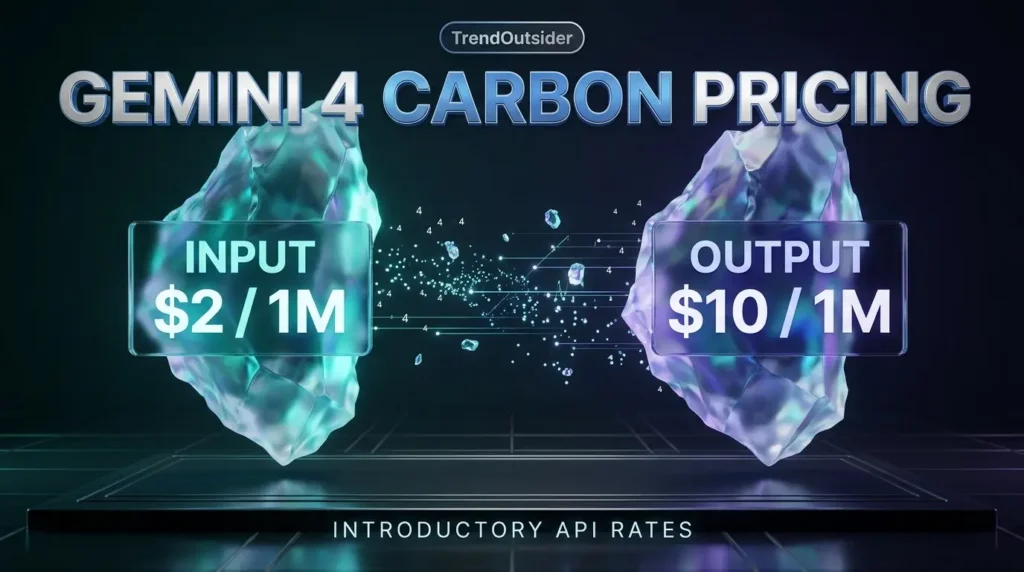
Google has announced introductory and subsequent API pricing.
The introductory rates are:
$2 per million input tokens and $10 per million output tokens.
After the introductory period, Google says the rates will increase to:
$4 per million input tokens and $20 per million output tokens.
The company also announced a 95% discount on cached input tokens during the introductory arrangement.
Google has not specified the exact date when the introductory period will end.
What are input and output tokens?
An input token represents part of the information sent to a model.
That might include a question, instructions, documents or code.
An output token represents part of the response generated by the model.
API providers typically charge separately for these two categories.
Long documents and large codebases can create substantial input usage.
Detailed reasoning, generated code and extensive reports can increase output usage.
Example Gemini 4 Carbon API costs
The following are hypothetical calculations using Google’s announced rates.
They are not bills from actual Carbon API usage.
| Example workload | Introductory cost | Later announced cost |
|---|---|---|
| 100,000 input and 20,000 output tokens | $0.40 | $0.80 |
| 1 million input and 200,000 output tokens | $4.00 | $8.00 |
| 5 million input and 1 million output tokens | $20.00 | $40.00 |
These examples assume ordinary uncached input and output pricing.
Actual charges may depend on the final product terms, caching, model usage patterns and other applicable billing conditions.
Is Gemini 4 Carbon free?
Google has not announced a general free public Carbon offering.
Its announced API rates are paid usage prices.
That does not rule out future consumer access through a subscription or limited free experience, but neither option has been confirmed.
Is Carbon worth the price?
For an individual asking occasional questions, the answer is impossible to determine before the model becomes available.
For a business, the calculation is more interesting.
Suppose a coding agent can reliably identify and fix a problem that would otherwise require several hours of engineering investigation.
In that case, model usage costs may be small compared with the value of the work.
But this is only a possible use case.
It is not evidence that Carbon will produce those savings consistently.
Real costs also include human review, testing, infrastructure, security controls and the consequences of incorrect changes.

Why Google Is Releasing Carbon to Cybersecurity Defenders First
A model that can find software vulnerabilities may be useful to security teams.
The same capabilities can create risks if misused.
This is known as the dual use problem.
A technology developed for legitimate defense may also have applications that require careful safeguards.
Google says it is taking a deliberate approach to Carbon’s rollout and participating in the United States government’s voluntary process for testing advanced models before release.
The initial focus on selected defenders gives Google an opportunity to gather feedback and evaluate safeguards before expanding access.
Can Carbon make software more secure?
Potentially, yes.
Its benchmark results suggest improvements in finding vulnerabilities and preparing fixes.
However, no model should be treated as a substitute for secure development practices.
Developers still need code review, testing, access controls, dependency management and incident response procedures.
AI can help with security work.
It cannot remove the need for accountability.
What about prompt injection?
Prompt injection occurs when untrusted content attempts to influence an AI system’s behavior.
For example, an AI agent reading a document might encounter instructions embedded in that document that attempt to override the user’s actual request.
Google reports that Carbon achieved a 0.0% attack success rate on the evaluated Gray Swan Indirect Prompt Injection benchmark.
That is a strong reported result within the test.
It does not mean Carbon is immune to every possible prompt injection attack.
New attack techniques, different environments and additional integrations can change the risk.
Google also reports that Carbon reduced successful cheating on Terminal Bench 4.0 to 0.0% in its evaluation.
Again, this is a benchmark result rather than a guarantee of flawless behavior.
Can Gemini 4 Carbon Hallucinate?
Yes.
Carbon remains an AI model, and users should not assume that every generated statement is correct.
Google says its internal testing found approximately half as many unsupported claims compared with Argon.
That is encouraging.
But an independent assessment of accuracy can produce a different picture depending on the benchmark.
One analysis of Artificial Analysis results reported that Carbon’s hallucination rate on AA Omniscience increased relative to Argon, even while its overall accuracy improved.
This illustrates an important point.
A model can become more capable while still making mistakes in particular situations.
For tasks involving money, security, legal obligations, healthcare or production infrastructure, the correct approach is to verify important claims and review consequential actions.
The goal should not be to find an AI that never makes mistakes.
It should be to use systems that make fewer mistakes, expose uncertainty clearly and allow humans to catch problems before they cause harm.
What Gemini 4 Carbon Means for Developers
For developers, Carbon’s most interesting potential is not necessarily writing code faster.
It is helping with work that usually requires sustained attention.
Consider a development team responsible for a large application.
The team discovers that a recent update has caused a rare error.
An AI agent could potentially examine the relevant code, compare recent changes, review logs, suggest a correction and prepare tests.
A human engineer would still need to validate the diagnosis and approve the fix.
But the process could become more efficient if the agent maintains context and handles repetitive investigation reliably.
Other possible applications include reviewing code changes, assisting with security remediation, exploring legacy systems and coordinating development tasks.
These are plausible uses based on the capabilities Google describes.
They are not claims that TrendOutsider has independently tested Carbon in production.
What Gemini 4 Carbon Means for Businesses
Businesses evaluating advanced AI models should look beyond leaderboard rankings.
A model that performs well in a benchmark may still be unsuitable for a particular workflow.
For example, a company automating customer support needs to consider accuracy, data protection, escalation rules and the ability to recover from errors.
A company building developer tools may prioritize code quality, context handling and tool execution.
A security organization may place greater importance on vulnerability detection, false positives and the reliability of proposed patches.
Carbon’s early results make it worth watching, particularly for technical teams.
However, restricted availability means most businesses cannot yet conduct a complete evaluation using their own workloads.
That is an important limitation.
Our Microsoft Copilot Autopilot guide explores another part of the same industry shift: AI agents designed to manage ongoing business work rather than answer isolated prompts.
Carbon approaches the challenge from the perspective of a powerful underlying model.
Enterprise products must still provide the surrounding permissions, integrations, monitoring and controls.
What Gemini 4 Carbon Means for Everyday Users
For most people, the immediate impact is limited.
If you use Gemini to summarize documents, brainstorm ideas, explain concepts or help with writing, Carbon does not automatically change your experience today.
Google has not announced universal consumer access.
The longer term implications are more interesting.
If the improvements translate into widely available products, future AI assistants could become better at complicated tasks that require planning, research and follow through.
Instead of answering a single question, an assistant might coordinate several steps, check its own work and ask for approval when a decision has meaningful consequences.
That is the direction many AI companies are pursuing.
Carbon is another indication of how important that direction has become.
But readers should distinguish a promising model announcement from a finished consumer feature.
Five Things Google Has Not Fully Answered
Despite the extensive benchmark disclosures, several practical questions remain open.
1. When will everyone get access?
Google has not announced a firm date for general developer or consumer availability.
2. Which products will include Carbon?
The company has not confirmed a complete list of consumer applications, enterprise products or subscriptions that will offer the model.
3. How will it perform in everyday use?
Independent benchmarks provide useful evidence, but broad public testing across ordinary tasks remains limited.
4. What will the final cost look like?
Google has published API rates, but the duration of introductory pricing and the complete range of eventual consumer offerings remain unclear.
5. How reliable will it be in production?
Google reports improved alignment, security and coding performance.
Real deployments will need to establish how those improvements hold up under varied workloads, integrations and security requirements.
These are not reasons to dismiss Carbon.
They are the questions that will determine whether the model’s impressive announcement becomes a meaningful improvement for ordinary users.
Frequently Asked Questions About Gemini 4 Carbon
What is Google Gemini 4 Carbon?
Gemini 4 Carbon is an advanced AI model developed by Google DeepMind. It focuses on complex reasoning, software engineering, long running AI agent tasks and cybersecurity.
When was Gemini 4 Carbon announced?
Google announced Gemini 4 Carbon on October 28, 2026.
Is Gemini 4 Carbon available now?
It is initially available to selected cybersecurity defenders. General consumer and developer availability has not yet been announced.
How can I access Gemini 4 Carbon?
Google is expanding access gradually through trusted partners and its Fairwind Program. Most users must wait for a broader rollout announcement.
Is Gemini 4 Carbon free?
Google has not confirmed a general free public offering. Its announced introductory API prices are $2 per million input tokens and $10 per million output tokens.
Is Gemini 4 Carbon better than Gemini 4 Argon?
Carbon performs better than Argon across the benchmark results highlighted in Google’s official comparison. Its advantages include coding, security and advanced reasoning, although broader practical testing is still needed.
Is Gemini 4 Carbon better than Claude Opus 5.5?
Carbon leads Claude Opus 5.5 on the Artificial Analysis Intelligence Index version 5, with scores of 59 and 58 respectively. Claude performs better on some other evaluations, so there is no universal winner.
Is Gemini 4 Carbon better than GPT 6 Astra?
Carbon leads on some reported benchmarks, including the Artificial Analysis Intelligence Index, while GPT 6 Astra leads on certain coding evaluations such as FrontierSWE 2. The better model depends on the task.
What is Gemini 4 Carbon’s context window?
Vals AI lists a context window of approximately one million tokens for Carbon. Actual limits should be checked against Google’s developer documentation when general API access becomes available.
Can Gemini 4 Carbon write code?
Yes. Coding is one of its main areas of focus. Google reports improvements in software engineering, debugging and extended agent workflows.
Can Gemini 4 Carbon find security vulnerabilities?
Google reports strong results on vulnerability discovery benchmarks, including 88.2% on SEC bench Pro. These results do not guarantee that it will detect every vulnerability in a real application.
Does Gemini 4 Carbon have an API?
Google has announced planned API pricing, but general public API access was not available at the time of the October 28 announcement.

Final Verdict: Is Gemini 4 Carbon a Major AI Breakthrough?
Gemini 4 Carbon is one of the more significant AI model announcements of October 2026.
Its reported improvements are not limited to writing better answers or generating more polished code.
Google is pushing toward models that can investigate difficult problems, work across complicated software systems and contribute to cybersecurity defense.
The benchmark results are strong.
A score of 59 on the Artificial Analysis Intelligence Index puts Carbon at the top of that particular ranking at announcement.
Its cybersecurity results are also noteworthy, particularly when considered across vulnerability discovery, validation and remediation.
But the most important question is still unanswered.
How well will Carbon perform when ordinary developers and businesses can use it on their own problems?
Google’s early results suggest substantial progress.
Independent evaluations support the view that Carbon is highly competitive, while also showing that other models remain stronger on certain tasks.
For now, Carbon is a promising frontier model with restricted access, not an AI assistant everyone can immediately install and use.
If you are a developer or security professional, it is worth following closely.
If you are an everyday Gemini user, there is no need to rush into a new subscription based on the announcement alone.
Wait for official access details, real world testing and clear information about what the model will actually cost.
The next major Gemini 4 Carbon story will not simply be another benchmark score.
It will be what happens when people finally get to use it.
Sources and Editorial Methodology
This article is based on publicly available information reviewed on October 29, 2026.
Primary sources:
- Google: Introducing Gemini 4 Carbon — Official announcement, benchmark results, security claims, pricing and availability.
- Google DeepMind: Gemini Models — Official model comparisons and capabilities.
- Vals AI: Gemini 4 Carbon Evaluation — Independent model evaluation and professional benchmark results.
- The Verge: Google Gemini 4 Carbon — Independent technology reporting.
- Investing.com: Google Unveils Gemini 4 Carbon — Independent coverage of the announcement.
Editorial disclosure: TrendOutsider has not independently tested Gemini 4 Carbon. Benchmark scores and performance claims are attributed to their published sources. Examples of developer and business workflows are illustrative, not measured case studies. Pricing and availability may change after publication.
Last researched: October 29, 2026.








Leave a Reply