

When I started researching AI freelance writing jobs, I kept seeing the same claim: freelancers are earning $5,000 a month with minimal effort. Then I’d dig deeper and find the reality was messier. Some writers were genuinely earning solid income. Others struggled at commodity rates. The difference wasn’t talent. It was strategy.
Here’s what I found after reviewing platform data, published rate surveys and tool documentation: AI freelance writing jobs are real, and writers who specialize can earn more than generalists. But the market has split. Commodity writing is under heavy price pressure, while specialist writing still commands premium rates.
This article walks you through which AI tools that professionals use to work faster actually work, what they cost, where to find jobs, and how to position yourself to earn at the top. If you’re considering freelance writing in 2026 or already freelancing and wanting to improve, this is the practical guide you need.
Note: This is informational content. Your actual earnings depend on specialization, market positioning, effort level, and time invested. Results vary by individual.
Quick Answer
Can you actually make money as a freelance writer with AI tools in 2026? Yes, but income varies widely. What you earn depends on your experience, your specialization, the clients you win, the rates you can charge and how much work you take on. It’s not passive income and it’s not guaranteed.
The critical factor isn’t which tool you choose first. It’s how you position yourself. A freelancer selling “AI writing services” competes on price with everyone else. A freelancer offering “B2B SaaS blog content written with AI efficiency” commands premium rates because they’re solving a specific business problem.
Here’s the realistic timeline:
- First week: Set up profiles, create samples (8-12 hours work)
- Weeks 2-4: Pitch for and land your first projects
- Month 2: Build your reputation and adjust your rates based on client feedback
- Month 3+: Focus on one niche and repeat clients for steadier work
Tool investment required: $20-100 monthly depending on your strategy. Start with the smallest setup that fits your niche. The table below compares setups by cost, fit and limitations, not by income.
| Strategy | Monthly Tool Cost | Best For | Main Limitation |
|---|---|---|---|
| Free tools only | $0 | Testing the market and building samples | Usage caps; generic output needs heavy editing |
| One paid tool (ChatGPT Plus) | $20 | Regular client work in one niche | You rely on one tool’s strengths and weaknesses |
| Full stack (ChatGPT, Jasper, Grammarly) | $100-150 | Higher-volume or specialist work | Higher monthly cost and more tools to learn |
What AI Freelance Writing Jobs Are
AI freelance writing jobs are remote positions where you use artificial intelligence writing tools to create content faster, then sell that work to clients. The AI handles the heavy lifting. Your job is editing, fact-checking, optimizing for client intent, and delivering polish.
Here’s what matters: you’re not handing clients raw AI output. You’re delivering strategically improved content that solves their business problem. ChatGPT drafts a blog article in 30 minutes. You spend another 60 minutes editing, fact-checking, optimizing for search intent, and customizing for their brand voice. The client pays for the result, not your time.
Common AI freelance writing jobs in 2026 include:
- Product descriptions for e-commerce (Copy.ai or Jasper focused)
- Blog writing for B2B SaaS companies (ChatGPT or Claude)
- Email sequences and marketing campaigns (ChatGPT)
- Long-form guides and whitepapers (Claude)
- Social media content batching (Jasper at scale)
- Ghostwriting for founders and entrepreneurs (Claude)
- LinkedIn content for professionals (ChatGPT)
- Ad copy and landing page content (Jasper)
- Newsletter writing (Writesonic)
These aren’t jobs where you disappear after sending a draft. These are jobs where AI makes you faster, not cheaper. The speed enables higher rates or more clients, not lower pricing.
Why This Matters in 2026
The freelance writing market transformed in 2025-2026. Three things happened simultaneously:
The market split in two. Mediabistro’s March 2026 analysis describes the freelance writing market as splitting in two: commodity work is under heavy pressure while specialist writing holds its value. Specialized, strategy-driven writing increased in value as clients realized AI output alone isn’t sufficient. They need writers who understand their industry, can edit AI content intelligently, and position it strategically.
Data proves the opportunity is real. Upwork reported that AI-related freelance work crossed $300 million in annualized value by late 2025. In its fourth-quarter 2025 results, Upwork said professionals working on AI projects earned 36% more per hour (it had reported 44% for 2024).
Specialization became mandatory. A “freelance writer using AI tools” is hard to sell at premium rates. A “B2B SaaS blog writer who uses AI to deliver SEO-optimized content 40 percent faster” is easy to sell. Your positioning matters more than your general writing ability in 2026. Pick a niche: e-commerce, healthcare, fintech, real estate, cybersecurity, etc. Become known as the go-to person for that niche.
How We Evaluated These Tools
This article reviews seven AI tools and platforms based on:
- Tool cost and free tier availability
- Typical use cases and main limitations
- Ease of use for beginners
- Where to find clients for that tool
- Best use cases and positioning
We focused on tools that have been battle-tested by freelancers in 2025-2026, not experimental AI tools that might disappear. We also focused on showing what actually works based on platform data (Upwork job listings, Fiverr gig requirements, Mediabistro research) rather than theoretical potential.
The 7 Best AI Tools for Freelance Writing Jobs
ChatGPT and ChatGPT Plus ($0-$20/month)

What it is: General-purpose AI writing assistant that drafts content in virtually any format. The free version has usage limits. ChatGPT Plus ($20/month) offers higher usage limits and broader model access, although OpenAI says message caps can still apply.
Best for: Content writers, email copywriters, social media creators, script writers, and anyone starting with minimal investment.
Key strengths: Incredibly versatile. Can handle blog posts, product descriptions, emails, social content, scripts, or technical writing. Fast output. Easy to learn. The free version is genuinely useful for testing before paid investment.
Main limitation: Can produce generic output without skilled editing. Free version has usage caps. Requires human refinement to shine.
Pricing: Free or $20/month Plus.
Who should avoid it: Writers unwilling to spend 30-60 minutes editing AI output. Those expecting completely finished, publication-ready content with zero human touch.
Practical use case: Draft a 2,000-word blog post in 45 minutes that would take 2-3 hours manually. Spend 45 minutes editing and optimizing.
Claude and Claude Pro ($0-$20/month)
What it is: Advanced AI writing platform from Anthropic, known for nuanced reasoning and producing more human-like prose. Claude Pro ($20/month) offers priority access and higher usage limits.
Best for: Long-form writers, B2B SaaS content creators, technical writers, ghostwriters, and anyone needing more sophisticated output.
Key strengths: Produces naturally written content. Excellent reasoning for complex topics. Better at maintaining voice consistency. Stronger at long-form writing where subtlety matters. Great for content that requires industry knowledge.
Main limitation: Slightly slower than ChatGPT. Less focused on marketing templates. Requires understanding how to prompt effectively.
Pricing: Free (limited) or $20/month Pro.
Who should avoid it: Marketers needing quick templates. Those wanting speed over quality. High-volume content creators working on tight deadlines.
Practical use case: Write a 5,000-word B2B guide for fintech companies in 4-5 hours including editing. For example, businesses using AI to improve their operations need exactly this type of strategic content.
Jasper AI ($39-$200+/month)
What it is: Marketing-focused AI writing platform with built-in templates, brand voice controls, and bulk content generation. Designed specifically for scaling content production.
Best for: E-commerce product description writers, social media creators at scale, marketing agencies, and anyone needing to generate dozens of pieces quickly.
Key strengths: Templates save setup time. Can generate 50+ pieces in hours. Built-in SEO features. Brand voice consistency. Integrates with multiple platforms. Good for bulk e-commerce work.
Main limitation: Monthly cost is higher. Templates can feel generic without customization. Overkill for beginners doing occasional projects.
Pricing: $39/month Starter to $200+/month Professional.
Who should avoid it: Budget-conscious beginners. One-off project freelancers. Anyone not needing scale.
Practical use case: Generate 50 product descriptions for e-commerce in 3-4 hours.
Copy.ai ($0-$50+/month)
What it is: Beginner-friendly AI writing tool focused specifically on marketing copy and marketing content. Simpler interface than competitors.
Best for: E-commerce sellers, email marketers, ad copywriters, complete beginners, and anyone wanting the lowest learning curve.
Key strengths: Free version is genuinely useful. Simple, intuitive interface. Fast learning curve. Good for marketing copy specifically. Affordable paid plans.
Main limitation: Specialized for marketing (not good for long-form). Less nuanced than Claude. Output can feel formulaic.
Pricing: Free (limited) or $50+/month paid plans.
Who should avoid it: Long-form writers. Technical content creators. Anyone needing versatility across content types.
Practical use case: Generate 20 product descriptions per day on Fiverr.
Writesonic ($15-$200+/month)
What it is: Middle-ground AI writing tool balancing ease of use with quality output. Good for blog writing and content marketing.
Best for: Blog writers, newsletter creators, content marketers, and anyone wanting professional output without enterprise-level complexity.
Key strengths: Good balance between simplicity and power. Blog-specific features. Affordable entry pricing. Quality output.
Main limitation: Monthly cost, even at entry level. Can feel formulaic without customization.
Pricing: $15/month Starter to $200+/month Professional.
Who should avoid it: Absolute budget-conscious beginners. Those needing specialized output (e-commerce, technical, etc.).
Practical use case: Write 1 blog article per hour including editing.
Grammarly Premium ($30/month)
What it is: Quality control and editing assistant. Not a content generation tool but a force multiplier for everything you generate.
Best for: Every freelancer using AI tools. Essential for maintaining professional quality.
Key strengths: Catches quality issues AI tools miss. Speeds up editing significantly. Improves consistency.
Main limitation: Doesn’t generate content. Only improves existing content.
Pricing: $30/month Premium.
Who should avoid it: Anyone not worried about quality (though this is short-sighted).
Practical use case: Edit AI-generated content faster and more consistently, so you can deliver cleaner work to clients.
Impact: Helps you deliver cleaner, more professional work. Non-negotiable for serious freelancers.
Semrush (from $139/month)
What it is: SEO specialist tool for keyword research, competitor analysis, content optimization, and positioning.
Best for: SEO writers, B2B content strategists, anyone specializing in search-optimized content at premium rates.
Key strengths: Serious SEO credentials. Client-facing data. Justifies premium pricing. Positions you as SEO expert, not generic writer.
Main limitation: High cost. Requires SEO knowledge to use well. Overkill for non-SEO specializations.
Pricing: From $139/month for the SEO plan ($117.33/month billed annually). Plans that add AI search visibility start at $199/month. Check Semrush’s pricing page for current rates.
Who should avoid it: Beginners. Anyone not specializing in SEO content. Those on tight budgets.
Practical use case: Create SEO brief using Semrush data. Write optimized article for B2B client. Build your niche with SEO-focused content writing using AI to command premium rates.
Comparison Table
| Tool | Monthly Cost | Free Plan Available | Best For | Main Limitation | Learning Curve | Ideal User |
|---|---|---|---|---|---|---|
| ChatGPT Plus | $20 | Yes (limited) | All-around content | Generic output without editing | Very low | Beginners, versatility seekers |
| Claude Pro | $20 | Yes (limited) | Long-form, B2B | Fewer marketing templates | Low | Quality-focused writers |
| Jasper | $39-200 | No | Bulk, e-commerce | Higher monthly cost | Low-medium | Scalers, agencies |
| Copy.ai | $0-50 | Yes (useful) | E-commerce, simple | Not built for long-form | Very low | Complete beginners |
| Writesonic | $15-200 | Limited | Blog, newsletter | Can feel formulaic | Low | Content marketers |
| Grammarly | $30 | Yes (limited) | Quality control | Doesn’t generate content | Very low | All freelancers |
| Semrush | $139+ | No | SEO specialists | High cost; needs SEO knowledge | Medium | SEO experts |
How to Choose the Right Tool
Ask yourself these five questions:
Question 1: What’s your starting budget?
- $0-20/month: Start with ChatGPT Free or Copy.ai Free and Fiverr
- $20-50/month: ChatGPT Plus or Claude Pro opens better clients
- $100-150/month: Add Jasper or Writesonic for specialization
- $150+/month: Build full stack with optional Semrush for premium positioning
Question 2: What type of writing appeals to you?
- E-commerce product copy: Copy.ai or Jasper
- Blog posts: Writesonic or ChatGPT
- Long-form strategy content: Claude
- Social media at scale: Jasper
- Emails and campaigns: ChatGPT or Writesonic
Question 3: Where will you find clients?
- Fiverr: Focus on speed and volume (Copy.ai, Jasper)
- Upwork: Emphasize specialization and rates (ChatGPT, Claude)
- Direct outreach: Build positioning and expertise (Claude, Semrush)
Question 4: How much time can you invest?
- Quick to profitable (weeks): E-commerce on Fiverr
- Slower but sustainable (months): B2B SaaS with direct clients
Question 5: What’s your specialization?
This matters more than tool choice. Pick a niche first, then choose the tool that serves it best.
Cost and Value Analysis
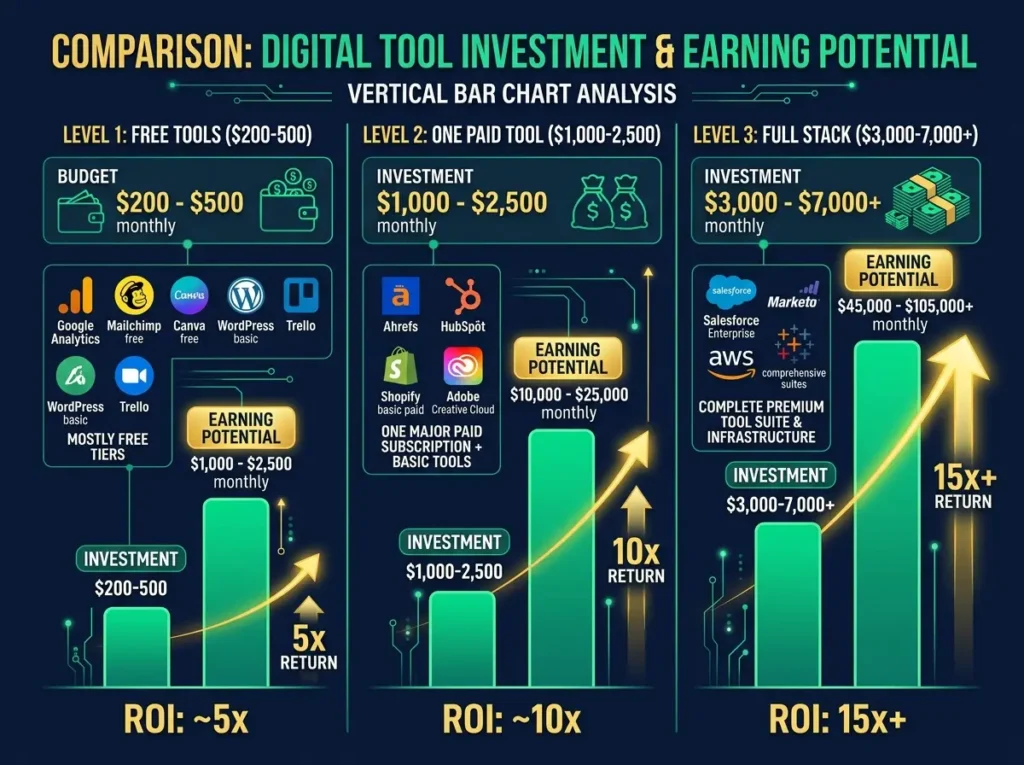
Here are three example setups at different budgets. They show which tools fit each stage, not what you will earn.
Scenario 1: Zero Investment, Absolute Beginner
- Tools: ChatGPT Free, Copy.ai Free, Fiverr account
- Value: Proves the concept works
Scenario 2: Modest Investment, Building Phase
- Tools: ChatGPT Plus ($20)
- Value: Better clients, professional positioning
Scenario 3: Full Stack, Professional Approach
- Tools: ChatGPT Plus ($20) + Claude Pro ($20) + Jasper ($99) + Grammarly ($30)
- Value: Premium client access, specialization capability
Start with the smallest setup that fits your niche, and add paid tools only when your workload justifies the cost. Then you can manage and budget the income you’re earning as it grows.
Step-by-Step Implementation Plan

Week 1: Setup and Samples
- Day 1-2: Choose one primary tool (I recommend ChatGPT Plus if budget allows)
- Day 2-3: Create profiles on Upwork and Fiverr
- Day 3-5: Write 3-5 sample pieces using your chosen tool
- Day 5-7: Polish samples and optimize profile copy
- Critical: Position by niche, not skill (“B2B SaaS blog writer using AI” not “freelance writer”)
- Time: 10-15 hours
- Outcome: 3-5 professional samples ready for pitching
Weeks 2-4: First Client Projects
- Apply to 5-10 Upwork jobs with personalized proposals
- Create 2-3 Fiverr gigs at competitive rates
- Timeline: Response times vary, so follow up and keep applying
- Time: 8-12 hours
- Outcome: 1-2 completed projects, client feedback collected
Month 2: Evaluate and Scale
- Review which tool and job type generated income
- Gather positive feedback and testimonials
- Upgrade tools if results justify investment
- Adjust rates based on feedback and demand
- Target: 3-5 active clients or 10-15 Fiverr gigs selling
- Time: 20-30 hours working
- Outcome: a clearer view of which tools and services work for you
Month 3+: Specialization and Direct Clients
- Double down on what worked (don’t diversify yet)
- Move toward retainer clients for income stability
- Start direct client outreach via LinkedIn or email
- Use AI workflows that increase productivity to scale faster
- Expected outcome: a clear niche and your first repeat or retainer clients
Common Mistakes and Risks
Mistake 1: Selling Raw AI Output
Many beginners think they can just hand clients unedited AI output. Wrong. Clients can generate that themselves for free. Your value comes from editing, fact-checking, and strategic optimization. Always spend 30-50 percent of your time on quality control.
Mistake 2: Using Only Free Tools
Free tools often mean competing with low-rate freelancers on low-value platforms. One paid tool ($20-50/month) can help you produce stronger samples and compete for better-paying work, but the tool alone does not set your rates.
Mistake 3: Positioning as Generic “Freelance Writer Using AI”
You’ll compete on price with everyone else. “B2B SaaS blog writer who uses AI” beats “freelance writer” every time at premium rates. Specialization is your competitive advantage.
Mistake 4: Starting with Too Many Tools
Beginners often spread themselves thin across five tools. Master one tool for 4-6 weeks. Then add a second. Expertise in one tool beats mediocrity in five.
Mistake 5: Underpricing Because You Use AI
Speed doesn’t mean cheaper. It enables premium rates or more clients. You’re not competing on price. You’re competing on value and specialization.
Risk 1: Market Saturation
More freelancers enter AI-assisted writing monthly. Differentiation through specialization is critical. A generic “AI freelancer” competes mainly on price, while a “healthcare fintech AI copywriter” can compete on expertise.
Risk 2: Client Concern About Ethics
Some clients worry about AI ethics. Be transparent. “I use AI tools to draft faster, then extensively edit and fact-check everything.” Honesty builds trust.
Risk 3: Tool Dependency
If you rely on one tool and it changes pricing or quality, you’re vulnerable. Learn 2-3 tools. Know ChatGPT AND Claude.
FAQ
Q: Can I start with just free tools?
A: Yes, free tools are enough to build samples and test the market, but usage caps and generic output mean more editing time. Many freelancers add one paid tool once they have regular work.
Q: How long until I get my first paid project?
A: It varies with your niche, samples, proposals and platform. Keep applying, follow up, and refine your profile based on the responses you get.
Q: Do clients care which AI tool I use?
A: No. Clients care about quality, deadline, and solving their problem. ChatGPT vs. Claude is invisible to them. Your specialization and delivery matter.
Q: Is it ethical to use AI tools for client work?
A: Yes, if transparent and delivering quality. In 2026, using AI tools is standard practice. The ethical issue would be misrepresenting (claiming you wrote everything manually) or delivering unedited output.
Q: Will AI completely replace freelance writers?
A: No. What’s happening is specialization. Generic, low-expertise writing is commoditized. Strategic, specialized writing is increasing in value. Position yourself at the specialized tier.
Q: Which tool should I start with if I have only $20/month?
A: ChatGPT Plus. Most versatile for any writing task. Or Copy.ai Free if wanting e-commerce focus.
Q: How much should I charge per article or project?
A: Rates vary widely by platform, niche, experience and project scope. Check what established writers in your niche currently charge on the platforms you use, and price on the value you deliver. Don’t undercut based on using AI.
Q: Should I tell clients I’m using AI tools?
A: Yes. Be transparent about process. Emphasize your editorial control and fact-checking. Honesty positions you as professional.
Q: Can I use these tools on different platforms?
A: Yes. Each platform has different rate expectations. Fiverr: lower rates, higher volume. Upwork: medium rates, competitive. Direct clients: highest rates.
Q: What’s the difference between ChatGPT and Claude?
A: ChatGPT is more versatile and faster. Claude is better for nuanced, complex, long-form work. Both work. Your choice depends on project type.
Q: Do I need writing experience?
A: No. You need editing skills and market knowledge. AI handles drafting. Your job is improving and optimizing. If you can edit and understand your niche, you can succeed.
Final Recommendation
For Complete Beginners (Zero Experience)
Start with ChatGPT Free or Copy.ai Free plus Fiverr. Investment: $0. Strategy: Prove it works, then upgrade.
For Budget-Conscious Starters ($20-50/month)
Best setup: ChatGPT Plus plus Grammarly Free plus Upwork. Investment: $20. Strategy: Better clients, build reputation.
For Serious Professionals ($100-200/month)
Best setup: ChatGPT Plus, Claude Pro, Jasper or Writesonic, Grammarly, optional Semrush. Investment: varies with the tools you choose (see the comparison table above). Strategy: Premium positioning, specialization.
For Everyone
Pick one niche and own it. Invest in one tool and master it. Position by industry, not skill. Deliver quality. Track what works and double down. You can also build multiple income streams with AI by combining freelance writing with complementary income sources.
Conclusion
AI freelance writing jobs are real in 2026, but only for writers who specialize and use tools strategically. The market has split decisively. The bottom is collapsing to commodity rates. The top is thriving at premium pricing.
Your path is straightforward: choose one AI tool, master it for 4-8 weeks, specialize in a specific industry or content type, build a portfolio, then scale to direct clients and retainer income.
Successful freelance writers in 2026 aren’t waiting for perfect conditions. They’re using imperfect tools today, delivering excellent work faster, and building lasting client relationships. You can do the same.
Your next step is simple. Choose one tool this week. Create 3-5 samples. Post on Fiverr or apply on Upwork. From there, scale what works and raise your rates as you improve. Then use AI to manage and grow your money as your freelance income increases.
The best AI freelance writing jobs go to freelancers who specialize and position themselves clearly. That’s your opportunity. You can also explore AI tools for creating different types of content to diversify your service offerings and increase income potential.






Comments (2)
100 Ways to Make Money With AI in 2026: Realistic Earnings & Quick Startsays:
June 21, 2026 at 7:06 pm[…] earns $3,200 per month writing 25 to 30 posts monthly. For writers interested in specialization, AI freelance jobs that professionals are bidding on today offer proven platform strategies and premium positioning techniques. She spends 2 to 3 hours daily […]
AI Tutor Jobs 2026: Which Companies Hire + Income Guidesays:
July 6, 2026 at 9:01 pm[…] targets writers and people with strong critical thinking skills. If you’re interested in AI freelance writing opportunities, this option works similarly to other writing-focused AI jobs but with better pay […]