

Introduction: The AI Startup Boom Is Just Getting Started
Something unprecedented is happening in technology right now, and most people haven’t fully grasped the scale of it yet.
Over the past three years, generative AI has gone from a research curiosity to a multi-billion dollar startup ecosystem. We’re talking about companies that barely existed in 2022 now commanding valuations that rival established Silicon Valley giants.
The numbers tell the story. More than $200 billion has flowed into generative AI startups globally between 2023 and 2026. Over 50 private AI companies now carry valuations above $1 billion. Some of the most valuable private companies in the world are AI startups that didn’t exist five years ago.
But here’s what matters more than the hype: these companies are building products that actually work and that people actually use.
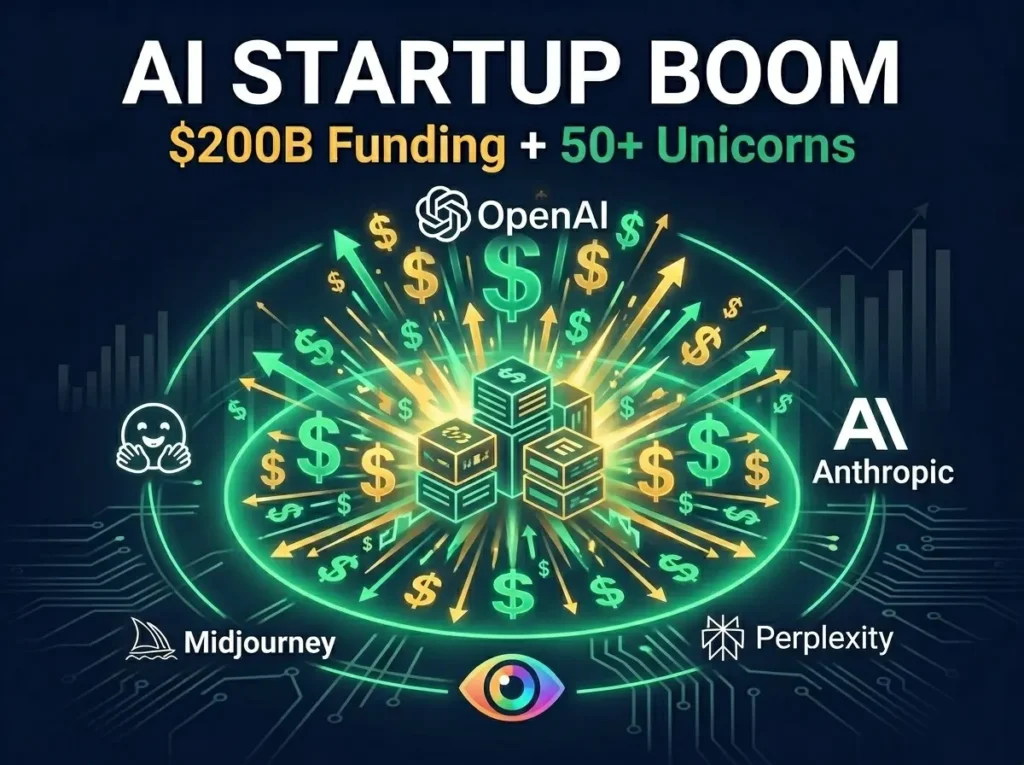
This guide covers more than 50 generative AI startups and shows you which ones matter, what categories are growing fastest, and how to evaluate whether an AI company is worth your time, your money, or your career.
Whether you’re an entrepreneur considering an AI startup, an investor looking at this space, a business deciding which AI tools to adopt, or someone trying to understand where technology is heading, this guide gives you the information you need to make smart decisions.
The most important insight is this: generative AI isn’t one market. It’s becoming the infrastructure layer for dozens of markets. The winners won’t only be the companies with the biggest models or the most funding. They’ll be the companies solving real problems, building strong distribution, and creating products people use every day.
How the Generative AI Startup Landscape Changed Between 2023 and 2026
The generative AI startups market has evolved dramatically in just a few years.
In 2023, the big question was whether AI assistants could compete with human workers. The answers from companies like OpenAI and Anthropic suggested that yes, AI was genuinely useful for many tasks.
By 2024, the conversation shifted. It became less about whether AI works and more about which AI startups would survive the inevitable market shake-out. Hundreds of me-too chatbots launched and failed. The winners were companies solving specific problems for specific customers.
In 2026, we’re seeing a maturity phase. Profitable unit economics matter. Customer retention matters. Defensible competitive advantages matter. The days of raising massive funding on hype alone are ending.
Why This Moment Matters
Generative AI startups attract capital because the potential is genuinely enormous. If AI can improve how people work, search, communicate, create, and make decisions, the revenue opportunity is massive.
But capital is not distributed evenly across the market.
Foundation model companies need extraordinary amounts of money. Training a competitive language model requires expensive compute infrastructure, world-class research talent, massive datasets, safety infrastructure, and enterprise sales organizations. That’s why funding concentrates in a smaller number of companies.
Meanwhile, application startups can succeed with far smaller funding rounds. A company building AI tools for a specific profession might raise $5 million to $30 million and reach profitability. That’s because they’re solving narrow problems for customers who are willing to pay.
This dynamic creates opportunity. You don’t need to build the next ChatGPT to build a valuable AI company. You need to identify a painful problem and solve it better than anything else available.
The Major Categories Driving Growth
The most active and important generative AI startups categories include language models, AI search engines, image and video generation, AI coding tools, enterprise AI, healthcare AI, legal tech, financial services AI, and infrastructure companies.
Each category serves different customers and creates different competitive dynamics. Understanding these categories helps you see where actual opportunities exist versus where there’s just hype.
Tier 1: Unicorn AI Companies That Are Reshaping Markets
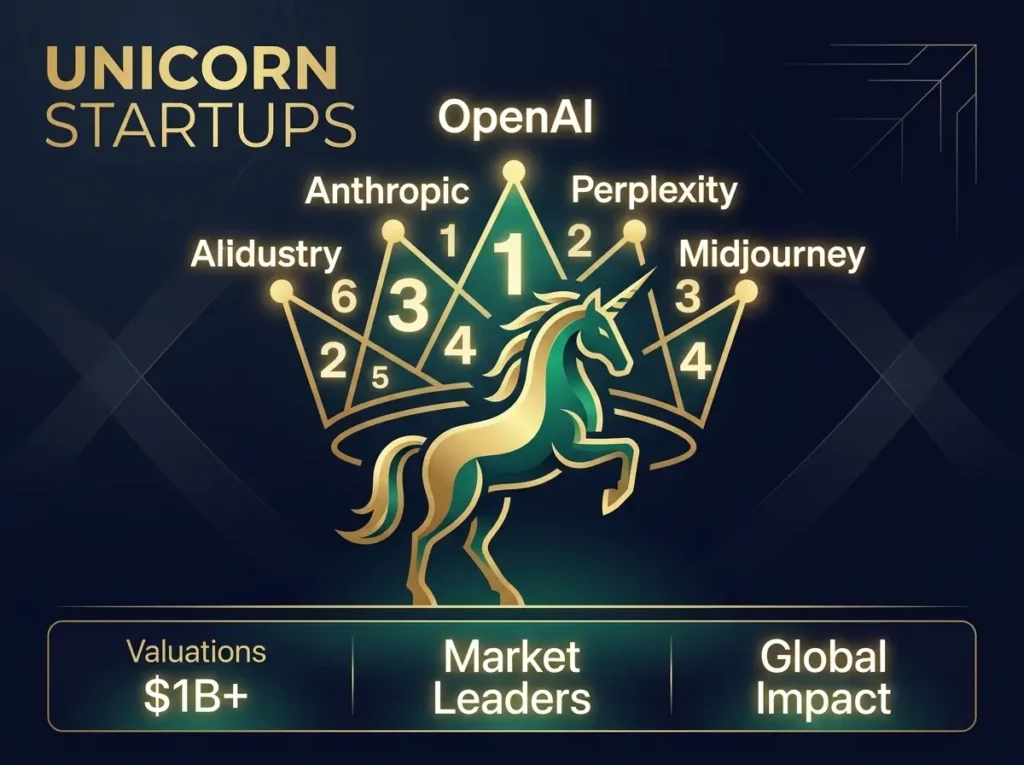
This first group includes private AI companies that have already become major forces. Some are foundation model labs. Some are consumer platforms. Some are infrastructure companies. All of them have reached valuations exceeding $1 billion.
These companies are important because they’re setting the tone for the entire market. They’re showing what’s possible and where capital flows.
OpenAI: The Company That Opened Pandora’s Box
OpenAI is the most famous generative AI company because ChatGPT made AI accessible to ordinary people.
What OpenAI actually does is broader than chatbots. The company builds advanced language models, provides APIs for developers, sells enterprise products, and continuously releases new capabilities like image generation and improved reasoning.
Why OpenAI matters: It shaped how the entire market thinks about AI. Hundreds of startups exist because OpenAI proved that AI assistants could be genuinely useful. Some startups build on top of OpenAI’s APIs. Some compete directly. All of them are responding to what OpenAI established.
For investors and founders, OpenAI remains the benchmark. When evaluating other AI companies, the question is always: how does this compare to OpenAI?
Anthropic: Building a Different Kind of AI Company
Anthropic was founded by researchers who wanted to build AI with a different philosophical approach, emphasizing safety and reliability over raw capability chasing.
The company’s main product is Claude, which has become a strong competitor to ChatGPT. Among professionals, researchers, and companies that value thoughtful AI systems, Claude has become increasingly popular.
Why Anthropic matters: It proved you can compete with OpenAI on performance while building a brand around responsibility. That’s a differentiation strategy that actually works in the market. Enterprise customers especially care about reliability and safety.
Perplexity: How AI Is Improving Search
Perplexity is an AI search engine that gives you direct answers with source citations, instead of making you click through ten blue links.
For researchers, students, and professionals, this is genuinely better than traditional search. You ask a question and get a comprehensive answer immediately, with sources listed so you can verify information.
Why Perplexity matters: It shows how AI can improve fundamental technology categories. It also demonstrates that Google’s search dominance is not inevitable. When AI can do something better, user behavior shifts remarkably fast.
Midjourney: Why AI-Generated Images Changed Creative Work
Midjourney created beautiful AI-generated images and became the platform of choice for designers, artists, marketers, and creators.
The company succeeded because the output quality is genuinely impressive, the user experience is intuitive, and it solved a real problem: creating visual concepts quickly.
Why Midjourney matters: It showed that AI-generated content could become a real creative tool, not just a novelty. It also demonstrated the power of strong community and user experience in a competitive market.
Hugging Face: The Open Source Foundation for AI Development
Hugging Face is less famous than ChatGPT but arguably more important to the AI ecosystem.
The company hosts open source AI models, datasets, and tools that thousands of developers and startups use every day. If you want to build an AI application, Hugging Face is often where you start.
Why Hugging Face matters: It became part of the infrastructure that the entire AI industry depends on. That gives it tremendous value and defensibility.
Other Important Unicorn Companies
ElevenLabs for voice generation, Scale AI for data infrastructure, Figure AI for robotics, and Runway for video generation are all major players that have found specific categories where they can dominate.
The pattern is clear: successful unicorn AI companies are the ones that either found a category they own or built infrastructure others depend on.
Table 1: 50+ Generative AI Startups Across Major Categories
| Category | Company | Main Focus | Why It Matters |
|---|---|---|---|
| LLM | OpenAI | General models | Market leader |
| LLM | Anthropic | Claude models | Strong competitor |
| LLM | Mistral AI | European models | Privacy-focused alternative |
| LLM | xAI | Grok models | Real-time AI |
| LLM | Cohere | Enterprise models | B2B focused |
| Search | Perplexity | AI search engine | Disrupting Google |
| Search | Glean | Enterprise search | Internal knowledge AI |
| Image Gen | Midjourney | Image creation | Professional quality |
| Image Gen | Black Forest Labs | Image models | Technical excellence |
| Video Gen | Runway | Video creation | Professional tools |
| Video Gen | Pika | Text-to-video | Accessible creation |
| Video Gen | Luma AI | 3D and video | Spatial AI |
| Voice Gen | ElevenLabs | Voice synthesis | Professional quality |
| Music Gen | Suno | AI music | Consumer friendly |
| Coding | Cursor | AI code editor | Developer productivity |
| Coding | Cognition AI | Coding agents | Autonomous coding |
| Coding | Replit | Browser coding | Accessible development |
| Enterprise | Writer | Content platform | B2B focused |
| Enterprise | Jasper | Marketing AI | Content automation |
| Enterprise | Sierra | Support agents | Customer service |
| Healthcare | Abridge | Clinical notes | Doctor productivity |
| Healthcare | Ambience | Medical docs | Healthcare automation |
| Legal | Harvey | Legal AI | Law firm tools |
| Legal | EvenUp | Document automation | Legal workflows |
| Finance | Rogo | Finance AI | Investment research |
| Finance | Hebbia | Document AI | Research analysis |
| Infrastructure | Hugging Face | Model hub | AI backbone |
| Infrastructure | Scale AI | Data infrastructure | Model evaluation |
| Infrastructure | Pinecone | Vector database | AI memory |
| Infrastructure | Baseten | Model deployment | AI hosting |
| Voice | Synthesia | Avatar videos | Video generation |
| Voice | HeyGen | AI avatars | Video creation |
| Automation | Dust | Enterprise agents | Internal assistants |
| Automation | Lindy | Workflow automation | Task automation |
| Developer | Codeium | Code assistant | AI completion |
| Developer | Tabnine | Code completion | Developer tools |
| App Building | Lovable | AI app builder | No-code development |
| App Building | Bolt.new | Quick generation | Rapid prototyping |
| Evaluation | Arize AI | Model monitoring | AI observability |
| Evaluation | Galileo | LLM evaluation | Quality assessment |
| Compliance | Virtue AI | AI governance | Enterprise safety |
| Robotics | Figure AI | Humanoid robots | Physical automation |
| Search API | Tavily | Agent search | Infrastructure |
| Presentation | Gamma | AI slides | Automation |
| Presentation | Tome | Storytelling AI | Content creation |
| Copy | Copy.ai | GTM automation | Sales workflows |
| Prospecting | Clay | Sales enrichment | Lead generation |
| Video Avatars | Synthesia | Avatar videos | Video content |
| Music | Udio | Music creation | AI composition |
Tier 2: High-Growth AI Startups Building Real Businesses
Below the unicorn tier exists a large group of companies growing rapidly with strong products and real customer traction.
These companies may not all carry billion-dollar valuations yet, but they’re proving that AI startups can build sustainable businesses, not just chase hype.
AI Coding Tools Are Becoming Developer Standard Infrastructure
Cursor, Cognition AI, and Replit have shown that AI coding assistants solve a real problem that developers will pay for.
Developers spend 30 to 40 percent of their time on routine coding tasks. AI that eliminates half of that immediately justifies its cost. The value is obvious, which is why this category attracts talented founders and hungry customers.
AI coding tools are becoming part of how software gets built. When development teams adopt these tools effectively, they don’t just ship code faster. They also have more time to focus on architecture, design, and solving complex problems. If you’re interested in understanding how AI is transforming the entire product development process across companies, our detailed guide to AI in product development shows the specific workflows and tools that are changing how teams ship faster.
The interesting dynamic is that even companies building on top of existing language models can win here because they understand developer workflows better than the model providers do.
Enterprise AI Is Where Serious Revenue Happens
Companies like Glean, Writer, and Jasper are building AI for business workflows. These aren’t consumer toys. They’re tools that companies choose because they reduce costs, save employee time, or improve customer experiences.
Enterprise AI adoption matters because enterprises pay more for reliable tools that integrate into existing systems. They also stick with products longer when the ROI is clear.
As enterprise AI startups grow and win more customers, they’re creating new career opportunities for skilled professionals. Product managers, engineers, and strategy people at these companies often command significant compensation packages. For anyone considering a career at an AI startup or trying to understand compensation in this space, our analysis of AI product manager salary trends in 2026 breaks down what professionals are actually earning at different company stages.
Healthcare AI Is Solving Real Doctor Burnout
Healthcare AI companies like Abridge and Ambience Healthcare are using generative AI to reduce the administrative burden on physicians.
Doctors spend 20 to 40 percent of their day on documentation instead of patient care. AI that automates documentation has immediate, measurable value. That’s why this category attracts both capital and customers who are willing to pay significant money for tools that work reliably.
Legal Tech AI Is Automating Expensive Workflows
Companies like Harvey and EvenUp are using AI for legal research, contract review, and document automation.
Law is expensive. Anything that makes lawyers more efficient creates enormous value. Legal AI also attracts experienced founders because law is a defined domain where AI can be evaluated relatively cleanly.
The AI Infrastructure Layer Is Essential
Vector databases, model hosting platforms, evaluation tools, and data infrastructure companies like Pinecone, Weaviate, and Baseten don’t get the headlines that ChatGPT does. But they’re essential to building AI applications.
Infrastructure companies matter because every AI startup needs reliable tools to build on. That creates recurring revenue, high customer stickiness, and defensible moats.
AI infrastructure companies are essential for the broader AI economy. Similarly, AI companies themselves need visibility and discoverability in search engines. For AI startups trying to reach customers through search, content visibility becomes critical. If you’re building an AI company or creating content about AI, our guide to AI SEO tools and optimization strategies helps ensure your work reaches the right audience through search.
Graphic 1: The AI Startup Ecosystem Map (Recommended Placement)
Create an infographic showing generative AI startups organized by category: Foundation Models, AI Search, Creative AI, Developer AI, Enterprise AI, Vertical AI, and Infrastructure. This visual helps readers understand how different startup categories connect.
Image alt text: Generative AI startup ecosystem map showing major categories and company examples.
Why Certain Categories Are Growing Much Faster Than Others
Not all generative AI startups grow at the same pace. Growth depends on whether the startup solves a painful problem that customers are already paying to solve.
AI Coding Tools Grow Fast Because Developers Have Clear Needs
Developers know exactly how much time they waste on routine tasks. They understand how much a one-person increase in productivity is worth. That clarity drives adoption.
Healthcare AI Grows Because Doctors Are Desperate
Physician burnout is real and measurable. Hospitals and practices are willing to pay to reduce administrative burden. That creates immediate market demand.
Legal AI Grows Because Law Is Expensive
Legal services cost thousands of dollars per hour. Any tool that improves lawyer efficiency has an obvious business case. Enterprise customers will pay for tools that save them money and reduce labor costs.
General Consumer AI Grows Slower Because Value Is Harder to Measure
A consumer chatbot is fun, but does it solve a critical problem? Is it worth paying for when free alternatives exist? These questions slow adoption for consumer-focused AI startups.
Infrastructure AI Has Steady Demand Because Every AI Company Needs It
As more AI startups launch, they all need databases, hosting, evaluation tools, and monitoring systems. That creates reliable demand for infrastructure companies.
How to Evaluate Whether an AI Startup Is Worth Your Time or Money

Not every generative AI startup is worth your attention or investment.
Smart evaluation starts by looking at specific metrics that separate real businesses from expensive experiments.
Ask About Revenue, Not Just Growth
A startup with $100,000 in monthly revenue is more impressive than a startup with $100 million in funding.
Revenue shows that customers will pay. Retention shows that customers keep paying. Together, they show that you’ve found something real.
Understanding which AI tools create real value is important not just for evaluating companies, but also for seeing where you might create your own value. Beyond investing in or working for AI startups, you can actually use these tools to generate personal income. Our guide to the best AI tools to make money in 2026 shows practical ways to leverage the same generative AI technologies these startups are built on.
Understand the Gross Margin
Generative AI is expensive to run. If every customer interaction costs the startup more than customers pay, the business doesn’t work at scale.
Strong AI startups have gross margins above 70 percent. Companies with margins below 50 percent may struggle to reach profitability.
Examine Customer Retention
User acquisition is cheap compared to keeping users. If people try a tool once and leave, that’s a warning sign. If customers use something every week and can’t imagine working without it, that’s validation.
Look For Proprietary Data or Defensible Advantages
A generic interface on top of another company’s model is easy to copy. Stronger advantages come from specialized data, workflow integration, community, expertise, or technical differentiation.
Check Whether Enterprise Customers Are Adopting
Enterprise adoption is the biggest validation signal. Enterprise customers care about security, reliability, ROI, and support. If an AI startup wins enterprise customers, it’s solving something real.
What Challenges Every AI Startup Eventually Faces
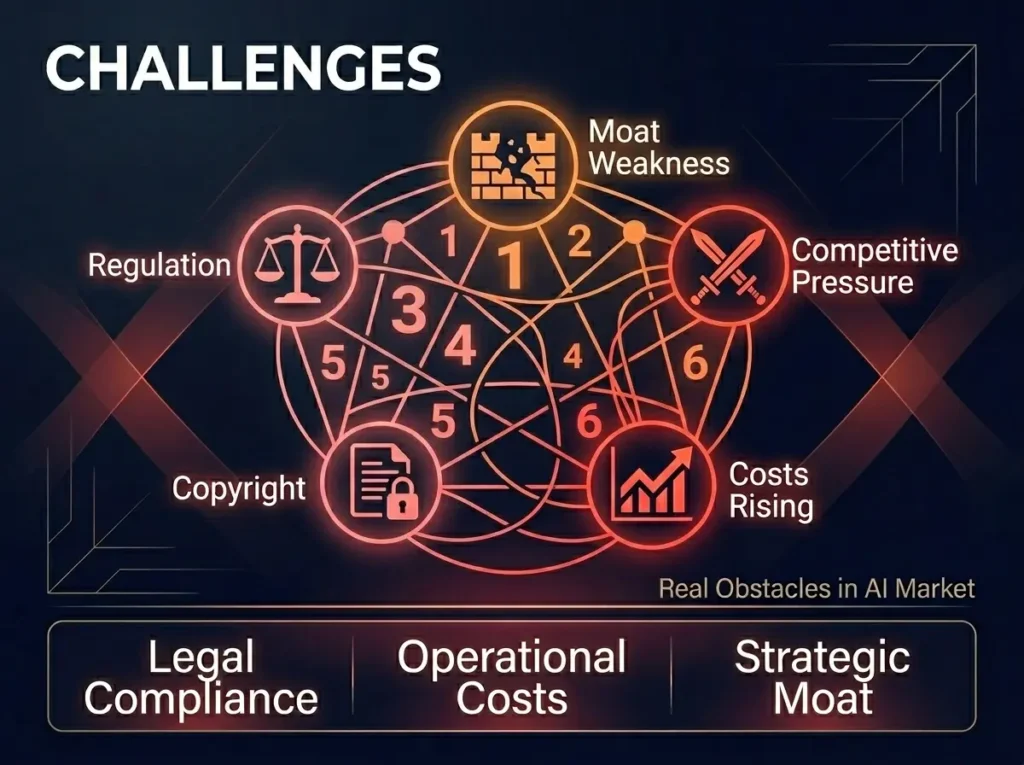
Building a generative AI startup is harder than it looks.
Regulatory Uncertainty Creates Long-Term Risk
AI regulation is still developing. A startup might be compliant today but face new rules tomorrow.
This is especially important for healthcare AI, legal AI, and financial AI. Startups that ignore regulation early can face serious problems later.
Copyright Lawsuits Are Real, Not Theoretical
Image generation, music generation, and text generation companies face active questions about training data, ownership, and licensing.
This isn’t a theoretical problem. It’s an active legal issue that affects business models and investor confidence.
Tech Giants Compete With Enormous Advantages
Google, Microsoft, Amazon, Meta, and Apple all have massive AI efforts. Large companies can build features faster than many startups. They have distribution, existing users, and resources.
Startups win by moving faster, understanding specific workflows better, building better user experience, or serving niches that big companies ignore.
High Infrastructure Costs Can Destroy Economics
Some AI startups have very high compute costs. If revenue doesn’t grow faster than infrastructure cost, the company runs out of money.
This affects model labs, video generation, voice generation, and agent platforms especially.
Weak Moats Mean Constant Competitive Pressure
Many AI products are easy to copy. If a startup only wraps another company’s model, competitors can build something similar quickly.
Stronger moats come from data, workflow integration, distribution, brand, and community.
The Most Important Generative AI Startup Categories in 2026
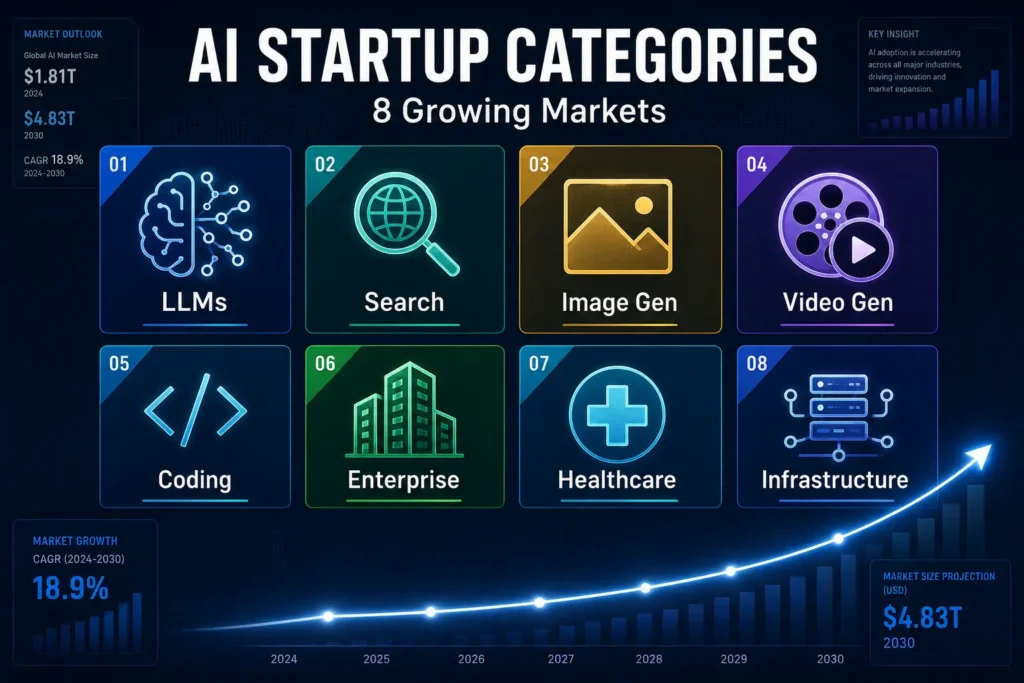
Understanding startup categories helps you see where real opportunities exist.
Language Model Startups
Companies like OpenAI, Anthropic, Mistral AI, and Cohere build the core technology everything else is built on.
These companies require enormous capital. They compete mainly on model quality, speed, cost, and specialized capabilities.
AI Search and Knowledge Platforms
Perplexity and similar companies are improving how people find and understand information.
This category matters because search is a fundamental technology with massive market potential.
Image, Video, Voice, and Creative AI
Companies like Midjourney, Runway, ElevenLabs, and Suno are making professional-quality content creation accessible.
This category matters because visual and audio content is expensive to produce manually. If AI reduces that cost dramatically, entire industries change.
AI Code Generation and Developer Tools
Cursor, Cognition AI, and others are improving developer productivity.
This matters because software development is expensive and time-consuming. Any tool that improves efficiency has clear ROI.
Enterprise AI and AI Agents
Companies building AI for business workflows are growing rapidly because enterprises have clear ROI requirements.
Vertical AI for Healthcare, Legal, Finance
Vertical AI companies focused on specific industries can build strong defensible positions because they require domain expertise.
AI Infrastructure
Vector databases, inference platforms, and monitoring tools are essential to the AI economy.
Graphic 2: AI Startup Categories by Growth Rate (Recommended Placement)
Create a chart showing different AI startup categories on axes of market size (x-axis) and growth rate (y-axis). This helps readers see which categories are growing fastest.
Image alt text: AI startup categories ranked by market size and growth rate.
What’s Coming for Generative AI Startups in 2026 and Beyond

The next phase of AI will look different from the recent past.
AI Agents Will Replace Chatbots
A chatbot answers questions. An agent completes tasks.
An AI agent might review 50 job applications and create a shortlist. Or analyze 100 support tickets and identify trends. Or research competitors and create a summary.
Agents are harder to build than chatbots, but they’re more valuable because they actually get work done.
Vertical AI Will Create Stronger Competitive Positions
AI built for one industry is stronger than generic AI because it requires specialized knowledge.
Healthcare AI, legal AI, financial AI, and real estate AI can build defensible positions because they require domain expertise and industry-specific data.
Consolidation Will Increase
Many AI startups will not survive independently.
Some will be acquired. Some will shut down. Some will become features inside bigger platforms.
This is normal in fast-moving markets. It doesn’t mean the space is bad. It means capital is concentrating around winners.
Open Source AI Will Continue Mattering
Open source communities and companies help developers build faster and reduce dependency on closed model providers.
This creates competition with closed models and gives developers choices.
Action Items Based on Your Role
For Investors
Evaluate generative AI startups by asking: What problem does it solve? Is customer revenue growing? Are customers retained? Does the company have proprietary advantages? Can tech giants copy it easily? Is the team strong?
Look for companies with clear ROI, strong retention, and defensible moats.
For Entrepreneurs
The lesson from successful AI startups is clear: start with the painful problem, not the technology.
What painful problem can you solve? Who has that problem? How much would they pay? Why won’t existing solutions work?
Answer those questions before you start coding.
For Businesses Evaluating AI Tools
Before buying from an AI startup, verify that it’s solving a real problem, has strong security, integrates with your workflow, and offers reliable support.
Also consider: what happens if the startup shuts down? Is there a way to transition to another tool?
Making smart decisions about which AI tools to adopt requires understanding AI deeply. Many business leaders and product managers are realizing they need stronger AI knowledge to evaluate tools effectively, negotiate with vendors, and implement AI successfully within their organizations. If you’re responsible for AI decisions at your company, our comprehensive guide to AI courses for product managers in 2026 covers learning resources specifically designed to help professionals build expertise in AI strategy and implementation.
For Job Seekers
Before joining an AI startup, look for: strong funding and runway, clear product-market fit, experienced leadership, real customer adoption, and a category likely to grow for years.
FAQ About Generative AI Startups
What exactly are generative AI startups?
Generative AI startups are companies building products using AI that can create content, code, images, video, audio, or decisions. Some build their own models. Some build tools on top of existing models. All are trying to solve problems with AI.
Which generative AI startups are worth watching in 2026?
OpenAI, Anthropic, Perplexity, Midjourney, Runway, ElevenLabs, Cursor, Glean, Harvey, and Scale AI are important for different reasons. But the best startup for you to watch depends on your interests.
Are generative AI startups profitable?
Some are profitable or close to it. Many are still investing heavily in growth. Profitability depends on pricing, retention, infrastructure costs, and customer acquisition.
What makes a generative AI startups actually successful?
Successful startups solve real problems, build strong customer retention, show clear ROI, have defensible advantages, and scale efficiently.
Can small teams build valuable AI startups?
Absolutely. Small teams can win by focusing on specific workflows, understanding customer needs deeply, and building better user experience.
Are AI startup valuations reasonable?
Some valuations seem high compared with revenue. Investors should be careful and evaluate unit economics and competitive moats.
Conclusion: The Generative AI Startup Market Is Still Early
This guide covers 50+ generative AI startups that matter in 2026.
But the most important AI startups of the next decade probably haven’t been founded yet. Some entrepreneur is probably building the next major category right now.
What separates successful AI startups from unsuccessful ones is not the technology or the funding. It’s the problem they solve, the customers they serve, and the execution they deliver.
The companies that will win won’t only have impressive demos. They’ll be the ones that save time, reduce costs, improve decisions, and become part of how work actually gets done.
For entrepreneurs, investors, businesses, and job seekers, this is an exceptional moment. The AI startup market is creating more opportunity than almost any sector of technology right now.
Understanding the landscape, the major players, and the challenges is the first step to making smart decisions about where to direct your time, money, and career.








Comments (6)
AI Hardware Startups: The Complete Guide to 40+ Companies Building the Future of AI in 2026 - Trendoutsidersays:
May 31, 2026 at 5:45 pm[…] at the bigger picture. If you want to see how AI hardware companies like Groq compare to the entire landscape of generative AI startups that are reshaping technology in 2026, our comprehensive guide breaks down 40+ software and infrastructure AI companies alongside their […]
Best AI Tools for HR Professionals: The Complete 2026 Guide to 30+ Tools That Save Time and Money - Trendoutsidersays:
June 2, 2026 at 11:46 am[…] you’re interested in understanding how the AI technology itself is evolving, our guide to generative AI startups changing technology in 2026 explores the companies building the AI models and platforms that power HR […]
Generative AI Workflows: The Complete 2026 Guide to 50+ Automation Tools That Save 15+ Hours Per Week - Trendoutsidersays:
June 2, 2026 at 4:51 pm[…] about the companies building these AI workflow tools and platforms, our comprehensive guide to generative AI startups that are reshaping technology covers the companies creating the AI models and tools that power workflow […]
Free AI Tools for Marketing: 40+ Tools That Actually Help Improve Results in 2026 - Trendoutsidersays:
June 2, 2026 at 6:22 pm[…] Many of these startups create tools that eventually become free versions to gain market share. Our guide to generative AI startups covers the companies building the AI tools you’re using and potential future tools to watch as […]
AI Tools for Affiliate Marketing: 35+ Tools That Multiply Your Commissions in 2026 - Trendoutsidersays:
June 2, 2026 at 6:54 pm[…] tools are transforming various business models beyond affiliate marketing, check out our detailed guide on generative AI workflows for different business types and organizational […]
13 Best Conversational AI Tools for Real Estate Agents 2026says:
June 5, 2026 at 7:35 pm[…] of the conversational AI startups listed in our guide to generative AI startups started exactly this way: entrepreneurs built custom solutions by combining ChatGPT or Claude with […]