

Google AI content guidelines 2026 have been updated, and the message is more nuanced than the headlines suggest. Google has not announced a blanket ban on AI-written blog posts. Instead, its October 1 documentation update puts renewed attention on content quality, accuracy, originality, and the risk of publishing large amounts of low-value material.
For bloggers and website owners, that distinction matters.
You spend hours building a website. You choose a WordPress theme, install an SEO plugin, research keywords, and start publishing articles.
Then someone tells you that Google can detect AI writing and that your entire website could be penalized because you used ChatGPT.
It’s an alarming claim. It’s also an oversimplification of what Google actually says.
AI-assisted publishing is not automatically spam. Human-written publishing is not automatically high quality. And passing an AI detector is not a shortcut to earning search visibility.
The more useful question is this:
If two websites publish articles on the same topic, what makes one genuinely worth reading while the other feels like another interchangeable page on the internet?
That’s what Google’s guidance helps us examine.
In this guide, we’ll explain the October 2026 update, what Google’s spam policies mean, how AI-written blogs can perform in Search, and how to build an editorial process that produces content worth publishing.
What changed in Google AI content guidelines 2026 in Google AI content guidelines 2026?
On October 1, 2026, Google updated its official guidance on using generative AI content on websites.
According to the Google Search documentation updates, the change brought the generative AI content guide into closer alignment with information from Google’s Search Quality Rater Guidelines.
The revised guidance points readers toward two particularly relevant sections of those guidelines:
- Section 4.6.5: Scaled content abuse.
- Section 4.6.6: Main content created with little effort, originality, or added value.
Google also continues to emphasize the need to fact-check AI-generated content, including page titles, meta descriptions, structured data, and image alt text.
That last point is easy to overlook.
A website owner might carefully review the main article but copy an AI-generated SEO title containing an incorrect claim, or publish a misleading image description.
Google’s advice applies to the entire publishing experience—not only the body paragraphs.
What the update does not mean
The October 1 documentation change should not be confused with a newly announced core ranking update, a new AI-detection penalty, or a rule banning ChatGPT-generated text.
Google did not say that all AI-written content would disappear from Search.
It clarified how its existing quality and spam principles apply when generative AI is involved.
That is an important distinction between a documentation update and a ranking-system update.
The practical takeaway: review how you create content, not simply which writing tool you use.
Does Google penalize AI-written content?
Not automatically.
Google’s published position is that generative AI can be useful for research and organizing original content.
The problem arises when AI or other automation is used to produce many pages primarily to manipulate search rankings, without adding meaningful value for readers.
That behavior can fall under Google’s scaled content abuse policy.
Here’s a simplified comparison.
| Publishing approach | How it relates to Google’s guidance |
|---|---|
| AI-assisted draft, thoroughly researched and fact-checked | Not inherently a spam violation |
| Human-written article with copied information and little added value | Can still be low quality |
| Hundreds of automated pages created mainly to capture keywords | Potential scaled content abuse |
| Original tutorial with accurate screenshots and useful explanations | Better aligned with people-first content |
| AI-generated product review falsely claiming hands-on testing | Misleading and untrustworthy |
| AI-generated article with invented citations or statistics | Fails accuracy and reliability expectations |
The key is not whether a machine helped produce a sentence.
It’s whether the finished page genuinely serves a reader.
Google’s official generative AI content guidance makes this distinction clear.

Can AI-written blog posts rank on Google in 2026?
Yes. AI-assisted content can be eligible to rank in Google Search.
But eligibility is not a ranking guarantee.
Google evaluates content using many systems and signals. Relevance, usefulness, originality, reliability, search intent, competition, and the overall experience all matter.
Consider two hypothetical articles targeting the same question:
“How can a small business use AI to automate customer support?”
Article A: The generic answer
The writer asks an AI tool to produce a 2,000-word article.
The result lists familiar benefits: save time, improve efficiency, reduce costs, and increase customer satisfaction.
It contains no realistic implementation examples, no explanation of costs, no limitations, and no indication that the recommendations were checked.
It may be grammatically perfect.
But the reader learns little they couldn’t find in dozens of similar posts.
Article B: The useful answer
The writer researches several support automation approaches and explains which situations each one suits.
The article shows a sample workflow, identifies where human escalation is necessary, discusses common implementation mistakes, and links to official documentation.
It also explains the difference between an AI chatbot that answers questions and an agent that can perform actions.
That article is more likely to satisfy a reader’s actual problem.
Not because it is necessarily longer, or because a human typed every word, but because it provides more useful information.
For a related practical example, see our guide to AI agents and workflow automation.
The principle applies whether you’re publishing a tutorial, news article, software comparison, or business guide.
What is scaled content abuse?
Scaled content abuse is one of the most important concepts in Google’s AI publishing guidance.
Google describes it as producing many pages primarily to manipulate search rankings rather than help users, particularly when the pages are unoriginal or offer little value.
The method used to generate the pages is not the defining factor.
It could involve generative AI, scraping, automated rewriting, or other mass-production techniques.
Examples that should raise concerns
1. Generating hundreds of near-identical articles
Imagine a website publishing 500 posts titled “Best AI Tool for [Industry],” changing only the industry name while leaving almost every recommendation unchanged.
If those pages exist mainly to capture variations of search queries and provide little differentiated value, the approach creates spam-policy risk.
2. Rewriting competitors without adding insight
A publisher copies the main points from several existing articles, asks an AI tool to paraphrase them, and publishes the result as original analysis.
Different wording doesn’t automatically create new value.
3. Publishing fabricated expertise
A site claims its team tested ten software products, even though no one actually used them.
AI can make that claim sound convincing. It doesn’t make it true.
4. Producing location pages without meaningful local information
A business generates hundreds of nearly identical city-specific pages, changing the location names but providing no genuinely relevant information for those communities.
This may create additional concerns under Google’s doorway abuse policies.
Is publishing frequently a problem?
Not by itself.
A publication can legitimately publish many useful articles. A small blog can also publish very little content and still offer poor value.
Frequency is not a substitute for examining purpose, originality, and usefulness.
The question is whether the publishing operation is built to help people or to manufacture search-targeted pages at scale.
Google explains these practices in its Search spam policies.
Google is asking a harder question: What did you actually add?
This is where the conversation about AI content gets interesting.
AI can now produce competent introductions, organized headings, FAQs, and summaries very quickly.
Those capabilities are useful.
They also make it easier for many websites to publish remarkably similar material.
If everyone can generate a passable explanation of the same topic, the value of another generic explanation becomes smaller.
So what can a publisher add that isn’t already available everywhere?
Sometimes it’s original reporting.
Sometimes it’s a firsthand demonstration, an interview, a detailed comparison, a useful calculation, or a clear explanation of a complicated policy.
And sometimes it’s simply the ability to identify what readers are confused about and answer that question better than anyone else.
Originality does not always require breaking news
A small website may not have the resources to interview the CEO of a major technology company.
That doesn’t mean it cannot create original value.
Consider a new AI product announcement.
One article might repeat the press release.
A stronger article could distinguish:
- Features available today from features still in preview.
- Free functionality from paid functionality.
- Confirmed pricing from speculation.
- Marketing claims from independently established facts.
- Ideal use cases from situations where the product isn’t suitable.
That editorial work matters.
For example, our Google Gemini Agent for Work guide focuses on what was announced, what is available, and which questions remain unanswered.
Readers don’t always need more information. Often, they need better-organized, better-verified information.
What Google’s E-E-A-T guidance means for AI content
E-E-A-T stands for:
Experience, Expertise, Authoritativeness, and Trustworthiness.
It’s a framework Google discusses in its guidance about assessing content quality.
It is not a single numerical ranking score that you can raise by inserting an author biography or repeating a keyword.
Trust is especially important.
Google’s helpful, reliable, people-first content guidance encourages publishers to consider who created the content, how it was produced, and why it exists.
Let’s make that practical.
Experience: Don’t invent firsthand testing
If you haven’t personally used an AI tool, don’t write:
“After testing it for three weeks, we found…”
You can still publish a useful researched overview.
Just explain that the analysis is based on official documentation, published examples, and available product information.
If you did conduct hands-on testing, describe the method and show evidence where appropriate.
Expertise: Understand the subject before explaining it
An article about Google Ad Manager should not confuse AdSense with Google Ad Exchange.
A comparison of AI agents should distinguish between simple workflow automation and systems capable of making decisions or taking actions.
Readers notice these differences.
Authoritativeness: Build a consistent body of useful work
A website that publishes thoughtful articles around a recognizable subject area can give readers a clearer reason to return.
That doesn’t mean a publication must cover only one topic forever.
It means related articles should reinforce one another rather than exist as disconnected keyword targets.
Trustworthiness: Make important claims verifiable
Use primary sources for product launches, policy changes, pricing, and technical requirements.
Correct mistakes when discovered.
Don’t invent authors, professional qualifications, interviews, research findings, or testing results.
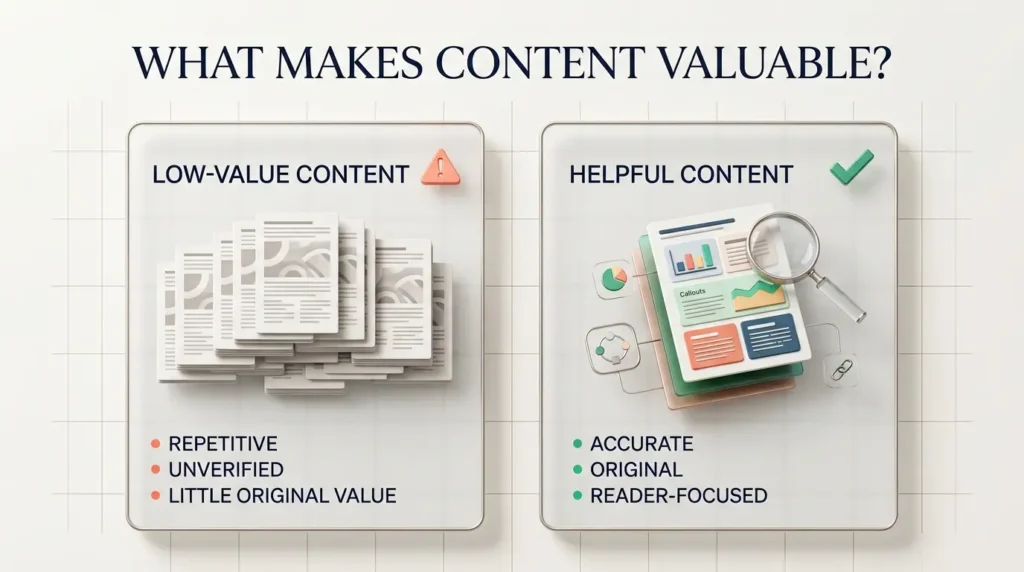
The AI content quality checklist: 12 questions before you publish
Here is a practical editorial checklist for anyone publishing AI-assisted articles.
It isn’t an official Google scoring system. It’s a quality-control framework based on the principles in Google’s documentation.
1. Does the article answer a real question?
Start with the reader’s problem, not just the keyword.
Someone searching “does Google penalize AI content” wants a clear explanation of risk, not a history of artificial intelligence.
2. Is the opening genuinely useful?
Answer the main question early.
Avoid several paragraphs of vague statements about technology changing the world.
3. Are important facts verified?
Check announcements, prices, dates, availability, statistics, and policy language.
Whenever possible, verify claims against original sources.
4. Does the article add something beyond existing coverage?
That might be a practical workflow, a thoughtful comparison, a decision framework, or a clearer explanation.
5. Are examples realistic?
Hypothetical examples should be clearly presented as examples.
Do not invent customer stories or imply they are real case studies.
6. Are sources linked where they matter?
Link to official documentation and credible evidence near the relevant claim.
A long bibliography does not compensate for unsupported statements throughout an article.
7. Is the article easy to scan?
Use descriptive headings, concise paragraphs, tables when useful, and visual explanations that genuinely help.
8. Does the article acknowledge limitations?
Explain uncertainty.
If a feature is not generally available, say so.
If a claim comes from a company’s own benchmark, identify the source.
9. Are internal links relevant?
A link should help readers understand the next related question.
For example, readers researching practical AI adoption may benefit from our AI business solutions, costs, and ROI guide.
10. Are images accurate and useful?
An attractive AI-generated illustration can improve presentation.
But a fake screenshot of a product that doesn’t exist can mislead readers.
Label conceptual imagery appropriately and provide meaningful alt text.
11. Are the title and metadata honest?
Don’t promise a guaranteed ranking method or claim a policy has changed when it hasn’t.
Google specifically advises reviewing AI-generated metadata for accuracy.
12. Would you publish the article if Google sent no traffic?
This is perhaps the most revealing question.
Would the article still be useful to someone who arrived through a newsletter, social media, or a direct visit?
If the answer is no, the page may need more work.
How to create Google-friendly AI-assisted blog posts in WordPress
Let’s turn those principles into a realistic publishing workflow.
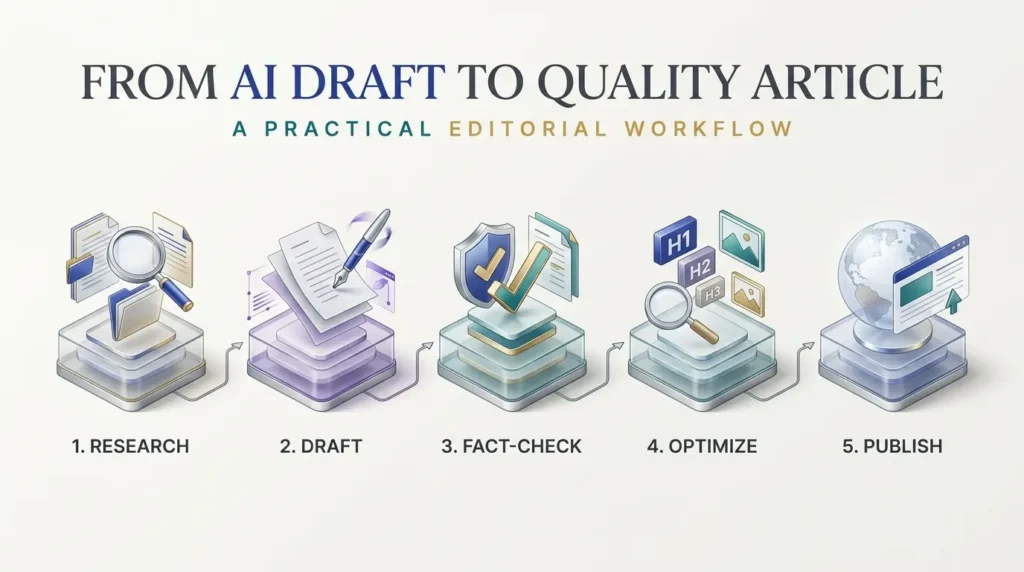
You don’t need an enormous editorial team. You need a repeatable process that separates research, drafting, verification, and publication.
Step 1: Choose a topic with genuine reader demand
Start by identifying a specific question.
For example:
“Can AI-generated content hurt my website’s SEO?”
Then examine related questions:
- Does Google ban AI-written articles?
- What is scaled content abuse?
- How much editing does AI content need?
- Should AI-assisted articles include disclosures?
Don’t choose a topic only because a keyword tool reports a large search volume.
Think about what readers actually need to accomplish.
Step 2: Research before drafting
Collect official sources and relevant background information.
For Google policy articles, start with Google Search Central.
For AI product comparisons, prioritize product documentation, official release notes, and clearly identified independent reporting.
Record dates and distinguish facts from interpretations.
Step 3: Build an outline around search intent
Organize the article in the order a reader would naturally ask questions.
Start with the direct answer.
Then explain the important details, exceptions, practical examples, and next steps.
Step 4: Use AI as an assistant, not an unquestioned authority
AI can help organize research, identify gaps, simplify complicated explanations, and improve clarity.
But don’t assume it has verified every claim.
Ask it to identify uncertain statements and missing sources.
Then check those sources yourself.
Step 5: Add original editorial value
This is the most important step.
Include a worked example, comparison, checklist, diagram, or carefully reasoned explanation that makes the page more useful.
If you have firsthand experience, document it accurately.
If you don’t, avoid implying that you do.
Step 6: Edit for human readability
Remove repetitive transitions, empty marketing phrases, and unnecessary conclusions after every section.
Vary sentence length naturally.
Keep the language specific.
A useful article should sound like someone explaining something they understand—not a collection of generic statements stitched together.
Step 7: Configure Rank Math properly
In WordPress, review:
- The SEO title and meta description.
- The primary focus keyword.
- The URL slug.
- Heading structure.
- Internal and external links.
- Image alt text.
- Canonical URL and indexing settings.
Rank Math can identify useful on-page issues, but a perfect plugin score is not a Google ranking requirement.
Don’t force unnatural keyword repetition to turn every indicator green.
Step 8: Review images and page experience
Use optimized image formats, descriptive filenames, and accurate alt text.
Check mobile readability.
Avoid layouts where large ads, intrusive popups, or oversized graphics make the article difficult to use.
Google’s page experience guidance emphasizes the overall quality of the browsing experience.
Step 9: Publish and monitor results
After publication, use Google Search Console to examine indexing, impressions, clicks, and the queries bringing readers to your page.
Don’t expect every article to generate traffic immediately.
Look for opportunities to improve titles, clarify sections, answer overlooked questions, and update facts when products or policies change.
Does AI-generated content need a disclosure?
Google encourages publishers to provide useful context about how content was created when that information would help readers understand the work.
That doesn’t mean every article needs an enormous warning at the top.
It does mean transparency can be appropriate, especially when automation substantially contributes to the finished content.
For example, a technology publication might include a short editorial note explaining that AI tools assisted with drafting or organization while the publisher remains responsible for checking facts and maintaining editorial standards.
The disclosure should reflect what actually happened.
Don’t claim an article was manually tested, independently reviewed by an expert, or written entirely by a human if that isn’t true.
Transparency isn’t a substitute for quality.
It’s part of building trust.
Do AI-generated images hurt SEO?
AI-generated images are not automatically disqualified from Google Search.
But their usefulness, accuracy, presentation, and applicable metadata requirements matter.
For an educational article, an original diagram may explain a concept more effectively than a generic stock photograph.
For a software tutorial, however, an invented interface can be worse than no image at all.
A reader trying to follow instructions needs to see what the actual product looks like.
Practical image recommendations
Use AI-generated illustrations for conceptual subjects, abstract systems, or visual storytelling.
Use authentic screenshots when demonstrating real software interfaces.
Avoid generating fake logos, fabricated charts, imaginary product features, or misleading visual evidence.
Write alt text describing the image—not merely repeating the target keyword.
If you operate an ecommerce business, check the separate requirements Google Merchant Center applies to AI-generated imagery and product information.
The same principle applies to visuals as to written content:
Make them helpful, accurate, and appropriate for their purpose.
What about Google AI Overviews and AI Mode?
This is where the conversation becomes bigger than traditional search rankings.
Website owners are no longer thinking only about the familiar list of blue links.
Google Search also includes AI-powered experiences that may summarize information and link to supporting websites.
That raises a new question:
“How do I make my content useful enough to be considered in AI-powered search results?”
Google’s answer is less mysterious than many marketing pitches suggest.
Its AI Search optimization guidance continues to emphasize fundamental SEO practices and valuable, non-commodity content.
There is no guaranteed trick that forces Google to cite your website.
Nor is there a special piece of schema markup that automatically earns placement in AI Overviews.
What publishers should prioritize
Clear, accessible information: Make it easy for readers and search systems to understand the page.
Original value: Offer something beyond widely repeated information.
Accurate structured data: Use supported schema types correctly where appropriate.
Useful images and videos: Visual content can help readers and may support additional discovery opportunities.
Technical accessibility: Ensure important pages can be crawled and indexed under your intended settings.
Search Console monitoring: Track how people find your content and adjust based on actual evidence.
Google has also expanded Search Console reporting for multimodal search, including image-based discovery experiences. That creates another reason to invest in accurate, useful visual content rather than treating images as decoration.

Seven AI content mistakes that can quietly weaken a website
Some publishing mistakes don’t require a formal spam penalty to hurt a website’s performance.
They simply make pages less useful or less competitive.
Mistake 1: Publishing the first AI draft
A first draft is a starting point.
Review the structure, claims, examples, and language before publishing.
Mistake 2: Targeting keywords without understanding intent
A 4,000-word article can still disappoint readers if it never answers their question clearly.
Mistake 3: Adding fake experience
Never describe imagined product tests as real.
Readers deserve to know what was actually researched or tested.
Mistake 4: Repeating the same content across dozens of pages
Changing a few headings and keywords doesn’t create meaningful originality.
Mistake 5: Treating SEO scores as guarantees
A green Rank Math indicator doesn’t mean Google will rank a page.
Use SEO tools as diagnostics, not substitutes for editorial judgment.
Mistake 6: Publishing misleading images
An attractive but inaccurate visual can damage credibility.
Mistake 7: Never updating time-sensitive articles
Software features, subscription plans, regulations, and platform policies change.
An article that was accurate six months ago may now need revision.
A realistic strategy for small blogs in 2026
If you’re running a small website, competing with established publications can feel intimidating.
Large publishers have recognizable brands, editorial teams, and existing audiences.
Trying to beat them by producing more generic articles is rarely a compelling strategy.
A more realistic approach is to become particularly useful within a focused group of topics.
For example, a technology blog might build related content around AI tools for small businesses, workflow automation, Google Search changes, and practical software guides.
Each article can answer a different question.
One explains a product launch.
Another compares alternatives.
Another walks through a real implementation.
Another clarifies a confusing policy.
Together, they create a more useful resource than a collection of unrelated keyword-targeted posts.
Quality beats arbitrary word counts
A short article can be excellent if it answers the question completely.
A long guide can also be excellent when the subject genuinely requires depth.
The right length is the length needed to do the job.
Don’t stretch an article to 3,000 words simply because a competitor has written 2,500.
Don’t shorten a complex guide until the important caveats disappear.
The reader’s needs should determine the depth.
Frequently asked questions
Does Google ban AI-generated blog posts?
No. Google’s guidance does not establish a blanket ban on AI-generated content. It focuses on quality, accuracy, usefulness, and avoiding spam practices.
What changed in Google’s AI content guidance in October 2026?
Google updated its documentation on October 1 to incorporate references to Search Quality Rater Guidelines concerning scaled content abuse and content with little effort, originality, or added value.
Can ChatGPT-written articles rank on Google?
AI-assisted articles can be eligible to rank. Their performance depends on the quality and relevance of the finished content, competition, and other ranking considerations.
Will Google penalize my website for using ChatGPT?
Using ChatGPT alone is not an automatic reason for a penalty. However, publishing large volumes of low-value content primarily to manipulate rankings may violate Google’s spam policies.
Is human editing enough to make AI content safe?
Not necessarily. Editing for grammar alone doesn’t fix fabricated claims, weak research, lack of originality, or content created primarily to manipulate search rankings.
Do I need to disclose AI-generated content?
Google recommends giving readers useful context about content creation where appropriate. Transparency is particularly relevant when automation substantially contributes to the work.
Does Google use AI detectors to penalize articles?
Google’s published guidance does not establish a blanket penalty based simply on a third-party AI detector score. Publishers should focus on Google’s documented quality and spam policies rather than trying to achieve a particular detector result.
Does Rank Math’s SEO score affect Google rankings directly?
Rank Math is a third-party SEO plugin. Its score is a diagnostic tool, not a direct Google ranking metric.
Can AI-generated images appear in Google Search?
AI-generated imagery is not categorically banned. Images should be useful, accurately described, and compliant with any applicable platform-specific requirements.
Is there a special optimization trick for Google AI Overviews?
Google’s official guidance emphasizes existing SEO fundamentals and useful original content. There is no guaranteed markup or shortcut that forces inclusion.
Final verdict: Google isn’t asking whether you used AI. It’s asking whether the result is worth reading.
The October 2026 guidance is an important reminder, but it isn’t the end of AI-assisted blogging.
Used thoughtfully, AI can help publishers research, organize information, improve clarity, and produce useful educational content.
Used carelessly, it can make it easier to flood the internet with repetitive articles that add little to what readers already know.
The difference isn’t always visible in the writing tool.
It’s visible in the finished work.
Did someone verify the facts?
Did the article answer the reader’s question?
Did it offer a useful example or explanation?
Was it honest about uncertainty and experience?
Would it still be worth reading if search engines didn’t exist?
Those are the questions worth asking before hitting Publish.
Because in 2026, the real competitive advantage isn’t being able to generate more content.
It’s giving people a reason to trust yours.
Sources and editorial methodology
This article is based on Google’s publicly available Search Central documentation, including its October 1, 2026 documentation update, generative AI publishing guidance, spam policies, helpful-content guidance, and AI Search recommendations.
Primary references:
- Google Search documentation updates
- Google’s guidance on using generative AI content
- Google Search spam policies
- Creating helpful, reliable, people-first content
- Optimizing for generative AI features in Search
- AI features and your website
- Google Search Console multimodal reporting announcement
Editorial note: This guide interprets Google’s published documentation and provides illustrative publishing examples. It does not claim access to Google’s internal ranking systems or promise rankings, indexing, AdSense approval, or protection from manual actions. AI tools may assist with content preparation; the publisher is responsible for final fact-checking, editorial decisions, and accuracy.








Leave a Reply