
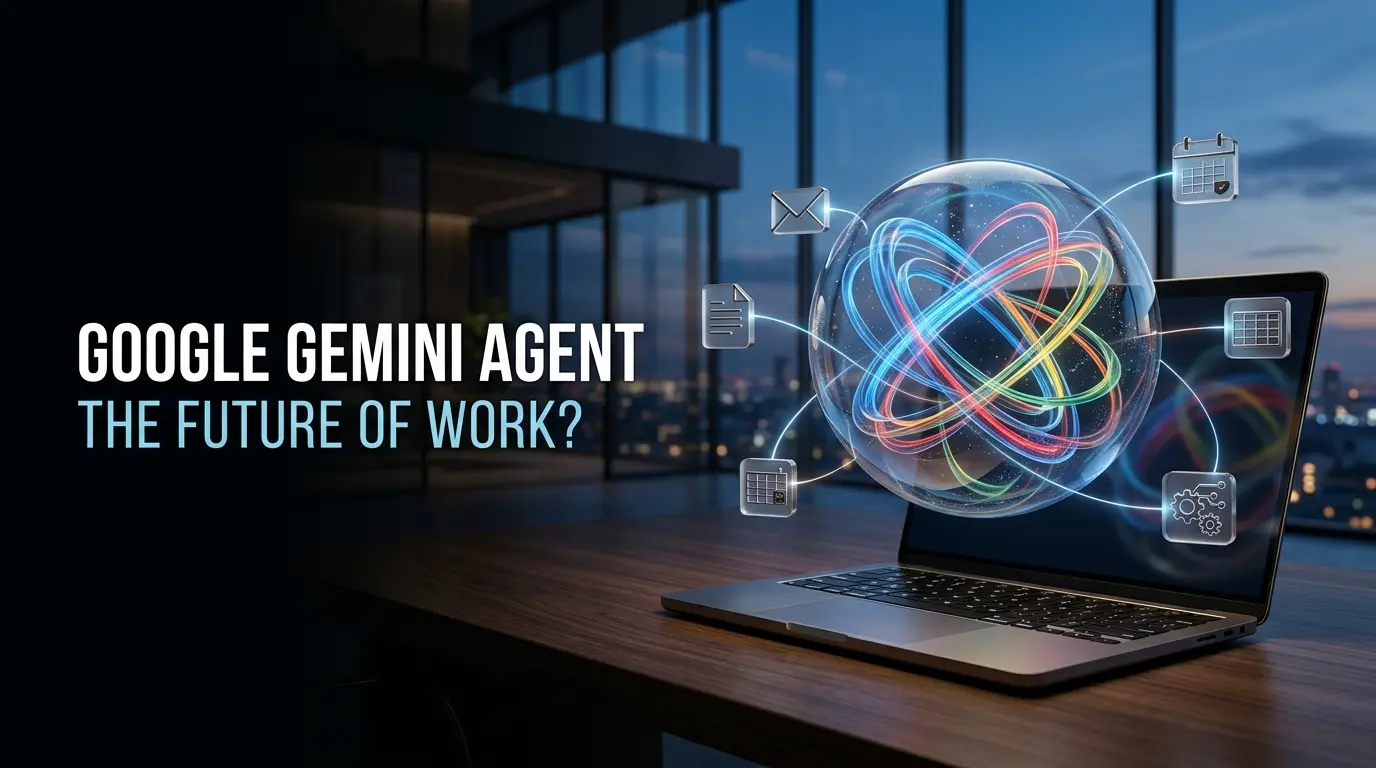
The short version: Google has announced a new Gemini agent that can work across business applications, manage multi-step tasks, create content, and even write code. It can also operate as a digital coworker with its own work identity. But the new universal agent is currently in private preview, and its separate public pricing and general release date have not been confirmed.
The Google Gemini agent for work could change how businesses handle everyday tasks. Announced on October 8, 2026, Google’s new AI agent aims to coordinate work across business applications, manage multi-step assignments, and help teams spend less time switching between tools.
But there’s an important catch: the newly announced universal agent is currently in private preview for enterprise customers. So what can it actually do, how much will it cost, and when will ordinary businesses be able to use it? Here’s what Google has confirmed…. and what remains unclear.
Imagine opening your laptop on Monday morning and finding that an AI assistant has already gathered the latest project updates, reviewed the documents your team shared, prepared a draft presentation, and organized the next steps.
You wouldn’t need to explain which spreadsheet contains the numbers, which email thread started the project, or where the meeting notes were saved.
You’d simply assign the work.
That’s the future Google is pitching with its newly announced Gemini agent for work.
On October 8, 2026, Google Cloud introduced a universal AI agent at its Gemini at Work event. The ambition is bigger than adding another chatbot to Gmail or Google Docs. Google wants one AI system that understands your business context, works across applications, and completes assignments that normally involve several tools and multiple steps.
The announcement sounds impressive. But it also raises practical questions.
Can you actually use it today? Does it work with an ordinary Gmail account? How much will it cost? And what happens when an AI agent has permission to access company information?
Here’s what Google has confirmed, what remains unclear, and what the announcement could mean for businesses that want to automate everyday work.
Google Gemini agent for work: What was announced?
Google’s new Gemini agent is designed to act as a general-purpose AI worker rather than a single-purpose chatbot.
According to the official Google Cloud announcement, it can combine conversational assistance, knowledge work, content creation, coding, and multi-step task execution within one system.
The underlying idea is straightforward: instead of asking AI to help with every individual step, you give it a goal.
For example, rather than asking an assistant to summarize a document, then separately requesting a spreadsheet, then asking it to draft a presentation, you could assign a broader task involving all three.
The agent would attempt to plan the work, select appropriate tools, and produce the requested output.
That doesn’t mean it can successfully perform every assignment without supervision. Its results still depend on connected systems, access permissions, available features, and the quality of the information it receives.
At a glance: What’s confirmed?
| Question | Answer as of October 9, 2026 |
|---|---|
| What is it? | A universal AI agent for workplace tasks |
| Who announced it? | Google Cloud |
| Announcement date | October 8, 2026 |
| Can it use Google Workspace? | Google has announced integration across major Workspace applications |
| Can it work with third-party software? | Google describes support for systems including Slack and Microsoft 365 |
| Can it complete multi-step tasks? | Yes, that is a central announced capability |
| Can it keep working in the cloud? | Google says long-running work can continue across sessions and devices |
| Is it available to everyone? | No; the new universal agent is in private preview |
| Is standalone public pricing confirmed? | Not established in the announcement |
| Is there a general release date? | No confirmed date in the reviewed announcement |
The most important distinction is between what Google has demonstrated or announced and what a typical business can activate right now.
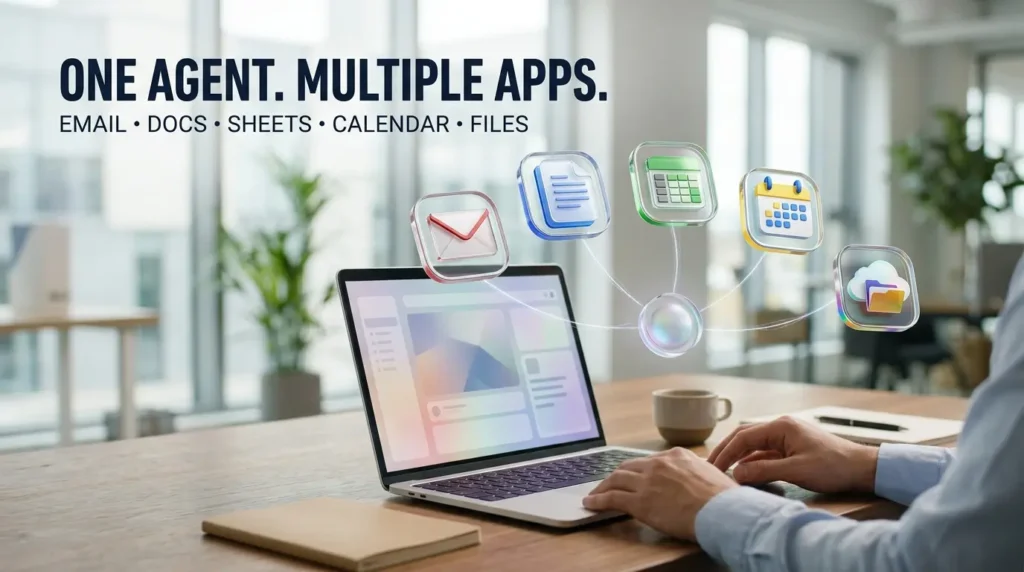
1. Gemini can work across Gmail, Docs, Sheets, Drive, and more
One of the most interesting parts of Google’s announcement is how closely the agent is designed to work with applications businesses already use.
Google describes the agent operating within Gmail, Google Drive, Docs, Slides, Sheets, Chat, and Calendar.
This matters because much of a working day isn’t spent inside one application.
A typical project might begin in an email, move to a shared document, require data from a spreadsheet, and end with a meeting or presentation.
The difficult part isn’t always creating the final document. It’s finding the right information and moving between systems.
Google’s proposed approach is to give the agent enough authorized context to handle more of that process.
Example: Preparing a client presentation
Imagine a small consulting firm preparing a quarterly update for a client.
The work might involve finding the latest performance report, reviewing notes from the previous meeting, summarizing the main changes, and building a slide deck.
A suitably configured Gemini agent could potentially coordinate these steps using the relevant applications and shared information.
The consultant would still need to review the conclusions, confirm the numbers, and approve anything being sent externally.
Why it matters: AI becomes more useful when it can work with the documents and applications that already contain your business information.
2. Google wants you to delegate goals, not individual prompts
Most people have learned to use AI through a question-and-answer process.
You ask something. The AI responds. You ask a follow-up. The AI produces another response.
That approach works well for many tasks, but complex projects can become a long chain of instructions.
Google is trying to change the interaction.
Instead of managing every step, a user could describe the desired outcome and allow the agent to plan the work.
Consider this hypothetical assignment:
“Review this week’s customer feedback, identify the three most common complaints, prepare a summary for our team, and draft recommended follow-up actions.”
Completing that request could require reading information, categorizing issues, comparing patterns, drafting a document, and identifying tasks for staff.
The new agent is intended to coordinate those activities rather than merely explain how a person could do them.
There is an important limitation, however: autonomy doesn’t automatically mean reliability.
A business still needs to decide which information the agent may access, which actions it may perform, and which results require approval.
If you’re unfamiliar with the underlying technology, our AI agents workflow automation guide explains how AI agents differ from conventional automation.
3. Gemini can keep working after you close your laptop
Here’s a feature that could matter more than flashy demonstrations.
Google says the new agent runs in the cloud and can maintain context across devices and sessions.
In the announced architecture, long-running assignments can continue even when the user’s laptop is closed.
That is different from an assistant whose work depends on an active interaction in one browser tab.
For example, an authorized agent might be assigned to collect information from multiple systems, prepare a detailed report, and return with the results when the task is finished.
Some assignments could take substantially longer than a normal chat response.
Google also describes the use of specialized sub-agents that can handle different parts of a larger assignment.
One might work on research while another handles a separate technical step.
The main agent can then coordinate the results.
Why this is significant
The potential benefit is less time spent supervising routine intermediate steps.
But businesses should also consider what happens when a long-running workflow encounters an error, an unexpected document, or a task outside its permissions.
A sensible deployment needs clear stopping conditions, activity monitoring, and a way for people to intervene.
4. The surprising feature: AI coworkers with their own email addresses
One of the most distinctive announcements is Google’s concept of a coworker agent.
Rather than existing only as a tool attached to an employee’s account, an agent can be assigned a persistent role within an organization.
Google says these agents can receive their own Workspace identity, including an email address, calendar, Drive storage, and a presence in the company directory.
That opens up a different way of working.
Instead of one employee privately asking AI for help, a team could interact with a shared agent that has a defined responsibility.
Example: A marketing coordination agent
Imagine a marketing team preparing a product launch.
The team could have an agent responsible for organizing launch-related information, preparing status summaries, and drafting documents.
Team members might interact with it through shared workspaces or mention it in collaborative discussions.
Google’s announced design also allows an agent’s edits to be associated with its own identity rather than being presented as changes made by an employee.
That distinction matters for accountability.
However, an AI coworker isn’t an employee in the human sense. It cannot independently accept legal responsibility, exercise human judgment, or replace the need for management.
Its identity is a way to organize permissions, collaboration, and auditability.

5. Google’s Gemini agent can use more than Google’s own AI models
Another notable detail is Google’s approach to model selection.
The company says its universal agent can route work across its Gemini models and Anthropic’s Claude models, with support for additional models planned.
That means the agent is being positioned as a system for completing tasks, while the underlying model can vary depending on the work.
Why does that matter?
Different AI models can have different strengths, speeds, and operating costs.
A simple classification task may not require the same computational resources as complex coding or analytical work.
Google says its approach can select models according to the assignment, potentially improving efficiency.
This is an announced design capability, not proof that every task will be cheaper or more accurate.
Businesses should evaluate actual performance and cost once the service becomes available to them.
6. What can small businesses actually do with Gemini?
Google has published a separate small-business-focused announcement describing the potential benefits of its agentic tools.
For small businesses, the most interesting opportunities aren’t necessarily complicated technical projects.
They’re the everyday responsibilities that repeatedly interrupt other work.
Here are five examples worth considering.
Customer inquiry preparation
A small service company could use an authorized workflow to organize incoming questions, identify common topics, and prepare response drafts.
A person would still review sensitive or unusual cases.
Sales and lead research
A business development team could use an agent to gather approved information, prepare prospect summaries, and organize follow-up work.
The team should verify important facts rather than treating generated research as automatically correct.
Reporting and analysis
A business could ask an agent to work with permitted spreadsheet data, identify trends, and prepare an initial report.
Financial or operational conclusions would still need validation.
Meeting coordination
An agent with the appropriate permissions could help gather project context, prepare agendas, and coordinate scheduling-related tasks.
Marketing operations
A small team might use an agent to organize campaign information, prepare content drafts, or coordinate project documents.
These are illustrative use cases based on the announced capabilities, not claims that we independently performed these workflows with the private-preview product.
For a broader look at implementation and business value, see our AI business solutions and ROI guide.
7. Google Gemini agent pricing: How much will it cost?
This is one of the biggest questions, and it’s also where readers need to be especially careful.
Google has not established a generally available standalone public price for unrestricted access to the newly announced universal Gemini agent in the October 8 announcement reviewed for this article.
Google already offers Gemini Enterprise products and subscriptions, but those should not be confused with confirmed access to every new preview feature.
You can review Google’s current enterprise offerings on the official Gemini Enterprise website.
Why the pricing distinction matters
A company might already pay for Google Workspace or another Gemini product.
That does not necessarily mean it automatically receives the newly announced universal agent, coworker identities, or every associated capability.
Availability can depend on product edition, organizational eligibility, rollout status, and administrator configuration.
Google has also discussed cost controls, including model routing and spending limits, as part of its broader enterprise agent architecture.
Those controls may help organizations manage consumption, but they don’t establish a universal monthly price for every customer.
Before paying for any Gemini product, ask:
- Does this subscription include the specific agent capability I need?
- Is that capability generally available or restricted to preview?
- Are usage charges separate from the subscription?
- What administrative controls are included?
- Can the organization set spending limits?
- What happens when the agent reaches a usage or budget threshold?

8. Is the new Gemini agent available now?
As of October 9, 2026, the newly announced universal Gemini agent is in private preview for enterprise customers.
That means an ordinary user should not assume the feature is available simply because they have a Google account or use Gemini.
This is especially important because Google’s naming can be confusing.
There are existing Gemini experiences for consumers, Workspace users, and enterprise customers.
The new universal work agent builds on Google’s broader ecosystem but has its own announced capabilities and access conditions.
Available now versus newly announced
| Capability | What readers should know |
|---|---|
| Existing Gemini products | Already available through various Google products and eligible plans |
| Existing Gemini features in Workspace | Availability depends on subscription and rollout |
| New universal Gemini agent | Private preview for enterprise customers |
| Dedicated coworker agents | Announced as part of the new work-agent experience |
| Broad public release | No confirmed general availability date in the reviewed announcement |
| Separate universal-agent price | Not confirmed publicly in the reviewed announcement |
Can you join the preview?
Businesses interested in the product should consult the official Google Cloud announcement and Gemini Enterprise product information for current eligibility and contact options.
Avoid websites claiming to provide guaranteed early access unless they are clearly authorized by Google.
9. What about security, privacy, and permissions?
Giving an AI system access to business applications creates a different level of responsibility from asking it to draft an email.
An agent that can read documents, interact with software, or modify information needs carefully defined permissions.
Google’s announcement emphasizes identity management, authorization, policy controls, auditing, and sandboxing.
The company also describes controls for managing which systems an agent can access and how its actions are governed.
These are important enterprise design features.
They do not eliminate the possibility of incorrect outputs, misconfiguration, inappropriate permissions, or malicious content attempting to influence an agent.
Four precautions businesses should take
Start with limited access. Give an agent only the permissions required for its assigned responsibility.
Require approval for consequential actions. Financial transactions, contractual commitments, sensitive customer communications, and destructive changes should not be casually delegated.
Keep records of important activity. Teams need to understand what the agent accessed, changed, or attempted.
Test before expanding. Begin with representative low-risk tasks and evaluate failures as carefully as successes.
For teams new to automation, our generative AI workflows guide provides additional context on organizing AI-assisted processes.

10. Gemini agent vs. other AI agents: What’s different?
Google is entering an increasingly competitive market.
Businesses can already find AI-enabled tools for customer support, workflow automation, coding, research, and administrative assistance.
What makes Google’s announcement interesting is its ambition to combine many of those responsibilities into one work-oriented agent connected to an organization’s existing systems.
But a broad feature set isn’t always the best fit for a small business.
A specialized customer support agent may be easier to deploy for a company whose only goal is answering routine inquiries.
A workflow platform may be sufficient for moving information between a few applications.
A universal agent becomes more attractive when tasks genuinely span multiple systems and require more flexible coordination.
A practical comparison
| Business need | Type of tool worth evaluating |
|---|---|
| Automate tasks between common apps | Workflow automation platform |
| Handle recurring support conversations | Customer service AI agent |
| Build custom multi-step business processes | Customizable agent platform |
| Coordinate complex work across enterprise systems | Universal enterprise agent |
| Draft emails and summarize documents | Existing AI productivity assistant |
Our previously published guide to the best AI agents for small businesses in 2026 compares seven platforms, including Zapier Agents, Relevance AI, Lindy, HubSpot Customer Agent, Intercom Fin, Relay.app, and n8n.
That comparison is useful if you want tools you can evaluate while Google’s new universal agent remains in private preview.
11. Should small businesses wait for Google’s new agent?
Not necessarily.
If your business has an immediate automation problem, waiting for an unannounced general release date may not make sense.
Instead, identify the work you want to improve.
If the problem is repetitive data entry, a straightforward workflow tool might solve it today.
If customer support is consuming significant staff time, a specialized support platform may be a more direct option.
If your company already uses Google Workspace extensively, it may be worth evaluating the Gemini capabilities included in your existing subscription while monitoring the new agent’s rollout.
Our recommendation
Start by listing three tasks that consume time every week.
For each task, ask:
- Is the process repetitive enough to automate?
- What information would an agent need?
- What permissions would it require?
- What mistakes could cause harm?
- How would we measure whether it actually saves time?
This approach is more useful than buying a new AI product simply because it has received a major announcement.
12. What Google’s announcement means for the future of work
For years, workplace software has largely expected people to move between applications.
Email is in one place. Documents are in another. Project information lives somewhere else.
AI assistants have made some of that work easier, but people still often coordinate the overall process themselves.
Google’s new Gemini agent points toward a different arrangement.
Instead of employees constantly moving information between tools, a configured agent could handle more of the coordination.
That could make AI genuinely useful for smaller teams with limited administrative resources.
It could also introduce new challenges involving oversight, cost, permissions, and accountability.
The important question is no longer simply whether an AI model can produce a convincing answer.
It’s whether a business can trust an AI-assisted process to complete useful work consistently, securely, and at a reasonable cost.
Google’s announcement is an ambitious step toward that future.
Whether the final product delivers on its promise will depend on real-world reliability, access, pricing, and how well organizations can control what their agents do.
Frequently asked questions
What is Google Gemini agent for work?
It is a newly announced universal AI agent designed to handle workplace tasks across connected applications. Google describes capabilities including answering questions, preparing content, coordinating multi-step work, and writing code.
When was Google’s new Gemini agent announced?
Google Cloud announced the new universal Gemini agent on October 8, 2026, during Gemini at Work 2026.
Is the Google Gemini agent available to everyone?
No. As of October 9, 2026, the new universal agent is in private preview for enterprise customers. Existing Gemini products have different availability conditions.
Is Google Gemini agent free?
Google has not established a separate, generally available public price for the newly announced universal agent in the announcement reviewed here. Existing Gemini subscriptions should not be assumed to include all preview capabilities.
Does Gemini agent work with Gmail and Google Docs?
Google has announced integration across Gmail, Drive, Docs, Sheets, Slides, Chat, and Calendar. Actual access to specific features depends on rollout and eligibility.
Can Gemini agent work while my computer is turned off?
Google says the agent runs in the cloud and can continue long-running assignments across devices and sessions. That is an announced capability of the new agent, not a guarantee that every existing Gemini product behaves the same way.
Can Gemini agent use Claude?
Google says the new agent can select between its Gemini models and Anthropic’s Claude models depending on the task, with additional model options planned.
Can a small business use Gemini agent?
Google is positioning the technology for businesses of different sizes, but the new universal agent’s initial access is restricted. Small businesses should check eligibility and evaluate existing tools in the meantime.
Will Gemini agent replace employees?
The technology may automate selected responsibilities, but it cannot be assumed to replace the full judgment, accountability, relationships, and decision-making involved in a human role.
Final verdict: Google’s new Gemini agent is promising, but access matters
Google’s new Gemini agent could change how businesses use AI.
Instead of repeatedly asking for individual answers, users may eventually be able to delegate broader assignments involving research, documents, spreadsheets, communication, and software tools.
The most interesting feature isn’t that Gemini can generate content or write code. Other AI products already do those things.
It’s Google’s attempt to connect those capabilities into one agent that understands business context and can operate across applications.
But for readers deciding what to do today, the key facts are straightforward:
The agent has been announced. Its capabilities are ambitious. Broad availability and standalone pricing are not yet confirmed.
Small businesses should follow the rollout, examine the security and pricing details as they become available, and continue solving immediate automation problems with tools they can actually access.
The future of work may involve more AI coworkers.
For now, the smartest approach is to separate what’s possible, what’s promised, and what’s available.
The Google Gemini agent for work represents an ambitious shift from simple AI assistance toward more coordinated workplace automation. For businesses, the real questions are whether the agent will become broadly accessible, how its pricing will work, and how reliably it can perform useful tasks under human supervision.
Sources and research methodology
This article is based on publicly available information reviewed on October 9, 2026, including:
- Google Cloud: Introducing Gemini agent at Gemini at Work 2026
- Google Cloud: How to grow your small business using Google Gemini
- Google Cloud: Gemini Enterprise
- The Verge: Google’s universal Gemini agent for work
Editorial disclosure: This is a research-based news analysis. TrendOutsider has not independently tested the new private-preview universal Gemini agent. Hypothetical business scenarios are identified as examples, not reported product tests. Features, eligibility, and pricing may change after publication.







Leave a Reply