
A student opens a school laptop, types a homework question into Google and receives a carefully written explanation before clicking a single website.
A few years ago, that might have sounded like an extraordinary improvement in educational technology.
Today, it is one of the reasons some school districts are reconsidering their relationship with Google.
Los Angeles Unified School District, which serves approximately half a million students, has temporarily disabled Google’s AI Overviews on district issued student devices. The decision follows earlier restrictions on Google’s conversational AI Mode and comes amid growing concerns about how artificial intelligence affects the development of independent learning skills.
The district is not banning the internet. Nor has it prohibited every teacher from using artificial intelligence.
Instead, officials are attempting to draw a boundary around the kinds of automated assistance students encounter while completing their schoolwork.
That boundary is becoming increasingly difficult to maintain.
Google has integrated artificial intelligence into its search engine so deeply that schools cannot simply assume they will continue receiving the traditional search experience after rejecting its generative features.
At the same time, researchers are discovering something more complicated than the idea that AI is either good or bad for education.
Under some conditions, it can help students learn remarkably well. Under others, it can help them complete assignments while leaving them less capable of solving similar problems on their own.
The distinction between those two outcomes is at the heart of the current debate.
What Happened to Google AI in Los Angeles Schools?
Los Angeles Unified has temporarily disabled AI Overviews on student devices as part of its efforts to manage children’s exposure to emerging digital technologies.
The development was reported locally on November 18 and subsequently received wider attention through Associated Press reporting published during the final week of November.
District officials indicated that the restriction was intended to provide students with an appropriate and safer online learning environment.
The decision follows a broader examination of artificial intelligence use throughout the school system.
Earlier in the academic year, Los Angeles Unified had already restricted student access to Google’s AI Mode, the conversational search experience that allows users to ask follow up questions and receive generated responses.
AI Overviews presented a different challenge because they appear within ordinary search results.
A student could encounter an AI generated explanation without deliberately opening a chatbot or requesting assistance from a separate AI application.
That makes conventional device restrictions more complicated.
As of November 27, the district has not announced how long the temporary AI Overviews suspension will remain in place.
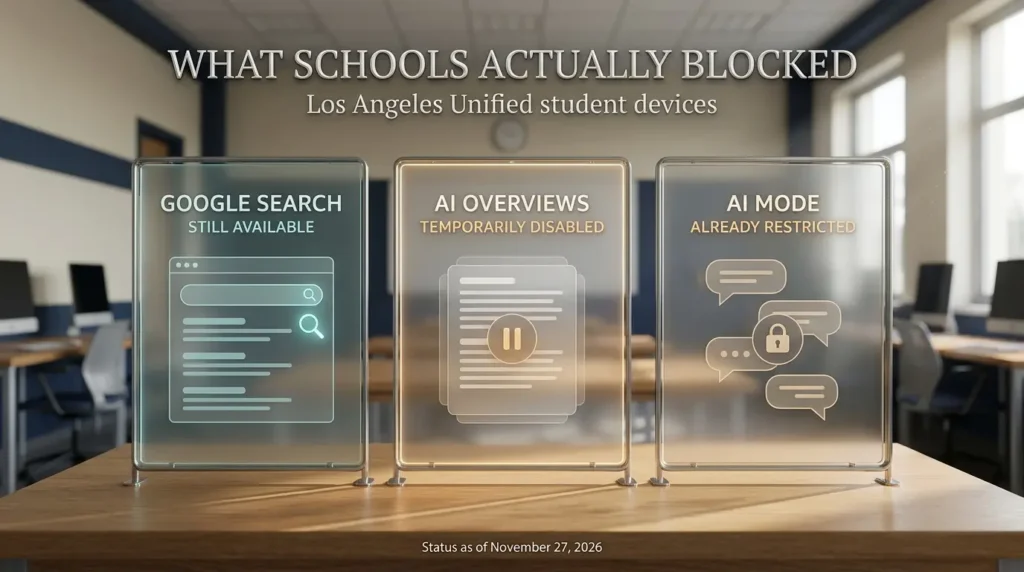
What Has Actually Been Blocked?
Several Google products are involved in the wider discussion, which has created understandable confusion.
| Google feature | Current LAUSD student device position |
|---|---|
| Conventional Google Search | Remains available under the current arrangement |
| AI Overviews | Temporarily disabled |
| AI Mode | Restricted earlier in the school year |
| Generative AI tools | Subject to the district’s broader student restrictions |
| Teacher and staff AI Mode access | Remains available |
| Google Classroom | Not established as discontinued |
| Chromebook access | Not established as discontinued |
The distinction is important.
Los Angeles Unified has not announced the permanent removal of Google Search, Google Classroom or Chromebook computers from its education system.
District officials have, however, acknowledged that alternative search providers could be considered if Google’s future product arrangements conflict with educational requirements.
Local reporting from LAist documented the district’s concerns before the latest AI Overviews restrictions were introduced.
Other American school systems are also reviewing the role of artificial intelligence, but their policies are not identical.
There is no single nationwide Google AI ban covering every American student.
AI Overviews, AI Mode and Gemini: What Is the Difference?
Part of the challenge facing schools is that artificial intelligence is no longer confined to one application.
It can appear in search results, classroom software, research tools and dedicated conversational assistants.
Understanding the differences helps explain why school administrators cannot necessarily resolve every concern by blocking a single website.
Google AI Overviews
AI Overviews are generated summaries that may appear within ordinary Google Search results.
They attempt to answer a query by presenting relevant information alongside links to supporting sources.
A student researching the causes of the American Civil War might receive a summarized explanation above conventional search results.
That can be useful for orientation, but it can also reduce the incentive to examine the underlying sources.
Google’s AI Overviews Help Center documentation acknowledges that generated information can contain errors.
Google AI Mode
AI Mode provides a more conversational search experience.
A user can ask a question, receive a generated response and continue exploring the topic through additional questions.
It is designed for more interactive research than a conventional list of web links.
Google Gemini
Gemini is Google’s broader AI assistant.
Depending on the account, product configuration and available features, it can help with writing, research, explanations and other tasks.
School access depends on administrative settings and eligibility.
Google Guided Learning
Guided Learning takes a different educational approach.
Instead of immediately producing a completed response, it is intended to lead students through the reasoning involved in understanding or solving a problem.
The objective is to support the learning process itself.
| Feature | Primary purpose |
|---|---|
| Conventional Search | Discover websites and information sources |
| AI Overviews | Receive a summarized explanation |
| AI Mode | Explore questions conversationally |
| Gemini | General AI assistance |
| Guided Learning | Work through educational concepts |
For further context on how Google’s generative features differ from ordinary search results, our explanation of Google AI Overviews and website visibility examines another side of the same technology.
How the Disagreement Between Google and Schools Developed
The current situation did not appear overnight.
Throughout 2026, schools have been reconsidering their policies as artificial intelligence becomes increasingly integrated into the software students already use.
September 2026
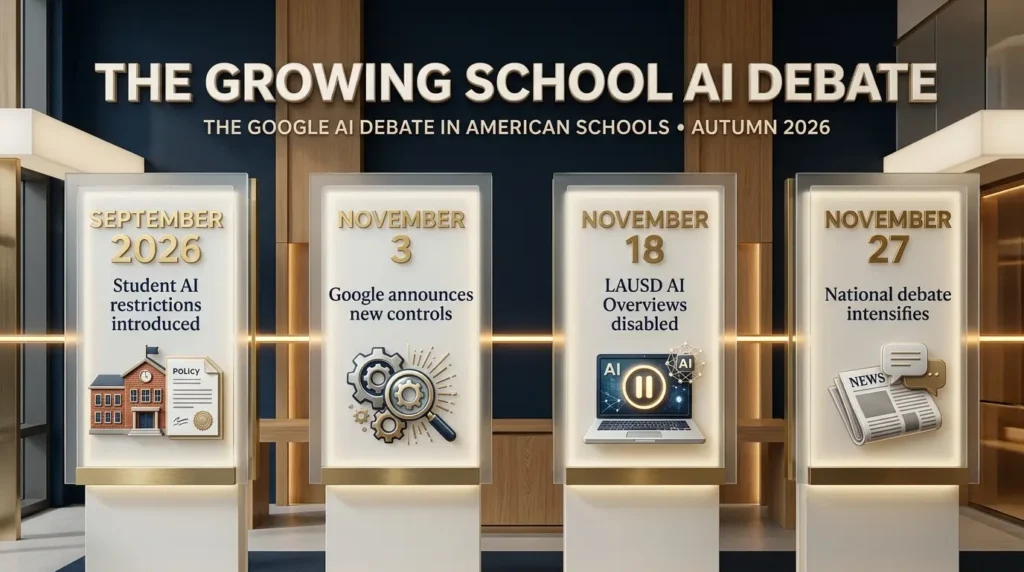
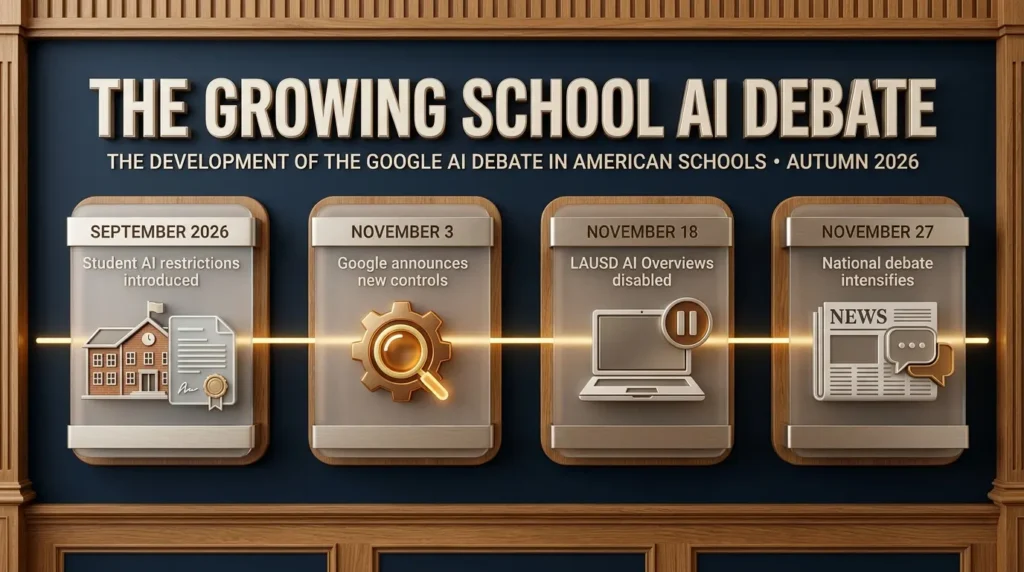
Los Angeles Unified introduced restrictions on student use of generative artificial intelligence on district devices while developing its longer term educational policy.
New York City also introduced student AI restrictions, including limitations through eighth grade.
The two districts have different implementation details, and their policies should not be treated as interchangeable.
November 3, 2026
Google published an announcement outlining changes to its educational AI products and administrative controls.
The company said that access to several services, including Google Search and Gemini, would be disabled by default for K–12 student accounts until administrators explicitly enabled them.
The changes were scheduled to arrive over the following months rather than taking effect immediately everywhere.
November 9 to 13, 2026
Los Angeles Unified officials were publicly reviewing the implications of Google’s planned changes.
Discussions included the relationship between conventional search, generative AI and school district policies.
November 18, 2026
Local reporting confirmed that Los Angeles Unified had disabled AI Overviews for students.
November 25 to 27, 2026
Wider reporting drew national attention to the increasingly difficult choices facing school systems that want to limit artificial intelligence while retaining access to familiar educational technology.
The unresolved issue is whether Google will eventually provide schools with a durable conventional search experience that does not expose students to generative summaries.
Why Schools Are Concerned About Google’s AI Search Features
Artificial intelligence can make information easier to access.
For a student struggling to understand a difficult concept, a clear explanation may be genuinely helpful.
For a teacher working with a classroom of students who learn at different speeds, educational AI may offer additional opportunities for individualized support.
But access to information is not the same thing as developing knowledge.
Schools have several reasons to examine that distinction carefully.
1. Students may complete assignments without developing the intended skills
Imagine that a mathematics teacher asks students to solve ten equations.
The purpose of the assignment is not simply to produce ten correct answers. It is to provide practice in identifying patterns, applying mathematical operations and recognizing mistakes.
An AI assistant might complete the assignment in seconds.
The result could look impressive.
But if the student cannot solve a similar equation without assistance the following day, the educational objective has not necessarily been achieved.
That is one of the most important differences between using AI for workplace productivity and using it while developing foundational skills.
A professional accountant may benefit from automating a calculation they already understand.
A student learning how the calculation works may need to perform it independently before automation becomes useful.
2. Generated summaries can contain incorrect information
Artificial intelligence systems can produce explanations that sound confident even when some of their details are inaccurate.
This becomes particularly important in education because students may not yet have enough subject knowledge to recognize an error.
An incorrect historical date, misunderstood scientific principle or fabricated quotation can become part of a student’s notes without being challenged.
The problem is not unique to AI. Ordinary websites can also contain unreliable information.
However, a polished generated answer may present incorrect information with a level of apparent coherence that makes verification less likely.
3. AI can shorten the process of discovering and evaluating sources
Traditional research requires students to make decisions.
Which source should they open? Who wrote it? Is it reliable? Does another publication provide a different interpretation?
Those questions are part of developing information literacy.
When an AI system immediately combines several sources into a single explanation, some of those decisions may disappear from the student’s experience.
That does not make generated summaries inherently harmful.
It means schools need to teach students how to examine the evidence behind them.
4. Automated homework assistance creates assessment challenges
Teachers use assignments to understand what students know and where they need additional support.
If a polished assignment was largely produced by an AI system, the completed work may provide a misleading picture of the student’s understanding.
This becomes especially difficult when the rules differ between teachers, subjects and assignments.
Clear policies are necessary so students understand when assistance is permitted and when independent work is required.
5. Schools want meaningful control over educational technology
School districts are responsible for determining which tools are appropriate for their students.
When artificial intelligence becomes embedded within software that schools already depend on, separating the desired functions from the unwanted ones can become difficult.
Administrators may want a search engine without generated summaries, or a classroom platform that allows educational research without unrestricted chatbot access.
Their ability to make those distinctions matters independently of whether an individual AI feature is beneficial.
Does Artificial Intelligence Actually Harm Student Learning?
This question deserves more than speculation.
Researchers have already begun examining how different forms of AI assistance affect students’ performance.
Some of the findings are particularly relevant to the current school policy debate.
A high school mathematics experiment revealed an important risk
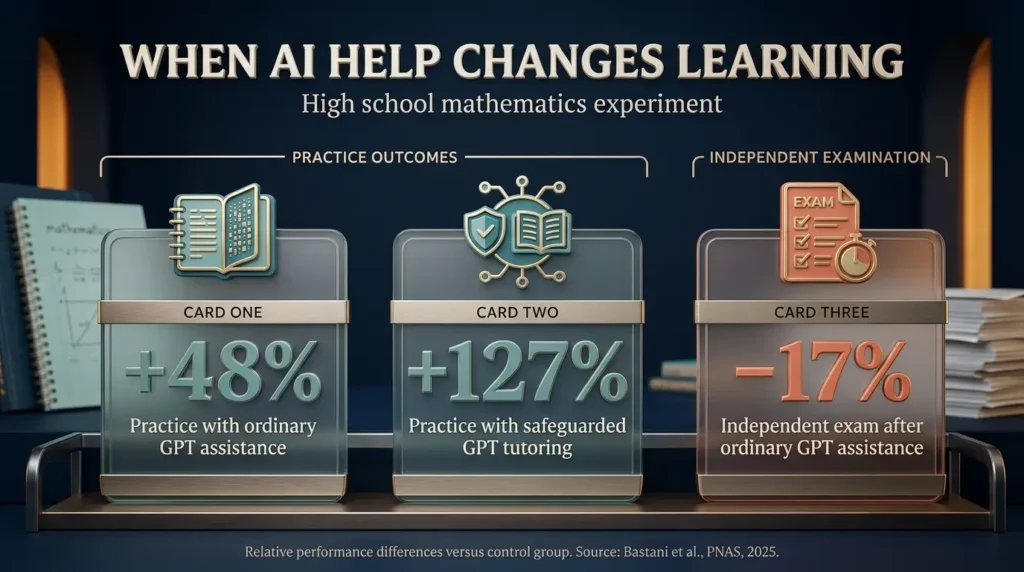
A 2025 study published in the Proceedings of the National Academy of Sciences examined approximately 1,000 high school mathematics students who used different forms of AI assistance.
The researchers compared students who worked without AI with groups using either a conventional GPT based assistant or a specially designed tutor with educational safeguards.
During practice, both assisted groups performed substantially better than students working without AI.
But the picture changed when access to artificial intelligence was removed.
Students who had used the conventional GPT assistant performed worse on the subsequent independent examination.
The carefully designed tutoring system substantially mitigated that negative result.
| Study outcome | Relative difference compared with the control group |
|---|---|
| Practice with ordinary GPT assistance | +48% |
| Practice with safeguarded GPT tutoring | +127% |
| Independent examination after ordinary GPT assistance | −17% |
The findings come from Generative AI Without Guardrails Can Harm Learning, published in 2025.
These percentages describe relative changes in study performance, not percentage point changes in all students’ grades.
The independent examination results for the safeguarded tutor group were not statistically distinguishable from those of the control group.
That qualification matters. The study does not establish that safeguarded AI tutoring improved every subsequent independent learning outcome.
Its central contribution is demonstrating that stronger performance while AI is available does not necessarily indicate stronger learning once that assistance disappears.
The experiment involved mathematics and particular AI configurations. Its results should not be treated as a direct measurement of Google’s AI Overviews or every classroom subject.
Other Research Shows That AI Can Improve Learning
There is another side to the evidence.
A 2025 randomized controlled study involving 194 eligible undergraduate physics students at Harvard University compared a carefully designed AI tutoring experience with classroom active learning.
The students using the custom tutor demonstrated stronger learning outcomes while requiring less time for the relevant lessons.
The tutor had been deliberately constructed around educational principles rather than simply providing unrestricted answers.
You can read the full peer reviewed study in Scientific Reports.
At first glance, the Harvard findings might appear to contradict the high school mathematics experiment.
They do not necessarily do so.
The studies involved different age groups, subjects, teaching approaches, assessments and AI configurations.
The comparison suggests that artificial intelligence should not be evaluated as though every product offers the same educational experience.
A chatbot that immediately completes an equation is different from a tutor that identifies a student’s misunderstanding and offers an appropriate hint.
A writing tool that produces an entire essay is different from one that asks a student to reconsider the evidence supporting their argument.
The 2026 OECD Digital Education Outlook similarly emphasizes the importance of designing AI use around genuine learning objectives.
The question for schools is therefore not only whether artificial intelligence should be available.
It is what the technology does when a student encounters difficulty.
Does it encourage the student to continue thinking, or does it make that thinking unnecessary?
How Much Are Students Already Using Artificial Intelligence?
Even if schools restrict certain applications, artificial intelligence is already part of many teenagers’ lives.
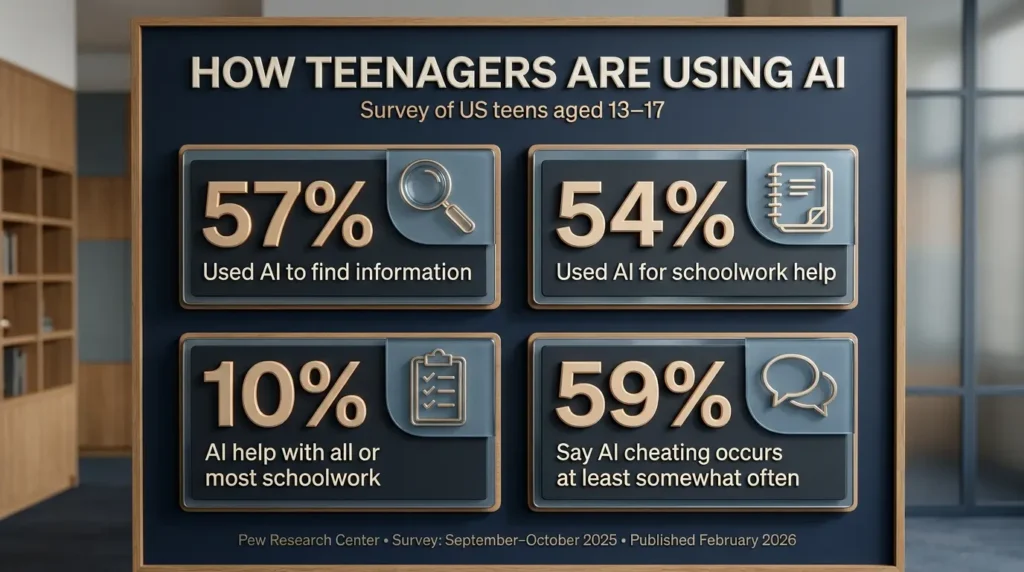
A Pew Research Center report published in February 2026 surveyed American teenagers between the ages of 13 and 17.
The findings illustrate how common these tools had become before the latest school policy controversy.
| Reported activity or attitude | Share of surveyed US teenagers |
|---|---|
| Used AI chatbots to find information | 57% |
| Used chatbots for schoolwork assistance | 54% |
| Used chatbot assistance for all or most schoolwork | 10% |
| Believed AI cheating occurred at least somewhat often at school | 59% |
The underlying survey took place from September 25 to October 9, 2025.
These figures are not measurements of the effects of Los Angeles Unified’s November 2026 restrictions.
They also do not indicate that everyone who uses AI for schoolwork is cheating.
A student might use a chatbot to understand an unfamiliar word, generate practice questions or request a clearer explanation of a lesson.
Another student might use it to produce an assignment they are expected to complete independently.
Those activities have very different educational implications.
For schools, the widespread use of artificial intelligence creates a practical challenge.
Simply preventing access to one application on one device does not eliminate the broader need to teach students how and when these tools should be used.
What Is Google Saying About the Restrictions?
Google has acknowledged concerns about students using artificial intelligence to bypass important learning activities.
In its November 3 announcement, Designing Responsible AI for Learning, the company described plans to introduce educational experiences that support students through difficult tasks rather than immediately providing solutions.
Google is developing Guided Learning capabilities within Search for eligible student accounts.
The proposed experience would recognize certain educational requests and respond with structured assistance.
For example, a student entering a complicated physics problem could be encouraged to explore the relevant principles and work through the solution.
Google announced a pilot involving selected American schools, with the intention of gathering feedback before expanding availability.
The latest reporting does not establish that this experience has become universally available.
Google also announced changes to school administrative settings covering several services.
Under its planned approach, K–12 student access would be disabled until administrators enabled the relevant product.
That sounds like a straightforward expansion of school choice.
But there is an important complication.
Google has not offered schools a separate permanently AI-free version of its search engine under the announced arrangement.
As Education Week reported in its analysis of Google’s new school controls, districts may still face a difficult choice between restricting generative features and retaining familiar search services.
Google’s position reflects its view that artificial intelligence has become an integral part of Search.
The schools’ concerns reflect their responsibility to determine which forms of technology students should encounter while learning.
Both positions help explain why the dispute is unlikely to be resolved by a single software setting.
What Is Guided Learning and Could It Be a Better Alternative?
Guided Learning attempts to preserve an important educational experience: working through a problem instead of immediately receiving its answer.
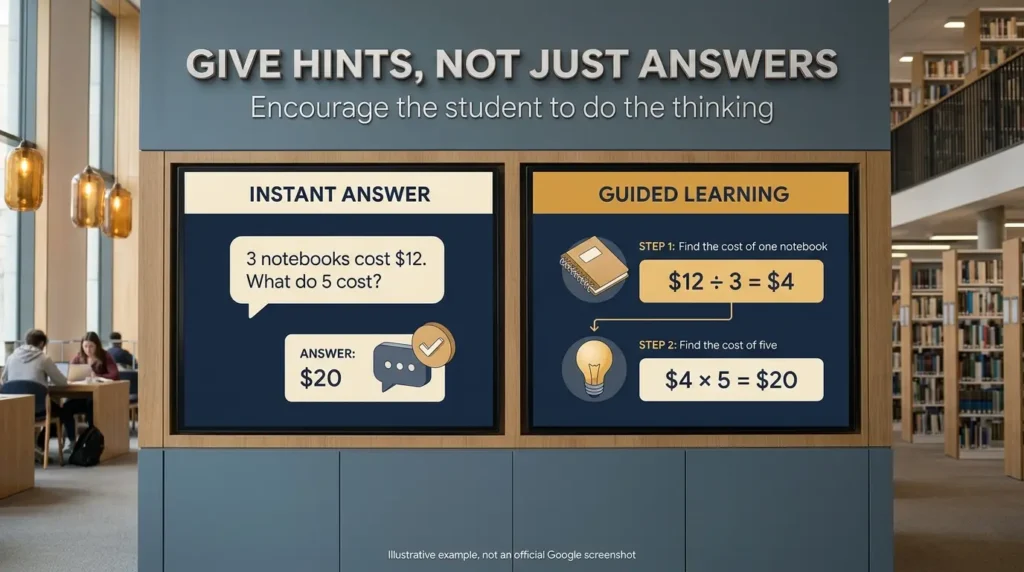
Consider a fictional mathematics exercise.
A student asks an AI system:
“If three notebooks cost $12, how much do five notebooks cost?”
A conventional assistant could immediately provide the answer of $20.
A learning focused assistant could instead begin by asking:
“How much does one notebook cost if three notebooks cost $12?”
The student identifies that a single notebook costs $4.
The assistant then asks:
“What would five notebooks cost at that price?”
The student performs the calculation and reaches the answer.
The final result is identical.
The educational process is not.
This is an illustrative example prepared for this article, rather than a transcript of a tested Google Guided Learning interaction.
The important concept is that students should remain active participants in constructing an answer.
Google has also published research concerning Guided Learning, including work involving university students in Japan.
Such findings are worth examining, but product developer research should be assessed alongside independent evidence and the conditions under which each study was conducted.
Schools will need to establish whether these tools actually improve understanding, rather than assuming that a tutoring interface automatically produces beneficial educational outcomes.
What Does This Mean for Students?
The most immediate consequence depends on where students attend school, which devices they use and the policies governing their accounts.
In Los Angeles Unified, students using district devices will not encounter the restricted generative search features in the same way they did previously.
They can still conduct ordinary web research under the current arrangement.
For students elsewhere, the experience may differ.
But the larger lesson applies across school systems.
Artificial intelligence may become a normal part of education without becoming an acceptable replacement for every assignment.
Students should understand which learning activities need to be completed independently and which permit assistance.
A useful rule is to distinguish between asking AI to help you learn and asking it to demonstrate knowledge you have not yet acquired.
The first may be appropriate under a school’s rules.
The second can undermine the purpose of an assessment.
Seven responsible ways to use AI for learning
Where school rules and age requirements permit, students can explore AI assistance through activities such as:
- Asking for a simpler explanation of a difficult concept.
- Requesting a hint after independently attempting a problem.
- Creating practice questions from approved study material.
- Checking their understanding through self assessment.
- Comparing an AI explanation with a textbook.
- Receiving feedback on a draft they have written themselves.
- Organizing notes without allowing the tool to complete the assessed work.
None of these activities eliminates the need for verification.
For example, AI generated study questions can include incorrect answers, and summarized material may omit important details.
Students should also follow their school’s restrictions rather than attempting to bypass administrative controls.
What Parents Should Ask Their Children’s Schools
Parents do not need to become artificial intelligence engineers to understand how these changes affect their children.
A few practical questions can clarify what is happening.
| Question | Why it matters |
|---|---|
| Which AI tools can students access? | Establishes what children may encounter |
| Do the rules differ by grade level? | Recognizes different developmental and educational needs |
| Is ordinary Google Search still available? | Clarifies the effect of current restrictions |
| Which assignments permit AI assistance? | Helps students understand academic expectations |
| How is student information handled? | Addresses privacy and data protection |
| What alternatives are available? | Ensures students can still access educational resources |
| How are learning outcomes evaluated? | Distinguishes useful tools from attractive demonstrations |
| How will parents be informed about changes? | Reduces confusion as policies evolve |
Parents should also remember that school issued devices and personal devices may operate under different arrangements.
A restriction applying to a managed Chromebook does not automatically describe every application a child can access elsewhere.
The most valuable discussions are often about why a particular rule exists.
If a student understands that independently solving an equation develops a skill they will need later, the restriction may feel less arbitrary than a simple instruction not to use artificial intelligence.
What This Means for Teachers
Teachers face a particularly difficult task.
They are expected to prepare students for a world in which artificial intelligence will be increasingly important, while preserving the skills students need to use that technology effectively.
That may require changing how some assignments are designed.
A conventional homework exercise might be supplemented with a short classroom explanation in which students describe their reasoning.
An essay could include a research record, an initial outline and a discussion of how the student developed the argument.
A mathematics assessment could distinguish between independent problem solving and an activity that explicitly permits AI assistance.
These approaches are not guaranteed solutions to academic dishonesty.
However, they can provide more information about a student’s understanding than examining a polished final answer alone.
Teachers may also benefit from AI tools for generating practice materials, exploring different explanations and adapting classroom resources.
Our guide to Google Gemini Notebook and interactive educational resources explores the emerging possibilities of turning supplied information into more interactive learning materials.
The underlying content still requires review.
An automatically generated worksheet does not become educationally appropriate simply because it was created quickly.
Student Privacy Is Another Part of the Debate
Artificial intelligence in schools raises questions that go beyond academic performance.
Students may enter information about their lives, learning difficulties, assignments, family circumstances or other personal matters while using an AI application.
That information deserves careful handling.
Schools need to understand the terms governing educational accounts, whether information is retained, which individuals or organizations can access it and how applicable privacy requirements are addressed.
A consumer AI account and an institutionally managed educational account may have different protections and data handling arrangements.
The existence of a school approved product should not be treated as a reason to share unlimited personal information.
Students should avoid entering confidential records, passwords, other people’s personal information or sensitive school documents into tools that have not been approved for that purpose.
Parents and teachers should also avoid assuming that every restriction is based on a proven privacy violation.
The Los Angeles Unified decision reflects wider educational and safety considerations. It is not evidence that Google has been found to have improperly handled every affected student’s information.
What an Effective School AI Policy Could Look Like
There is unlikely to be one policy that suits every age group, subject and learning objective.
However, schools can benefit from making the permitted uses of technology understandable.
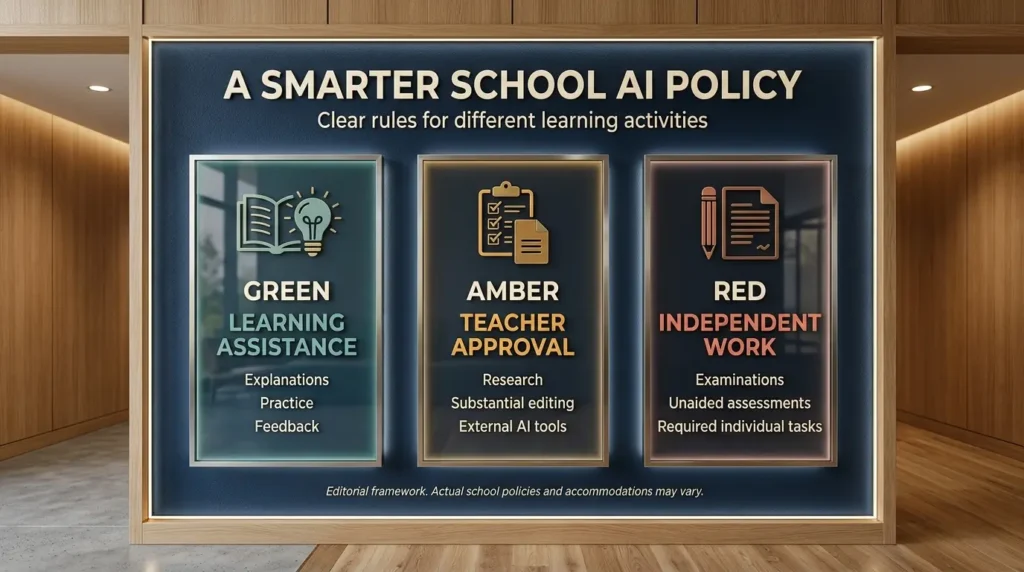
The following three category framework offers one practical way to organize those rules.
It is an original editorial framework, not an official Los Angeles Unified or Google policy.
Green category: Learning assistance
Where explicitly allowed by the school, students may use approved tools for explanations, practice exercises and feedback.
The student remains responsible for understanding the material and verifying important information.
Amber category: Teacher approval required
Activities such as AI assisted research, substantial editing, code generation or access to external AI services may require specific teacher approval.
Students should understand what assistance is permitted and how it must be disclosed.
Red category: Independent work required
Activities intended to measure unaided knowledge should remain independent unless the assessment explicitly permits assistance.
These may include examinations, certain homework assignments and tasks designed to develop foundational skills.
Accessibility accommodations and individually approved support arrangements should be considered separately and should not automatically be treated as misconduct.
The purpose of this framework is clarity.
Students should not be expected to guess whether a particular tool is allowed after receiving conflicting instructions from different adults.
Can Schools Turn Off Google AI Without Losing Google Search?
This is the technical question at the center of the controversy.
For ordinary users, Google’s current Search Help documentation describes AI Overviews as a core feature that cannot simply be disabled through a universal user setting.
The Web filter can display conventional text based links after a search.
However, selecting that filter is not equivalent to permanently disabling AI Overviews across an entire managed school environment.
Schools may use administrative controls or additional filtering tools.
The exact results depend on the device, software configuration, network arrangements and current product behavior.
Some districts have reportedly experimented with tools that suppress generated search summaries.
Those workarounds may not provide the same stability as a permanently supported product setting.
The relationship between AI Overviews, AI Mode and conventional Google Search will therefore remain important for administrators.
Our analysis of Google’s generative AI Search Console reports illustrates how these newer experiences have become part of the wider Google Search ecosystem.
For schools, however, the central issue is not search performance measurement. It is whether educational decision makers can choose which experiences students receive.
Will More Schools Move Away From Google?
It is possible, but the extent of any transition remains uncertain.
Schools have invested in devices, staff training, communication systems, classroom software and administrative processes that depend on existing technology providers.
Changing a default search engine may be relatively straightforward.
Replacing an entire educational software ecosystem is a much larger undertaking.
It can involve reviewing contracts, retraining employees, transferring information, protecting student records and maintaining continuity for families.
Districts considering alternative search tools must also evaluate content filtering, accessibility, privacy, reliability and the quality of available educational resources.
An alternative search engine may have its own AI features.
Moving away from Google would not automatically resolve every concern associated with artificial intelligence.
The more sustainable question is whether education systems can retain meaningful control over the technologies they adopt, regardless of which company provides them.
Why AI Literacy Matters Even When Schools Restrict AI
A temporary restriction may give schools time to evaluate technology and develop more suitable policies.
It cannot remove artificial intelligence from the society students will enter after graduation.
Students will increasingly encounter generated information in workplaces, public services, search engines, entertainment and ordinary digital communication.
They will need to understand how such information is produced, where it may be unreliable and how to assess its relevance.
In June 2026, the OECD and European Commission published Empowering Learners for the Age of AI, an AI literacy framework for primary and secondary education.
Its approach recognizes that understanding artificial intelligence involves more than learning how to enter a prompt.
Students need knowledge, judgment and the ability to evaluate the ethical and practical consequences of using these systems.
That means a school can reasonably restrict unrestricted chatbot access while still teaching students about artificial intelligence.
A student might analyze a generated answer, identify unsupported statements and compare it with reliable sources under teacher supervision.
They could learn how AI systems make mistakes without depending on those systems to complete their everyday work.
The goal is not to produce students who have never encountered artificial intelligence.
It is to produce students who can use it without surrendering their ability to think independently.
Frequently Asked Questions
Why are schools blocking Google AI?
Some school districts are concerned that unrestricted generative assistance may interfere with independent learning, academic assessment and age appropriate technology use. They also want greater control over the educational tools available to students.
Has Los Angeles Unified banned Google Search?
No. The district has temporarily disabled AI Overviews on student devices and previously restricted AI Mode. Conventional Google Search remains available under the current arrangement.
Has every American school banned artificial intelligence?
No. School policies differ by district, grade level, device and educational purpose. There is no established nationwide ban covering all students.
Can teachers still use Google’s AI features?
Teachers and staff in Los Angeles Unified retain access to AI Mode, according to current reporting. Other AI use remains subject to applicable school policies.
Does artificial intelligence make students less intelligent?
Research does not support such a broad conclusion. Some studies indicate that unrestricted AI assistance can undermine independent performance in specific learning situations. Carefully designed educational tutoring can also produce beneficial outcomes.
Is using AI for homework always cheating?
No. Whether AI assistance is permitted depends on the assignment and school rules. Requesting an approved explanation is different from submitting generated work as an independent assessment.
Can AI Overviews be permanently turned off in Google Search?
Google does not currently provide a universal consumer setting to permanently disable AI Overviews. Its Web filter displays conventional text links for a particular search. Managed school restrictions and additional filtering systems operate differently.
What is Google Guided Learning?
It is an educational AI approach intended to help students understand concepts and work through problems rather than immediately presenting completed answers.
Will Google’s new education controls affect every school immediately?
No. Google announced changes that are expected to roll out over the following months. Individual account settings and product availability may differ.
Should parents stop children from using all AI tools?
There is no universal answer. Appropriate use depends on age, school policy, educational purpose, supervision and the design of the tool. Parents can benefit from discussing responsible use rather than treating all AI applications as identical.
Can artificial intelligence replace teachers?
Current evidence does not establish that AI can comprehensively replace the professional, educational and interpersonal responsibilities of teachers. It may support selected teaching activities when appropriately designed and supervised.
What should schools teach students about AI?
Students should learn how generated information can contain errors, how to verify claims, how to protect personal information and when independent reasoning is necessary.
Final Thoughts: The Answer Is Not the Same as the Education
The growing disagreement over Google’s AI features reveals a problem that reaches far beyond one technology company.
We have developed systems that can produce information extraordinarily quickly.
Schools are now trying to determine how that convenience fits into an environment where the process of finding an answer is often more important than the answer itself.
A student who struggles through a difficult mathematics problem may learn something valuable from the struggle.
A student who compares conflicting historical sources develops a skill that cannot be measured simply by the quality of a finished paragraph.
Artificial intelligence can support those experiences.
It can also shorten them until very little independent work remains.
The difference depends on the design of the technology, the purpose of the activity and the decisions made by the people responsible for education.
Google’s Guided Learning initiative suggests that technology developers are recognizing this distinction. The decisions being made in Los Angeles and other school systems suggest that educators want a meaningful role in defining it.
The most important question for the future of AI in schools is not whether students can obtain an answer in seconds.
It is whether they will still know what to do when the answer is not already there.
Editorial methodology: This article is based on Associated Press reporting, local and specialist education journalism, Google’s official announcements, peer reviewed educational studies, Pew Research Center survey findings and OECD publications available as of November 27, 2026. TrendOutsider has not independently interviewed school officials, examined individual student devices or tested Google’s new Search Guided Learning pilot. Classroom examples and the three category school policy framework are original editorial illustrations.
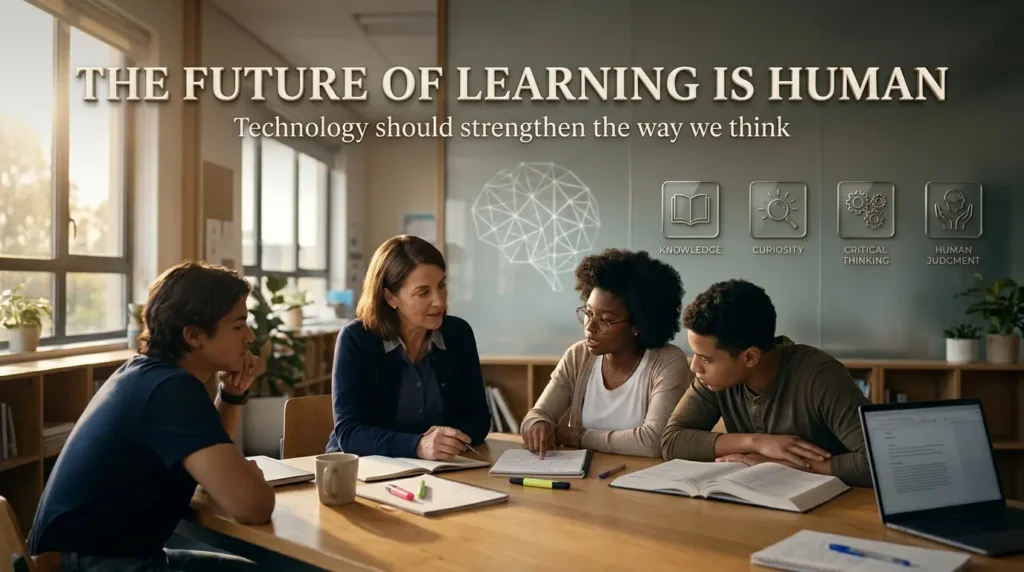
Visual disclosure: AIl editorial images accompanying this article illustrate educational concepts and documented policy developments. They do not depict actual affected students, specific Los Angeles Unified classrooms or real photographs of the reported events.








Leave a Reply