
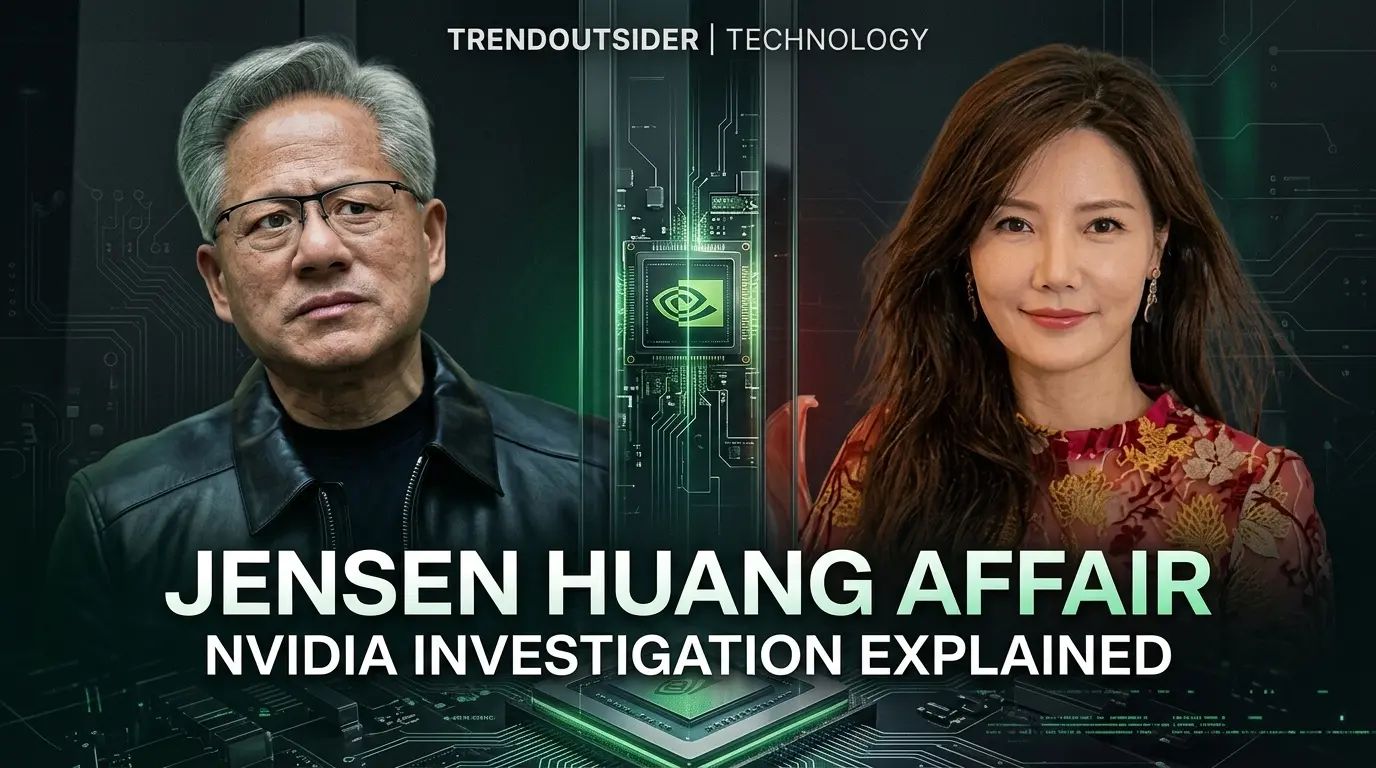
NVIDIA CEO Jensen Huang has spent more than three decades building one of the most influential companies in technology. His chips now power much of the artificial intelligence industry, and his decisions can affect everything from Silicon Valley investment to relations between Washington and Beijing.
Now, his personal life has become part of an extraordinary corporate and national security controversy.
On November 8, 2026, Huang publicly acknowledged that he had been unfaithful to his wife. That same day, NVIDIA announced an independent investigation into reports that its chief executive may have been targeted by a foreign intelligence operation.
At the center of the reporting is Alice Huang, a Chinese business executive formerly associated with Singapore based AI infrastructure company Megaspeed.
US intelligence officials reportedly believe Alice Huang was connected to Chinese intelligence activities. However, those allegations remain disputed, and Reuters has said it could not independently verify them.
The controversy has raised questions about NVIDIA’s corporate governance, access to advanced AI chips, US export restrictions and what company leaders knew about potential security risks.
Here is what has been confirmed, what remains under investigation and why the story matters far beyond the private lives of the people involved.
What happened to NVIDIA CEO Jensen Huang?
The most significant confirmed development came on November 8, when NVIDIA published a personal message from its founder and chief executive.
In that statement, Huang acknowledged being unfaithful to his wife, apologized to his family and colleagues, and accepted responsibility for his conduct.
He did not identify the other person involved in the statement.
Huang also addressed the national security concerns raised by news reports and said he would cooperate with NVIDIA’s independent investigation.
The complete statement is available through NVIDIA’s official newsroom.
On the same day, NVIDIA’s board announced that an independent committee, assisted by outside counsel, would investigate reports that Huang had been the target of a foreign intelligence effort.
Importantly, the board said it had no reason to believe that US national security or NVIDIA’s confidential information had been compromised.
That was not a declaration that every allegation was false. It was the company’s position when the investigation was announced.
The board also expressed confidence in Huang and his leadership team.
Read the official NVIDIA board statement.
Who is Alice Huang?
Alice Huang, also known as Huang Le in some reporting, is a Chinese businesswoman whose professional background includes work in the technology and media sectors.
She has been associated with Megaspeed International, a Singapore based business involved in AI computing infrastructure and the acquisition of advanced semiconductor hardware.
According to reporting by Channel NewsAsia, she became a managing director of Megaspeed International in March 2023. Corporate records cited in that reporting indicate that she and another director resigned from their directorships later that year.
Megaspeed’s relationship with NVIDIA matters because access to powerful AI processors has become a strategic issue between the United States and China.
The New York Times and subsequent reports identified Alice Huang as the business executive whose relationship with Jensen Huang attracted the attention of US intelligence authorities.
The two share a surname but are not related.
It is important not to confuse allegations about her activities with established criminal findings.
Reuters reported on November 11 that it had not independently verified the intelligence allegation or her current employment status with Megaspeed.
China’s foreign ministry has rejected the espionage claims.
For additional background, see Channel NewsAsia’s detailed chronology.

Jensen Huang and Alice Huang: A timeline of the controversy
The public controversy did not begin with Huang’s November apology.
It developed through business reporting, intelligence allegations and questions about NVIDIA’s commercial relationships.
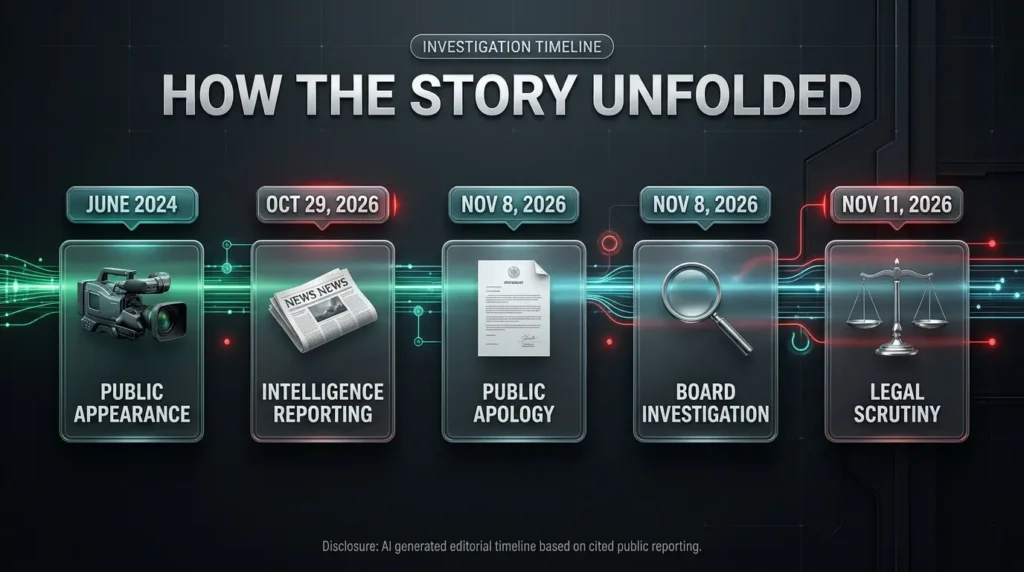
March 2023: Megaspeed’s business develops
Megaspeed International expanded its focus on AI infrastructure. Corporate records later became relevant to reporting about its leadership and ownership.
June 2024: Public appearance in Taiwan
Jensen Huang and Alice Huang were photographed at events connected with the Computex technology conference in Taiwan.
Photographs and public appearances establish that people attended an event. They do not, by themselves, establish the nature of a private relationship or any intelligence activity.
October 29, 2026: Intelligence concerns become public
The New York Times reported concerns involving Alice Huang, NVIDIA and access to advanced chips.
The reporting prompted questions about whether a relationship involving the company’s chief executive could create national security or corporate governance risks.
October 30 and 31: Competing accounts emerge
Additional reporting examined the intelligence allegations.
China rejected claims of espionage.
Singapore also disputed reporting that its government or officials had expressed certain concerns or conducted the investigations attributed to them.
These responses are important because they show that some accounts of the alleged intelligence operation remain contested.
November 8: Huang apologizes and NVIDIA opens an investigation
Huang acknowledged infidelity in his public message.
NVIDIA’s board announced an independent investigation and expressed confidence in his continued leadership.
November 9 and 10: Scrutiny intensifies
Reuters and other news organizations reported growing investor concern and political attention.
The Financial Times reported that President Donald Trump said the FBI was looking into the matter.
Reuters also reported allegations, originally published by The Information, concerning shipments of NVIDIA chips through a network of businesses associated with Alice Huang.
Those shipment allegations have not been established as proven violations by Huang.
November 11: Legal and political questions grow
Reuters examined the potential legal exposure facing Huang, NVIDIA and its directors.
The report described an independent board review, congressional pressure and a proposed investor class action.
US senators also sought preservation of government records connected with the reported intelligence concerns.
The developments show how quickly a personal controversy can become a question of corporate accountability and government oversight.
For a detailed sequence of events, see Reuters’ November 11 timeline.
Why is Megaspeed involved?
Megaspeed is important because it operated in a business where access to NVIDIA’s advanced processors can be enormously valuable.
Modern AI systems depend on specialized computing hardware.
Companies training or running large models need access to GPUs, servers, networking equipment and data centers.
NVIDIA supplies many of the processors used in this infrastructure.
According to reporting cited by the Associated Press, Megaspeed purchased more than $4.8 billion worth of NVIDIA chips over approximately two years.
That figure concerns reported commercial purchases. It is not proof of illegal exports.
Separately, Reuters reported that The Information had alleged a network of companies connected to Alice Huang helped facilitate at least $7.5 billion in chip shipments to Chinese firms.
The report described alleged movements of restricted processors, including H100 and H200 products.
These are serious allegations, but their existence in a news report does not establish that Huang knowingly participated in illegal activity.
The central questions are whether restricted chips reached prohibited destinations, whether any rules were violated and what the relevant companies or individuals knew.

Why does the United States restrict NVIDIA AI chips going to China?
To understand the wider controversy, it helps to understand why NVIDIA’s processors have become a national security issue.
Advanced AI chips are useful for training language models, processing large amounts of information and powering sophisticated scientific and commercial applications.
The same computing capabilities can also have military and intelligence applications.
The United States has imposed export controls on certain advanced semiconductor products and related technology to restrict access by countries and entities considered security risks.
These restrictions have evolved over time and vary according to the product, destination, end user and applicable licensing requirements.
They do not mean that every NVIDIA chip sale involving China is illegal.
That distinction is essential.
A legitimate transaction involving an authorized product is different from an alleged attempt to divert restricted hardware through intermediaries.
The controversy surrounding Megaspeed matters because investigators may need to establish whether commercial relationships were used to circumvent export controls.
Readers interested in the wider technology behind the AI boom can explore TrendOutsider’s Dessa AI research explainer, which discusses the NVIDIA computing hardware used in a recent experimental voice AI project.

Was Alice Huang a Chinese spy?
That is one of the biggest questions surrounding the story, and it is also the question that requires the most careful language.
The New York Times reported that US authorities believed Alice Huang was connected to Chinese intelligence.
Reuters subsequently reported on those allegations but said it could not independently verify them.
China rejected the claims as groundless.
At the time of writing, the publicly available reporting does not establish a criminal conviction or a completed public finding proving that Alice Huang carried out espionage against NVIDIA.
It would therefore be misleading to present the allegation as a settled fact.
The same caution applies to claims about confidential information, export violations and Huang’s personal knowledge of any alleged intelligence activity.
NVIDIA’s board has said it has no reason to believe national security or company secrets were compromised, while also committing to examine the available information.
What has been confirmed, and what remains uncertain?
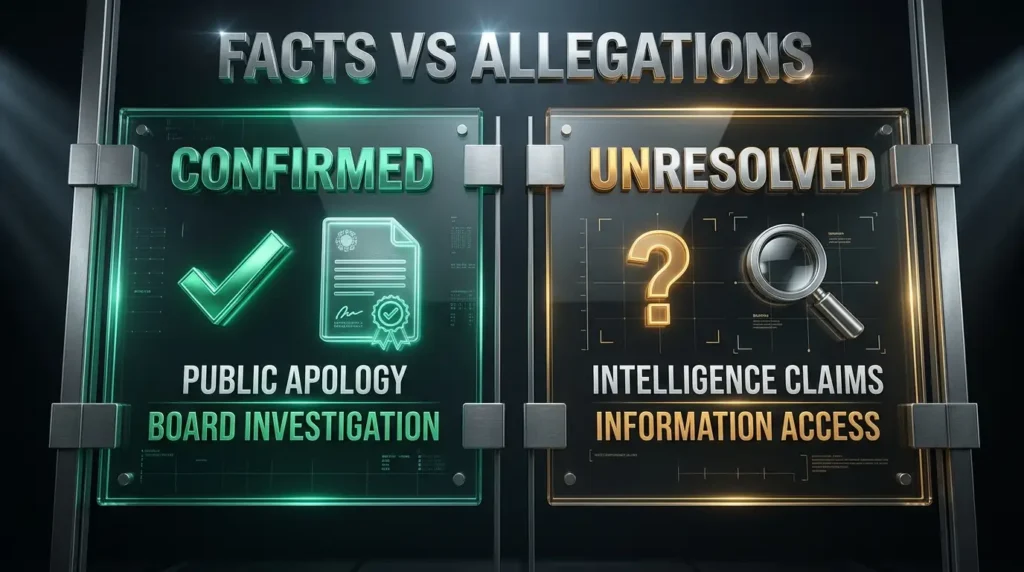
| Confirmed or officially acknowledged | Alleged or unresolved |
|---|---|
| Jensen Huang acknowledged infidelity | The full nature and history of the relationship |
| NVIDIA announced an independent investigation | Whether an intelligence operation targeted Huang |
| The board expressed confidence in Huang | Whether any confidential information was obtained |
| Megaspeed had commercial connections involving NVIDIA hardware | Whether specific transactions violated export controls |
| US political scrutiny increased | Whether individuals or companies face future legal liability |
These categories may change as investigators publish findings.
What has Jensen Huang said about the affair?
Huang’s November 8 message was unusually personal for the chief executive of a major public technology company.
He apologized to his family and acknowledged that his actions had hurt people close to him.
He also addressed NVIDIA employees, partners and shareholders, recognizing that his conduct had affected confidence in his leadership.
His statement did not attempt to provide a detailed public account of the private relationship.
Instead, he accepted responsibility for infidelity and said he would cooperate with the independent investigation.
That is an important distinction.
An apology for personal misconduct does not automatically establish knowledge of espionage, illegal chip shipments or the misuse of company information.
Those questions require separate evidence.
What does the investigation mean for NVIDIA?
NVIDIA is not an ordinary technology company in the context of this controversy.
Its products are central to the global AI industry.
Its chief executive has led the business since its founding in 1993 and remains closely associated with its strategy, commercial relationships and public reputation.
That concentration of leadership makes questions about governance especially important.
The board’s responsibilities
Independent directors must consider whether the company has adequate controls for conflicts of interest, confidential information, sensitive business relationships and executive conduct.
The existence of an investigation does not mean the board has already concluded wrongdoing occurred.
It means the company has recognized that the allegations warrant formal examination.
Reuters reported that NVIDIA’s independent directors hired the law firm Wachtell, Lipton, Rosen & Katz to assist with the review.
Investor concerns
Investors may be concerned about several possible consequences.
These include regulatory investigations, legal expenses, reputational damage, leadership uncertainty and changes to commercial relationships.
Reuters reported that NVIDIA shares fell following the announcement and that the controversy affected its market value.
A short term market reaction should not be treated as proof of lasting financial damage.
The longer term implications will depend on what the investigations establish and how the company responds.
For readers interested in how organizations evaluate the business impact of AI technology, TrendOutsider’s AI business solutions guide provides additional context on implementation, oversight and operational risk.
Could Jensen Huang face legal consequences?
Potential legal consequences depend on facts that are not yet publicly established.
Reuters’ November 11 legal analysis discussed several areas of possible exposure, including corporate governance duties, securities law questions and regulatory scrutiny.
However, an investigation, allegation or proposed lawsuit is not the same as a finding of liability.
Reuters reported that Huang had not been accused of criminal wrongdoing.
Whether legal action develops further will depend on evidence, applicable law and decisions by regulators, prosecutors or courts.
Readers should avoid treating speculation about future charges or leadership changes as confirmed developments.
What about the viral photographs?
The controversy has also created an environment where photographs and social media posts can circulate faster than their original context.
A photograph of two people together at a public event may be genuine without proving the allegations attached to it.
Other images may be mislabeled, altered or generated using AI.
That is particularly relevant when online posts claim to show private encounters or identify someone without a reliable source.
For this article, any visual representation of the individuals should be based on authenticated reference material.
AI generated editorial illustrations should be disclosed as illustrations, not presented as photographic evidence.
This is also an important distinction in the broader AI industry. TrendOutsider’s Gemini 4 Carbon analysis explores the capabilities and limitations of another advanced AI system, including why generated outputs still require verification.
What happens next for NVIDIA and Jensen Huang?
Several developments will determine how the story evolves.
First, NVIDIA’s independent investigation may establish whether any confidential information, company policies or security procedures were compromised.
Second, government authorities may provide additional information about the intelligence allegations and reported chip transactions.
Third, lawmakers may seek testimony, documents or changes to oversight of advanced semiconductor exports.
Finally, investors will watch how NVIDIA’s board handles the matter and whether Huang continues to lead the company without disruption.
For now, NVIDIA’s board has expressed confidence in him.
That position could remain unchanged or evolve as new evidence emerges.
The most responsible approach is to follow official statements and credible reporting rather than treat speculation as a final verdict.
Frequently asked questions
Did Jensen Huang admit having an affair?
Yes. On November 8, 2026, Huang publicly acknowledged being unfaithful to his wife in a message published by NVIDIA.
Who is Alice Huang?
Alice Huang is a Chinese business executive formerly associated with Singapore based AI infrastructure company Megaspeed. News reports have linked her to the relationship and to disputed intelligence allegations.
Is Alice Huang related to Jensen Huang?
No. Despite sharing the surname Huang, they are not related.
Is Alice Huang confirmed to be a Chinese spy?
No publicly established criminal finding confirming that allegation was identified in the sources reviewed. US intelligence concerns have been reported, but Reuters has said it could not independently verify the allegation, and China has rejected it.
Is Jensen Huang leaving NVIDIA?
NVIDIA’s board expressed confidence in Huang when announcing the investigation. No confirmed departure was identified in the official statements reviewed for this article.
Did NVIDIA secrets reach China?
NVIDIA’s board said it had no reason to believe national security or company secrets were compromised. The investigation is intended to examine available information.
What is Megaspeed?
Megaspeed is a Singapore based company associated with AI computing infrastructure and purchases of NVIDIA hardware. Its commercial relationships have attracted scrutiny over possible chip diversion.
Has Jensen Huang been charged with a crime?
Reuters reported on November 11 that Huang had not been accused of criminal wrongdoing.
Why does this matter to the AI industry?
NVIDIA supplies critical computing hardware used throughout the AI industry. Questions involving its leadership, export controls and national security therefore have implications beyond the company’s reputation.
Final analysis: Why the NVIDIA controversy matters
The most striking part of this story is how quickly a private admission became a matter of international significance.
Jensen Huang’s apology is a confirmed fact.
NVIDIA’s independent investigation is also a confirmed fact.
But the intelligence allegations, questions about restricted chip shipments and possible legal consequences require evidence that has not yet been fully established in public.
That difference should guide how the controversy is understood.
NVIDIA occupies a central position in the global AI economy, and its chief executive has extraordinary influence over the company.
When questions arise about security, corporate relationships and executive judgment, they deserve scrutiny.
They also deserve accuracy.
For now, the important story is not simply that a famous technology executive admitted infidelity.
It is that the resulting investigation may test how one of the world’s most influential AI companies manages leadership accountability, sensitive commercial relationships and national security risks.
The findings, rather than the speculation, will ultimately determine what this controversy means for NVIDIA.
Sources and editorial methodology
This article is based on official NVIDIA statements and reporting available through November 12, 2026.
Primary and authoritative references:
- NVIDIA: A Message to Our Company, November 8
- NVIDIA: Statement From the Board of Directors, November 8
- Reuters: What we know about NVIDIA’s investigation
- Reuters: Could Huang, NVIDIA and the board face liability?
- Reuters: How the NVIDIA controversy unfolded
- Reuters: Reported allegations concerning chip shipments
- Channel NewsAsia: Timeline and background
- US Senate: November 11 record preservation letter
Editorial disclosure: TrendOutsider has not independently investigated the private relationship, obtained confidential intelligence records or verified the disputed espionage allegations. The article distinguishes official statements, reported allegations and unresolved questions. Any accompanying AI generated images are conceptual editorial illustrations and are not evidence of real events.
This is a developing story. New official findings may change the information presented here.





Leave a Reply