
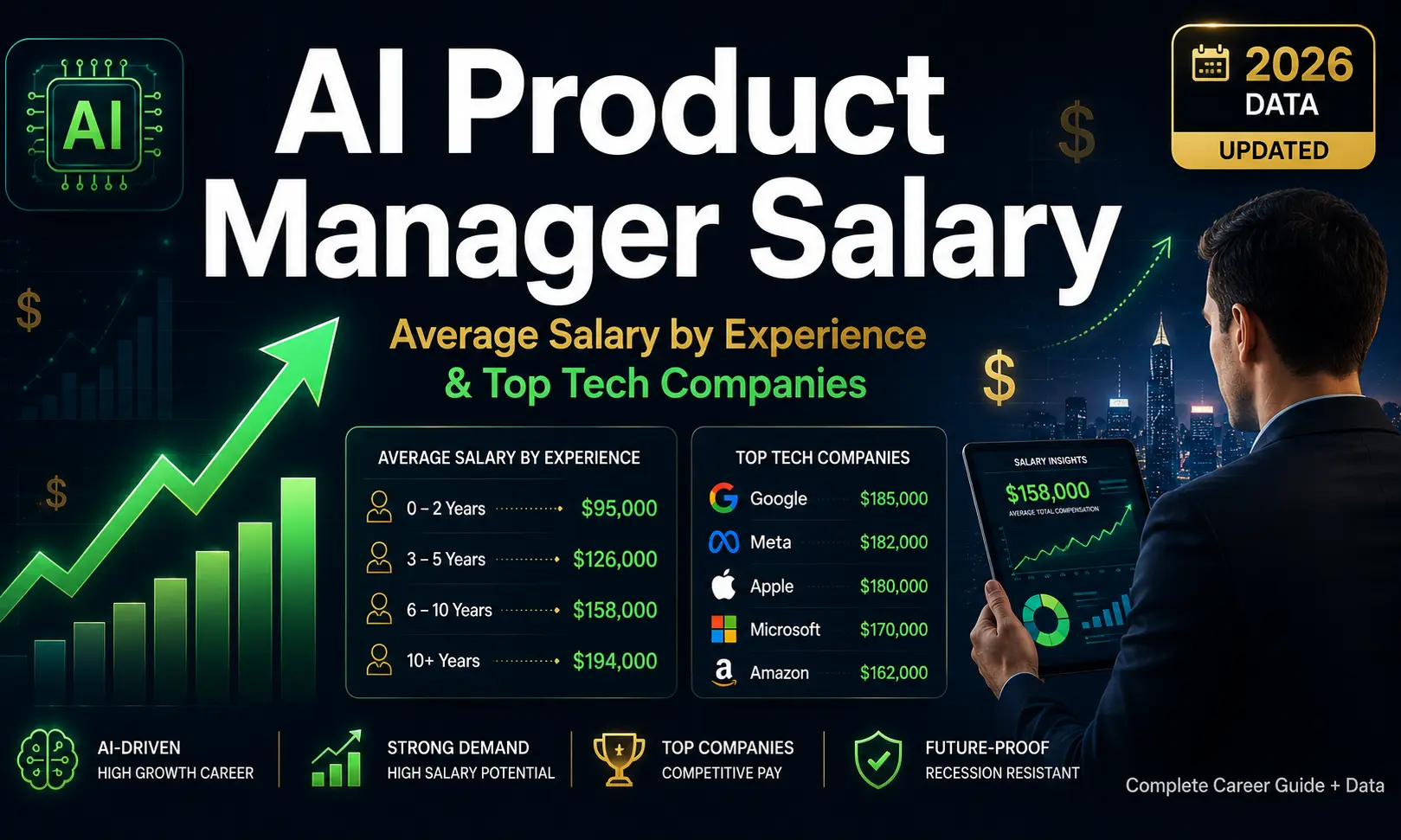
When I started researching AI product manager salaries for 2026, I noticed something interesting. Most salary guides online are either outdated or so vague they don’t actually help anyone make real career decisions.
A few years ago, if you wanted to become a product manager, the path was fairly straightforward. You learned user research, prioritized features, worked with engineers, and shipped products. That was the job.
Today’s AI product manager role is completely different.
Companies now expect product managers to understand artificial intelligence at a meaningful level. Not as buzzwords. Not as features to add to a marketing slide. But as actual technology that requires specific product judgment, customer communication, technical decision-making, and business strategy.
That combination of skills is rare. And rare skills command higher salaries.
The question I get asked most often by product managers considering the AI space is simple: “How much can I actually make?”
This guide answers that question with real numbers, honest context, and practical information you can use right now.
Understanding the AI Product Manager Salary Landscape in 2026
Let me be direct about something first. The salaries you see on Glassdoor or Levels.fyi are averages. They don’t tell you what you might actually earn at Google versus a Series B startup. They don’t explain why someone with the same title at Microsoft might earn $150,000 less than someone at OpenAI.
The truth is more nuanced.
In the United States, product managers are already among the highest-paid individual contributors in technology. The average product manager salary sits somewhere around $195,000 to $230,000 depending on which data source you trust and how each source defines the role. But AI product managers often earn more because companies are willing to pay for the specific combination of product expertise and AI knowledge.
Here’s what makes an AI product manager valuable to companies. They need to translate complex AI capabilities into products that customers actually want to use. They work between engineering teams, data scientists, designers, security experts, legal teams, and sales organizations. They need enough technical understanding to make intelligent product decisions, but also enough business sense to know what customers will pay for and how to build sustainable products.
The companies paying the most for this skill set are the ones where AI isn’t just a feature. It’s the core of the business or it directly affects revenue, risk, or customer experience in ways that matter.
What AI Product Managers Actually Earn in 2026
The salary ranges for AI product managers vary significantly based on experience level. Let me break this down in a way that actually makes sense.
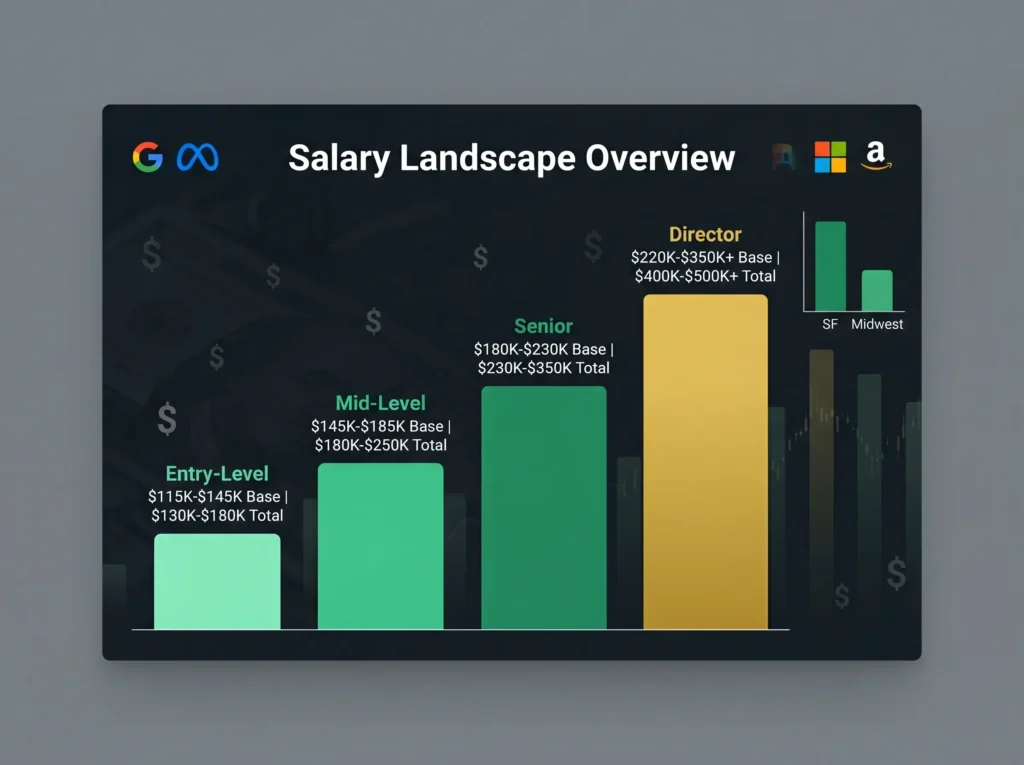
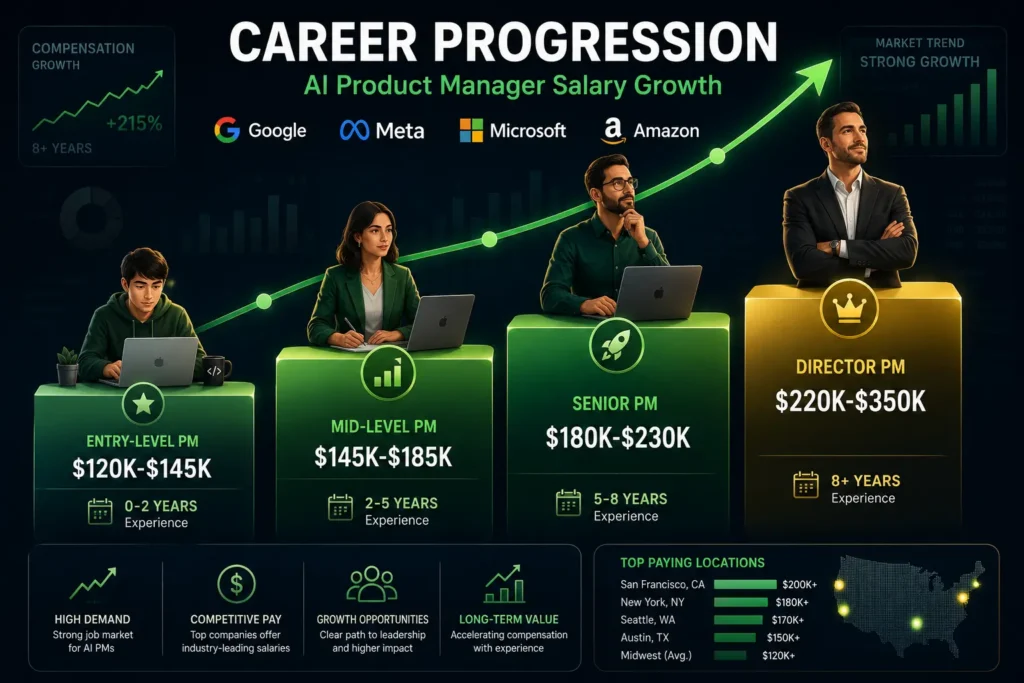
If you’re just starting out as an AI product manager, you’re likely looking at a base salary somewhere between $115,000 and $145,000. Your total compensation, which includes bonus and equity, probably lands between $130,000 and $180,000 depending on where you work.
As a mid-level AI PM with a few years of proven product experience, your base salary typically moves to the $145,000 to $185,000 range. Total compensation at this level, especially at strong tech companies, can reach $180,000 to $250,000. This is where you start to see real increases because you’re expected to own meaningful product areas and drive business outcomes.
Senior AI product managers, the ones who have proven they can make high-stakes decisions and influence across organizations, usually earn between $180,000 and $230,000 in base salary. Total compensation for senior roles commonly reaches $230,000 to $350,000 or higher. At this level, you’re not just managing features. You’re setting direction.
At the director and principal level, compensation gets even stronger. Directors and group product managers working on AI can command base salaries of $220,000 to $350,000 or more, with total compensation frequently exceeding $400,000 at major tech companies. This is where equity really starts to matter because it can make up 40% or more of your total pay.
The key thing to understand is that these numbers assume you’re working at a company where AI is genuinely important to the business. If you’re a product manager at a small company adding an AI chatbot feature to an otherwise traditional software product, your salary expectations should be different than if you’re owning an enterprise AI platform at a major tech company.
How Your Company Choice Affects Your Paycheck
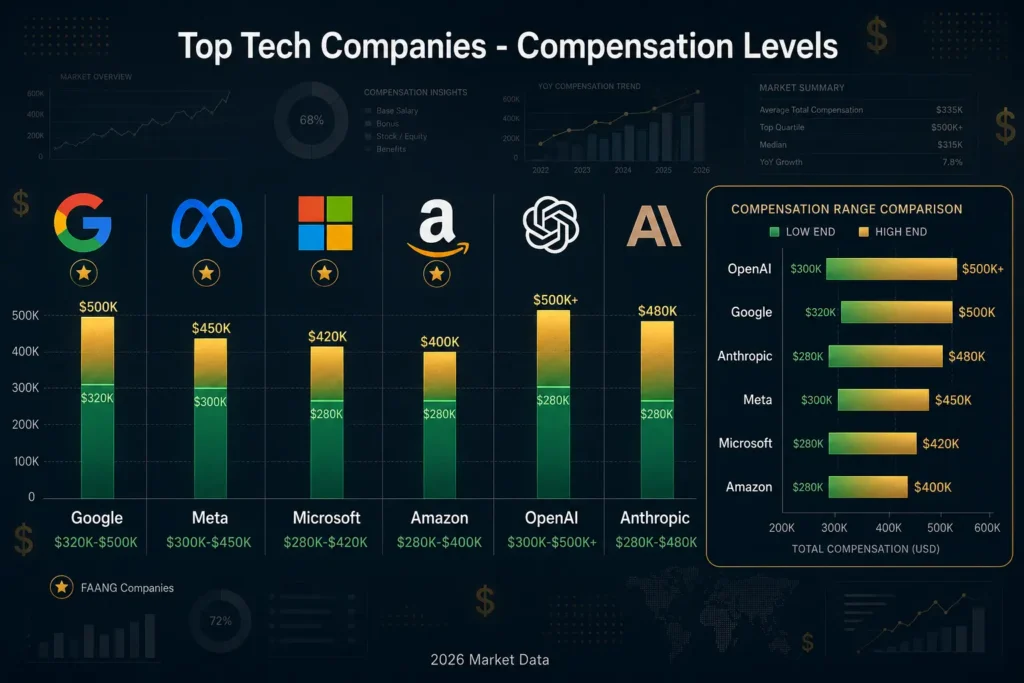
One of the biggest factors determining your salary as an AI product manager is which company you work for. The same person with the same experience could earn dramatically different amounts depending on whether they work at Google, a mid-size SaaS company, or a Series C startup.
Let me walk you through the major companies actually hiring AI product managers and what they typically pay.
Google is straightforward to understand if you know their leveling system. At Google, you start as an Associate Product Manager, then progress through different levels. An APM at Google might earn around $190,000 to $240,000 in total compensation. As you move up, a regular Product Manager could see total compensation in the $250,000 to $350,000 range. Senior PMs often exceed $350,000, and at the Group PM level, you’re looking at over $500,000.
Google’s structure is valuable because they pay meaningfully in all three components: base salary, annual bonus, and restricted stock units. That equity component is especially valuable because Google stock is stable and predictable.
Meta is aggressively investing in AI and has many AI product opportunities across recommendation systems, generative AI products, advertising automation, and AI assistants. Their compensation approach tends to be highly competitive, especially for senior product roles. Meta product managers working on AI systems that directly affect platform engagement and monetization often see some of the strongest packages in tech.
At Microsoft, the investment in AI is enormous. You have AI roles across Azure, Copilot products, GitHub Copilot, security AI, and enterprise applications. The compensation at Microsoft can be very competitive, particularly when you factor in strong bonus targets and equity packages. Microsoft is especially attractive if you’re interested in enterprise AI adoption because that expertise becomes increasingly valuable.
Amazon has product opportunities everywhere from AWS AI services to Alexa to ecommerce personalization to logistics optimization. Senior product managers in Seattle working on AI can earn nearly $300,000 in total compensation, which gives you a sense of how the company values experienced product talent.
Beyond the traditional tech giants, the frontier AI companies are reshaping the market. OpenAI and Anthropic are competing aggressively for product talent. These companies need experienced product managers who understand how to build products around advanced language models, APIs, and enterprise AI systems. Compensation at these companies can be extremely high, though it’s worth noting that the exact numbers are less transparent than at public companies.
Stripe, while not primarily an AI company, values AI product expertise because their core financial platform can be dramatically improved with machine learning. Figma similarly values designers and product managers who understand how to integrate AI into creative workflows.
The key insight is that compensation often directly correlates with how central AI is to the company’s business model and revenue.
What Your Experience Level Means for Your Salary
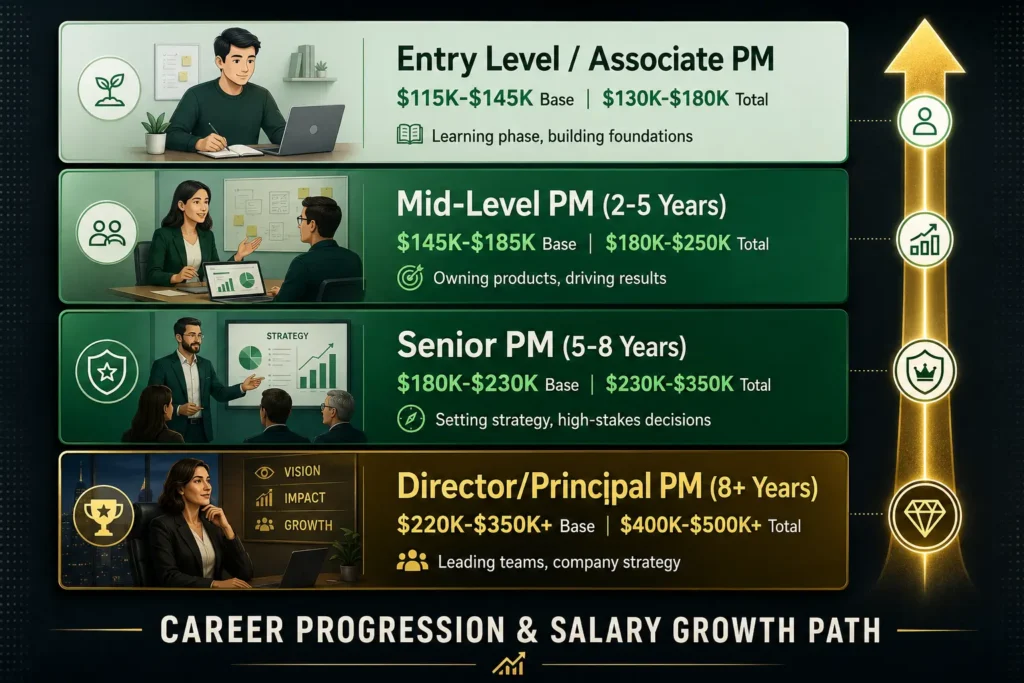
If you’re completely new to product management or you’re transitioning from another field, you’ll likely start in an associate or entry-level role. At this stage, companies understand you’re learning the fundamentals. You’re expected to write clear requirements, analyze user data, coordinate experiments, and learn how AI features are actually built. Your salary reflects that you’re building foundational skills.
Don’t expect to earn top-tier compensation at this level. Your job is to prove you can think clearly about products and that you understand the basics of how AI systems work. Entry-level AI PMs typically take assignments managing smaller features or assisting senior product managers.
Once you’ve been in the role for two to five years and have real product wins under your belt, you’ve reached the mid-level stage. At this point, companies expect you to own meaningful product areas. You should be able to define what gets built, work confidently with machine learning teams, understand model limitations, make trade-off decisions, and measure whether your products are actually driving business value.
This is also where AI knowledge starts to meaningfully increase your compensation. If you can explain how different types of AI systems work, what constraints they have, and how to work with teams building and evaluating models, companies are willing to pay more for that expertise.
Senior product managers are paid for judgment. They work on high-stakes products. They influence organizations. They make decisions that affect revenue, customer experience, or competitive position. A senior AI PM might own an entire AI product roadmap, work on enterprise AI strategy, define responsible AI requirements for their company, or lead the team that figures out how to price and sell AI features.
Principal and director level roles are about setting strategy and building teams. Compensation at these levels can become very substantial because equity plays a much larger role. When you own multiple product lines or lead product strategy across an AI initiative, you command compensation that reflects that scope.
The progression matters because each level builds on the previous one. You can’t jump directly from entry-level to principal. You need to prove yourself at each stage.
Regional Differences in AI Product Manager Compensation
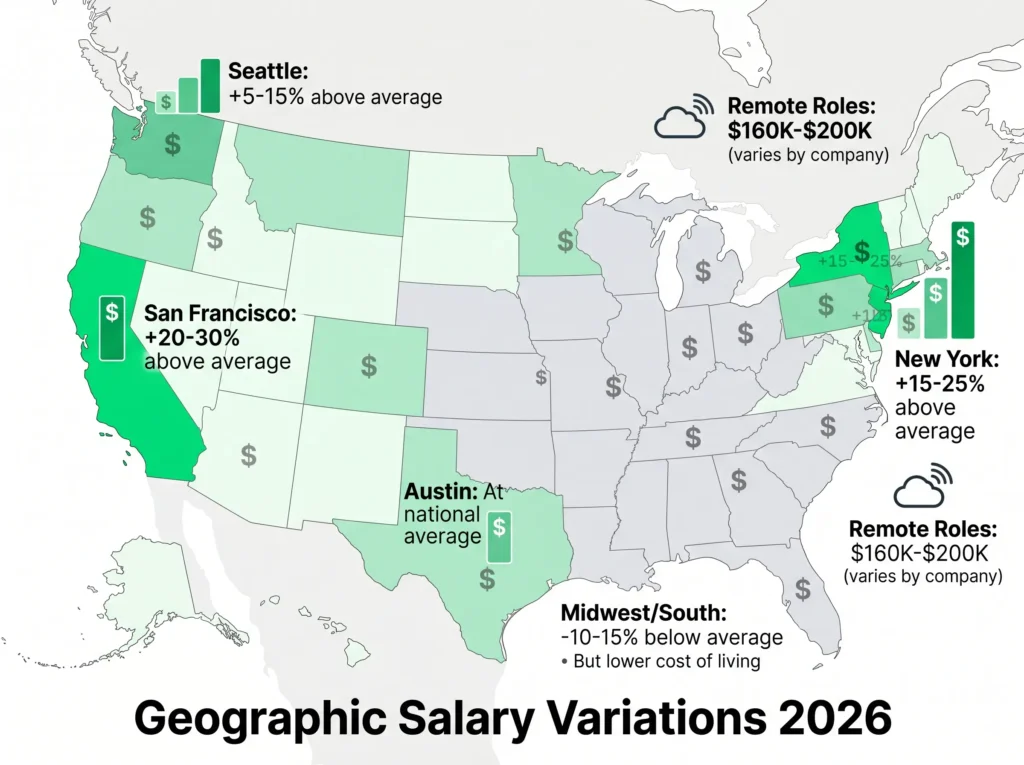
Where you live or where you work makes a real difference in what companies pay for AI product manager roles.
If you’re in the San Francisco Bay Area, you’re in the highest-paying market in the United States for AI product roles. The concentration of AI companies, venture capital, and major tech headquarters means companies there are competing aggressively for talent. An AI PM in the Bay Area might earn 20 to 30 percent more than the national average. If you’re a senior PM earning $230,000 in base salary in the Midwest, that same role in San Francisco might pay $280,000 or more.
New York City is another premium market, especially if you work in fintech, enterprise SaaS, or advertising technology. New York compensation might be 15 to 25 percent higher than national averages, particularly for roles where AI directly affects revenue or risk management. Financial services companies especially seem willing to pay high compensation for product managers who understand AI and its implications.
Seattle benefits from Amazon and Microsoft being headquartered there, plus a strong startup ecosystem. Compensation in Seattle can be substantial, especially at senior levels. Senior PM packages can approach $300,000 or exceed it at major employers.
Austin has grown as a tech hub, but salaries there tend to cluster closer to national averages rather than the premium coastal markets. If you’re considering Austin, you’ll likely find opportunities in SaaS, enterprise software, fintech, and cybersecurity, with compensation that’s competitive but not quite at San Francisco levels.
Remote work has changed the landscape. Many companies now hire remote AI product managers and pay national rates regardless of where the person lives. Some companies adjust compensation based on location. If you’re in a lower-cost area and applying for remote roles, it’s worth understanding how the company approaches remote compensation.
The basic principle is simple: the higher the cost of living and the more companies competing for talent in that area, the higher the salaries tend to be.
Industry-Specific Salary Differences
Not all AI product roles pay the same, and the industry matters a lot.
Software and SaaS companies offer some of the highest AI product manager compensation outside of pure AI companies. When your work on AI search, workflow automation, customer support automation, or AI-powered analytics directly improves retention or allows the company to charge more, companies justify paying well for that talent.
Financial services and fintech companies tend to pay very well for AI expertise. If you’re building AI for fraud detection, risk assessment, compliance, or trading automation, the business impact is enormous. Financial services companies also tend to be older and often have stronger salary bands than typical startup compensation.
E-commerce companies use AI for recommendations, personalization, and conversion optimization. When AI directly impacts conversion rate or average order value, it affects millions of dollars in revenue. That justifies paying premium compensation for the product managers driving those systems.
Healthcare is an interesting case. Healthcare AI product managers can earn good salaries, especially at companies building clinical tools or administrative automation. However, healthcare salaries might not match pure software salaries because sales cycles are longer, regulatory requirements are stricter, and adoption moves slower. If you’re building healthcare AI, understand that the business environment is different and compensation might reflect that.
Enterprise software and B2B SaaS also pay well for AI product managers, especially those working on enterprise AI features, analytics, or automation. B2B products often have higher margins and more value per customer, which justifies paying for experienced product talent.
What Your Total Compensation Actually Includes
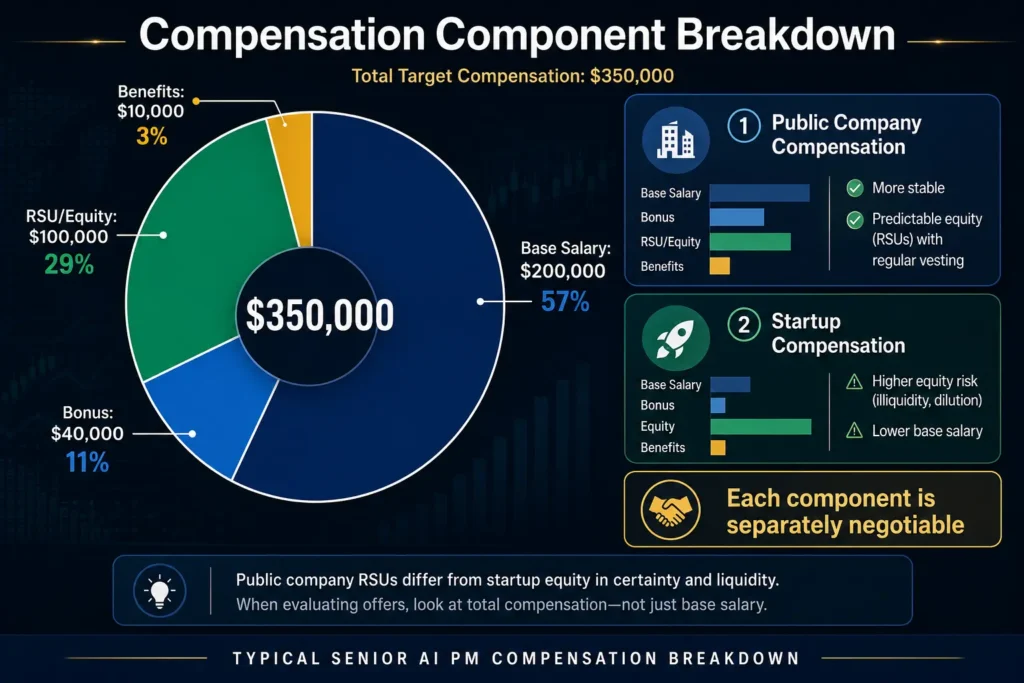
One of the biggest mistakes people make when evaluating offers is looking only at base salary.
In tech, especially at established companies, total compensation includes several components. Your base salary is just the beginning. On top of that comes an annual performance bonus, which might be 15 to 25 percent of your base salary. You get stock or restricted stock units, which are often more valuable than the bonus. Many companies also offer signing bonuses, especially for senior hires. Then there’s the benefits package, which includes health insurance, 401k matching, paid time off, and other perks.
Let me give you a concrete example. Imagine a senior AI PM with total compensation of $350,000. That might break down as follows: base salary of $200,000, annual bonus of $40,000, annual RSU grant value of $100,000, and benefits valued at about $10,000. Each component matters, and companies have flexibility in how they structure your package.
At startup companies, equity is often a much larger percentage of the total package, sometimes 40 to 50 percent. The risk is that startup equity is uncertain. An RSU at Google is straightforward to value because Google stock trades publicly. An equity grant at a private startup might be worth a lot if the company succeeds, or it might be worthless if the company fails.
When you’re negotiating an offer, never assume equity is worth face value. Ask the company about the strike price, vesting schedule, total shares outstanding, and what percentage of the company you’re getting. That context helps you evaluate whether the equity component is actually attractive.
Benefits also matter more than people think. A company with great health insurance, strong 401k matching, generous parental leave, professional development budgets, and remote flexibility might be more valuable than a company offering slightly higher base salary with weak benefits.
The Factors That Really Drive AI Product Manager Compensation
Several factors consistently influence how much companies pay for AI product manager roles.
Experience and track record is the most important factor. Companies pay more for product managers who have shipped successful products, can show measurable business impact, and understand how to navigate product trade-offs. If you can point to a product you led that increased user engagement by 15 percent or helped the company capture a new market segment, that track record speaks louder than any generic description of your skills.
AI knowledge also increases compensation, but not all AI knowledge is created equal. You don’t need to be a machine learning engineer, but you should understand the basics of how modern AI systems work. Understand what large language models can and cannot do. Know what model hallucinations mean and why they matter. Understand the difference between fine-tuning and retrieval augmented generation. When you can talk intelligently about these concepts with engineering teams, companies are willing to pay more.
Company size and stage affects your compensation significantly. Large public tech companies offer more predictable compensation and typically stronger equity because their stock is stable. Startups might offer lower base salaries but more equity upside. Mid-size companies might offer a balance of reasonable salary with equity that’s less speculative than very early stage startups.
The complexity and business importance of the product you’re working on matters. AI infrastructure product managers often earn more than people managing single AI features. If your work affects enterprise customers, revenue, or company risk, you can command higher compensation.
Leading teams or working with enterprise customers also increases compensation. PMs who work directly with enterprise accounts, manage other product managers, or present regularly to executives tend to earn more than individual contributors.
How to Actually Negotiate Your AI Product Manager Salary
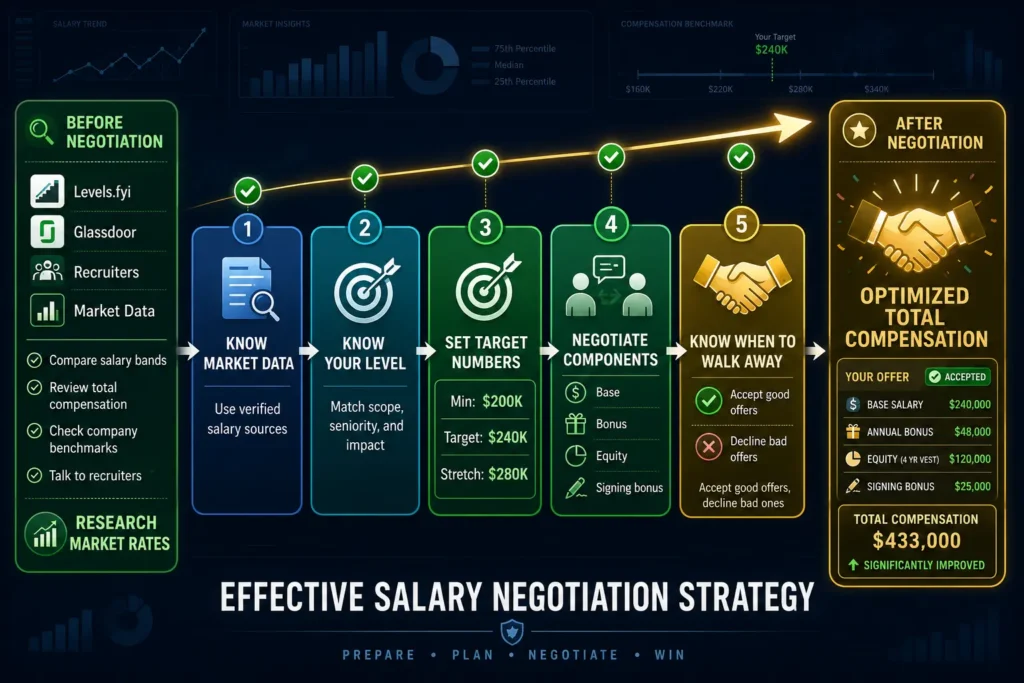
Negotiation is one of the most important skills for increasing your compensation, and many people don’t do it effectively.
Start by researching market rates. Use multiple sources like Levels.fyi, Glassdoor, Built In, and talking directly with recruiters. You want to understand what other AI PMs at companies similar to the one making you an offer are earning.
Understand exactly what level the company is hiring you for. A senior PM at one company might be equivalent to a mid-level PM at another. Ask your recruiter to clearly explain the level, what the compensation bands are for that level, and what the expectations are.
Build your target numbers before you start negotiating. Create three numbers in your mind: your minimum acceptable offer, your fair target, and your ambitious stretch offer. For example, you might decide your minimum is $200,000 total compensation, your target is $240,000, and your stretch is $280,000. Having these numbers in mind helps you negotiate rationally rather than emotionally.
Negotiate your total compensation, not just base salary. You can often get flexibility on the equity component, signing bonus, or annual bonus target even if the company seems reluctant to increase base salary. If they say they can’t increase base from $200,000, ask if they can improve the equity grant, signing bonus, or bonus target instead.
Use data when you negotiate. A strong negotiation sounds like this: “Based on my AI product experience at X company, the scope of this role managing enterprise customers, and the market data I’ve researched for comparable AI PM roles, I was expecting total compensation closer to X. Can you help me understand if there’s flexibility in any component of the package?”
Know when to walk away. If the offer is significantly below market for your experience level, if the company is unclear about equity terms, if the role has unrealistic expectations, or if something feels unhealthy about the culture, walking away is the right call. Your career is a long game. A higher salary at a bad company can actually harm your long-term earning potential.
Career Growth Path for AI Product Managers
How fast can your salary grow as an AI PM? It depends on how intentional you are about it.
In your first year or two, your focus should be learning. Learn how products get made. Learn how to write clear requirements. Build relationships with engineers and data scientists. Ship features, even small ones. Your salary growth might be modest during this phase, moving from $120,000 to maybe $135,000, but you’re building the foundation for much higher earnings later.
In your second to fifth years as a product manager, this is when compensation can really start to accelerate. You might move from $140,000 base salary to $180,000. This is the period where your experience with AI systems, your ability to work with technical teams, and your track record of shipped products start to command real premium compensation.
After five to eight years, you should be operating at a senior level. Your salary might move to $190,000 to $230,000 base. You should be influencing product strategy, working on complex problems, and potentially managing or mentoring other product managers.
If you continue past eight years and reach principal or director level, that’s when total compensation can exceed $400,000 to $500,000 or higher, depending on the company.
The speed at which you move through these levels depends on several things. Working on products that drive revenue helps tremendously. Being explicit about wanting to grow to the next level, rather than hoping your manager notices, matters. Building specialization in AI, understanding customer needs deeply, and learning to communicate with executives all accelerate growth.
Real Examples of AI Product Manager Compensation
Let me give you some concrete examples of what actual AI product manager packages might look like.
A person transitioning from software engineering into an associate AI PM role at a mid-size SaaS company might receive a package of about $165,000 total compensation. That could be broken down as $135,000 base salary, a $10,000 bonus, and $20,000 in annualized equity. This person has technical credibility from engineering but is new to product management, so the package reflects that they still need to prove themselves in the PM role.
A product manager with five years of experience joining Google to work on AI might see total compensation around $320,000. That could be $180,000 base salary, $30,000 bonus, and $110,000 in annualized RSU value. Google pays meaningful compensation at all three levels, which is part of why they can attract strong talent.
A senior product manager joining a venture-backed AI startup working on enterprise AI might see a package around $300,000 to $350,000 on paper. That might be $220,000 base salary, $20,000 bonus, and $100,000 in private company equity value. The important caveat here is that the equity component is uncertain. If the startup succeeds, that equity could be worth millions. If the company fails or has a disappointing exit, it could be worth nothing.
These examples illustrate why researching specific companies and understanding total compensation breakdown matters. The person at Google has lower base salary than the person at the startup, but the Google RSUs are more certain in value. The startup person might get richer if the company succeeds, but takes on more risk.
Questions People Ask About AI Product Manager Salary
What skills actually increase my salary the most?
The highest-value skills include AI product strategy, technical knowledge of language models and ML systems, the ability to work with data teams, enterprise customer discovery, product analytics, and executive communication. Basically, you’re most valuable when you can connect AI technology to real business outcomes and customer needs.
Will I actually earn more as an AI PM than a regular PM?
In many cases, yes. AI product managers often earn 10 to 20 percent more than general product managers because the role requires that additional technical knowledge. When you understand both product fundamentals and AI systems, companies value that combination.
How long does it take to move from entry-level to senior level?
Most people move through these stages in five to seven years, assuming they’re working at growing companies on meaningful products. If you’re at a company where product growth is limited or you’re not working on high-impact initiatives, it might take longer.
What’s the fastest way to reach $300,000 in total compensation?
The most reliable path is becoming a senior AI PM at a major tech company, a frontier AI company like OpenAI or Anthropic, or a high-growth SaaS company. Total compensation above $300,000 requires some combination of senior level, strong equity, and good negotiation skills.
Is AI PM salary sustainable or is it just hype?
AI PM salaries are likely to remain strong as long as companies are investing in AI. However, the market will probably get more selective over time. Compensation will go to product managers who understand real customer value and business outcomes, not just those who add AI features for the sake of it.
The Bottom Line on AI Product Manager Salary in 2026
AI product management is one of the most attractive career paths in technology right now, both in terms of impact and compensation.
The role pays well because it requires a specific combination of product thinking, technical knowledge, business acumen, and customer empathy. Companies need product managers who can translate what AI systems can do into products that customers actually want to use and that move the business forward.
For people entering the field right now, realistic total compensation ranges from about $130,000 for entry-level roles to $300,000 or more for senior roles at strong companies. At the highest levels, principal and director level product managers can earn significantly more through equity, bonuses, and broader business impact.
The biggest salary drivers are your experience and track record, your knowledge of AI systems, the company you work for, and your willingness to negotiate effectively for compensation that matches your value.
If you’re considering moving into AI product management, focus on more than learning AI terminology. Build genuine product judgment. Learn what customers actually need. Understand how AI systems work and what their limitations are. Measure the business impact of products you ship. Build strong relationships with technical teams. And when you get offers, negotiate thoughtfully for total compensation that reflects your value.
The product managers earning the highest salaries aren’t necessarily the ones who know the most AI buzzwords. They’re the ones who help companies build AI products that customers trust and use, that actually solve real problems, and that drive sustainable business outcomes.
That expertise is valuable. Price it accordingly.
If you’re interested in exploring the broader landscape of AI product tools and resources, check out our guide on the best AI tools for product managers in 2026 to see what resources can help you be more effective in this role.









Comments (8)
AI Courses for Product Managers 2026: Learn Skills + Earn 20-35% Higher Salary - Trendoutsidersays:
May 27, 2026 at 7:09 pm[…] product decisions. More importantly, it positions you for higher-paying roles. Glassdoor data shows AI product managers earn an average of about $196,071 per year in the United States, while many traditional PM roles […]
AI SEO Tools That Actually Work: Save 50% Time on Content Optimization - Trendoutsidersays:
May 30, 2026 at 1:10 pm[…] you’re interested in how AI is changing career prospects, check out our article on AI product manager salary 2026. It covers how companies are paying premiums for professionals who understand AI. The same […]
AI in Product Development: How to Cut Time-to-Market by 50% in 2026 - Trendoutsidersays:
May 30, 2026 at 3:09 pm[…] interested in how AI skills are changing compensation in the technology industry, our guide on AI product manager salary trends in 2026 shows how companies are increasingly paying premium salaries for people who understand both product […]
Generative AI Startups: The Complete Guide to 50+ Companies Changing Tech in 2026 - Trendoutsidersays:
May 30, 2026 at 7:00 pm[…] a career at an AI startup or trying to understand compensation in this space, our analysis of AI product manager salary trends in 2026 breaks down what professionals are actually earning at different company […]
AI Hardware Startups: The Complete Guide to 40+ Companies Building the Future of AI in 2026 - Trendoutsidersays:
May 31, 2026 at 6:27 pm[…] at an AI hardware startup or trying to understand compensation in this fast-growing sector, our analysis of AI product manager salaries in 2026 breaks down what professionals actually earn at different company stages and in different […]
AI Tools for Affiliate Marketing: 35+ Tools That Multiply Your Commissions in 2026 - Trendoutsidersays:
June 2, 2026 at 7:08 pm[…] paths, particularly in product management and marketing roles, you might find our analysis of AI product manager salaries and market trends valuable for understanding your career options in this […]
15+ Best Topview AI Alternatives That Create Viral Videos in 2026says:
June 5, 2026 at 5:36 pm[…] AI is reshaping marketing careers and business models helps inform tool selection. Our breakdown of AI product manager salaries and roles shows how companies structure teams around AI-powered content […]
13 Best Conversational AI Tools for Real Estate Agents 2026says:
June 5, 2026 at 7:34 pm[…] for AI product managers and automation specialists helps you build the right team. Our breakdown of AI product manager salaries shows that companies prioritizing AI automation now are willing to pay premium salaries for talent. […]