
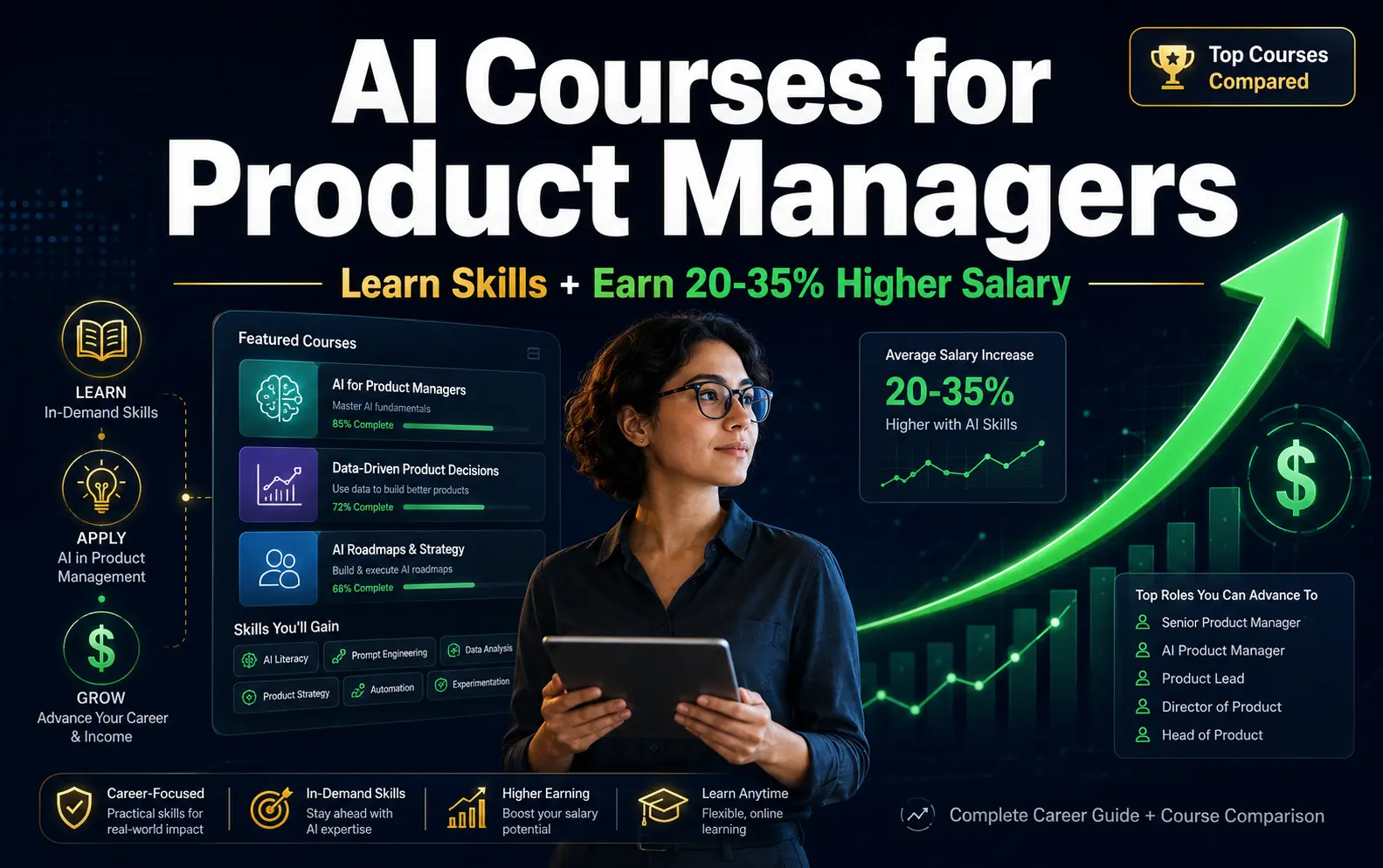
When I talk to product managers about their career concerns, one question keeps coming up. “How do I stay competitive in a market where AI is changing everything?”
That question matters because the product management role is fundamentally transforming in 2026.
A few years ago, being a good product manager meant understanding your customers, writing clear requirements, collaborating with engineers, analyzing metrics, and managing your roadmap effectively. Those skills are still important. But they’re no longer enough if you want to advance your career and increase your earning potential.
Today’s companies are asking product managers to understand artificial intelligence at a meaningful level. Not as a buzzword to throw around in presentations. Not as something only engineers need to worry about. But as a real technology that affects product strategy, customer experience, and business outcomes.
The companies paying the most for product talent are the ones where product managers can translate complex AI capabilities into products people actually want to use. They need PMs who can work across engineering, design, data science, and business teams. They need people who understand when AI solves a real problem and when it creates unnecessary complexity.
This is why AI courses for product managers have become one of the smartest investments a PM can make in 2026.
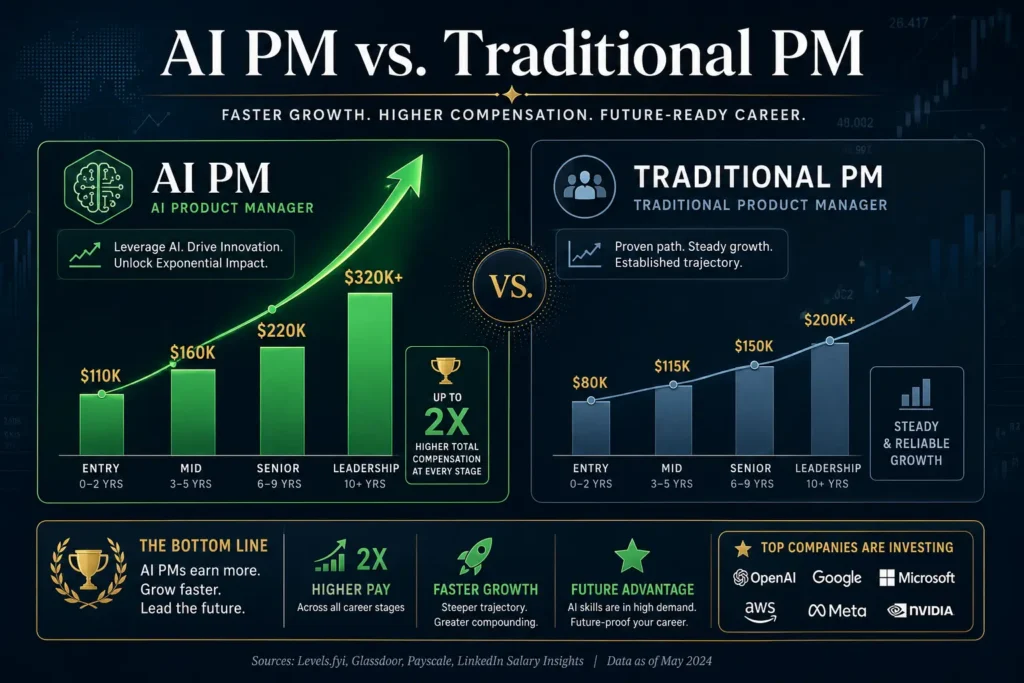
The right course can help you understand large language models, evaluate AI features, design AI workflows, handle responsible AI concerns, and make better product decisions. More importantly, it positions you for higher-paying roles. Glassdoor data shows AI product managers earn an average of about $196,071 per year in the United States, while many traditional PM roles fall below that. At senior levels, the gap widens even more, with AI PMs often earning 20-35% more than their non-AI counterparts.
But here’s what’s important to understand: no course guarantees a salary increase. A course is a tool that gives you skills and credibility. Your salary depends on how you use those skills, the company you work for, your experience level, and your ability to negotiate. What a course can do is open doors that would otherwise stay closed.
This guide walks you through the actual best AI courses for product managers in 2026. I’ve included free options for beginners, mid-range choices that offer real value, and premium programs for senior professionals. The goal is to help you find the right fit for where you are in your career and what you actually need to learn.
Why Product Managers Need AI Skills Right Now
Let me be direct about what’s happening in the product world right now.
AI is no longer something you can ignore. It’s not a feature that maybe gets added someday. It’s becoming fundamental to how companies build products and make decisions.
Every product team is asking similar questions these days. Should we add an AI feature to our product? Can AI improve how customers experience onboarding? Can we use AI to summarize customer feedback automatically? Can AI help users make decisions faster? What risks come with adding AI to our workflow?
Here’s the problem: these aren’t just engineering questions. They’re product questions. And they require product thinking, not just technical implementation.
When you’re building traditional software, the behavior is usually predictable. Click a button, get the same result every time. AI products work differently. An AI model might give different outputs based on the input, the model’s training data, how you phrase your request, or the context it has access to. That’s fundamentally different from traditional software behavior.
This changes what a PM needs to understand.
A strong AI product manager needs to grasp why AI systems sometimes fail in unexpected ways. They need to know how to evaluate whether an AI feature actually works or just looks impressive. They need to think about when human review is necessary. They need to understand hallucination (when AI makes things up) and know how to design around it. They need to consider data privacy and user trust.
It’s more complex work. And complexity is what the market pays for.
The salary data backs this up. Product managers with strong AI skills consistently earn more than those without. At entry level, an AI PM might earn $130,000 to $145,000 in base salary, while a traditional PM in the same location might earn $100,000 to $120,000. At senior levels, the gap is even bigger, with AI PMs sometimes making $300,000 or more in total compensation at major tech companies.
That’s not because companies love buzzwords. It’s because AI product managers can handle more complex problems and drive more business value.
This is exactly why taking an AI product management course in 2026 is one of the smartest career moves you can make.
What Every AI Product Manager Actually Needs to Know
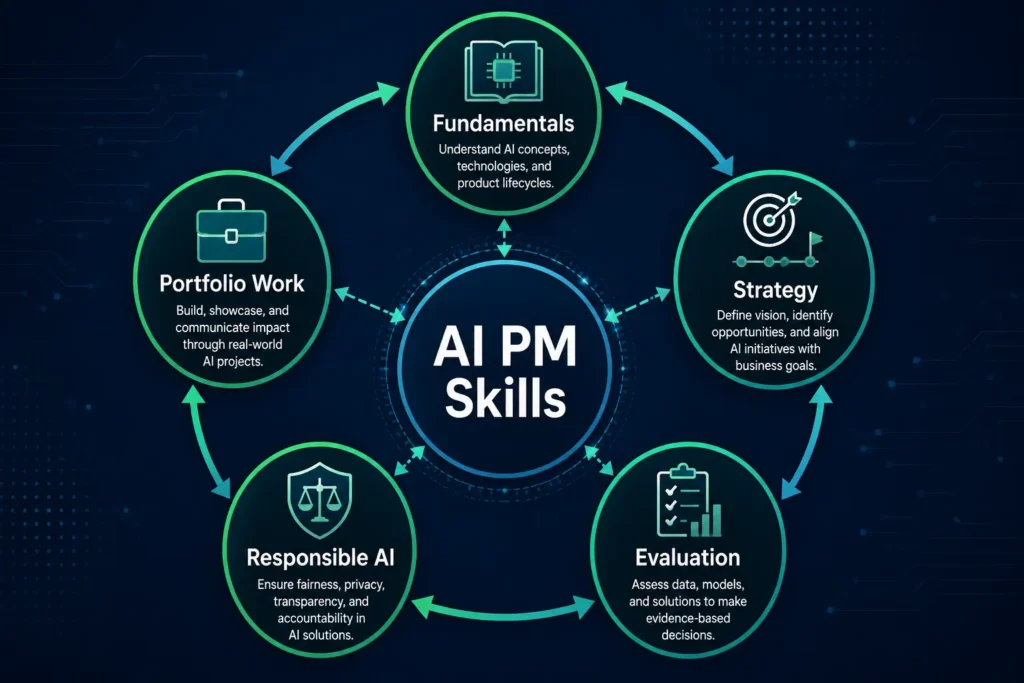
Before you pick a course, it helps to know what you’re actually trying to learn.
I see a lot of weak courses online that just define terms. They explain what machine learning is, what generative AI means, what an LLM is. That’s vocabulary, not skill.
A course worth your time teaches you how to actually use AI in product work. There’s a real difference.
AI Fundamentals That Matter
You need to understand the basics of how modern AI works. Not at an engineer’s level. At a product manager’s level.
What are large language models and why do they work? What’s the difference between different types of AI systems? What’s retrieval augmented generation and when would you actually use it in a product? What are AI agents and how might they fit into your roadmap?
You don’t need to code. You don’t need to understand the math behind neural networks. But you need enough knowledge to ask intelligent questions of your engineering team and understand their constraints.
Strategic Thinking About AI Features
Here’s something I see constantly: companies adding AI to products just because AI is trendy.
A product gets an AI summarization feature. Nobody uses it. A competitor adds an AI assistant. Customers hate it because it doesn’t actually help them do their job. A company builds an AI-powered feature that technically works but adds more friction than value.
The best AI product managers ask harder questions before building anything.
What customer problem does this AI feature actually solve? Would a simpler, non-AI solution work better? What’s the business value here? What happens when the AI gets it wrong? How will we know if it’s actually helping users? What are the risks and how do we handle them?
A course should teach you this framework for thinking, not just the technology itself.
How to Evaluate AI
This is perhaps the most important skill and the one many courses skip over.
Evaluation means you can actually test whether an AI feature works. You know how to run tests. You understand what metrics matter. You can spot when a model is failing in ways users haven’t reported yet. You know when an AI feature is ready for real users and when it needs more work.
This is incredibly valuable because most product teams don’t have a strong evaluation process. Companies ship AI features that technically work but create problems. Teams can’t measure whether an AI initiative is actually worth the investment.
A PM with strong evaluation skills becomes indispensable.
Responsible AI and Real-World Concerns
AI products create privacy issues. They can perpetuate bias. They affect user trust. They create compliance headaches for enterprises. They require careful data handling.
A modern AI course should teach you how to think about these concerns from day one, not as an afterthought. You need to understand what responsible AI actually means in practice. You need frameworks for building AI features that don’t create problems with privacy, fairness, transparency, or safety.
Real Portfolio Work
The best courses ask you to build something.
Not just watch videos and take a quiz. Actually create something you can show in interviews or on your resume. A product brief for an AI feature. A case study of an AI-powered workflow. An evaluation plan for an AI model. A prototype or proof of concept.
That portfolio work matters more than the certificate.
How to Actually Choose the Right Course for Your Situation
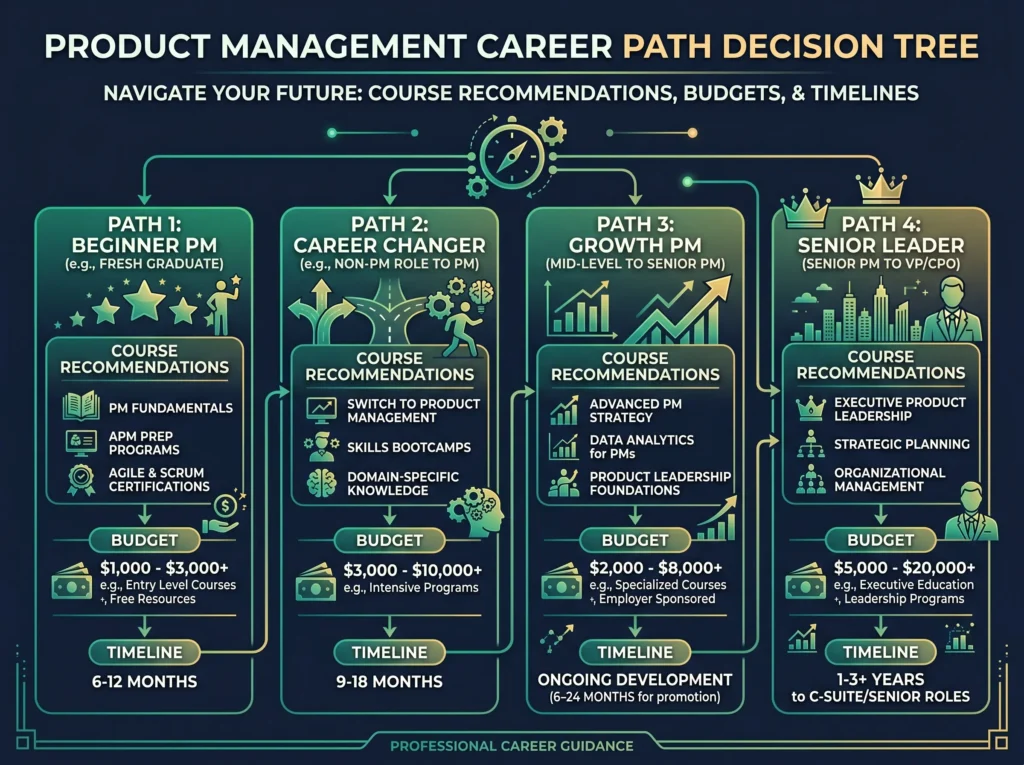
The biggest mistake people make is looking for the single best course.
There’s no single best course because your situation is unique. Your career stage, your budget, your available time, your learning style, and your actual goals all matter.
Let me break this down by situation.
If You’re Brand New to AI and Product Management
Start with free or very cheap resources. Your goal right now isn’t to become an AI expert. It’s to get comfortable with the vocabulary and understand how AI is changing product work.
Free options work fine for this phase. Google’s AI learning resources are solid. Pendo’s AI for Product Management course is free and product focused. Coursera lets you audit many courses for free (though you don’t get a certificate). These resources cost nothing but give you real knowledge.
Spend a month with free resources. See if AI product management actually interests you. Apply what you learn at work. Then decide if you want to invest money in more structured learning.
If You’re Already a PM and Want to Add AI Skills
You probably don’t need a course that explains product management fundamentals. You need something that specifically teaches you how to apply your existing PM skills to AI.
Look for courses that focus on AI product strategy, how to evaluate AI features, how to work with ML teams, how to design responsible AI products. You want something that assumes you already know product basics and builds from there.
The sweet spot for most working PMs is probably in the $500 to $2,000 range. Duke’s specialization on Coursera, IBM’s certificate, Maven courses from experienced operators, or Product School’s certification. These give you structure, feedback, and a credential without being overwhelmingly expensive.
If You’re Moving From Another Role Into Product
Maybe you’re an engineer, designer, data scientist, or business person who wants to become a PM. You need more than just AI knowledge. You need to learn product thinking itself.
Look for courses with structured projects. You need proof that you understand how to think like a PM, not just that you know about AI. Portfolio pieces matter more here than certificates.
If You’re a Senior PM or Product Leader
You probably already understand product fundamentals. You’re looking to develop deeper strategic thinking about how AI transforms your industry and your organization.
Advanced programs from Reforge, Stanford, or specialized programs focusing on AI strategy, AI agents, or AI governance might make more sense than beginner courses. You’re investing in advanced thinking and credibility, not basic knowledge.
The 12 Best AI Courses for Product Managers Right Now
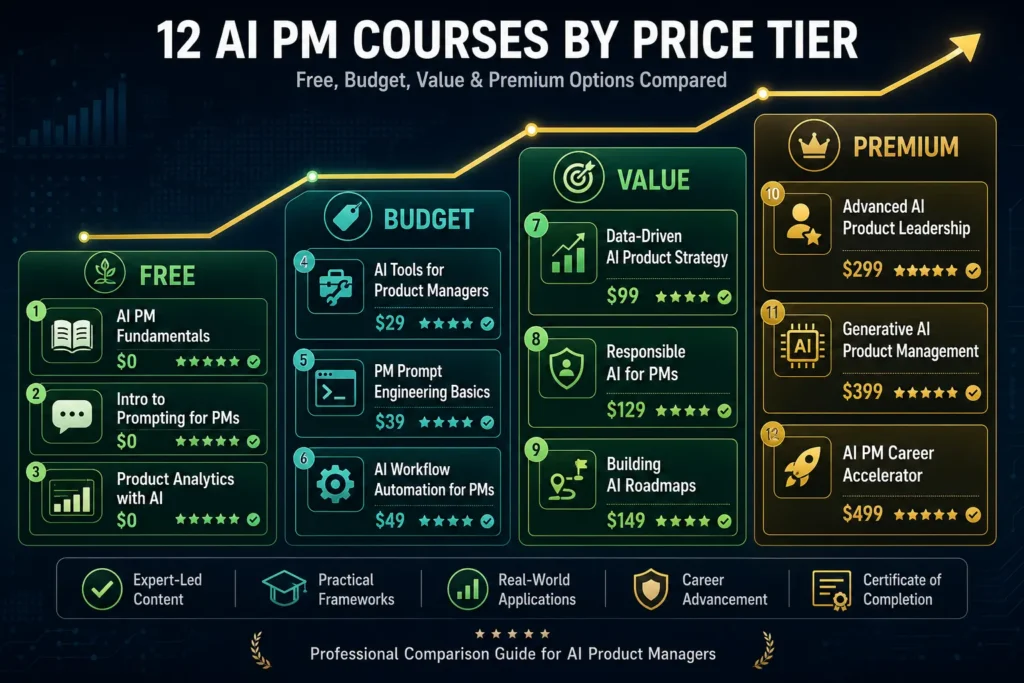
Let me walk you through the actual best options I see in 2026.
Option 1: Google AI Learning Resources (Free)
Start here if you want to understand AI basics from a trusted source without spending money.
Google offers several free AI courses and learning paths. They’re not specifically designed for product managers, but they cover generative AI, responsible AI principles, and how AI is used in real business applications. The content is clear and Google’s reputation adds credibility.
Who should take this: Beginners, early-career PMs, anyone exploring AI without budget constraints.
Time commitment: 10-20 hours spread over a month.
Best for: Building AI vocabulary and foundational understanding.
Option 2: Pendo AI for Product Management (Free Right Now)
Pendo created this course specifically for product managers. It covers six modules over about two hours of video, focusing on how AI actually fits into product management work.
The course is currently free (though normally priced at $149). You get a badge after completing it. The content is practical and focuses on real PM use cases.
Who should take this: PMs who want practical AI product thinking without cost.
Time commitment: 2-5 hours total.
Best for: Quick, practical introduction to AI from a PM perspective.
Option 3: Coursera Free Audit + Certificates (Flexible Pricing)
Coursera is useful because you can audit most courses for free. You just don’t get a certificate.
If you want a certificate, Coursera professional certificates and specializations usually run around $39 to $79 per month. Many AI and product management courses are available. Duke’s AI Product Management Specialization and IBM’s AI Product Manager Professional Certificate are both on Coursera.
Who should take this: Learners who want flexibility and affordable structured learning.
Time commitment: Varies by course, usually 4-12 weeks part-time.
Best for: Structured learning on a budget.
Option 4: Product School AI Product Management Certification (Mid-Range)
Product School has built a reputation in the PM community for quality training and relevant content. Their AI PM certification is designed specifically for product managers.
The curriculum covers AI fundamentals, AI product strategy, how to build AI features, and responsible AI thinking. You get a certificate that’s recognized in product circles.
Pricing varies by program and cohorts, but generally runs several hundred to a couple thousand dollars. Check their website for current offers.
Who should take this: PMs who want a structured program from a respected PM training brand.
Time commitment: 4-8 weeks part-time.
Best for: Recognized credential in the PM community.
Option 5: Maven AI PM Courses (Varies, Practical Learning)
Maven hosts courses from experienced product operators. The benefit is you’re learning from people who actually build AI products, not just academics.
Various instructors offer different courses on AI product topics. Quality and pricing vary by instructor. Some are short workshops in the $200-$500 range. Some are longer programs at higher costs.
The strength of Maven is practical, hands-on learning often in cohorts where you learn alongside other PMs.
Who should take this: PMs who learn well from experienced practitioners.
Time commitment: Varies widely, usually 4-12 weeks.
Best for: Practical operator-led learning.
Option 6: Duke University AI Product Management Specialization (On Coursera, Affordable)
Duke’s specialization focuses on managing machine learning products and human-centered AI. The university backing adds credibility. The course covers ML fundamentals, data science process, and responsible AI.
You get university credentials, which some employers value. Pricing is usually around $39-$79 per month through Coursera.
Who should take this: PMs who value university credentials and want solid ML product knowledge.
Time commitment: 3-6 months part-time.
Best for: University-backed learning at reasonable cost.
Option 7: IBM AI Product Manager Professional Certificate (Coursera, Beginner-Friendly)
IBM’s professional certificate is a structured 10-course sequence. It’s designed to get someone job-ready for AI product roles without prior experience.
The courses cover product management, AI fundamentals, prompt engineering, and applied AI thinking. It’s one of the more structured paths available.
Pricing is around $39-$79 per month through Coursera.
Who should take this: Career changers and beginners wanting a complete structured path.
Time commitment: 3-4 months part-time.
Best for: Complete AI PM learning path for beginners.
Option 8: Maven Product Faculty AI PM Certification (Premium, Deep Learning)
This is a premium option. Product Faculty offers deeper AI PM certification programs on Maven. Pricing is typically $2,500 for the main program, with more advanced tracks at higher costs.
This isn’t a casual beginner program. It’s designed for PMs ready to make a serious investment in mastering AI product management.
Who should take this: Experienced PMs ready for premium training.
Time commitment: 6-10 weeks intensive.
Best for: Deep specialization in AI product management.
Option 9: Reforge Advanced AI Courses (For Experienced PMs)
Reforge offers advanced product programs for experienced PMs. Some AI-related courses like AI Prototyping might be free or offered at premium rates depending on your access level.
Reforge is best for mid-level and senior PMs who want strategic thinking, not basic education.
Who should take this: Senior PMs and product leaders.
Time commitment: Varies, usually 4-8 weeks.
Best for: Advanced product strategy and AI thinking.
Option 10: Upskillist AI for Product Managers (Budget-Friendly Subscription)
Upskillist offers self-paced AI courses at a subscription model, usually around $49 per month with a free trial period.
The course is self-paced, so it works well for people with unpredictable schedules. The cost is low, but self-paced learning requires self-discipline to complete.
Who should take this: Budget-conscious self-motivated learners.
Time commitment: 4-8 weeks self-paced.
Best for: Low-cost structured learning.
Option 11: FreeAIPMCourse.com (Free, Community-Driven)
This free resource is community-driven and available online. It’s less polished than other options but covers practical AI PM concepts.
Use this as a supplement, not your only source. Combine it with other resources and hands-on practice.
Who should take this: Exploratory learners with limited budgets.
Time commitment: 2-4 weeks.
Best for: Free community-driven learning.
Option 12: Stanford Online Product and AI Programs (Premium Executive Learning)
Stanford offers paid programs combining product management and generative AI. Pricing runs $2,975 to $3,750 depending on the program.
These are best for senior professionals, executives, and those with employer learning budgets.
Who should take this: Senior leaders and executives with budgets.
Time commitment: 4-8 weeks.
Best for: Premium academic credential and executive networks.
Comparing Your Options: A Quick Reference
I want to make this simple. Here’s what matters most depending on your situation.
If you’re just exploring and have no budget: Start with Google AI courses and Pendo. Free. Good quality. See if you like it.
If you want structured learning under $500: Try Coursera audit options, Upskillist, or Product School if on sale. Good value.
If you want quality mid-range investment ($500-$2,000): Duke specialization, IBM certificate, Maven courses, or Product School certification are solid choices.
If you want premium specialization and can invest significantly: Maven Product Faculty, Reforge, or Stanford Online.
The key insight is simple: start cheap, then invest more when you know exactly what gap you need to fill.
The Real Truth About Salary Increases and AI Courses
I need to be honest about something because the article title mentions earning 20-35% more.
A course does not automatically give you a raise. That’s not how this works.
Companies don’t pay more just because you completed a certificate. They pay more when your actual capabilities become more valuable. They pay more when you can handle more complex work. They pay more when you help them solve expensive problems.
An AI course supports a salary increase by making you qualified for better-paying work. It gives you skills you can apply. It gives you portfolio pieces to show in interviews. It makes you more confident talking about AI in interviews and salary negotiations.
A realistic path looks like this:
Learn the basics through a free or cheap course.
Build something real to show what you learned. A product brief, a case study, a feature evaluation plan.
Use those skills in your current job. Actually apply what you learned.
Show measurable business impact. How did AI help? What got better?
Update your resume and LinkedIn with real skills and outcomes.
Apply for AI PM roles that pay more.
Negotiate using actual market data about what AI PMs earn.
That’s how a course becomes a 20-35% salary increase. It’s not automatic. It requires action and real application.
How to Actually Get Value From a Course You Take
Many people buy courses and never finish them.
They watch a few videos. They get busy. The course sits unfinished. They get a certificate but didn’t learn anything useful.
Here’s how to actually extract value:
Do the portfolio project. Most good courses ask you to build something. Do it. Make it good. This is more valuable than the certificate.
Apply immediately at work. Don’t wait until the course is over. Start using what you learn in your actual job.
Learn how to evaluate. Go deeper than just prompting and using tools. Learn how to actually test whether AI works in your product.
Update your professional presence. Your resume, LinkedIn, and online presence should reflect what you now know. Practical language, not just certificate names.
Talk about it in interviews. When you interview, the certificate matters less than whether you can discuss AI product strategy intelligently.
Real Examples of How This Works
Here are realistic scenarios of how this actually plays out.
A junior PM at a mid-size SaaS company starts with free Google AI courses and Pendo’s free course. They learn enough vocabulary to stop feeling lost in AI conversations. They start using AI to help with their actual job. They use it to analyze customer feedback and draft product requirements faster.
Their manager notices they’re working more efficiently and asking better questions. No immediate raise, but they’re building credibility. Six months later, when an AI PM role opens at their company, they interview well and get offered the position with a 20% raise.
A mid-level PM at a larger company completes Duke’s AI specialization and builds a case study about an AI feature they helped ship. In interviews, they can now explain data quality concerns, model evaluation, and user trust issues intelligently. They get interviewed for AI PM roles they previously didn’t qualify for. One offers 25% more compensation.
A senior PM gets their company to sponsor a Reforge course. They’re not learning basics. They’re learning strategic thinking about AI product transformation. They use the frameworks to build a stronger AI roadmap for their company. They present to executives with more confidence. They get promoted to director level with a 35% increase.
The pattern is clear. Course leads to skills. Skills get applied. Application creates value. Value gets rewarded with better opportunities and higher compensation.
Free vs Paid Courses: What Actually Matters
Here’s a simple decision framework.
Use free courses when you’re exploring or just need vocabulary. Free courses are excellent for building foundational understanding without financial pressure. They’re good for PMs who just want to understand what their teams are talking about.
Pay for courses when you need structure, accountability, feedback, or portfolio work. If you’re trying to change roles, if you’re actively job hunting, if you need to demonstrate expertise to an interviewer, if your company will reimburse you, then a paid course becomes worth it.
The most expensive course is not always the best. The best course is the one that matches your actual situation and goals.
Putting It All Together
AI product management is one of the most valuable career directions in 2026.
The right course helps you understand AI at a PM level. It helps you work more confidently with technical teams. It positions you for higher-paying roles. It gives you credibility in interviews.
But the course is just the beginning.
Real career value comes from applying what you learn. Build something real. Use it in your job. Show business impact. Update how you present yourself. Then leverage those skills when you interview for better opportunities.
If you’re starting from scratch, begin with free resources. Explore for a month. See if you like it. Then decide if you want to invest money.
If you want structured learning, choose based on your budget and timeline. Duke and IBM on Coursera offer solid value around $200-$300 total. Maven courses give you operator-led learning. Product School offers PM community credibility.
The smartest move is usually the simplest: start small, learn fast, apply immediately, then invest more when you know exactly what you need.
Your career is a long game. A few months investing in the right AI skills can change your trajectory for years to come.
Ready to explore? Start with the free options this week. You’ll be surprised how much you learn in just a few hours.
Want to compare real AI tools used by product teams? Read our full guide on 15 Best AI Tools for Product Managers in 2026.








Comments (4)
AI in Product Development: How to Cut Time-to-Market by 50% in 2026 - Trendoutsidersays:
May 30, 2026 at 3:16 pm[…] your team needs training on these tools and processes, you might find value in our breakdown of the best AI courses for product managers, which covers both conceptual understanding and practical implementation […]
Generative AI Startups: The Complete Guide to 50+ Companies Changing Tech in 2026 - Trendoutsidersays:
May 30, 2026 at 7:05 pm[…] organizations. If you’re responsible for AI decisions at your company, our comprehensive guide to AI courses for product managers in 2026 covers learning resources specifically designed to help professionals build expertise in AI […]
AI Hardware Startups: The Complete Guide to 40+ Companies Building the Future of AI in 2026 - Trendoutsidersays:
May 31, 2026 at 6:28 pm[…] knowledge of AI infrastructure, strategy, and the technical aspects of AI hardware deployment, our comprehensive guide to AI courses for product managers in 2026 covers learning resources specifically designed for professionals navigating these complex […]
13 Best Conversational AI Tools for Real Estate Agents 2026says:
June 5, 2026 at 7:29 pm[…] your entire organization, having someone trained on AI product management helps. Our guide to AI courses for product managers covers how to evaluate tools, manage implementation timelines, and measure AI adoption success. […]