
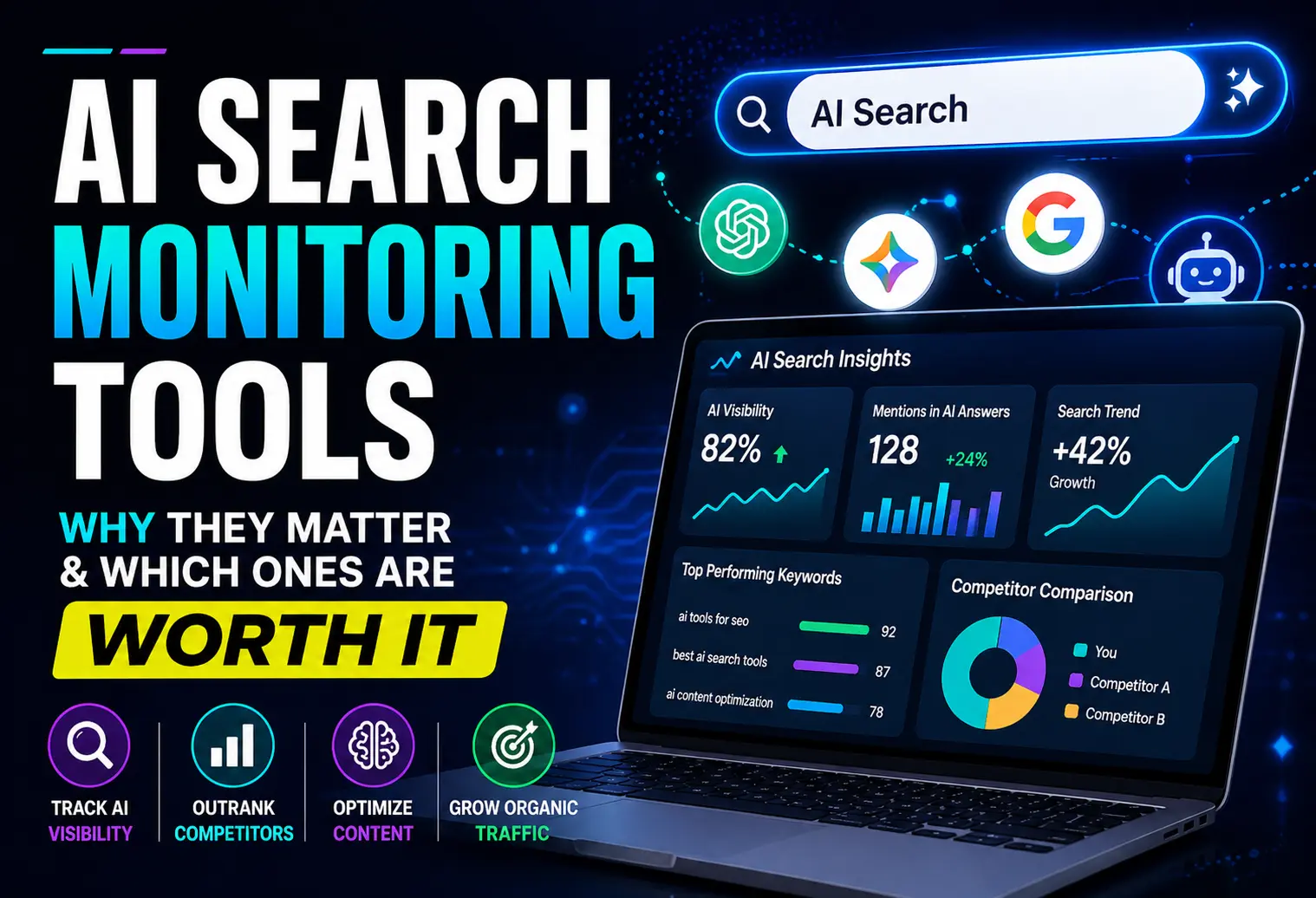
Most people who build blogs or content websites hit a wall about six months in. They publish articles, wait, check Google Search Console, and wonder why the traffic never really climbs the way they imagined. The common advice “just create good content” starts to feel hollow.
The truth is, search has changed so dramatically over the past two years that traditional SEO habits no longer tell the whole story. Keyword rankings still matter, but they are only one piece of a much larger picture. If you are serious about growing a website in 2026, understanding why AI search monitoring tools exist — and how they can help you — is no longer optional. It is part of running a modern content business.
This article breaks it all down clearly, without the fluff.
What Has Actually Changed in Search
Before getting into the tools themselves, it helps to understand the problem they solve.
Google, Bing, and other search engines have been rebuilding their core systems around artificial intelligence for years. What you see today when you type a question into Google is not just a list of links pulled from an index. The results are shaped by machine learning models that try to understand what you actually want , not just what you typed.

In practice, this means a few things have shifted:
AI-generated answer summaries now appear at the top of many search results. Google’s AI Overview feature pulls information from multiple sources and presents a direct answer before a user ever sees your article. If your content is included in that summary, you gain visibility without a click. If it is not, you may rank on page one and still lose ground to competitors who are being referenced by the AI layer.
Zero-click searches have grown significantly. Research from SparkToro and others has consistently shown that a large portion of Google searches — estimates range from 25% to nearly 60% depending on query type — end without a user clicking on anything. They get what they need from the results page itself. This makes traditional click-through rate data incomplete as a measure of real visibility.
Search intent has become the dominant ranking signal. Google’s algorithms are increasingly good at understanding the purpose behind a search, not just the words used. Two articles targeting the same keyword can perform very differently based on how well each one matches what the searcher genuinely needs. A tool that helps you monitor this alignment in real time gives you an edge that raw keyword data simply cannot.
What AI Search Monitoring Tools Actually Are
The name sounds technical, but the core idea is practical.
AI search monitoring tools are platforms that help you see how your website performs inside modern, AI-driven search environments. They go beyond telling you where you rank for a keyword. They help you understand whether your content is being used in AI summaries, what type of intent your pages are satisfying, how your visibility compares to competitors across different search behaviours, and what gaps exist in your content that are costing you traffic.
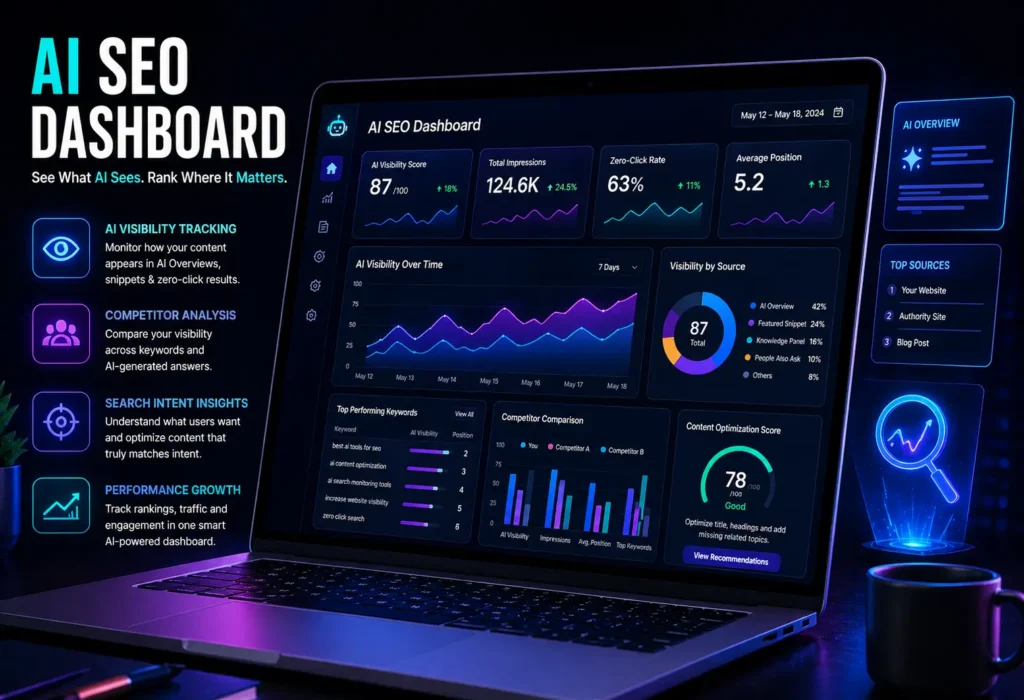
Think of traditional SEO tools as a rearview mirror. They show you what already happened — your rankings last week, your traffic last month, which backlinks you earned. AI search monitoring tools are closer to a dashboard with real-time instruments. They give you a live picture of how your content is performing across a search landscape that is constantly shifting.
The distinction matters because acting on old data in a fast-moving environment leads to wasted effort. You might spend three weeks optimizing an article for a keyword that AI summaries have essentially absorbed. Or you might miss a content opportunity that dozens of users are searching for right now because your existing tools only surface data from the previous quarter.
Six Reasons These Tools Make a Genuine Difference

1. They Show You Whether Your Content Is Being Used — Not Just Ranked
Ranking in the top five results used to be enough to guarantee solid traffic. That is no longer reliably true.
When Google generates an AI Overview for a search query, it references specific sources. If your article is one of them, you get brand visibility and sometimes referral traffic even from users who do not click through. If a competitor’s article is the one being cited, they capture that attention instead.
AI search monitoring tools track which content is being pulled into these AI-generated answers. For a website trying to build authority with a U.S. audience, knowing this is the difference between optimizing what matters and chasing the wrong metrics.
2. They Help You Understand Search Intent at a Detailed Level
Not all searches that look similar are actually similar.
Someone searching “best AI tools for small business” is in a different mindset than someone searching “how AI tools help small businesses.” The first person is likely ready to make a comparison and possibly a purchase decision. The second person is still learning and wants a broad explanation.

If you write an article designed for the first person and Google interprets your page as serving the second, you will get traffic from the wrong audience and poor engagement signals — which eventually hurts your rankings further.
AI monitoring tools analyze the intent behind the queries driving traffic to your pages and flag mismatches. They help you understand whether your content is genuinely satisfying what users want, or just technically ranking for words that are associated with what they want. That distinction, when corrected, tends to produce lasting improvements in both rankings and time-on-page.
3. They Reduce the Time Between Publishing and Knowing What to Fix
Traditional content workflows involve a lot of waiting.
You publish an article, wait four to six weeks for Google to fully index and assess it, check your rankings, and then decide what to change. If you are running a new website trying to qualify for Google AdSense within a specific timeframe, that delay is a real obstacle.
AI search monitoring tools compress that feedback loop. Many of them provide suggestions at the content-creation stage — before you publish — based on what is currently performing well in AI search results for your target topic. Others update performance data far more frequently than traditional rank trackers, giving you faster signals on what is working and what needs adjustment.
For a new website, this speed advantage is significant.
4. They Surface Competitor Weaknesses You Would Otherwise Miss
Knowing your competitors rank for a keyword is useful. Understanding exactly why they rank and where they fall short , is far more useful.
AI search monitoring tools often include competitive analysis features that go beyond listing which domains outrank you. They analyze the structure, depth, and semantic coverage of top-performing content and show you the specific areas where your competitors are either too thin or out of date. Those gaps are your opportunities.
A new website cannot beat an established domain on authority alone. But a well-structured article that genuinely covers a topic more thoroughly than anything currently on page one can outperform older content, especially when AI-driven search is actively looking for the most accurate and complete source on a given topic.
5. They Help You Prioritize Where to Spend Your Time
One of the most common mistakes content creators make is treating all their articles as equally important. They end up making small updates everywhere and seeing little improvement anywhere.
AI monitoring tools help you identify which pages have the most untapped potential, pieces that are close to ranking but held back by a specific issue, or articles that are already being referenced in AI answers and could capture significantly more visibility with targeted improvements.
That kind of prioritization is what separates websites that grow steadily from those that plateau.
6. They Prepare You for Where Search Is Heading, Not Just Where It Is
Voice search continues to grow, especially in the United States, where smart speakers and mobile voice queries are common behaviors. Visual search, where users take a photo and ask a question about it, is expanding. And AI assistants like ChatGPT, Perplexity, and Google’s own Gemini are increasingly functioning as search interfaces, pulling from indexed web content to answer questions directly.
Every one of these channels rewards content that is structured clearly, answers specific questions well, and demonstrates expertise on a topic. AI search monitoring tools help you build content with those qualities by analyzing what the current AI systems actually respond to. The habits you build now, using these tools, position you correctly for the search environment that will exist two or three years from today.
Key Features Worth Looking For in Any AI Search Monitoring Tool
Not all tools in this category are equally useful, and some are more appropriate for different stages of website growth. When evaluating options, these are the features that tend to deliver the most practical value:
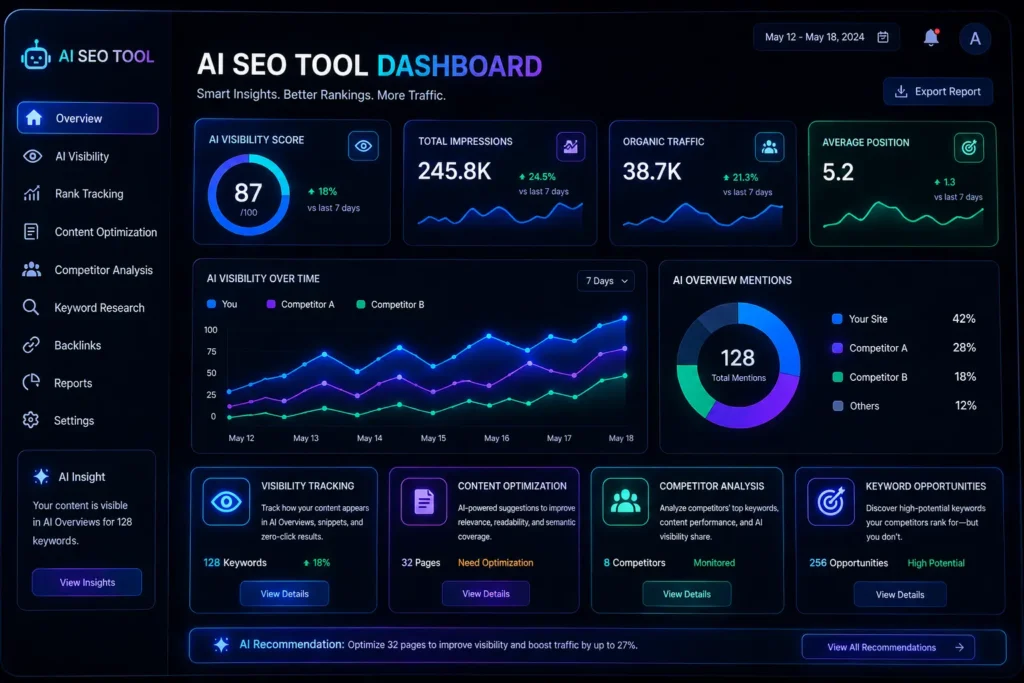
Real-time AI visibility tracking. The tool should tell you whether and how your content is appearing in AI-generated search results, not just traditional organic rankings.
Content gap analysis. It should identify topics and subtopics that your competitors cover and you do not, particularly those being referenced by AI systems.
Search intent classification. The tool should categorize queries by intent type, informational, navigational, commercial, transactional — and help you verify that your content matches the dominant intent for your target keywords.
Actionable content recommendations. Flagging a problem is only useful if the tool also tells you how to address it. Look for platforms that give specific suggestions, not just scores.
Competitor benchmarking. The ability to compare your content’s AI visibility directly against specific competitors is more useful than aggregate industry data.
Frequency of data updates. For a growing website, weekly data is often too slow. Look for tools that update frequently enough to reflect recent changes in your rankings and visibility.
Tools Worth Considering in 2026
A few platforms have established genuine credibility in this space:
Surfer SEO remains one of the most practical options for writers who want data-driven guidance during the content creation process. Its content editor scores your article in real time against what is currently performing well in search, and its SERP analyzer gives clear structural insights.
Clearscope focuses on semantic relevance — making sure your content uses the full range of related terms and concepts that define a topic, not just the primary keyword. It integrates cleanly with Google Docs, which makes it easy to use in everyday writing workflows.
MarketMuse is particularly strong for planning content at scale. It uses AI to map out the topics a website should cover to build genuine authority in a niche, and its content briefs are detailed enough to guide a complete article structure.
Frase excels at aligning content with search intent. Its research tool pulls the most common questions users ask around any topic, which is especially useful for building content that has a strong chance of appearing in featured snippets and AI summaries.
SE Ranking offers a solid combination of traditional SEO tracking and newer AI-focused features at a price point that works for early-stage websites. For a blog that is still building its initial content library, it provides enough depth without an overwhelming cost.
Ahrefs, while primarily known as a traditional SEO platform, has added AI-related tracking features and remains the most comprehensive tool for understanding backlink profiles, keyword opportunities, and competitor strategies in one place.
How to Use These Tools Without Overcomplicating Your Workflow
The biggest mistake new website owners make with monitoring tools is treating them as a substitute for thinking rather than a support for it.
Start with keyword research. Use the tool to identify questions your target audience is genuinely asking not just high-volume keywords, but specific, conversational queries that reflect real problems. These tend to be lower competition and much more likely to produce satisfied readers who return.
Before writing, run a content brief. Most of the tools above will show you what a competitive article on your topic covers, how long it tends to be, and what related questions it addresses. Use that as a structure guide, not a template to copy.
After publishing, track performance on a specific schedule. Check your AI visibility metrics weekly during the first two months of a new article’s life. If a page is not gaining traction after six weeks, look at the intent alignment and content depth signals before making changes.
Update high-potential articles before creating new ones. If you have a page sitting at position eight or twelve for a keyword you care about, improving that article, based on what the monitoring tool flags will almost always produce faster results than starting from scratch.
A Note on Realistic Expectations
AI search monitoring tools are genuinely useful, but they are not magic.

They help you make better decisions faster. They reduce the guesswork in content creation. They give you a clearer picture of a search environment that has become considerably more complex. But they do not replace the work of actually writing helpful, accurate, well-researched content.
Google’s systems, AI-powered or otherwise , are getting better at recognising content that was written primarily to satisfy an algorithm rather than a reader. The websites that grow consistently are the ones where the tools are in service of genuinely useful content, not the other way around.
If you are building a blog for a U.S. audience and aiming for sustainable ad revenue, AI search monitoring tools give you a real competitive advantage. Use them to get smarter about what you create and why — and then create things that are actually worth reading.
That combination is what earns traffic, earns trust, and earns long-term results.
Final Thoughts
The websites that are growing in 2026 are not the ones with the most content. They are the ones with the most useful content, structured in ways that modern search systems can understand and reference.

AI search monitoring tools exist to help you understand that standard and meet it. For a new website trying to build authority quickly, they shorten the learning curve considerably. For an established site looking to break through a traffic plateau, they surface the specific improvements that actually move the needle.
Either way, they are tools worth understanding — and worth using.
If you’re ready to actually use AI tools for income, don’t miss our full breakdown: 17 Best AI Tools to Make Money in 2026 (Honest Guide With Real Strategies)









Comments (6)
10 Best AI Search Optimization Tools to Boost Your Rankings in 2026 – Trendoutsidersays:
May 3, 2026 at 6:59 pm[…] Search is no longer just about ranking on Google’s blue links. Today, a massive portion of your potential audience is getting answers directly from ChatGPT, Perplexity, Google AI Overviews, and Gemini without ever clicking through to a website. […]
15 Best AI Tools for Product Managers in 2026 : Tested, Ranked & Reviewed - Trendoutsidersays:
May 10, 2026 at 8:15 pm[…] more powerful AI tools for growing your website traffic and visibility? Read our detailed guide: Why Use AI Search Monitoring Tools? A Real Answer for Website Owners in […]
15 Best Uncensored AI Tools in 2026: Free & Paid Options Reviewed - Trendoutsidersays:
May 16, 2026 at 5:01 pm[…] need AI that won’t block legitimate research into sensitive topics. Medical students want detailed explanations of complex conditions without […]
15 Best AI Governance Tools in 2026: Free & Paid Solutions for Enterprise Compliance - Trendoutsidersays:
May 16, 2026 at 9:52 pm[…] 2026, the conversation shifted. AI is no longer just deployed models. It includes generative AI applications, AI agents that take autonomous action, shadow AI usage that happens without approval, and AI […]
AI SEO Tools That Actually Work: Save 50% Time on Content Optimization - Trendoutsidersays:
May 30, 2026 at 2:06 pm[…] you this. That’s where AI search monitoring becomes critical. I’ve written separately about why AI search monitoring tools matter in 2026 , it’s the blind spot that costs most content creatorsthousands of dollars in missed […]
13 Best Conversational AI Tools for Real Estate Agents 2026says:
June 5, 2026 at 7:53 pm[…] the highest-quality conversations helps you refine your conversational AI strategy. Our guide on why you should use AI search monitoring tools explains how data about search patterns informs whether your conversational AI should emphasize […]