
If you’ve ever tried applying hair oil directly to your scalp, you probably know how quickly a simple beauty routine can become messy.
You part your hair, tilt the bottle and try to place a little oil along the roots. Instead, too much comes out at once. Some runs toward your forehead, some ends up on your fingers, and the hair around your part suddenly looks much greasier than you intended.
It’s not exactly the relaxing scalp care ritual you had in mind.
That’s the everyday problem behind one of the more interesting beauty gadgets attracting attention in 2026: the scalp oil applicator comb.
These small devices promise to make applying hair oil or compatible scalp serums easier, using a comb shaped head, dispensing tips or a refillable reservoir to direct the product toward the scalp.
Some look like ordinary hairbrushes with a little transparent tank built into the handle. Others are attachments designed to replace the cap on an existing oil bottle.
The appeal is easy to understand. Less guessing, less oil on your hands and, ideally, better control over where the product lands.
But the videos demonstrating these gadgets often leave out a few important questions.
Do the applicators actually dispense oil evenly? Are they suitable for thick or curly hair? Do they work with heavy oils? Are they difficult to clean? And perhaps most importantly, does delivering oil through a comb make any difference to hair growth?
The short answer is that scalp oil applicator combs can be useful dispensing tools, but they are not proven hair growth treatments. Their value depends on the design, the product you’re applying and whether you find them more convenient than a simple dropper.
Here’s what the emerging trend, manufacturer instructions, user concerns and available research tell us.
Why Is Everyone Talking About Scalp Oil Applicator Combs?
Hair oiling isn’t new.
People have used oils as part of hair and scalp care routines for generations, and many modern products draw on those familiar practices.
What’s changing is the equipment being sold to apply them.
Instead of using fingertips, droppers or nozzle bottles, beauty shoppers can now choose from comb shaped dispensers, massage applicators and refillable tools that attempt to combine several steps into one.
According to SpoonLens’ hair oil applicator trend tracking, updated on October 15, 2026, the representative US search phrase “oil applicator hair” showed a 166.7% increase when its latest three month average was compared with the previous three months.
The report also labels the trend as rising, with moderate evidence confidence.
That’s an encouraging signal for product interest, although it isn’t proof that every related keyword is surging or that the gadget is becoming a permanent beauty essential.
Another sign of real consumer interest comes from Amazon search analysis. ASInsight reported approximately 10,899 US Amazon searches for “hair oil applicator” during the week of July 5 to July 11, 2026.
Those figures represent different data sources and periods. Neither is a verified Google search volume for the exact phrase “scalp oil applicator comb.”
Still, together with the growing range of commercial products, they help explain why this relatively simple tool has become a beauty shopping subject worth examining.
The more interesting question is whether the device earns a permanent place in someone’s routine after the initial excitement fades.
What Exactly Is a Scalp Oil Applicator Comb?
A scalp oil applicator comb is a tool designed to distribute a liquid product toward the scalp while moving through or across the hair.
The term covers several distinct products.
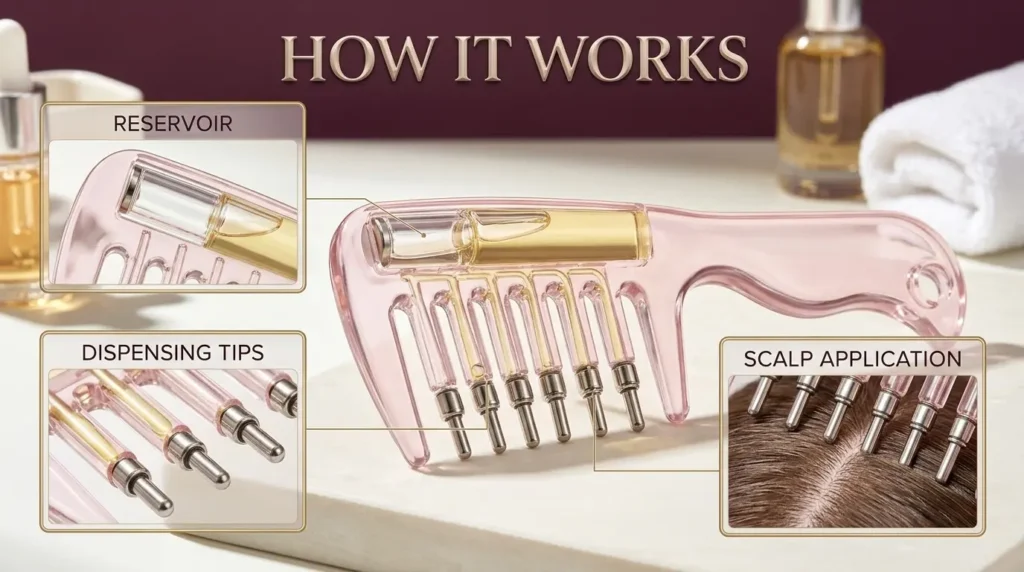
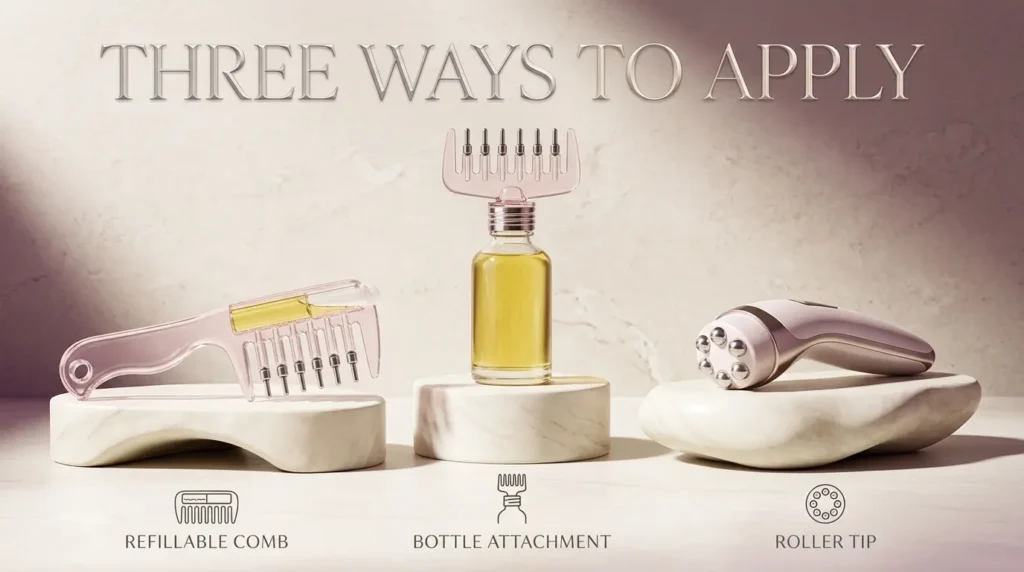
Some contain an internal reservoir that you fill with oil or serum. Small dispensing openings or rounded tips release the liquid as the tool moves along a parting.
Others use a comb shaped attachment fixed directly to the neck of a product bottle.
There are also scalp massage tools with hollow prongs, rounded metal tips or roller mechanisms.
These designs may look similar on screen, but they don’t necessarily work in the same way.
A refillable applicator relies on its reservoir, dispensing mechanism and seals.
A bottle attachment depends on compatibility with the bottle and the liquid flowing through its tips.
A scalp massager that doesn’t dispense product is something else entirely.
What Is the Comb Actually Supposed to Do?
The core purpose is controlled application.
Ideally, the tool helps you reach the scalp without coating large sections of hair or pouring more product than you intended.
Some designs add gentle mechanical contact through rounded tips, making the application feel like a scalp massage.
That can make a routine more comfortable.
But physical massage, oil distribution and medically demonstrated hair regrowth are three different things.
A comb can be convenient without doing anything to stimulate follicles.
The Three Main Types of Hair Oil Applicators
Before buying one, it’s worth understanding which design you’re actually looking at.
1. Refillable Reservoir Combs
These are among the most visually recognizable versions.
They typically include a small container built into the body of a comb or brush.
You fill the reservoir with a compatible liquid, close it and move the dispensing head along the scalp.
The advantage is flexibility. In principle, you can use a suitable product without needing a matching branded bottle.
The downside is that you now have another container to wash, dry and store.
If the reservoir seal isn’t secure, the tool may leak. If the openings are small, thick products may not flow consistently.
Whether those problems occur depends on the particular applicator.
2. Bottle Attachment Applicators
These replace or attach to the opening of a compatible scalp oil bottle.
A verified example is the Kitsch Scalp Oil Applicator.
Kitsch describes a design using stainless steel tips to apply oil near the scalp while creating a cooling massage sensation.
Its instructions specify attaching the tool to a compatible Kitsch oil bottle, priming it by placing the inverted bottle on a flat surface for ten minutes, and detaching the applicator for storage or travel.
That’s a useful detail because it reveals something the shortest product videos rarely explain: dispensing may require preparation, and the attachment isn’t necessarily ready to work immediately.
It also means bottle compatibility matters.
Don’t assume an attachment designed for one brand’s oil will fit a bottle from another manufacturer.
3. Roller Tip and Massage Applicators
Some tools incorporate rounded metal contact points or roller style dispensing tips.
Others rely on simple openings that release oil as the device is tilted or squeezed.
The practical experience can differ significantly.
A rounded tip may feel comfortable against the scalp, but it may also have difficulty reaching the skin through dense hair if the user applies too much pressure or moves too quickly.
The fact that a tool feels like a massage device doesn’t mean its massage mechanism has been clinically shown to increase hair density.
Do Scalp Oil Applicator Combs Actually Work?
That depends on what you expect them to accomplish.
If the goal is to make a scalp oiling routine neater and easier to manage, an applicator may be genuinely useful.
If the goal is to regrow thinning hair because the oil comes through a special comb, the evidence doesn’t support that conclusion.
Let’s separate the claims.
Claim One: More Precise Oil Application
This is the most plausible benefit.
A dispensing tip that contacts the scalp can potentially place oil closer to the roots than pouring it into your palm.
And a reservoir or bottle attachment may help people who find droppers awkward to use.
However, the phrase “precise application” shouldn’t be mistaken for a guarantee of a measured dose.
Different tools dispense differently, and without controlled testing, we cannot establish which commercial model distributes the most consistent amount.
Some people may find an ordinary dropper easier to control.
Claim Two: Less Mess
A well-designed applicator may reduce the amount of oil that gets on fingers and surrounding hair.
That’s a reasonable product design objective.
But whether it achieves that goal depends on the viscosity of the oil, the size of the openings, the seal and how the tool is used.
A refillable applicator that leaks around its cap could create more mess than a conventional bottle.
The device should be judged on its performance, not just how satisfying it looks in a short video.
Claim Three: A Relaxing Scalp Massage
Rounded tips may make application feel pleasant.
That experience is subjective.
Someone with a sensitive scalp might prefer a soft dropper nozzle, while another person enjoys gentle contact from smooth metal tips.
Comfort matters, especially for a tool intended for repeated use.
But aggressive rubbing isn’t necessary. Tugging at the roots can increase friction and potentially damage fragile hair.
Claim Four: Faster Hair Growth
This is where the marketing claims deserve the greatest skepticism.
A mechanical applicator doesn’t automatically make an oil more effective.
It doesn’t create new hair follicles, reverse hereditary baldness or reproduce the effects of a medically evaluated treatment simply because it touches the scalp.
If a particular oil has an effect, the evidence must concern that ingredient and its formulation.
The applicator itself needs its own evidence before anyone can claim it improves hair growth compared with another application method.
Verdict: The convenience claim is plausible. The hair growth claim is not established for the applicator category.
How to Use a Scalp Oil Applicator Comb Without Making a Mess
The exact instructions depend on the design and the product being applied.
A Kitsch bottle attachment, for example, shouldn’t automatically be used according to the same directions as a generic refillable reservoir.
For an applicator whose instructions permit your chosen oil, the following approach is a sensible starting point.
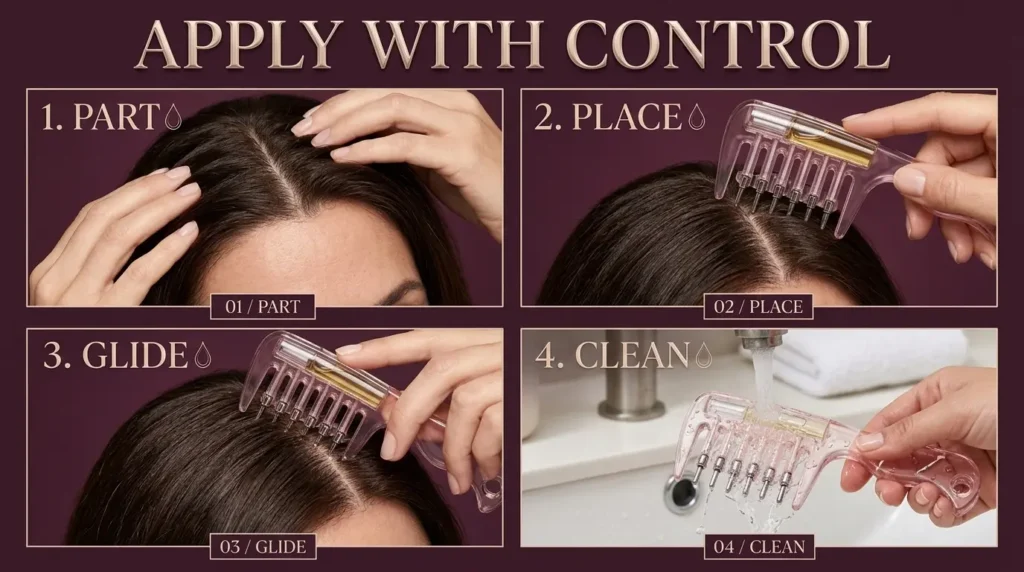
Step 1: Check the Product and Tool Compatibility
Read the instructions for both the applicator and the oil.
Confirm that the tool accepts the formulation and whether the product is intended for scalp contact.
Don’t assume every hair oil belongs directly on the scalp.
Some are intended mainly for the lengths and ends of the hair.
Step 2: Start With a Small Amount
If the tool is refillable, avoid filling the reservoir to the very top unless the instructions require it.
A smaller amount makes it easier to understand how the tool dispenses and reduces waste if the seal leaks.
If you’re using a bottle attachment, follow its priming procedure.
Step 3: Part the Hair
Create a comfortable parting so the applicator can reach the skin.
For dense or curly hair, working in sections may be easier than trying to push the device straight through the entire hairstyle.
Don’t force the teeth or tips through tangles.
Step 4: Apply Gently Along the Part
Touch the applicator to the scalp as instructed.
Move slowly and avoid pressing hard.
Watch how much product appears.
If the oil is flowing too quickly, stop and adjust your technique rather than continuing until the entire scalp feels saturated.
Step 5: Repeat Only Where Needed
Move to another parting if your routine calls for more application.
The goal isn’t necessarily to cover every strand of hair.
It’s to place the appropriate amount of product where it is intended to go.
Step 6: Follow the Oil’s Instructions
Some cosmetic hair oils are designed to be washed out. Others are leave-in products.
Follow the formulation’s directions, including frequency and contact time.
Don’t leave a product on the scalp overnight simply because someone in a viral video does.
Step 7: Clean and Dry the Applicator
Use the manufacturer’s maintenance instructions.
Empty leftover product if required and clean the dispenser with a compatible method.
Pay attention to narrow openings, crevices and detachable parts.
Allow the tool to dry properly before storing.
Don’t assume a sealed reservoir filled with old oil is hygienic simply because its outside looks clean.
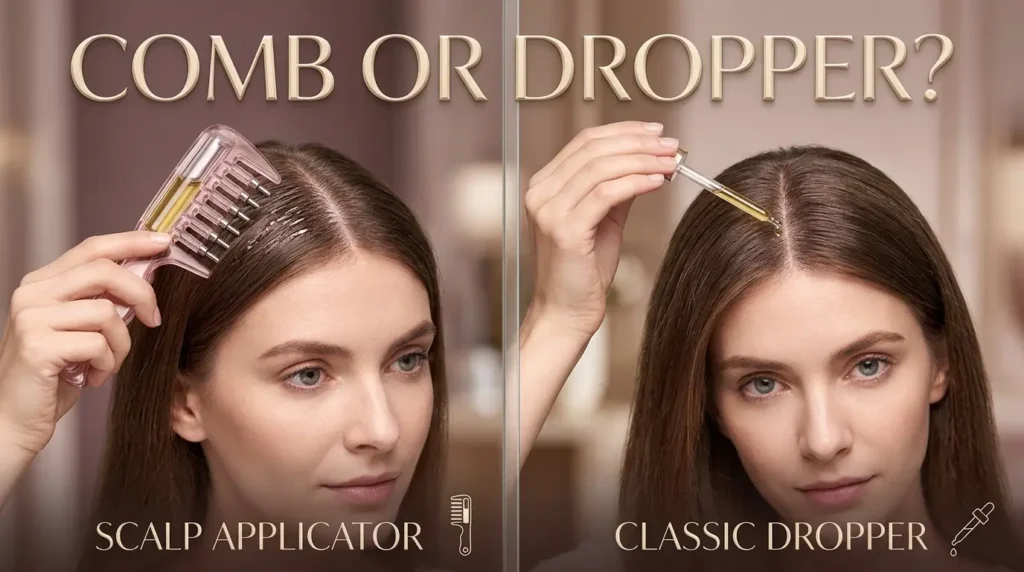
Scalp Oil Applicator Comb vs Dropper: Which Is Better?
For many people, the most revealing comparison isn’t between one viral applicator and another.
It’s between the new gadget and a tool they may already own.
| Feature | Applicator comb | Ordinary dropper |
|---|---|---|
| Applying along a parting | May feel convenient | Usually straightforward |
| Keeping oil off fingers | Potential advantage | Often manageable |
| Dosing control | Varies by mechanism | Depends on dropper and user |
| Thick oil compatibility | Can be limited by openings | Often easier with a suitable dropper |
| Cleaning | More surfaces or openings | Usually simpler |
| Bottle compatibility | Important for attachments | Usually supplied with the product |
| Applying through thick hair | Depends on tip design | Can be easier with deliberate parting |
| Travel convenience | Depends on cap and seals | Depends on bottle design |
| Hair growth benefit | No independent proof | No independent benefit from the delivery tool itself |
A dropper has one major advantage: simplicity.
You can see where the liquid goes, and there are relatively few parts to maintain.
An applicator comb may be more comfortable if you’re treating several scalp sections or dislike handling oily bottles.
But the difference is a matter of usability, not proof that one method improves the biological effectiveness of the oil.
Who Might Prefer a Dropper?
Someone who applies only a few drops, uses several different serums or wants precise control over small areas may find a dropper entirely adequate.
If the current method works and isn’t messy, there may be no practical reason to replace it.
Who Might Prefer an Applicator Comb?
Someone who regularly oils several partings, wants to avoid touching the oil or enjoys a gentle scalp massage may find the device appealing.
The key is whether it saves effort after the novelty wears off.
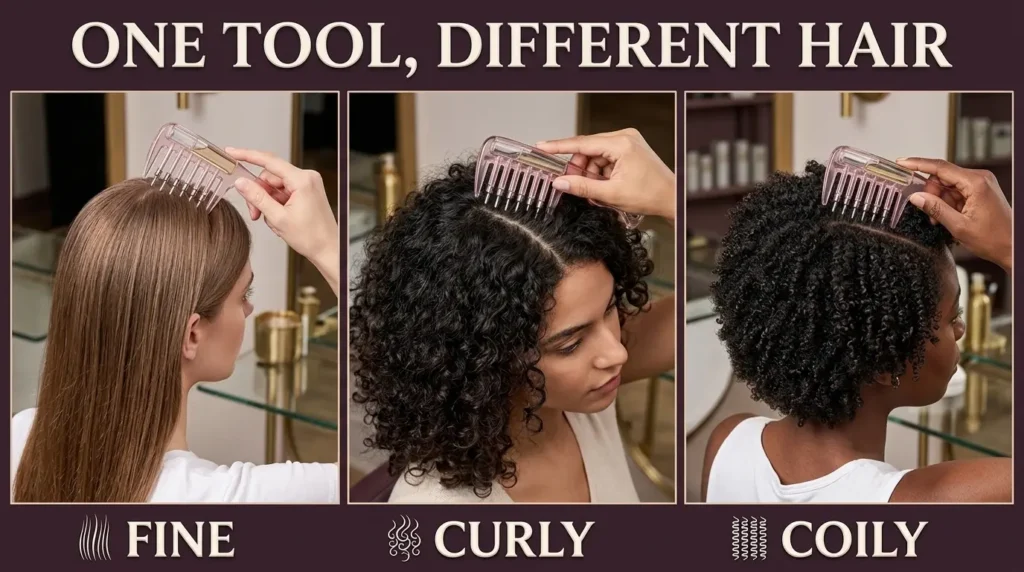
Will It Work on Thick, Curly or Coily Hair?
A product page might describe an applicator as suitable for every hair type.
That doesn’t mean every user will experience the same convenience.
Hair density, curl pattern, styling and scalp sensitivity can change how easily the tips reach the skin.
Straight or Fine Hair
A parting may be relatively easy to expose.
However, heavy oil can make fine hair appear greasy quickly, particularly when too much reaches the roots.
A tool that dispenses slowly may be helpful, but the amount used matters more than the gadget’s appearance.
Thick Hair
The main challenge is access.
A short applicator tip may remain in the hair rather than reaching the scalp.
Working in clear sections and choosing a design with appropriately shaped tips may help.
Avoid applying extra pressure to force the tool through dense hair.
Curly and Coily Hair
For textured hair, minimizing unnecessary manipulation is important.
The American Academy of Dermatology’s hair care guidance recommends choosing products and grooming methods suited to your hair type and being gentle when detangling.
A scalp applicator may be helpful when it allows precise application along an existing part.
But it shouldn’t be used as a substitute for properly detangling hair or forced through curls.
Braids and Protective Styles
A narrow nozzle or attachment may seem appealing for applying a compatible product between braids.
However, pulling a comb shaped head along tight sections may create unnecessary friction.
A targeted dropper or narrow nozzle may sometimes be easier.
If the style causes scalp pain, redness or tension, adding oil isn’t a solution to the underlying mechanical stress.
Does Scalp Oiling Really Help Hair Grow?
The question is more complicated than many product demonstrations suggest.
Hair oils are not one standardized treatment.
Different formulations contain different ingredients, and their effects may vary according to the condition being treated.
Some oils are used mainly to reduce friction or improve the feel of hair shafts.
Others are marketed for scalp comfort or hair growth.
Those purposes shouldn’t be confused.
What About Rosemary Oil?
Rosemary oil is frequently mentioned in hair growth discussions.
One small randomized trial published in 2015 compared rosemary oil with 2% minoxidil in 100 people with androgenetic alopecia over six months.
According to the study indexed in PubMed, both groups had an increase in hair counts at six months compared with baseline.
That finding is interesting, but it doesn’t establish that rosemary oil is equivalent to every approved hair loss treatment or that every commercial rosemary product will produce the same results.
The study was relatively small, involved a particular comparison and did not investigate the modern applicator combs now circulating online.
Most importantly, the research tested the topical interventions, not whether applying them with a comb improves their effectiveness.
Can Scalp Oil Make Dandruff Worse?
For some people, yes.
Not everyone who experiences flakes has a dry scalp.
Dandruff and seborrheic dermatitis involve a more complex interaction among skin oil, microorganisms and inflammation.
An article published in the medical literature on hair oils and seborrheic dermatitis discusses why applying certain oils directly to the scalp may worsen symptoms in susceptible people.
This doesn’t mean all oils are harmful or that everybody should avoid scalp oiling.
It means a flaky or irritated scalp shouldn’t automatically be treated by adding more oil.
If a product causes persistent itching, burning, redness or worsening flakes, stop using it and seek appropriate advice.
What About Actual Hair Loss?
Persistent thinning can have many causes.
Hereditary pattern hair loss, temporary shedding, inflammatory scalp conditions and hair breakage are not interchangeable problems.
The American Academy of Dermatology recommends identifying the cause of hair loss rather than relying on products that promise regrowth without adequate evidence.
A device that makes applying oil easier isn’t a substitute for that diagnosis.
Is This the Same as the Detangle Electric Hair Growth Comb?
No, and this distinction is especially important because the two products can look superficially similar.
TrendOutsider previously covered the Detangle electric hair growth comb research, based on a November 2026 study involving an experimental bioelectronic device.
That prototype combined electrical stimulation with the delivery of specialized molecular treatments and produced promising results in a mouse model of hair loss.
It has not established comparable human regrowth results.
The viral scalp oil applicator combs discussed here are ordinary consumer dispensing accessories.
They don’t contain Detangle’s experimental molecular delivery system simply because they have metal tips or resemble a comb.
Here’s the difference.
| Feature | Consumer scalp oil applicator | Experimental Detangle device |
|---|---|---|
| Main purpose | Apply cosmetic oil or compatible serum | Experimental hair loss treatment research |
| Mechanism | Mechanical dispensing and optional massage | Electrical stimulation plus molecular delivery |
| Typical availability | Commercial beauty accessories | Research prototype |
| Human regrowth evidence | No demonstrated independent benefit from applicator | Human efficacy not established |
| Appropriate claim | May simplify application | Promising experimental animal findings |
A similar shape doesn’t establish a similar medical function.
That is why product marketing should explain the actual technology rather than borrowing the excitement surrounding unrelated scientific research.

What the Viral Videos Don’t Tell You
Product demonstrations are designed to make the process look satisfying.
The oil flows neatly. The tips glide across a visible parting. The person finishes without getting anything on their hands.
It’s a persuasive image.
But a short demonstration doesn’t establish how the tool behaves after several weeks of use.
A few practical questions deserve attention.
Will It Leak in a Bag?
A reservoir or bottle attachment needs secure seals.
Before traveling with one, check the manufacturer’s storage instructions.
Kitsch, for example, advises detaching its applicator from the oil bottle for storage and travel.
That’s a useful limitation to know before assuming the attachment can simply stay fitted inside a handbag.
Can It Handle Thick Oils?
Not all oils have the same viscosity.
A narrow opening that works with a light serum may dispense a heavy oil poorly.
The manufacturer should explain which formulations are compatible.
A product demonstration using one lightweight liquid isn’t proof that every oil will flow equally well.
Can You Clean Every Part?
A beauty tool that dispenses liquid repeatedly needs appropriate cleaning.
Check whether the reservoir is accessible, whether the tips can be cleaned and whether the maker provides clear instructions.
If the tool cannot be cleaned adequately, its convenience becomes less appealing.
Does It Tug at Hair?
Rounded tips may feel comfortable, but their movement still matters.
People with fragile or easily tangled hair should avoid forcing the comb through knots.
An applicator is meant to place product near the scalp, not aggressively detangle the entire head.
Does It Actually Save Time?
That depends on the routine.
A person applying a few drops may spend longer filling and cleaning an applicator than they would using the original bottle.
Someone oiling many separate parts may have the opposite experience.
Convenience is personal, and that’s one reason an honest product review should involve actual repeated use rather than a single attractive video.
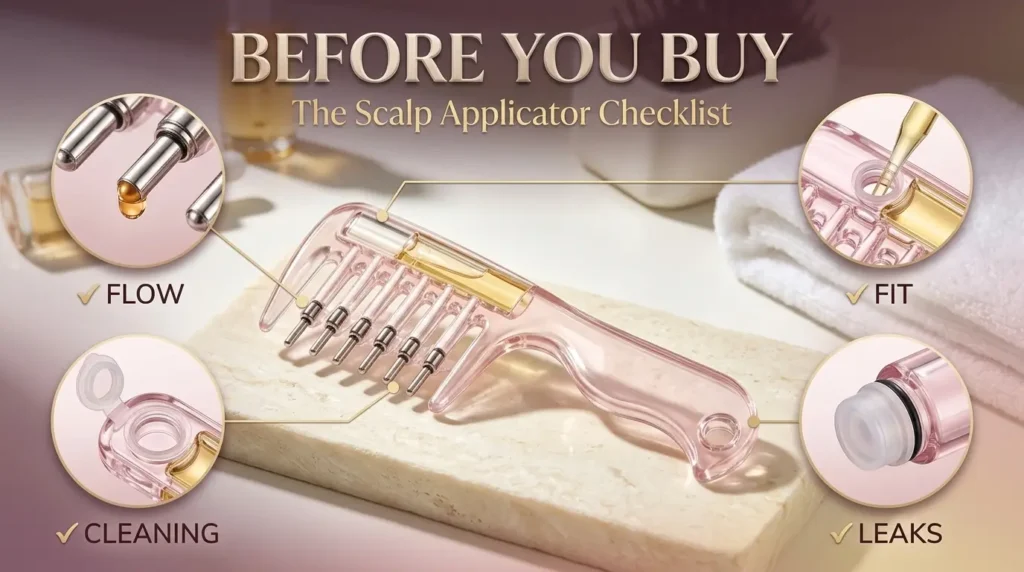
Seven Things to Check Before Buying a Scalp Oil Applicator
A useful shopping decision starts with a few details that promotional photographs may overlook.
1. Dispensing mechanism. Does the product use small openings, rounded roller tips or another system? Look for a clear explanation of how the liquid flows.
2. Oil compatibility. Confirm whether the tool accepts your specific product type and viscosity.
3. Reservoir design. If refillable, can it be filled without spills and cleaned afterward?
4. Bottle fit. If it’s an attachment, check the compatible bottles rather than assuming every cap is interchangeable.
5. Tip comfort. Smooth, appropriately shaped tips matter more than decorative metallic finishes.
6. Leak prevention. Look for realistic storage instructions and a properly secured cap.
7. Replacement and returns. Check the seller’s return policy, replacement availability and whether the product can be cleaned without damaging it.
Price matters too.
A low cost applicator that breaks, leaks or wastes oil may not be a bargain.
An expensive one isn’t automatically better.
Without independent hands-on comparison data, it’s not responsible to rank individual models by performance solely from their product descriptions.
Is a Scalp Oil Applicator Comb Worth Buying in 2026?
For the right person, yes.
But it helps to be clear about what you’re buying.
You’re not purchasing a clinically proven hair growth treatment.
You’re buying a grooming accessory that may make applying a compatible product more manageable.
That can be worthwhile if you regularly use scalp oil, dislike the mess of traditional bottles and find the dispensing mechanism comfortable.
It may be less worthwhile if you only use a few drops occasionally, already own a dropper that works well or dislike cleaning small accessories.
A sensible verdict looks like this:
| Your situation | Is an applicator worth considering? |
|---|---|
| You oil several scalp sections regularly | Potentially useful |
| Your current bottle dispenses too much | Worth comparing |
| You want gentle contact while applying oil | May be appealing |
| You use very thick oils | Check compatibility carefully |
| You have an irritated or flaky scalp | Get appropriate scalp care advice first |
| You’re seeking proven hair regrowth | Not a treatment by itself |
| Your existing dropper works perfectly | Probably unnecessary |
| You need a low maintenance routine | Consider cleaning requirements first |
The strongest reason to buy one is convenience.
The weakest reason is believing that a fashionable applicator will automatically change the medical effects of whatever oil goes into it.

Frequently Asked Questions About Scalp Oil Applicator Combs
Do scalp oil applicator combs actually work?
They can help place compatible oils or serums near the scalp, depending on the design. There is no established evidence that the applicator itself improves hair growth.
Are scalp oil applicators better than droppers?
Not necessarily. An applicator may be more comfortable for repeated application along several partings, while a simple dropper may offer easier dosing and cleaning.
Can a scalp oil applicator grow hair?
The dispensing tool itself has not been shown to regrow hair. Any treatment claim requires evidence for the formulation and, separately, evidence for any claimed benefit of the delivery device.
Can you use rosemary oil in a scalp applicator?
Only if the tool permits that type of formulation and the product itself is suitable for your scalp. Essential oils generally require appropriate formulation and should not be applied undiluted merely because an applicator can hold them.
Are refillable scalp oil combs messy?
Some may be convenient, while others can leak or dispense unevenly. Performance depends on the reservoir, sealing system, oil and technique.
Does the Kitsch scalp oil applicator fit any bottle?
Its official instructions describe use with compatible Kitsch oils. Don’t assume compatibility with unrelated bottles unless the maker confirms it.
How do you clean a scalp oil applicator?
Follow the manufacturer’s instructions for emptying, washing and drying the reservoir or tips. Avoid storing old product indefinitely in an unclean container.
Are scalp applicators good for curly hair?
They may be useful when applied gently along established partings. Avoid dragging the tool through tangles or putting unnecessary tension on curls.
Can scalp oiling make dandruff worse?
Certain oils may worsen seborrheic dermatitis in susceptible individuals. Persistent flaking or irritation should be assessed rather than automatically treated with more oil.
Can you use an applicator every day?
Frequency should follow the oil or scalp product’s directions and your individual needs. Daily application isn’t automatically necessary or beneficial.
Is a scalp oil applicator the same as a scalp massager?
Not always. Some applicators have massage tips, while other scalp massagers don’t dispense any liquid.
Is the viral scalp applicator the same as the Detangle electric comb?
No. Consumer oil applicators are mechanical accessories. Detangle is a research device combining electrical stimulation and experimental molecular delivery.
Are scalp oil applicators worth the money?
They may be worthwhile when they solve a real inconvenience in a regular routine. If an ordinary dropper already works well, the added gadget may provide little benefit.
The Bottom Line
The best thing about the scalp oil applicator comb trend is that it addresses a real, familiar annoyance.
Applying oil to the scalp can be awkward.
A clever dispensing tool may make that process a little cleaner, faster or more pleasant.
That’s a perfectly reasonable reason for a beauty gadget to exist.
But it’s also where the claims should stop unless better evidence emerges.
The applicator doesn’t turn an ordinary oil into a medical treatment. It doesn’t reproduce an experimental electric hair growth system. And it can’t guarantee the results promised in a glossy product demonstration.
Before buying, think about the product you actually use, how often you apply it and whether a refillable reservoir or bottle attachment would make that routine easier.
Check the cleaning instructions. Check compatibility. Be cautious about regrowth promises.
And remember that sometimes the best beauty purchase isn’t the newest tool.
It’s the one that genuinely makes an everyday task simpler.
Editorial disclosure: This article is based on manufacturer descriptions, third-party search trend research, publicly available user concerns and medical literature. TrendOutsider has not physically tested the applicators discussed, and no brand sponsored this article.
Medical note: Hair loss and scalp disorders have different causes. This article does not replace individual advice from a qualified healthcare professional.
Visual disclosure: Visuals used with this guide are conceptual product and grooming illustrations, not photographs of verified hands-on tests or clinical results.








Leave a Reply