
The most interesting number in Alibaba’s new AI announcement might not be 2.4 trillion.
That is the total number of parameters in Qwen4-Max, the company’s latest flagship model, released on November 16. It’s an enormous figure, the kind that naturally attracts attention in a crowded artificial intelligence market.
But Alibaba is making a more practical argument. It says its new model can handle difficult coding and professional tasks while using fewer computational resources than its predecessor, making sophisticated AI work less expensive to run.
That matters to developers who spend money on API calls, businesses experimenting with AI agents and anyone trying to decide whether they really need the most expensive model for every task.
Qwen4-Max combines a one million token context window with text, image and video understanding, advanced reasoning and support for external tools. It can be accessed through Alibaba’s Qwen ecosystem and production API.
There is an important catch for people who associate Qwen with downloadable open source models: Qwen4-Max itself has not been released with open weights.
And while Alibaba has published promising benchmark results, the evidence does not establish that Qwen4-Max is universally better than Claude, GPT or Google’s Gemini models.
So what exactly has Alibaba built, what does it cost, how do you use it and which performance claims deserve attention?
What Is Qwen4-Max?
Qwen4-Max is Alibaba’s flagship artificial intelligence model from the Qwen4 generation.
It is designed to process large amounts of information, understand visual material, generate text, reason through complicated instructions and interact with software tools through supported interfaces.
Alibaba announced the production release on November 16, 2026, after opening a limited Qwen4-Max preview on November 11.
According to Alibaba Cloud’s official launch announcement, the model contains 2.4 trillion total parameters and activates approximately 71 billion parameters for each token it processes.
That distinction is central to its architecture.
Qwen4-Max is a mixture of experts model, meaning it does not use all its parameters in the same way for every piece of text.
Alibaba says this design helps reduce the resources required to perform inference, the process of running a trained model to produce an answer.
Qwen4-Max specifications at a glance
| Specification | Official information |
|---|---|
| Developer | Alibaba |
| Release date | November 16, 2026 |
| Model name | Qwen4-Max |
| API model identifier | qwen4-max |
| Architecture | Sparse mixture of experts |
| Total parameters | 2.4 trillion |
| Activated parameters per token | Approximately 71 billion |
| Context window | One million tokens |
| Input types | Text, images and video |
| Output type | Text |
| Reasoning | Supported |
| Function calling | Supported |
| Structured JSON output | Supported |
| OpenAI compatible API formats | Supported |
| Anthropic compatible Messages format | Supported |
| Downloadable model weights | Not released |
| Customer fine tuning | Not supported in current Model Studio documentation |
These specifications come from the official Qwen4-Max model documentation and Alibaba’s launch materials.
The most relevant point for ordinary users is that Qwen4-Max is meant to handle more than a conventional question and answer conversation.
Developers can use it as part of applications that inspect documents, interpret screenshots, analyze video, write code or use authorized external tools.
That does not mean the model automatically has permission to access your computer, browse every website or operate business systems. Those capabilities depend on the application and tools connected to it.
Why 2.4 Trillion Parameters Doesn’t Tell the Whole Story
Model parameter counts make compelling headlines because they appear to offer a simple measure of scale.
But parameters are not the same as intelligence, reliability or useful output.
A model with more parameters does not automatically outperform one with fewer parameters on every task.
In Qwen4-Max’s case, the number also needs explanation because the model uses a sparse mixture of experts architecture.
What does mixture of experts mean?
Imagine a large organization with many specialist departments.
Not every department needs to work on every request.
A mixture of experts model uses a related principle. Its architecture routes parts of the computation through selected components rather than activating the full network in the same way for every token.
Alibaba says Qwen4-Max has 2.4 trillion total parameters but activates approximately 71 billion per token.
The full model remains enormous, yet the computation involved in processing each token is different from what the headline total alone might suggest.
That does not make the model lightweight enough to run on an ordinary laptop.
The total weights, memory requirements, model serving infrastructure and other engineering considerations still matter.
What did Alibaba change?
Alibaba describes Qwen4 as an architectural improvement over the Qwen3.8 generation, with changes to attention, residual connections and embeddings.
It attributes some of its efficiency improvements to this architecture.
Those claims are technically meaningful, but the practical question is whether the improvements produce better results at a lower total cost for a user’s particular tasks.
That requires testing both accuracy and spending, not simply comparing parameter counts.

What Can Qwen4-Max Actually Do?
Alibaba highlights several areas where the model is intended to be useful.
The most important are coding, complex reasoning, visual understanding, document analysis and AI agent workflows.
Coding and software development
A developer can ask the model to explain code, propose changes, interpret errors or help work through a software problem.
Its support for tool calling also allows developers to build systems that connect model reasoning with authorized development tools.
However, coding quality depends on more than the model.
The surrounding system matters: repository access, the tools that execute code, how tests are run, how feedback is supplied and whether changes are reviewed.
A model might perform well on a benchmark while still introducing defects into a real application.
Frontend design
Alibaba identifies frontend development as one of the intended strengths.
That can include generating interface code, interpreting design references and proposing layout changes.
Multimodal input could be useful when a developer supplies a screenshot of a design and asks for an implementation.
The result still needs responsive layout checks, accessibility testing and code review.
Image understanding
Qwen4-Max accepts images as input.
For example, an application can send an authorized screenshot and ask the model to describe what appears on it.
Potential uses include document understanding, interface analysis and visual information extraction.
That is not the same as saying Qwen4-Max generates original images directly. Its documented output modality is text.
Video understanding
The model also accepts video inputs within documented limits.
A developer might use this capability to inspect a short product demonstration, summarize a recording or identify relevant events in authorized footage.
The quality of the result depends on how the video is processed and which frames or segments the system evaluates.
Video analysis should not be presented as perfect observation of every moment.
Business and research work
Qwen4-Max can also be used for structured information processing, classification, document examination and research assistance.
Alibaba is positioning it for professional tasks that require multiple steps and tool interactions.
That is why the company emphasizes its ability to support agents rather than presenting it solely as another consumer chatbot.
The One Million Token Context Window: Why It Matters
Qwen4-Max supports a context window of up to one million tokens.
A token is a unit used to process text and other information. It is not exactly the same as a word.
A large context window allows a model to receive substantial amounts of material within a request.
That can be helpful when working with lengthy documents, software repositories or complex multi step instructions.
But it is important not to confuse capacity with understanding.
A model can accept a very long input and still miss an important detail, misunderstand a relationship or make an incorrect conclusion.
How large is the context window in practice?
A million tokens is enough to represent a very substantial quantity of text, depending on language, formatting and tokenization.
The limit is not an invitation to upload every available file automatically.
Long requests can increase costs, processing time and the difficulty of validating the output.
The official documentation also distinguishes total context capacity from maximum input length and output budgets.
For the production model, Alibaba documents a nonthinking maximum output length of 131,072 tokens and a combined reasoning and final answer budget of up to 262,144 tokens.
Those numbers are technical ceilings, not a promise that every application should request a response that long.
Why developers should care about context
A larger context window can reduce the need to split some tasks into very small pieces.
For example, a developer may want the model to examine multiple related files rather than a single function.
A researcher may need to compare several lengthy reports.
A business application may want to analyze a substantial set of records.
Yet a well designed retrieval system can still be more efficient than sending an enormous document into every request.
The right approach depends on information quality, latency, privacy and cost.
Qwen4-Max Pricing: What Does the API Cost?
Pricing is one of the strongest reasons for developers to pay attention to Alibaba’s latest release.
The international QwenCloud reference rates reported at launch were:
| Usage category | Reported reference rate |
|---|---|
| Standard input | $1.50 per million tokens |
| Standard output | $4.50 per million tokens |
| Qualifying implicit cache hit input | $0.075 per million tokens |
These are QwenCloud launch reference figures, not a promise that every region, Alibaba service, reseller or API route charges exactly the same rate.
Alibaba’s own Model Studio console has displayed different figures for particular service routes.
Before integrating the model into an application, confirm the price shown for your chosen region, endpoint, billing plan and account.
What do input and output tokens mean?
Input tokens are the information sent to the model.
That can include instructions, conversation history, retrieved documents or text associated with other inputs.
Output tokens are generated by the model, including chargeable reasoning content under applicable billing rules.
If an application sends large amounts of context with every request, its input charges can rise.
If the model generates lengthy reasoning and answers, its output charges can rise.
A hypothetical cost example
Suppose an application processes one million standard input tokens and generates 200,000 output tokens at the reference rates above.
The input portion would cost $1.50.
The output portion would cost $0.90.
The combined inference charge would therefore be $2.40 before other charges or adjustments.
This is only a calculation based on the stated reference rates.
It does not represent an actual tested workload, and it excludes any extra hosting, application infrastructure, tool or third party costs.
Why caching matters
Applications often send repeated context.
A customer support system, for example, may include the same instructions or source information in many requests.
Caching can reduce the price of certain repeated input tokens when the request qualifies and the cache is actually used.
Alibaba’s context cache documentation explains that cached tokens are billed differently from ordinary input.
The lower rate does not mean every input token automatically receives a discount.
Developers need to monitor actual usage and cache behavior.
Is Qwen4-Max cheaper than Claude or GPT?
It may be less expensive for many API workloads, especially when compared with higher priced frontier models.
But a token price comparison alone is incomplete.
If one model needs several attempts to complete a task that another model finishes correctly on the first attempt, the cheaper tokens may not produce the cheaper outcome.
The relevant measure is the total cost of an accepted, reliable result.
This becomes especially important in software development, research and agent workflows, where an incorrect answer can trigger additional tool calls or human review.
For a related discussion of model price and capability tradeoffs, TrendOutsider’s Gemini 4 Hydrogen analysis examines a different approach to balancing reasoning performance and accessibility.
Qwen4-Max Benchmarks: Does It Beat Claude and ChatGPT?
This is where the launch becomes more complicated.
Alibaba reports substantial improvements over Qwen3.8-Max and competitive results on several benchmarks covering software engineering, agent work and visual reasoning.
But the results are not uniformly favorable when Qwen4-Max is compared with leading alternatives.
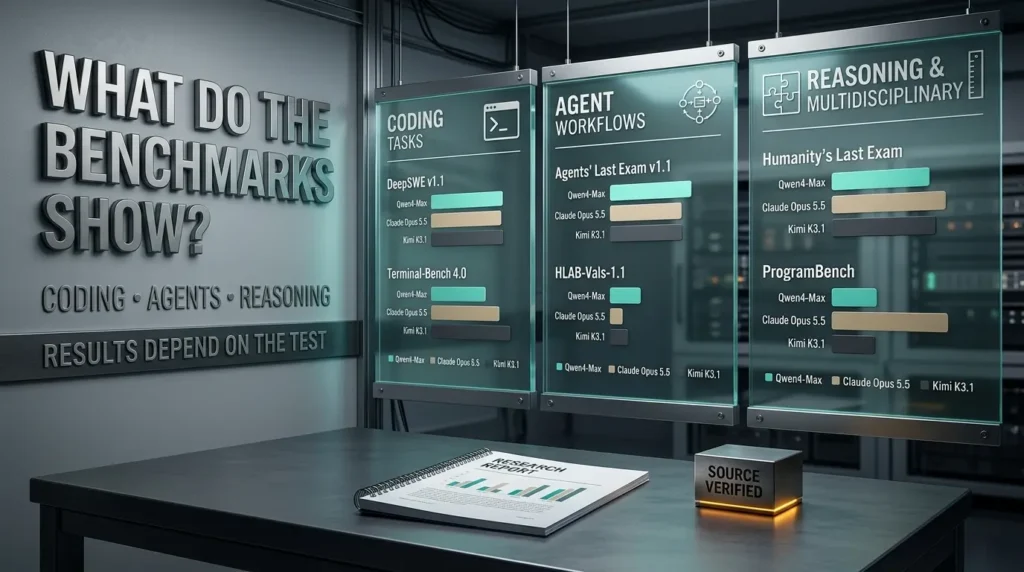
Different benchmarks measure different things.
A model may be strong at interpreting charts, competitive at using tools and less successful at completing difficult software engineering tasks.
There is no single score that captures every form of useful intelligence.
Coding results
Alibaba’s launch comparison reports Qwen4-Max scoring 48.5% on Terminal-Bench 4.0.
The same comparison lists Claude Opus 5.5 at 59.6%.
On ProgramBench, Alibaba’s comparison reports 31.5% for Qwen4-Max and 65.0% for Claude Opus 5.5.
Those are meaningful gaps within the reported test configurations.
They do not support a claim that Qwen4-Max has become the undisputed best coding model.
Agent reasoning
The picture looks more favorable for Alibaba on certain agent evaluations.
In its comparison for Agents’ Last Exam, Qwen4-Max is reported at 46.7%, ahead of Claude Opus 5.5’s listed 43.4%.
That suggests strength on the particular tasks represented in that evaluation.
It does not establish that Qwen4-Max will be more reliable in every real business automation.
Visual reasoning
Alibaba has also highlighted improvements in visual understanding and chart interpretation.
Its published Chartography comparison lists Qwen4-Max at 54.2%, above Qwen3.8-Max’s 42.0%.
However, some competing models score higher in the same launch comparison.
The practical takeaway is that Qwen4-Max offers meaningful multimodal capabilities without clearly dominating every visual test.
How to read benchmark charts honestly
A benchmark should be evaluated by its task definition, scoring method, model settings, tool access and who performed the measurement.
Vendor charts often bring together results from multiple public evaluations and internal tests.
That does not automatically make the figures false, but it does mean the reader needs to understand which results were independently evaluated and which were assembled or run by the vendor.
On November 17, VentureBeat’s independent coverage highlighted the model’s cost positioning while cautioning against treating the benchmark results as a clear victory over every frontier competitor.
What about Artificial Analysis?
Third party model evaluations provide another perspective.
Reports checking Artificial Analysis after launch describe Qwen4-Max as competitive but not at the top of every overall intelligence measure.
Those scores depend on the benchmark version and reasoning effort, so it would be misleading to compare numbers from different configurations as though they were identical tests.
The most useful approach for developers is to select tasks that resemble their own work and evaluate models on the same inputs under comparable conditions.
A cheap model that performs well on your actual application can be more valuable than a model with a higher overall leaderboard position.
Qwen4-Max vs Qwen3.8-Max: What Changed?
Alibaba’s direct comparison with its previous flagship is more straightforward than comparing models made by several companies.
Both are large Qwen models designed for demanding workloads.
Both support long context and advanced reasoning.
The new generation introduces architectural changes that Alibaba says improve efficiency and task performance.
Reported improvements
Alibaba says Qwen4-Max reduces the number of activated parameters per token compared with Qwen3.8-Max.
It also reports better performance on its Work360 professional work evaluation.
In that evaluation, the company says the new model uses fewer tokens and reduces the average cost of completing a task.
That is a more useful efficiency measure than comparing parameter counts alone.
However, Work360 is an Alibaba developed evaluation. Its results should not be represented as independently established savings for every organization.
Is it worth upgrading?
If you’re already using Qwen3.8-Max, test the new model on representative requests before switching production traffic.
Compare answer accuracy, tool behavior, latency, reasoning token usage and total cost.
Check for changes in output structure, API behavior and prompts.
A model upgrade can improve one workflow while causing unexpected regressions in another.
Treat the release as a candidate for evaluation, not an automatic replacement for every existing deployment.
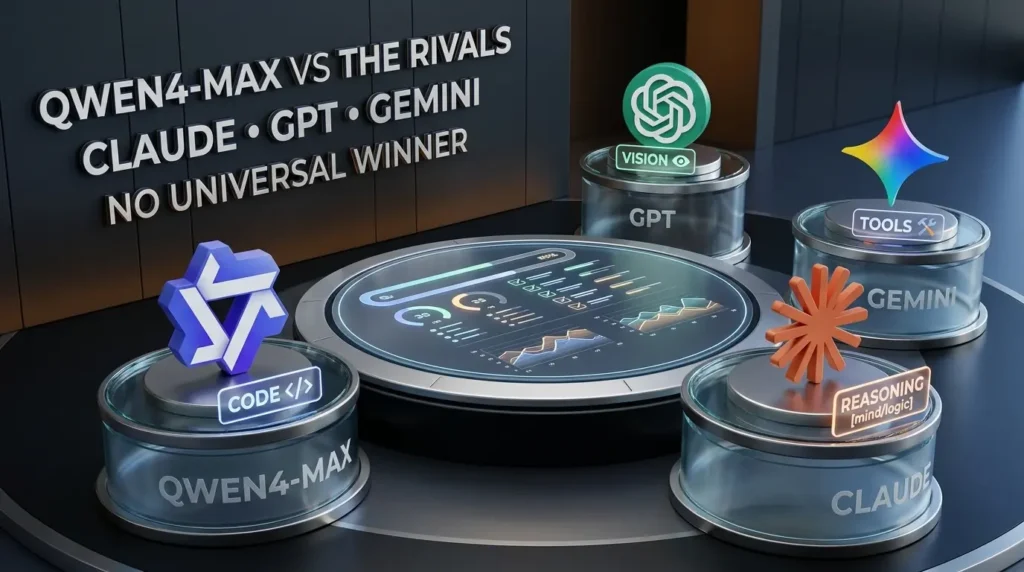
Qwen4-Max vs Claude, ChatGPT and Gemini
A model comparison becomes much more useful when we separate several different questions.
Which model gives the best answer?
Which model performs the task with the least human correction?
Which has the right context and tools?
Which is easiest to integrate?
And what does the completed task actually cost?
Qwen4-Max vs Claude
Claude models are prominent in long form reasoning, software development and coding agent workflows.
Qwen4-Max competes in some of those same use cases.
Alibaba’s launch comparisons indicate that Qwen4-Max performs well on selected agent evaluations, but Claude remains stronger on several published coding tasks.
That means developers should not assume Qwen4-Max is a drop in quality upgrade simply because its standard API rates may be lower.
The better choice depends on task difficulty, the coding environment and the amount of review required.
Qwen4-Max vs ChatGPT and GPT models
ChatGPT is a user facing product, while Qwen4-Max is a model accessible through several Alibaba products and APIs.
Comparing Qwen4-Max directly with “ChatGPT” can be misleading unless the particular GPT model and product mode are identified.
For developers, the fairer comparison involves specific model endpoints, reasoning settings, tool support, usage costs and observed results on identical tasks.
A chatbot subscription price also should not be treated as interchangeable with API token pricing.
Qwen4-Max vs Gemini
Google’s Gemini ecosystem includes consumer tools and developer models.
Some Gemini models emphasize large context windows, multimodal input, coding and tool use, overlapping with Qwen4-Max’s intended applications.
But model selection should account for ecosystem requirements.
A team already working heavily with Google Cloud may value the integration of its existing services.
Another team may prioritize QwenCloud compatibility, pricing or supported tools.
There is no responsible basis for declaring one provider universally superior without a clearly defined use case and comparable evaluation.
Practical comparison
| Question | Qwen4-Max | Claude, GPT or Gemini alternative |
|---|---|---|
| Large context | One million tokens documented | Varies by specific model |
| Visual understanding | Images and video supported | Depends on model and endpoint |
| Coding | Supported and benchmarked | Several strong alternatives |
| Tool calling | Supported | Common among leading developer models |
| Downloadable flagship weights | Not released | Depends on provider and model |
| API pricing | Competitive launch reference rates | Varies widely |
| Best model overall | Not established | No universal winner |
How to Try Qwen4-Max Without Writing Code
Alibaba says Qwen4-Max is available through its own Qwen services, including QwenStudio and QwenWork, as well as API access.
The exact interface, free allowance, subscription requirement and model selector can vary by account and region.
A beginner should start with an official Alibaba product rather than a third party website that merely claims to offer the new model.
Step 1: Visit an official Qwen product
Start from Alibaba Cloud’s Qwen4-Max launch announcement or the relevant official Qwen platform.
Follow its documented sign in process.
Step 2: Check model availability
Look for Qwen4-Max in the model selection interface.
Do not confuse it with Qwen4-Max-Preview or another Qwen model.
The production release uses a different model identifier from the earlier preview.
Step 3: Begin with a modest task
Ask the model to explain a nonconfidential document, compare two concepts or review a short piece of code.
Avoid uploading private client information while evaluating a new service.
Step 4: Verify the result
Check whether the response actually follows the instructions.
If you ask about a document, compare the answer with the original.
If you ask for code, inspect it and run appropriate tests.
Step 5: Review the usage terms
Before attempting demanding, repeated or commercially sensitive work, check available quotas, model access conditions and data handling rules.
An official product listing does not automatically mean unrestricted free use.
How Developers Can Access the Qwen4-Max API
For developers, the production model identifier is:
qwen4-max
Alibaba’s Model Studio documentation lists support for OpenAI compatible APIs, including Chat Completions and Responses, and for Anthropic compatible Messages requests.
This compatibility can make integration easier for applications built around familiar request formats.
But it does not mean every feature or parameter behaves identically across providers.
Step 1: Set up an Alibaba Cloud account
Choose the Model Studio service and a supported deployment region.
Review the applicable billing terms and regional availability.
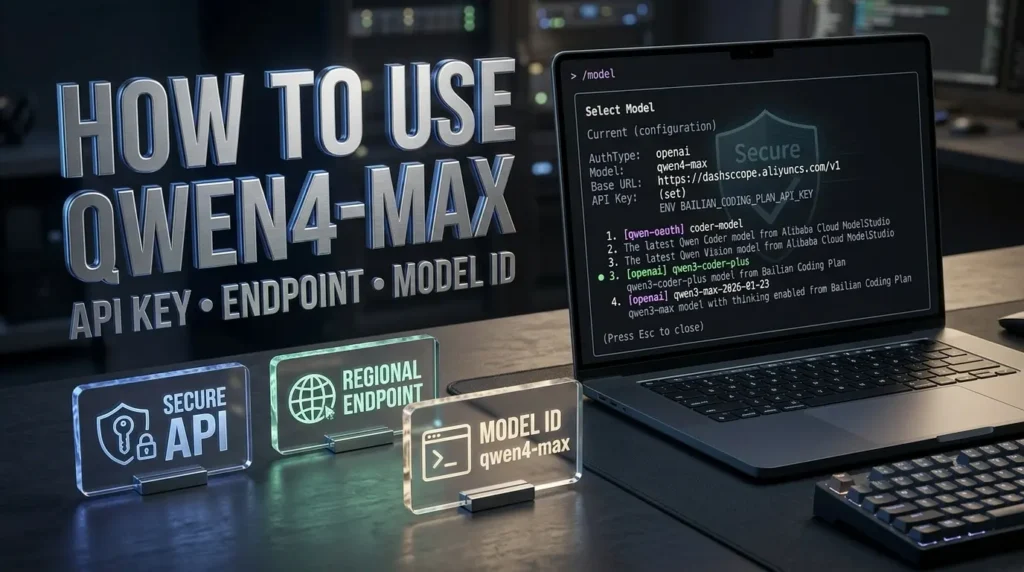
Step 2: Create an API key
Follow Alibaba’s API key setup instructions.
Do not paste a secret API key into public code, a browser page or a shared screenshot.
Use an environment variable or an appropriate secrets manager.
Step 3: Choose the correct endpoint
Alibaba’s endpoint depends on the region, workspace and API protocol.
Use the current endpoint shown in your Model Studio configuration.
Do not assume that a Token Plan preview endpoint can be used interchangeably with the production pay as you go API.
Step 4: Send a minimal request
Alibaba’s official text generation documentation demonstrates using its OpenAI compatible API with the qwen4-max model identifier.
A simplified Python illustration, based on that interface, looks like this:
import os
from openai import OpenAI

client = OpenAI(
    api_key=os.environ["DASHSCOPE_API_KEY"],
    base_url=os.environ["QWEN_BASE_URL"],
)

response = client.responses.create(
    model="qwen4-max",
    input="Explain the advantages and limits of a large context window."
)

print(response)
Set QWEN_BASE_URL to your actual Alibaba Cloud compatible endpoint for the selected region and workspace. It is deliberately not hardcoded here because Alibaba documents multiple regional routes.
Install and configure the required Python package in your own environment before running the example.
This code illustrates the documented request structure. TrendOutsider has not executed it against a live Qwen4-Max account.
Step 5: Check output and billing
Verify the response, inspect recorded usage where available and monitor actual charges.
Then test specific capabilities such as structured output or tool calling in a controlled environment.
Do not connect the model to production systems until permissions, error handling and failure cases have been reviewed.
Step 6: Evaluate with your own tasks
A meaningful comparison should use the same set of requests for each model.
For example, a developer can compare how models investigate an error, propose a repair and respond to test feedback.
Track accepted results, human corrections, token usage, elapsed time and cost.
The cheapest individual request is not always the cheapest reliable workflow.
Qwen4-Max vs Qwen4-Max-Preview: Don’t Mix Them Up
The preview and production versions are separate model identifiers.
Alibaba opened the preview on November 11, 2026, under the identifier:
qwen4-max-preview
It is available through a limited Token Plan arrangement.
The official documentation says the preview is scheduled to be retired after November 25, 2026.
The production model, released November 16, uses:
qwen4-max
Alibaba recommends the production model for new use.
Why does the distinction matter?
A developer who builds an integration around the preview identifier may need to update it before the preview is retired.
The preview and production models also have different documented limits and access arrangements.
Do not copy preview token ceilings or billing terms into a production configuration without checking the correct model page.
This is especially important because some early articles describe only the November 11 preview. Those articles may already be outdated after the November 16 release.
Is Qwen4-Max Open Source? Can You Download It?
No downloadable weights for the full Qwen4-Max model have been released with the November 16 announcement.
This is one of the most important facts for developers who want to run their own models.
Alibaba has a history of releasing open weight Qwen models, and that broader ecosystem has helped popularize the brand.
But the flagship Qwen4-Max production release is a proprietary hosted model.
Alibaba says smaller Qwen4 family models will be released with open weights in the future.
It has not provided a guaranteed release date for those models.
Can Qwen4-Max run locally?
Not in the ordinary sense of downloading its published weights and running them on a local GPU.
Those weights are not available.
The model’s enormous total parameter count would also create substantial infrastructure requirements even if a deployable version were offered.
Access through a hosted API is different from owning a local model deployment.
Can you fine tune Qwen4-Max?
Alibaba’s current Model Studio documentation lists fine tuning as unsupported for the production model.
Organizations that need a customized system can still investigate prompting, retrieval, tools and application level logic.
But those techniques should not be mislabeled as fine tuning the model’s weights.
For developers interested in self hosted AI, the appropriate path is to evaluate separately released open weight models whose licenses, memory requirements and deployment tools match the intended use.
Is Qwen4-Max Worth Using for AI Agents?
Potentially, especially when cost and large context are important.
But the answer depends on how the agent is constructed.
A useful AI agent is not simply a language model given a long instruction.
It needs a defined objective, permission boundaries, connected tools, error handling and a way to verify the work.
Qwen4-Max supports the model capabilities needed for many such systems, including function calling and structured outputs.
That makes it relevant to applications that route support requests, examine documents, interact with approved software or assist with development.
But a supported function calling format does not automatically make an agent reliable.
What about Claude Code style workflows?
Alibaba’s documentation identifies compatibility with Anthropic style Messages requests.
That can simplify integration with certain agent clients that support configurable model providers.
However, developers should check the client documentation, endpoint behavior, authentication method and any feature limitations.
Compatibility with an API format is not a guarantee of identical performance to Claude models.
It also does not make Qwen4-Max an official Anthropic product.
What should teams measure?
A team testing an AI agent should track more than completion rates reported by a benchmark.
Useful measures include the percentage of tasks accepted without corrections, tool failures, unauthorized action attempts, time spent on human review, model token consumption and total cost.
For a broader explanation, TrendOutsider’s AI agents workflow automation guide examines why automated workflows need clear scope and oversight.
Our coverage of DeepSeek Super Agent also explores the distinction between model capability and the surrounding system that coordinates software work.
A stronger model can improve an agent, but it cannot replace sound engineering.
What Qwen4-Max Still Needs to Prove
A model can have impressive specifications and still leave important questions unanswered.
Consistent coding reliability
How often does the model produce working changes across unfamiliar repositories?
A good answer requires tests on representative tasks and measured human correction.
Long context accuracy
Can the model consistently locate relevant information in very large inputs?
The one million token specification alone does not establish retrieval quality at every position.
Real world agent performance
How reliably does Qwen4-Max execute multi step workflows without getting stuck, repeating actions or making unsafe assumptions?
This requires evaluating the complete agent system.
Total cost of successful work
How much does a completed, accepted task cost after retries, tools, reasoning and review?
A lower token price is encouraging but not sufficient.
Independent evaluation
More outside testing will help clarify where Qwen4-Max is strongest and where rivals remain ahead.
Benchmark tables should continue to be updated with source dates and the configurations used.
Enterprise suitability
Organizations must consider deployment region, privacy rules, logging, support, contractual terms and service reliability.
A model’s technical capabilities do not replace procurement or security review.
Frequently Asked Questions
When was Qwen4-Max released?
Alibaba announced the production release on November 16, 2026. Its separate preview became available on November 11.
How many parameters does Qwen4-Max have?
Alibaba reports 2.4 trillion total parameters and approximately 71 billion activated per token.
What is Qwen4-Max’s context window?
The official documentation lists a one million token context window, with separate limits for input, output and reasoning.
Is Qwen4-Max free?
Availability and free or paid access depend on the Alibaba product, account and current plan. The production API has usage based pricing. Do not assume unlimited free access.
How much does the API cost?
QwenCloud launch reference rates were $1.50 per million standard input tokens and $4.50 per million output tokens. Actual rates depend on the service, region, account and billing route.
Is Qwen4-Max better than Claude?
Not across all measured tasks. It is competitive in selected evaluations, but Claude performs better in several coding comparisons published around the launch.
Is Qwen4-Max better than ChatGPT?
There is no single verified answer because ChatGPT includes different models and product features. Compare specific models on the same tasks.
Does Qwen4-Max understand images and video?
Yes. Alibaba documents text, image and video inputs, with text output.
Can Qwen4-Max generate images?
The production model’s documented output modality is text. Image understanding should not be confused with standalone image generation.
Can Qwen4-Max write code?
Yes. Coding and frontend work are among its stated applications. Generated code still requires review and testing.
Is Qwen4-Max open source?
The flagship has not been released with downloadable open weights. Alibaba says smaller Qwen4 models are planned for future open weight release.
Can I download Qwen4-Max to my computer?
Not as a released local weight package. The production model is offered through hosted services and APIs.
Can Qwen4-Max be fine tuned?
Alibaba’s current Model Studio documentation lists customer fine tuning as unsupported.
What is the difference between Qwen4-Max and Qwen4-Max-Preview?
They have different model identifiers and access arrangements. The preview is scheduled for retirement after November 25, while the production version is the recommended model.
Does Qwen4-Max support the OpenAI API format?
Alibaba documents compatibility with OpenAI Chat Completions and Responses formats, among others. The endpoint and supported behaviors must be checked against its own documentation.
Should developers switch immediately?
Not automatically. Test the model on actual workloads and compare quality, cost, latency, tools and security requirements before changing a production system.
The Bottom Line
Alibaba’s Qwen4-Max is a serious new competitor in the frontier AI market.
Its combination of a massive mixture of experts architecture, one million token context, visual understanding and competitive API reference pricing makes it particularly interesting for developers and businesses building AI powered applications.
The release also shows how the industry is changing.
The biggest model is not automatically the most valuable one.
The model with the highest benchmark score is not always the right commercial choice.
And the cheapest tokens do not necessarily produce the lowest cost of completed work.
Alibaba’s most persuasive argument is that Qwen4-Max can deliver strong capabilities while making sophisticated tasks less expensive.
That deserves attention.
But the independent evidence is more nuanced than the idea that Qwen has simply defeated Claude, GPT and Gemini.
For developers, the right next step is a controlled evaluation using realistic workloads.
For ordinary users, the sensible approach is to explore official product access, understand the limits and judge the quality of actual answers.
And for anyone hoping to download the flagship model, the answer is clear: Qwen4-Max is not an open weight release.
The real significance of the launch will be measured by what people can build reliably, not by the number of parameters in the headline.

Editorial disclosure: This article is based on Alibaba’s official launch announcement, Model Studio documentation and independent technology reporting available on November 17, 2026. TrendOutsider has not independently deployed, benchmarked, fine tuned or security tested Qwen4-Max.
Pricing disclosure: API rates, promotions, caching rules and access conditions may differ across regions and platforms. Reference prices are informational, not quotations or guarantees of future billing.
Visual disclosure: AI generated illustrations accompanying this article are conceptual editorial artwork. They must not be presented as authentic benchmark screenshots, actual deployed systems or photographs of completed tests.







Leave a Reply