

DeepSeek has entered the autonomous coding-agent race with a new open-source research prototype called Super-Agent. Rather than simply answering coding questions or waiting for another prompt, the system is designed to receive authorized requests from development workflows, coordinate separate coding sessions and return useful results… potentially including GitHub pull requests.
The shift toward autonomous agents is part of a larger change in how people interact with artificial intelligence. As explored in our guide to ChatGPT’s intelligent UI and evolving AI interfaces, AI systems are moving beyond simple question-and-answer experiences toward interfaces that help people complete more complex tasks.
The release arrived over the October 31–November 1 weekend and quickly attracted attention because it addresses one of the biggest problems with today’s AI coding tools: developers still spend considerable time managing the agents that are supposed to save them time.
But there is an important catch. DeepSeek describes Super-Agent as a research prototype, not an official production-ready DeepSeek product. Its public implementation also differs from the broader architecture proposed by the DeepSeek Harness team.
So what can it actually do? Can ordinary developers install it? And is it a serious alternative to Claude Code, OpenAI Codex or GitHub Copilot?
Here’s what the official documentation and independent reporting establish… and where the unanswered questions remain.
Quick takeaways
- DeepSeek Super-Agent is an open-source coding-agent prototype built for a single GitHub repository.
- It operates through DeepSeek Harness, a separate open-source agent application.
- Its documented workflow includes GitHub requests, optional Feishu integration, authorization rules, isolated task sessions and a review panel.
- The larger Super-Agent vision involves more proactive, coordinated work, but not every proposed feature exists in the public prototype.
- The software uses an MIT license, although running it may still involve model, infrastructure and maintenance costs.
- There is no credible basis yet for declaring it faster, more accurate or cheaper than Claude Code or Codex in real-world use.
What is DeepSeek Super-Agent?
DeepSeek Super-Agent, published as dsh-superagent-prototype, is an experimental coding-agent system from the DeepSeek Harness team.
Its purpose is to make AI assistance less dependent on a developer manually opening a chat, describing a task, watching each step and deciding what to do next.
Instead, the prototype connects an AI agent to a development team’s existing work environment.
An authorized person can request work through GitHub or an optionally connected Feishu conversation. The system then creates a work item, launches a separate agent session, performs the task and responds in the original conversation.
For example, a developer might identify a bug in a GitHub issue. Rather than copying the entire issue into a separate AI assistant, the developer can initiate an authorized agent workflow associated with that repository.
The agent can investigate the task and potentially prepare a pull request for human review.
That is the practical concept behind the release.
According to the official DeepSeek Super-Agent repository, the public code is intended for research and adaptation. It may contain bugs and should not be treated as production-ready.
This matters because the phrase super agent can create the impression of a fully autonomous AI employee. The published prototype is much narrower: it is a coding workflow system with defined sources, authorization rules and task execution.
The challenge is not simply making AI generate code faster. It is reducing the coordination work required to turn AI output into reliable results. This distinction also matters when evaluating AI productivity tools that promise to save time: the meaningful measure is the work actually completed, not the number of automated actions performed.
Is Super-Agent the same as DeepSeek Harness?
No.
DeepSeek Harness is the broader open-source agent application and execution environment. Its public preview supports activities such as coding, document work, research and extensible plugins.
Super-Agent is a specialized prototype packaged to work with that environment.
Think of Harness as the underlying workspace and runtime, while Super-Agent adds a particular way of receiving, organizing and executing coding requests.
DeepSeek’s Harness website explains the wider application and its plugin-oriented architecture.
Why DeepSeek built a more autonomous agent
Modern AI coding assistants can already generate functions, explain errors, inspect repositories and modify files.
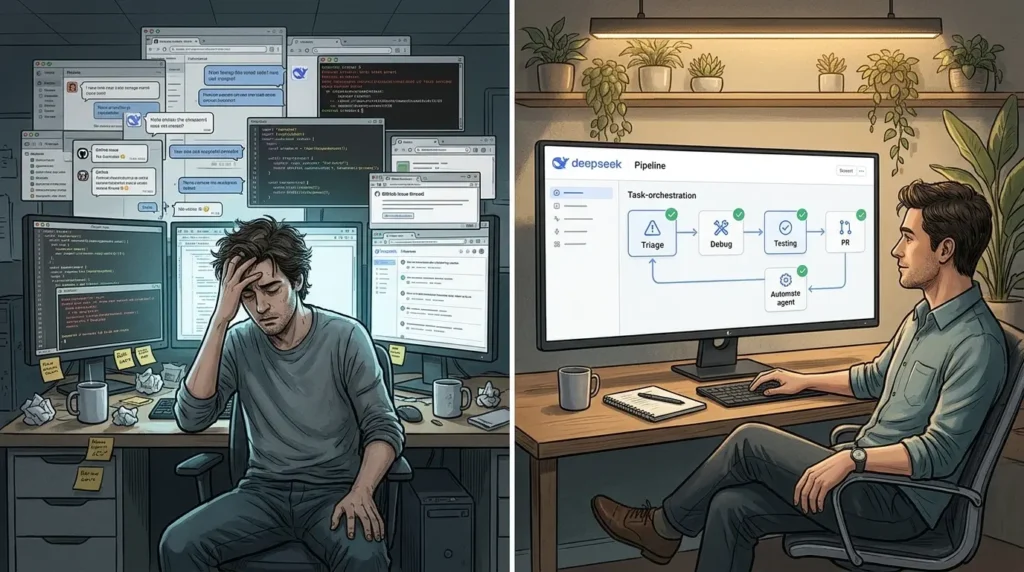
Yet using an agent for a substantial engineering project often creates a second job: supervising the agent.
A developer may have to repeatedly:
- Explain what changed in the repository.
- Open another session for a different task.
- Monitor progress and tool execution.
- Reconcile conflicting changes.
- Check whether the agent has finished.
- Copy information between GitHub and messaging tools.
- Review the final implementation.
The AI may write code quickly while the human still coordinates the entire process.
DeepSeek’s Super-Agent approach attempts to reduce that coordination burden.
The design principle is not simply to maximize autonomous activity. It is to minimize unnecessary human attention while producing useful, reviewable results.
That distinction is important. An AI system that constantly interrupts a team with suggestions, notifications and speculative fixes could reduce productivity rather than improve it.
The broader research vision therefore emphasizes controlled triggers, task ownership, worker execution and selective communication.
As reported by Bloomberg and the South China Morning Post, DeepSeek’s team is exploring ways for agents to coordinate more work without requiring constant human direction.
However, the prototype’s actual behavior should not be confused with every capability discussed in the team’s architectural vision.
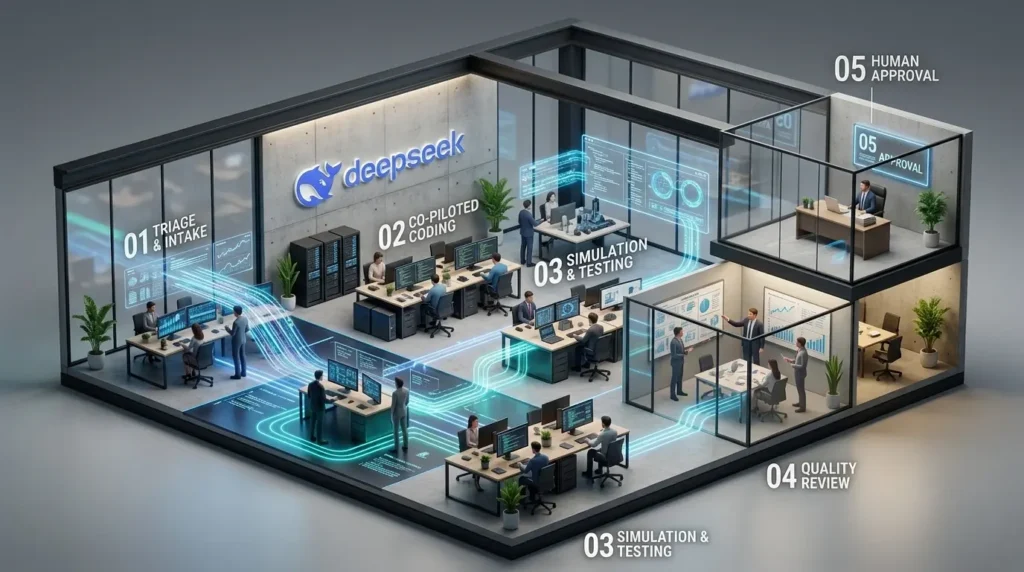
How DeepSeek Super-Agent works: the architecture explained
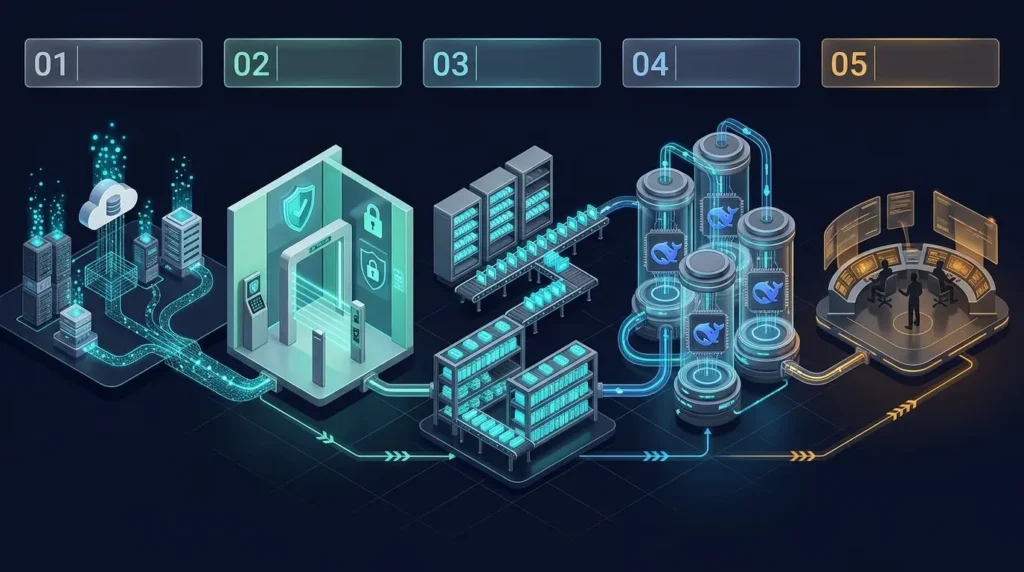
The easiest way to understand the system is to follow a task from the moment someone requests it.
1. A request arrives from GitHub or Feishu
The prototype is designed around external work events rather than an ordinary chat window.
GitHub is its central integration. Feishu, also known as Lark, is an optional messaging source.
These sources allow the system to observe relevant requests and conversations.
That does not mean the agent has unrestricted permission to act on every message it encounters.
2. Authorization determines whether work can begin
A central requirement is deciding who may ask the agent to do something.
The system uses authorization concepts so that merely mentioning an issue or discussing a bug does not automatically grant permission for arbitrary code execution.
This is a fundamental difference between a useful autonomous agent and an uncontrolled automation bot.
An organization needs to decide which people, repositories and events can initiate work.
It also needs rules for what the agent may do without additional approval.
3. A work item organizes the task
Once a request qualifies, the system creates a work item.
This gives the agent a defined task to process rather than relying entirely on a long-running conversation.
A work item can help separate the original request from the execution session and the eventual response.
It also gives operators a clearer way to understand which requests are active and which require attention.
4. A worker handles execution
The system creates an agent session and working directory for the task.
That separation matters because multiple coding requests should not all share one uncontrolled conversational context.
A task might involve reading repository files, identifying a defect, proposing changes or running available development tools.
The exact actions depend on the connected model, execution environment, permissions and task instructions.
Importantly, a separate working directory is not automatically a secure operating-system sandbox. Process isolation and security permissions must be evaluated separately.
5. The result returns to the original workflow
After working on a request, the agent can respond where the task originated.
For GitHub work, a useful result may be a pull request containing proposed changes.
The human reviewer can then inspect the implementation, check tests and decide whether to accept it.
6. A panel highlights work needing attention
The prototype includes a web panel intended to show work that requires a person.
This is an important part of the architecture.
The objective is not to hide everything the AI does. It is to make progress visible while reducing unnecessary interruptions.
A real-world example: fixing a software bug
Consider a small software company maintaining a customer dashboard.
Customers report that the invoice page occasionally shows the wrong currency symbol.
A developer creates a GitHub issue describing the problem and provides reproduction steps.
In a conventional AI workflow, the developer might open a coding assistant, paste the issue, explain the repository and guide the assistant through the investigation.
With a properly configured Super-Agent workflow, the process could look different.
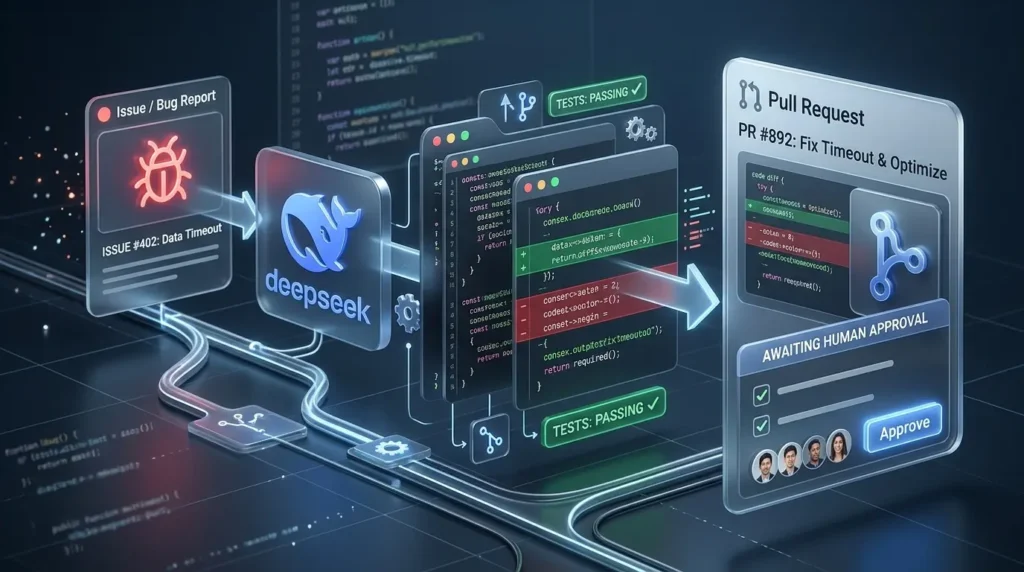
Step 1: Request. An authorized developer asks the agent to investigate the GitHub issue.
Step 2: Validation. The system checks whether the request meets its configured authorization rules.
Step 3: Task creation. A work item is opened for the investigation.
Step 4: Execution. An agent worker examines the relevant code and attempts to identify the cause.
Step 5: Proposed fix. If the worker can complete the task, it may prepare a code change and pull request.
Step 6: Review. A developer inspects the changes, runs appropriate checks and decides whether to merge.
This is an illustrative workflow based on the documented design, not a claim that we independently tested the prototype on an invoicing application.
The key advantage is the potential to reduce the number of times the developer must transfer context between tools.
But the agent still needs a clear issue, suitable access, safe permissions and human review.
For readers interested in building applications rather than managing coding agents, our guide to building apps with Google AI Studio explores a different approach to AI-assisted development. Google AI Studio focuses on helping users create and experiment with applications, while DeepSeek Super-Agent explores the orchestration of authorized development tasks.
What features does the current prototype offer?
The official repository establishes several important capabilities and boundaries.
| Capability | What the public documentation supports |
|---|---|
| GitHub integration | Receives and responds to work associated with a GitHub repository |
| Feishu integration | Optional messaging source |
| Authorized requests | Work initiation governed by configured rules |
| Work items | Tracks accepted tasks |
| Separate worker sessions | Executes tasks in dedicated sessions and directories |
| Review interface | Web panel for human attention |
| Pull request workflow | Can return coding results through GitHub |
| Open-source licensing | MIT license |
| General-purpose autonomous operation | Not established as a finished feature |
| Production reliability | Not guaranteed by DeepSeek |
One limitation deserves particular emphasis: the public prototype targets one GitHub repository.
It should not be described as a ready-made system that independently manages an entire company, hundreds of repositories or every workplace application.
DeepSeek also states that the published implementation differs from its internal version.
Some ideas in the broader design are future directions rather than implemented features.
Does it work proactively?
This depends on what proactive means.
The project is designed to react to relevant events and authorized requests without requiring a developer to manually start a separate coding conversation for each task.
But that is different from saying it independently scans everything, decides what the business needs and modifies production software without permission.
Its philosophy explicitly places limits on when it should act.
For readers evaluating the project, the correct question is not simply, “Can it work automatically?”
It is, “What event starts the work, who authorized it, what permissions does it receive, and what review happens afterward?”
How to install and try DeepSeek Super-Agent
Super-Agent is aimed primarily at developers and technically capable teams.
There is no basis for presenting it as a one-click consumer application with guaranteed results.
Step 1: Review the official repository
Start with:
DeepSeek Super-Agent on GitHub
Read the README and setup documentation before running anything.
Pay particular attention to its research-prototype warning and the differences between implemented functionality and proposed architecture.
Step 2: Understand DeepSeek Harness
The prototype runs as a bundle for DeepSeek Harness.
Visit the DeepSeek Harness website and review the supported installation methods, models and runtime requirements.
The Harness website documents a Node.js-based web launch method:
npx @deepseek-ai/dsh web
This command starts the broader Harness interface. It is not, by itself, a complete Super-Agent installation.
Step 3: Prepare a disposable repository
For a first experiment, use a test repository rather than production software.
A suitable test project might contain a simple application with intentionally created bugs and automated tests.
Do not connect the prototype to customer data, payment credentials, sensitive code or production deployment infrastructure during initial evaluation.
Step 4: Follow the prototype’s setup guide
DeepSeek recommends having a coding agent assist with the setup.
Its README provides this instruction:
Read SETUP.md in this repository and set up dsh-superagent with me.
The setup process is designed to walk the operator through the required configuration.
Read the plan before accepting any commands or granting access.
Step 5: Configure permissions carefully
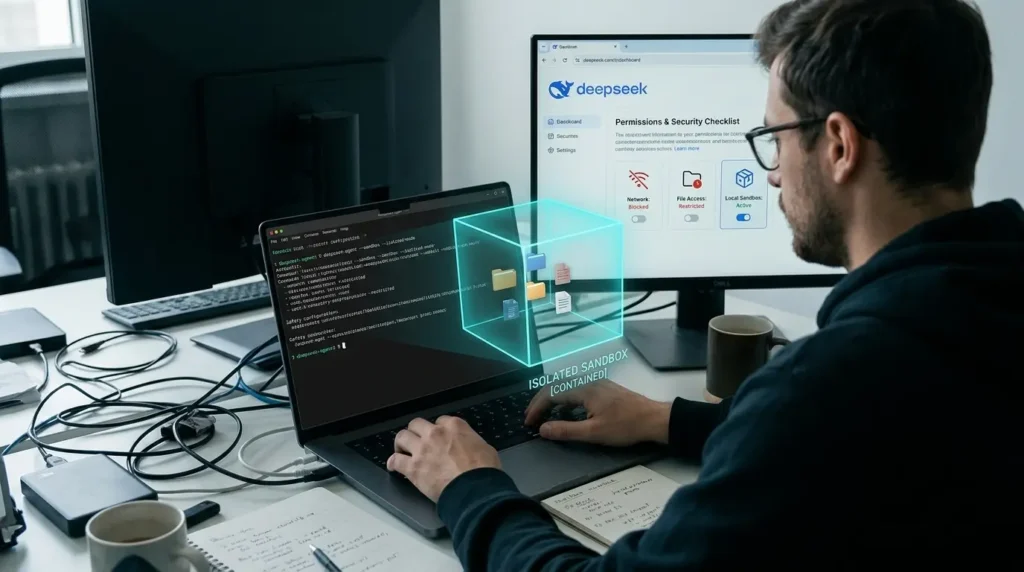
Use a dedicated operating-system account or isolated test environment where practical.
Grant only the repository and service permissions required for the experiment.
Review how worker commands execute and whether they require approval.
Do not assume that GitHub authorization alone restricts what an agent can do on the host computer.
Step 6: Test one small issue
Create a low-risk GitHub issue with a clearly defined expected result.
For example:
“Update the README installation instructions and open a pull request.”
Observe whether the system accepts the request, creates the work item, runs the worker and returns an appropriate result.
Step 7: Review everything
Inspect the proposed changes before merging.
Check for unexpected files, insecure dependencies, incorrect assumptions and unrelated modifications.
If the prototype fails or produces an unexpected result, treat that as useful evaluation evidence rather than a reason to give it broader permissions.
Testing disclosure: This guide is based on the published documentation and reporting. We have not independently installed, benchmarked or security-audited the Super-Agent prototype.
DeepSeek Super-Agent vs Claude Code vs OpenAI Codex vs GitHub Copilot
The most important comparison is not which AI has the most impressive name.
It is which system best fits the work a developer needs to complete.
DeepSeek Super-Agent is primarily an experimental workflow architecture.
Claude Code and Codex are more established coding-agent ecosystems. GitHub Copilot offers particularly direct integration with GitHub development workflows.
These tools overlap, but they are not identical products.
Feature comparison
| Tool | Primary strength | Typical workflow | Key consideration |
|---|---|---|---|
| DeepSeek Super-Agent | Authorized event-driven coding orchestration | GitHub/Feishu request to worker and result | Research prototype requiring setup |
| Claude Code | Repository-aware coding and developer collaboration | Developer directs agent through coding tasks | Model access, permissions and workflow configuration |
| OpenAI Codex | Coding agents with reusable harness and tool execution | Local, IDE, app or integrated agent workflows | Choose suitable execution and approval controls |
| GitHub Copilot cloud agent | GitHub-native task delegation | Issue or prompt to branch and pull request | GitHub plan, policies and repository access |
| DeepSeek Harness | Extensible general agent runtime | Desktop/web workspace and plugins | Different product scope from Super-Agent |
This table compares documented workflows, not measured coding performance.
DeepSeek Super-Agent vs Claude Code
Claude Code is useful when a developer wants an AI collaborator that can understand a codebase, investigate problems, modify files and work through implementation tasks.
It is especially relevant to interactive development workflows where the human and agent collaborate closely.
DeepSeek Super-Agent emphasizes a different layer: accepting requests from existing team workflows and coordinating task execution with less manual session management.
That distinction makes the comparison interesting.
Claude Code focuses strongly on the coding-assistant experience. Super-Agent’s prototype explores how coding work gets delegated, authorized, organized and returned to the team.
The systems are not necessarily mutually exclusive in concept. An agent orchestration system and an underlying coding model or runtime can occupy different layers of the same workflow.
However, actual interoperability must be confirmed for each supported configuration rather than assumed.
For developers who need a more mature day-to-day coding assistant, Claude Code is a more straightforward starting point.
For teams studying experimental orchestration architecture, DeepSeek’s prototype may be more interesting.
DeepSeek Super-Agent vs OpenAI Codex
OpenAI Codex is also designed to work beyond simple code completion.
Its agent harness manages context, tool execution, approval boundaries and multi-step work. OpenAI has documented ways to build on the Codex harness and integrate agent behavior into external applications.
The difference is partly one of maturity and emphasis.
Codex provides an established coding-agent ecosystem and documented integration surfaces.
DeepSeek Super-Agent offers an open-source reference implementation of a particular team-oriented, event-driven workflow.
A fair evaluation should compare the actual execution environment, permission model, task recovery, review process and operational overhead…. not merely whether both products can generate a pull request.
The coding-agent comparison also raises a separate question: how much of an agent’s performance comes from the underlying language model, and how much comes from its tools, context management and execution environment? Our GPT-6 vs GPT-5 comparison provides additional context on differences between model generations, although model comparisons alone cannot establish which coding agent performs best.
See OpenAI’s Codex harness architecture discussion for more detail.
DeepSeek Super-Agent vs GitHub Copilot cloud agent
GitHub Copilot cloud agent is a particularly relevant competitor because it already supports delegated work directly inside GitHub.
According to GitHub’s documentation, developers can initiate tasks, inspect changes and review pull requests without manually managing every coding step.
That means DeepSeek cannot claim uniqueness simply because its agent can respond to GitHub issues or prepare pull requests.
Its differentiator is the specific architecture it proposes for combining event sources, authorization, work items, worker sessions and human attention management.
GitHub Copilot is likely the simpler choice for teams already committed to GitHub’s supported cloud-agent workflow.
DeepSeek’s prototype is more appropriate for developers who want to examine and potentially adapt an experimental orchestration system.
What about Cursor, Windsurf and other AI coding tools?
AI-native editors and development environments such as Cursor and Windsurf belong in the broader comparison, but they solve a somewhat different problem.
They focus on bringing AI assistance directly into the developer’s editing and coding experience.
Super-Agent is not primarily an editor.
It is a system for receiving, organizing and executing coding requests through external workflows.
A developer may therefore use an AI editor for interactive implementation while using another system for asynchronous issue handling.
The strongest setup depends on whether the team’s bottleneck is writing code, reviewing code, coordinating work or managing infrastructure.
Which AI coding agent should you choose?
There is no verified universal winner.
The practical decision depends on your situation.
Choose Claude Code when: you want a capable, interactive coding collaborator for repository work, debugging, implementation and iterative development.
Choose OpenAI Codex when: you want a coding-agent ecosystem with documented execution, tool integration and reusable harness capabilities.
Choose GitHub Copilot cloud agent when: your engineering workflow is centered on GitHub issues, branches and pull requests, and you want supported task delegation.
Explore DeepSeek Super-Agent when: you are comfortable running experimental software and want to study event-driven orchestration, authorization and agent workflow design.
Consider DeepSeek Harness when: your interest extends beyond repository automation into a broader extensible agent application.
For most nontechnical users, DeepSeek Super-Agent is not the best first AI agent to install.
Its present value is strongest for engineers, agent-framework developers and teams researching autonomous software workflows.
Product managers and engineering leads should evaluate coding agents against their team’s actual workflow, including requirements gathering, prioritization, implementation and review. Our overview of AI tools for product managers provides related context for teams looking beyond code generation.
Is DeepSeek Super-Agent safe?
This is one of the most important questions in the entire release.
An autonomous coding agent may need permission to read files, execute commands, access repositories, create branches and interact with external services.
Those permissions can be powerful.
If the agent encounters malicious instructions inside an issue, comment, repository file or other untrusted content, it may face a prompt-injection attempt.
A coding agent may also accidentally remove files, expose credentials, introduce vulnerabilities or modify code outside the intended task.
Five security concerns to evaluate
1. Prompt injection
Repository content and external messages should be treated as untrusted input, not as higher-priority operating instructions.
2. Command execution
A worker capable of running shell commands may have access beyond the particular GitHub issue being processed.
3. Credential exposure
Repository tokens, API keys and local environment secrets must be protected from unnecessary access.
4. Unauthorized changes
The system should not accept instructions from arbitrary users or merge changes without appropriate controls.
5. Isolation failures
Separate directories and sessions can help organize work, but they do not necessarily provide strong security isolation.
The safest starting point is a disposable environment, minimal permissions, protected secrets, mandatory pull-request review and clear logging.
The public repository itself warns that the prototype is not production-ready.
That warning should carry more weight than promotional descriptions of autonomous AI.

Is DeepSeek Super-Agent free?
The repository is published under the MIT license.
That makes the source code available for use, modification and distribution subject to the license terms.
But open-source does not automatically mean zero operating cost.
A deployment may involve expenses for:
- AI model access or API usage.
- Compute resources.
- Hosting and storage.
- Monitoring and maintenance.
- Developer time.
- Security review.
- Integration services.
The actual cost depends on the selected model, workload, deployment environment and configuration.
There is no verified basis for quoting a universal monthly price for running Super-Agent.
Likewise, the prototype should not be advertised as a free replacement for every commercial coding assistant.
The code license and the total cost of running the system are different questions.
Can Super-Agent use other AI models?
Super-Agent is packaged for DeepSeek Harness, which provides the underlying agent environment.
The architecture separates the workflow system from aspects of the model configuration.
However, the precise models and providers supported in a particular installation depend on the current Harness implementation and configuration.
Readers should check the official documentation before assuming that a specific Claude, GPT, DeepSeek or locally hosted model will work with every feature.
Model compatibility is not the same as demonstrated performance.
Even if two models can execute through the same framework, their reliability, tool behavior, coding quality and cost may differ substantially.
Why this matters beyond software development
The broader significance of DeepSeek Super-Agent is the movement from individual AI conversations toward persistent, workflow-connected agent systems.
An ordinary chatbot responds to a message.
A coding agent can investigate and modify software.
An orchestration system decides how requests become work, how that work is assigned, when humans are involved and how results return to the original workflow.
That distinction matters because many organizations do not need an AI that writes more text.
They need systems that can complete defined tasks reliably without creating additional management overhead.
Consider a digital agency.
A client reports a website problem. A support ticket is created. An authorized engineering workflow investigates the issue, prepares a fix and requests review.
The valuable outcome is not the number of AI messages generated.
It is whether the issue moves from report to verified resolution with fewer unnecessary handoffs.
Super-Agent explores part of that architecture in the software-development context.
It does not yet provide a turnkey automation platform for every business process.
But the principles….. authorized triggers, task ownership, isolated execution, observable progress and human review… could inform future systems in customer support, operations and other fields.
What DeepSeek still needs to prove
The public release is technically interesting, but important questions remain unanswered.
Reliability
How often does the system successfully complete real engineering tasks without intervention?
A convincing answer would require repeatable testing across representative repositories and issue types.
Security
How well does the implementation resist prompt injection, permission misuse and unsafe command execution?
A research prototype’s documentation is not a substitute for an independent security assessment.
Scalability
Can the approach coordinate many tasks and repositories without producing conflicting changes, excessive costs or confusing results?
The current single-repository prototype does not establish large-scale operational performance.
Human attention
Does the system genuinely reduce the time engineers spend supervising AI?
This is central to the design philosophy, but it needs measurement.
Useful metrics would include review time, interruptions, accepted pull requests, rework, escaped defects and time to resolution.
Competitive performance
How does it compare with Claude Code, Codex and GitHub Copilot on identical tasks under comparable conditions?
There is no reliable head-to-head benchmark established here that justifies ranking these products by coding accuracy or speed.
Production readiness
Can organizations safely deploy it with the support, documentation, observability and controls expected of production infrastructure?
DeepSeek’s own warning indicates that the public prototype is not at that stage.
The future of autonomous AI coding agents
The coding-agent market is moving beyond the question of whether AI can write code.
The next challenge is whether agents can participate safely and effectively in an entire engineering workflow.
That includes recognizing authorized work, maintaining context, coordinating tasks, using tools, recovering from failures and producing results that humans can verify.
DeepSeek’s contribution is noteworthy because it publishes a concrete implementation and design materials for others to study.
Its MIT licensing also allows developers to experiment with and adapt the code.
But open-source availability alone does not prove technical superiority.
The strongest agent systems will likely be judged by measurable outcomes: fewer defects, faster delivery, lower coordination overhead, predictable costs and appropriate human control.
The potential benefits extend beyond writing code. Autonomous agents could eventually help teams coordinate planning, development, testing and delivery. Our analysis of AI in product development and time-to-market explores the broader relationship between AI adoption and product development workflows.
DeepSeek Super-Agent is an early example of that direction… not proof that the problem has been solved.

Final verdict: Is DeepSeek Super-Agent worth trying?
For experienced developers and agent researchers, yes—as an experiment. For production teams seeking a dependable replacement for existing coding tools, not yet.
The release is important because it focuses on an increasingly practical problem: coordinating AI work without requiring a human to manage every session.
Its GitHub-centered workflow, authorization concepts, separate task execution and review interface provide a useful foundation for studying more autonomous development systems.
But the current public implementation has explicit limitations, and DeepSeek does not present it as production-ready.
Claude Code, OpenAI Codex and GitHub Copilot remain relevant alternatives with different strengths and more established user workflows.
The most interesting question is not whether DeepSeek has built the world’s best AI agent.
It is whether this kind of architecture can eventually make AI assistance feel less like supervising a collection of chatbots and more like working with a reliable, accountable engineering system.
That is the development worth watching.
Frequently asked questions
What is DeepSeek Super-Agent?
DeepSeek Super-Agent is an open-source research prototype for handling authorized coding requests through GitHub and optionally Feishu, executing tasks through agent sessions and returning results for review.
Is DeepSeek Super-Agent officially released?
Its research code has been publicly released, but DeepSeek explicitly states that the prototype is not an official production-ready product.
Is DeepSeek Super-Agent free?
The source code uses the MIT license. Model access, hosting, computing and maintenance may still cost money.
Can DeepSeek Super-Agent replace Claude Code?
Not as a proven direct replacement. The products emphasize different workflows, and no verified head-to-head evidence establishes Super-Agent as superior.
Does it work with GitHub?
Yes. GitHub is the central repository integration described in the public prototype.
Can it build a complete application automatically?
It can attempt authorized coding tasks, but the available documentation does not justify promising reliable, fully autonomous end-to-end application development.
Is it safe for production?
DeepSeek warns that the prototype is not production-ready. Use an isolated test environment and review permissions before experimenting.
Does it support multiple agents?
The architecture uses separate agent sessions for work items and explores coordinated agent execution. That should not be confused with proof of unrestricted, production-scale multi-agent orchestration.
What is the difference between DeepSeek Harness and Super-Agent?
DeepSeek Harness is the broader agent runtime and application. Super-Agent is a specialized research prototype built to operate through it.
Which AI coding agent is best in 2026?
The answer depends on the workflow. Claude Code is relevant for interactive coding, Codex for integrated coding-agent workflows, GitHub Copilot for GitHub-native delegation and Super-Agent for experimental orchestration research. No universal performance winner is established by the available evidence.
Sources and further reading
- DeepSeek Super-Agent — Official GitHub repository
- DeepSeek Harness — Official website
- Bloomberg — DeepSeek Drops Enhanced Coding Agent
- South China Morning Post — DeepSeek Unveils AI Super Agent
- The Next Web — DeepSeek Open-Sources Super-Agent
- OpenAI Developers — Codex as a Platform
- GitHub Docs — Use Copilot Agents
- Anthropic — Claude Code Documentation
Editorial disclosure: This article was prepared using official documentation and independent reporting available on November 3, 2026. No hands-on Super-Agent deployment, comparative benchmark or security penetration test was performed. Conceptual illustrations should be labelled as AI-generated and should not be presented as actual product screenshots.





Leave a Reply