

There’s something strangely satisfying about watching a little robot crawl across a glass window.
It moves slowly, sprays a fine mist and works its way across the pane in neat rows. The glass behind it looks cleaner, the person filming barely has to lift a finger, and suddenly washing windows seems like a chore we might finally be able to hand over to a machine.
Then you look at your own windows.
There’s dust stuck around the edges. Rain has left streaks on the outside. A few fingerprints have survived your last attempt at cleaning, and the upstairs windows haven’t had much attention because reaching them is such a nuisance.
You start to wonder whether one of these robots would actually make life easier.
That question is becoming increasingly relevant in 2026.
The latest window cleaning robots are far more sophisticated than the simple suction devices that first appeared years ago. Some can plan their movement across large panes, spray cleaning solution, scrub close to the frame and operate using a portable battery station. One premium model can even wash its own dirty cleaning pads.
And the internet is paying attention.
In November 2026, the viral product tracking platform ViralSpyAI listed an automatic window cleaning robot among its most watched gadget discoveries, associating the product with a video that had accumulated approximately 53.9 million views.
That number reflects a tracked social media video, not verified purchases or Google searches. Still, it helps explain why these devices are attracting curiosity.
The more interesting question is what happens after the camera stops recording.
Do robotic window cleaners actually work? Yes, some can remove everyday dust, fingerprints and light dirt from suitable glass. But they don’t guarantee perfectly clear windows, they may leave marks or miss corners, and they are not fully independent cleaning machines.
Recent independent testing has produced dramatically different experiences, ranging from impressive results on large, smooth windows to frustration with awkward frames, stubborn grime and machines getting stuck.
So before spending hundreds of dollars on a gadget that promises to make window cleaning effortless, here’s what the technology really does, what has improved in 2026 and where the limitations still matter.
Why Window Cleaning Robots Are Going Viral in 2026
The appeal isn’t difficult to understand.
Cleaning windows is one of those household tasks that sounds straightforward until you actually start.
Large glass doors require repeated wiping. Floor to ceiling windows leave you reaching awkwardly around frames. Exterior panes may be difficult to access safely, especially in apartments or multistory homes.
A compact robot that grips the glass and moves around on its own seems like an obvious answer.
And unlike a traditional window cleaning tool, it creates an unusually compelling video.
You can watch it moving, spraying and cleaning in real time.
The 53.9 Million View Viral Signal
A November 2026 ViralSpyAI product tracker listed an automatic window cleaner robot with approximately 53.9 million tracked video views.
The platform reported first identifying the item on November 16.
That is a significant social discovery signal, but it needs context.
It doesn’t mean 53.9 million people bought the device. It doesn’t establish that the particular video featured the newest ECOVACS model, and it isn’t evidence that robot window cleaners perform as advertised.
It tells us people are interested enough to watch.
The more substantial story is that manufacturers are making genuine changes to the technology.
The Technology Has Changed This Year
At IFA 2026 in Berlin, ECOVACS introduced the WINBOT W2S PRO OMNI and WINBOT W2S PRO.
The company’s September 4 announcement highlighted improvements in edge cleaning, intelligent movement, spray coverage and portable operation.
Meanwhile, its WINBOT W3 OMNI has brought attention to something much less glamorous but surprisingly important: cleaning the dirty pad.
On October 27, ECOVACS announced that the W3 OMNI had been recognized in TIME’s Best Inventions of 2026.
The award recognition is real, but it shouldn’t be mistaken for proof that the robot outperforms every competing cleaner or works perfectly on every window.
That distinction matters because glossy product announcements and everyday household performance aren’t always the same thing.
How Does a Robot Window Cleaner Stay Attached to Glass?
The first time you see a window robot working vertically, the obvious question is whether it’s about to fall.
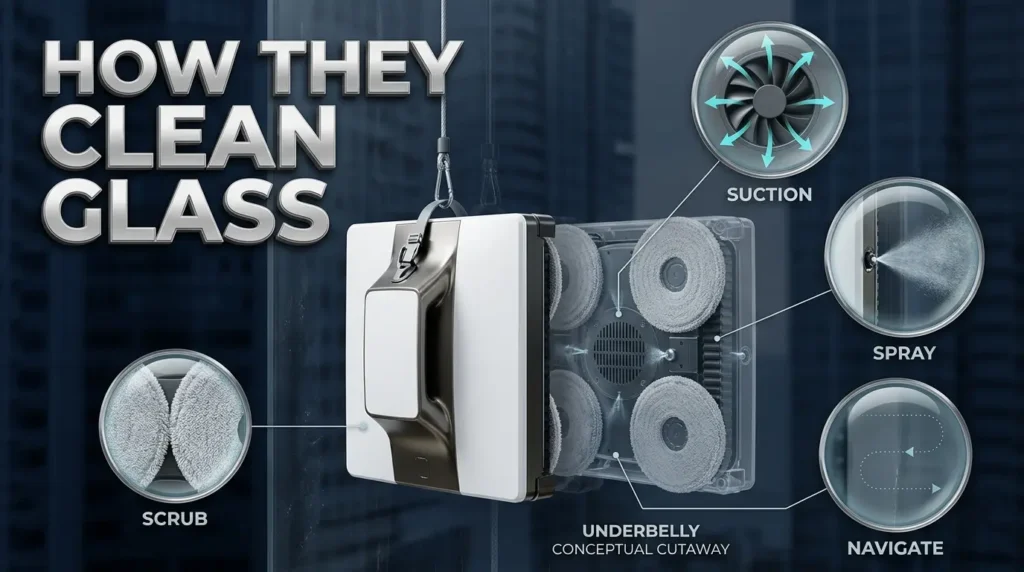
Most modern robotic window cleaners use powered suction to hold themselves against a suitable smooth surface.
A motor creates the airflow needed to maintain contact, while drive tracks or other movement mechanisms allow the machine to travel across the glass.
Cleaning pads contact the surface, and some models spray cleaning solution ahead of the wiping area.
Sensors and navigation software help the robot identify edges, obstacles and an efficient cleaning route.
The basic process looks like this:
- The owner checks that the window is suitable and prepares the robot according to its manual.
- The safety system is secured before the machine is placed on the glass.
- The robot powers its suction system and attaches to the pane.
- It moves across the surface according to its selected cleaning pattern.
- Spray and wiping mechanisms loosen and collect surface dirt.
- The machine finishes its route and signals that the user should retrieve it.
The principle is clever, but it also explains several limitations.
A robot needs the right surface to maintain suction.
It needs enough room to move.
And it must remain attached while cleaning solution, dirt and changes in surface texture affect the contact between the machine and the glass.
Is It Really Hands Free?
Not entirely.
Someone still needs to prepare the machine, fill the cleaning system where required, attach the safety tether, place the robot on the window and retrieve it after cleaning.
On a home with many separate panes, you may have to repeat that process several times.
A window cleaning robot can automate the movement and wiping.
It doesn’t necessarily automate the whole job.
That’s one reason a device that looks effortless in a 20 second video may be less convenient in a house full of small windows.
Do Window Cleaning Robots Actually Remove Dirt?
This is where the evidence gets more interesting.
For light and ordinary grime, some window robots can perform well.
But the results depend heavily on the machine, the window design, the cleaning pad and the type of dirt.
What Independent Testing Found
In an August 19, 2026 review for WIRED, technology journalist Simon Hill tested an ECOVACS WINBOT W2S Omni on his Victorian home.
His experience was far from the effortless result promised by glossy advertising.
The robot did a reasonable job on one large modern window, but left dirt around corners and along edges.
On more complicated traditional windows, the situation became more frustrating. Hill reported difficulty navigating features of the frame, an incident involving damaged paintwork and a later attempt where the machine became stuck.
That review is valuable because it describes actual use in a particular home, rather than simply repeating manufacturer specifications.
It doesn’t prove that every WINBOT performs poorly.
It shows why the design of the windows can matter as much as the cleaning technology.
A separate 2026 TechRadar hands-on guide also found that performance varies by device.
Its testing suggests robots can handle lighter dirt, but some leave visible tracks and struggle with tougher deposits.
A particularly important point from TechRadar’s experience is that a machine can unexpectedly lose its grip, even when it has safety measures designed to prevent a dangerous fall.
That’s a compelling reason to treat the safety tether as essential rather than optional.
What About More Favorable Tests?
Not every independent assessment reaches the same conclusion.
In May 2026, German technology publication COMPUTER BILD ranked the WINBOT W3 OMNI first in its window cleaning robot comparison.
The publication praised its cleaning performance and automated pad washing station, while noting disadvantages including its size, weight and unsuitability for certain steeply angled surfaces.
Taken together, these reports suggest a more useful conclusion than either “robot window cleaners are amazing” or “robot window cleaners are terrible.”
They can work well on the right windows, but the wrong window design can make an expensive robot disappointing.
Why Do Robot Window Cleaners Sometimes Leave Streaks?
It’s reasonable to expect clean glass from a machine sold specifically for cleaning windows.
But removing dirt and leaving a perfectly streak free finish aren’t always the same thing.
Several factors can affect the result.
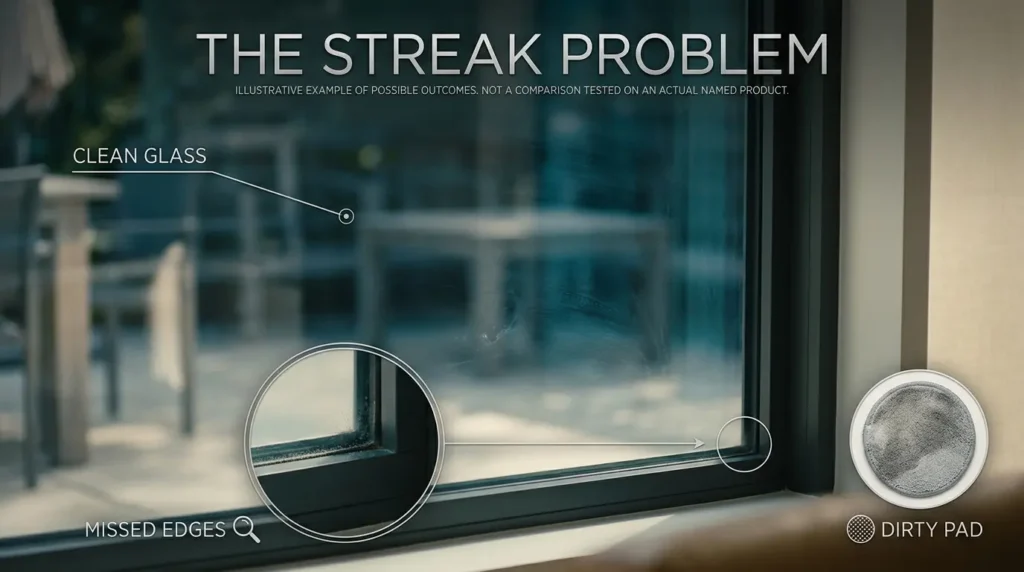
Dirty Cleaning Pads
The pad absorbs or collects material as it moves.
If it becomes saturated with grime, it may spread some of that dirt across the next section of glass.
This is especially relevant when the window hasn’t been cleaned for months.
Changing or washing the pad during a large job may improve the finish.
Too Much Dirt for One Pass
A thin film of household dust is very different from hardened bird droppings, thick mud or residue left by building work.
A window robot typically uses a limited amount of liquid and controlled wiping pressure.
It may not remove every deposit in one pass.
Trying to use the robot on surfaces the manual excludes can also create safety or damage risks.
Residue From Cleaning Solution
Using the wrong liquid or an excessive quantity can contribute to streaking or interfere with the machine.
Follow the manufacturer’s specified solution and filling instructions.
Don’t assume any glass cleaner, detergent or household mixture will be compatible with its spray system.
Edges and Corners
A robot’s cleaning body has a particular shape.
Its pads, tracks, sensors and bumpers all occupy space.
Even with improved edge cleaning technology, corners can remain difficult to reach perfectly.
That is particularly noticeable on windows where dust has accumulated tightly against the frame.
Window Features That Interrupt Movement
Handles, dividing bars, decorative trim and other protrusions can interfere with movement.
If a machine needs to navigate around obstacles, it may leave untouched areas or become stuck.
That’s why a flat, unobstructed picture window is often a much better match than a complicated traditional window.
What’s New in the ECOVACS WINBOT W2S PRO OMNI?
The WINBOT W2S PRO OMNI is one of the most relevant 2026 examples because its improvements address problems that existing window cleaning robots have faced.
According to the official ECOVACS product page, the robot includes an upgraded three nozzle spray system, automatic pad positioning around edges and a portable station.
Improved Edge Cleaning
ECOVACS describes an automatic pad lifting mechanism that adjusts around certain window edges and uneven frames.
The purpose is to improve coverage while helping the robot move over features that might otherwise interrupt cleaning.
That is a product design improvement, not a guarantee of complete corner coverage.
Real results still depend on the particular surface.
Three Nozzle Water Spray
The machine uses a wider spray arrangement intended to distribute cleaning solution more effectively.
ECOVACS claims higher spray pressure and longer spray duration compared with its previous design.
Those are manufacturer claims. They should not be interpreted as independent proof that stubborn deposits will always be removed in one pass.
Portable Battery Station
The W2S PRO OMNI can operate using a portable station with an integrated battery.
ECOVACS advertises up to 110 minutes of operation under its specified conditions.
That could be convenient for windows located far from a suitable electrical outlet.
Actual operating time depends on settings and conditions.
Safety Features
The product description includes suction protection, a safety rope and a weighted station.
These features are intended to reduce the consequences of losing attachment.
They do not make every exterior cleaning situation safe.
The user must still follow the specified anchoring, placement and supervision instructions.
What Makes the WINBOT W3 OMNI Different?
The W3 OMNI addresses another annoying part of window cleaning: the dirty wiping pad.
Its main innovation isn’t that it climbs glass in a completely new way.
It’s that the accompanying station can wash the robot’s cleaning pads.
According to ECOVACS’ official W3 OMNI information, its Vortex Wash system uses pressurized water and mechanical cleaning action to wash the pads in approximately one minute.
The system is designed to reduce the need to remove and hand wash pads during a cleaning session.
For someone with a large amount of glass, that could make a meaningful difference.
Instead of moving a dirty pad from one window to the next, the user has a way to refresh it between passes.
But there are tradeoffs.
The station is another substantial item to store.
The equipment still needs water and routine care.
And a cleaner pad cannot solve problems caused by unsuitable glass or poor access.
Is the W3 OMNI Better Than the W2S PRO OMNI?
They’re different kinds of upgrades.
The W2S PRO OMNI emphasizes portable operation and enhanced edge cleaning.
The W3 OMNI puts particular emphasis on automated pad washing and station maintenance.
Which matters more depends on the home.
Someone with many large windows may appreciate reducing the repeated task of cleaning pads.
Someone with a simpler layout might find a less elaborate system sufficient.
Without testing the two models under the same controlled conditions, it would be misleading to declare either one the universal winner.

Can Window Cleaning Robots Fall?
Yes.
Modern models have safety systems, but a robot attached to vertical glass is still a physical object that can lose grip or encounter a fault.
The answer isn’t to panic.
It’s to understand what the safety systems do and follow the manufacturer’s instructions every time.
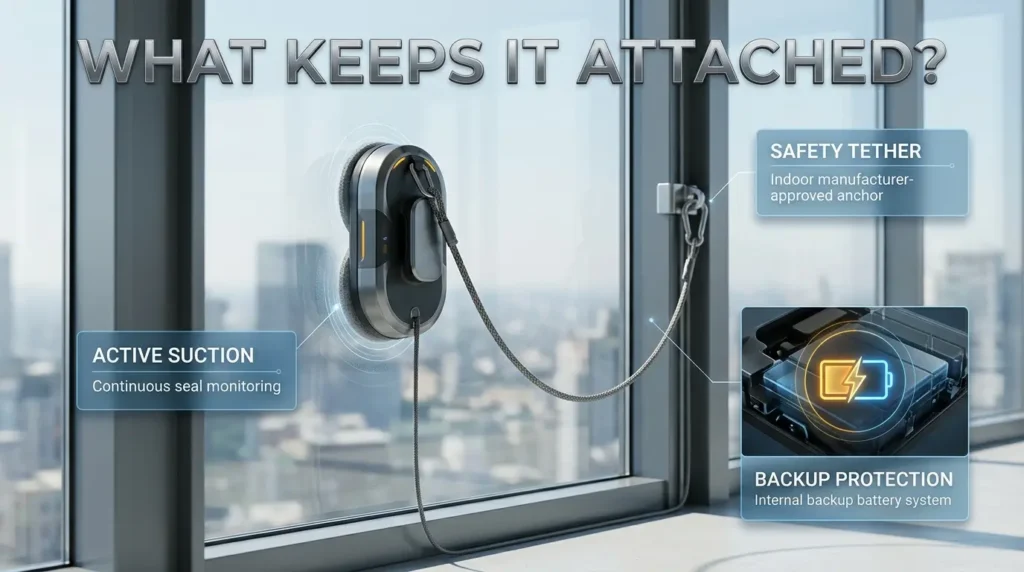
Suction Is the Primary Attachment Method
The fan keeps the machine attached to suitable glass.
If the surface is incompatible or its operating conditions fall outside the approved limits, the system may not perform as intended.
Battery Backup Is Not Unlimited Protection
Some designs include backup power or reserve capacity intended to help maintain attachment temporarily if normal power is interrupted.
The exact arrangement and duration vary by model.
A backup system is an emergency feature, not permission to leave the machine unattended or continue cleaning during a power failure.
The Safety Rope Is Essential
A properly secured tether provides an additional measure of protection if the robot loses attachment.
It must be connected exactly as the manufacturer instructs, using a suitable anchor.
Don’t assume that a lightweight curtain accessory, loose furniture item or casually tied knot is adequate simply because it is nearby.
Use the anchoring method specified for the product.
Keep People Away From the Area Below
Never arrange a cleaning session where people, pets or fragile objects could be struck if something falls.
This matters especially for exterior windows above ground level.
The owner should maintain supervision throughout the operation.
ECOVACS’ official support instructions for the W2S PRO OMNI include specific troubleshooting procedures for slipping, low air pressure, abnormal movement and obstructions.
These warnings reveal a limitation that marketing videos often understate.
Robotic window cleaning still requires attention to safety.
What If the Power Fails?
Follow the emergency procedure for the exact model.
Do not assume the robot can remain attached indefinitely.
Do not climb onto a windowsill, lean dangerously outside or reach into an unsafe position to retrieve it.
If the device cannot be reached safely, seek suitable professional assistance rather than risking a fall.
Can a Window Cleaning Robot Work on Any Type of Glass?
No.
This may be the single most important question to answer before buying one.
A window cleaning robot that performs beautifully on a large glass wall may be unsuitable for smaller or more complicated surfaces.
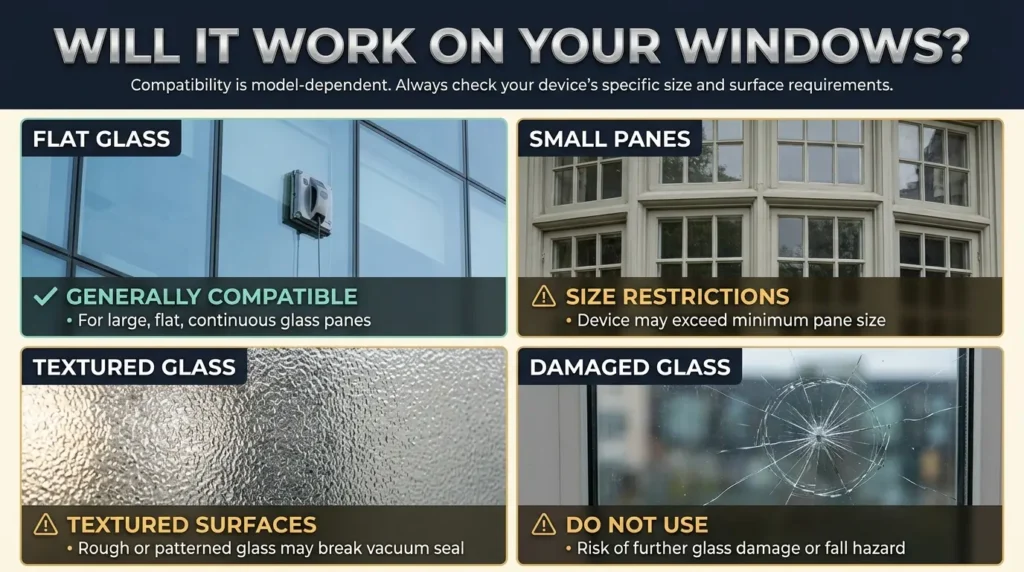
Large Flat Windows
These are generally the most natural fit.
A broad, smooth pane provides space for the machine to attach, move and follow its navigation pattern.
That doesn’t eliminate safety requirements, but it gives the robot a relatively simple cleaning area.
Sliding Glass Doors
Some sliding doors offer a useful surface for robotic cleaning.
However, handles, overlapping panels and decorative features may interrupt movement.
Check whether the machine’s dimensions and clearance requirements suit the door.
Frameless Glass
Some robots support certain frameless glass configurations.
But that doesn’t mean every frameless surface is safe.
An exposed edge, insufficient clearance or gap between separate panes may be a serious problem.
Check the exact manufacturer’s frame and edge requirements.
Tinted or Coated Glass
Compatibility depends on the surface and the specific robot.
Some glass coatings, films or textured treatments may affect suction or be damaged by cleaning.
Check both the glass manufacturer’s care recommendations and the robot manual.
Don’t rely on a broad advertising statement that the device works on glass.
Frosted, Textured or Patterned Glass
Raised textures and uneven surfaces can interfere with maintaining consistent contact.
A robot designed for smooth glass may be unsuitable.
Cracked or Damaged Glass
Do not use a robot on visibly damaged glass if the manual prohibits it.
A suction based cleaner cannot compensate for a weakened pane.
Small Windows
Compact individual panes may not provide enough room for the robot to move correctly.
The minimum usable surface can vary among models.
Curved or Irregular Glass
A robot designed for flat surfaces may struggle to maintain suction or navigate unusual shapes.
Never assume curved architectural glass is supported.
Shower Screens and Mirrors
Some compatible flat glass surfaces may be suitable, depending on the model.
But their size, thickness, fixtures, coatings and condition still matter.
The ECOVACS WINBOT guidance discusses compatibility limits, including small or irregular panes, decals, cracks, obstacles and problematic surface conditions.
A useful rule is to check the actual dimensions and surface requirements before assuming a machine will work.
Are Robot Window Cleaners Worth It for Apartments?
Potentially, but apartments introduce important practical and safety questions.
If your apartment has large windows that are difficult to reach from inside, the appeal is obvious.
A properly designed window robot may help clean compatible glass without the same repetitive manual wiping.
But living above ground level increases the consequences of a failure.
You also need to consider building rules, external access restrictions and whether the windows can be reached safely for attaching and removing the robot.
A robot doesn’t make it safe to lean outside a high window.
If the exterior glass cannot be accessed safely using the manufacturer’s approved procedure, professional window cleaning may be the better option.
What About Homes With Many Small Windows?
This is where the value proposition becomes less convincing.
Imagine a house with twelve small panes separated by decorative bars.
Even if the robot can clean each one, you may have to position it repeatedly.
Then consider its setup, tether placement, pad maintenance and retrieval.
The total effort might be greater than simply cleaning those accessible panes manually.
A home with a few very large glass doors is a different situation.
The robot has room to work and may reduce a meaningful amount of repetitive labor.
Can It Replace a Professional Window Cleaner?
For some routine maintenance on compatible glass, it may reduce the frequency of professional cleaning.
But it is not a universal substitute.
Professional cleaning may still be appropriate for difficult exterior access, complicated architectural glazing, heavy deposits or surfaces the device cannot safely handle.
A robot should never be used as an excuse to attempt dangerous access.
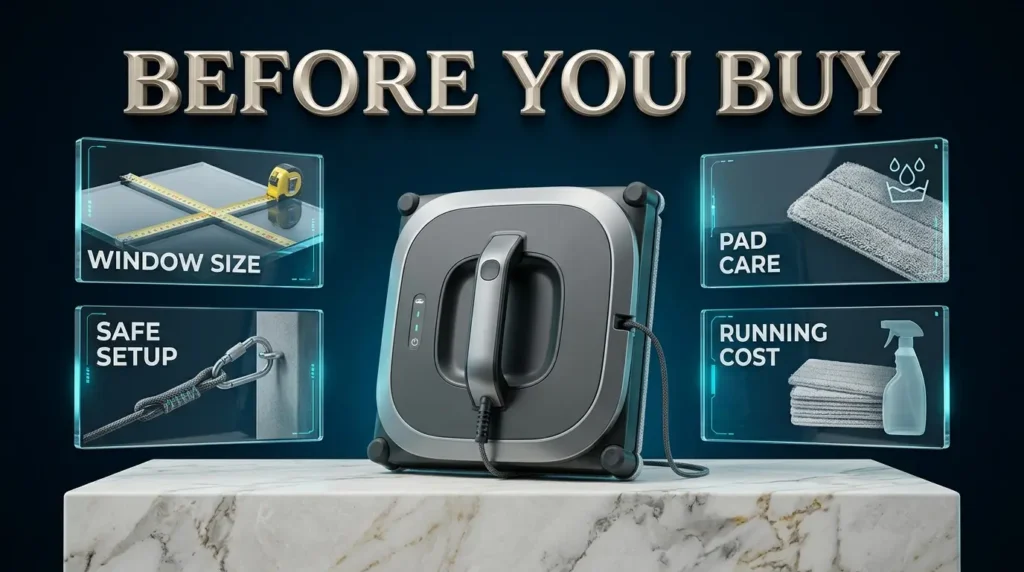
What to Check Before Buying a Window Cleaning Robot
It’s easy to become distracted by powerful suction figures and futuristic product names.
A more practical buying decision starts with the windows you actually own.
| What to check | Why it matters |
|---|---|
| Window dimensions | The robot needs sufficient space to attach and move |
| Surface texture | Uneven or damaged glass may be incompatible |
| Frame and edge design | Obstacles and gaps affect navigation and safety |
| Safety tether | The anchoring system must suit the intended use |
| Battery and power requirements | A portable station may be useful away from outlets |
| Cleaning pad system | Dirty pads can affect the final finish |
| Spray system | Different designs vary in liquid application |
| Replacement pads and solution | Ongoing supplies add to ownership cost |
| Storage size | Premium stations can be bulky |
| Return policy | Real home compatibility may be difficult to judge from advertising |
| Warranty and local support | Particularly important for more expensive appliances |
Don’t Buy Based on Suction Power Alone
A high suction specification may sound reassuring.
But cleaning quality also depends on the pad, liquid distribution, route planning, coverage and the machine’s ability to handle the window’s geometry.
There isn’t a single specification that tells you whether a robot will leave streaks.
Think About Ongoing Costs
Some robots require particular cleaning solutions or replacement pads.
These costs can add up over time.
Check the price and availability of consumables before purchasing.
Look at the Windows Before the Robot
Measure the panes.
Photograph the frames.
Note any handles, crossbars, unusual coatings or gaps.
Then compare those details with the official compatibility instructions.
This is far more useful than choosing a device because it performed beautifully on an enormous window in a promotional video.
Should You Buy a Robot Window Cleaner or Keep Using a Squeegee?
For some households, a traditional squeegee is still the sensible choice.
It’s inexpensive, easy to store and effective when you can safely reach the glass.
It doesn’t need charging, software or replacement cleaning pads.
A robot may make more sense when the windows are large, suitable for automated movement and inconvenient to clean repeatedly.
Here is a practical comparison.
| Situation | More sensible starting point |
|---|---|
| A few small, easily accessible windows | Manual cloth and squeegee |
| Large flat glass doors | Consider a compatible robot |
| Many narrow divided panes | Manual cleaning may be simpler |
| Exterior panes with unsafe access | Qualified professional cleaner |
| Regular light dirt on large windows | Robot may offer convenience |
| Heavy paint, cement or stuck deposits | Appropriate specialist cleaning |
| Limited storage space | Manual equipment |
| Large amount of compatible glass | Robot worth investigating |
The robot isn’t automatically better because it costs more.
The important question is whether it solves a problem that actually exists in your home.

Frequently Asked Questions
Do robot window cleaners really work?
Yes, some can remove everyday dust, fingerprints and light dirt from suitable smooth glass. Independent testing also shows limitations involving corners, streaks, complicated frames and heavy grime.
Do window cleaning robots leave streaks?
They can. Dirty pads, cleaning solution residue, stubborn deposits and incomplete edge coverage may all contribute.
Can robotic window cleaners fall off?
Yes. Safety systems reduce risk but do not eliminate it. Always follow the manufacturer’s tethering and supervision instructions.
What happens if a window cleaning robot loses power?
Protection systems vary by model. Some provide temporary backup power to maintain attachment, but the duration is limited. Follow the manual’s emergency retrieval instructions.
Can they clean windows outside a high rise apartment?
Only where the manufacturer permits that use and the robot can be attached, secured, supervised and retrieved safely. Never lean dangerously outside or attempt unsafe access.
Can a robot clean frameless glass?
Some models support certain frameless panes, but gaps, exposed edges, minimum dimensions and glass condition can restrict use.
Are window cleaning robots good for small windows?
Not always. Some panes are too small for the robot to move properly, and repeated manual repositioning can eliminate much of the convenience.
Can a robot remove bird droppings?
Light deposits may be removable, but hardened material can exceed what a gentle automated pass can handle. Follow the manufacturer’s instructions and avoid incompatible surfaces or aggressive cleaners.
Can window robots clean mirrors?
Some models support suitable smooth mirrors, subject to thickness, dimensions and the manufacturer’s instructions.
Is the ECOVACS WINBOT W3 OMNI better than the W2S PRO OMNI?
The W3 OMNI emphasizes automatic pad washing, while the W2S PRO OMNI emphasizes features including edge control and portable operation. The better choice depends on the windows and priorities.
Are window cleaning robots completely automatic?
No. Most still require placement, retrieval, maintenance, safety setup and supervision.
How often should a robot window cleaner’s pad be washed?
Follow the manufacturer’s instructions and clean or replace the pad when it becomes dirty. Continuing with a heavily soiled pad can reduce cleaning quality.
Are cheap robotic window cleaners worth it?
A lower price is appealing, but check compatibility, safety instructions, replacement parts, customer support and credible independent testing. Price alone doesn’t establish quality.
Can they replace professional window cleaning?
They may reduce the work needed for routine cleaning on compatible glass, but they cannot safely or effectively handle every building, surface or type of dirt.
The Verdict: Clever Technology, but Not a Magic Window Cleaner
There’s a reason robotic window cleaners make such good videos.
Watching a small machine climb a vertical pane and clean it in careful rows feels like seeing a chore disappear.
And in the right home, some of that promise is real.
Modern models can clean large, smooth windows, navigate across the glass and reduce the amount of manual wiping required.
The newer 2026 machines bring meaningful improvements, especially in edge coverage, portable operation and the maintenance of dirty cleaning pads.
But those advances don’t erase the practical limitations.
Some robots still leave marks. Some struggle with corners. Others become awkward around traditional frames, handles or irregular glass.
They also require preparation, maintenance and proper safety measures.
If your home has broad, flat windows that are difficult to clean regularly, a well chosen robot could be a useful appliance.
If you have a handful of easily accessible windows, a squeegee may still be all you need.
The smartest purchase isn’t necessarily the robot with the most impressive promotional video.
It’s the one that can safely and reliably clean the windows in your actual home.
And sometimes, after looking closely at those windows, the smartest decision is not buying a robot at all.

Editorial disclosure: This article is based on official manufacturer documentation, independent technology reviews and public social trend reporting. TrendOutsider has not physically tested the window cleaning robots discussed, and no brand sponsored this coverage. Product performance and availability vary by model, country and conditions.
Safety notice: Never rely on suction alone. Follow the manufacturer’s official safety, surface compatibility, tethering and supervision instructions. Do not lean out of windows or attempt hazardous retrieval.
Visual disclosure: Any AI generated illustrations accompanying this guide are conceptual editorial images, not photographs of TrendOutsider product testing.








Leave a Reply