
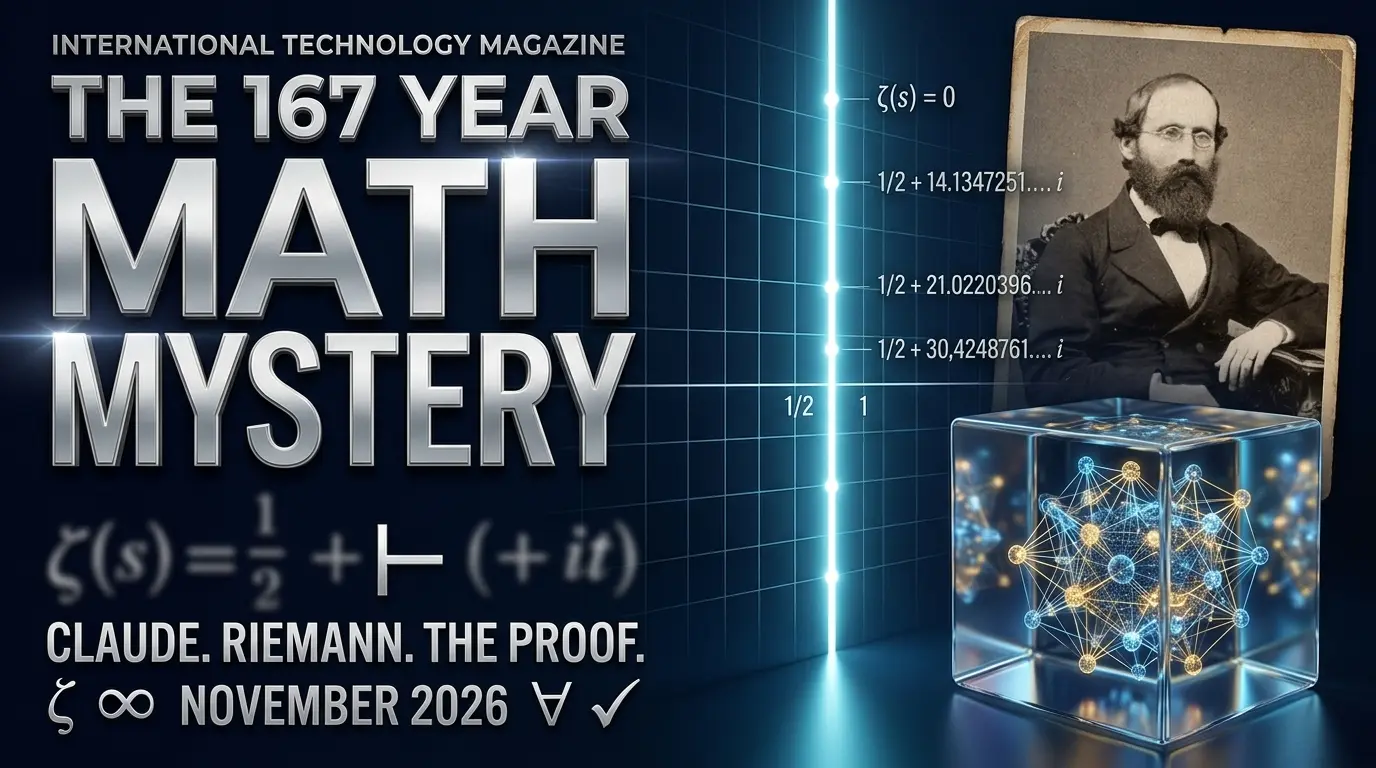
For 167 years, some of the world’s most accomplished mathematicians have tried to solve a question about prime numbers that looks deceptively simple when written down.
Nobody had managed to produce a universally accepted proof.
Then, on November 20, 2026, a mathematician working at the artificial intelligence company Anthropic released something extraordinary: a proposed solution developed with Claude, the company’s AI assistant.
It wasn’t an ordinary research paper.
It was approximately 17 million lines of computer readable mathematics.
Within a day, independent mathematical software communities had checked the enormous formal argument and publicly declared confidence that it proved the Riemann Hypothesis.
For a problem first proposed in 1859, that is a remarkable development.
But an equally important distinction is being lost in some of the excitement.
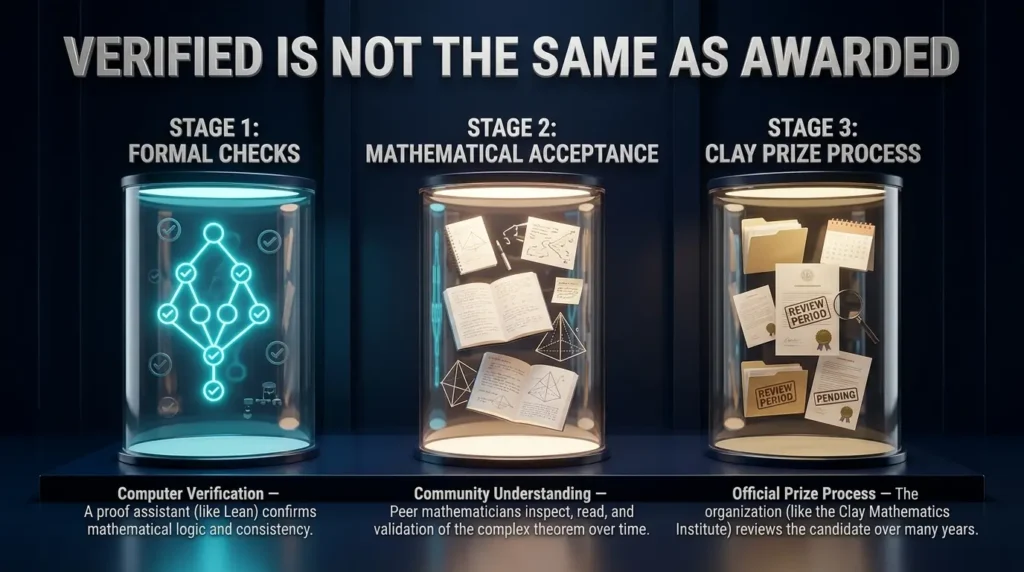
The computer verified proof has passed major independent checks. The mathematical community is still working to understand the argument, and the Clay Mathematics Institute continues to list the Riemann Hypothesis as an active Millennium Prize Problem.
That doesn’t diminish the achievement. It makes the story considerably more interesting.
For the first time, one of mathematics’ most celebrated unsolved problems has a formally checked proposed solution produced through a collaboration between a human mathematician and a frontier AI system.
The question now is not simply whether a machine can check the result.
It is whether mathematicians can understand the ideas inside it, establish their broader significance and decide what this extraordinary episode means for the future of scientific discovery.
What Happened on November 20, 2026?
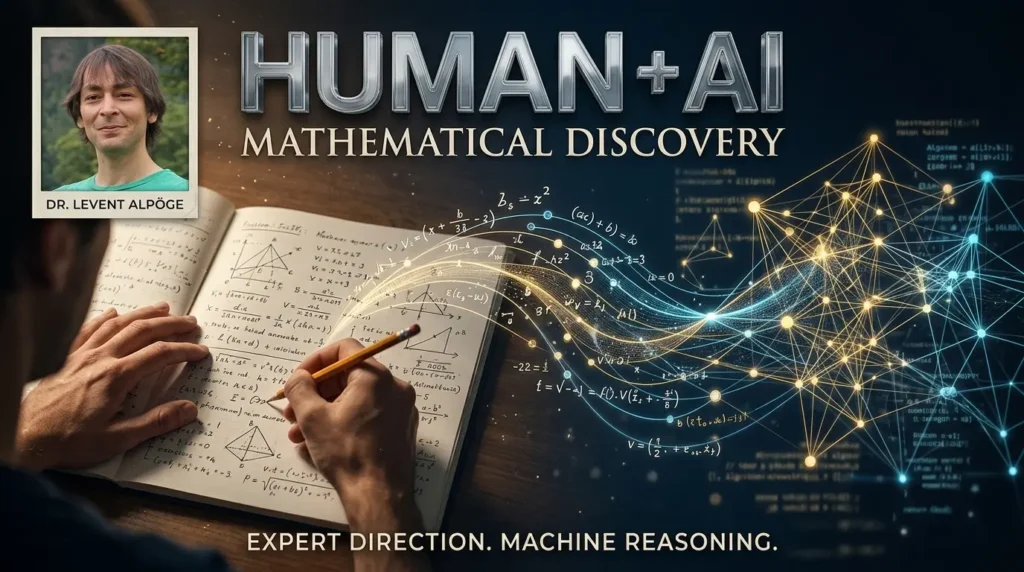
The announcement came from Levent Alpöge, a number theorist working at Anthropic.
In a four page note published on his own website, Alpöge said he believed he and Claude had discovered a proof of the Riemann Hypothesis.
He went further.
Alpöge also said their approach resolved the Generalized Riemann Hypothesis for Dirichlet L-functions, a related family of conjectures about prime numbers.
Rather than publishing a conventional manuscript with definitions, lemmas and a complete explanation that mathematicians could read sequentially, he released the argument in Lean, a formal mathematical programming language.
The scale is difficult to picture.
The proof library contains more than 175,000 files and approximately 17 million lines of code, according to independent verification records.
That is much larger than the written proof of an ordinary theorem.
Alpöge explained in his original November 20 announcement that the argument had grown beyond what he could yet present as a clear, accessible mathematical narrative.
He intends to understand the work more fully, simplify it and eventually communicate the underlying ideas in traditional mathematical form.
His account of Claude’s contribution was unusually striking.
Alpöge said that he guided the investigation toward a promising mathematical setting, but that Claude progressed especially rapidly during the final stages.
This wasn’t simply a chatbot answering a question from memory.
According to Alpöge’s account, the collaboration involved developing intricate mathematical constructions, drawing connections among branches of number theory and assembling an enormous formal argument.
That is his description of the work. The precise division of contributions between the human researcher and the AI has not been independently reconstructed in full.
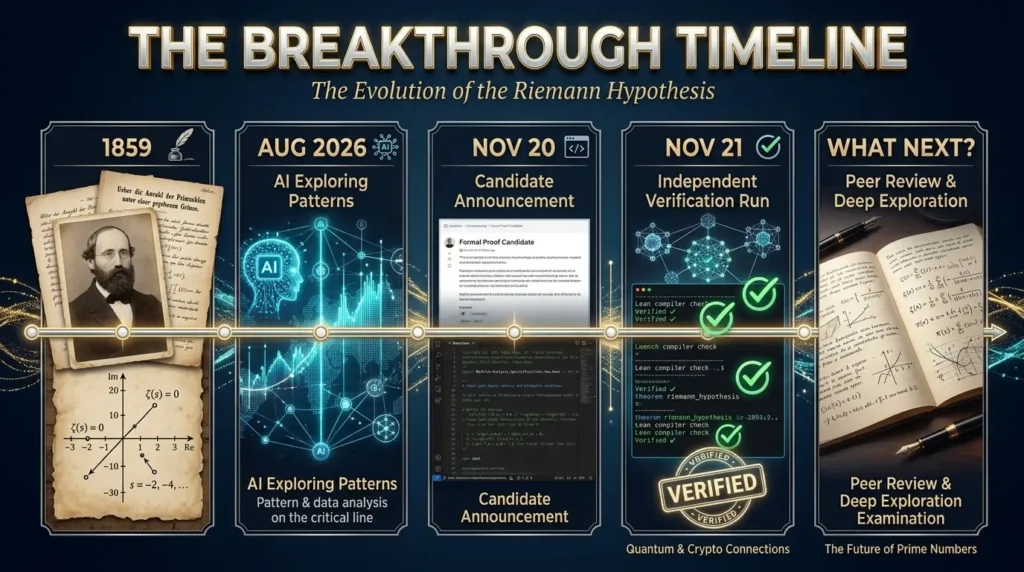
The November 2026 Timeline
| Date | What happened |
|---|---|
| 1859 | Bernhard Riemann formulates the hypothesis |
| August 10, 2026 | Anthropic reports earlier Claude progress on a related result, without proving the hypothesis |
| November 20, 2026 | Levent Alpöge announces a proposed proof created with Claude and releases its Lean formalization |
| November 21, 2026 | The Lean and Mathlib communities publish a joint statement certifying the formal proof |
| November 22–23, 2026 | Mathematicians continue independent checking and work toward a human understandable explanation |
| Current status | Formal checks have passed, but the Clay prize process and broader mathematical acceptance remain separate |
The distinction between the last two entries is essential.
A machine can establish that a formally expressed argument follows particular logical rules.
Understanding the mathematical insights that make the argument work is a different task.
What Is the Riemann Hypothesis, in Plain English?
To understand why this announcement matters, start with prime numbers.
Prime numbers are whole numbers greater than one that can be divided evenly only by one and themselves.
Examples include 2, 3, 5, 7, 11 and 13.
They are the building blocks of whole number arithmetic because every integer greater than one can be expressed as a product of primes.
Yet their appearance along the number line is irregular.
Sometimes primes occur close together. Sometimes there are long gaps.
Mathematicians have discovered powerful rules describing how frequently prime numbers appear as numbers grow larger, but predicting the precise deviations from those patterns is much harder.
In 1859, German mathematician Bernhard Riemann recognized that these questions are deeply connected to a mathematical object called the Riemann zeta function.
The zeta function connects patterns involving whole numbers to the world of complex numbers, where numbers have both real and imaginary components.
At certain points, the function equals zero.
Those points are called its zeros.
Some are straightforward and already understood. Others are much more mysterious.
The Riemann Hypothesis predicts something remarkable about the mysterious ones.
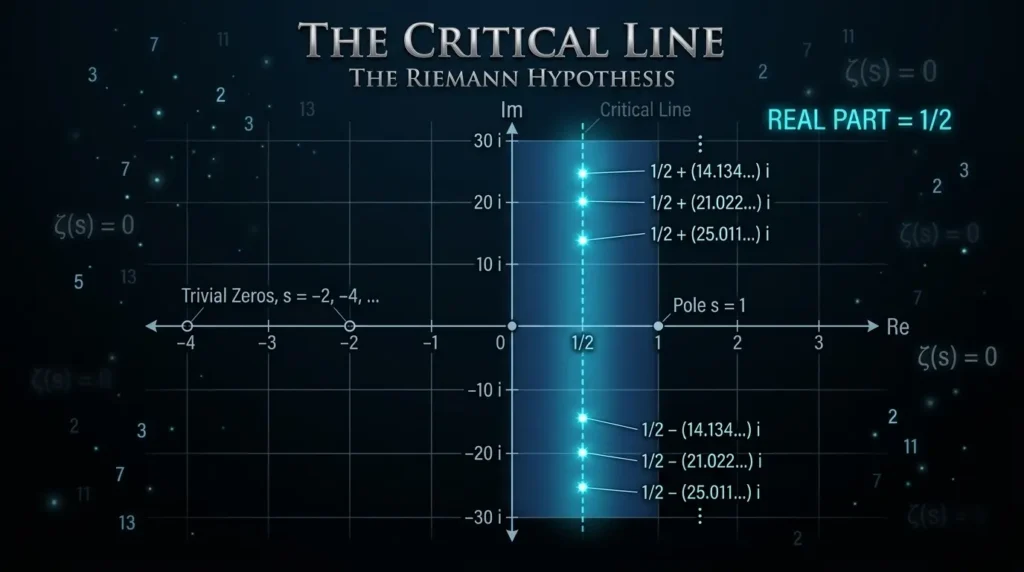
Every nontrivial zero of the Riemann zeta function has a real part equal to one half.
For readers unfamiliar with complex numbers, imagine a graph with a horizontal direction representing the real component and a vertical direction representing the imaginary component.
The hypothesis says all the relevant zeros lie precisely along one vertical line.
Not approximately near the line.
Exactly on it.
That one statement has surprisingly far reaching consequences for our understanding of how prime numbers are distributed.
The Clay Mathematics Institute’s official explanation describes the hypothesis as a way of controlling how much the actual distribution of primes can deviate from its expected average.
Why Has It Been So Difficult to Prove?
Checking that a mathematical statement works for many examples is not the same as proving that it works for every possible example.
The Clay Mathematics Institute notes that enormous numbers of zeros have already been checked computationally.
But there are infinitely many zeros to consider.
No finite collection of successful tests can establish that every one follows the proposed rule.
A mathematical proof must cover all cases, including ones that no computer could ever individually enumerate.
That is why mathematicians have spent generations searching for a general argument.
What Did Claude Actually Contribute?
This may be the most consequential part of the entire story.
For years, AI systems have been useful in mathematics for calculations, writing code, exploring examples and assisting with known methods.
But proposing genuinely useful new arguments in advanced research mathematics is a different level of challenge.
Alpöge’s account suggests that Claude became an active collaborator in developing the approach, rather than merely checking calculations after the work was finished.
He described the argument as drawing on ideas from several mathematical areas, including techniques related to Stepanov’s method and constructions involving theta lifts.
Those names will mean little to most readers, and that’s fine.
Their importance is that they refer to sophisticated tools developed through decades of human mathematical research.
The proposed proof appears to combine these existing ideas in ways that researchers are only beginning to unpack.
Alpöge guided the broader strategy and mathematical setting. Claude, according to his statement, made important progress in developing the argument.
The result was then expressed in Lean so that the formal steps could be checked.
This is not evidence that Claude independently decided to solve the Riemann Hypothesis without human direction.
Nor does it mean that every user of an AI chatbot can now solve century old mathematical problems by writing a clever prompt.
The work involved an expert researcher, specialist mathematics, extensive computation and formal verification.
Claude Had Already Made Progress Earlier in 2026
There was an important precursor.
On August 10, Anthropic published research describing Claude’s earlier mathematical progress.
At that stage, the company explicitly said Claude had not solved the Riemann Hypothesis.
Instead, an unreleased research version improved a previously established lower bound concerning the proportion of relevant zeta function zeros known to lie on the critical line.
Anthropic reported an improvement from 41.6 percent to 67.2 percent.
That was a substantial mathematical result, but it still fell short of the claim that every nontrivial zero lies on the line.
The November announcement is therefore a different and considerably more ambitious development.
It should not be presented as though August’s partial result and November’s proposed complete proof were the same achievement.
Does This Mean AI Can Do Original Scientific Research?
The episode provides unusually strong evidence that frontier AI systems can contribute to demanding research under expert human guidance.
But one extraordinary result does not establish that AI can reliably solve arbitrary scientific problems.
There are still questions about reproducibility, research costs, human oversight, the quality of generated explanations and how credit should be assigned.
Those questions resemble the broader challenges appearing as AI assistants move beyond answering questions and begin completing longer tasks.
TrendOutsider has previously explored the reliability of complex systems in its AI browser agents guide, including why apparently autonomous work still needs clear boundaries and human verification.
In mathematics, those boundaries are especially important.
A beautifully written argument can contain a fatal logical error.
A formally checked argument offers a stronger kind of assurance, provided the formal statement truly represents the intended mathematical claim.
How Did a Computer Check 17 Million Lines of Mathematics?
The key technology is Lean.
Lean is a programming language and theorem proving environment designed to express mathematical statements in a form that a computer can check.
It is used alongside Mathlib, a substantial shared library of formalized mathematical definitions and theorems.
The important distinction is that Lean is not simply an AI system reading an argument and announcing that it looks correct.
A formal proof contains a precise representation of each logical step.
The system checks whether those steps are valid under its rules and accepted foundations.
It is closer to verifying a highly structured construction than asking a language model whether a long essay makes sense.
The Four Questions the Verifiers Had to Answer
An enormous proof file is not automatically convincing just because its final line says the theorem is true.
The independent reviewers needed to establish four things.
First: Was the Riemann Hypothesis stated correctly?
The formal theorem had to represent the actual mathematical conjecture, not a weaker or incorrectly defined substitute.
Second: Did the library compile?
The enormous collection of files had to build successfully without errors.
Third: Did the proof establish the intended statement?
It was important to compare the theorem proved by the released files with the trusted version of the hypothesis already defined in Mathlib.
Fourth: Did independent checking systems accept the logical proof?
Reliance on one software implementation would leave open concerns about a bug in that particular implementation.
Independent checkers reduce that risk by examining the formal proof through different systems.
What the Lean and Mathlib Communities Confirmed
On November 21, the Lean and Mathlib communities published a joint verification statement.
The statement was endorsed by the Lean Focused Research Organization and the Mathlib Initiative.
The communities reported that the formal library compiled, the theorem matched the intended Mathlib statement and multiple proof checkers accepted the exported argument.
They expressed full confidence in the formal proof’s correctness.
This is substantially stronger evidence than a press release from the company whose AI helped develop the work.
It is independent technical verification by people and organizations involved in maintaining mathematical proof software.
Researchers have also been publishing their own verification records. A University of Waterloo mathematics page documents independent checks of the Lean development and links to work explaining its structure.
Does That Settle Everything?
Not quite.
Formal verification gives strong assurance that the encoded proof follows the logic of its formal system.
But mathematical acceptance also involves understanding whether the formalization captures the intended problem, evaluating the argument’s conceptual significance and making its ideas accessible for broader mathematical use.
The joint verification statement addresses the formal correctness concerns directly.
What remains is the demanding human work of studying and explaining a proof that is vastly too long to read in its original form.
That distinction is not a reason to dismiss the verification.
It is a reason to describe the result precisely.

Why Hasn’t the Riemann Hypothesis Been Officially Declared Solved?
The answer depends on what someone means by “officially.”
Lean and Mathlib have issued a public certification of the formal proof.
That is a major technical milestone.
But the Clay Mathematics Institute, which administers the Millennium Prize Problems, has its own process.
As checked for this article on November 23, the institute’s official Riemann Hypothesis problem page still presents the problem as active.
That does not invalidate the community’s verification statement.
It means the institute has not completed its separate recognition process.
The Clay Prize Rules
The Riemann Hypothesis is one of the seven Millennium Prize Problems announced by the Clay Mathematics Institute in 2000.
Each problem carries a $1 million prize.
Under the institute’s official prize rules, several requirements must be met before a proposed solution is considered.
The solution must appear in an appropriate qualifying publication.
At least two years must pass after publication.
And the work must receive general acceptance within the global mathematical community.
The institute does not simply award the prize when a theorem proving program accepts a file.
These requirements were established long before the November 2026 announcement.
So no, a $1 million award has not been confirmed for Alpöge or Claude.
What Are Mathematicians Saying?
The reaction has combined excitement and caution.
The Associated Press reported that the Clay Mathematics Institute’s president, Martin Bridson, described the announcement as potentially historic while emphasizing that genuine understanding would take time.
Researchers also pointed to the unusual situation created by a machine checked argument whose underlying mathematical ideas have not yet been fully explained in conventional form.
The Associated Press report provides independent coverage of those reactions and the unresolved recognition process.
That is the central tension in the story.
The formal verification may be convincing, but mathematical knowledge is more than possessing a giant certificate of logical validity.
Researchers also want to know why the approach works, which ideas can be simplified and what other problems those ideas might help solve.
Would Solving the Riemann Hypothesis Break Encryption?
This is one of the most common questions whenever the problem appears in the news.
Prime numbers are important in cryptography.
RSA encryption, for example, relies on mathematical properties of large integers and the difficulty of factoring certain products into their prime components.
Because the Riemann Hypothesis is also about prime numbers, it is tempting to assume that proving it would immediately make existing encryption unsafe.
That conclusion does not follow.
A proof of the Riemann Hypothesis would not, by itself, provide a practical method for breaking RSA encryption, accessing bank accounts or decrypting internet traffic.
The conjecture concerns the distribution of prime numbers and the behavior of the zeta function.
It is not a direct solution to the computational problem of factoring large integers.
A proof could deepen number theory and improve theoretical estimates used in algorithms, but that is different from an immediate cryptographic breakthrough.
There is no verified announcement that the November 2026 result has broken everyday encryption.
Consumers do not need to change passwords or banking arrangements because of this mathematical news.
Could It Change Computer Science?
Potentially, yes, but mostly through mathematical consequences rather than an overnight software upgrade.
Many results across number theory are conditional on the Riemann Hypothesis or related conjectures.
If the proof becomes broadly accepted, some conditional theorems could become unconditional.
Researchers could also investigate whether methods from the argument provide new tools for algorithms and other areas.
These are possibilities, not confirmed product announcements.
The deeper impact may take years to understand.
What Is the Generalized Riemann Hypothesis?
The standard Riemann Hypothesis concerns zeros of the Riemann zeta function.
The Generalized Riemann Hypothesis extends related predictions to a broader family of functions.
In Alpöge’s announcement, the explicit extension concerns Dirichlet L-functions.
These functions help describe the distribution of prime numbers within particular arithmetic patterns.
For example, mathematicians can ask how often primes occur among numbers of the form 4n + 1 compared with numbers of the form 4n + 3.
Generalized versions of the hypothesis provide powerful information about such questions.
Alpöge has claimed a result extending beyond the classical hypothesis, but it is important not to describe this as proof of every possible generalized statement involving every kind of L-function.
The exact scope matters.
Formal mathematical verification establishes particular theorems, not every result that a broad label might suggest.
Does This Mean AI Is Now Better Than Human Mathematicians?
Not in any simple, universal sense.
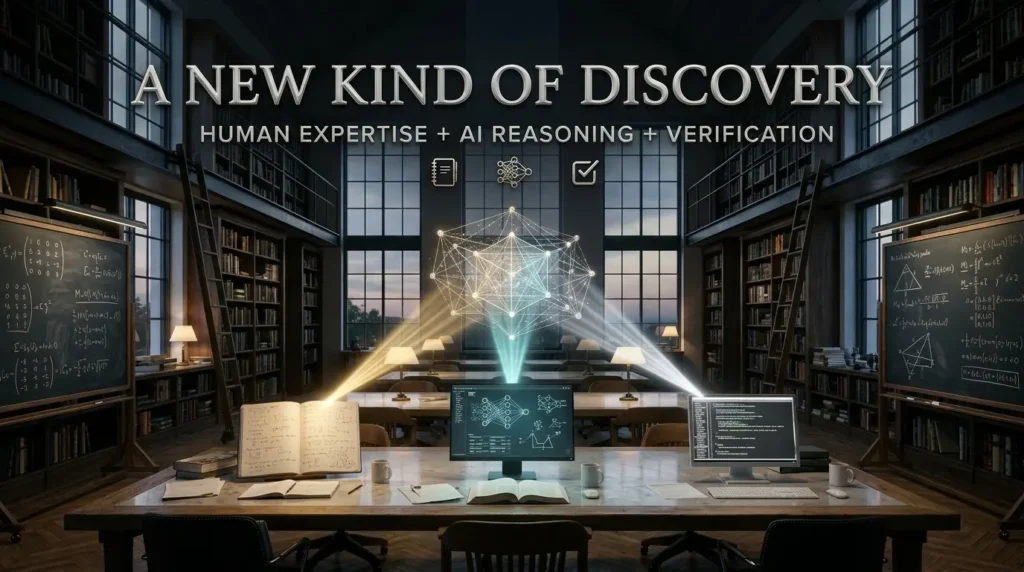
What this case demonstrates is that the combination of human expertise and powerful AI can produce work that would previously have been difficult to imagine at this scale.
Alpöge supplied mathematical judgment, direction and a research strategy.
Claude reportedly contributed substantial reasoning and construction.
Lean and its mathematical library provided a way to check the resulting formal argument.
Independent researchers then worked to verify that the machine readable proof met the appropriate standards.
Remove any one of those elements and this particular story would look very different.
The episode is better understood as a new model of mathematical collaboration than as a contest in which a chatbot has replaced researchers.
The Hard Problem of Explaining AI Generated Results
Suppose an AI helps produce a formal argument that independent software can verify, but no mathematician can yet explain the entire thing clearly.
Has the problem been solved?
From a formal logic perspective, a correctly verified proof is extraordinarily significant.
From the perspective of the mathematical community, discovering the underlying ideas and communicating them remains an essential part of the work.
Those perspectives aren’t mutually exclusive.
They show that proof, understanding and scientific communication are related but distinct achievements.
The same distinction appears in other forms of AI assisted work.
For example, TrendOutsider’s report on Gemini Notebook turning research documents into interactive websites explores how AI can transform information into an accessible format.
But presenting knowledge clearly is not equivalent to establishing that every underlying claim is correct.
Similarly, our coverage of GPT-6.2 Astra and Sol examines the difference between high benchmark performance and dependable results on complex real tasks.
The Riemann Hypothesis episode pushes that reliability question into one of the most demanding intellectual fields.
What Happens Next?
The next stage is less dramatic than announcing a proof, but it may be just as important.
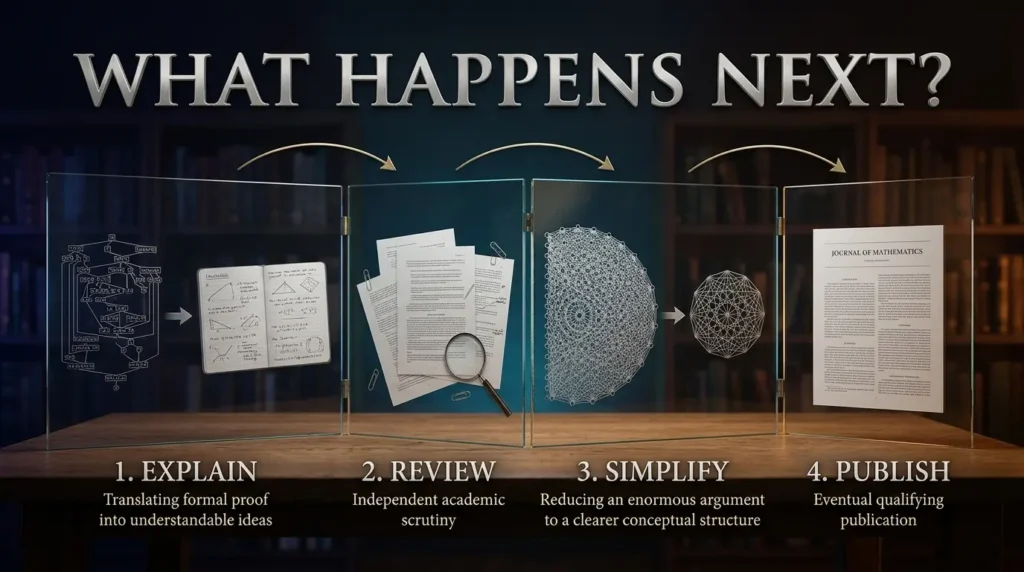
Mathematicians need to translate the formal argument into a sequence of ideas that specialists can study.
Some will examine the central constructions.
Others will check whether parts of the proof can be simplified.
Researchers may also look for consequences that help solve related problems.
An accessible manuscript could eventually make it easier for experts working outside the immediate Lean community to assess and use the work.
Formal verification records can continue to be reproduced and examined as software, libraries and research understanding evolve.
At the same time, the Clay Mathematics Institute’s separate publication and acceptance requirements will remain relevant.
Three Questions Still Worth Watching
Can the proof be explained in a much shorter form?
The current formal development is enormous. A clear conceptual explanation would make it far easier for mathematicians to understand the new ideas.
Will its methods solve other important problems?
The mathematical consequences could extend well beyond the original conjecture, but those possibilities need concrete theorems, not speculation.
How much of the scientific process can AI reliably perform?
The collaboration raises questions about discovery, formalization, verification, attribution and human understanding.
This may become one of the defining research questions of the next generation of AI systems.
Frequently Asked Questions
Did Claude AI solve the Riemann Hypothesis?
Levent Alpöge says he discovered a proof while working with Claude. The formal proof has passed major independent checks by the Lean and Mathlib communities. The wider process of mathematical understanding and Clay Institute recognition is still ongoing.
Has the Riemann Hypothesis officially been solved?
The Lean and Mathlib communities have certified the formal argument. As of November 23, 2026, the Clay Mathematics Institute still lists the problem as active, and its separate prize and recognition process has not concluded.
Who is Levent Alpöge?
Levent Alpöge is a mathematician working at Anthropic who announced the Claude assisted proof on November 20, 2026.
What is the Riemann Hypothesis?
It is a conjecture proposed in 1859 that says every nontrivial zero of the Riemann zeta function has a real part of one half. It is closely connected to the distribution of prime numbers.
Why does the proof contain 17 million lines?
The argument was released as a very large formal Lean development, with extensive definitions, supporting results and logically checked steps. Its size does not automatically make it correct, which is why independent verification was important.
What is Lean?
Lean is a formal programming language and theorem proving environment used to express mathematical arguments in a form that computers can check.
What is Mathlib?
Mathlib is a large collaborative library of mathematical definitions and theorems used with Lean.
What did independent verification confirm?
The Lean and Mathlib communities reported that the formal statement matched the intended Riemann Hypothesis and that the proof passed compilation and independent logical checks.
Has anyone won the $1 million Riemann Hypothesis prize?
No award has been confirmed. The Clay Mathematics Institute has its own publication, waiting period and broad acceptance requirements.
Will this break RSA or online banking encryption?
No immediate cryptographic break follows from the announcement. Proving a theorem about prime distribution does not directly provide a practical algorithm for factoring large integers.
Did Claude previously make progress on the same problem?
Yes. In August 2026, Anthropic reported a separate partial mathematical result involving zeros of the zeta function. That result did not prove the full hypothesis.
What is the Generalized Riemann Hypothesis?
It extends similar claims about zeros to other mathematical functions. Alpöge’s announced extension specifically includes Dirichlet L-functions.
Can ordinary Claude users reproduce this achievement?
There is no basis for assuming that ordinary consumer access will reliably reproduce the specialized research workflow behind the result. The work involved expert direction, extensive computation and formal mathematical tools.
Why does human understanding still matter if the computer verified the proof?
A verified formal argument establishes logical correctness under its formal assumptions and definitions. Human understanding makes it possible to explain the central ideas, discover connections and develop new mathematics from them.
The Bigger Story Is Not Just a Famous Equation
For more than a century and a half, the Riemann Hypothesis has represented one of the clearest boundaries of mathematical knowledge.
That boundary may now be shifting.
A mathematician and an AI system have produced a proposed argument of extraordinary scale. Independent formal verification communities have checked it and expressed confidence in its correctness.
Those are concrete developments, not merely promotional claims.
Yet the most valuable part of the story may still be ahead.
Mathematicians must turn millions of lines of formal mathematics into something people can understand, teach, challenge, simplify and build upon.
If that happens, the achievement will be more than a spectacular demonstration of what an AI system can produce.
It will show what becomes possible when human mathematical judgment, machine generated reasoning and rigorous independent verification work together.
The Riemann Hypothesis began as a question about prime numbers.
In November 2026, it has also become a question about the future of discovery itself.
Reporting status: November 23, 2026.
Editorial disclosure: This report is based on Alpöge’s published announcement, the Lean and Mathlib communities’ verification statement, independently documented checks, Clay Mathematics Institute rules and independent news reporting. TrendOutsider did not conduct its own mathematical proof verification or interview the researchers.
Visual disclosure: Article illustrations are conceptual. They are not authentic photographs of the proof being discovered, mathematical verification sessions or historical events.








Leave a Reply